
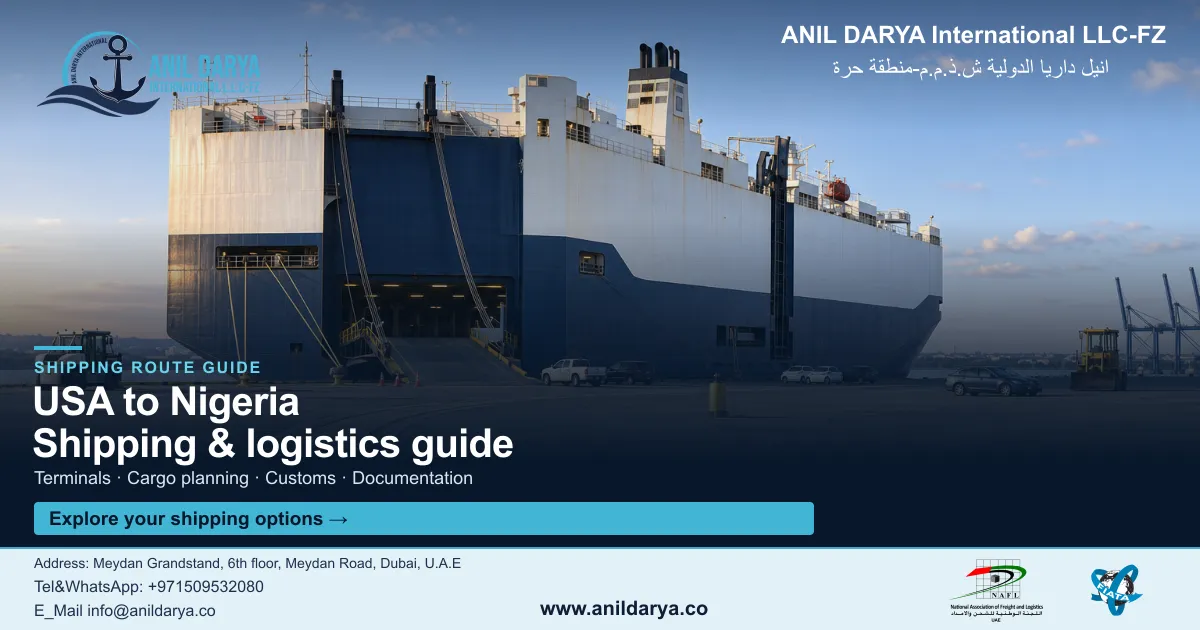
Shipping from USA to Nigeria is an Atlantic sea lane: containers load at New York, Baltimore, Savannah or another East or Gulf Coast port and discharge at Tin Can Island or Apapa in Lagos, while used cars and machinery often go Ro-Ro. The US exporter files Electronic Export Information in AES, and the Nigerian importer needs an approved Form M, SONCAP papers for regulated goods and a licensed customs agent on B'Odogwu. Anil Darya books the ocean freight from Dubai and keeps the US shipper and the Lagos agent working to the same dates.
USA to Nigeria shipping at a glance
| Item | Detail |
|---|---|
| Main modes | FCL and LCL containers, Ro-Ro for vehicles and wheeled machinery, flat rack and breakbulk for project pieces |
| Typical US load ports | New York and New Jersey, Baltimore, Savannah, Jacksonville, Houston |
| Nigerian discharge ports | Tin Can Island and Apapa (Lagos Port Complex) in Lagos; Lekki Deep Sea Port; Onne in Rivers State |
| Example container service | MSC's USWASA loop: New York, Baltimore, Savannah, Freeport (Bahamas), Tema, then Lagos (Tin Can), per its March 2026 rotation |
| US export filing | EEI in the Automated Export System; required for every used vehicle whatever its value |
| Nigerian pre-import approval | Form M, opened by the importer through its Authorised Dealer Bank before the cargo sails |
| Product conformity | SONCAP for regulated goods, NAFDAC registration for food, drugs and cosmetics |
| Duty and VAT | ECOWAS Common External Tariff bands of 0% to 35% on CIF value, plus 7.5% VAT; vehicles pay 20% duty plus a National Automotive Council levy |
| Trade agreement | No US-Nigeria free trade agreement, so US goods pay the full tariff rate |
| Bill of lading | The shipping line's own B/L, issued and released to you through us as agent for the line |
| Who clears in Nigeria | The consignee's licensed customs agent, agreed before we confirm the booking |
Who handles what when the booking sits in Dubai
The cargo never touches the UAE. Only the booking, the carrier paperwork and the follow-up run from Dubai.
| Task | Who does it |
|---|---|
| Carrier, sailing, equipment and the ocean freight booking | Anil Darya, with the shipping line |
| Pickup at the US plant, dealer lot or auction yard, trucking or rail to the terminal, stuffing | The US shipper or its US forwarder, using the cut-offs we send |
| EEI filing in AES, title presentation for vehicles, any US export licence | The US exporter (the USPPI) or the agent it authorises |
| Form M, SONCAP or NAFDAC approvals, Nigerian insurance | The Nigerian importer and its bank |
| PAAR, import declaration on B'Odogwu, duty, release | The consignee's licensed customs agent in Nigeria |
The carrier's bill of lading is the title document. Because we are agent for many shipping lines, the line issues its own B/L from the US port to Tin Can, Apapa or Onne, and we check the draft and release it to you from Dubai. Lagos banks compare that B/L with the Form M, so the consignee name, Form M number and discharge terminal must be right on the draft before the ship leaves the US.
Agree the Incoterm early. Many Nigerian buyers of American goods buy FOB a US port and insure locally, since Nigerian rules expect imports to be covered by an insurer registered in Nigeria. A US seller quoting CIF Lagos with its own US policy creates a mismatch with the Form M. Our Incoterms 2020 guide for sea freight explains where cost and risk change hands under each term.
Which US ports suit Nigeria cargo?
West Africa sailings mostly leave from the Atlantic side. Start with the port closest to the goods that a Lagos service actually calls.
| US port | What we checked | Usual Nigeria cargo |
|---|---|---|
| New York and New Jersey | First US call on MSC's USWASA rotation of March 2026 | FCL from the Northeast and Midwest, consolidated LCL |
| Baltimore | Second USWASA call; the Maryland Port Administration says it is the number one US port for Roll-On/Roll-Off cargo | Used cars, trucks, buses, tractors and construction machines |
| Savannah | Third USWASA call; Ocean Terminal is being rebuilt for 2 million TEU of container capacity and has heavy-lift capability | Containers from the Southeast, heavy pieces |
| Jacksonville (Blount Island) | JAXPORT's trade lane map lists a Grimaldi and ACL North America to West Africa entry that includes Lagos, for containers and Ro-Ro | Vehicles and rolling stock from Florida and Georgia |
| Houston | Port Houston reports 220.1 million short tons of foreign waterborne cargo in 2024 and 75% of US Gulf Coast container traffic | Oilfield equipment, pipe, resins, machinery from Texas |
West Coast cargo usually reaches the East Coast by rail or moves on a transhipped service.
Where US cargo lands in Nigeria
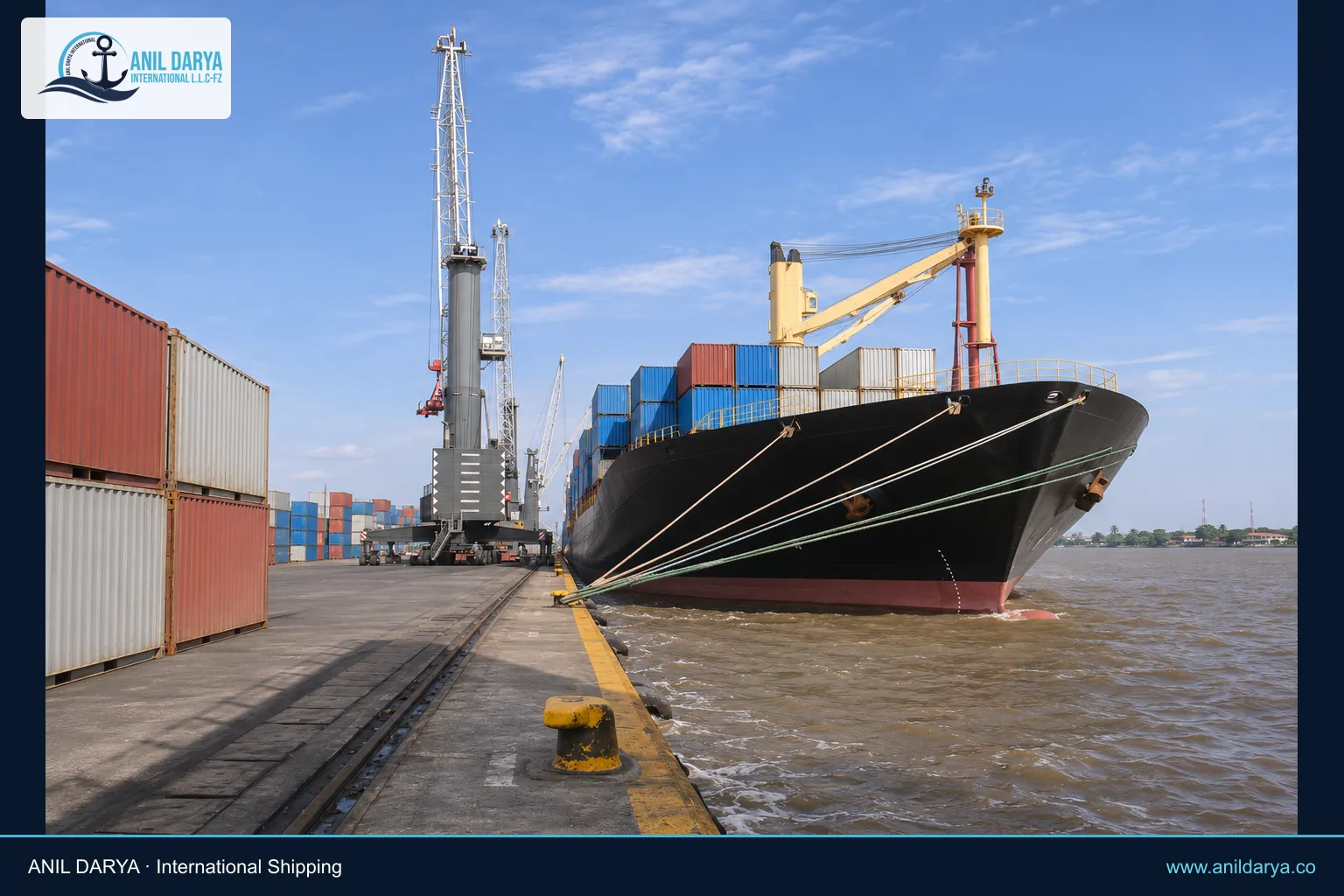
The Nigerian Ports Authority owns and regulates the ports, and private companies run the terminals under concession. The terminal on your B/L sets the free time, gate rules and terminal charges you will meet. NPA figures show 602,392 TEU handled across Nigerian ports in the second quarter of 2026.
| Port | Terminals that matter for US cargo | Good for |
|---|---|---|
| Tin Can Island, Lagos | Tincan Island Container Terminal for boxes; the PTML Ro-Ro terminal for vehicles and containers | Used cars from the US, Lagos traders, the Tin Can call on MSC's USWASA |
| Lagos Port Complex (Apapa) | APM Terminals Apapa for containers, plus general cargo terminals | Containers for Lagos, Ogun and the south-west |
| Lekki Deep Sea Port | Lekki Freeport Terminal | Large container ships and the Lagos Free Zone, on services that call there |
| Onne, Rivers State | West Africa Container Terminal and the Onne Oil and Gas Free Zone | Oil and gas equipment, buyers in Port Harcourt and the south-east |
Lekki is about 65 km east of Lagos, and the NPA describes it as the deepest seaport in sub-Saharan Africa. Onne matters for US oilfield suppliers: goods brought into the Onne Oil and Gas Free Zone pay duty only when they leave the zone for the Nigerian market.
Sea freight from USA to Nigeria: services and transit
- MSC's USWASA service, as reported by Container News on 16 March 2026, runs New York, Baltimore, Savannah, Freeport (Bahamas), Tema, Lagos (Tin Can), then Durban, Port Elizabeth, Cape Town and Abidjan before returning to New York. Lagos is the second African call, after Tema.
- JAXPORT's trade lane map lists a Grimaldi and Atlantic Container Line North America to West Africa entry at Blount Island, carrying containers and Ro-Ro, with Lagos among the listed ports. The page shows no sailing days.
Neither source publishes a port-to-port day count that we could check against the rotation, so we do not print one. The quotes we send carry the carrier's own schedule for that sailing.
Other lines serve Lagos with a change of ship on the way. Ask every quote whether the box stays on one vessel, and if not, where it connects.
[AMIR-FACT: the carriers and services we actually book from US East and Gulf Coast ports to Tin Can, Apapa and Onne in 2026, which are same-vessel and which tranship (and where), and the real port-to-port days for FCL and Ro-Ro]
Container shipping USA to Nigeria: FCL, LCL and reefer
Each Nigerian import needs its own Form M, PAAR and, for regulated goods, SONCAP certificate. That fixed paperwork favours fewer, fuller boxes over many small lots.
| Option | Typical US goods | Nigeria point to watch |
|---|---|---|
| 20ft FCL | Valves, drilling spares, chemicals in drums, heavy machine parts | Weight limits on the trucks out of Lagos ports |
| 40ft or 40ft high cube FCL | Medical equipment, consumer goods, auto parts, one or more cars stuffed with general cargo | Every item on the packing list must sit on the Form M |
| LCL | Samples, spare parts, small first orders | Each consignee still needs a Form M and its own clearance |
| Reefer | Food ingredients, temperature-sensitive medicines | NAFDAC approval in place; frozen poultry is restricted |
With several American suppliers, consolidate at one warehouse near the load port so one box and one set of Nigerian entries cover the order. Our FCL vs LCL guide shows where a full container starts to pay, and our sea freight service lists the equipment we book.
Shipping vehicles and machinery from the US to Lagos
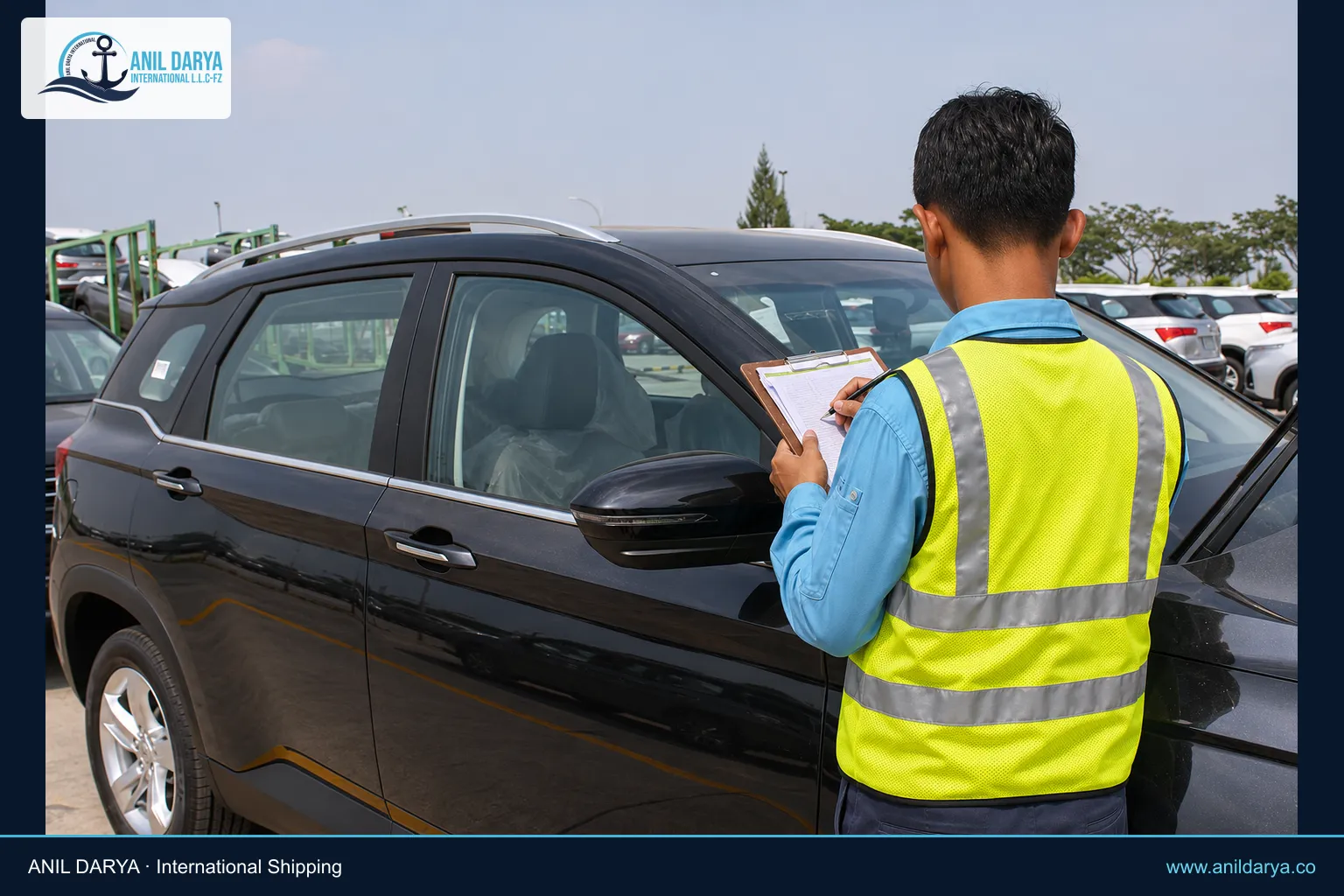
Used vehicles are a large part of this lane, and both countries have rules that stop cars at the quay if missed.
US export rules for vehicles
- Under 19 CFR 192.2, a used self-propelled vehicle going by sea must be presented to CBP at the port of export, with its documents, at least 72 hours before export.
- For a US-titled vehicle the owner provides the original title or a certified copy, plus two complete copies. The papers must show the VIN.
- Under 15 CFR 30.2, EEI is required for every used self-propelled vehicle regardless of value.
Nigerian import rules for vehicles
- Used motor vehicles more than 15 years past their year of manufacture are on Nigeria's prohibited list.
- The US International Trade Administration reports a 20% duty on used vehicles with a 15% National Automotive Council levy, and 20% duty with a 20% levy on new vehicles.
- A Green Tax Surcharge on certain vehicles started on 1 July 2026 under Nigeria's 2026 fiscal policy measures.
- SON exempts used products from SONCAP except automobiles, so ask your agent how SONCAP applies to the vehicle before it sails.
Ro-Ro suits running cars, trucks and excavators. A container suits non-runners or a car shipped with spare parts, which must also appear on the Form M.
Project cargo and dangerous goods
US firms ship pumps, compressors, wellhead gear and pipe to operators around Lagos and Onne. Pieces that fit a 40ft flat rack or open top can travel on a container service; heavier or longer units need Ro-Ro or breakbulk tonnage. Our guide to flat rack, open top and out-of-gauge cargo shows the limits of each, and our break bulk and project cargo team plans stowage with the line.
Send drawings, weights and lifting points early, and get the carrier's written acceptance, hub included, before the Form M is closed.
Oilfield chemicals, paints, lithium batteries and lab reagents move under the IMDG Code, whose 2024 edition (Amendment 42-24) has been mandatory since 1 January 2026. The US shipper supplies the UN number, class, packing group, Safety Data Sheet and a signed DG declaration. Our dangerous goods shipping desk confirms the line and any hub will take the class before we hold space.
The US export side: EEI, AES and export controls
Export formalities in the US belong to the exporter or its US forwarder. We share the booking and drafts with them; we do not file in the US.
- EEI is filed in AES, part of CBP's ACE system, through ACE AESDirect or filing software. It is needed when one Schedule B line is over $2,500, when an export licence is needed, and always for used vehicles.
- For ocean cargo the ITN or exemption legend must reach the carrier at least 24 hours before the cargo loads. No ITN, no loading.
- Check each item against the Commerce Control List. Unlisted goods are EAR99; an item with an ECCN needs a licence only where the Country Chart shows an "X" for Nigeria and no exception applies.
Form M: Nigeria's approval before the cargo leaves the US
Nigeria controls commercial imports through the Form M, and the NPA's import guidelines set the order. The importer first needs a company registered in Nigeria, a Tax Identification Number and an Authorised Dealer Bank. Then:
- For SONCAP-regulated goods, the importer obtains a Product Certificate, which SON says is needed to open the Form M.
- The importer opens the Form M through its bank on the Nigeria Single Window, with the US proforma invoice, a Nigerian insurance certificate and the Product Certificate.
- The bank validates it and passes it to the Nigeria Customs Service for acceptance.
- The approved Form M number goes to the US seller for the invoice and to us for the B/L.
We hold the booking until the Form M is approved. A box that sails without one cannot get a PAAR in Lagos.
SONCAP and NAFDAC for American goods
SONCAP is the Standards Organisation of Nigeria's conformity programme for imported goods, checked before shipment. SON issues three Product Certificate routes: PC1 for unregistered products, valid for one shipment, and PC2 or PC3 for registered or licensed products, valid for one year. After the goods ship, an accredited firm sends SON a Certificate of Conformity and SON issues the SONCAP Certificate used for customs clearance.
SON lists accredited firms including Intertek, Cotecna and TUV Austria, and says no territory is assigned to any of them; they may work at any location in the world. A US factory can therefore use any accredited firm able to inspect at its site. Outside SONCAP are:
- food products, drugs, and medical items other than equipment and machines;
- chemicals used as raw material by genuine manufacturers;
- military wares, and goods the Federal Government classes as contraband;
- used products other than automobiles.
Food, drugs, cosmetics and many chemicals fall under NAFDAC instead. The NAFDAC registration must be held by a Nigerian company or the maker's local agent, so a US brand selling to Nigeria for the first time needs that holder in place before it ships.
[AMIR-FACT: the usual time we see from SONCAP inspection booking to certificate for US-origin cargo, and which accredited firms our US shippers use most]
Customs clearance in Nigeria on B'Odogwu
We do not clear goods in Nigeria. Before we confirm a booking from the US, we check that the consignee has a licensed customs agent and that the agent has seen the draft invoice, packing list and B/L.
The Nigeria Customs Service handles imports on B'Odogwu, its trade platform. The PAAR is generated on B'Odogwu from the registered Form M, and the agent files the declaration against it. Inspection happens on arrival, with scanners used to cut physical checks. Duty is paid in naira at the Central Bank of Nigeria rate, which B'Odogwu applies automatically.
| Document | Issued by | What the Nigerian agent checks |
|---|---|---|
| Commercial invoice and packing list | US seller | Form M number, HS code, values and weights |
| Carrier bill of lading | Shipping line, released to you through us | Consignee, notify party, Form M number, port and terminal |
| Vehicle title and VIN list | US seller, after CBP presentation | VIN and year match the Form M and the age limit |
| SONCAP Certificate or NAFDAC approval | SON, or the importer for NAFDAC | Covers these goods on this shipment |
| Insurance certificate | Insurer registered in Nigeria | Matches the Form M |
| PAAR | Nigeria Customs Service on B'Odogwu | Raised before the entry is filed |
Import duty, VAT and trade agreements for US goods
The US and Nigeria signed a Trade and Investment Framework Agreement in 2000, but it is a forum for dialogue, not a tariff deal. The US International Trade Administration lists no US-Nigeria free trade agreement. AfCFTA and ECOWAS preferences need African origin, so American goods pay the full ECOWAS Common External Tariff rate for their HS code, mostly on the CIF value at the Nigerian port.
| Charge | Rate or basis | US goods often here |
|---|---|---|
| CET band 0 | 0% | Essential social goods |
| CET band 1 | 5% | Raw materials and capital goods, many machines |
| CET band 2 | 10% | Intermediate goods and inputs |
| CET band 3 | 20% | Finished consumer goods |
| CET band 4 | 35% | Specific goods for economic development |
| Vehicles | 20% duty plus a 15% (used) or 20% (new) NAC levy | Cars, SUVs, pickups |
| VAT | 7.5% standard rate | On top of duty |
The Nigeria Customs Service Act 2023 brought in a charge of at least 4% of FOB value, but Customs suspended it in February 2025 for consultation. Duty and taxes at destination are paid by the consignee or its broker, so get a duty estimate on the exact HS code before the Form M is opened.
Storing or splitting US goods in Dubai costs no preference, because US origin has none in Nigeria.
Banned and restricted goods from the US
Several items on Nigeria's prohibition lists are common in US shipments.
- Second-hand clothing is absolutely prohibited. Bales of used clothes cannot be cleared, whatever the paperwork.
- Restricted items include frozen poultry, used compressors and used fridges or freezers, and used or retreaded tyres (except used truck tyres of 11.00 x 20 and above for retreading).
- From 1 April 2026 a revised trade prohibition list covers 17 categories of goods from outside ECOWAS, including selected steel products, cartons, large glass bottles, ballpoint pens, soaps and detergents, and listed medicines.
Does routing via Dubai help on the USA to Nigeria lane?
For most American cargo, no. The direct Atlantic sailing is shorter, and Dubai is not on the path. Dubai earns its place when a Nigerian buyer mixes US goods with stock from the Gulf, India or Asia.
| Option | How it works | What to watch |
|---|---|---|
| Direct from the US | Box or vehicle sails from the US port to Lagos or Onne on the line's B/L | The default for most cargo |
| Free zone stock and re-export | US goods held in Jafza, next to Jebel Ali, and shipped to Nigeria in smaller lots with Gulf or Asian stock | Dubai Chambers issues certificates of origin for re-exports; SONCAP still follows the goods |
| Jebel Ali to West Africa loops | CMA CGM's MIDAS 1 rotation of May 2024 linked Jebel Ali with Apapa via India | Confirm the current rotation before planning on it |
Where goods are landed, held or re-exported in Dubai, we handle the UAE customs clearance for a fee. See our Jebel Ali port guide and our note on re-exporting through Jafza.
[AMIR-FACT: whether any of our USA to Nigeria customers route part of the order through Dubai (Jafza stock or consolidation with Gulf or Asian cargo), and the extra days against a direct US sailing]
Typical cargo on this lane
The US International Trade Administration puts US exports of goods and services to Nigeria at $4.8 billion in 2023 and points to oil and gas, including LNG, as a key field for US firms. On the water that mix looks like this:
| Cargo | Usual equipment | Papers to plan |
|---|---|---|
| Used cars, SUVs and pickups | Ro-Ro, or 40ft high cube for several cars | Title, CBP presentation, EEI, age limit, NAC levy |
| Trucks, buses and construction machines | Ro-Ro or flat rack | Title or bill of sale, SONCAP where applicable |
| Oil and gas equipment and pipe | Flat rack, breakbulk, 20ft FCL | ECCN check, piece list, Onne free zone option |
| Medical equipment and supplies | 40ft FCL, reefer for some items | NAFDAC for drugs, SONCAP for equipment |
How shipping from USA to Nigeria works, step by step
Nothing loads until steps 1 to 4 are done.
- Send us the cargo, HS code, weights and sizes (or VINs for vehicles), the US pickup city, the Nigerian port and the Incoterm.
- The Nigerian agent checks the HS code against the prohibition lists and says whether SONCAP, NAFDAC or a permit applies.
- The importer gets its Product Certificate or NAFDAC approval, buys Nigerian insurance and opens the Form M.
- We confirm the Nigerian agent has accepted the clearance, then confirm space with the line to Tin Can, Apapa, Lekki or Onne.
- The US shipper moves the cargo to the terminal, presents vehicles and titles to CBP 72 hours before export, and files EEI in AES at least 24 hours before loading.
- The accredited firm inspects where SONCAP applies, and the US seller prints the Form M number on the invoice.
- The line issues its B/L with the Form M number, and we release it to you from Dubai.
- While the ship is at sea, the importer collects the SONCAP Certificate and the agent raises the PAAR on B'Odogwu.
- On arrival the agent files the entry, the consignee pays duty and VAT, and the cargo is released and the empty returned within free time.
[AMIR-FACT: one real USA to Nigeria cross-trade shipment we booked (cargo or vehicles, US load port, Nigerian terminal, carrier, days at sea and what we coordinated with the US shipper and the Lagos agent), cleared for publication]
What drives the cost of shipping from USA to Nigeria?
Rates move with every sailing, so we quote per shipment rather than publish prices. The total is built from these parts.
| Cost part | What moves it | Usually paid by |
|---|---|---|
| US inland and terminal charges | Distance to port, rail or truck, auction yard pickup, EEI filing | Seller on FOB, buyer on EXW |
| Ocean freight | Container, Ro-Ro unit size, season, direct or transhipped, surcharges | Set by the Incoterm |
| SONCAP inspection | Product, certificate route, testing | Exporter or buyer, as agreed |
| Nigerian terminal and line charges | Terminal, container size, vehicle type | Consignee |
| Duty, levies and VAT | HS code, CIF value, vehicle age, naira rate on the day | Consignee or its broker |
| Storage, demurrage and detention | Late Form M, missing SONCAP, slow clearance | Whoever caused the delay |
Our article on demurrage and detention shows how those charges add up, and our Dubai freight forwarding team will take you through a quote line by line.
Checklist before the cargo leaves the US
- HS code checked against Nigeria's prohibition lists, including the 2026 trade list.
- Form M approved, with its number on the invoice and on the draft B/L.
- SONCAP Product Certificate and inspection booked, or NAFDAC approval held.
- Cargo insured with a Nigerian insurer, matching the Form M.
- Nigerian customs agent named and the clearance accepted before booking.
- For vehicles: clean title, VIN list, CBP presentation 72 hours before export, age under 15 years.
- EEI filed in AES and the ITN with the carrier 24 hours before loading.
Mistakes that hold US cargo in Lagos
- Shipping before destination clearance is agreed. With no Nigerian agent signed up, the container or car waits at the terminal while charges build.
- Loading without an approved Form M. No Form M, no PAAR, no release.
- Buying a vehicle at auction that is older than the 15-year limit or has a salvage title that cannot be exported cleanly.
- Packing used clothing in with a car or household goods. It is on the absolute ban list.
- Quoting CIF with US insurance when the Form M needs a Nigerian policy.
Frequently asked questions
How long does sea freight from the USA to Nigeria take?
It depends on the carrier and whether the cargo changes ship. On MSC's USWASA loop, Lagos (Tin Can) is the second African call after Tema. We give you the carrier's own dates for each sailing rather than a general figure.
Do I need a Form M to ship from the USA to Nigeria?
Yes, for commercial imports. The Nigerian importer opens it through its bank on the Nigeria Single Window before the cargo sails, and its number goes on the US invoice and the bill of lading.
Can I ship a used car from the US to Nigeria?
Yes, if it is not more than 15 years past its year of manufacture. In the US it must be presented to CBP with its title 72 hours before export and needs EEI whatever its value. In Nigeria it pays 20% duty plus a 15% NAC levy, and a Green Tax Surcharge applies to certain vehicles.
Is there a free trade agreement between the US and Nigeria?
No. The two countries have a Trade and Investment Framework Agreement from 2000, which covers dialogue only, so US goods pay the full ECOWAS Common External Tariff rate plus 7.5% VAT.
Does SONCAP apply to goods made in the US?
Yes, for regulated products. A SON-accredited firm such as Intertek or Cotecna inspects before shipment, and SON says no territory is assigned to these firms. Food, drugs and most used products other than automobiles are outside SONCAP.
Who issues the bill of lading on a USA to Nigeria cross-trade?
The shipping line issues its own B/L from the US port to the Nigerian terminal. We act as agent for many lines, so the B/L is checked and released to you through our Dubai office.
Does Anil Darya clear customs in Nigeria?
No. The consignee's licensed customs agent clears the goods on B'Odogwu, and duty and taxes at destination are paid by the consignee or its broker. We agree the plan with that agent before we confirm the booking.
Get a quote for shipping from USA to Nigeria
Send the cargo or VIN list, US pickup city, Nigerian port and ready date for a routing and a price. Use our freight rate inquiry form, or contact our team to plan a Ro-Ro, project or DG shipment first.
Sources
- Container News: MSC realigns USWASA service (16 March 2026)
- JAXPORT: North America to West Africa trade lane entry
- Maryland Port Administration: Port of Baltimore
- Georgia Ports Authority: Ocean Terminal
- Port Houston: Statistics
- Nigerian Ports Authority: Terminals and operators
- Nigerian Ports Authority: Import and export guidelines
- Nigerian Ports Authority: Lekki Deep Sea Port
- Nigerian Ports Authority: Q2 2026 cargo throughput
- Oil and Gas Free Zones Authority: Incentives
- Standards Organisation of Nigeria: SONCAP services and accredited firms
- Legal 500: Registration of imported products with NAFDAC
- Federal Ministry of Information: Form M and PAAR on B'Odogwu
- Nairametrics: CBN rate applied to cargo clearance (February 2026)
- Federal Ministry of Information: 4% FOB charge suspended
- Nigeria Customs Service: 2026 Fiscal Policy Measures
- SCP Law: Nigeria's 2026 import restrictions
- US International Trade Administration: Nigeria import tariffs
- US International Trade Administration: Nigeria trade agreements
- US International Trade Administration: Nigeria market overview
- US International Trade Administration: Nigeria prohibited and restricted imports
- US International Trade Administration: Nigeria customs regulations
- ECOWAS: Common External Tariff bands
- PwC Worldwide Tax Summaries: Nigeria VAT
- 19 CFR 192.2: Export of used self-propelled vehicles
- 15 CFR 30.2: When EEI must be filed
- 15 CFR 30.4: EEI filing time limits
- 15 CFR 30.37: EEI exemptions ($2,500 per Schedule B line)
- 15 CFR 732.3: EAR99 and the Commerce Country Chart
- US Census Bureau: Automated Export System
- IMO: IMDG Code 2024 edition
- CMA CGM via Hellenic Shipping News: Africa lines from the India Middle East Gulf region (May 2024)
- Dubai Chambers: Certificate of origin for re-exported goods
- Jafza: About the Jebel Ali Free Zone
Reviewed: 11 November 2026