
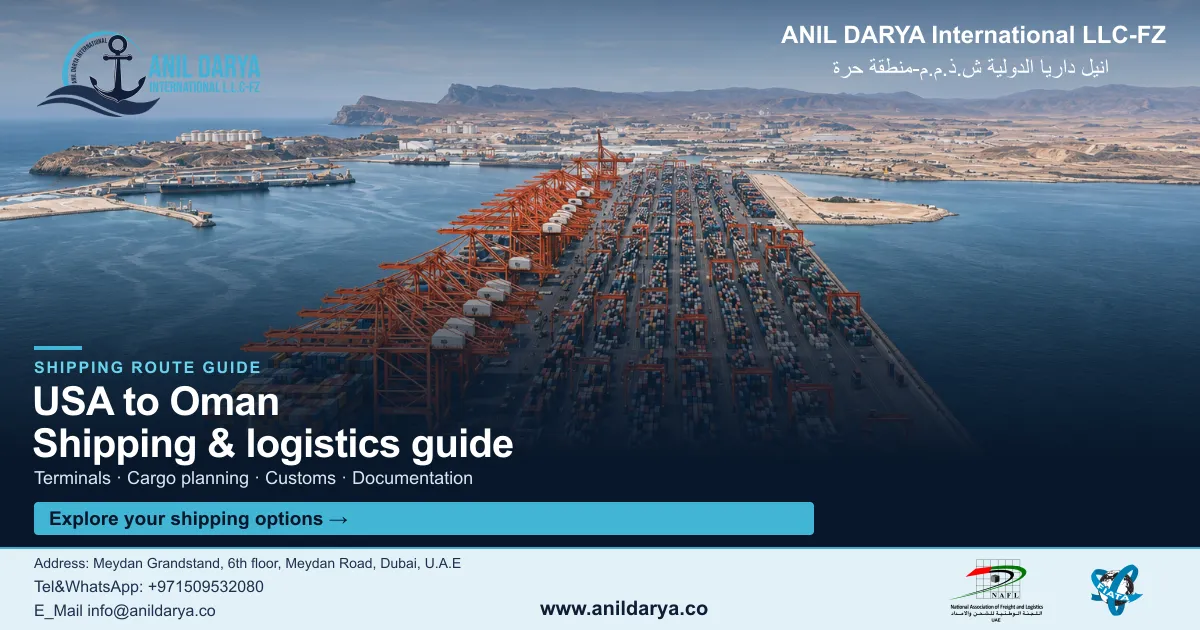
Shipping from USA to Oman is a long ocean leg from an East Coast or Gulf Coast port to Salalah, Sohar or Duqm, and it is one of the few Gulf lanes where American goods can enter duty-free. The US-Oman Free Trade Agreement removes Oman's customs duty on US-origin goods, but only if the cargo is shipped directly and not split or processed on the way. Anil Darya books this lane from Dubai as a cross-trade: we pick the carrier and routing, keep the US exporter and the Omani importer's broker on one plan, and release the shipping line's bill of lading through our desk.
USA to Oman shipping at a glance
| Question | Short answer |
|---|---|
| US load ports | Newark, Norfolk, Charleston, Savannah and Houston for containers; Baltimore, Jacksonville and Freeport for Ro-Ro |
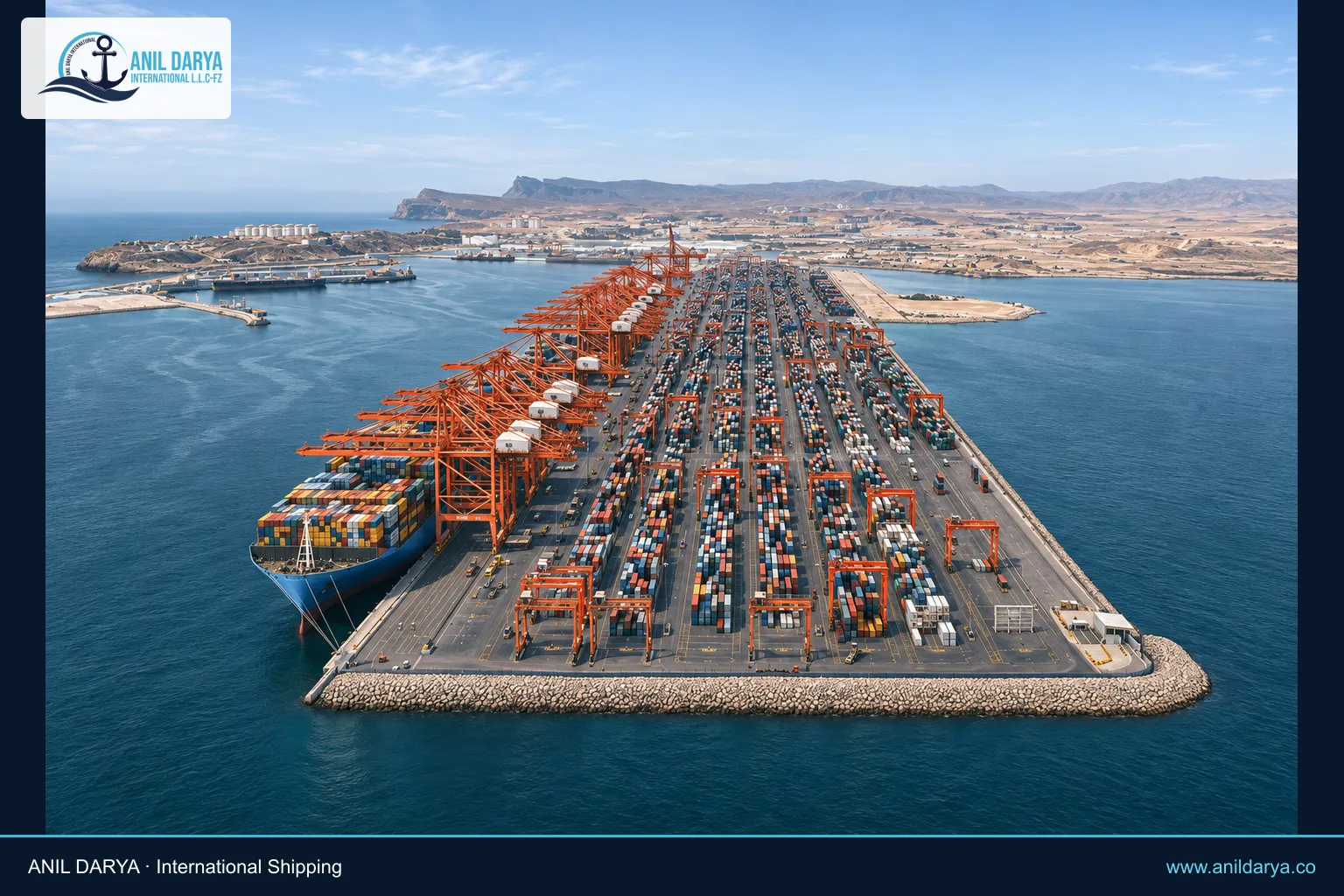
| Oman ports | Salalah (deep-sea container hub), Sohar (north, near Muscat), Duqm (project and heavy cargo) |
| Container services we found | Maersk MECL calls Salalah on its eastbound loop from the US East and Gulf coasts; ONE's INE calls Salalah after India |
| US export filing | EEI in AES, ITN to the carrier at least 24 hours before loading |
| Oman clearance | Customs declaration in Bayan, run by the Royal Oman Police Directorate General of Customs |
| Duty on US goods | 0% under the US-Oman FTA for qualifying goods shipped directly; 5% GCC rate if the claim fails |
| Certificate of origin | Not required for the FTA claim; the importer claims, the invoice shows US origin |
| VAT | 5% on imported goods; excise on tobacco, alcohol, pork and some drinks |
How the USA to Oman cross-trade works from our Dubai desk
The goods move from an American terminal to an Omani one; the booking and paper checks sit with us in Dubai.
| Task | Who does it |
|---|---|
| Choosing the carrier, service and equipment; booking the space | Anil Darya, with the shipping line |
| Pickup at the US factory or yard, trucking or rail to the terminal, stuffing the box | The US shipper or its American forwarder, working to the cut-offs we send |
| AES filing, export licences, used vehicle titles | The US exporter (USPPI) or its filing agent |
| Bill of lading | The shipping line's own B/L, released to you through us |
| Bayan declaration, the FTA claim, permits, VAT, delivery in Oman | The Omani importer and its customs broker |
Anil Darya is an agent for many shipping lines. For a box leaving Savannah for Salalah, that means the carrier writes the bill of lading, our team checks it against the invoice and packing list, and we hand it over once the freight terms are met. We have no office, yard or agent in the US or in Oman.
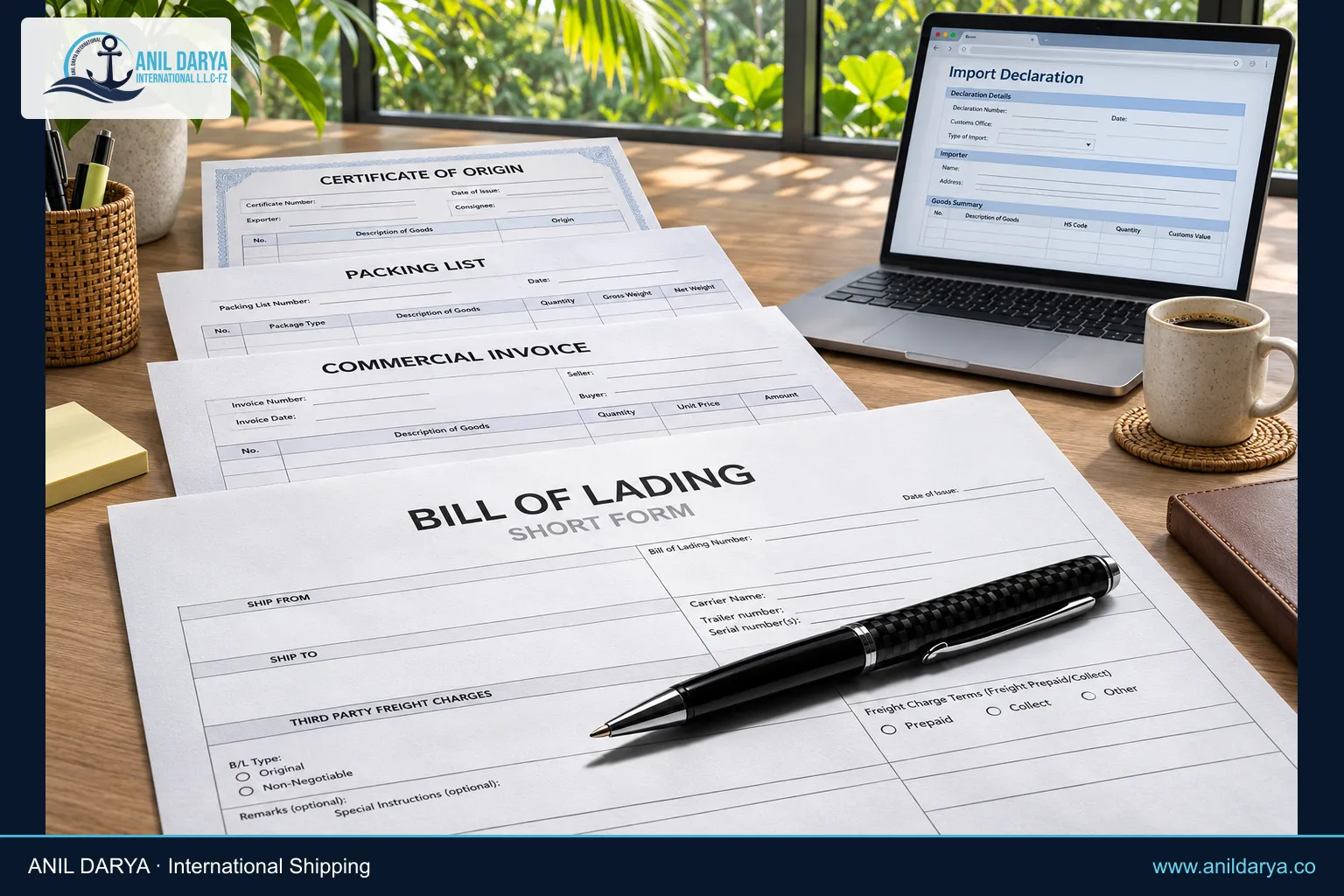
The bill of lading matters more than usual on this lane, because the FTA claim depends on it. The B/L should show a US load port, an Omani discharge port and one continuous carriage. If the buyer wants the freight under its control, it buys FOB Charleston or FOB Houston and we book the sea leg; on CFR Salalah the seller books, but duty, VAT and port costs in Oman stay with the buyer. Our guide to Incoterms 2020 for sea freight sets out who pays what.
US load ports for Oman cargo
Choose the port by where the goods sit and which service calls there. Inland rail and trucking in the US often cost more than shippers expect, so the closest port with a Salalah or Sohar call usually wins.
| US port | What we checked | Oman cargo it suits |
|---|---|---|
| Charleston, Savannah, Norfolk, Newark | All four are on Maersk's MECL eastbound loop that calls Salalah; Norfolk, Savannah and Charleston are also on ONE's INE | FCL from the Southeast, the Carolinas and the Northeast |
| Houston | On the MECL loop before the Atlantic ports | Oilfield equipment, valves, chemicals and resins from Texas |
| New York | On ONE's INE loop | Northeast consumer goods, machinery, medical equipment |
| Baltimore, Jacksonville, Freeport | Load ports on NYK RoRo's US to Middle East sheet, which listed Sohar as a discharge port | Cars, trucks, buses and wheeled machinery |
West Coast cargo has no Salalah call in the carrier sources we opened, so compare a transpacific relay with rail to an East Coast or Gulf port.
Salalah, Sohar or Duqm: which Omani port to use
Oman's three cargo ports sit far apart, so pick the one closest to the final site.
| Port | Facts from the operator | Best for |
|---|---|---|
| Salalah (Dhofar, south) | Container terminal with 6 berths, 2,197 m of quay, up to 18 m draft, 6 million TEU a year and more than 1,500 reefer plugs | Containers on deep-sea services, Dhofar consignees, transhipment |
| Sohar (Al Batinah, north) | Hutchison Ports Sohar: 2 million TEU, 18 m draft, 13 quay cranes, with Muscat, Dubai and Abu Dhabi within about four hours by road; C. Steinweg runs 4 berths at 16 m for project cargo, steel and Ro-Ro | Muscat and northern Oman, vehicles, steel, industrial plants |
| Duqm (central coast) | About 2.2 km of commercial quay with 18 m guaranteed depth; multipurpose terminal for project, heavy-lift, OCTG and line pipe | Refinery, energy and mining projects, oversized pieces |
Do not book to Muscat. Port Sultan Qaboos stopped receiving commercial ships in 2014 and that trade moved to Sohar, so a Muscat buyer receives through Sohar and a truck.
Salalah's monsoon runs from June to August, with waves of up to 4 m, so allow spare days in summer.
Sea freight from USA to Oman: services and routing
Unlike most Gulf lanes from America, Oman has a mainline call. These are the services we found on carrier and carrier-agent pages:
| Service and source | Rotation as published | What it means for Oman |
|---|---|---|
| Maersk MECL, carrier update for July 2026 sailings | Charleston, Savannah, Houston, Norfolk, Newark, Tangier, Jeddah, Salalah, Mundra, Pipavav, Nhava Sheva, back to Charleston | US cargo stays on one ship to Salalah, with two calls on the way |
| ONE INE, from 1 August 2026 | Nhava Sheva, Mundra, Salalah, New York, Norfolk, Savannah, Charleston, back to Nhava Sheva | From the US the ship calls India first, then Salalah |
| NYK RoRo USEME, sheet of 7 April 2026 | Load at Freeport, Jacksonville, Newark, Baltimore; discharge list includes Sohar as a direct call | The sheet shows the service suspended until further notice; it is still the newest USEME sheet on NYK's schedule page |
We do not print day counts here. The carrier notices give rotations, not transit times, and route sites quote figures from about 25 days to more than 50 days without a carrier source. Ask us for the carrier's own dates for the sailing you want.
[AMIR-FACT: the carriers and services we actually book from US East Coast and Gulf Coast ports to Salalah, Sohar and Duqm in 2026 (container and Ro-Ro), and our real port-to-port days on each]
Sohar and Duqm cargo on a container line may continue from a hub by feeder or truck. Ask which port the B/L names as final discharge; it decides the FTA paper trail.
FCL, LCL, vehicles, project cargo and DG
FCL and LCL
A 20ft box suits heavy loads such as drilling spares, valves and engine parts; a 40ft high cube suits medical equipment, consumer goods and plastics. LCL works for trial orders, but every lot needs its own invoice, its own Bayan declaration and its own FTA claim, and an LCL box that is opened and re-stuffed at a hub can fail the direct shipment test. Our FCL vs LCL guide shows when a full box pays off.
Cars, trucks and used equipment
Oman Customs publishes age limits for used imports: private vehicles under 7 years, trucks and buses under 10, and equipment under 15. Classic vehicles of 30 or 50 years are allowed with General Traffic Department approval, and all vehicles must meet Oman's standard specifications. The page carries no date.
[AMIR-FACT: confirm with an Omani broker that the used vehicle limits on the Oman Customs page (7 years private, 10 years trucks and buses, 15 years equipment) are the current rule for November 2026, and how the age is counted (model year or first registration)]
On the US side, a used vehicle needs its original title or a certified copy plus two copies, with the VIN, and both the papers and the vehicle must reach US Customs and Border Protection at least 72 hours before export by sea. Clear any lien in writing first.
Project and breakbulk cargo
Compressors, transformers, wellhead equipment and plant modules often go to Duqm or Sohar, where the operators handle heavy-lift and out-of-gauge pieces. Moderate pieces travel on flat racks or open tops on a container line; larger ones need multipurpose or Ro-Ro tonnage. Our break bulk service plans lifting and lashing, and the note on flat rack, open top and out-of-gauge cargo shows the size limits.
Dangerous goods
Paints, oilfield chemicals, lithium batteries and lab reagents sail under the IMDG Code. Oman adds its own step: Port of Salalah Customer Advisory 05/26, dated 26 March 2026, says vessel operators need prior approval from the Ministry of Transport, Communications and Information Technology for Classes 1, 2.1, 3, 4.3, 5.1 and 5.2, even for cargo in transit, and the port accepts the call only on that approval. Our dangerous goods desk checks the SDS and the DG declaration against the line's rules before we ask for space.
[AMIR-FACT: whether Salalah Customer Advisory 05/26 (MTCIT pre-approval for DG Classes 1, 2.1, 3, 4.3, 5.1 and 5.2) is still in force in November 2026, and whether the same rule applies at Sohar and Duqm]
The US export side: AES and export controls
US formalities sit with the exporter or its American forwarder; we file nothing with US agencies.
- Electronic Export Information is required when any Schedule B line is worth more than $2,500, or when the goods need an export licence at any value. It is filed in AES, part of ACE, and AESDirect is free to use.
- The ITN or exemption legend must reach the ocean carrier at least 24 hours before the cargo loads.
- Check each item against the Commerce Control List. Items not on it are EAR99. A listed item needs a licence for Oman only if the Country Chart shows an "X" for its reason for control and no licence exception applies.
One easy saving on this lane: trade.gov says the US-Oman FTA does not require legalisation or consularisation of trade documents. Do not pay for chamber and embassy stamps unless the Omani broker asks for them for a specific product.
The US-Oman FTA: how to get duty-free entry
The agreement entered into force on 1 January 2009. USTR says Oman gives duty-free access to all industrial and consumer products, and Oman Customs states that all US-origin goods covered by the agreement were fully exempt from 1 January 2018. None of the competitor guides we read mentions it.
What counts as US origin
Chapter 4 of the agreement treats a good as originating if it is wholly made in the US or Oman, or if it is a new or different article made there with at least 35% of its appraised value coming from US or Omani materials plus direct processing costs. Simple combining, repacking or dilution does not count. A product of an American company made in a third country does not qualify, as Oman Customs points out.
The direct shipment rule
Article 4.9 is the rule that catches cross-trade cargo. Goods lose their preference if they go through any production or other operation outside the two countries, except unloading, reloading and steps needed to keep them in good condition or to carry them on. Oman Customs adds practical tests:
- Goods may pass through other ports and free zones if they are not altered, travel on the exporter's original documents and stay under customs control there.
- Goods split during transit, or reloaded into containers with new numbers under new bills of lading, do not qualify.
- Where goods cross a third country, a declaration from that country's customs confirming they stayed under customs control must be provided.
How the claim is made
The importer, not the US exporter, makes the claim. Oman Customs says a certificate of origin is not required; origin is checked through the invoice or shipping documents, and the importer states in the declaration that the goods meet the agreement's terms. Customs may ask for a declaration on how the goods were produced, and the importer keeps that information for five years. If the claim is doubted, goods can be released against a guarantee equal to the duty, and the importer can claim a refund within one year.
| Paper for the FTA claim | Who prepares it | What to check |
|---|---|---|
| Commercial invoice | US exporter | Country of origin, HS code, weights and quantities on every line |
| Bill of lading | Shipping line, released through us | US load port, Omani discharge port, same container numbers end to end |
| Importer's request for preferential treatment | Omani importer or broker | Filed with the Bayan declaration |
| Production records, bill of materials | US manufacturer, held by the importer on request | Shows the 35% rule for goods with foreign parts |
Trade.gov lists problems exporters have reported: duty collected on some bonded goods moved by road through the UAE, goods without a "Made in the USA" marking refused preference, mixed containers losing preference because of a few non-US parts, and claims refused when goods were invoiced through a third-party regional office. Mark each item, keep non-qualifying goods on a separate invoice, and invoice from the US seller.
Oman customs: Bayan, documents and permits
The Royal Oman Police Directorate General of Customs clears imports through the Bayan system. Its declaration service lists commercial invoices, a certificate of the manufacturer's country of origin and a declaration from the exporting country, with a fee of OMR 15 for companies. For a US shipment claiming the FTA, the agreement page above says no certificate of origin is needed, so ask the broker which list it files under. Foreign invoices must be translated into Arabic where required, and goods must match permits and standards from the competent authorities.
Value, HS code and origin can be lodged in Bayan before the ship arrives. The Port of Salalah tells customers that release now comes electronically through Bayan, so the B/L details must be right from the load port: a consignee name or container number that differs from the invoice stops the release.
Permits that often apply to US goods
| US product | Permit or rule | Issued by |
|---|---|---|
| Low voltage electrical equipment, lead-acid batteries | Import permit | Ministry of Commerce, Standards and Metrology |
| Cars, motorcycles, tyres; second-hand vehicles | Import permits | Ministry of Commerce (Standards and Metrology; Commercial Affairs) |
| Chemicals, cosmetics, paints, lubricating oils | Import permits; cosmetics also need a GSO 1943 conformity certificate | Ministry of Commerce; Environment Authority for chemicals |
| Meat, dairy, eggs, fish, feed | Health certificate and import permit; halal certificate for meat | Ministry of Agriculture, Fisheries and Water Resources |
| Dual-use goods, drones, night-vision devices, explosives | Import permits | Royal Oman Police |
| Telecom and radio equipment | Release of controlled goods | Telecom Regulatory Authority |
Food is tested before release against GCC and Codex standards, and unfit consignments are destroyed or sent back, according to trade.gov's Oman guide last published on 18 December 2025.
Duty, VAT and excise on American goods in Oman
| Charge | Rate or rule | Source and date |
|---|---|---|
| Customs duty, qualifying US goods | 0% under the FTA | Oman Customs agreement page; USTR |
| Customs duty, non-qualifying goods | GCC common tariff, 5% for most goods, collected at the first GCC point of entry | GCC customs union, UAE ICP |
| VAT | 5% standard rate, applies to imported goods | Oman Tax Authority VAT FAQ |
| Excise | 50% to 100% on alcohol, carbonated and energy drinks, pork products and tobacco | trade.gov, 18 December 2025 |
| Digital tax stamp | From 1 January 2026, soft drinks, energy drinks, alcohol and other excise goods (sweet drinks excluded) cannot be sold without one | trade.gov, 18 December 2025 |
The FTA removes duty, not VAT. Duty and taxes at destination are paid by the consignee or its broker. ROP Customs gives advance rulings on classification, valuation and origin, worth asking for before a large first order.
Restricted goods in Oman
Oman bars goods prohibited by international or local rules, counterfeit goods, goods that infringe intellectual property and goods that do not meet approved specifications. Pork products and alcohol are restricted; alcohol, firearms, medicines and explosives need special licences. Media can be examined and refused. Live swine stay illegal even though the FTA tariff schedule made them duty-free in 2019.
Agree the Omani broker before the cargo leaves the US
We do not sell customs clearance in Oman. The importer uses its own broker, and we confirm the booking only after that broker has accepted the job and checked the FTA papers. On this lane the broker has two tasks before sailing: confirm the permits, and confirm that the routing keeps the direct shipment rule.
The broker reviews the draft invoice, HS codes and routing, permits start, and only then do we confirm space and send cut-offs to the US shipper. A box that lands without a broker, or with a broken FTA trail, sits in the terminal while charges add up. Our guide to demurrage and detention explains how those charges start.
Where Dubai fits on the US to Oman lane
Dubai can help, but plan it around the FTA.
| Option | How it works | FTA effect |
|---|---|---|
| Through B/L, relay at Jebel Ali | The box changes ship at Jebel Ali and continues to Sohar on the line's own B/L, same container, no handling of the goods | Should keep the preference if the cargo stays under customs control; confirm with the Omani broker |
| Consolidation or stock in Dubai, JAFZA | US goods are stored, split or combined with other cargo, then sent to Oman on new papers | Oman Customs says split cargo under new bills of lading does not qualify, so expect 5% duty |
| Road from Dubai to Sohar | Goods cleared or in transit in the UAE are trucked to Oman through the Hatta crossing | Trade.gov reports duty collected on some bonded goods moved by road through the UAE |
Jebel Ali has more than 80 weekly services to over 150 ports and handles Ro-Ro, breakbulk, reefer and IMDG cargo, as our Jebel Ali port guide explains. If the buyer accepts paying duty in return for stock close to Oman, our note on re-exporting through JAFZA covers the free zone route. Customs clearance in Dubai, for goods entering or leaving the UAE, is a service we provide for a fee.
[AMIR-FACT: whether we route USA to Oman cargo through Jebel Ali in practice, which feeder or truck connection we use to Sohar, how many days it adds, and whether Omani brokers have accepted the FTA claim on cargo relayed at Jebel Ali on a through B/L]
What US cargo goes to Oman?
USTR puts US goods exports to Oman at about $2.2 billion in 2025, up 12.5% on 2024. Trade.gov names vehicles, aircraft, petroleum products, chemicals, plastics and industrial engines as the main US exports. By sea that means Ro-Ro or containerised vehicles into Sohar, FCL chemicals and plastics into Salalah or Sohar, and engines and plant equipment into Sohar or Duqm.
What decides the cost of shipping from USA to Oman?
Ocean rates change with every sailing, so we do not publish them. These are the parts of the landed cost.
| Cost part | Usually paid by | What moves it |
|---|---|---|
| US inland trucking or rail, terminal charges, AES filing | Seller on FOB, buyer on EXW | Distance to the port, rail ramp, filer fees |
| Ocean freight and any feeder to Sohar or Duqm | Set by the Incoterm | Service, equipment, DG or reefer, season, Salalah monsoon |
| Omani terminal charges, broker fee, permits, VAT | Buyer or its broker | CIF value, permit type, inspection |
| Duty | Buyer | 0% if the FTA claim holds, 5% if it fails |
A cheap quote through a hub where the goods are handled can cost 5% of CIF in lost preference.
Shipping from USA to Oman step by step
- Agree the Incoterm, the Omani port and the delivery site with the buyer.
- Send us the commodity, HS code, weights and sizes, US pickup city, ready date and any vehicle, DG or oversized detail.
- We propose the US port, carrier, discharge port and routing, and flag anything that could break the direct shipment rule.
- The importer names its broker, and we agree the clearance and FTA plan with that broker before confirming the booking.
- Permits and any DG approvals start; we book the space.
- The US shipper delivers to the terminal, presents any used vehicle to CBP 72 hours ahead, and files EEI so the ITN reaches the carrier 24 hours before loading.
- We check the draft B/L against the invoice and packing list, and the line's B/L is released to you through us.
- The broker lodges the Bayan declaration with the FTA request, the consignee pays VAT, and the cargo is delivered.
[AMIR-FACT: one real USA to Oman cross-trade shipment we booked (cargo, US load port, carrier, Omani port, total days, whether the FTA claim was accepted, one problem we solved), cleared for publication]
Our Dubai freight forwarding team runs these steps.
Checklist before the cargo sails
- Incoterm, Omani port and delivery site in the sales contract.
- Omani broker confirmed, with the FTA plan agreed.
- Invoice from the US seller, with origin, HS code, weights and quantities per line.
- "Made in the USA" marking on the goods; non-US items on a separate invoice.
- Routing with no splitting, re-stuffing or new B/L on the way.
- Permits ready: electrical, chemicals, cosmetics, food or vehicles.
- Used vehicles and equipment inside Oman's age limits; title with CBP 72 hours before export.
- ECCN or EAR99 checked, EEI filed, ITN with the carrier.
- DG: SDS, IMDG declaration and Omani pre-approval where the class needs it.
Mistakes that cost money on this lane
- Shipping before destination clearance is agreed. With no broker ready, the box waits at Salalah or Sohar and charges grow each day.
- Splitting or consolidating US goods in a hub and expecting the FTA to apply. New B/Ls and new container numbers end the preference.
- Paying for embassy legalisation the FTA does not need.
- Booking to Muscat, which has had no commercial cargo calls since 2014.
- Buying a used car or machine at a US auction without checking Oman's age limits.
- Invoicing through a regional office outside the US, which trade.gov lists as a reason claims were refused.
Frequently asked questions
How long does shipping from the USA to Oman take by sea?
It depends on the service and the Omani port. Maersk's MECL carries US East and Gulf Coast cargo to Salalah on one ship with calls at Tangier and Jeddah, while ONE's INE calls India before Salalah. Carriers do not publish day counts on these notices, so each quote from us carries the line's own dates.
Is there a direct ship from the US to Oman?
Yes for Salalah: Maersk's MECL eastbound loop calls Salalah after leaving the US. Sohar and Duqm usually need a feeder, a truck or a Ro-Ro service, and NYK RoRo's US to Middle East sheet, which lists Sohar, showed the service suspended in April 2026.
Do American goods pay import duty in Oman?
Not if they qualify under the US-Oman FTA and are shipped directly. Goods that fail the origin or direct shipment rule pay the GCC rate, 5% for most goods. Either way, 5% VAT applies, paid by the consignee or its broker.
Do I need a certificate of origin for the US-Oman FTA?
No. Oman Customs says a certificate of origin is not required. The importer makes the claim, the invoice shows US origin, and customs may ask for production details, which the importer keeps for five years.
Can I ship through Dubai and still get the FTA rate?
A relay at Jebel Ali on a through bill of lading, with the same container and no handling, should keep the preference if the cargo stays under customs control. Storing, splitting or re-booking the goods in Dubai does not. Confirm the routing with your Omani broker first.
Which Omani port should US cargo go to?
Salalah for containers on deep-sea services and Dhofar delivery, Sohar for Muscat and northern Oman and for vehicles, Duqm for project and heavy cargo. Muscat's old port takes no commercial cargo.
Does Anil Darya clear customs in Oman?
No. The Omani importer's broker clears the goods. We agree that plan with the broker before we confirm the booking, and we clear customs in Dubai for a fee when the cargo passes through the UAE.
Get a quote for shipping from the USA to Oman
Send us the US pickup city, the Omani delivery site, the cargo, the ready date and your broker's name if you have one. Use our freight rate inquiry form, or contact our team to talk through a vehicle, project or DG move first.
Sources
- Oman Customs: Free trade agreement with the United States (rules of origin, transit, documents)
- US-Oman FTA final text, Chapter 4: Rules of Origin
- Office of the US Trade Representative: Oman Free Trade Agreement
- Office of the US Trade Representative: Oman (2025 trade figures)
- US International Trade Administration: Oman import tariffs (18 December 2025)
- US International Trade Administration: Oman import requirements and documentation (18 December 2025)
- US International Trade Administration: Oman market overview (18 December 2025)
- US International Trade Administration: Oman prohibited and restricted imports
- Oman Customs: Request to apply a customs declaration (Bayan)
- Oman Customs: Before imports
- Oman Customs: Import of goods
- Oman Customs: Permits by authority
- Oman Customs: Import of used vehicles, motorcycles and classic vehicles
- Oman Tax Authority: VAT FAQs
- UAE ICP: GCC customs union
- Port of Salalah: Container terminal
- Port of Salalah: Marine services (monsoon)
- Port of Salalah: Customer Advisory 05/26, DG pre-approvals (26 March 2026)
- Port of Salalah: Customer Advisory 04/24, Bayan integration
- Asyad: Hutchison Ports Sohar
- C. Steinweg: Oman (Sohar)
- Port of Duqm: Terminals
- MarineLink: Sultan Qaboos Port stops cargo trade (2013)
- Kuehne+Nagel: Carrier services update, 4 to 22 July 2026 (MECL, INE)
- NYK RoRo: USEME trade schedule, week 15, 7 April 2026
- US Census Bureau: Automated Export System
- 15 CFR 30.4: EEI filing time limits
- 15 CFR 30.37: EEI exemptions
- 15 CFR 732.3: EAR99 and the Commerce Country Chart
- 19 CFR 192.2: Export of used self-propelled vehicles
- DP World: Jebel Ali Port
- Dubai Media Office: Hatta Customs Center
Reviewed: 11 November 2026