
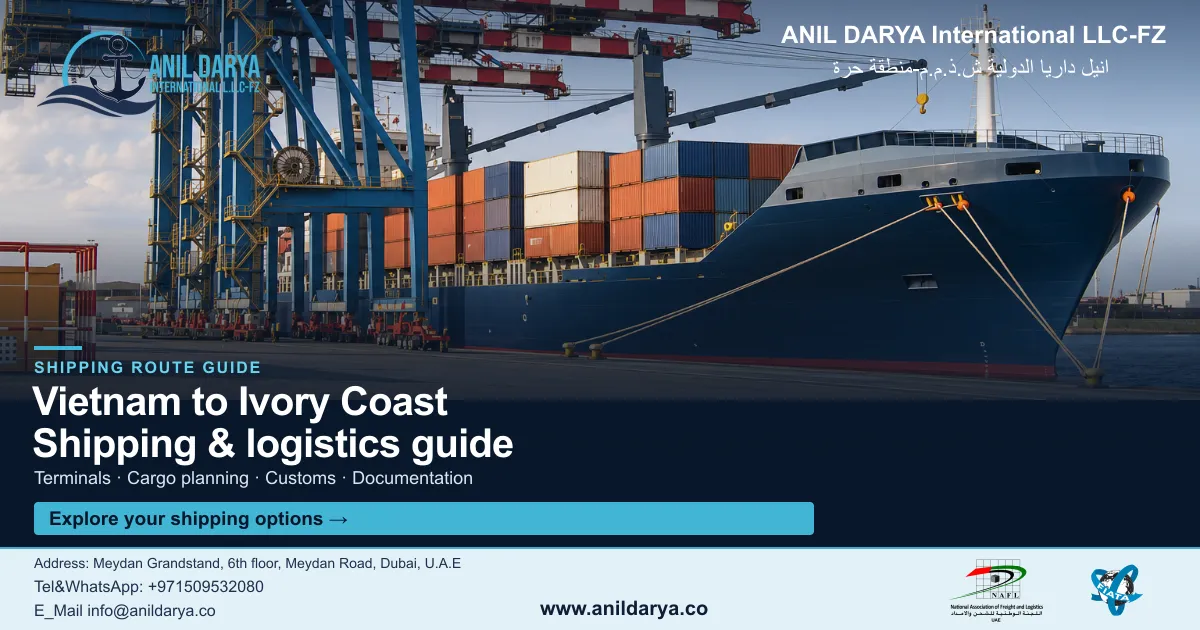
Shipping from Vietnam to Ivory Coast mostly means bagged rice and other dry cargo leaving Cai Mep, Cat Lai or Hai Phong in containers and landing at Abidjan, with San Pedro as the second option in the south-west. No carrier we checked publishes a westbound loop from Vietnam straight to Cote d'Ivoire, so most boxes change ship at an Asian hub. We book the ocean freight from Dubai, release the shipping line's own bill of lading to you, and agree the clearance plan with your Ivorian broker before the booking is confirmed.
Shipping from Vietnam to Ivory Coast at a glance
| Item | Detail |
|---|---|
| Main cargo | Milled and broken rice, plastics, textiles and garments, mixed consumer goods |
| Vietnamese load ports | Cat Lai (Ho Chi Minh City), Cai Mep, Hai Phong; Da Nang and Quy Nhon by feeder |
| Ivorian ports | Abidjan (main container port); San Pedro (smaller, with a grain berth) |
| Routing | Usually transhipped at an Asian hub onto an Asia to West Africa service |
| Published transit days | No carrier schedule we opened shows a Vietnam to Abidjan figure; ask for the schedule of each leg |
| Before loading | BSC cargo tracking note; FDI pre-declaration in GUCE; certificate of conformity for regulated goods |
| Rice duty | 10% on milled and broken rice in the official tariff updated 27 March 2026, plus small levies |
| VAT | 18% on most goods; the tariff shows 0 in the VAT column for rice lines |
| Trade agreement | None between Vietnam and Cote d'Ivoire; standard tariff applies |
| Who clears in Abidjan | The consignee or its licensed customs broker, agreed before the cargo sails |
Who does what on a Vietnam to Abidjan cross-trade booking
Three parties share the work.
- The Vietnamese exporter, or its forwarder in Vietnam, trucks the goods to the terminal, stuffs or delivers the container and files the export declaration in VNACCS.
- We book space with the shipping line from Dubai, check the draft bill of lading against Ivorian rules and follow the box through the hub.
- Your customs broker in Cote d'Ivoire files the FDI pre-declaration and the customs entry, settles duty and taxes from the importer's funds and takes delivery at the terminal.
The bill of lading you receive is the carrier's own document. We act as agent for many shipping lines, so the line issues its B/L and we release it to you once freight is paid.
Fill in that B/L with care. Maersk's import notes for Ivory Coast require the consignee or the notify party to be located in Cote d'Ivoire or a neighbouring country, and they refuse consignee addresses in Europe or Asia. A rice trader in Singapore or Dubai that resells to an Abidjan wholesaler should therefore show the Abidjan buyer, or a local notify party, on the bill.
Most Ivorian rice and goods buyers purchase FOB a Vietnamese port, so the exporter clears the goods out of Vietnam and you control the ocean leg. If the Ivorian buyer wants to pay freight at destination, check first: Maersk calls Ivory Coast a conditional freight collect country and needs finance approval for each collect shipment. Paying freight prepaid through us in Dubai avoids that step. Our guide to Incoterms 2020 for sea freight compares FOB, CFR and CIF.
Vietnamese load ports for West Africa cargo
Vietnam has three container gateways of world size. Lloyd's List's 2026 ranking, reported by Saigon Newport, put Ho Chi Minh City at about 8.9 million TEU in 2025 (22nd in the world), Hai Phong above 8.2 million TEU (26th) and Cai Mep above 7.6 million TEU (31st).
| Supplier region | Usual load port | What it means for Abidjan cargo |
|---|---|---|
| Mekong Delta rice mills, Long An, Can Tho, An Giang | Cat Lai or Cai Mep | Closest gateway for most rice cargo |
| Binh Duong, Dong Nai, Ho Chi Minh City factories | Cat Lai or Cai Mep | Plastics, garments, footwear and furniture; many hub feeders sail from here |
| Ba Ria-Vung Tau | Cai Mep | Deep-water terminals; the Maersk FEW1 loop calls Vung Tau, but on its way back to Asia |
| Hanoi and the north | Hai Phong (Lach Huyen) | Electronics, garments and plastics from northern provinces; usually a longer feeder to the hub |
| Central Vietnam | Da Nang or Quy Nhon | Smaller volumes; often trucked or fed to a southern port first |
Abidjan or San Pedro for cargo from Vietnam
Abidjan is where nearly all container cargo from Vietnam ends up. The Port Autonome d'Abidjan handled 1,697,131 TEU in 2025, against 1,646,304 TEU in 2024, and 46.6 million tonnes in total, with a target of 2 million TEU by 2027. Its deep-water box terminal, Cote d'Ivoire Terminal (CIT), opened in November 2022. Run by Africa Global Logistics and APM Terminals, it has a 1,100 m quay, 16 m of water, 1,100 reefer plugs and a capacity of 1.5 million TEU a year. The older Abidjan Terminal beside it has a maximum draft of 11.5 m.
San Pedro, in the south-west, is built around cocoa exports. Its official infrastructure page lists an access channel dredged to 13.5 m, a west quay with 11 to 12 m of water, a container terminal with four mobile cranes, 10 reefer outlets and a grain berth. That grain berth matters if your rice buyer is in the west of the country, but most Far East services do not call San Pedro, so containers for it usually come on a feeder or by truck from Abidjan. Confirm the routing before you name San Pedro as the port of discharge.
Sea freight from Vietnam to Ivory Coast: hubs and services
The big Asia to West Africa loops start in China and cross from a Southeast Asian hub. Maersk's network update of February 2026 gives two rotations from the second quarter of 2026:
- FEW3: Qingdao, Ningbo, Nansha New Port, Tanjung Pelepas, Tema, Abidjan, Pointe Noire, Tanjung Pelepas.
- FEW1: Qingdao, Ningbo, Nansha New Port, Shekou, Singapore, Abidjan, Lekki, Kribi, Vung Tau.
Look at where Vietnam sits. On FEW1, Vung Tau is the last call after the West African ports, so the ship stops in Vietnam on its way back to China. That call serves cargo coming from West Africa, such as the raw cashew nuts Vietnam buys from Cote d'Ivoire, not exports going the other way. For a westbound box from Vietnam, the possible connection is a feeder from Cai Mep, Cat Lai or Hai Phong to Singapore or Tanjung Pelepas, where these loops call before crossing to Abidjan. That is our reading of the published rotations, not a routing the carrier publishes for Vietnam, and each line has its own feeder network.
Forwarder guides quote conflicting transit ranges with no carrier schedule behind them. What decides the door-to-door time is the feeder sailing in Vietnam, the waiting time at the hub and whether the mother vessel calls Abidjan first or later in its West African rotation. Ask for the vessel and voyage on each leg, and the hub, before you agree a delivery date with your buyer.
[AMIR-FACT: the carriers and services we actually book from Cai Mep, Cat Lai and Hai Phong to Abidjan and San Pedro, the hub each one uses (Singapore, Tanjung Pelepas or other), and the real port-to-port days and sailing frequency we see]
Container shipping Vietnam to Ivory Coast: FCL, LCL and reefer
| Option | Typical cargo from Vietnam | What to plan for in Abidjan |
|---|---|---|
| 20ft dry | Bagged rice, plastic resin, ceramic tiles | Heavy cargo: load to the box's payload, not to its volume |
| 40ft dry or high cube | Garments, footwear, furniture, plastic household goods | Maersk takes 20ft and 40ft standard and high cube boxes; 45ft boxes are not accepted |
| LCL | Samples, spare parts, small garment lots | Each consignee in the box needs its own papers and BSC before release |
| Reefer | Frozen pangasius fillets and other seafood | Only 2 free days at the port for reefers on Maersk's Ivory Coast tariff |
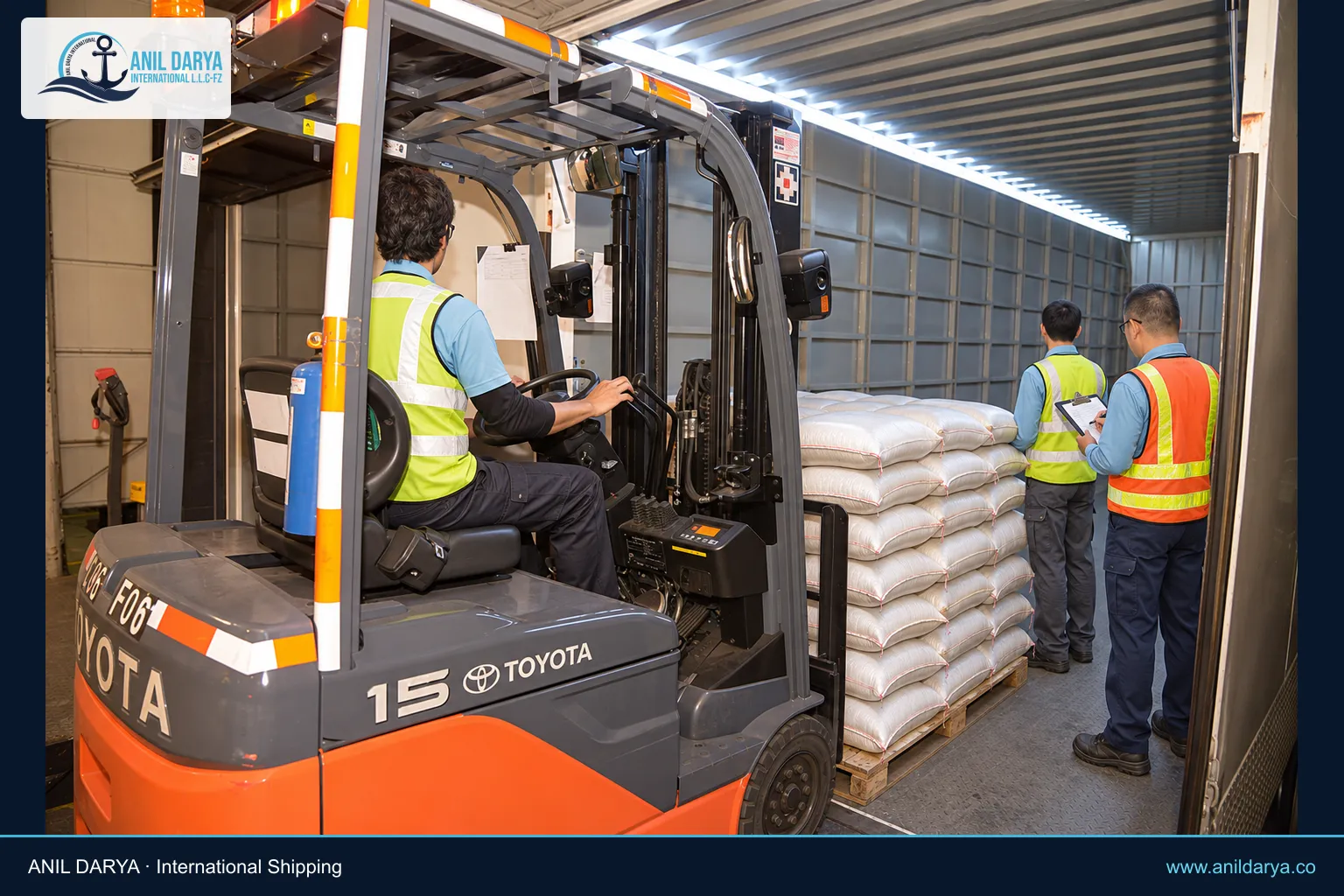
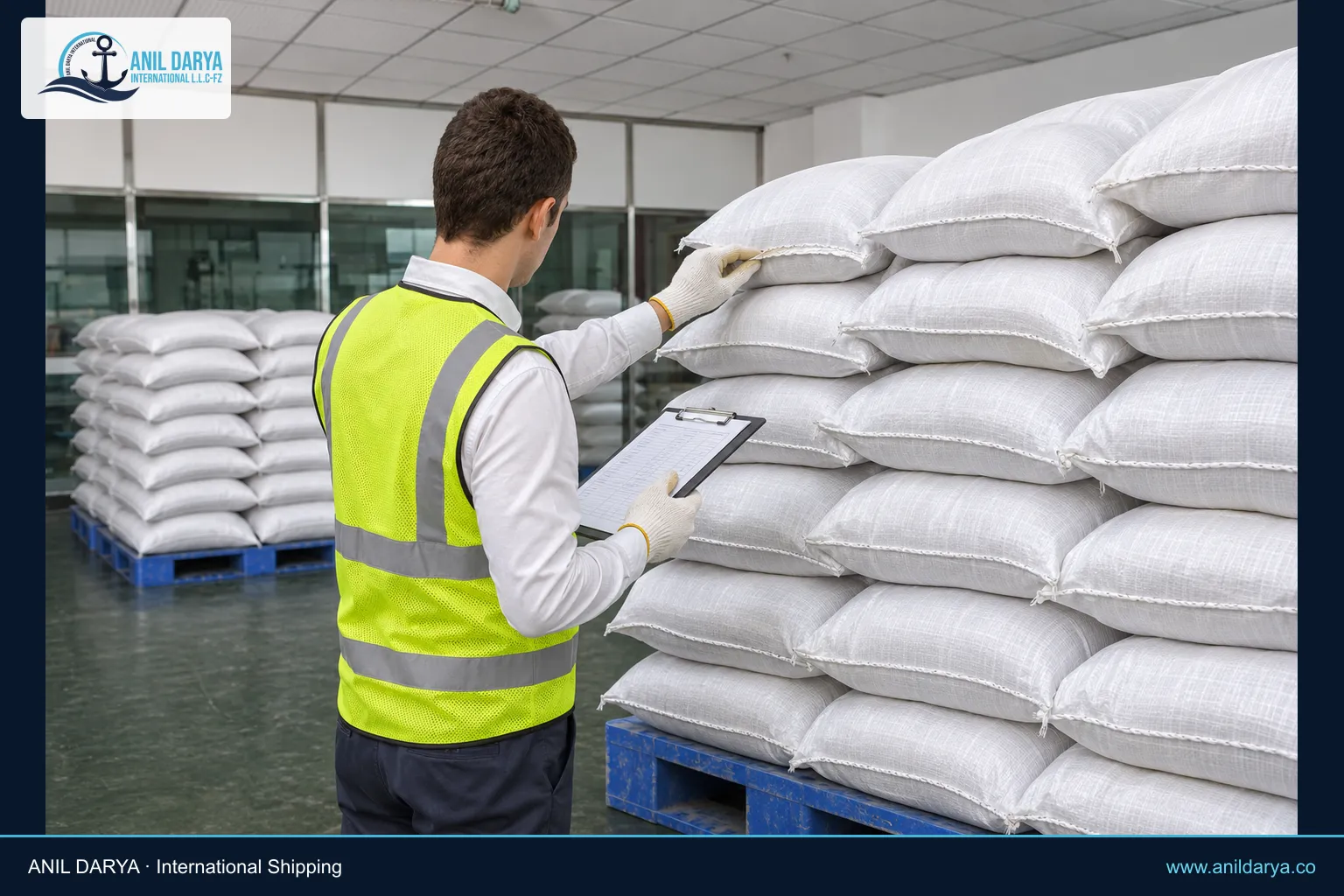
Rice is a payload cargo. A 20ft box of bagged rice reaches its weight limit long before it is full, so plan your contract tonnage in multiples of the payload your carrier accepts, and make sure the exporter's VGM matches the weight on the B/L.
Write a real description on the bill. Maersk does not accept "pallets" as a package type or "general cargo" as a description for Ivory Coast, and it lists retread tyres as a restricted commodity. Our FCL vs LCL guide shows when a full box pays, and our sea freight service covers booking and equipment.
Large rice lots, dangerous goods and project cargo
Very large rice contracts are sometimes moved on bulk or breakbulk ships instead of containers, with laytime, stevedores and a port agent at discharge. San Pedro's grain berth is one option for the west of the country. Send the tonnage, bagging and delivery window, and our bulk cargo team will compare both routes.
Lithium batteries in electronics and e-bikes, paints and resins travel as dangerous goods under the IMDG Code, whose 2024 edition (Amendment 42-24) has been mandatory since 1 January 2026. Maersk also requires a letter of indemnity, signed and stamped by shipper and consignee, for every dangerous cargo shipment to Ivory Coast. Our dangerous goods team checks carrier acceptance on both legs. Out-of-gauge machinery is accepted to Ivory Coast only on special request, so send drawings and weights early.
The Vietnam export side: VNACCS, C/O and phytosanitary papers
Vietnam's export declaration is filed in VNACCS by the exporter. The Ministry of Industry and Trade's VNTR portal describes three steps: EDA registration, which can be changed for up to 7 days, EDB for any change, and EDC for the final declaration. Customs then sends it to a green, yellow or red channel. The legal basis listed includes Decree 206/2025/ND-CP and Circular 39/2018/TT-BTC.
- Keep the VNACCS description, weights and value identical to the invoice your Ivorian broker uses.
- Since 5 May 2025 the Ministry of Industry and Trade is the only body issuing certificates of origin in Vietnam, including the non-preferential Form B used for Cote d'Ivoire. Its 18 regional offices handle the request through the eCoSys system.
- Food and agricultural products, rice included, need a phytosanitary or sanitary certificate for entry into Cote d'Ivoire, so the exporter should order it from the Vietnamese plant protection authorities in time for the B/L date.
- Ask for the commercial invoice in French, or at least bilingual. Ivorian customs works in French, and trade.gov says the invoice must be in French.
Ivory Coast import customs: BSC, FDI, GUCE and RFCV
Clearance in Cote d'Ivoire is prepared while the cargo is still in Vietnam. We do not sell customs clearance there. Your licensed broker does that work, and we agree the plan with the broker before we confirm the space, so nobody discovers a missing file when the box is already at the hub.
Start with the BSC (Bordereau de Suivi des Cargaisons), the electronic cargo tracking note run by the Office Ivoirien des Chargeurs (OIC), the Ivorian shippers' council. Maersk's import notes state that customs clearance is impossible without the BSC, so the cargo cannot be delivered. Germany's trade agency GTAI describes it as mandatory for sea freight and requested at the loading stage, with exporter, carrier or forwarder and importer registered on the platform. On a transhipped booking, the BSC must describe the final sailing into Abidjan, so make sure the B/L data the platform receives is the through B/L, not a feeder document.
Next comes the FDI (Fiche de Declaration a l'Importation), filed by the importer or its broker through the GUCE foreign trade single window. trade.gov states that it must be validated before the goods arrive. Customs then issues the RFCV, its final report on classification and value, and the declaration itself goes into SYDAM World. If the importer disputes the value in an RFCV, the douanes.ci FAQ points to the Comite d'Arbitrage de la Valeur.
| Document | Who provides it | What to check on a Vietnam shipment |
|---|---|---|
| BSC | Requested on the OIC platform before loading | Matches the through B/L and the final vessel into Abidjan |
| FDI | Importer or broker, in GUCE | Validated before arrival |
| Carrier bill of lading | Shipping line, released through us | Consignee or notify party in Cote d'Ivoire; detailed description |
| Commercial invoice | Vietnamese exporter | In French, with CIF value, terms of sale, weights and marks; two copies |
| Packing list | Vietnamese exporter | Bag count and weights agree with the B/L and VGM |
| Certificate of origin (Form B) | Ministry of Industry and Trade, Vietnam | Required in duplicate |
| Phytosanitary certificate | Vietnamese plant protection authorities | Rice, other food and agricultural goods |
| Certificate of conformity | Approved inspection company | Issued before loading for regulated goods |
| Prior import authorisation | Importer, from the ministry concerned | Some agricultural products, chemicals and controlled goods |
trade.gov notes that some agricultural products may need a prior import authorisation (API), so rice buyers should ask their broker before signing the contract.
Certificate of conformity and rice
Cote d'Ivoire's verification of conformity programme requires regulated goods to be inspected in the exporting country by an approved body, which then issues a certificate of conformity (CoC) before loading. Cotecna, an approved firm, says the programme rests on Decrees 2016-1152 and 2017-567, became mandatory on 15 February 2019 and widened to 4,299 HS codes, chemicals included, for shipments with a B/L dated on or after 1 July 2026. Maersk's notes give the threshold as a FOB value of XOF 1 million and name Bureau Veritas, Cotecna and Intertek among the agencies.
Food products are the first family on Intertek's list of regulated goods, next to electrical goods, construction materials, packaging, textiles, footwear and toys. Neither Intertek nor Cotecna names rice on its public page, so do not assume either way: have the importer check the exact HS line against the regulated list with the inspection company. If it is covered, book the inspection while the rice is being bagged at the mill.
The penalty for skipping it is severe. Maersk warns that shipments arriving without a certificate of conformity are rejected by customs, with a penalty of 50% of the cargo value plus confiscation and destruction at the importer's cost.
[AMIR-FACT: whether rice and other food shipments from Vietnam to Cote d'Ivoire needed a CoC and an API in the files we coordinated, which inspection company the Vietnamese exporters used, and the usual lead time from inspection request to certificate]
Import duty and taxes on goods from Vietnam
Cote d'Ivoire applies the ECOWAS Common External Tariff, with bands of 0%, 5%, 10%, 20% and 35% charged on CIF value. trade.gov lists 18% VAT on CIF plus duties and taxes, a 1% statistical fee and community levies. There is no trade agreement between Vietnam and Cote d'Ivoire: trade.gov's list of Ivorian agreements covers AfCFTA, ECOWAS, WAEMU, AGOA and the EU partnership agreement, with nothing for Vietnam or ASEAN. Vietnamese goods therefore pay the standard tariff, and a certificate of origin is for identification, not for a lower rate.
Ivorian customs publishes the tariff with every national tax per line, last updated on 27 March 2026. Lines for goods that often come from Vietnam:
| Goods (HS) | Duty | VAT column |
|---|---|---|
| Semi-milled or milled rice, bags over 5 kg or bulk (1006.30.10) | 10% | 0 |
| Milled rice in packs of 5 kg or less (1006.30.90) | 10% | 0 |
| Broken rice (1006.40) | 10% | 0 |
| Frozen pangasius and catfish fillets (0304.62) | 20% | 18% |
| Woven polypropylene sacks (6305.33) | 20% | 18% |
| Rubber or plastic sandals (6402.99.20) | 20% | 18% |
| Wooden furniture (9403.60) | 20% | 18% |
| Motorcycles 80 to 250 cc, not for assembly (8711.20.99) | 20% | 18% |
Nearly every line also carries small entries of 0.5%, 0.8%, 0.2% and 1% in the levy columns. Rice has two extra points to check. trade.gov says Cote d'Ivoire applies specific taxes on rice and a minimum import price on broken rice, so the taxable value can sit above your invoice. Ask your broker for the full tax sheet on your 10-digit code before you fix the price with the mill. Duty and taxes at destination are paid by the consignee or its broker, not by the Vietnamese exporter and not by us.
Restricted goods to check before a Vietnam order
| Goods | Rule (trade.gov, May 2026) |
|---|---|
| Ordinary plastic bags | Banned for import, sale and use (Decree 2013-327, amended by Decree 2014-844) |
| Sugar | Import prohibited (Decree 2008-164) |
| Certain textiles | Prior authorisation from the Ministry of Commerce |
| Animal-origin products, including seafood | Sanitary and veterinary clearance |
Woven rice and cocoa sacks are not ordinary plastic bags, but the HS code and invoice description must make that plain.
Can cargo from Vietnam to Cote d'Ivoire go through Dubai?
A through booking via an Asian hub fits most cargo. Dubai helps when your trading company already works from the UAE.
| Option | How it works | What to watch |
|---|---|---|
| Consolidation in Dubai | Vietnamese goods join goods from other origins and leave in one box for Abidjan | CoC still needed per product; the BSC follows the final sailing to Cote d'Ivoire |
| Jafza stock and re-export | You hold Vietnamese stock in the free zone and ship to Abidjan as orders come in | Dubai Chambers issues certificates of origin for re-exports; the goods keep Vietnamese origin |
| Relay at Jebel Ali | The box lands from Vietnam and connects to a West Africa sailing | Dubai Customs runs transit as a separate regime from import |
The UAE-Vietnam CEPA, in force since 3 February 2026, covers trade between those two countries only, and with no Vietnam to Cote d'Ivoire preference, a Dubai stop costs you no tariff benefit. Jafza sits next to the port, so splitting, relabelling into French and repacking are practical. See our Jebel Ali port guide and our note on re-exporting through Jafza. When cargo is landed, stored or re-exported in Dubai, we handle the UAE customs clearance for a fee.
[AMIR-FACT: whether we route Vietnam to Cote d'Ivoire cargo via Jebel Ali in practice (relay, consolidation or Jafza stock), the carriers used from Jebel Ali to Abidjan, and the real extra or saved days compared with a through booking via Singapore or Tanjung Pelepas]
Typical cargo on the Vietnam to Ivory Coast lane
Rice dominates. Vietnam's Department of Customs data, reported by Ho Chi Minh City's trade promotion centre, show rice exports to Cote d'Ivoire up 152% in the first nine months of 2025. A Vietnamese forwarder's summary of the same customs data puts total Vietnamese exports to Cote d'Ivoire at about USD 699 million in 2025, roughly double 2024, with rice at about 1.06 million tonnes. Trade the other way is larger: Vietnam imported about 746,000 tonnes of Ivorian cashew nuts in 2025, which is why the carriers' loops stop in Vietnam on the way back from West Africa.
Step by step: shipping from Vietnam to Ivory Coast with Anil Darya
- Send us the goods, HS code, tonnage or volume, load port in Vietnam, ready date and the delivery point in Cote d'Ivoire.
- Name your customs broker in Cote d'Ivoire. We agree the BSC, FDI, CoC, API and local charges with the broker before we confirm the booking.
- Agree the Incoterm with the exporter, usually FOB a Vietnamese port, and decide who pays freight and where.
- We book the carrier space, confirm the hub and send the exporter the booking, cut-offs and the draft carrier B/L.
- The exporter books the CoC inspection if needed, orders the Form B and the phytosanitary certificate, and stuffs the container.
- The BSC is requested on the OIC platform and the FDI filed in GUCE, so both are ready before the feeder sails.
- The exporter or its forwarder files VNACCS; we check consignee, notify party, description and weights on the draft B/L.
- We follow the box through the hub. The carrier B/L is released to you through us, and your broker clears the cargo after the RFCV and payment of duty.
[AMIR-FACT: one real Vietnam to Cote d'Ivoire cross-trade shipment we handled (cargo, Vietnamese load port, hub, Abidjan or San Pedro, carrier, how the BSC and broker were lined up, door-to-door days), cleared for publication]
What decides the cost of Vietnam to Ivory Coast shipping?
We do not print rates on this page, because the price depends on the sailing, the hub and the season. These are the parts of the landed cost and who usually carries them.
| Cost part | What moves it | Usually paid by |
|---|---|---|
| Vietnamese origin charges | Trucking from the mill, terminal handling, VNACCS filing | Exporter under FOB |
| Inspections and certificates | CoC route, phytosanitary certificate, fumigation if asked | As agreed in the contract |
| Ocean freight and hub | Feeder plus mother vessel, box type, season, fuel surcharges | Buyer under FOB |
| BSC fee | Charged through the OIC platform | As agreed between the parties |
| Abidjan charges | Terminal handling, line import fees, delivery order | Consignee |
| Duty, levies and taxes | HS code, CIF value, specific tax and MIP on rice | Consignee or its broker |
| Demurrage and detention | Missing BSC or CoC, late FDI, examination | Whoever caused the delay, under your contract |
Watch the clock at Abidjan. Maersk's Ivory Coast tariff gives 6 calendar days of port free time for dry and flat-rack boxes and 2 for reefers, counted from discharge and including weekends, then 4 days of detention free time once the box leaves the terminal. From the 25th day, customs takes uncleared containers into its custody, and after 90 days the cargo can be treated as abandoned and auctioned. Our article on demurrage and detention shows how the charges add up.
Checklist before the cargo leaves Vietnam
- Ivorian customs broker named and the clearance plan agreed before booking.
- Incoterm, freight payment place and cargo insurance written into the contract.
- HS code, duty, specific tax and MIP checked with the broker.
- CoC and API status confirmed for the exact product.
- BSC requested and FDI filed in GUCE.
- Invoice in French, packing list, Form B and phytosanitary certificate ready.
- Consignee or notify party in Cote d'Ivoire on the B/L, with a precise description.
- Hub, feeder and mother vessel confirmed for each leg.
Mistakes that hold Vietnamese cargo at Abidjan
- Shipping before destination clearance is agreed. Without a broker on the file, no FDI is filed and the free days run out.
- Booking without a BSC, or with a BSC that shows feeder details instead of the through voyage.
- Assuming rice is outside the CoC programme without checking the HS line.
- Pricing broken rice on the invoice value and forgetting the minimum import price.
- Putting a Singapore or Dubai trader as consignee instead of the Ivorian buyer.
Frequently asked questions
Is there a direct ship from Vietnam to Abidjan?
We found no published westbound loop from Vietnam to Cote d'Ivoire. Maersk's FEW1 calls Vung Tau only on its way back from West Africa, so Vietnamese exports usually feed to a hub such as Singapore or Tanjung Pelepas and connect to an Asia to West Africa service there.
How long does sea freight from Vietnam to Ivory Coast take?
No carrier page we opened gives a Vietnam to Abidjan figure. The time depends on the feeder, the hub wait and the mother vessel's rotation, so ask for the schedule of each leg before you confirm a date to your buyer.
What import duty applies to Vietnamese rice in Cote d'Ivoire?
The official tariff updated in March 2026 shows 10% duty on milled and broken rice, with 0 in the VAT column and small levies on top. trade.gov adds that rice carries a specific tax and broken rice a minimum import price.
What is the BSC and who arranges it?
The BSC is the electronic cargo tracking note of the Office Ivoirien des Chargeurs. It is requested before loading, and Ivorian customs will not clear sea cargo without it. The importer, exporter and carrier or forwarder must be registered on the platform.
Does Vietnamese cargo need a certificate of conformity?
Regulated goods above XOF 1 million FOB do, and the regulated families include food, packaging, textiles, footwear and electrical goods. An approved inspection company issues the certificate in Vietnam before loading.
Does Anil Darya clear customs in Cote d'Ivoire?
No. The consignee's broker clears the cargo, and duty and taxes at destination are paid by the consignee or its broker. We agree the plan with that broker before we confirm the booking and coordinate the papers until release.
Can I route Vietnamese cargo for Abidjan through Dubai?
Yes, for consolidation with other origins, Jafza stock or a relay at Jebel Ali. Because no tariff preference applies on this lane, the Dubai stop does not change the duty, and we handle UAE customs clearance for a fee.
Get a quote for sea freight from Vietnam to Cote d'Ivoire
Send us the product, tonnage, load port, ready date and the name of your broker in Cote d'Ivoire, and we will come back with a routing, a carrier and a rate. Use our freight rate inquiry form, or contact our team to plan a bulk rice lot or a dangerous goods booking. You can also read more about our Dubai freight forwarding team.
Sources
- Douanes ivoiriennes: ECOWAS tariff with national duties and taxes, updated 27 March 2026
- Douanes ivoiriennes: FAQ (VAT, value arbitration)
- trade.gov: Cote d'Ivoire import tariffs (May 2026)
- trade.gov: Cote d'Ivoire import requirements and documentation (May 2026)
- trade.gov: Cote d'Ivoire prohibited and restricted imports (May 2026)
- trade.gov: Cote d'Ivoire trade agreements (May 2026)
- GTAI: Cote d'Ivoire customs declaration (BSC, FDI, GUCE)
- Office Ivoirien des Chargeurs: BSC platform
- Cotecna: Cote d'Ivoire verification of conformity, scope from 1 July 2026
- Intertek: Cote d'Ivoire regulated product families
- Maersk: Ivory Coast import information (BSC, CoC, free time, restrictions)
- Maersk: Asia to West Africa network update, FEW3 and FEW1 (February 2026)
- Economie ivoirienne: Port Autonome d'Abidjan traffic in 2025
- APM Terminals: Cote d'Ivoire Terminal specifications
- Port Autonome de San Pedro: Port infrastructure
- Saigon Newport: Vietnamese ports in the 2026 Lloyd's List ranking
- Vietnam Trade Repository (MoIT): Export customs procedure in VNACCS
- Viet Nam News: MoIT sole issuer of certificates of origin from 5 May 2025
- HCMC Investment and Trade Promotion Centre: Vietnam rice exports by market, 2025
- HP Global: Vietnam and Cote d'Ivoire trade by commodity, citing Vietnam Customs
- IMO: IMDG Code 2024 edition (Amendment 42-24)
- UAE Ministry of Economy and Tourism: UAE-Vietnam CEPA
- Dubai Customs: Customs declaration regimes
- Dubai Chambers: Certificates of origin for re-exported goods
Reviewed: 11 November 2026