|
Getting your Trinity Audio player ready...
|
Hormuz Traffic Hits Record Low as Ship Attacks Intensify
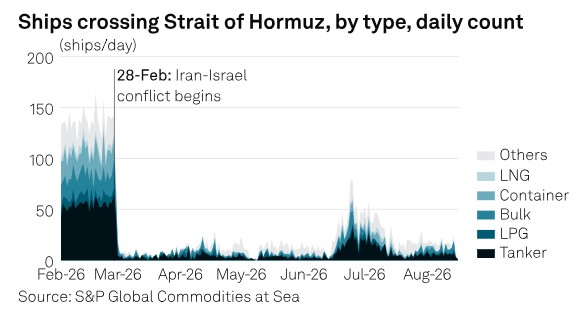
Ship traffic through the Strait of Hormuz fell to a record low on 16 August, with only one vessel crossing the strategic waterway as security concerns intensified following a series of attacks on commercial shipping.
According to S&P Global Commodities at Sea (CAS), Hormuz traffic dropped from eight ships on 15 August to just one ship on 16 August. Traffic through Bab al-Mandab also declined slightly, falling from 40 to 37 vessels over the same period.
The latest figures underline the growing pressure on two of the Middle East’s most important maritime chokepoints, with attacks and security risks continuing to disrupt vessel movements.
Only One Ship Crosses Strait of Hormuz
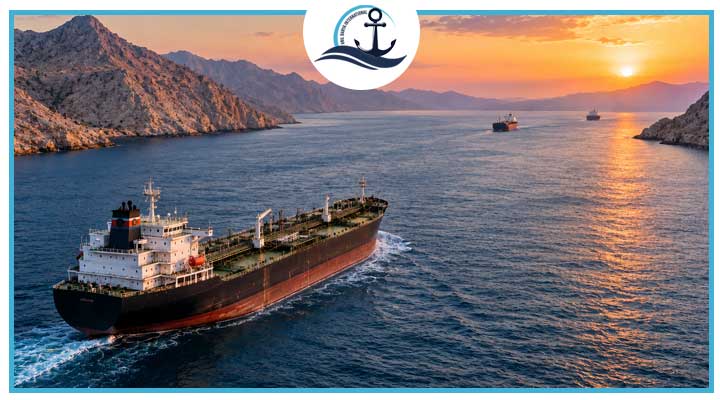
CAS identified the MR tanker Lubna as the only vessel to cross the Strait of Hormuz on 16 August.
The tanker was acquired by Saudi Arabia’s National Chemical Carriers in June.
According to CAS, Lubna travelled inbound from the Gulf of Oman without visible signals. It was last observed off Musandam, Oman, on 17 August, with Mina Saqr in Ras Al Khaimah, UAE, indicated as its destination.
National Chemical Carriers is jointly owned by Bahri and SABIC.
The decline to a single crossing represents a sharp deterioration in traffic through a waterway that normally plays a critical role in global energy and maritime trade.
Ship Attacks Increase Security Concerns
The collapse in vessel traffic comes amid further attacks in the Hormuz area.
The US Navy-backed Joint Maritime Information Center reported three ship attacks in the area during the 72 hours to 16 August.
The UAE Ministry of Foreign Affairs said that an ADNOC-affiliated vessel was targeted on 15 August while transiting the Strait of Hormuz.
That incident followed two other attacks involving ADNOC-affiliated vessels on 14 August and another reported incident on 8 August.
The series of attacks has added to security concerns for shipowners and operators assessing voyages through the region.
Total Crossings Through Blockade Line Decline
Wider vessel movements in the area also weakened.
According to CAS, total crossings through the US naval blockade line fell to 37 ships on 16 August, compared with 53 vessels a day earlier.
The figures indicate that the reduction in activity extends beyond vessels completing full Hormuz transits.
Continued security incidents could complicate vessel scheduling and voyage planning for operators using ports across the Persian Gulf and Gulf of Oman.
Bab al-Mandab Traffic Falls to 37 Ships
Traffic through Bab al-Mandab also declined, although the reduction was considerably smaller than at Hormuz.
CAS recorded 37 vessel movements through the strait on 16 August, down from 40 on 15 August.
Among the vessels transiting the waterway was the Pakistani Aframax tanker Mardan, which sailed southbound through Bab al-Mandab on 16 August after loading Saudi crude at Yanbu two days earlier.
The VLCC He Ping Hai had moved northbound through the strait on 14 August and was potentially heading to load Saudi crude, according to CAS.
These movements remain particularly important as Saudi crude exports from the Red Sea provide an alternative route for energy flows affected by disruption around the Strait of Hormuz.
Hormuz Disruption Adds Pressure to Regional Shipping
The record-low Hormuz traffic highlights the continuing impact of security risks on commercial shipping across the Middle East.
With only one vessel recorded crossing the strait on 16 August, shipowners, charterers and cargo interests face increasing uncertainty over vessel routing, scheduling and exposure to regional maritime risks.
At the same time, continued tanker movements through Bab al-Mandab demonstrate the importance of alternative crude export routes through the Red Sea.
Further disruption at either chokepoint could add additional pressure to tanker operations and regional supply chains.