|
Getting your Trinity Audio player ready...
|
Hull War Insurance Cover Updated as High-Risk Areas Expand
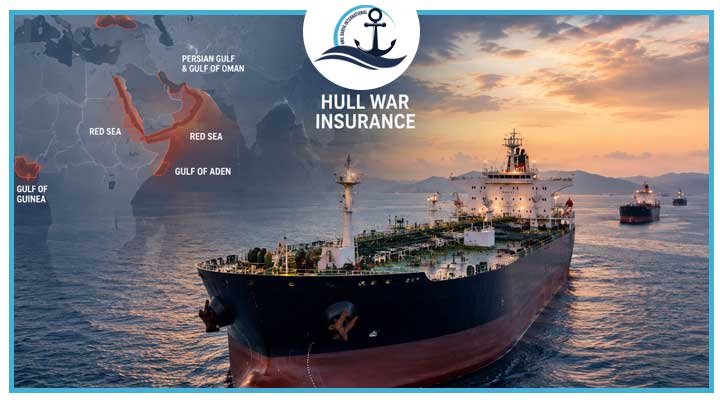
Marine war risk insurers have cancelled and reissued Hull War policies with an updated list of high-risk trading areas, reflecting the deteriorating security environment across the Persian Gulf, Red Sea and several other strategic maritime regions.
The revised cover will take effect from 10 August 2026 and introduces amendments to the Joint War Committee (JWC) Listed Areas used by shipowners, charterers and insurers when assessing voyage risk and insurance requirements.
Escalating Security Risks Prompt Policy Revision
According to the notice, the decision follows the continued deterioration of security conditions in the Persian Gulf and Red Sea, where recent geopolitical tensions have significantly increased operational risks for commercial shipping.
Under the revised arrangements, all existing Hull War policies will be cancelled and immediately reinstated under updated terms. The revised cover incorporates a new list of high-risk trading areas for Hull War, Piracy, Terrorism and Related Perils, ensuring that insurance arrangements reflect the latest security assessment.
Such notices are routinely issued when insurers determine that trading risks have changed sufficiently to justify revised policy conditions.
High-Risk Trading Areas Revised
The updated notice maintains the Persian Gulf and surrounding waterways among the world's principal war risk trading areas while introducing several amendments.
The revised list continues to include:
- Persian/Arabian Gulf
- Gulf of Oman
- Gulf of Aden
- Southern Red Sea
- Indian Ocean risk zone
- Black Sea and Sea of Azov
- Gulf of Guinea
- Cabo Delgado waters
One of the principal amendments extends the Red Sea boundary to waters south of latitude 25.5°N, while Egyptian territorial waters remain excluded.
The updated notice also adds Eritrea to the listed countries and removes Pakistan from the country list, reflecting the latest assessment of regional security conditions.
Broad Geographic Coverage Remains in Place
The revised Joint War Committee Listed Areas continue to cover numerous regions where commercial vessels may face elevated security risks.
Countries across the Middle East—including Iran, Iraq, Saudi Arabia, the United Arab Emirates, Bahrain, Qatar, Oman, Yemen, Israel, Lebanon and Syria—remain within the listed framework.
Outside the Middle East, the notice also continues to include the Black Sea, Sea of Azov, Libya, Nigeria, Somalia, Sudan, Gulf of Guinea, Cabo Delgado, as well as selected offshore areas in Guyana and Venezuela.
Detailed geographical coordinates defining these trading areas have also been updated as part of the revised notice.
What the Changes Mean for Shipowners
The revised listed areas do not prohibit vessels from trading within these regions.
Instead, they provide the framework used by marine insurers when determining whether additional Hull War terms or Additional War Risk Premiums (AWRP) apply to a voyage.
For shipowners and operators, voyages through listed areas may require:
- revised insurance declarations;
- additional war risk premiums;
- updated voyage risk assessments;
- confirmation of charter party obligations;
- closer coordination with insurers before entering designated waters.
The practical impact will vary depending on the vessel, cargo, voyage duration and prevailing security conditions at the time of transit.
Operational Planning May Become More Complex
For operators trading through the Persian Gulf and Red Sea, the updated notice reinforces the importance of voyage planning and risk management.
Shipping companies may need to review routing decisions, insurance arrangements and contractual obligations before fixing cargoes into affected regions.
Charterers could also face higher voyage costs where additional insurance premiums become applicable, particularly for tankers and other vessels regularly operating through strategic energy corridors.
As security conditions continue to evolve, insurers are expected to reassess listed areas whenever regional developments materially alter the level of maritime risk.
War Risk Remains Central to Maritime Operations
The revised Hull War notice highlights how rapidly changing geopolitical conditions continue to influence commercial shipping.
Rather than introducing entirely new risk zones, the latest amendments update the boundaries and country listings used by insurers to assess exposure across some of the world's busiest maritime trade routes.
For shipowners, charterers and marine insurers, the revised cover serves as another reminder that war risk considerations remain an increasingly important part of voyage planning, insurance placement and operational decision-making.