
Break bulk cargo examples from oil, gas and refineries
The five most common break bulk cargoes, then pipe, rigs, turbines, reactors, columns, modules and transformers from oil, gas and refinery projects.
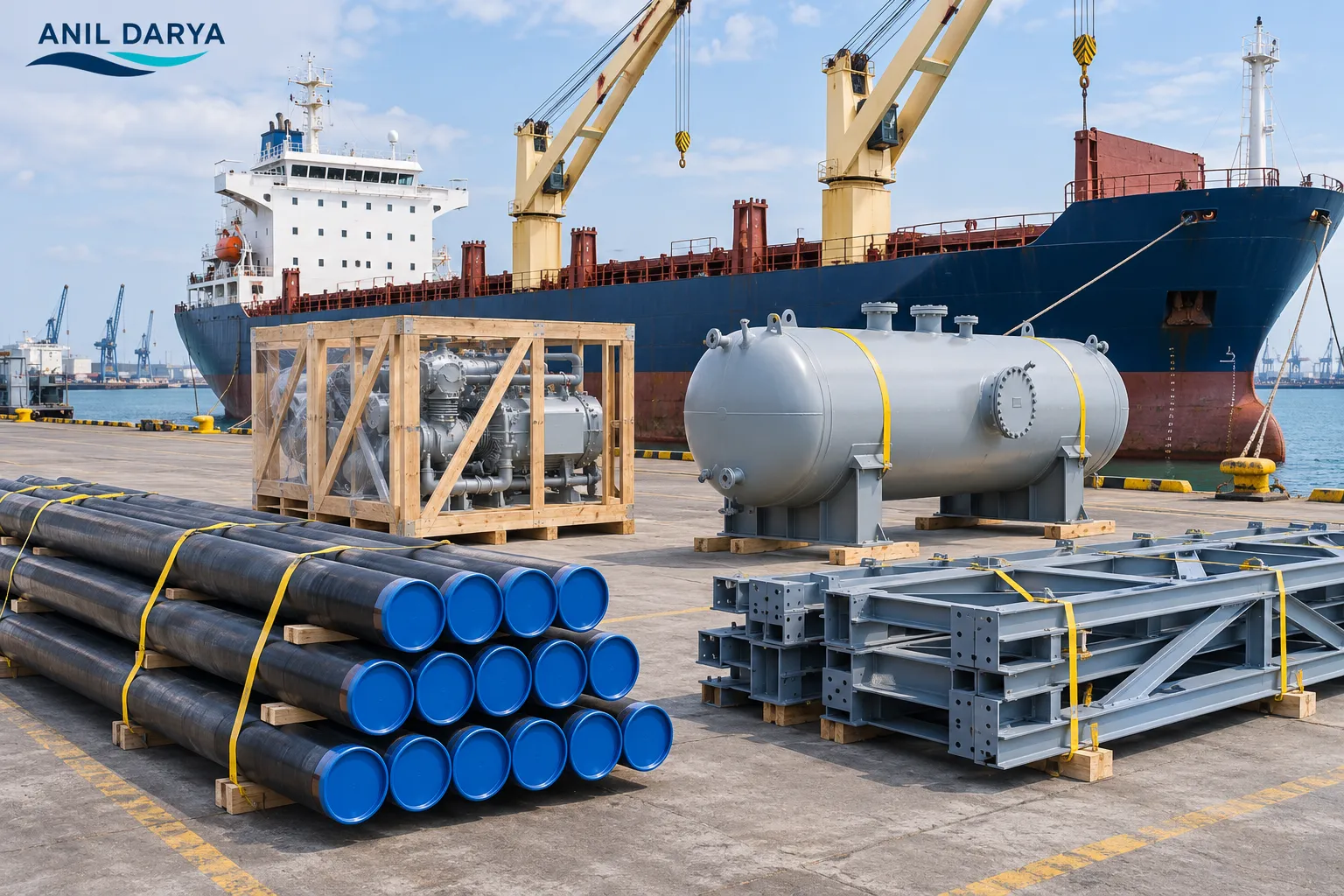
Break bulk cargo examples are easiest to understand by looking at what sits on a quay before loading: steel, timber, bagged goods, vehicles and machinery, each lifted and stowed one piece or one bundle at a time. In oil, gas and refinery work, the list gets heavier and larger: line pipe and casing, rig components, gas turbines, reactors, columns, process modules and transformers. This article starts with the five cargoes most often named as break bulk, then goes through the oil and gas pieces we are asked about, with how each one is usually shipped.
Break bulk cargo examples at a glance
Break bulk, also called general cargo, is freight loaded onto a ship as individually counted units rather than in a standard container. Each unit might be a bundle, a crate, a bag, a drum, a pallet or a single loose piece. It differs from bulk cargo, which is loaded loose into the hold and measured by weight or volume, such as grain, iron ore or crude oil.
Typical break bulk cargo includes:
- Steel coils, plates, beams, rebar and pipe
- Logs, lumber and plywood
- Bagged commodities such as coffee, cocoa, sugar or cement
- Drums and barrels of liquids and chemicals
- Paper reels and cable reels
- Trucks, tractors and construction machinery
- Turbines, generators, transformers and industrial presses
- Prefabricated modules and steel structures
- Rail rolling stock and wind turbine components
If you are unsure where break bulk ends and project cargo begins, our article on explains the difference.
Five commonly shipped break bulk cargoes
Lists from shipping and logistics sources vary, but these five appear again and again.
1. Steel products
Coils, plates, beams, wire rod and pipe. Steel is dense and heavy for its size, so it fills a ship's weight capacity long before its volume. It is stowed directly in the hold on timber dunnage and lashed or chocked to stop it shifting. Rust and handling damage are the main claims risk, which is why a pre-loading survey matters. See our article on the steel cargo pre-loading survey and the bill of lading.
2. Energy and industrial equipment
Turbines, generators, transformers, compressors and large machinery. These are often too heavy or too large for containers and are lifted one piece at a time, sometimes with spreader bars or custom lifting frames. This is the category where break bulk crosses into heavy lift and project cargo.
3. Wood and timber
Logs, sawn lumber and plywood, usually bundled and strapped. Timber is also used on board as dunnage to spread loads and keep other cargo off the steel deck.
4. Bagged goods
Sugar, flour, salt, coffee, cocoa, cement, grain and fertiliser in bags or big bags. Bagged cargo is counted piece by piece, which is what separates it from the same commodity shipped loose as bulk.
5. Vehicles and construction equipment
Trucks, buses, road rollers, bulldozers and cranes. Units that can drive often go on RoRo ships. Tracked or non-running units, and units too heavy for a RoRo ramp, are lifted on as break bulk.
Other common examples include drums and barrels, reels and rolls, rail cars, boats and complete plant components. Our main break bulk shipping service covers all of these from and to Dubai.
Break bulk cargo examples from oil, gas and refineries
Oil and gas projects produce some of the largest and heaviest break bulk pieces in shipping. The table lists the main families, how they usually arrive at the port, and what drives the plan.
| Cargo | How it is presented | Usual ship type | What drives the plan |
|---|---|---|---|
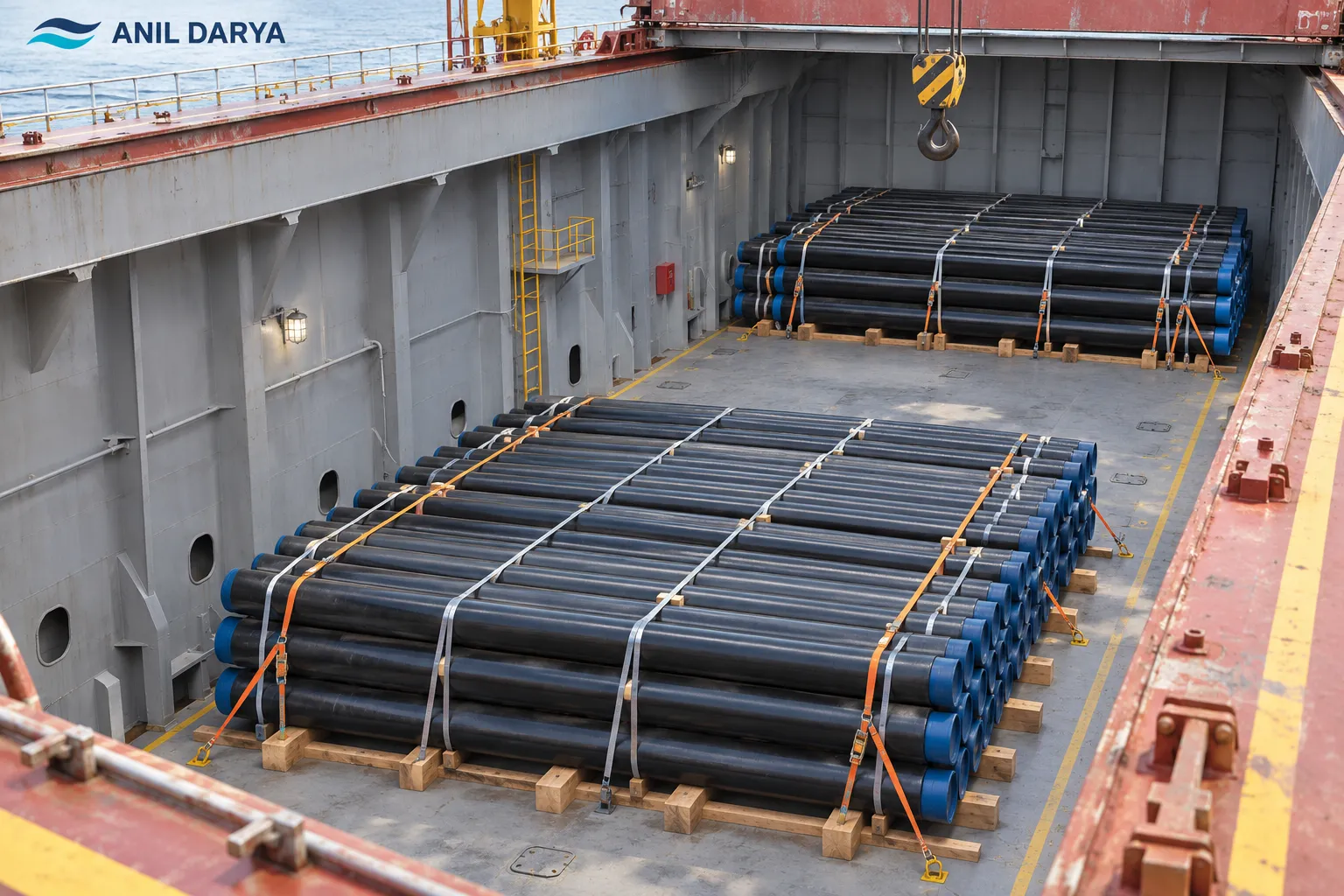
| Line pipe (API 5L) | Bundles or loose joints, often coated | Multipurpose or general cargo ship, in the hold | Protecting coating and pipe ends, stow height |
| Casing and tubing (API 5CT) | Bundled joints with thread protectors | Multipurpose ship, in the hold | Thread protection, bundle count and marking |
| Drill pipe and drill collars | Bundles or racks | Multipurpose ship | Weight per bundle, separation from other cargo |
| Land rig components | Mast sections, substructure, mud pumps, generators, tanks | Multipurpose ship, some pieces on flat racks | Piece tagging, many pieces of very different sizes |
| Gas turbines and compressors | Skid-mounted packages with lift points | Heavy lift ship, under deck where possible | Centre of gravity, preservation, lifting gear |
| Power transformers | Heavy tank, often shipped dry under dry air or nitrogen, oil sent separately | Heavy lift ship | Single-piece weight, road axle loads at destination |
| Reactors and pressure vessels | Long cylinders on saddles | Heavy lift or multipurpose ship, often on deck | Saddles, lifting lugs, discharge port crane capacity |
| Distillation columns | Very long cylinders, sometimes in sections | Heavy lift ship | Length, overhang, stowage on deck |
| Heat exchangers and drums | Heavy shells, sometimes with tube bundles inside | Multipurpose ship or flat rack | Internal securing, nozzle protection |
| Process modules and skids | Pre-assembled steel frames with piping and equipment | Heavy lift or deck carrier | Footprint, height, jetty access at site |
| Storage tank plates and structural steel | Bundled plates, beams and sections | Multipurpose ship | Bundle weight, marking for erection order |
| Cable reels | Large wooden or steel drums | Multipurpose ship or flat rack | Chocking so the reel cannot roll |
| Drums of chemicals and lubricants | Palletised drums | Containers or break bulk | Dangerous goods rules |
A few notes on the main groups.
Casing and tubing are covered by API Specification 5CT, and line pipe by API Specification 5L. Explainers on the product itself are in , and shipping details in .
Turbines, compressors and generators ship as skid packages that need a known centre of gravity and a lift plan. Large transformers are usually shipped without their oil, with the tank charged with dry air or dry nitrogen and the fluid shipped separately. See and .
Marine consultancies such as BMT list reactors and pressure vessels for refineries and petrochemical plants among the cargo they advise on, alongside power generation components. These are the pieces where saddles, lifting lugs and discharge port capacity decide the plan. Our page on goes into detail.
Pre-assembled modules for industrial plants and offshore platforms move as one piece to cut site work. The piece gets larger and the plan gets harder. See .
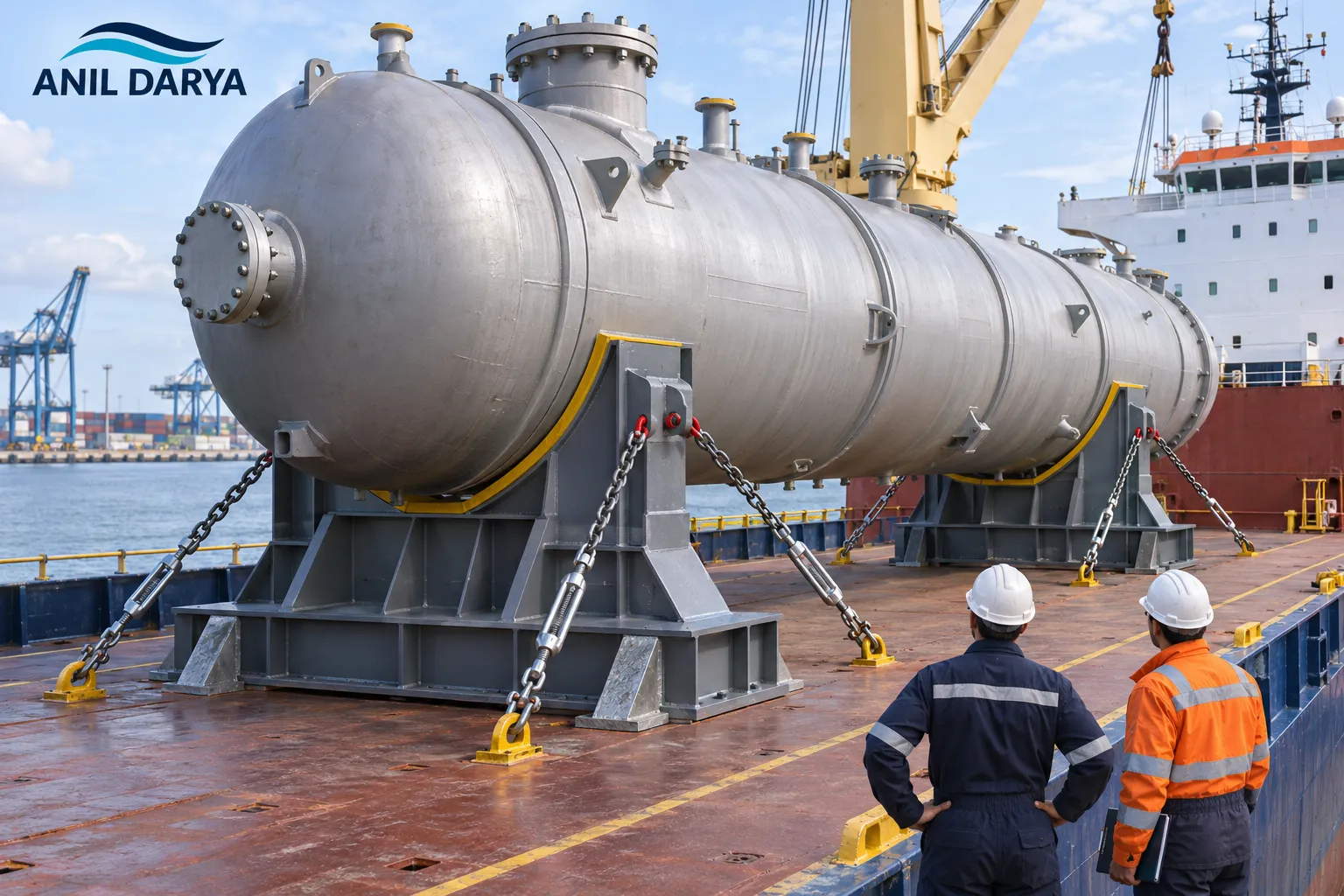
We have shipped cargo for a refinery project in Iraq and parts for a refinery project in Saudi Arabia.
[AMIR-FACT: which of the cargo types in the table above were in the Iraq and Saudi Arabia refinery shipments, the vessel type used, and cleared photos of a real lift]
How these pieces are handled and secured
All break bulk is handled one unit at a time, but the method scales with the piece.
- Ship or shore cranes lift each piece onto a multipurpose, heavy lift or general cargo ship, into the hold or on deck. Heavy or sensitive items may need spreader bars or a custom lifting frame and a written lift plan.
- Heavy, dense cargo such as steel goes low in the hold. Long and tall pieces that do not fit through the hatch go on deck.
- Chains, steel wire, turnbuckles and supports hold the cargo against the ship's motion. For heavy pieces, the forces and lashing are calculated first.
- Route surveys, port capacity, weather and ship stability are all checked before loading.
IMO's Code of Safe Practice for Cargo Stowage and Securing (CSS Code), adopted in 1991, is the international reference for this work, and the people planning stowage are expected to know the ship's Cargo Securing Manual. For the largest moves, an independent marine warranty surveyor reviews the operation; DNV-ST-N001 sets out marine warranty requirements for load-out and voyages.
Most damage to break bulk happens during handling, not at sea. Our article on breakbulk damage prevention lists the common causes and how to avoid them.
Examples that usually go in containers instead
Not every oil and gas item needs break bulk. Valves, instruments, spare parts, gaskets and crated small fittings usually travel in standard containers, which are faster to handle and better protected from weather and theft. Short pipe lengths can also be containerised.
Between the two sit flat racks and open-top containers. They carry wide or tall items that are still light enough for container handling, such as small skids and pipe spools. Our guide to flat rack and open top OOG cargo explains when they work. Chemicals, lubricants and anything with fuel or batteries must also follow the dangerous goods rules covered on our dangerous goods page.
Crude oil itself is not break bulk. It is liquid bulk, carried in tankers. Dry commodities shipped loose, such as sulphur or petroleum coke from a refinery, are dry bulk and fall under our bulk cargo service.
Shipping these cargoes into the UAE, out of Dubai or cross-trade
Oil and gas break bulk moves in all directions through the region. Pipe, valves and refinery equipment arrive at Jebel Ali and other UAE ports for local projects. On arrival we arrange customs clearance, arrange payment of the duty and VAT, and book the heavy haulage contractor to site. Rigs, spares and refurbished equipment leave Dubai for projects abroad, and some cargo is stored in a free zone before re-export, as described in our article on JAFZA re-export of bulk and breakbulk.
Cross-trade shipments go straight from one foreign country to another without touching the UAE. We book with the shipping line, the line's own bill of lading is issued and released through us as agent for the line, and destination clearance is agreed with the consignee's broker before sailing. The overview of all our oil and gas work is on our page.
Free consultation before you ship your pieces
Every list of examples is general. Your own pieces are what matter. Send us the piece list with dimensions and weights, drawings with lift points, the centre of gravity for anything heavy, the packing list, the origin, the destination and your dates.
We sort each item into container, flat rack or break bulk, and reply with the ship types that fit the largest pieces, the surveys and lift planning required, the documents list, the checks to run at the discharge port, and a suggested route: into the UAE, out of Dubai or cross-trade. There is no fee and no obligation. Use the freight rate inquiry form, or read how it works on our page.
Frequently asked questions
What are five commonly shipped break bulk cargoes?
Steel products, energy and industrial equipment, wood and timber, bagged goods, and vehicles and construction equipment. These five appear on most lists of break bulk cargo.
What are examples of break bulk cargo in oil and gas?
Line pipe, casing and tubing, drill pipe, land rig components, gas turbines, compressors, transformers, reactors, pressure vessels, distillation columns, heat exchangers, process modules and structural steel.
Is steel pipe break bulk cargo?
Usually, yes. Pipe is shipped in bundles or loose joints in the hold of a multipurpose or general cargo ship. Short lengths can go in containers.
Is crude oil break bulk?
No. Crude oil is liquid bulk, pumped into tankers and measured by volume or weight. Drums of oil products, on the other hand, are counted units and can travel as break bulk or in containers.
What is an example of project cargo in oil and gas?
A refinery reactor or a gas turbine package bound for a specific plant, with a lift plan, survey and fixed delivery date. It is loaded as break bulk but planned as project cargo.
Can break bulk cargo be shipped in containers?
Wide or tall items that are light enough can travel on flat racks or in open-top containers. Larger and heavier pieces go on multipurpose or heavy lift ships.
What is the difference between bulk and break bulk cargo?
Bulk cargo is loose and unpackaged, loaded directly into the hold, such as grain or ore. Break bulk is made up of individual pieces, bundles or packages that are lifted and secured one by one.
Sources
- Breakbulk cargo: definition, types, handling and examples (Identec Solutions)
- What is breakbulk (IncoDocs)
- Bulk cargo vs break bulk cargo (Ship4wd)
- Break bulk cargo (Wikipedia)
- API Specification 5L, Line Pipe (API)
- API Specification 5CT, Casing and Tubing (API)
- Code of Safe Practice for Cargo Stowage and Securing (IMO)
- DNV-ST-N001 Marine operations and marine warranty (DNV)
- Heavy lift and project cargo advisory (BMT)
- Getting the most from your transformer installation (EC&M)
Reviewed: 16 November 2026