
What is OCTG? Casing, tubing and drill pipe explained for shippers
OCTG means oil country tubular goods: casing, tubing and drill pipe. What each one does, the API 5CT and 5DP standards, and what shippers need to know.
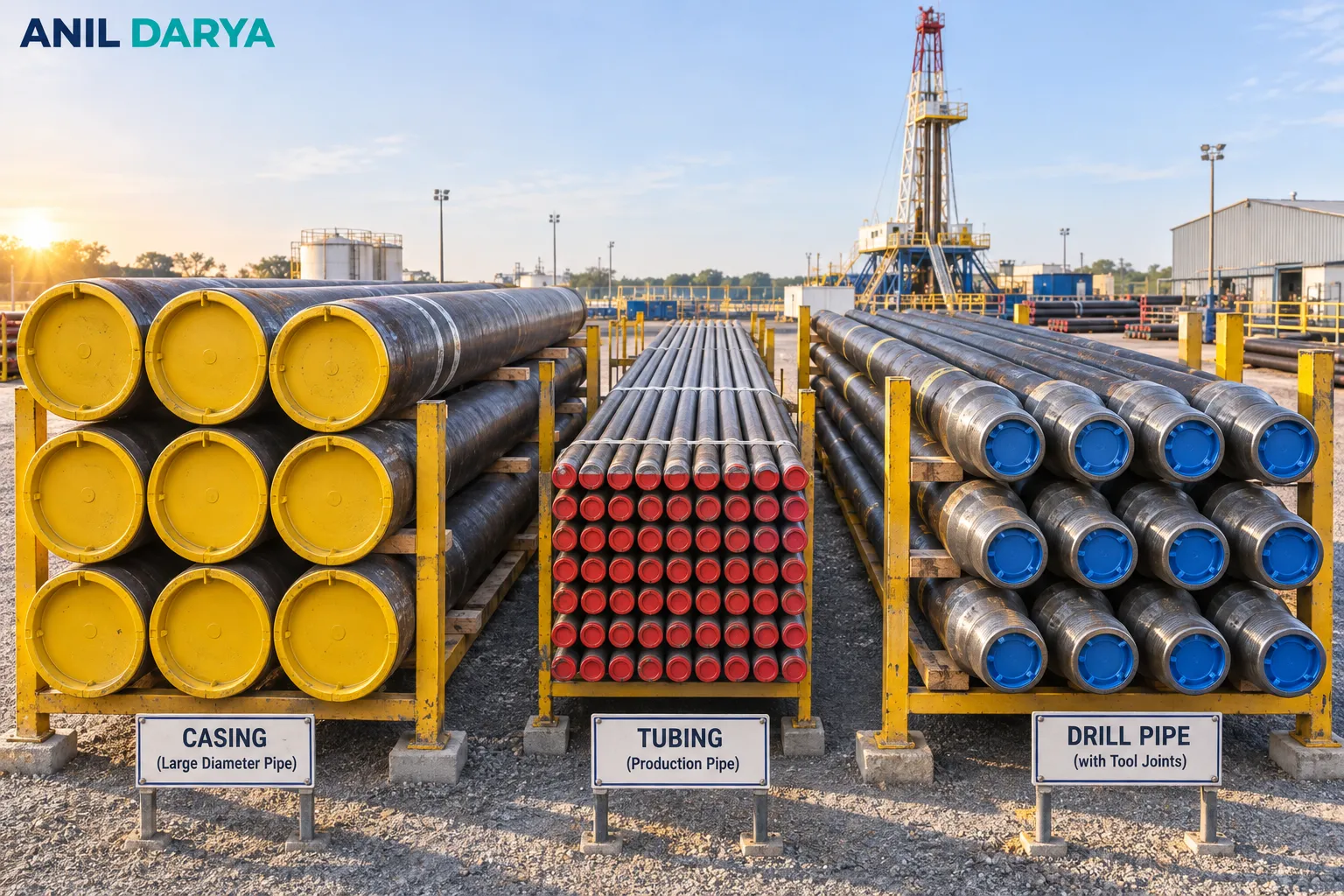
What is OCTG? The letters stand for oil country tubular goods, the steel pipe that goes down an oil or gas well. In most trade and engineering use the term covers three products: casing, tubing and drill pipe. Casing lines the hole, tubing carries the oil or gas up inside the casing, and drill pipe turns the bit while the well is being drilled. This article explains each one, the API standards they are made to, how OCTG differs from line pipe, and what changes when you ship it.
What OCTG is and where the term is used
OCTG is a product family in steel mill catalogues, in purchase orders from drilling contractors and operators, and in customs and trade data.
Definitions are not always identical. Engineering guides usually put casing, tubing and drill pipe together. Some trade definitions are narrower. A 2014 US Federal Register notice defined OCTG for its purposes as hollow steel products of circular cross-section, including oil well casing and tubing, welded or made without a weld seam, with any end finish and whether or not made to API specifications. The same notice excluded drill pipe, unattached couplings and unattached thread protectors from its scope. So when a contract, a customs entry or a supplier quote says "OCTG", check which products it actually means.
Casing, tubing and drill pipe compared
All three are threaded steel tubes, but they do different jobs, live in the well for different lengths of time, and are made to different standards.
| Product | Job in the well | Typical outside diameter | Stays in the well? | Main standard |
|---|---|---|---|---|
| Casing | Lines the borehole, stops it collapsing, isolates formations, supports the wellhead | 4 1/2 in to 20 in | Yes, cemented in place for the life of the well | API 5CT |
| Tubing | Carries oil, gas and fluids from the reservoir to surface inside the casing | 1.050 in to 4 1/2 in | Yes, but can be pulled during a workover | API 5CT |
| Drill pipe | Turns the bit, carries drilling fluid down and lets cuttings return | Various | No, it is reused from well to well | API 5DP |
The diameter ranges above come from the Project Materials OCTG guide, which also notes that tubing joints are about 30 ft long.
Casing
Casing is cemented in place and stays for the life of the well. API describes casing and tubing as the primary and secondary barriers that keep well fluids contained during construction and production. That is why casing failures are treated so seriously, and why buyers specify grade, wall thickness and connection very carefully.
Tubing
Tubing is the smaller pipe hung inside the casing. Produced fluids flow up the tubing, not against the casing wall. It also carries downhole equipment such as packers and pumps. Tubing ends come in non-upset (NUE), external upset (EUE) or integral joint forms. With an upset, the wall is thicker at the end, so the threaded part is stronger.
Drill pipe
Drill pipe is a heavy tube, made without a weld seam, that rotates the bit and carries drilling fluid down the hole. The wermac.org OCTG guide notes it has to handle axial tension, high torque and high internal pressure at the same time. Its ends are tool joints, which carry the threads.
What standards OCTG is made to: API 5CT and API 5DP
API Specification 5CT, Casing and Tubing, is the main standard for casing and tubing. API says its 11th edition sets requirements for steel casing, tubing and pup joints, as well as coupling stock, coupling material and accessory material, including sizes, masses, wall thicknesses, grades and end finishes. API traces it back to its first oilfield equipment standard in the 1920s. The 11th edition added a grade, L80 3Cr, designed for mildly corrosive downhole conditions, and updated the rules on thread protectors and straightness measurement.
API Specification 5DP, Drill Pipe, covers drill pipe. API's notice to its Monogram licensees says the 2nd edition was issued in May 2020 and took effect on 1 November 2020.
Both standards run under the API Monogram programme, where licensed mills can mark product with the API monogram. Many buyers also accept ISO 11960, which the Project Materials guide lists alongside API 5CT for casing and tubing.
Grades
Grades describe the steel's strength and, for some grades, its suitability for sour service. Commonly listed API 5CT grades include H40, J55, K55, N80, L80, C90, T95, P110 and Q125. Drill pipe under API 5DP uses its own grades, often written as E75, X95, G105 and S135. Strength is only part of the choice. API added L80 3Cr for mildly corrosive downhole conditions, so corrosion resistance drives some selections as well.
Connections
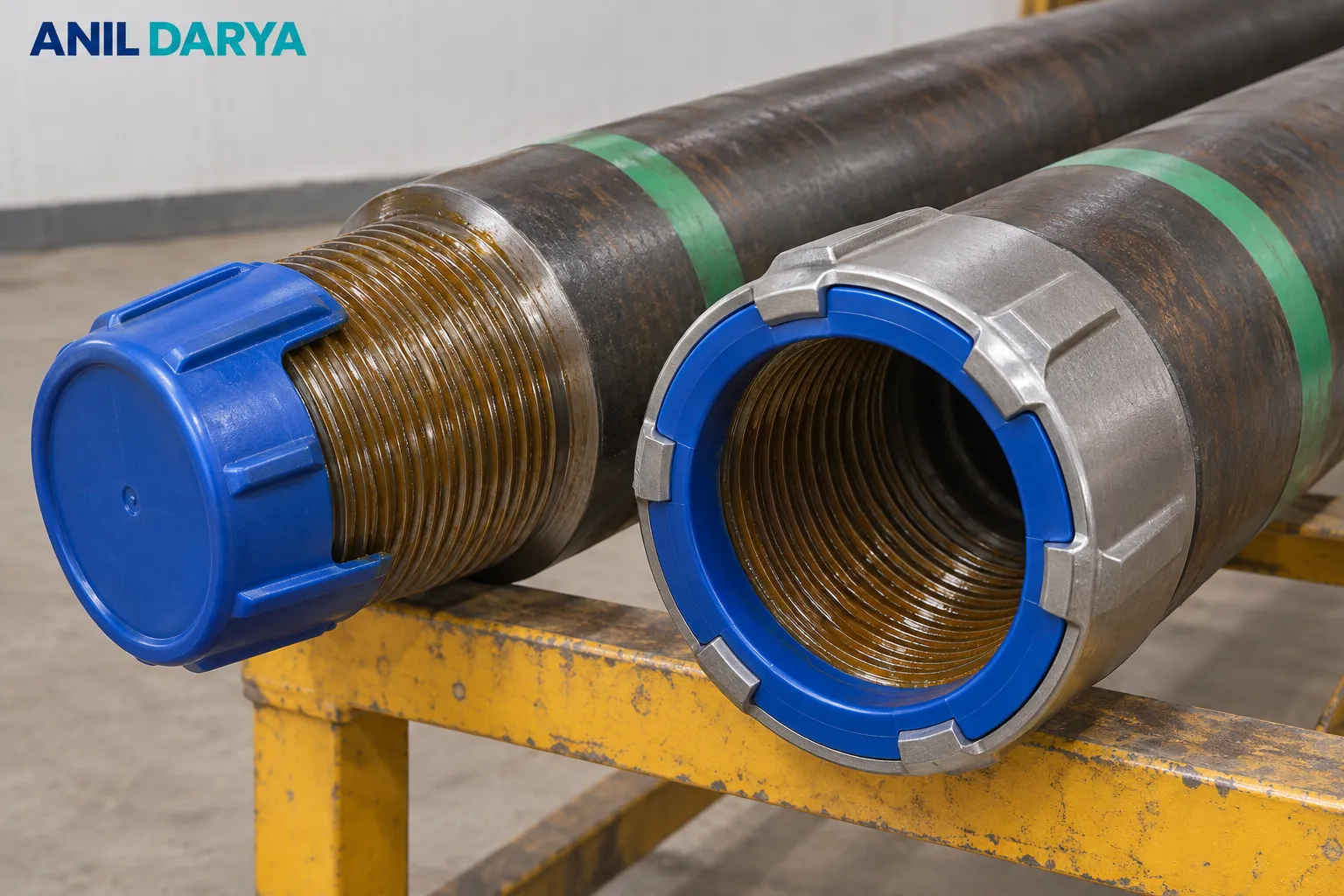
Casing commonly uses short round thread (STC), long round thread (LTC), buttress (BTC) or a proprietary premium connection with a gas-tight seal. Tubing uses NUE, EUE or premium connections. Drill pipe joins through its tool joints. For shipping, the connection type matters because every pin and box thread needs a thread protector that fits it.
OCTG vs line pipe
Line pipe and OCTG are both steel tubes, and both may sit in the same port. They are still different products, and the difference shows up in specifications, testing and handling.
| Point | OCTG (casing and tubing) | Line pipe |
|---|---|---|
| Where it is used | Inside the well | Pipelines that move oil, gas or water between facilities |
| Main standard | API 5CT | API 5L |
| How lengths join | Threaded connections and couplings | Welded in the field, ends are bevelled |
| Weak point in transit | Threads and thread protectors | Bevels and external coating |
If you are moving line pipe, our page covers coating and bevel protection in detail. Read it alongside this one rather than instead of it.
What is different about shipping OCTG
OCTG is high-value pipe with machined threads at both ends. That changes how it is packed, lifted and checked, compared with plain structural pipe.
Thread protectors stay on
Every joint should leave the mill with pin and box protectors fitted and tight. The German insurers' Transport Information Service (TIS) notes that pipes with threads or chamfers get plastic or metal end caps. A missing protector is noted at the pre-loading check and replaced before the joint is lifted.
Bundles or loose joints
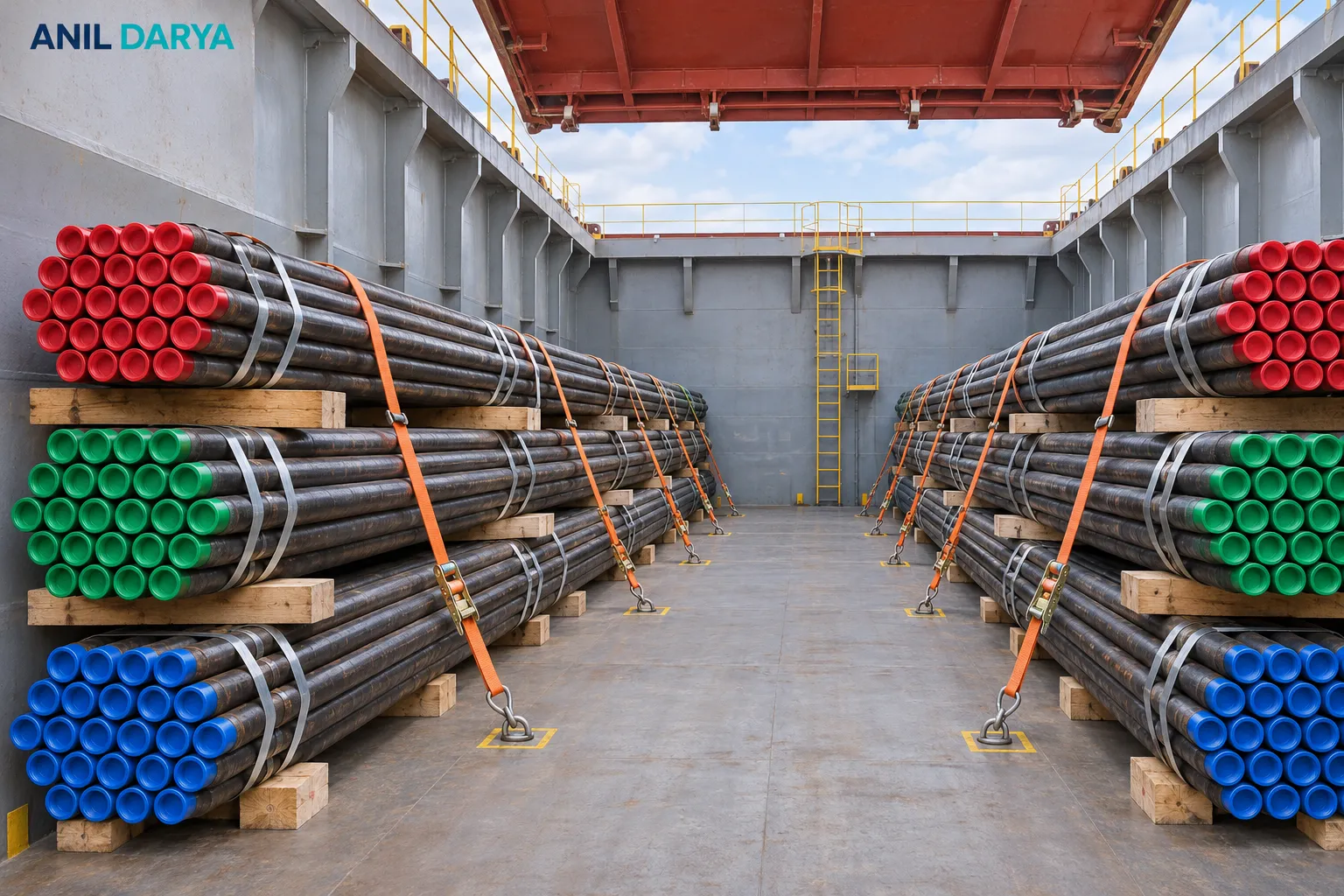
Smaller tubing and casing usually ships in strapped bundles. TIS says strapping should be tight enough that the pipes cannot rub against each other. Larger casing can travel as loose joints. Each joint or bundle carries marking for size, grade and heat number so it can be matched to the mill certificate at the other end.
Keep it dry
TIS states that steel begins to corrode at 40 percent relative humidity and that corrosion speeds up sharply above 60 percent. Threads with rust or pitting may be rejected at the rig, so OCTG is handled in dry weather or under cover. It goes into clean, dry holds or containers.
Break bulk or containers
Small lots of tubing and casing often travel in containers or on flat racks. A drilling campaign with thousands of joints, or long casing that does not fit a box, usually goes break bulk in the hold of a multipurpose ship. The detailed stowage, lashing and survey steps belong to the shipping side, and we cover them on our steel pipe page and in our article on the pre-loading survey for steel cargo and the bill of lading.
Both directions apply. Anil Darya ships OCTG into the UAE through Jebel Ali and other UAE ports, out of Dubai for drilling projects abroad, and as cross-trade from the mill's country to the field's. On a cross-trade the shipping line's B/L is released to you through us as agent for the line, and destination clearance is agreed with the consignee's broker before shipping. More on how we handle steel and other non-containerised cargo is on our break bulk service page and in break bulk damage prevention.
[AMIR-FACT: OCTG or drill pipe shipments we can mention without client names, with product type, trade lane and vessel or container type]
Free OCTG shipping consultation
If you are buying casing or tubing from a mill, or moving drill pipe from one field to another, send us the pipe list before you agree the Incoterm. Include sizes, grades, connection types, joint count, weight per joint, total tonnage, whether it is bundled or loose, the mill or yard, the destination and the ready date.
Our specialists answer straight away by email, and arrange a meeting in person if the project needs it. We come back with the best way to ship that lot, container, flat rack or break bulk, the checks on thread protectors and marking at loading, the documents the destination needs, the points to confirm at the discharge port, and a suggested route into the UAE, out of Dubai or as cross-trade. You can also send the list through our freight rate inquiry form or the contact page.
Frequently asked questions
What does OCTG stand for?
Oil country tubular goods. It is the steel pipe used to drill, line and produce oil and gas wells.
What is OCTG in oil and gas?
It is the family of downhole pipe: casing that lines the well, tubing that carries production to surface, and drill pipe used while drilling. Some trade definitions count only casing and tubing.
What is the difference between casing and tubing?
Casing is the larger pipe cemented into the borehole to hold it open and isolate the rock. Tubing is the smaller pipe hung inside the casing that carries oil or gas to surface and can be pulled out later.
Is drill pipe part of OCTG?
In engineering use, yes. In some trade and customs definitions, no. The 2014 US Federal Register scope for OCTG, for example, excluded drill pipe. Check the definition in your contract.
What is API 5CT?
API Specification 5CT, Casing and Tubing, is the American Petroleum Institute standard for steel casing, tubing, pup joints and coupling stock. API has published its 11th edition.
What is the difference between OCTG and line pipe?
OCTG goes inside the well and joins with threads. Line pipe carries oil, gas or water between facilities, is made to API 5L and is welded in the field.
What are common OCTG grades?
For casing and tubing under API 5CT, common grades include J55, K55, N80, L80 and P110, among others. Drill pipe under API 5DP uses grades such as E75, X95, G105 and S135.
How is OCTG shipped?
In strapped bundles or as loose joints with thread protectors on both ends, kept dry. Small lots go in containers or on flat racks, and large drilling campaigns usually go break bulk in the hold of a multipurpose ship.
Sources
- API: New edition of Spec 5CT, Casing and Tubing
- API Monogram Program: API 5DP Drill Pipe, 2nd edition notice (June 2020)
- US Federal Register, 18 July 2014: Certain oil country tubular goods, scope definition
- Project Materials: OCTG pipes, API 5CT casing and tubing guide
- Wermac: What are OCTG tubular products?
- Cortec Steel: Line pipe vs OCTG
- TIS (German Insurance Association): Steel pipes
Reviewed: 16 November 2026