
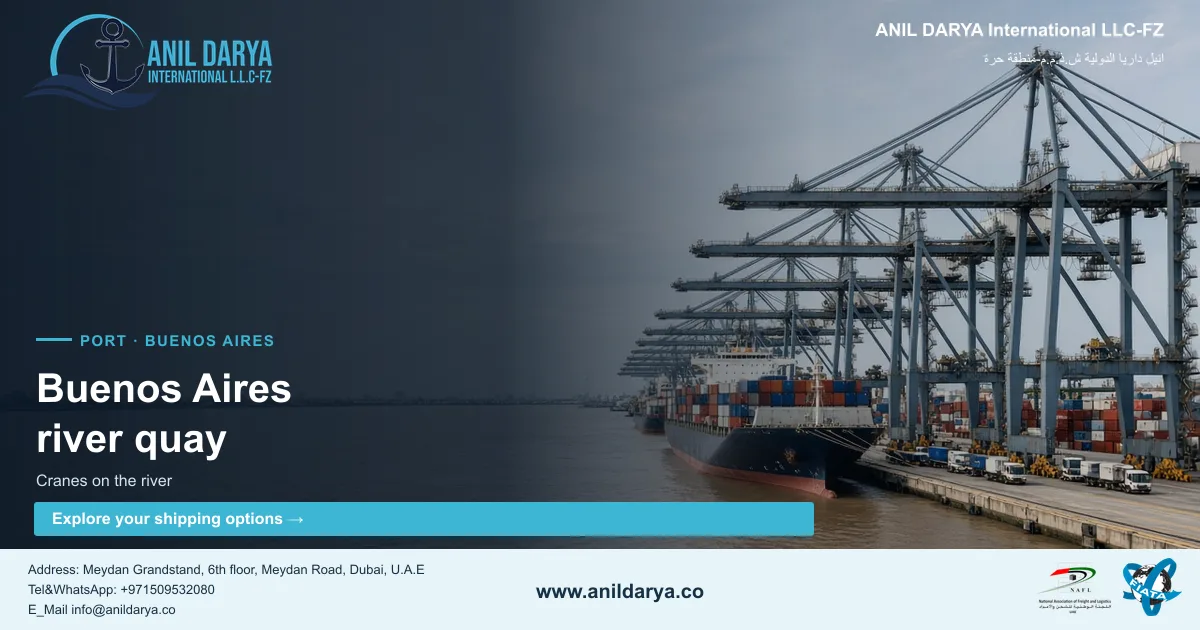
Port of Buenos Aires shipping covers most of the containers that enter Argentina. The port sits on the Rio de la Plata inside the city, with the Puerto Nuevo container terminals to the north and Dock Sud, a separate port in Avellaneda, just to the south. This guide covers the terminals, depths, cargo types, dangerous goods rules, customs at the port, the Zarate and Campana alternatives, and how we ship your cargo there from Dubai. We ship both ways: from Dubai to Buenos Aires, and from Buenos Aires to Dubai with UAE clearance on arrival.
Port of Buenos Aires shipping: key facts at a glance
| Item | Detail |
|---|---|
| UN/LOCODE | ARBUE (Buenos Aires); ARDKS (Dock Sud) |
| Location | Retiro, Buenos Aires, on the right bank of the Rio de la Plata; Dock Sud in Avellaneda, Buenos Aires Province |
| Port authority | National port authority: long run by the Administracion General de Puertos (AGP); Spanish-language sources now name the Agencia Nacional de Puertos y Navegacion (ANPYN). Dock Sud belongs to the Province of Buenos Aires |
| Customs | General Customs Directorate (DGA), part of ARCA |
| Container terminals, Puerto Nuevo | Terminals 1 to 3 (DP World TRP), Terminal 4 (APM Terminals), Terminal 5 (BACTSSA, Hutchison Ports) |
| Container terminal, Dock Sud | Exolgan |
| Containers handled, 2024 | Buenos Aires 675,232 TEU and Dock Sud 434,196 TEU, January to November |
| Maximum depth | About 10.1 m for containers, breakbulk and ro-ro (Find a Port); Terminal 4 lists a 10.3 m draft |
| Puerto Nuevo layout | Five basins (A to E) for overseas traffic and one (F) for coastal shipping |
| Cargo types | Containers (dry and reefer), breakbulk, project cargo, ro-ro, liquid bulk and gas at Dock Sud, cruise passengers |
| Nearest cargo airport | Ministro Pistarini, Ezeiza (EZE), about 38 km away |
| Buenos Aires to Dubai | Export declaration filed in ARCA's SIM by the shipper's despachante; UAE declaration to Dubai Customs, duty 5% of CIF for most goods plus 5% import VAT |
| Alternatives up river | Zarate (vehicles, ro-ro, containers) and Campana |
Where is the Port of Buenos Aires and how is it laid out?
The port is at Km 0 of the River Plate channel system, on the right bank of the river, inside the city. It has two parts. Puerto Nuevo, reached by the North Access Channel, holds the main container terminals. The south side, reached by the South Access Channel, includes Dock Sud, which is owned by the Province of Buenos Aires and handles its own container, fuel and gas traffic.
Ships reach the port through a long dredged channel. APM Terminals describes the access route as running from km 37 to km 12 (Port of Buenos Aires channel) and from km 12 to km 0 (North Channel), with a tidal range of 0.60 m and a maximum estimate of 1.05 m. A low tidal range means the draft limit hardly changes through the day, so the depth on the booking is the depth you plan around.
Depth is the main limit here. Find a Port lists a maximum of 10.1 m for containers, breakbulk, passengers and ro-ro, 10.0 m for products and gas, and 8.8 m for chemicals. Large container ships often call part-loaded, which is one reason cargo from the Gulf is transshipped before it arrives.
Which terminals handle containers at the Port of Buenos Aires?
Your carrier's service decides the terminal. The arrival notice names it, and the gate, the appointment system and the storage tariff all follow from that.
| Terminal | Operator | Key facts |
|---|---|---|
| Terminals 1, 2 and 3 (TRP), Basins A, B and part of C | DP World | 430,000 m2 operational area, described by DP World as Argentina's largest container terminal; reefer, IMDG and out-of-gauge handling; on-dock and off-dock CFS; rail connection; also runs the Quinquela Martin cruise terminal |
| Terminal 4, part of Basin C | APM Terminals | 2 berths, up to 495 m; 10.3 m draft; vessels up to 370 m LOA; 5 mobile cranes; 6 RTGs; 16 ha; 850,000 TEU capacity; 600 reefer plugs; 3,558 m2 bonded warehouse; 450 m of on-dock rail |
| Terminal 5, part of Basin D | BACTSSA (Hutchison Ports) | 2 container berths of 695 m plus a 190 m feeder berth; 10.0 m draft; fiscal and non-fiscal storage; national rail link |
| Exolgan, Dock Sud | Exolgan | 500,000 m2 operational area; 3 berths for container ships up to 300 m and a feeder berth; 1,308 reefer slots; 13,500 m2 container freight station; port rail terminal |
Terminal 4 figures come from APM Terminals. The Terminal 5 and Exolgan figures come from a local ship agency's port guide, because we could not open the operators' own pages, so confirm them with the terminal before you plan around them. Terminal operators at Puerto Nuevo work under concessions, and Spanish-language sources list a further terminal as being tendered. Check the operator named on your booking rather than relying on any list.
Other berths in the port
Not every berth is a container terminal. The AGP public berth at Dock E North takes mainly rail cargo plus general, project and oil cargo, with a 480 m pier and a 10 m draft. Dock Sud has fuel, gas and petroleum product berths along its channel, and a public section for general, project and bulk fertiliser cargo. Cruise ships use the Quinquela Martin terminal.
What cargo can you ship through the Port of Buenos Aires?
| Cargo type | Where it usually goes | What to plan |
|---|---|---|
| General goods, FCL | Puerto Nuevo terminals or Exolgan | Terminal on the booking, free time, truck appointment |
| LCL | Bonded CFS at the terminal or an off-dock bonded warehouse | Consolidator's documents, unpacking time |
| Chilled and frozen food | Reefer plugs at TRP, Terminal 4 or Exolgan | Set temperature, SENASA requirements |
| Machinery and steel | Flat racks at container terminals, or breakbulk at public berths | Lifting points, lashing, road permits |
| Vehicles | Mostly Zarate (ro-ro); some in containers | Check import rules first; used cars are restricted |
| Dangerous goods | Container terminals that accept the class | Customs authorisation before arrival for Class 1 and 7 |
| Fuels and gas | Dock Sud product berths | Receiving facility and discharge plan |
FCL and LCL shipping through Buenos Aires port terminals
- FCL (full container load). You book a whole 20ft, 40ft or 40ft high cube. The box stays sealed from the UAE through the transshipment port to Buenos Aires.
- LCL (less than container load). Your cargo shares a box with other shippers and is unpacked in a bonded warehouse after discharge. DP World lists on-dock and off-dock CFS at TRP, and APM Terminals offers stuffing and stripping at Terminal 4.
With LCL, your release depends on the consolidator's paperwork as well as your own, and Argentine customs checks each consignment. On a lane with one or two transshipments, FCL often pays off at lower volumes than you would expect. Our guide to FCL vs LCL costs shows the maths, and our sea freight service page explains what we book.
Breakbulk, project cargo and vehicles at Buenos Aires
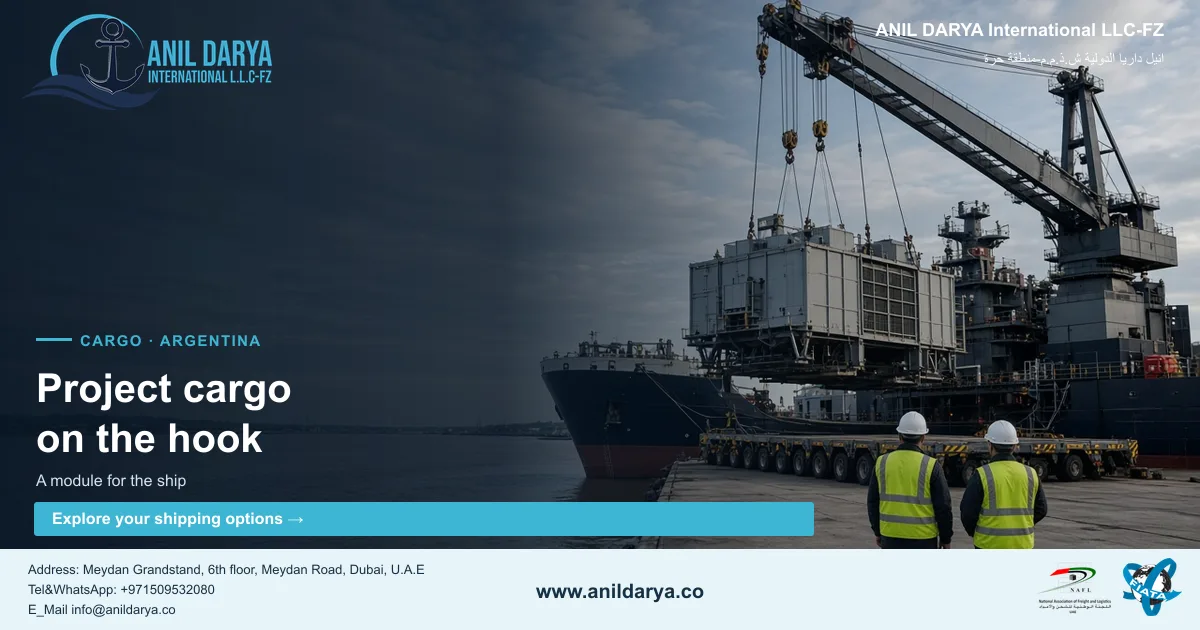
Project cargo that fits a flat rack or open top moves through the container terminals. DP World lists out-of-gauge handling at TRP, and the AGP public berth at Dock E North takes general and project cargo. Cargo that needs a heavy-lift ship also has to respect the river depth, so the vessel type and its draft need checking early.
A decision rule we use: if a piece fits a 40ft flat rack by size and weight, book it on the container network, which has more sailings to Buenos Aires. If it does not, the breakbulk sailing drives the plan, and the discharge port may be Buenos Aires, Zarate or another river port depending on the vessel and the consignee's site. Our article on flat rack, open top and breakbulk cargo explains the options, and our break bulk and project cargo service covers what we plan from the UAE side.
Vehicles mostly arrive at Zarate rather than Buenos Aires. Check the import rules before shipping any car: the US Commercial Service guide updated in August 2025 lists used cars as prohibited.
Dangerous goods at the Port of Buenos Aires
DP World lists IMDG handling among its yard services at TRP. All DG cargo must be packed, marked and declared under the IMDG Code, and each carrier on the routing, including the feeder from the transshipment hub, must accept it.
APM Terminals sets a clear rule at Terminal 4 for the most sensitive classes. For IMO Class 1 (explosives) and Class 7 (radioactive) cargo, the consignee or its broker must obtain an IC05 or TLMD authorisation from customs and hand it to the terminal's customer service before the vessel arrives. If it is not submitted in time, the container will not be landed. Check the rules for other classes with the terminal on your booking.
What you need for any DG booking:
- UN number, proper shipping name, class and packing group.
- Safety data sheet for each product.
- Signed dangerous goods declaration.
- UN-approved packaging, labels and container placards.
- Customs authorisation in Argentina before arrival for Class 1 and 7.
Our dangerous goods shipping team handles the UAE side and gets carrier acceptance, and our guide to dangerous goods classes explains what each class means for shipping.
Customs clearance at the Port of Buenos Aires
Customs at the port is run by the General Customs Directorate (DGA), part of ARCA, the agency that replaced AFIP under Decree 953/2024. The importer or its customs broker files the import declaration in ARCA's SIM system. Since DNU 70/2023 the importer can file for its own account or through an authorised person, but most use a despachante de aduana (customs broker). We work with the consignee's broker or a clearing agent in Argentina.
Documents needed at the port
The US Commercial Service guide lists these for every sea shipment: a commercial invoice in Spanish (original and three copies, each signed in ink, dated before the bill of lading), a bill of lading showing weight and volume per package, a packing list and, if bought by the exporter, an insurance certificate. A certificate of origin is needed for goods such as textiles, footwear and other consumer goods, and for any goods under anti-dumping duties.
Rules that changed recently
| Date | Change |
|---|---|
| 26 February 2025 | SEDI statistical import declaration eliminated (General Resolution 5651/2025) |
| April 2025 | Import licensing system fully eliminated, according to the US Commercial Service |
| 1 January 2025 to 31 December 2027 | Statistics fee kept at 3% on definitive imports (Decree 1140/2024) |
Import VAT is 21% for most goods under article 28 of the VAT law, and import duty follows the Mercosur nomenclature on the CIF value.
Inspection and release at the terminal
At Terminal 4, customs inspections are carried out one day and the import delivery can follow the next day. Inspections or deliveries cancelled after 3:00 p.m. on the previous day are charged as if they had happened. To collect a container, the truck needs a full gate pass stamped and signed by customs, showing the truck and trailer plates and the driver's name and ID, with no corrections. The importer also needs a "free debt" certificate from the terminal and a copy of the customs clearance cover. Truck appointments are booked through the terminal's Digital Port platform, which runs 24 hours a day.
Moving cargo out of the port: trucks, rail and bonded storage
Most import containers leave the Port of Buenos Aires by truck on a booked appointment. Because the terminals sit inside the city, the appointment window matters: a truck that misses its slot waits for a new one, and storage keeps running in the meantime.
Rail is a real option here. APM Terminals says Terminal 4 has 450 m of on-dock track connected directly to its RTG cranes, so containers move between train and stack without an internal truck move, and it describes itself as the only terminal in the port with this access. DP World lists rail connectivity at TRP, and Terminal 5 is connected to the national rail network. For cargo going far inland, ask the consignee whether a rail leg from the terminal makes sense.
Bonded storage gives you time when clearance is slow. Terminal 4 has a 3,558 m2 bonded warehouse, TRP offers covered warehouses and container stack storage, and Terminal 5 offers fiscal and non-fiscal storage. A simple rule: if the consignee cannot clear within the carrier's free time, moving the cargo into bonded storage can cost less than paying demurrage on the box. Check both tariffs before you decide.
| Your consignee | Usual exit from the port | What to check |
|---|---|---|
| In the city or Greater Buenos Aires | Truck from the terminal | Appointment slot, gate pass, city access times |
| Far inland | Rail from Terminal 4, TRP or Terminal 5, or truck | Rail connection at your terminal, transit bond |
| Not ready to clear | Bonded storage at or near the terminal | Storage tariff against the carrier's free time |
| LCL cargo | Collected from the CFS after unpacking | Consolidator's release and CFS charges |
Zarate and Campana: when to use them instead
Zarate and Campana are river ports on the Parana, north of Buenos Aires. Zarate is the main vehicle and ro-ro gateway for Argentina and also takes containers. Terminal Zarate describes itself as a privately funded port terminal and is part of Grupo Murchison.
| Port | Containers 2024 (period) | Best for |
|---|---|---|
| Buenos Aires | 675,232 TEU (January to November) | Most containers and LCL for the capital region |
| Dock Sud | 434,196 TEU (January to November) | Containers for the south of Greater Buenos Aires; fuels and gas |
| Zarate | 79,787 TEU (January to September) | Vehicles, ro-ro, containers for industry north of the capital |
| Campana | 2,068 TEU (January to September) | Industrial cargo near Campana |
| Bahia Blanca | 7,555 TEU (January to October) | Petrochemicals and energy project cargo for the south |
Pick Zarate when the cargo is a vehicle or ro-ro unit, or when the consignee is closer to it and a carrier quotes a through rate. For general containers, Buenos Aires and Dock Sud give you far more sailings.
How to ship from Dubai to the Port of Buenos Aires
Shipping from Dubai to Buenos Aires means a transshipped routing. No direct sailing appears in the schedule data we checked.
| Published routing (November 2026) | Transit | Transfers | Frequency |
|---|---|---|---|
| Jebel Ali to Buenos Aires, CMA CGM | 43 days 18 hours | 2 | Every 2 to 4 weeks |
| Khor Fakkan to Buenos Aires, Hapag-Lloyd | 48 days 7 hours | 1 | Every 1 to 2 weeks |
| Air: DWC to Ezeiza, Emirates freighter | 22 hours 46 minutes | Direct | 2 to 4 times a week |
These figures are from Fluent Cargo's schedule data and are port to port. Check the estimated arrival on your booking.
[AMIR-FACT: the carriers and transshipment hubs we actually use from Jebel Ali to Buenos Aires or Dock Sud, and our typical port-to-port days]
Here is how we handle it:
- Send us the cargo details: goods, HS codes, weight, volume or dimensions, and the consignee's address in Argentina.
- Ask your buyer to confirm the NCM code, duty, any SENASA or ANMAT rule, and its customs broker.
- We compare carriers and routings from Jebel Ali or Khor Fakkan and confirm which Buenos Aires terminal each uses.
- We book space. For DG, reefer or out-of-gauge cargo we get acceptance for every leg first.
- We check the Spanish invoice, packing list, certificate of origin and bill of lading data so they match line by line.
- We arrange trucking to the UAE port, the export declaration, loading and sealing. See our Jebel Ali port guide for the UAE side.
- We send the documents and arrival notice to the consignee's broker before the vessel reaches Buenos Aires, including any Class 1 or 7 authorisation request.
- The broker files the declaration, taxes are paid, the terminal releases the container and it is delivered.
How to ship from the Port of Buenos Aires to Dubai
We also handle the other direction: shipping from Buenos Aires to Dubai, with arrival at Jebel Ali, Khalifa Port or Sharjah port. We book the space with the carrier and run the UAE side. The Argentine export papers stay with the shipper or its Argentine customs broker.
The Argentine export side
- Export declaration. A registered despachante de aduana files it for the exporter in ARCA's Sistema Informatico MALVINA (SIM). The system produces form OM-1993-A SIM, also called the permiso de embarque.
- Registration number. Once the broker makes the declaration official, SIM gives it a number. That number is used to track the shipment and to pay any export duty.
- Validity. The declaration is valid for 31 calendar days from registration, so plan the booking and loading inside that window.
- Terminal gate. At Terminal 4, export trucks first pass the CTVP site to get the gate pass stamped. Customs tells the driver at the gate if the box must be scanned, and a skipped scan means extra moves paid by the exporter. Export appointments go through Digital Port.
The UAE import side
On arrival in Dubai, the declaration goes to Dubai Customs with the commercial invoice, the packing list, a certificate of origin and any permit for restricted goods. The carrier releases the cargo against the original or released bill of lading. Customs duty in Dubai is 5% of the CIF value for most goods, with 50% on alcohol and 100% on cigarettes. Import VAT is 5%, and a VAT-registered importer accounts for it on its VAT return under the reverse charge.
- Send us the shipper's details in Argentina, the cargo, the HS code and the UAE delivery address.
- We book space from Buenos Aires or Dock Sud and send the booking and cut-offs to the shipper.
- The shipper or its trucker collects the empty, loads it and delivers it to the terminal inside its appointment.
- The shipper's despachante files the export declaration in SIM.
- We check the draft bill of lading against the invoice and packing list.
- We file the UAE declaration before the vessel arrives.
- We arrange payment of the duty and VAT and collect the delivery order.
- We truck the box to your site and return the empty inside free time.
[AMIR-FACT: the carriers and hubs we actually use from Buenos Aires or Dock Sud to Jebel Ali, Khalifa Port or Sharjah, and our real port-to-port transit days in this direction]
Free time, storage and demurrage at Buenos Aires
Two clocks run once the box is discharged: the terminal's storage tariff and the carrier's free time on the container. Both differ by terminal, carrier and container type, so read them on your quote and arrival notice. Argentine clearance can take time when an inspection is ordered, so ask for extra free time at booking on cargo likely to be inspected. Our article on demurrage and detention shows how the charges build up.
Checklist before you ship to Buenos Aires
- Importer's CUIT on the invoice and bill of lading.
- Spanish invoice, original plus three copies, signed in ink.
- NCM code, duty and VAT rate confirmed by the broker.
- Certificate of origin if the goods need one.
- SENASA, ANMAT or product certification in place where needed.
- Terminal on the booking known and the broker told.
- DG acceptance for every leg, and Class 1 or 7 authorisation filed before arrival.
- Vessel draft checked for breakbulk or heavy-lift cargo.
- Free time known and clearance planned before it ends.
Common mistakes at the Port of Buenos Aires
- Shipping DG Class 1 or 7 without the customs authorisation. The container is not landed.
- Cancelling an inspection or delivery late. After 3:00 p.m. the day before, it is charged anyway at Terminal 4.
- A gate pass with corrections or missing truck details. The truck is turned away.
- English-only invoices. Clearance waits for a correct Spanish original.
- Booking a large breakbulk ship without checking the river draft.
- Sending a vehicle to Buenos Aires when the carrier's ro-ro service calls at Zarate.
- Following an old guide that still mentions SEDI or import licences.
Frequently asked questions
What is the port code for Buenos Aires?
The UN/LOCODE for the Port of Buenos Aires is ARBUE. Dock Sud, the separate port just south of it, uses ARDKS.
Who operates the container terminals at the Port of Buenos Aires?
At Puerto Nuevo, DP World runs Terminals 1 to 3 (TRP), APM Terminals runs Terminal 4 and BACTSSA (Hutchison Ports) runs Terminal 5. Exolgan runs the container terminal at Dock Sud. Check the terminal on your booking.
How deep is the water at the Port of Buenos Aires?
Find a Port lists a maximum depth of about 10.1 m for containers, breakbulk and ro-ro. APM Terminals lists a 10.3 m draft at Terminal 4, and other terminals list about 10 m.
How many containers does the Port of Buenos Aires handle?
Official figures compiled by Argenports show 675,232 TEU at the Buenos Aires terminals and 434,196 TEU at Dock Sud from January to November 2024.
What is the difference between Buenos Aires port and Dock Sud?
Puerto Nuevo is the city's port, under the national port authority. Dock Sud is a separate port in Avellaneda owned by the Province of Buenos Aires, with the Exolgan container terminal and fuel and gas berths.
How long does shipping from Dubai to Buenos Aires take?
Published schedule data shows about 44 days from Jebel Ali with two transfers and about 48 days from Khor Fakkan with one transfer. Air freight from Al Maktoum to Ezeiza takes about 23 hours.
Can you handle shipping from Buenos Aires to Dubai?
Yes. We book the space, check the bill of lading and clear the cargo in Dubai. The shipper's Argentine broker files the export declaration in ARCA's SIM. In Dubai, duty is 5% of CIF for most goods, plus 5% import VAT.
Can I ship dangerous goods to Buenos Aires?
Yes, under the IMDG Code. For Class 1 and Class 7 at Terminal 4, customs authorisation must reach the terminal before the vessel arrives, or the container is not landed.
Should I use Zarate instead of Buenos Aires?
Use Zarate for vehicles and ro-ro cargo, or when the consignee is near it and a carrier quotes a through rate. Buenos Aires and Dock Sud have far more container sailings.
Get a quote for Port of Buenos Aires shipping
Send us your cargo details and we will come back with a routing and a price to Buenos Aires, Dock Sud or Zarate. Use our freight rate inquiry form, or contact our team to talk through a breakbulk, project or DG shipment first. You can also read more about our Dubai freight forwarding team.
Sources
- APM Terminals Buenos Aires: our terminal (berths, draft, capacity, rail, access channel)
- APM Terminals Buenos Aires: import, export and DG procedures
- DP World: TRP Buenos Aires (area, services, cruise terminal)
- NABSA: Port of Buenos Aires terminals (Terminal 5, Exolgan, public berths)
- DatamarNews: container volumes by port, 2024 (Argenports data)
- Find a Port: Port of Buenos Aires (depths, Dock Sud code, airport distance)
- Wikipedia: Port of Buenos Aires (location, AGP, Dock Sud ownership, LOCODE)
- Wikipedia (Spanish): Puerto de Buenos Aires (basins, terminal tender)
- Terminal Zarate
- Interworld Freight: Argentine ports (Zarate vehicle gateway)
- Fluent Cargo: Dubai to Buenos Aires by air and sea
- Fluent Cargo: United Arab Emirates to Argentina (Khor Fakkan routing)
- US Commercial Service: Argentina import requirements and documentation
- US Commercial Service: Argentina customs regulations (DGA, ARCA)
- US Commercial Service: Argentina prohibited and restricted imports
- Decree 1140/2024: 3% statistics fee to 31 December 2027
- VAT law, consolidated text (article 28)
- eAduana: customs brokers and self-filing after DNU 70/2023
- Argentina.gob.ar: Generate and file the export declaration (despachante, SIM, OM-1993-A, 31-day validity)
- Dubai Customs: Submit customs declaration (documents)
- UAE Government portal: Customs duty (5% of CIF, alcohol 50%, cigarettes 100%)
- Federal Tax Authority: VAT guide (5% rate, import VAT, reverse charge)
Reviewed: 10 November 2026