
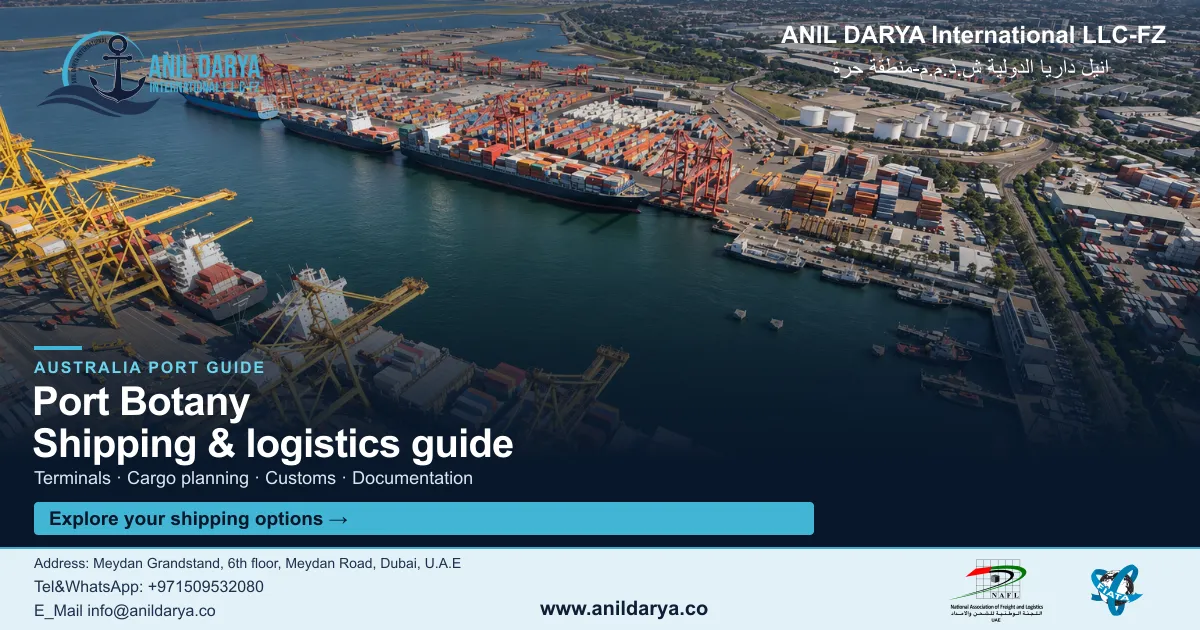
Port Botany shipping is how almost all container cargo reaches Sydney today. The port sits on the north shore of Botany Bay, next to Sydney Airport, and handles 2.8 million TEU a year through three container terminals, each with its own rail siding. This guide covers the terminals, the truck and rail links, the dangerous goods dwell limits, customs at Sydney and how to ship to Port Botany from Dubai, step by step. We ship both ways: from Dubai to Port Botany, and from Port Botany to Dubai with UAE clearance on arrival.
Port Botany at a glance
| Item | Detail |
|---|---|
| Location | Botany Bay, in Sydney's south, beside Sydney Airport |
| UN/LOCODE | AUPBT for Port Botany; carriers often book the city code AUSYD |
| Port manager (landside) | NSW Ports, on a 99-year lease since May 2013 |
| Navigation and marine safety | Port Authority of New South Wales |
| Container terminals | Three: DP World and Patrick at Brotherson Dock, Hutchison Ports at Hayes Dock |
| Container berths and quay | 12 berths, 3,793 m of container quay line |
| Container volume | 2.8 million TEU a year, with capacity for over 7 million TEU |
| Largest ships today | Infrastructure supports vessels up to 15,000 TEU |
| Ship visits | Around 1,600 ships a year |
| Share of NSW container trade | 99.6% |
| Rail | On-dock rail at all three container terminals |
| Bulk liquids | Two bulk liquid berths, over 5.5 million kilolitres of liquids and gas a year |
| Opening hours | 24/7 |
| Port Botany to Dubai | We book from Port Botany and clear at Jebel Ali, Khalifa Port or Sharjah; the ABF Export Declaration stays with the shipper or its broker |
What is Port Botany and how does it differ from Sydney Harbour?
When a carrier says "Sydney" on a container booking, it almost always means Port Botany. Before 1960 Sydney's international ships used Port Jackson, at Darling Harbour, Walsh Bay, Glebe Island and White Bay. Containers needed more land, so the state built a new port in the north of Botany Bay. The bulk liquids berth opened on 23 April 1979, and Brotherson Dock, the first container terminal, opened on 10 December 1979.
Two bodies share the port. NSW Ports manages the landside: the terminals' land, the roads and the rail inside the port. It took a 99-year lease from the state in May 2013. The Port Authority of New South Wales runs vessel traffic services, pilotage and the dangerous goods notification system for Botany Bay and Sydney Harbour.
For you as a shipper, neither of them releases your box. The stevedore does. Your trucker or rail operator collects from one of three terminals, and each has its own slots, rules and storage charges.
The 2011 expansion and ship size
NSW Ports describes the Port Botany Expansion as a $1 billion project approved in 2005. It added 1,850 m of quay line, five berths and 60 hectares of reclaimed land, with berth depths up to 16.5 m, and doubled container capacity. The third terminal was completed in June 2011. Today the port's infrastructure takes ships of up to 15,000 TEU. Cargo from the Gulf usually reaches it by transhipment, as the schedule data later in this guide shows.
Which container terminals operate at Port Botany?
NSW Ports lists three container terminals, run by independent stevedores. Two share Brotherson Dock and the third is at Hayes Dock, on the land built in the expansion.
Patrick Terminals, Sydney AutoStrad (Brotherson Dock)
Patrick says its Sydney AutoStrad terminal opened in early 2016 and is the largest container terminal in Sydney by capacity. It lists four berths (numbers 6 to 9), a 1,400 m quay, 63 hectares with 7,900 ground slots, 980 reefer plugs and capacity of 1.6 million TEU. Its automated rail terminal, Sydney AutoRail, was completed in October 2024 and lifts rail capacity at the terminal from 250,000 TEU to over 1 million TEU a year when fully running.
DP World Sydney (Brotherson Dock)
DP World lists a 36-hectare terminal with three berths, a 936 m quay and 14 to 15 m depth alongside. The yard uses rubber tyre gantries, the quay has post-Panamax cranes, and the terminal has two rail tracks.
Hutchison Ports Sydney (Hayes Dock)
Hutchison Ports Australia runs the third terminal at Hayes Dock. Hutchison invested in it in December 2009 under a 30-year lease. The terminal sits on the land reclaimed in the expansion completed in June 2011, which was built to bring in a third stevedore.
| Terminal | Dock | Published figures |
|---|---|---|
| Patrick Sydney AutoStrad | Brotherson Dock | 4 berths, 1,400 m quay, 63 ha, 980 reefer plugs, 1.6 million TEU capacity, automated rail terminal |
| DP World Sydney | Brotherson Dock | 3 berths, 936 m quay, 36 ha, 14 to 15 m depth, 2 rail tracks |
| Hutchison Ports Sydney | Hayes Dock | Third terminal, on the 2011 expansion land; on-dock rail |
Your bill of lading may only say "Sydney". Ask the carrier which terminal its vessel uses before you book a truck or a rail slot. Collection slots, storage free time and empty return rules are set terminal by terminal.
How does cargo leave Port Botany by road and rail?
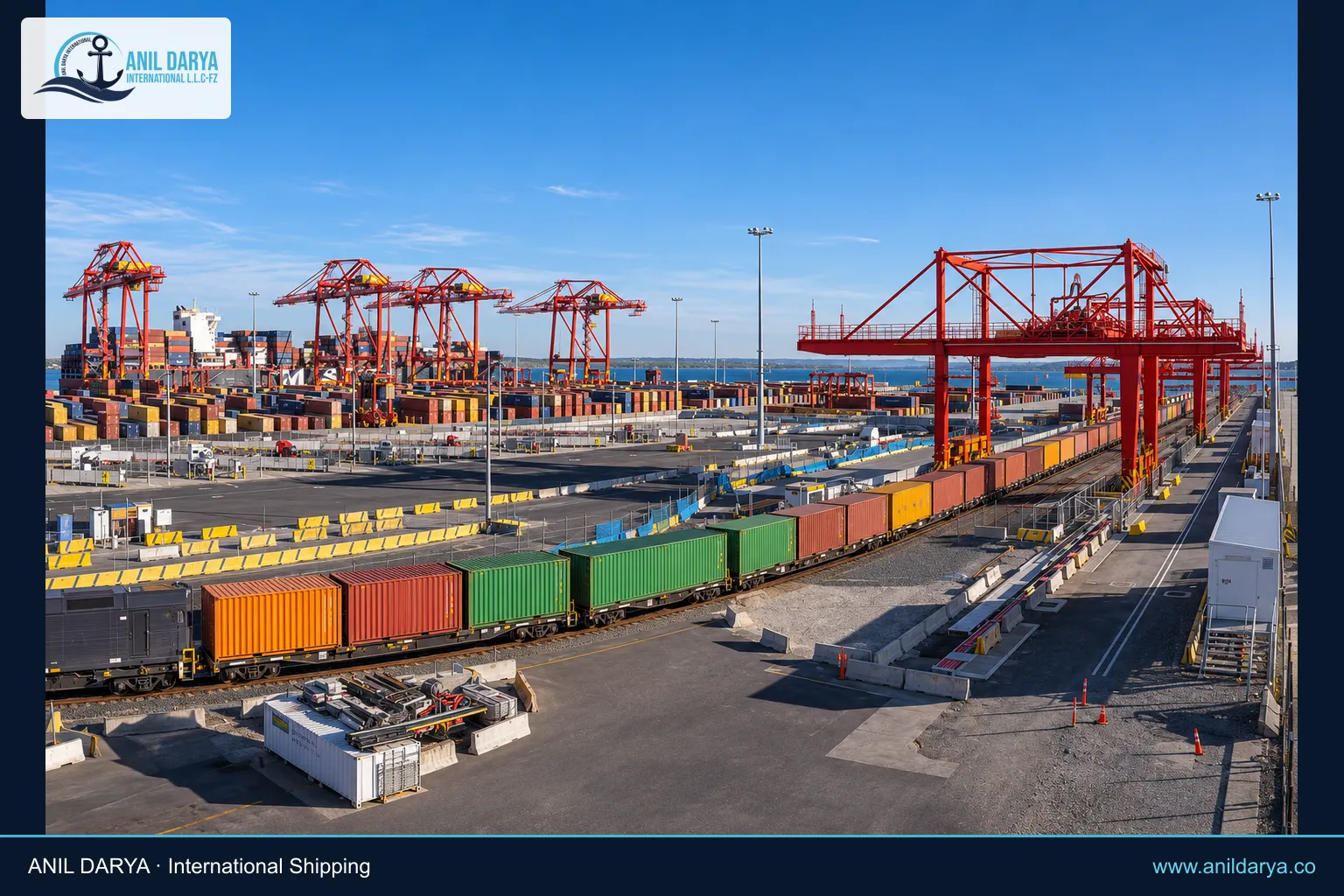
This is where Port Botany is different from other Australian ports. NSW Ports says it is the only Australian port with on-dock rail at all three container terminals, and trains of up to 1,300 m can be handled. Trains run to metropolitan intermodal terminals at Enfield and Moorebank, which serve Greater Sydney, and to Cooks River, which stacks large volumes of empty containers.
Most boxes still go by truck, and they do not go far. NSW Ports says 80% of import containers travel no further than 40 km from the port. Port Botany also runs the only regulated truck booking and penalty system at an Australian port, so trucks collect on booked slots and both trucking companies and terminals face penalties for missed performance.
| If your consignee is | Usual way out of Port Botany | What to check |
|---|---|---|
| In the eastern or southern suburbs | Direct truck from the terminal | Truck slot at the right terminal, receiving hours at the warehouse |
| In western Sydney | Rail to Enfield or Moorebank, then a short truck move | Whether the carrier or your trucker offers a rail-linked delivery |
| In regional New South Wales | Truck or rail to the region | Biosecurity rules for rural unpacking addresses, return of the empty |
| Returning an empty | To the park or terminal the shipping line names | The line's return date, to avoid detention |
Detention starts when the line's free time for the empty runs out, not when you finish unpacking. Our guide to demurrage and detention explains how free time works.
What cargo can you ship through Port Botany?
Port Botany is a container and bulk liquids port. NSW Ports says it carries 99.6% of the state's containers, 98% of its LPG, 90% of its bulk chemicals and all of its bitumen. Plan heavy and oversized cargo early, because the container terminals are built around boxes.
| Cargo type | At Port Botany | What to check first |
|---|---|---|
| Dry containers (FCL and LCL) | All three container terminals | Terminal, truck or rail slot, biosecurity packaging |
| Reefer containers | Container terminals with reefer plugs (Patrick lists 980) | Food import conditions, fast collection |
| Flat racks and open tops | Container terminals | Carrier acceptance, lashing, cleanliness of machinery |
| Dangerous goods in containers | Container terminals | ShIPS notification and wharf dwell limits |
| Bulk liquids and gas | Bulk liquid berths BLB1 and BLB2 | Terminal acceptance; this is a tanker trade, not a forwarder booking |
FCL or LCL into Sydney?
Our sea freight service books both. FCL is simpler at Sydney: one consignee, one release, one truck slot. LCL boxes go to a depot to be unpacked, and the whole container has to clear biosecurity before your share is released, so a problem with someone else's goods can hold yours. For urgent cargo, compare landed time, not only freight. See our guide to FCL vs LCL costs.
Machinery and out-of-gauge cargo
Units that fit a flat rack or open top can move through the container terminals on mainline services. Anything bigger needs a carrier willing to take it and a berth that can work it, so ask before you sell on a delivered basis. In every case the machine must be clean of soil and plant material, and biosecurity seasonal rules can apply to goods made in certain countries. We collect drawings, weights and lifting points, agree lashing with the carrier and plan the UAE road leg to the quay through our break bulk and project cargo service.
Dangerous goods rules at Port Botany
The Port Authority of New South Wales must be told about every dangerous goods consignment imported or exported by vessel at Port Botany, including transhipments and goods in transit. Notification is lodged electronically in Sydney's Integrated Port System (ShIPS). What matters most for an importer is how long a DG box may stay on the wharf.
| Category | Maximum dwell on the wharf | What falls in it |
|---|---|---|
| Nominated Red Line cargo | 2 hours | Highest-hazard cargo nominated by the Port Authority |
| Nominated Amber Line cargo | 12 hours | Includes more than 500 kg of listed classes, packing group I, ammonium nitrate (UN 1942, 2067, 2426, 3375), calcium hypochlorite (UN 1748, 2880, 3485, 3487) and Class 1.4 |
Missing a dwell period can bring penalties, including fines. Exemption application templates come from the stevedores, DP World, Hutchison and Patrick, and are lodged under the NSW dangerous goods guidelines. The Port Authority applies AS 3846 and the IMDG Code.
In practice, a 12-hour box needs a truck booked before the ship arrives. We get carrier acceptance in Dubai, check segregation and send the DG data early so the consignee's agent can plan collection. Read more about our dangerous goods shipping team and our guide to IMDG segregation in containers.
Customs and biosecurity at Port Botany in short
Customs at Sydney follows the same national rules as every Australian port. Our Port of Melbourne guide covers biosecurity in detail, so here are the points that decide whether your box leaves Port Botany on time.
- The Australian Border Force (ABF) clears goods through the Integrated Cargo System. The importer, or a licensed customs broker acting for them, lodges an Import Declaration or a Self-Assessed Clearance Declaration.
- For most goods worth AUD 1,000 or less there are no duties, taxes or charges. Alcohol and tobacco pay at any value.
- GST is 10% of the value of the taxable importation: customs value, plus duty, plus transport and insurance to Australia.
- The Australia-UAE CEPA has been in force since 1 October 2025. Schedule 16 of the Customs Tariff lists the lines where UAE-originating goods do not get a free rate. Goods made elsewhere and re-exported from Dubai pay the rate for their real origin.
- The Department of Agriculture, Fisheries and Forestry (DAFF) checks the container, the packaging and the goods. Check BICON for your goods, use treated or no timber packaging, ship in a clean box and send a packing declaration.
- Seasonal brown marmorated stink bug measures can apply to goods made in a target risk country, even when they sail from Jebel Ali.
| Document | Who uses it at Sydney |
|---|---|
| Commercial invoice and packing list | The broker, for the declaration and the HS code |
| Bill of lading | The carrier, for release; DAFF, for the shipped date |
| Packing declaration | DAFF, for packaging and container cleanliness |
| Evidence of UAE origin | The broker, only to claim the CEPA rate |
| DG declaration and safety data sheet | Carrier, terminal and the ShIPS notification |

How to ship from Dubai to Port Botany: step by step
Most sea freight to Sydney loads at Jebel Ali or Khor Fakkan and is transhipped on the way. Our Jebel Ali port shipping guide covers the UAE side. Fluent Cargo's schedule data shows its quickest option from Khor Fakkan to Sydney at about 31 days with one transfer, sailing 2 to 4 times a week with Maersk and Hapag-Lloyd. Its Jebel Ali option shows about 57 days with two transfers. Treat these as indications and check the arrival date on your booking.
[AMIR-FACT: the carriers or services we actually book from Jebel Ali or Khor Fakkan to Port Botany, the transhipment port, which Sydney terminal they use, and our typical port-to-port days]
- Confirm the HS code, the real country of manufacture and the Incoterm.
- Check BICON for import conditions, and check whether seasonal stink bug measures apply.
- Name the importer of record and the licensed customs broker in Sydney.
- Decide FCL or LCL, and truck or rail delivery from the port.
- We book space with the carrier and confirm the Jebel Ali or Khor Fakkan cut-off.
- Pack in a clean container with compliant packaging and prepare the packing declaration.
- We arrange UAE trucking, export customs clearance and gate-in.
- For DG, we pass the data to the consignee's agent so the ShIPS notice and collection are ready.
- After sailing, we send the bill of lading, invoice, packing list and certificates to the broker.
- The broker lodges the declaration and answers any biosecurity direction.
- Once released, the trucker books a slot at the right terminal and returns the empty on time.
How to ship from Port Botany to Dubai
We also handle the other direction: shipping from Port Botany to Dubai, with arrival at Jebel Ali, Khalifa Port or Sharjah port. We book the space with the carrier and run the UAE side. The Australian export filings stay with the shipper or its Australian agent.
The Australian export side
- Export Declaration. Goods must be reported to the ABF on an Export Declaration if they are worth more than AUD 2,000, need an export permit at any value, carry a duty drawback claim, or are dutiable goods with duty unpaid. Goods under AUD 2,000 can be reported with an exemption code.
- Who files. The exporter or its agent lodges the declaration in the Integrated Cargo System (ICS), up to 6 months before export. The ICS returns an Export Declaration Number (EDN) and a status that shows whether the goods may be exported.
- Duty and controls. The ABF states there are no customs duties on export. Some goods are prohibited or need a permit, so the shipper checks the ABF list before booking.
The UAE import side
On arrival in Dubai, the import declaration goes to Dubai Customs with the commercial invoice, the packing list, the certificate of origin and any permit for restricted goods. The carrier's agent also needs the bill of lading before it issues the delivery order. Customs duty in Dubai is 5% of the CIF value for most goods, with 50% on alcohol and 100% on cigarettes. Import VAT is 5% of the customs value, which includes insurance and freight. A VAT-registered importer whose customs number is registered with the Federal Tax Authority accounts for it on its VAT return. An importer that is not registered pays it before the goods are released.
- Send us the shipper's details in Port Botany, the cargo, the HS code and the UAE delivery address.
- We book space from Port Botany and send the booking, cut-offs and terminal details to the shipper.
- The shipper or its trucker delivers the cargo to the Port Botany terminal named on the booking inside the carrier's receiving window.
- The shipper or its customs broker lodges the Export Declaration in the ICS and gives the EDN to the carrier, or quotes an exemption code for low-value goods.
- We check the draft bill of lading against the invoice and packing list before it is issued.
- We file the Dubai Customs declaration before the ship arrives.
- We arrange payment of the duty and VAT and collect the delivery order from the carrier's agent.
- We truck the cargo to your site and return the empty container inside the free time.
[AMIR-FACT: the carriers we actually use from Port Botany to Jebel Ali/Khalifa/Sharjah and our real transit days in this direction]
Checklist before you ship to Port Botany
- Terminal confirmed with the carrier: Patrick, DP World or Hutchison.
- Broker in Sydney appointed and holding copies of the documents before arrival.
- Origin documents ready if you claim the CEPA rate.
- Container swept clean, no soil or plant material, timber treated or not used.
- Packing declaration signed.
- Delivery address checked: metropolitan or rural.
- Truck or rail slot planned for the day of release.
- For DG: Red or Amber Line status known and collection booked inside the dwell limit.
- Empty return point and date known.
Common mistakes when shipping to Port Botany
- Booking "Sydney" without asking which terminal, then missing the truck slot.
- Assuming the Port Authority or the terminal will hold an Amber Line DG box for a day. The limit is 12 hours.
- Choosing LCL for urgent goods without allowing for depot unpacking and whole-box biosecurity clearance.
- Claiming CEPA duty-free entry for goods only re-exported through Dubai.
- Untreated timber pallets or a dirty container, which lead to inspection and treatment at the importer's cost.
- Planning a breakbulk delivery into Port Botany without checking that a carrier and berth can take it.
- Sending documents to the broker after the ship arrives.
Port Botany or another Australian port?
| If your consignee is in | Usually ship to |
|---|---|
| Sydney and most of New South Wales | Port Botany |
| The Canberra region | Port Botany, then road |
| Victoria or Tasmania | Melbourne |
| South-east Queensland | Brisbane |
| Western Australia | Fremantle |
Moving a container between states by road or rail adds cost and days, so land the box at the port nearest the consignee. For heavier cargo that needs speed, our air cargo service books Dubai to Sydney, where Fluent Cargo lists direct flights of about 14 hours.
Frequently asked questions
Is Port Botany the same as the Port of Sydney?
For containers, yes. Sydney's container terminals are all at Port Botany on Botany Bay. Sydney Harbour (Port Jackson) is used mainly for cruise and some specialist trades.
What is the port code for Port Botany?
The UN/LOCODE for Port Botany is AUPBT. Many carriers and booking systems use the Sydney code AUSYD, so check both on your documents.
Which companies run Port Botany?
NSW Ports manages the landside on a 99-year lease from May 2013. The Port Authority of New South Wales handles navigation, pilotage and DG notices. Patrick, DP World and Hutchison Ports run the three container terminals.
How big is Port Botany?
NSW Ports says it handles 2.8 million TEU a year, with capacity for over 7 million TEU, 12 container berths and 3,793 m of container quay. It carries 99.6% of New South Wales container trade.
How long does shipping from Dubai to Sydney take?
Fluent Cargo's schedule data shows about 31 days from Khor Fakkan to Sydney with one transfer, and longer routings from Jebel Ali. Times change with carrier and season, so check your booking.
How long can dangerous goods stay on the wharf at Port Botany?
Nominated Red Line cargo may stay 2 hours and Amber Line cargo 12 hours. All DG moved by vessel must be notified to the Port Authority through ShIPS.
Can containers leave Port Botany by rail?
Yes. All three terminals have on-dock rail, and trains run to intermodal terminals at Enfield and Moorebank in Sydney's west, and to Cooks River for empties.
Do I need a customs broker to import through Port Botany?
No, the importer can lodge the declaration. In practice most importers use a licensed customs broker, who files in the ABF Integrated Cargo System and handles biosecurity questions.
Is cargo from Dubai duty-free in Australia?
Goods that qualify as UAE origin under the CEPA enter duty-free except for the lines in Schedule 16. GST of 10% still applies. Goods made elsewhere pay the duty for their real origin.
Can you handle shipping from Port Botany to Dubai?
Yes. We book the space from Port Botany, check the bill of lading and run the UAE side: the Dubai Customs declaration, the 5% duty and 5% import VAT, which we arrange payment of, the delivery order and trucking. The shipper or its Australian broker lodges the Export Declaration when one is needed.
Get a quote for Port Botany shipping
Send us the cargo details, the delivery suburb in New South Wales, the Incoterm and the country where the goods were made, and we will come back with a routing and a price. Use our freight rate inquiry form, or contact our team to talk through a DG or out-of-gauge shipment first. You can also read more about our Dubai freight forwarding team.
Sources
- Australian Border Force: Export requirements (AUD 2,000 rule, permits, no export duty)
- Australian Border Force: ICS export overview (exporter or agent lodges, EDN, up to 6 months before export)
- Dubai Customs: Submit customs declaration (invoice, packing list, certificate of origin, permits)
- UAE Government portal: Customs duty (5% of CIF in Dubai, alcohol 50%, cigarettes 100%)
- Federal Tax Authority: VAT (5% rate)
- Federal Tax Authority: VAT guide, section 3.5 (import VAT at 5% on customs value, VAT return or payment before release)
- NSW Ports: Port Botany (terminals, berths, quay, TEU, capacity, trade share, expansion, history)
- NSW Ports: Network connections (on-dock rail, intermodal terminals, truck booking)
- Port Authority of NSW: Port Botany overview
- Port Authority of NSW: Port Botany dangerous goods (ShIPS, Red and Amber Line dwell periods)
- Patrick Terminals: Sydney AutoStrad and Sydney AutoRail
- DP World: DP World Sydney terminal facts
- Hutchison Ports Australia: Port Botany terminal
- Wikipedia: Port Botany (history, lease, third terminal, UN/LOCODE)
- PortServiceFinder: Port of Sydney (Port Botany) operator guide (Sydney Harbour cruise and specialty role)
- iContainers: Port of Sydney (AUPBT and AUSYD codes)
- Australian Border Force: Import declarations
- Australian Border Force: GST and other taxes
- Australian Border Force: Current tariff (Schedule 16, UAE)
- Austrade: Australia-UAE CEPA
- Fluent Cargo: Dubai to Sydney (sea and air schedules)
Reviewed: 10 November 2026