
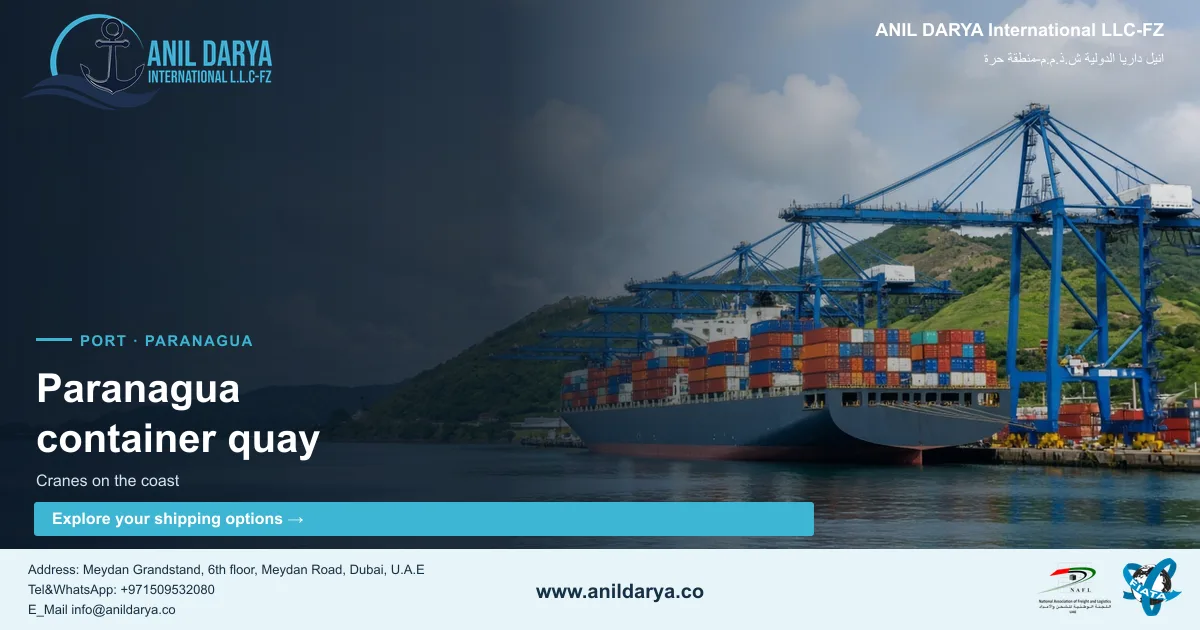
Port of Paranagua shipping is how most cargo for southern Brazil, and a growing share for Paraguay, enters and leaves the country. The port sits on Paranagua Bay in Parana state, is run by the state company Portos do Parana, and handles grain, fertilizer, frozen meat in reefers, vehicles and general containers through the TCP container terminal. This guide covers what is specific to Paranagua: drafts, terminals, cargo, the Paraguay link and how we ship your cargo there from Dubai. We ship both ways: from Dubai to Paranagua, and from Paranagua to Dubai with UAE clearance on arrival.
Port of Paranagua guide: key facts at a glance
| Item | Detail |
|---|---|
| Port authority | Portos do Parana (Administracao dos Portos de Paranagua e Antonina, APPA), a Parana state company |
| UN/LOCODE | BRPNG |
| Location | South edge of Paranagua Bay, about 27 km from the bar; about 100 km by highway from Curitiba |
| Sister port | Antonina, about 14 nautical miles upstream, run by the same authority |
| Cargo in 2025 (Paranagua and Antonina) | 73.5 million tonnes, a record, up 10.1% on 2024 |
| Containers in 2025 (ports of Parana) | About 1.66 million TEU, a record, up 7% on 2024 |
| Main container terminal | TCP (Terminal de Conteineres de Paranagua) |
| TCP containers, first half of 2025 | 744,650 TEU, third largest container terminal in Brazil (Antaq) |
| Reefer plugs at TCP | 5,268 |
| Largest container ships handled | 366 m long, since January 2024 |
| TCP operational draft | Up to 13.30 m with tide (from November 2025) |
| Main exports | Soybeans, soymeal, corn, frozen chicken and beef, pulp, sugar, wood |
| Main imports | Fertilizers (11.6 million tonnes in 2025), wheat, malt and barley |
| Road | BR-277 to Curitiba, plus PR-401, PR-410, PR-411, PR-412 |
| Rail | Southern rail network (Malha Sul); the container terminal has direct rail access |
| Customs | Receita Federal do Brasil, Duimp in the Portal Unico Siscomex |
| Paranagua to Dubai | Exporter or its broker registers the DU-E in the Portal Unico Siscomex; UAE entry at Jebel Ali, Khalifa Port or Sharjah with 5% duty on CIF for most goods and 5% import VAT |
Where is the Port of Paranagua and what does it serve?
Paranagua lies on the south edge of Paranagua Bay, on the Atlantic coast of Parana state. Ships come in from the sea bar through the bay to a port about 27 km inside it. The city of Curitiba is about 100 km away by highway, and Curitiba international airport is about 80 km from the port. A 97.6 km pipeline also links the port to the Getulio Vargas refinery in Araucaria.
The port's reach is much wider than Parana. Its area of influence covers Mato Grosso do Sul, Mato Grosso, Santa Catarina, Rio Grande do Sul, Minas Gerais, part of Sao Paulo state and Paraguay. That is why grain from the interior and frozen meat from far-off states leave through Paranagua, and why fertilizer for those same farms comes in through it.
The same authority also runs the smaller port of Antonina, about 14 nautical miles up the Paranagua River. For most container cargo from the UAE, Antonina does not come into play. It matters only if a breakbulk or bulk cargo is booked there.
Which terminals does Paranagua have?
Paranagua is a public port with areas leased to private operators. Directories list 45 port operating companies. The table groups the facilities by cargo, as described in port directories and by the authority.
| Facility | Main cargo | What to know |
|---|---|---|
| TCP container terminal | Containers, including reefers | Direct rail access, 5,268 reefer plugs, about 25 regular weekly calls (2024) |
| Export corridor grain terminals | Soybeans, soymeal, corn | Grain can load at three berths at the same time |
| Fertilizer pier and solid bulk terminals | Fertilizers, salt, other dry bulk | Fertilizer is the port's largest import |
| Sugar terminal | Bagged and bulk sugar | Bagged sugar exports rose 15% in 2025 |
| Liquid bulk piers | Vegetable oils, fuels, chemicals | Four liquid bulk terminals; 540,781 m3 of liquid storage listed |
| General cargo and Ro-Ro berths | Vehicles, wood, paper, steel, machinery | Public commercial wharf, shared by several operators |
| Paraguayan free warehouse | Cargo for Paraguay | Area in Warehouse 8 run by Paraguay's port administration (ANNP) |
TCP, the container terminal that matters for UAE cargo
Almost every container you ship from Dubai to Paranagua will be handled at TCP. In the first half of 2025 it moved 744,650 TEU. Antaq data quoted for that period make it the largest container terminal in southern Brazil and the third largest in the country. TCP has handled 366 m ships since January 2024, and simulations have covered ships up to 368 m long and 51 m wide.
TCP also runs one of the largest reefer yards in South America, with 5,268 reefer plugs. That number tells you what the terminal is built around: frozen chicken and beef going out, and empty reefers coming back in. For an importer of dry cargo, that means steady carrier calls and empty equipment flows, which helps when you look for space.
TCP also has direct rail access, the only container terminal in southern Brazil with that link. Trucks on BR-277 remain the default, but rail is worth asking about for heavy, regular flows.
How deep is Paranagua and what ships can berth?
Draft is the topic Paranagua competitors skip, and it is the one that decides how much a ship can load. Portos do Parana raised the TCP operational draft in November 2025 through Ordinance No. 224/2025.
| Ship length | Draft at zero tide | Draft with tide |
|---|---|---|
| Up to 300 m | 13.00 m (was 12.80 m) | 13.30 m with 30 cm of positive tide |
| 336 m to 366 m | 12.80 m | 13.10 m with 30 cm of tide; 13.30 m with 50 cm of tide |
The change lets a container ship load about 400 more full TEU per call. The access channel draft had already gone from 12.10 m to 12.80 m at zero tide in 2024. The channel concession plans a 15.5 m depth within its first five years.
For breakbulk, bulk and tanker calls, the limits are different. A port directory lists these maximum sizes:
| Ship type | Maximum length | Maximum draft |
|---|---|---|
| Containers | 400 m | 12.6 m |
| Ro-Ro | 400 m | 12.6 m |
| Breakbulk | 300 m | 12.3 m |
| Dry bulk | 245 m | 13.1 m |
| Tankers | 229 m | 12.5 m |
| Gas carriers | 190 m | 11.6 m |
The directory figures are older than the November 2025 change for TCP, so treat them as a guide for planning, not a booking limit. If you charter a breakbulk vessel for project cargo, the owner and the local ship agent confirm the berth and draft for that call.
What cargo moves through the Port of Paranagua?
Portos do Parana handled 73.5 million tonnes in 2025, the highest growth of any Brazilian port that year at 10.1%. The table shows the cargo that drove those results.
| Cargo | Direction | 2025 volume or change |
|---|---|---|
| Soybeans | Export | 14.6 million tonnes, up 11% |
| Soymeal | Export | 6.5 million tonnes, up 5% |
| Corn | Export | 5.09 million tonnes, up from 1.07 million in 2024 |
| Fertilizers | Import | 11.6 million tonnes, up 4% |
| Wheat, malt and barley | Import | 1.1 million tonnes |
| Frozen chicken | Export, reefer | 2.8 million tonnes, flat on 2024 |
| Beef | Export, reefer | 1.2 million tonnes, up 46.5% |
| Wood | Export | 1.6 million tonnes |
| Vegetable oils, pulp, bagged sugar | Export | Up 32%, 16% and 15% |
Paranagua is the largest export corridor for frozen animal protein in Brazil, with a 34% share. That is why most containers leaving the port are reefers, and why the container business here runs heavy on exports.
What this means for cargo from the UAE
| Cargo from the UAE | How it usually moves | What to plan at Paranagua |
|---|---|---|
| General goods, parts, consumer goods | FCL or LCL to TCP | NCM code, importer's habilitation, terminal free time |
| Machinery and steel | FCL, flat racks or breakbulk | Lifting points, lashing, breakbulk draft limit |
| Chemicals and other dangerous goods | IMDG containers | Carrier and terminal acceptance, Brazilian agency consent |
| Fertilizer and other dry bulk | Bulk vessel to the fertilizer pier | Receiver's discharge slot, survey, bulk draft |
| Cargo for Paraguay | FCL to TCP, then bonded trucking | Transit paperwork, Paraguayan broker, ANNP area |
| Used vehicles and equipment for Paraguay | Ro-Ro or containers | Paraguayan import rules checked first |
Shipping from Dubai to Paranagua: FCL and LCL
Most UAE cargo for Paranagua moves in containers from Jebel Ali Port. There is no single published direct service we can quote from an official source. Services from the Gulf to the east coast of South America usually reach Brazil by transshipment or on loops that call several Brazilian ports, so Paranagua may come before or after Santos and Itajai on the rotation.
[AMIR-FACT: Our real port-to-port transit Jebel Ali to Paranagua (days), the transshipment hub, and the carriers or services we actually book to Paranagua]
FCL is the default for a full load or for any cargo that needs its own seal to the consignee's door. LCL to Paranagua is possible but often moves through a hub, which adds handling and time. As a rule, once your cargo passes about half a 20 ft container, compare both. Our guide to FCL vs LCL costs shows where the crossover usually sits.
Check the port of discharge on the booking. A service may list Paranagua as the destination but discharge in another Brazilian port and feeder the box, which changes your transit time.
Breakbulk, project cargo and dangerous goods at Paranagua
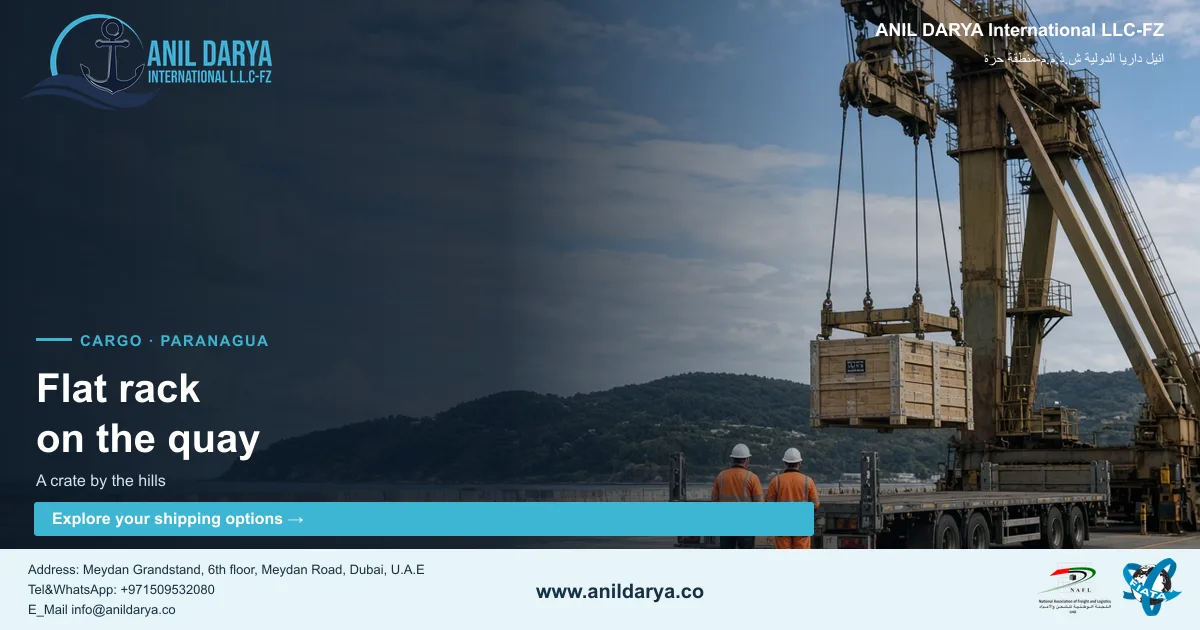
Paranagua handles breakbulk on its public commercial wharf, with ships up to about 300 m and 12.3 m draft listed for this trade. Steel, machinery, wood, paper and vehicles all use these berths. For a single heavy piece, a flat rack on a container service to TCP is often simpler than a breakbulk call. For a full project, a chartered or liner breakbulk vessel may be the right answer.
Plan the inland leg with the consignee from the start. Oversized loads on BR-277 to Curitiba need a route survey and the right permits on the Brazilian side. Our break bulk and project cargo service covers the UAE side, from packing and lifting plans to loading at Jebel Ali.
For dangerous goods, carrier acceptance comes first, then the terminal. You need the UN number, proper shipping name, class and packing group, a Safety Data Sheet, a signed DG declaration, UN packaging, labels and placards. Many chemicals also need consent from a Brazilian agency, requested by the importer in the Portal Unico, before the cargo is loaded. Our dangerous goods shipping team checks the documents before you commit to a sailing.
Shipping to Paraguay through Paranagua
Paranagua has had an area for Paraguayan cargo since 1957. It works as a free warehouse in the first part of Warehouse 8, run by Paraguay's port administration, the ANNP. Goods for Paraguay can be stored there and move on without Brazilian cargo taxes. The border is about 730 km from the port, roughly 12 hours by road.
This route has grown. TCP handled 7,673 TEU to or from Paraguay from January to October 2024, up 129%, and Paraguayan reefer exports through TCP rose 567%. About 80% of Paraguay's foreign trade normally moves by river to Montevideo and Buenos Aires. Low river levels between winter and spring slow that route, and imports through Paranagua can reach Paraguay up to 25 days faster.
If your buyer is in Paraguay, tell us at the quote stage. The bill of lading, the consignee details and the transit paperwork must match the Paraguayan importer and its broker, not a Brazilian company.
Customs at the Port of Paranagua: a short summary
Customs rules at Paranagua are the same as at any Brazilian port. The Receita Federal clears imports through the Duimp, filed in the Portal Unico Siscomex. Our Santos guide covers the full process and the tax list, so here is the short version and what changes at Paranagua.
| Step | Who does it | What to watch at Paranagua |
|---|---|---|
| Importer habilitation (Radar) | Brazilian importer | Must be active and in a modality other than limited for normal volumes |
| NCM code and agency consent | Importer and broker | Fix before sailing; consent for chemicals, food, some electronics |
| Duimp registration | Importer or broker | Can be registered before the cargo arrives or after it is stored |
| Taxes and terminal release | Importer and broker | Storage at TCP keeps running until release |
| Transit to Paraguay | Paraguayan broker with the ANNP | Bonded move to the border, no Brazilian import |
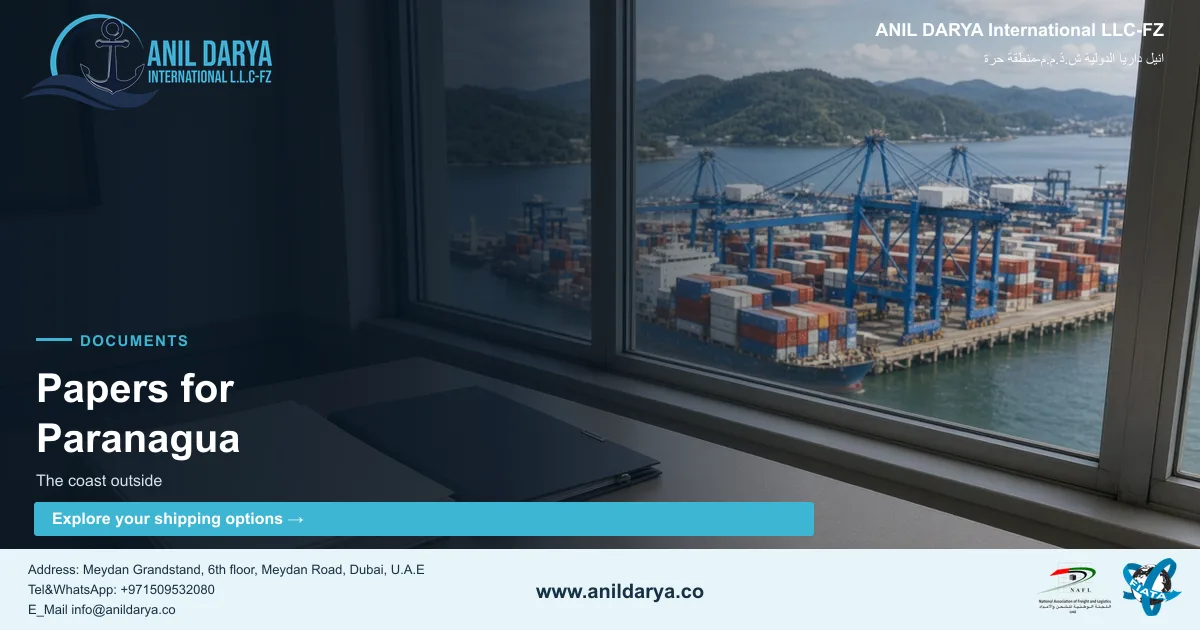
Documents you send from the UAE: a commercial invoice and packing list that match each other, the bill of lading, a certificate of origin where the importer needs it, and ISPM 15 marked wood packaging. Our article on Incoterms 2020 for sea freight explains who pays what on each term.
How to ship from Dubai to the Port of Paranagua: step by step
- Confirm the importer. The Brazilian or Paraguayan consignee checks its habilitation, the NCM code and any agency consent before you ship.
- Get a quote. We compare carrier services from Jebel Ali to Paranagua and check whether each discharges direct or by transshipment.
- Agree the Incoterm and who pays the Brazilian terminal and inland costs.
- Book space and the right equipment: dry, reefer, flat rack or open top.
- Pack and mark the cargo. Use ISPM 15 wood and label DG cargo correctly.
- We arrange trucking in the UAE, export customs and gate-in at Jebel Ali.
- Send the invoice, packing list and draft bill of lading to the consignee's broker before the vessel sails.
- The broker registers the Duimp and pays the taxes.
- The consignee books trucks from TCP on BR-277, or the bonded move to Paraguay.
How to ship from the Port of Paranagua to Dubai
Paranagua is above all an export port, and the ports of Parana are a major outlet for Brazil's frozen protein exports in reefers. We also handle this direction, shipping from Paranagua to Dubai with arrival at Jebel Ali, Khalifa Port or Sharjah port. We book the space with the carrier and run the UAE side. The Brazilian export papers stay with the shipper or its Brazilian broker.
The Brazil export side
- DU-E. Every export is declared on the Declaracao Unica de Exportacao, registered in the Portal Unico Siscomex. The exporter or declarant, or its legal representative such as a customs broker (despachante), files it.
- Electronic invoice. As a rule, the DU-E is filled in from the exporter's electronic invoice (NF-e). Paper or no invoice is allowed only in cases the law sets out.
- Changes. The DU-E can be amended without Receita Federal approval until the cargo is presented for clearance, so the shipper's broker fixes errors before the box reaches TCP.
- Reefer cargo. Frozen meat needs the set temperature on the booking. Before loading, the UAE importer confirms which health and origin papers its food permit will ask for, so the shipper can get them in Brazil.
The UAE import side
On arrival, the import declaration goes to Dubai Customs with the commercial invoice, the packing list, the certificate of origin and a permit from the relevant authority for restricted goods, such as food. The carrier releases the delivery order against the bill of lading. Customs duty in Dubai is 5% of the CIF value for most goods, with 50% on alcohol and 100% on cigarettes. Import VAT is 5%, and a VAT-registered importer accounts for it through the reverse charge on its VAT return.
- Send us the shipper's details, the cargo, the HS code, the reefer temperature if any and the UAE delivery address.
- We book space from TCP and send the booking and cut-offs to the shipper.
- The shipper or its trucker collects the empty, loads it and gates it in full at TCP.
- The shipper or its broker registers the DU-E and completes export clearance.
- We check the draft bill of lading against the invoice and packing list.
- We file the UAE declaration, with any food permit, before the vessel arrives.
- We arrange payment of the duty and VAT, and collect the delivery order from the carrier.
- We truck the container to your site or cold store and return the empty inside free time.
[AMIR-FACT: the carriers we actually use from Paranagua to Jebel Ali, Khalifa Port or Sharjah and our real transit days in this direction]
Free time, storage and demurrage at Paranagua
Each carrier sets its own free time for containers at Paranagua, and TCP charges storage on its own tariff once the box is in the yard. Neither figure is the same across carriers, so we do not quote one here. Ask for both on the quote and plan the clearance around them.
Three things keep these costs down: an importer that is ready before arrival, documents that match, and a broker who has the papers before the ship berths. In Brazil, slow clearance also raises the state ICMS tax, because storage and handling costs go into its base. Our article on demurrage and detention shows how the charges are worked out.
Paranagua or Santos: which port fits your cargo?
| Question | Paranagua | Santos |
|---|---|---|
| Where is the consignee? | Parana, Santa Catarina, Mato Grosso do Sul, Paraguay | Sao Paulo state and the southeast |
| Container terminals | One main terminal (TCP) | Several, on both banks |
| Reefer focus | Very strong, 5,268 plugs at TCP | Strong, spread across terminals |
| Cargo for Paraguay | Free warehouse run by the ANNP | Not the usual route |
| Fertilizer and grain | Large dedicated corridor | Large, mostly sugar and soy |
If both ports work for your consignee, ask us to price both. The inland leg often decides the total cost more than the sea freight does.
Checklist before you ship to the Port of Paranagua
- Consignee's habilitation active and the NCM code agreed.
- Agency consent requested for chemicals, food or regulated goods.
- Port of discharge on the booking confirmed as Paranagua, direct or by transshipment.
- Free time at destination and TCP storage terms known.
- Invoice, packing list and bill of lading match on weight, packages and description.
- Wood packaging ISPM 15 marked.
- DG documents, labels and carrier acceptance in place.
- For Paraguay: consignee and transit details set up for the ANNP route.
- For oversized pieces: drawings, lifting points and a Brazilian road route agreed.
Common mistakes when shipping to Paranagua
- Booking to Santos by habit when the consignee is in Parana or Paraguay, then paying a long truck leg.
- Not checking whether the service calls Paranagua direct or feeders from another port.
- Shipping before the importer's habilitation or agency consent is ready, so the box sits at TCP.
- Naming a Brazilian consignee on the bill of lading for cargo that is meant for Paraguay.
- Sending invoices with weights or descriptions that do not match the packing list.
- Planning a breakbulk call on container draft limits instead of the breakbulk limit.
Frequently asked questions
Who manages the port in Paranagua?
Portos do Parana, the Parana state port company also known as APPA, runs the ports of Paranagua and Antonina. The container terminal is operated by TCP under a lease.
How much cargo does the Port of Paranagua handle?
Paranagua and Antonina handled 73.5 million tonnes in 2025, a record and up 10.1% on 2024. The ports of Parana also moved about 1.66 million TEU of containers in 2025.
Which container terminal is at Paranagua?
TCP, the Terminal de Conteineres de Paranagua. It handled 744,650 TEU in the first half of 2025, has 5,268 reefer plugs and has handled 366 m ships since January 2024.
What is the draft at the Port of Paranagua?
Since November 2025, ships up to 300 m can use up to 13.00 m at zero tide at TCP and 13.30 m with tide. Ships of 336 m to 366 m use 12.80 m at zero tide and up to 13.30 m with 50 cm of tide.
What is the port code for Paranagua?
The UN/LOCODE is BRPNG. Use it on bookings and in schedule searches to avoid mix-ups with other Brazilian ports.
Can I ship cargo to Paraguay through Paranagua?
Yes. Paraguay has a free warehouse area at the port, run by its port administration ANNP. Goods move to the border, about 730 km away, without Brazilian cargo taxes, with a Paraguayan broker handling the transit.
How far is Paranagua from Curitiba?
About 100 km by highway, mainly on BR-277. Curitiba international airport is about 80 km from the port.
How are goods shipped from Dubai to Paranagua cleared?
The Brazilian importer, or its broker, files a Duimp in the Portal Unico Siscomex and pays the import taxes. The importer must hold an active habilitation, and some goods need agency consent before shipping.
Can you handle shipping from Paranagua to Dubai?
Yes. We book the space from TCP, the shipper or its broker registers the DU-E, and we clear the cargo through UAE customs and deliver it. Most goods pay 5% duty on the CIF value plus 5% import VAT, and food needs a UAE permit.
Get a quote for Port of Paranagua shipping
Send us your cargo details and the consignee's city, and we will come back with a routing and a price to Paranagua. Use our freight rate inquiry form, or contact our team to talk through a breakbulk, project or DG shipment first. You can also read more about our Dubai freight forwarding team and our sea freight service.
Sources
- Parana state government: Portos do Parana record 73.5 million tonnes in 2025 (January 2026)
- Parana state government: 1.66 million TEU in 2025, frozen protein exports (January 2026)
- Parana state government: Paraguayan cargo area at Paranagua (July 2024)
- Portos do Parana: port authority site (2025 tonnage panel)
- Datamar News: TCP increases operational draft, Ordinance 224/2025 (November 2025)
- Datamar News: TCP Paraguayan cargo, reefer plugs, weekly calls (December 2024)
- Findaport: Port of Paranagua (maximum size by ship type, pipeline, airport distance)
- Shipnext: Paranagua port description (location, Antonina, terminals, storage)
- Wikipedia: Port of Paranagua (area of influence, road and rail, container terminal rail link)
- Wikipedia (Portuguese): Porto de Paranagua (rail network, access roads)
- Receita Federal: Preparing the Duimp
- FreightAmigo: Shipping from Dubai to Brazil (Radar, NCM, ISPM 15)
- Gov.br: Declare an export (DU-E in the Portal Unico Siscomex, who files, NF-e, amendments before cargo presentation)
- Dubai Customs: Submit customs declaration (invoice, packing list, certificate of origin, permits)
- UAE Government portal: Customs duty (5% of CIF, alcohol 50%, cigarettes 100%)
- Federal Tax Authority: VAT guide (5% import VAT, reverse charge)
Reviewed: 10 November 2026