
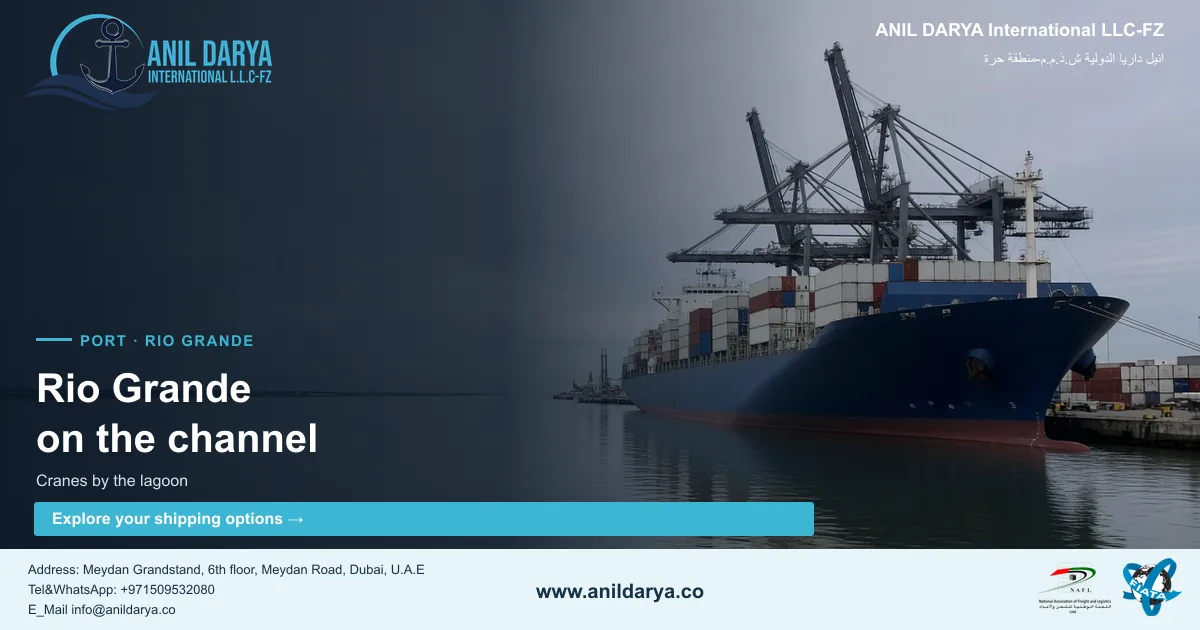
Port of Rio Grande shipping is how most sea cargo for Rio Grande do Sul, Brazil's southernmost state, enters and leaves the country. The port sits on the channel that links the Lagoa dos Patos with the Atlantic, is run by the state port company Portos RS, and handles grain, fertilizer, pulp, frozen meat and general containers through Tecon Rio Grande. This guide covers what is specific to Rio Grande: its three port areas, drafts, terminals, cargo, inland links and how we ship your cargo there from Dubai. We ship both ways: from Dubai to Rio Grande, and from Rio Grande to Dubai with UAE clearance on arrival.
One point first: this page is about Rio Grande in Brazil (port code BRRIG). It is not Rio de Janeiro, and it is not the town of Rio Grande in Argentina. Check the port code on every quote and booking.
Port of Rio Grande guide: key facts at a glance
| Item | Detail |
|---|---|
| Port authority | Portos RS, the port company of the state of Rio Grande do Sul (administration delegated to the state in 1997, formerly SUPRG) |
| UN/LOCODE | BRRIG |
| Location | City of Rio Grande, right bank of the North Channel between the Lagoa dos Patos and the Atlantic; about 500 km northeast of Montevideo |
| Port areas | Porto Velho (local craft), Porto Novo (grain and dry cargo), Superporto (private and leased terminals for bulk, liquids and containers) |
| Cargo, January to November 2025 | 40,884,088 tonnes, more than 96% of the state's public port cargo |
| Cargo, full year 2025 | Over 46 million tonnes (including private terminals) |
| Containers, January to November 2025 | 934,691 TEU, up 29.11% on the same period of 2024 |
| Main container terminal | Tecon Rio Grande, run by Wilson Sons |
| Tecon quay and berths | 900 m of quay, three berths, 15 m depth |
| Tecon capacity | 1.42 million TEU a year, 2,800 reefer connections |
| Permitted vessel draft | Confirm current channel and berth restrictions with Portos RS and the local agent; berth depth is not sailing authorization |
| Main exports | Soybeans and soymeal, corn, pulp, frozen meat, tobacco, polymers |
| Main imports | Fertilizers, sulphates, wheat and other inputs |
| Road | BR-392, BR-471 and BR-116 |
| Nearest airports | Rio Grande airport about 6 km; Porto Alegre airport about 320 km |
| Customs | Receita Federal do Brasil; Duimp or the applicable transitional declaration according to the current Siscomex schedule |
| Rio Grande to Dubai | We book from Rio Grande and clear at Jebel Ali, Khalifa Port or Sharjah; the DU-E stays with the shipper or its agent |
Where is the Port of Rio Grande and what does it serve?
Rio Grande is at the bottom of Brazil, close to the border with Uruguay. The port lies on the right bank of the North Channel, the narrow outlet that joins the Lagoa dos Patos, a large coastal lagoon, to the Atlantic. Two long breakwaters at the mouth of the channel keep the bar open for ships.
That position gives Rio Grande two jobs. It is the sea gate for Rio Grande do Sul, a large farming and industrial state whose capital, Porto Alegre, sits at the north end of the lagoon. It is also a transshipment point for the River Plate: Wilson Sons says Tecon Rio Grande handles transshipment cargo from Uruguay, Argentina and Paraguay, and the terminal has a feeder partnership for cargo bound for Argentina and Uruguay.
A simple rule for UAE shippers: if your consignee is in Rio Grande do Sul, Rio Grande is almost always the port to quote first. If the consignee is in Parana or Sao Paulo state, compare it with Paranagua or Santos, because the truck leg from Rio Grande north is long.
Which terminals does the Port of Rio Grande have?
Rio Grande is a public port with leased terminals inside the port area and private terminals alongside it. Port guides split it into three zones.
| Zone | What it handles | Relevance for UAE cargo |
|---|---|---|
| Porto Velho (old port) | Local traffic, fishing and passenger craft | Not used for cargo from the UAE |
| Porto Novo (new port) | Grain and other dry cargo, general cargo | Possible berth for breakbulk and bagged cargo |
| Superporto | Private and leased terminals for dry bulk, liquid bulk and containers | Tecon Rio Grande for containers; bulk terminals for fertilizer and grain |
Datamar lists the leased terminals as Braskem, Tergrasa, Transpetro, Petrobras and Tecon, and the private terminals as Bunge, Bianchini, Termasa and Yara. From January to May 2026, the terminals moved these volumes:
| Terminal | Cargo, January to May 2026 |
|---|---|
| Tecon Rio Grande | 4.32 million tonnes (25.4% of the port total) |
| Porto Novo | 3.66 million tonnes |
| Bianchini | 3.1 million tonnes |
| Tergrasa | 2.67 million tonnes |
| Yara | 1.05 million tonnes |
| Bunge | 857,000 tonnes |
Tecon Rio Grande, the container terminal for your boxes
Almost every container you ship from Dubai to Rio Grande will be handled at Tecon Rio Grande, operated by the Brazilian group Wilson Sons. As reported in December 2025, the terminal has 900 m of quay split into three berths, 15 m of water, a total area of 735,000 m2, nine ship-to-shore cranes, 22 rubber-tyred gantry cranes and 2,800 reefer connections. Its stated capacity is 1.42 million TEU a year.
Volumes are rising fast. The terminal handled about 867,000 TEU in 2024 and expected to pass 1 million TEU for the first time in 2025. In May 2026 Wilson Sons announced more than R$1.1 billion of investment to 2030, extending the quay from 900 m to 1,200 m so that three large ships, including 366 m New Panamax vessels, can work at the same time. The plan adds three more ship-to-shore cranes, 14 yard cranes and 26 terminal tractors, all electric.
What this means for you: planned capacity does not guarantee an available berth or yard slot for a particular sailing. The carrier's service still decides when your box arrives, so check the vessel and terminal on the arrival notice.
How deep is Rio Grande and what ships can berth?
Draft is the first thing to check if you ship bulk or breakbulk to Rio Grande, because the limit changes with ship type and berth. Findaport lists the following reference figures. These are directory values, not current operational limits; Portos RS publishes changing channel and berth restrictions:
| Ship type | Directory size reference | Directory draft reference |
|---|---|---|
| Container ships | Not stated by length | 15.0 m |
| Dry bulk carriers | 100,000 dwt, 250 m long | 14.5 m |
| Tankers | 85,000 dwt, 260 m long | 12.8 m |
| Breakbulk ships | 65,000 dwt, 240 m long | 12.2 m |
| Gas carriers | 65,000 dwt, 225 m long | 12.2 m |
| Ro-Ro ships | 232 m long | 9.4 m |
Berth water depth and a vessel’s permitted sailing draft are different measures. For breakbulk and project cargo, directory figures are not an operational clearance to sail. Ask the carrier to confirm the berth and arrival draft before you fix the vessel.
What cargo moves through the Port of Rio Grande?
Rio Grande is mainly a bulk export port with a fast-growing container trade. From January to November 2025, Portos RS reported this mix: solid bulk 59.82%, general cargo (which includes containers) 32.5% and liquid bulk 7.6%.
| Cargo | Volume reported | Direction |
|---|---|---|
| Soymeal | 4 million tonnes (January to November 2025) | Export |
| Pulp | 3.8 million tonnes (January to November 2025) | Export |
| Fertilizers | 4.31 million tonnes (January to July 2025) | Import |
| Sulphates | 1 million tonnes (January to November 2025) | Import |
| Meat | 877,000 tonnes (January to November 2025) | Export, mostly in reefers |
| Corn | 1.39 million tonnes (January to May 2026) | Export |
| Tobacco | 8,151 TEU at Tecon (January to May 2026) | Export in containers |
| Ethylene polymers | 6,400 TEU at Tecon (January to May 2026) | Export in containers |
What this means for cargo from the UAE
The port exports far more tonnage than it imports. From January to July 2025, Portos RS counted 12.8 million tonnes of exports against 6.1 million tonnes of imports. If you ship general goods, machinery or chemicals from the UAE, they will go in containers through Tecon. Bulk fertilizer and sulphates go to the bulk terminals instead, on chartered ships.
The strong export flow also means reefers and dry boxes are in steady demand at Rio Grande. Any reuse of an import container for export requires the carrier’s approval, suitable equipment and the necessary customs arrangements.
Shipping from Dubai to Rio Grande: FCL and LCL
Containers for Rio Grande usually load at Jebel Ali. Our Jebel Ali port shipping guide covers the export side in the UAE. Confirm the carrier’s dated routing, any transshipment ports and estimated transit before booking. Connections and cargo acceptance can affect the schedule.
Request a dated quotation identifying the carrier, loading and discharge ports, any transshipment, terminal and estimated transit for your cargo.
| Option | When it fits | What to watch at Rio Grande |
|---|---|---|
| FCL 20ft or 40ft | A full box or cargo you do not want handled with others | Free time and Tecon storage start when the box lands |
| FCL reefer | Chilled or frozen goods | 2,800 reefer connections at Tecon; set temperature at booking |
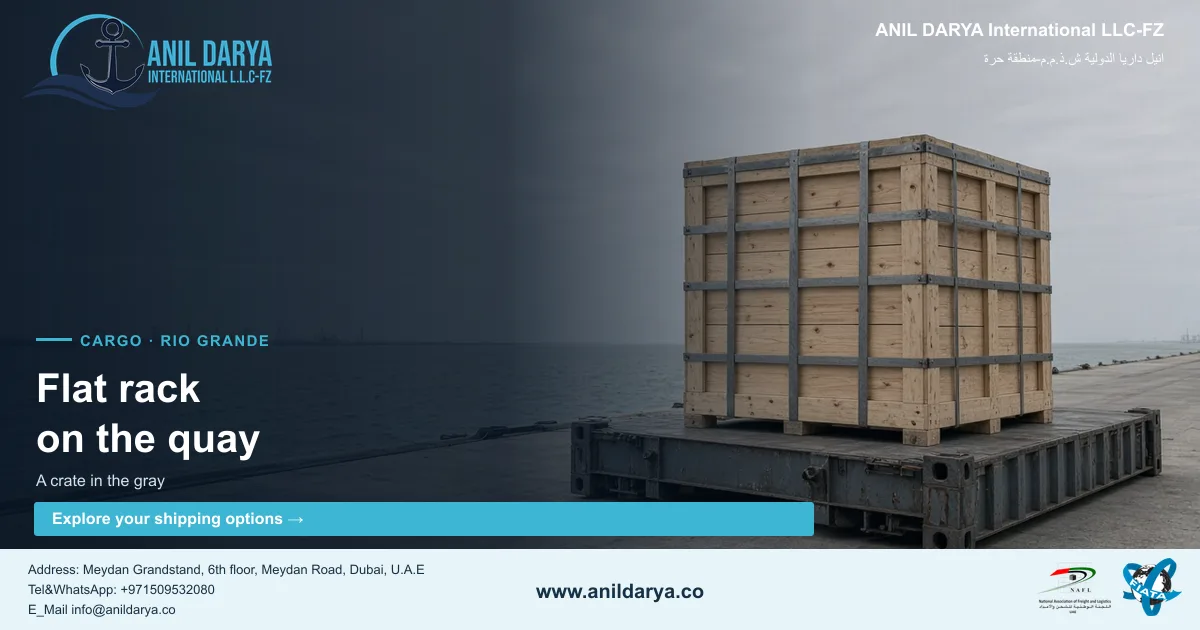
| Flat rack or open top | Machinery too tall or wide for a standard box | Lashing survey and special gear at the transshipment hub |
| LCL | A few pallets | Often routed through a Santos or Paranagua consolidator, then trucked; check the final deconsolidation point |
LCL into Rio Grande needs a close look. Not every consolidator unpacks at Rio Grande itself, and a quote "to Brazil" may end at a warehouse in another state. Ask where the box is opened and who pays for the last leg. Our guide to FCL vs LCL costs shows where a full box starts to make sense, and our sea freight service page explains what we book.
Breakbulk, project cargo and dangerous goods at Rio Grande
Rio Grande has a large industrial district next to the port. Datamar counts 54 companies operating there, about 39% of them in agribusiness, with chemicals, food and shipbuilding also present. New projects are coming: a pulp terminal for CMPC with Neltume Ports is planned to start construction at the end of 2026 and finish in 2028, and a biorefinery conversion is planned at the Riograndense refinery. Projects like these bring machinery, steel and modules by sea.
For a breakbulk or project shipment from the UAE to Rio Grande, we plan it in this order:
- Collect drawings, weights, dimensions, centre of gravity and lifting points for each piece.
- Choose between flat racks on a container service and a breakbulk or heavy-lift vessel.
- Check the current permitted berth and channel draft with the port authority and local agent, then confirm discharge equipment: ship’s cranes or shore gear.
- Agree the lashing and stowage plan with the carrier and order a survey at loading.
- Line up the trailer, escort and road permits on the Brazilian side with the consignee's agent.
Our break bulk and project cargo team handles the planning in the UAE, and our article on flat racks, open tops and out-of-gauge cargo explains the equipment choice.
DG to Rio Grande must follow the IMDG Code with the correct UN number, proper shipping name, class, packing group where assigned, safety data sheet and signed DG declaration. Where transshipment is included, each hub and carrier leg must accept the cargo. In Brazil, many chemicals also need consent from an agency before customs releases them, so the importer should check that before sailing. Our dangerous goods shipping team gets carrier and hub acceptance before you commit to a sailing.
How does cargo leave the Port of Rio Grande inland?
Most import boxes leave Rio Grande by truck. Three federal highways serve the port: BR-392, BR-471 and BR-116. BR-116 is a main route towards Porto Alegre. Confirm the actual road distance and truck route to the delivery address; an airport distance is not a reliable road-haulage distance.
| Mode | Route | What to know |
|---|---|---|
| Road | BR-392, BR-471, BR-116 | Main option for containers; the Pelotas road concession ends in 2026 |
| Rail | Southern rail network run by Rumo | Used mainly for grain; the concession ends in 2027 |
| Inland waterway | Lagoa dos Patos to Pelotas and Porto Alegre | Barges carry logs, fertilizer, wheat and some containers |
The waterway is a feature few Brazilian ports have. In 2025 the river port of Pelotas handled 1.17 million tonnes, mostly logs, and Porto Alegre's port handled fertilizer, wheat and salt by barge. For containers, the truck is still the normal choice, but if your consignee is near Porto Alegre and the cargo is not urgent, ask whether a barge leg is offered.
A decision rule: for a consignee within Rio Grande do Sul, ship to Rio Grande and truck. For a consignee in Uruguay or Argentina, ask your carrier whether its service relays the box from Rio Grande on a feeder, since Tecon already handles River Plate transshipment.
Customs at the Port of Rio Grande: a short summary
Customs rules at Rio Grande are the same as at any Brazilian port. Brazil is migrating imports from DI to Duimp in phases. The importer or broker must check the current Siscomex schedule for the operation and use Duimp where mandatory; legacy declarations remain subject to the transition rules. Eligible Duimp registrations can be made before arrival. Our Santos guide covers the full process and the tax list. Here is the short version and what to watch at Rio Grande.
| Step | Who does it | What to watch at Rio Grande |
|---|---|---|
| Importer registration (Radar) | Brazilian importer | Must be active in Siscomex before the cargo ships |
| NCM code and agency consent | Importer and customs broker | Fix before sailing; chemicals, food and some electronics need consent |
| Import declaration | Importer or broker | Check the current migration schedule; use Duimp where mandatory and register before arrival where permitted |
| Taxes and release | Importer and broker | Terminal storage runs until release |
| Onward move to Uruguay or Argentina | Carrier and destination broker | Booked as transshipment through Brazil, not a Brazilian import |
Documents you send from the UAE: a commercial invoice and packing list that match each other, the bill of lading, a certificate of origin where required, and compliant ISPM 15 treatment and marking for regulated solid-wood packaging; processed-wood and other exemptions must be checked. Our article on Incoterms 2020 for sea freight explains who pays which cost on each term.
How to ship from Dubai to the Port of Rio Grande: step by step
- Confirm the destination is Rio Grande, Brazil (BRRIG), and that the consignee is in or near Rio Grande do Sul.
- Check with the importer that their Radar registration is active and the NCM codes and any agency consents are settled.
- Send us the cargo details: commodity, HS code, weight, volume, packing, Incoterm and pickup point in the UAE.
- We quote FCL, LCL or breakbulk options and book space with a carrier that serves Rio Grande on the agreed routing.
- We arrange trucking to Jebel Ali or Khalifa Port and UAE export clearance.
- For DG, we get acceptance from the carrier and every hub port before loading.
- You send the invoice and packing list; we issue or check the bill of lading draft.
- The consignee’s broker confirms the applicable declaration and registers Duimp where required, before arrival where the procedure permits.
- After release, the box is collected from Tecon Rio Grande and trucked to the consignee.
If you load at Abu Dhabi instead of Dubai, our Khalifa Port guide covers that side.
How to ship from the Port of Rio Grande to Dubai
We also handle the other direction: shipping from Rio Grande to Dubai, with arrival at Jebel Ali, Khalifa Port or Sharjah port. We book the space with the carrier and run the UAE side. The Brazilian export filings stay with the shipper or its Brazilian agent.
The Brazilian export side
- DU-E. The exporter prepares the Declaracao Unica de Exportacao (DU-E) in the Portal Unico Siscomex. It replaced the older export registration routes.
- Clearance flow. Receita Federal's manual lists the order: the exporter files the DU-E, the terminal or warehouse receives the cargo, customs reviews and clears the DU-E, the terminal delivers the cargo for loading, the carrier records the loading data, and the system registers the shipment (averbacao) once the cargo is fully exported.
- Our part. We do not file Brazilian export declarations. The shipper or its Brazilian customs agent does, and we take over once the cargo is on board.
The UAE import side
On arrival in Dubai, the import declaration goes to Dubai Customs with the commercial invoice, the packing list, the certificate of origin and any permit for restricted goods. The carrier's agent also needs the bill of lading before it issues the delivery order. Customs duty in Dubai is 5% of the CIF value for most goods, with 50% on alcohol and 100% on cigarettes. Standard-rated import VAT is generally 5% of the customs value including freight and insurance, plus applicable customs duty and excise tax; exemptions and special treatment may apply. A VAT-registered importer whose customs number is registered with the Federal Tax Authority accounts for it on its VAT return. An importer that is not registered pays it before the goods are released.
- Send us the shipper's details in Rio Grande, the cargo, the HS code and the UAE delivery address.
- We book space from Rio Grande and send the booking, cut-offs and terminal details to the shipper.
- The shipper or its trucker delivers the cargo to Tecon Rio Grande or the terminal named on the booking inside the carrier's receiving window.
- The shipper or its Brazilian customs agent files the DU-E in the Portal Unico and follows it to clearance before loading.
- We check the draft bill of lading against the invoice and packing list before it is issued.
- We arrange the declaration with the customs authority for the UAE port of entry: Dubai Customs for Jebel Ali, Abu Dhabi Customs for Khalifa Port, or Sharjah Customs for a Sharjah arrival.
- We arrange payment of the duty and VAT and collect the delivery order from the carrier's agent.
- We truck the cargo to your site and return the empty container inside the free time.
Request a dated quotation identifying the carrier, loading and discharge ports, any transshipment, terminal and estimated transit for your cargo.
Free time, storage and demurrage at Rio Grande
Each carrier sets its own container free time at Rio Grande, and Tecon charges storage on its own tariff once the box is in the yard. Neither number is the same across carriers, so we do not quote one here. Ask for both on the quote.
Two habits keep these costs down: a broker who has the documents before the ship berths, and an importer whose NCM codes and consents are ready. Delays raise logistics costs, but terminal storage and handling should not automatically be added to the ICMS customs-expense base. Rio Grande do Sul guidance excludes port-operator charges not collected for the National Treasury through DARF or authorized PUCOMEX debit. Ask the importer’s tax adviser to apply the relevant state rules. Our article on demurrage and detention shows how the charges are worked out.
Rio Grande, Paranagua or Santos: which port fits your cargo?
| Question | Rio Grande | Paranagua | Santos |
|---|---|---|---|
| Where is the consignee? | Rio Grande do Sul, Uruguay border area | Parana, Santa Catarina, Paraguay | Sao Paulo state and the southeast |
| Main container terminal | Tecon Rio Grande (one main terminal) | TCP | Several on both banks |
| Container depth | 15 m at Tecon | Check per terminal | Varies by terminal |
| Inland waterway | Lagoa dos Patos barges | No | No |
| River Plate links | Transshipment to Uruguay and Argentina | Paraguay cargo | Not the usual route |
If two ports could work for your consignee, ask us to price both. The truck leg in Brazil often decides the total cost more than the ocean freight.
Checklist before you ship to the Port of Rio Grande
- Port code BRRIG on the booking, quote and bill of lading.
- Importer's Radar registration active.
- NCM codes agreed with the importer; agency consent in place for regulated goods.
- Invoice and packing list match in weights, quantities and descriptions.
- Regulated solid-wood packaging treated and ISPM 15 marked; exemptions checked.
- For reefers, set temperature and ventilation on the booking.
- For DG, UN number, class, SDS and DG declaration ready, and hub ports approved.
- For breakbulk, drawings, weights and lifting points sent, berth draft checked.
- Free time and Tecon storage terms known before the box sails.
- Final delivery point and inland mode agreed with the consignee.
Common mistakes when shipping to Rio Grande
- Booking to the wrong Rio Grande. Check the code is BRRIG, not a port in Argentina or Rio de Janeiro.
- Accepting an LCL quote "to Brazil" without asking where the box is unpacked.
- Letting the box sail before the NCM code and consents are settled.
- Planning a breakbulk ship using a directory draft rather than the current berth and channel restrictions.
- Forgetting that each hub on a transshipped lane must accept your DG class.
- Assuming the same free time as on a previous lane.
Frequently asked questions
Who manages the port in Rio Grande?
The port belongs to the Brazilian federal government, and its administration was delegated to the state of Rio Grande do Sul in 1997. The state runs it through its port company, Portos RS, which also oversees the ports of Pelotas and Porto Alegre.
What is the port code for Rio Grande, Brazil?
The UN/LOCODE is BRRIG. Use it on every booking so the cargo is not routed to Rio de Janeiro or a port with a similar name in another country.
How much cargo does the Port of Rio Grande handle?
Portos RS reported 40.9 million tonnes from January to November 2025, more than 96% of the state's public port cargo, and Datamar reports over 46 million tonnes for the full year 2025 including private terminals. Containers reached 934,691 TEU in the first eleven months of 2025.
Which container terminal is at Rio Grande?
Tecon Rio Grande, operated by Wilson Sons. It has 900 m of quay with three berths, 15 m of depth, nine ship-to-shore cranes, 2,800 reefer connections and a capacity of 1.42 million TEU a year. A reported expansion plan would extend the quay to 1,200 m; confirm project status with the operator.
What is the draft at the Port of Rio Grande?
Findaport lists a maximum draft of 15.0 m for container ships, 14.5 m for bulk carriers, 12.8 m for tankers, 12.2 m for breakbulk ships and 9.4 m for Ro-Ro ships. Confirm the berth and arrival draft with the carrier for each shipment.
Is there a direct ship from Dubai to Rio Grande?
Ask for the dated carrier schedule for your cargo and loading port. Confirm whether transshipment is included and check the connection and estimated arrival on the booking.
How far is the Port of Rio Grande from Porto Alegre?
Confirm the road distance to the actual delivery address rather than using the directory’s airport distance. Cargo moves north via the highway network; waterway options across the Lagoa dos Patos depend on service and cargo availability.
How do I clear goods at the Port of Rio Grande?
The Brazilian importer or broker checks the operation-specific migration schedule and uses Duimp where mandatory. Eligible Duimp registrations can be made before arrival; do not assume every operation has already migrated. The importer needs an active Radar registration, correct NCM codes and any agency consent the goods require.
Can you handle shipping from Rio Grande to Dubai?
Yes. We arrange the booking, documents, clearance with the customs authority at the UAE entry port, delivery order and trucking. Duty and VAT depend on classification, origin and applicable relief. The shipper or its authorized Brazilian agent handles the DU-E.
Get a quote for Port of Rio Grande shipping
Send us your cargo details and we will come back with a routing and price for shipping to Rio Grande from the UAE. Use our freight rate inquiry form, or contact our team if you want to talk through a reefer, DG or project shipment first.
Sources
- Siscomex: current phased DI and DSI shutdown schedule
- Receita Federal: migration from DI to Duimp
- Rio Grande do Sul tax authority: import ICMS customs-expense base, 5 February 2026
- Portos RS: current port regulations and draft restrictions
- IPPC: ISPM 15 explanatory document and processed-wood exemptions
- UAE Federal Tax Authority: VAT importers guide
- Receita Federal: Export manual, Portal Unico (DU-E prepared by the exporter, cargo reception, clearance, loading data, averbacao)
- Dubai Customs: Submit customs declaration (invoice, packing list, certificate of origin, permits)
- UAE Government portal: Customs duty (5% of CIF in Dubai, alcohol 50%, cigarettes 100%)
- Federal Tax Authority: VAT (5% rate)
- Federal Tax Authority: VAT guide, section 3.5 (import VAT at 5% on customs value, VAT return or payment before release)
- Rio Grande do Sul state government / Portos RS: January to November 2025 cargo, TEU, cargo mix and products (December 2025)
- Rio Grande do Sul state government / Portos RS: January to July 2025 results, fertilizer imports (August 2025)
- Datamar News: 2025 total, terminals list, industrial district, CMPC terminal (March 2026)
- Datamar News: January to May 2026 volumes by terminal and cargo (June 2026)
- Datamar News: Wilson Sons plans Tecon Rio Grande expansion (May 2026)
- Hellenic Shipping News: Rio Grande Container Terminal expansion and Southern Cone transshipment (May 2026)
- MundoMaritimo: Tecon Rio Grande quay, berths, depth, cranes, reefer connections, capacity (December 2025)
- Jornal do Comercio: Tecon Rio Grande 2024 volume, feeder partnership, road and rail concessions (October 2025)
- Findaport: Port of Rio Grande (maximum size by ship type, port areas, distances)
- Wikipedia: Port of Rio Grande (location, administration, breakwaters, highways)
- iContainers: Port of Rio Grande (UN/LOCODE)
- Receita Federal: Preparing the Duimp
- FreightAmigo: Shipping from Dubai to Brazil (Radar, NCM, ISPM 15)
Reviewed: 16 November 2026