
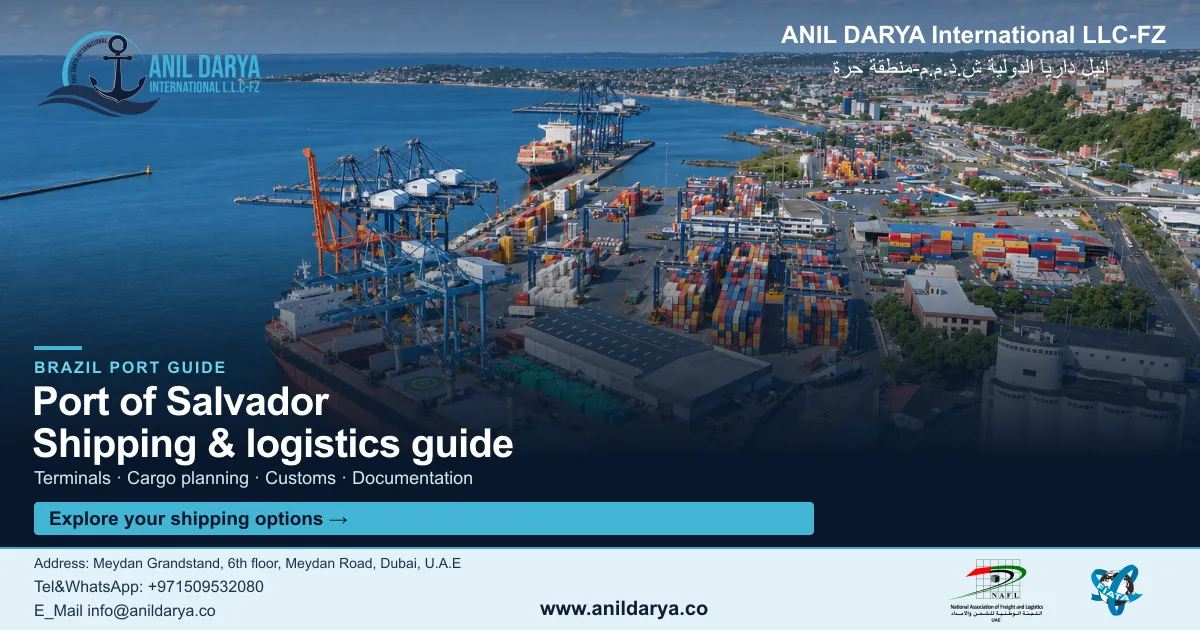
Port of Salvador shipping is how most container cargo reaches Bahia state in northeast Brazil. The port sits on the Bay of All Saints in the city of Salvador, is run by the federal port company Codeba, and its container terminal, Tecon Salvador, is being expanded from 553,000 TEU a year to over 1 million TEU. This guide covers the terminals, depth and cargo, and both directions of the lane: shipping from Dubai to Salvador, and shipping from Salvador to Dubai for UAE importers.
Port of Salvador guide: key facts at a glance
| Item | Detail |
|---|---|
| Port authority | Codeba (Companhia das Docas do Estado da Bahia), a federal company |
| Location | Bay of All Saints (Baia de Todos os Santos), city of Salvador, Bahia |
| UN/LOCODE | BRSSA |
| Quay | 2,085 m of berthing quay, protected by a breakwater, in three sections |
| Berths | 11 |
| Warehouses | 9 |
| Container terminal | Tecon Salvador (Wilson Sons), operating since 2000, 800 m berth |
| Container capacity | 553,000 TEU a year now; over 1 million TEU after the expansion |
| Channel depth | 15 m, up to 18 m depending on the tide; deepening to 17.5 m planned |
| Cargo in 2023 | 5.5 million tonnes, 43.2% of Bahia's public port throughput |
| Cargo, first half of 2026 | 3.79 million tonnes, up 20.94% on the same period of 2025 |
| Largest ships | 366 m New Panamax container ships call |
| Road and rail | Via Expressa Baia de Todos os Santos, BR-324, FCA railway |
| Other Codeba ports in Bahia | Aratu-Candeias and Ilheus |
| Customs authority | Receita Federal do Brasil (Duimp in the Portal Unico) |
Where is the Port of Salvador and what does it serve?
The port lies inside the Bay of All Saints, on the waterfront of Salvador's lower city. Two channels bring ocean-going ships into the bay, and the anchorage is 700 m wide with depths of 9 to 12 m. A breakwater protects the quay. It is one of the oldest ports in the Americas, and the first container terminal here opened in 1975.
Because the port is in the middle of a large city, the road link matters. Trucks leave by the Via Expressa Baia de Todos os Santos, which connects the port to the BR-324 federal highway. The FCA railway (Ferrovia Centro-Atlantica) also serves the port.
Salvador is the main container gate for Bahia, including the industrial and petrochemical complex built near the city in the 1970s. Codeba runs two other public ports in the state. Aratu-Candeias, also on the bay, handled 6.6 million tonnes in 2023. Ilheus, in the south of the state, handled about 556,000 tonnes. For containers, Salvador is the port you want.
Which terminals does the Port of Salvador have?
The port is a public port where Codeba leases areas to private operators. Three uses matter to shippers.
| Terminal or area | Operator | Main cargo |
|---|---|---|
| Tecon Salvador | Wilson Sons | Containers, dry and reefer |
| Public general cargo berths | Codeba with port operators | Breakbulk, steel, project cargo, bagged and bulk cargo |
| SSDA3 lease area | Lease approved by Antaq through a simplified process | Non-containerised general cargo |
| Passenger terminal | Contermas consortium, 25-year lease from 2016 | Cruise ships |
Tecon Salvador
Tecon Salvador has handled the port's container loading and unloading since 2000. It belongs to Wilson Sons, which has worked in Salvador for 185 years. The terminal's berth was extended to 800 m in an investment completed in 2023. In 2023 it moved 400,000 TEU, and its capacity stood at 553,000 TEU a year when the latest expansion was financed.
In November 2025 Brazil's development bank BNDES approved R$ 848 million of financing from the Merchant Marine Fund for the next phase. The works cover a larger storage yard, new port equipment, infrastructure and technology. Capacity will rise to over 1 million TEU a year, and quay productivity from 70 to more than 100 container moves per hour. No completion date was published, so ask us about the current status when you book.
How deep is Salvador and what ships can berth?
The access channel reaches 15 m, and up to 18 m depending on the tide. Codeba planned to deepen it to 17.5 m from 2025. In July 2024 the 366 m New Panamax MSC Orion opened what was described as the first direct line from Brazil's north and northeast to the Far East, calling Singapore and other Asian ports. Schedule trackers in November 2026 also showed 366 m container ships expected at Salvador.
Older directory figures, such as a 10 m maximum draft and 265 m LOA, do not match the 366 m ships now calling. Plan with the carrier's own acceptance for your ship size, not a directory number.
What cargo moves through the Port of Salvador?
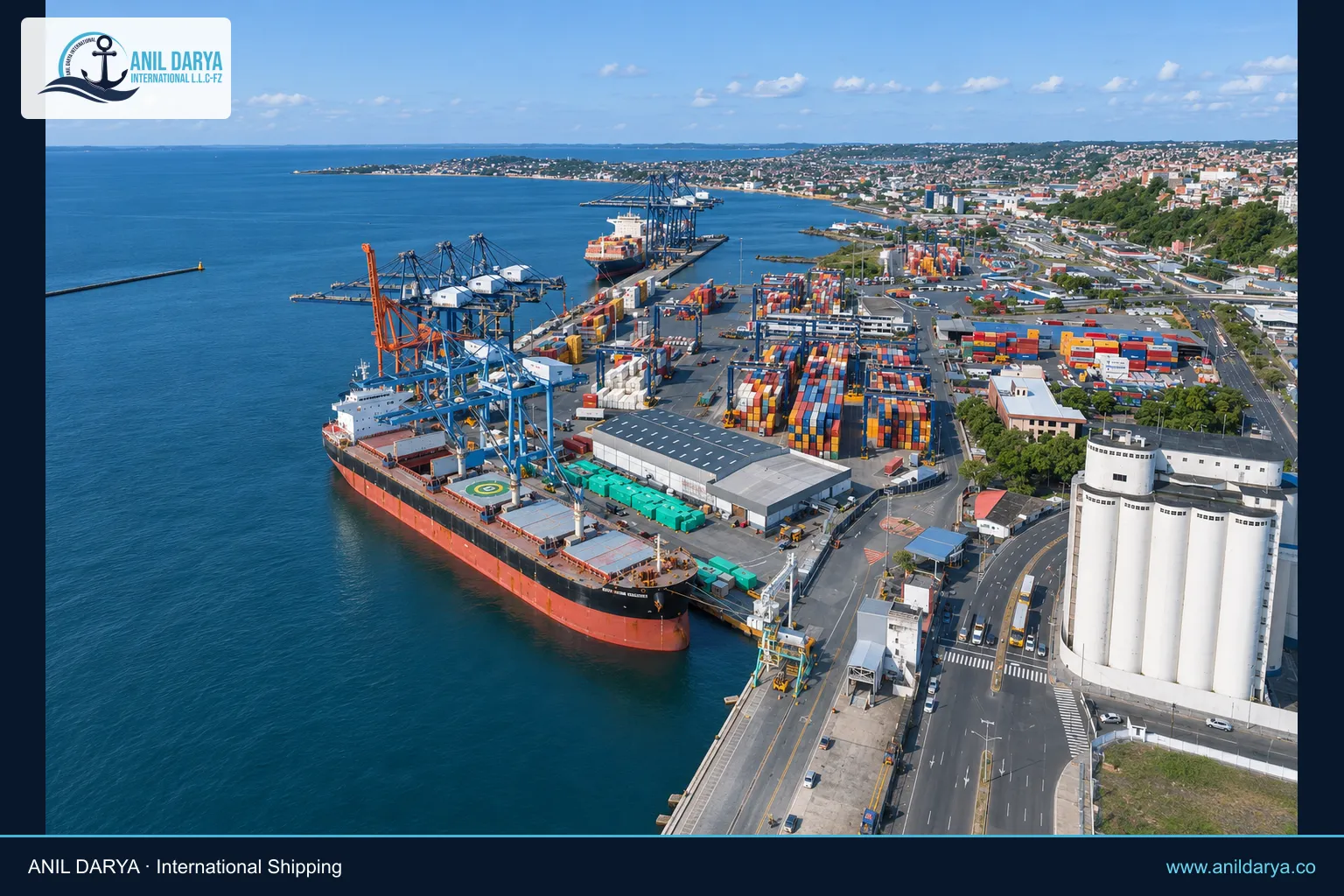
Salvador handled 5.5 million tonnes in 2023, nearly 5% more than in 2022 and 43.2% of all cargo at Bahia's public ports. In the first half of 2026 it moved 3.79 million tonnes, up 20.94%, with imports up 31.84% and exports up 2.47%. In June 2026 alone it handled 703,900 tonnes, up 44.52%. The Codeba ports together moved more than 13 million tonnes in 2025, and Salvador led them.
| Direction | Main cargo |
|---|---|
| Imports | Wheat and grains, food, chemicals, equipment, vehicles, malt, electronics |
| Exports | Chemicals and petrochemicals, metals and steel, ores, tyres, granite, fruit and juices, sisal, pulp, copper, vehicles |
For a shipper in the UAE, the import list is the useful part. Equipment, chemicals, electronics and food all move in containers through Tecon Salvador.
The export list tells you about equipment. Chemicals, tyres and fruit leave in containers, often reefers for fruit and juice, so empty reefer and dry boxes do come into the port. That helps importers who need reefers at the Bahia end.
Routes and carriers between the UAE and Salvador
We found no published direct UAE call at Salvador. Cargo from the UAE moves through at least one transshipment hub. Two examples from published sources show how this works.
- When MSC announced its Santana service in April 2025, the planned rotation ran from China through South Korea, Panama, the Dominican Republic, Pecem, Suape, Salvador, Santos, India and Singapore.
- Schedule aggregator Fluent Cargo lists Maersk routings from the UAE to Salvador with two transshipments, using the ME1 and NEO Bossa Nova services.
These are examples, not our booking plan. Carriers change rotations often, and the best hub for your cargo depends on the week.
[AMIR-FACT: the carriers and transshipment hub we actually use from Jebel Ali to Salvador, whether the box arrives on a deep-sea call or a coastal feeder, and our real port-to-port days in 2026]
FCL, LCL and reefer to Salvador
| Option | Fits | What to check for Salvador |
|---|---|---|
| FCL 20ft or 40ft | Machinery, chemicals in drums, building materials, consumer goods | Whether the service calls Salvador or ends at another port with a feeder |
| LCL | Small loads, samples, spare parts | Whether the consolidator delivers to Salvador or only to Santos |
| Reefer | Chilled and frozen food | Set temperature and a plug at every transshipment port |
| Flat rack or open top | Out-of-gauge equipment | Acceptance at each hub and on any feeder |
A rule for small loads: if the consignee is in Bahia, ask for a rate that ends at Salvador. An LCL rate to Santos plus a domestic leg north often costs more than you expect. Our FCL vs LCL guide shows where the break-even point usually sits, and our sea freight service can price both.
Breakbulk, project cargo and dangerous goods at Salvador
Steel, metals and equipment are on both the import and export lists, and the public berths take non-containerised general cargo. Antaq has approved a new lease, SSDA3, specifically for non-containerised general cargo. The petrochemical complex near the city and other Bahia industry generate project moves.
For a breakbulk or project shipment from the UAE to Salvador, we plan it this way:
- Collect drawings, weights, dimensions and lifting points for every piece.
- Choose between flat racks on a container service and conventional breakbulk tonnage.
- Confirm the berth in Salvador and whether the terminal or the ship's gear will lift the piece.
- Check the road route through the city with the consignee, since oversized loads leave by the Via Expressa.
- Prepare customs before arrival so the cargo does not sit in storage.
Our break bulk and project cargo team handles the UAE side, and our guide to flat rack, open top and out-of-gauge cargo explains equipment limits.
Chemicals are among Salvador's main imports and exports, so DG in containers is routine here. What decides your booking is acceptance of your IMDG class by the carrier and every hub on the route. We collect the SDS, UN number, class and packing group and the signed DG declaration, then get the line's acceptance before you commit. Segregation inside the box also matters for mixed chemical loads, which our article on IMDG segregation in containers explains. The Brazilian importer must confirm any agency consent for the product. Our dangerous goods shipping team runs these checks.

Customs at the Port of Salvador: a short summary
Salvador follows the same national customs process as every Brazilian port. Our Santos guide covers the Duimp process and the tax list in full. Here is the short version and what to watch in Salvador.
| Step | Who does it | What to watch at Salvador |
|---|---|---|
| Importer habilitation (Radar) | Brazilian importer | The Duimp is for importers outside the limited modality, so check the buyer's status before shipping |
| NCM code and agency consent | Importer and customs broker | Food, chemicals and electronics often need consent before loading |
| Duimp registration | Importer or its representative | Can be registered before arrival, which keeps the box from sitting at Tecon Salvador |
| Taxes and release | Importer and broker | II, IPI, PIS/COFINS, AFRMM, ICMS and the Siscomex fee are paid before release |
The documents common to every import declaration are the bill of lading, commercial invoice, packing list, proof of origin, cargo manifest and papers that prove the sale. From the UAE, send an invoice and packing list that match, the bill of lading, a certificate of origin where the importer needs one, and ISPM 15 marked wood packaging. Food, cosmetics and some electronics often need ANVISA or MAPA approval, so the importer should confirm this before you ship.
Shipping from Dubai to Salvador: step by step
- Confirm the destination is Salvador (BRSSA), not Aratu, and give the consignee's city.
- Check with the importer that its habilitation is active and NCM codes and consents are settled.
- Send us the cargo details: commodity, HS code, weight, volume, packing, Incoterm and pickup point in the UAE.
- We quote FCL, LCL or breakbulk options and book space with a carrier that delivers to Salvador through a hub.
- We tell you and the consignee the hub and whether the last leg is a deep-sea call or a coastal feeder.
- We arrange trucking to Jebel Ali Port and UAE export clearance.
- For DG, reefer or out-of-gauge cargo, we get acceptance from the carrier and each hub before loading.
- We check the draft bill of lading against your invoice and packing list, and release the bill after sailing.
- The consignee's broker registers the Duimp, ideally before the vessel reaches Salvador.
- After release, the box leaves Tecon Salvador by truck and the empty goes back within free time.
How to ship from Salvador to Dubai
We also handle the reverse lane for UAE importers. Shipping from Salvador to Dubai fits what Bahia already exports: chemicals and petrochemicals, metals, tyres, granite, fruit and juices, pulp and copper all leave through the port. We book space with carriers from Salvador through a hub to Jebel Ali Port, Khalifa Port or Sharjah, and take over at the UAE end. We have no office in Brazil, so the export side at origin is handled by the supplier or its forwarding agent.
| Stage | Who does it | What happens |
|---|---|---|
| Booking | We book with the carrier | Space from Salvador to the UAE port, with the hub and empty pickup at Tecon Salvador confirmed for the supplier |
| Brazilian export clearance | Supplier or its origin agent | The exporter files a DU-E in the Portal Unico; the cargo is presented to customs, released, and the carrier reports the loading |
| Bill of lading | Carrier, checked by us | We check consignee, weights and HS codes against the invoice before release |
| UAE customs clearance | We arrange it through a licensed clearing agent | Declaration filed before arrival; duty in Dubai is 5% of CIF value for most goods |
| Delivery | We arrange it | Truck from the terminal to your site or free zone, empty returned within free time |
- Send us the supplier's details, the cargo, the Incoterm (FOB Salvador is common) and the UAE delivery address.
- We quote and book space, and send the booking and cut-off dates to the supplier.
- The supplier stuffs the box, files the DU-E and gets the cargo released by Brazilian customs.
- For chemicals, the supplier sends the SDS and DG declaration, and we confirm the line and every hub accept the class before loading.
- We collect the invoice, packing list, certificate of origin and bill of lading, plus any UAE permit needed for restricted goods.
- We file the UAE declaration before the vessel arrives, collect the delivery order and deliver to your site.
Dubai Customs needs a customs business code from the importer, or a licensed clearing agent with the owner's authorisation. Import VAT also applies, and how it is paid depends on your VAT registration. If the goods will be re-exported from the UAE, tell us before arrival so the right declaration type is used.
[AMIR-FACT: the carriers and hub we actually use from Salvador to Jebel Ali, and our real port-to-port days for this direction]
Free time, storage and demurrage at Salvador
Each carrier sets its own free time at Salvador, and Tecon Salvador charges storage on its own tariff. We do not quote a figure here. Ask for both on the quote. If the box first lands at another Brazilian port and comes on by feeder, check when free time starts.
Two things keep the bill down: a broker who has the documents before the ship berths, and an importer whose consents are ready. Storage and handling also go into the base of the state ICMS tax, so delays cost twice. Our article on demurrage and detention explains how the charges are worked out.
Recent and planned changes at the Port of Salvador
| Change | Status | Effect for shippers |
|---|---|---|
| Tecon Salvador berth extended to 800 m | Completed in 2023 | Room for 366 m ships |
| Direct Asia line with New Panamax ships | Started July 2024 | More deep-sea options via Singapore |
| Tecon Salvador expansion, R$ 848 million | Financing approved November 2025 | Capacity to over 1 million TEU, faster quay work |
| Channel deepening to 17.5 m | Planned by Codeba from 2025 | Deeper loaded ships |
| SSDA3 general cargo lease | Approved by Antaq | More capacity for breakbulk |
| Partial concession of Codeba ports | New proposal being drafted | Possible change of port manager in future |
Salvador, Suape or Santos: which port fits your cargo?
| Question | Salvador | Suape | Santos |
|---|---|---|---|
| Where is the consignee? | Bahia state | Pernambuco and the central northeast | Sao Paulo state and the southeast |
| Container terminals | One: Tecon Salvador | Two | Several on both banks |
| Main strength | City port with growing container capacity | Deep water, liquid bulk, vehicles | Largest service network in Brazil |
| Container route from the UAE | Via a hub or coastal feeder | Via a hub or coastal feeder | More direct deep-sea options |
If your consignee is in Bahia, Salvador saves a long truck run from the south. If two ports could work, ask us to price both, since the inland leg often decides the total cost in Brazil.
Checklist before you ship to the Port of Salvador
- Port code BRSSA on the booking, quote and bill of lading.
- Importer's habilitation active and broker named.
- NCM codes agreed; ANVISA or MAPA consent in place for regulated goods.
- Invoice and packing list match in weights, pieces and descriptions.
- Wood packaging ISPM 15 marked.
- Hub and last leg known: deep-sea call or coastal feeder.
- For reefers, set temperature and ventilation on the booking.
- For DG, UN number, class, SDS and DG declaration ready, and every hub's acceptance confirmed.
- For breakbulk, drawings and lifting points sent, and the road route through the city checked.
- Free time and storage terms known before the box sails.
- For imports to the UAE: supplier ready to file the DU-E, UAE permits in hand and a customs business code or clearing agent authorised.
Common mistakes when shipping to Salvador
- Booking to Aratu when the cargo should go to Salvador, or the reverse. Both are on the same bay but are different ports.
- Accepting an LCL rate "to Brazil" that ends in Santos, then paying for a long domestic leg.
- Planning ship size on old directory drafts instead of the carrier's acceptance.
- Letting the box sail before NCM codes and agency consents are settled.
- Forgetting that every hub on a transshipped lane must accept your DG class.
- Assuming free time starts in Salvador when the box first lands at another Brazilian port.
- On imports to Dubai, applying for a UAE permit only after the vessel arrives.
Frequently asked questions
Where is Salvador port located?
The Port of Salvador is on the Bay of All Saints, on the waterfront of the city of Salvador in Bahia state, northeast Brazil.
What is the port code for Salvador in Brazil?
The UN/LOCODE is BRSSA. Use it on bookings and bills of lading so the cargo is not routed to Aratu or another bay port.
Who operates the container terminal at Salvador?
Tecon Salvador, part of the Wilson Sons group, has run container operations at the port since 2000. The port itself is managed by Codeba.
How much container capacity does Salvador have?
Tecon Salvador's capacity is 553,000 TEU a year. A R$ 848 million expansion financed by BNDES in November 2025 will raise it to over 1 million TEU.
How deep is the water at Salvador?
The access channel reaches 15 m, and up to 18 m depending on the tide. Codeba planned to deepen it to 17.5 m, and 366 m container ships already call.
Is there a direct ship from Dubai to Salvador?
We found no published direct UAE call at Salvador. Cargo from Jebel Ali moves through a transshipment hub, then on a deep-sea loop or coastal feeder that calls Salvador.
Can you arrange shipping from Salvador to Dubai?
Yes. We book space with carriers from Salvador to Jebel Ali, Khalifa Port or Sharjah through a hub. The supplier or its agent handles Brazilian export clearance, and we arrange UAE customs clearance and delivery.
What cargo does the Port of Salvador handle?
Containers, general cargo and bulk. Main imports include wheat, food, chemicals, equipment and vehicles, and exports include chemicals, metals, tyres, fruit and pulp.
How do I clear goods at the Port of Salvador?
The Brazilian importer or its broker registers a Duimp in the Portal Unico, which can be done before arrival, pays the import taxes and attaches the documents. The Receita Federal then releases the cargo or selects it for checks.
Get a quote for Port of Salvador shipping
Send us your cargo details and the delivery city, and we will come back with a routing and a price, from Dubai to Salvador or from Salvador to Dubai. Use our freight rate inquiry form, or contact our team to talk through a breakbulk, project or DG shipment first. You can also read more about our Dubai freight forwarding team.
Sources
- Wikipedia (Portuguese): Porto de Salvador (quay, berths, warehouses, Tecon, cruise terminal, trade, access)
- Wikipedia: Port of Salvador (operator, channels, anchorage, first container terminal)
- Agencia iNFRA: Salvador container terminal to get direct Asia line (August 2024, updated May 2026)
- Agencia iNFRA: BNDES approves R$ 848 million for Salvador container terminal (November 2025)
- Movimento Economico: Tecon Salvador to double capacity (November 2025)
- Agencia iNFRA: Bahia ports post record revenue in 2025 (April 2026)
- Agencia iNFRA: Port of Salvador articles (SSDA3 lease, Codeba concession)
- Ministry of Ports and Airports: Ports in the first half of 2026 (August 2026)
- DatamarNews: Port of Salvador growth in Bahia throughput (February 2024)
- DatamarNews: Santana service rotation (April 2025)
- Fluent Cargo: UAE to Salvador routings
- VesselFinder: Port of Salvador expected ships
- ShipNext: Salvador port directory data
- Receita Federal: Preparing the Duimp
- Gov.br: Declare imported goods (documents)
- Invest and Export Brasil: Tax treatment on imports
- Receita Federal: Export via DU-E in the Portal Unico
- Dubai Customs: FAQ (duty rate, business code, clearing agents)
- UAE Government portal: Customs duty
- FreightAmigo: Shipping from Dubai to Brazil (Radar, ANVISA/MAPA, ISPM 15)
Reviewed: 10 November 2026