
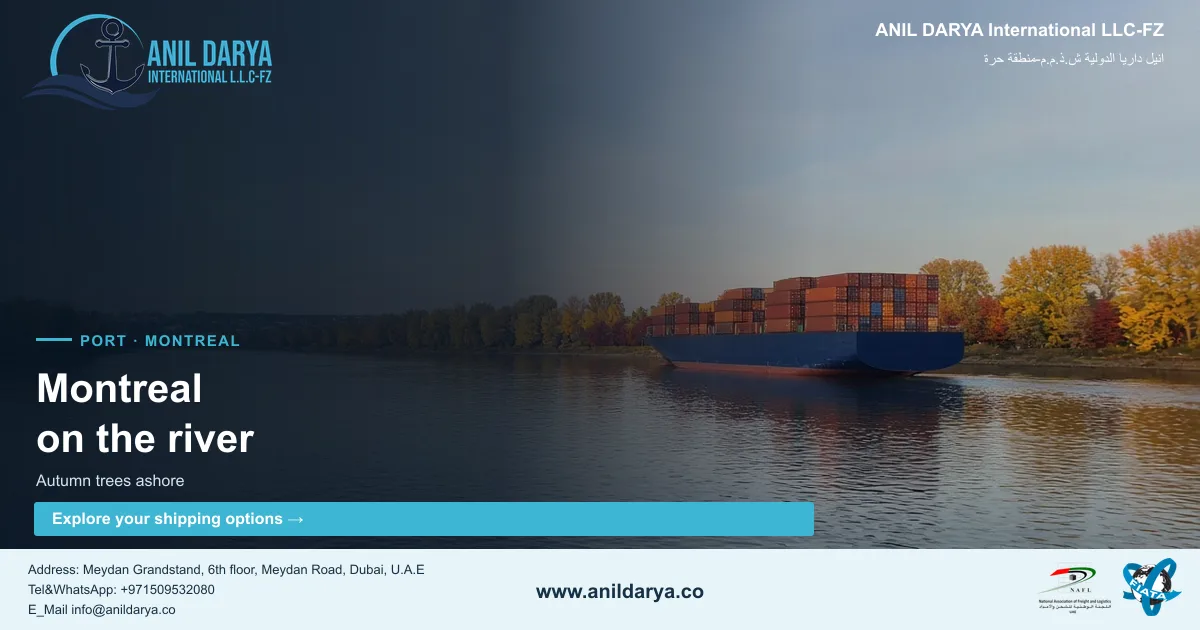
Port of Montreal shipping means moving cargo through Eastern Canada's main container port, about 1,600 km up the St. Lawrence River from the Atlantic. Four international container terminals, each with dockside rail, feed Quebec, Ontario and the US Midwest. If you are shipping from Dubai to Montreal, your box is transshipped on the way, so this guide covers the terminals, the river limits on ship size, the CBSA rules that start before loading in the UAE, and the steps we follow so the cargo clears on time. We ship both ways: from Dubai to Montreal, and from Montreal to Dubai with UAE clearance on arrival.
Port of Montreal: key facts at a glance
| Item | Detail |
|---|---|
| Port authority | Montreal Port Authority (MPA), a federal port authority |
| UN/LOCODE | CAMTR |
| Location | Island of Montreal, Quebec, plus land at Contrecoeur about 40 km downstream |
| Distance from the Atlantic | About 1,600 km inland on the St. Lawrence River |
| Total cargo (2025) | 34.3 million tonnes |
| Containers (2025) | 1.52 million TEU, 12.3 million tonnes of containerized goods |
| Container terminals | Five: Viau, Maisonneuve, Cast and Racine (international), Bickerdike (domestic) |
| Depth alongside container berths | 10.8 m at chart datum (8.8 m at Bickerdike) |
| Railways | CN and CPKC, with dockside rail at every international container terminal |
| Season | Open all year; year-round navigation since 1964 |
| Reach | Trade with more than 140 countries |
| New terminal | Contrecoeur, 1.15 million TEU a year, commissioning planned for 2030 |
| Customs authority | Canada Border Services Agency (CBSA) |
| Taxes at import | 5% GST on value for duty plus duty; Quebec sales tax is 9.975% |
| Montreal to Dubai | We book from Montreal and clear at Jebel Ali, Khalifa Port or Sharjah; the CBSA export declaration stays with the shipper or its agent |
What is the Port of Montreal and why does the river matter?
The Port of Montreal is run by the Montreal Port Authority, a federal port authority. The MPA owns the land and sets the port tariff. Private operators run the terminals: Termont Montreal and Montreal Gateway Terminals Partnership (MGT) for international containers, QSL for domestic containers, and Logistec for bulk and general cargo.
The port sits far inland. Ships sail about 1,600 km up the St. Lawrence from the open sea, which puts cargo close to Canada's biggest consumer markets. The MPA says it can reach more than 110 million consumers in Canada, the US Midwest and the US Northeast in under two days by rail or truck. Toronto is about 5 hours away by the Trans-Canada Highway.
The trade-off is ship size. The river channel limits draft, so Montreal does not take the largest container ships. Wikipedia gives a channel and port draft of 11.3 m and a maximum container ship of about 6,700 TEU. The MPA's own real-time page reported a channel depth of 11.26 m at Jetée 1 on the day we checked, and it publishes live water levels from 14 tide gauges between Montreal and Quebec City. Water is highest in the spring flood (April to May) and lowest from August to October.
A practical rule: carriers serve Montreal with mid-size ships on direct Atlantic services, and your cargo from the UAE joins one of them at a hub in Europe or the Mediterranean. That is why the routing, not just the destination, decides your transit time.
Which container terminals does the Port of Montreal have?
There are four international container terminals and one domestic terminal. The MPA says each international terminal can berth two post-Panamax ships at once and has dockside rail access.
| Terminal | Operator | Area | Berths and length | Ship-to-shore cranes | Handling capacity | Storage |
|---|---|---|---|---|---|---|
| Cast | MGT | 76 acres | 3 berths, 740 m | 4 | 800,000 TEU | 20,000 TEU |
| Viau | Termont | 55 acres | 2 berths, 630 m | 4 | 600,000 TEU | 17,000 TEU |
| Racine | MGT | 61 acres | 3 berths, 770 m | 5 | 500,000 TEU | 15,000 TEU |
| Maisonneuve | Termont | 50 acres | 3 berths, 630 m | 4 | 450,000 TEU | 12,500 TEU |
| Bickerdike (domestic) | QSL | 24 acres | 2 berths, 357 m | 2 | 150,000 TEU | 4,500 TEU |
All four international terminals list 10.8 m depth alongside at chart datum. Bickerdike, at 8.8 m, mainly handles domestic boxes between Montreal and St. John's, Newfoundland and Labrador, plus breakbulk and Ro-Ro.
Which lines call at which terminal?
The MPA's cold chain page lists CMA CGM, COSCO, Hapag-Lloyd, Maersk and OOCL at the MGT terminals (Cast and Racine), and COSCO, Hapag-Lloyd, MSC and OOCL at the Termont terminals (Maisonneuve and Viau). You do not choose the terminal. The carrier's service does. Check the terminal on the arrival notice, because gate hours and rules differ. MGT, for example, lists truck hours at Racine (section 62) and Cast (section 77) of 06:00 to 23:00 on weekdays, with both closed on Saturday.
Reefer capacity
The MPA reports more than 200% growth in refrigerated container traffic over five years. Cast has the most reefer power, with 420 electrical plugs plus generator outlets. Maisonneuve and Racine list 288 and 280 plugs plus generator outlets. If you ship chilled food from the UAE, ask the carrier which terminal its service uses before you book.
Port of Montreal rail and road links to inland Canada and the US
Rail is the main reason shippers choose Montreal. The port has direct access to CN and CPKC, and Wikipedia records more than 100 km of port track. Each international terminal has its own rail tracks at the quay.
| Terminal | On-dock rail capacity |
|---|---|
| Cast | 120 x 89-ft cars, 8 tracks |
| Racine | 120 x 89-ft cars, 4 tracks |
| Maisonneuve | 110 x 89-ft cars, 4 tracks |
| Viau | 85 x 89-ft cars, 5 tracks |
| Bickerdike | 50 railcars |
A decision rule for inland delivery: if your consignee is in Quebec or eastern Ontario, a truck from the terminal gate is usually simplest. For Toronto, the wider Ontario market or the US Midwest, ask for a through rail routing at booking. Wikipedia's regional breakdown of the port's traffic shows 53% tied to Quebec, 29% to Ontario, 10% to Western Canada and 8% to the US, which matches this pattern.
If your cargo goes to British Columbia or Alberta, Montreal is the wrong gate. Ship to the west coast instead. Our Port of Vancouver guide covers that lane.
What cargo moves through the Port of Montreal?
Montreal is a diversified port. In 2025 it handled 34.3 million tonnes: about 13.4 million tonnes of liquid bulk, 8.3 million tonnes of dry bulk, 12.3 million tonnes of containerized cargo and 0.23 million tonnes of non-containerized general cargo.
| Containerized goods, 2025 | Inbound (tonnes) | Outbound (tonnes) |
|---|---|---|
| Food products | 1,953,778 | 861,625 |
| Miscellaneous metallurgical products | 574,746 | 299,936 |
| Steel products | 452,749 | 189,855 |
| Building materials | 404,236 | 26,149 |
| Forest products | 335,299 | 874,308 |
| Chemical products | 213,255 | 86,681 |
| Textile products | 112,964 | 97,724 |
That mix suits typical cargo from the UAE: building materials, steel and aluminium products, chemicals and food. Wikipedia lists the Middle East as the origin of 8% of Montreal's imports. The MPA adds that Asia, the Middle East and Latin America together make up nearly 35% of its container market.
Breakbulk and project cargo at Montreal
Non-containerized cargo goes mainly through Logistec. Its Laurier terminal (berth 43) is 266 m long with 10.2 m depth alongside and 31,082 m2 of open area. In Montreal Logistec lists mobile harbour cranes of 64, 104 and 144 tonnes and two 80-tonne crawler cranes, with a maximum tandem lift of 240 tonnes. At Contrecoeur it has a rail-mounted harbour crane rated at 124 tonnes on a 229 m berth with 10.8 m depth.
For a heavy piece from the UAE, the real question is whether it goes in a container on a flat rack or as breakbulk on a multipurpose ship. Many container services to Montreal transship in Europe, and the flat rack must be accepted at every hub on the way. Our guide to flat rack, open top and breakbulk cargo explains the choice, and our break bulk and project cargo service covers the origin side in the UAE.
Shipping from Dubai to Montreal: routings and transit
We found no direct sailing from the UAE to Montreal in the schedule data we checked. Cargo is transshipped, often in the Mediterranean. The MPA says its direct links run to Northern Europe, the Mediterranean and Latin America, and that it connects to transshipment ports in Europe, the Mediterranean and the Caribbean.
| Routing (Fluent Cargo data) | Transit shown | Transfers | Frequency |
|---|---|---|---|
| Sea: Jebel Ali to Montreal, CMA CGM (GULFEMIR, EPIC, MEDCAN) | 39 days 14 hours | 2 | Every 2 to 4 weeks |
| Air: Dubai (DXB) to Montreal (YUL) | 13 hours 33 minutes | Direct | Every 1 to 2 days |
In October 2026, OOCL and COSCO SHIPPING Lines started the weekly GEX3 service linking Montreal with Tangier, Salerno, Livorno, Genoa, Fos-sur-Mer, Sagunto and Algeciras. The MPA says the Mediterranean accounts for 20% of its overseas trade, and calls these ports connection points to Asia and India. For you, that means more Mediterranean hubs where a box from the Gulf can meet a Montreal-bound ship.
These figures are port-to-port indications from schedule data, not promises. Add UAE trucking and export clearance at origin, and CBSA release and delivery at Montreal. Our Jebel Ali port shipping guide covers the origin side.
[AMIR-FACT: the carrier services we book from Jebel Ali to Montreal, the transshipment hub they use, which Montreal terminal they discharge at, and our typical port-to-port and door-to-door days on this lane]
FCL or LCL to Montreal?
With FCL you book a whole 20ft, 40ft or 40ft high cube container. With LCL your cargo shares a box packed at a UAE container freight station, then is unpacked at a warehouse in Montreal. LCL release depends on every shipment in the box clearing, so it can take longer at destination. If your cargo fills more than about half a 20ft box, get both prices. Our FCL vs LCL cost comparison shows how, and our sea freight service explains what we book from the UAE.
Customs at the Port of Montreal: a short CBSA summary
Montreal follows the same federal rules as every Canadian port. Our Port of Vancouver guide covers them in full, so here is the short version with the points that trip up UAE shippers.
| Rule | What it means for a box from Dubai |
|---|---|
| Advance cargo data | For containers loaded outside the US, the carrier must send cargo data to the CBSA 24 hours before loading. Forwarders send house bill data on consolidated cargo. |
| Importer registration | The importer needs a business number (BN9), an import program account (together the BN15) and a CARM Client Portal account. Non-residents get the BN9 from the Canada Revenue Agency first. |
| Customs broker | The importer must be registered in CARM before delegating a broker in the portal. |
| Release and payment | Each shipment gets a 14-digit transaction number. With Release Prior to Payment and financial security, you pay by the due date; without it, you pay at release. |
| Duty | 10-digit tariff numbers. UAE-origin goods pay the Most-Favoured-Nation rate. |
| Trade agreement | Canada and the UAE signed a CEPA on 27 October 2026. It is not yet in force. |
| Wood packaging | Non-compliant wood packaging may be refused entry. Packaging made entirely of manufactured material such as plywood or cardboard is exempt. |
Taxes on goods landed in Montreal
The CBSA charges 5% GST on the value for duty plus duty. Quebec does not use HST. The Canada Revenue Agency lists the Quebec sales tax at 9.975%, separate from GST. Ask your broker how QST applies to your goods, since it depends on what you import and who sells or uses it in Quebec. If the cargo is for Ontario, the HST rate there is 13%.
Port of Montreal charges
The MPA's tariff covers harbour dues and berthage paid by the ship, and wharfage paid by cargo through the carrier. Terminal handling, storage, demurrage and detention are set separately by the terminal operators and carriers. Our note on demurrage and detention explains how these add up when release is late.

Dangerous goods through the Port of Montreal
The MPA requires a dangerous goods permit before any dangerous goods are moved in the port. The person responsible for the vessel files the form, and the MPA publishes a list of dangerous goods under surveillance and separate limits for explosives. Canada's Transportation of Dangerous Goods Regulations include a marine part built around the IMDG Code.
For you as shipper, the work starts in the UAE. You need the UN number, proper shipping name, class, packing group, a safety data sheet, a signed DG declaration and UN-approved packaging. The carrier, each transshipment hub and the Montreal terminal must accept the class. Our dangerous goods shipping team gets that acceptance before we confirm the booking.
Every shipper must also give the carrier a verified gross mass (VGM) for each packed container, which the MPA lists in its port regulations.
Contrecoeur: the next Port of Montreal terminal
The MPA says its terminals on the island will soon reach full capacity. Its answer is a new container terminal at Contrecoeur, about 40 km downstream, on land it bought between 1988 and 1992. When running, it will handle 1.15 million TEU a year, which the MPA says equals 60% of the containers handled in Montreal today. It will have two berths, an intermodal rail yard and a truck gate.
In-water works start in 2026, land works in 2027, and completion and commissioning are planned for 2030. The MPA signed a joint development agreement with DP World in September 2025. Until then, all container cargo for Montreal uses the island terminals.
How to ship from Dubai to the Port of Montreal: step by step
- Confirm the delivery address, the Incoterm and who is the importer of record in Canada.
- Check the importer has a BN15, a CARM account and a broker delegated in CARM.
- Send us HS codes, a precise description, weights, volume and origin of the goods.
- We compare routings to Montreal, check the hub and the discharge terminal, and confirm space.
- Check wood packaging, food and plant rules, and DG acceptance for your goods.
- We arrange trucking and UAE export clearance and deliver before the cut-off.
- The carrier sends cargo data to the CBSA 24 hours before loading; we send house bill data for LCL.
- We issue the bill of lading and send documents to the consignee or its broker.
- The broker requests release and pays or secures duty and GST.
- The trucker or railway collects the box, and the empty goes back within free time.
If you want us to handle the whole lane from the UAE side, start with our Dubai freight forwarding team.
How to ship from the Port of Montreal to Dubai
We also handle the other direction: shipping from Montreal to Dubai, with arrival at Jebel Ali, Khalifa Port or Sharjah port. We book the space with the carrier and run the UAE side. The Canadian export filings stay with the shipper or its Canadian agent.
The Canadian export side
- Export declaration. Commercial goods going to a country other than the US need one when they are worth CAN$2,000 or more, and restricted goods always need one. The exporter files it in the CBSA's Canadian Export Reporting System (CERS) or by G7 EDI. It can hand the filing to a customs service provider but stays responsible for the data.
- Timing. For marine shipments the declaration must be in at least 48 hours before the goods are loaded on the vessel. The exporter gives the carrier the proof-of-report number that CERS issues.
- Accounts and permits. The exporter needs a business number with an RM export program account, set up through the CARM Client Portal. Controlled, regulated or prohibited goods may need a permit, certificate or licence before export.
The UAE import side
On arrival in Dubai, the import declaration goes to Dubai Customs with the commercial invoice, the packing list, the certificate of origin and any permit for restricted goods. The carrier's agent also needs the bill of lading before it issues the delivery order. Customs duty in Dubai is 5% of the CIF value for most goods, with 50% on alcohol and 100% on cigarettes. Import VAT is 5% of the customs value, which includes insurance and freight. A VAT-registered importer whose customs number is registered with the Federal Tax Authority accounts for it on its VAT return. An importer that is not registered pays it before the goods are released.
- Send us the shipper's details in Montreal, the cargo, the HS code and the UAE delivery address.
- We book space from Montreal and send the booking, cut-offs and terminal details to the shipper.
- The shipper or its trucker delivers the cargo to the Montreal terminal named on the booking inside the carrier's receiving window.
- The shipper or its Canadian agent files the export declaration in CERS at least 48 hours before loading and passes the proof-of-report number to the carrier.
- We check the draft bill of lading against the invoice and packing list before it is issued.
- We file the Dubai Customs declaration before the ship arrives.
- We arrange payment of the duty and VAT and collect the delivery order from the carrier's agent.
- We truck the cargo to your site and return the empty container inside the free time.
[AMIR-FACT: the carriers we actually use from Montreal to Jebel Ali/Khalifa/Sharjah and our real transit days in this direction]
Checklist before you ship to Montreal
- Importer of record has a BN15, CARM access and a delegated broker.
- Precise cargo description and 10-digit tariff number ready.
- Invoice shows description, price and terms of sale.
- Wood packaging compliant, or non-wood packaging used.
- DG acceptance confirmed with the carrier, every hub and the terminal.
- Reefer plug availability checked for chilled cargo.
- Inland leg agreed: truck from the gate or through rail.
- VGM ready for each packed container.
Common mistakes when shipping from Dubai to Montreal
- Expecting a three-week transit. Published schedule data shows about 40 days with two transfers.
- Booking to Montreal for a consignee in British Columbia or Alberta.
- Assuming every carrier calls Montreal directly. Many use a hub, and the hub decides DG and flat rack acceptance.
- Late cargo data, so the box misses the vessel in the UAE.
- Leaving CARM registration until the ship is on the river.
- Forgetting that free time is set by the terminal and carrier, not the port authority.
Frequently asked questions
Who manages the Montreal port and its terminals?
The Montreal Port Authority, a federal port authority, manages the port. Termont runs the Viau and Maisonneuve container terminals, Montreal Gateway Terminals runs Cast and Racine, QSL runs Bickerdike and Logistec handles bulk and general cargo.
How many container terminals does the Port of Montreal have?
Five. Viau, Maisonneuve, Cast and Racine handle international containers, and Bickerdike handles mainly domestic containers to Newfoundland and Labrador.
What is the port code for Montreal?
The UN/LOCODE for the Port of Montreal is CAMTR.
How many containers does the Port of Montreal handle?
The port handled 1.52 million TEU in 2025, up 3.6% on 2024, within 34.3 million tonnes of total cargo.
Is the Port of Montreal open in winter?
Yes. The port has had year-round navigation since 1964. Water levels on the St. Lawrence change with the seasons and are lowest from August to October.
How long does shipping from Dubai to Montreal take?
Fluent Cargo lists Jebel Ali to Montreal at 39 days 14 hours with two transfers on CMA CGM. Air from Dubai to Montreal is listed at 13 hours 33 minutes direct. These are port-to-port figures.
Can the largest container ships call at Montreal?
No. The river channel limits draft. Container berths have 10.8 m depth at chart datum, and Wikipedia gives a maximum of about 6,700 TEU, so cargo from Asia and the Gulf is usually transshipped in Europe or the Mediterranean.
When must cargo data reach the CBSA for a Montreal shipment?
For containers loaded outside the United States, 24 hours before loading at the foreign port. For bulk and breakbulk, 24 hours before arrival.
Can you handle shipping from Montreal to Dubai?
Yes. We book the space from Montreal, check the bill of lading and run the UAE side: the Dubai Customs declaration, the 5% duty and 5% import VAT, which we arrange payment of, the delivery order and trucking. The shipper or its Canadian agent files the CBSA export declaration at least 48 hours before loading when one is required.
Get a quote for Port of Montreal shipping
Send us your cargo details, the delivery address in Canada and the Incoterm, and we will come back with a routing and a price. Use our freight rate inquiry form, or contact our team to talk through a DG or project shipment first.
Sources
- CBSA: Exporting goods from Canada (CAN$2,000 rule, CERS, 48 hours before loading for marine, permits)
- Dubai Customs: Submit customs declaration (invoice, packing list, certificate of origin, permits)
- UAE Government portal: Customs duty (5% of CIF in Dubai, alcohol 50%, cigarettes 100%)
- Federal Tax Authority: VAT (5% rate)
- Federal Tax Authority: VAT guide, section 3.5 (import VAT at 5% on customs value, VAT return or payment before release)
- Montreal Port Authority: Containers (terminal specifications, 2025 container figures)
- Montreal Port Authority: Non-containerized cargo (Logistec and Bickerdike berths, cranes)
- Montreal Port Authority: Cold chain (reefer capacity, shipping lines by terminal)
- Montreal Port Authority: Strategic advantages (market reach, rail, Toronto)
- Montreal Port Authority: Traffic summary 2015-2025
- Montreal Port Authority: Containerized cargo by commodity 2024-2025
- Montreal Port Authority: Water levels
- Montreal Port Authority: Contrecoeur expansion project
- Montreal Port Authority: Stronger trade links with the Mediterranean (GEX3)
- Montreal Port Authority: Forms and permits (dangerous goods permit)
- Montreal Port Authority: Regulations (VGM)
- Maritime Magazine: Montreal Port Authority 2025 results (1.52 million TEU)
- Wikipedia: Port of Montreal (UN/LOCODE, distance, draft, vessel size, rail track, trade shares)
- Termont Montreal: About
- Montreal Gateway Terminals: trucking hours
- Container Intermodal: Port of Montreal tariffs guide
- Fluent Cargo: Dubai to Montreal
- CBSA: Memorandum D3-5-1, marine reporting timeframes
- CBSA: Determining duties and taxes
- CBSA: Setting up your business to import
- CBSA: Release, accounting and payment
- Canada Revenue Agency: GST/HST and provincial rates
- Global Affairs Canada: Canada-UAE CEPA
- CFIA: Wood packaging imports
- Transport Canada: Transportation of Dangerous Goods Regulations
Reviewed: 10 November 2026