
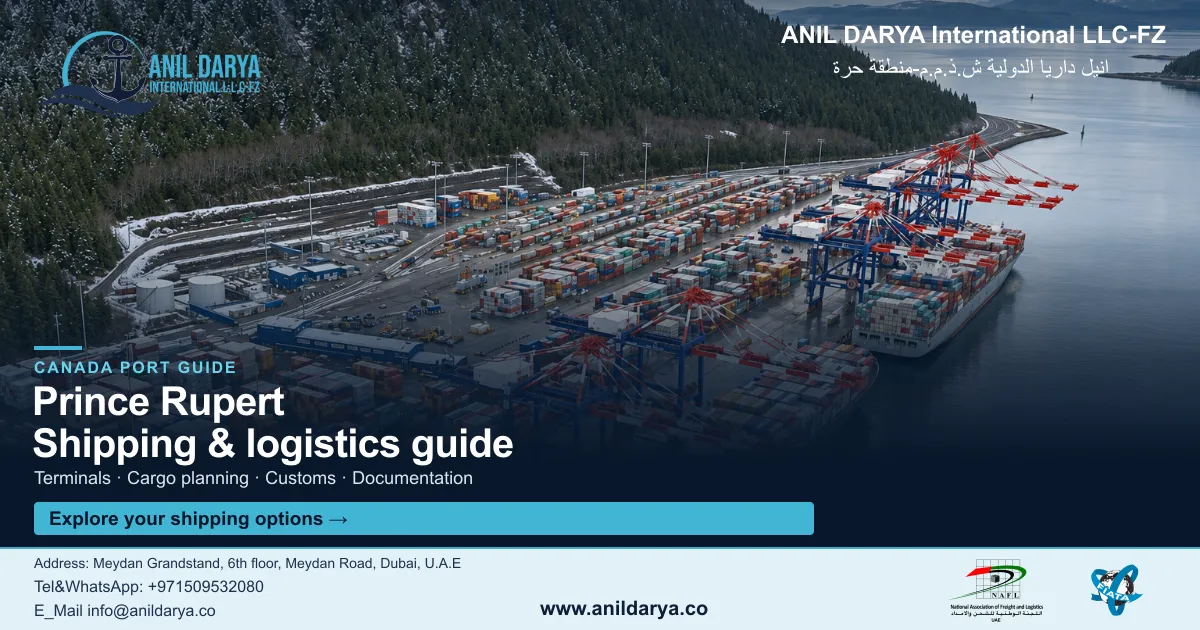
Port of Prince Rupert shipping is about one thing for most importers: a deep-water container terminal on Canada's north Pacific coast that hands boxes straight to CN rail for the trip inland. The port is run by the Prince Rupert Port Authority, the container terminal (Fairview) is operated by DP World, and cargo clears the Canada Border Services Agency (CBSA). This guide covers what is specific to Prince Rupert: the terminal specs, the rail link, the port's own dangerous goods rules, and how we plan a shipment from Dubai so it does not stall on arrival. We ship both ways: from Dubai to Prince Rupert, and from Prince Rupert to Dubai with UAE clearance on arrival.
Port of Prince Rupert: key facts at a glance
| Item | Detail |
|---|---|
| Port authority | Prince Rupert Port Authority (PRPA), created on 1 May 1999 under the Canada Marine Act |
| Container terminal | Fairview Container Terminal, operated by DP World |
| Customs authority | Canada Border Services Agency (CBSA) |
| UN/LOCODE | CAPRR |
| Location | North coast of British Columbia, about 750 km northwest of Vancouver and 60 km south of the Alaska border |
| Harbour | Deep and ice free all year; inner harbour entrance 457 m wide and at least 35 m deep |
| Fairview container capacity | 1.6 million TEU after the expansion completed in summer 2022; next phase planned to 2.0 million TEU |
| Fairview berth | 800 m in total: south berth 400 m, north berth 400 m |
| Fairview controlling depth | 16.6 m |
| Largest container ship accepted at Fairview | 400 m length overall, 16 m draught, no air draught limit |
| Containers handled (calendar 2019) | 1.21 million TEU; total cargo 29.84 million revenue tonnes |
| Rail | All PRPA facilities are served by CN |
| Dangerous goods | All DG moving through the port must be pre-approved by the PRPA |
| Time zone | Pacific Time (UTC -8, UTC -7 in summer) |
| Prince Rupert to Dubai | We book from Prince Rupert and clear at Jebel Ali, Khalifa Port or Sharjah; the CBSA export declaration stays with the shipper or its agent |
What is the Port of Prince Rupert and why do shippers use it?
Prince Rupert is a natural harbour on the north coast of British Columbia. The port authority describes it as deep and ice free, and says ships can enter at all times and in all seasons. It is the third-busiest Canadian seaport by container volume and tonnage, after Vancouver and Montreal.
The container business is young. Fairview was converted into an intermodal container terminal and opened on 12 September 2007. It has grown in steps since: 1.35 million TEU of capacity after a $200 million expansion in 2017, and 1.6 million TEU after a further project finished in summer 2022.
The reason shippers pick Prince Rupert over Vancouver is the rail link, not the local market. Prince Rupert is a city of about 12,300 people, so almost every import box leaves the port on a train. If your consignee is in Prince Rupert itself or on the north coast, the port is close. If the consignee is in Alberta, Saskatchewan, Manitoba, Ontario or the US Midwest, Prince Rupert competes with Vancouver on the rail leg.
Fairview Container Terminal: berths, depth and vessel limits
Fairview is the only container terminal at the port. Figures are from the port authority's Port Information Guide (February 2025).
| Item | Fairview Container Terminal |
|---|---|
| Operator | DP World |
| Berths | Two: south berth (Fairview 2) 400 m, north berth (Fairview 4) 400 m |
| Controlling depth | 16.6 m |
| Maximum vessel | 400 m length overall, 16 m draught |
| Distance from pilot station to berth | 27 nautical miles |
| Crane wind limit | Cranes operate up to 45 knots of wind |
| Shore power | Available at both the south and north berths |
| DG restriction | Explosives in divisions 1.1, 1.2, 1.3 and 1.5 are restricted to the southern end of the terminal |
The port guide states there is no restriction on maximum vessel size at Prince Rupert, though inner harbour anchorages 2 to 7 are limited to ships of 250 m or less. In practice this means the large transpacific ships that call can berth without waiting for tide.
A second container terminal south of Fairview, studied with DP World since 2022, could add up to 2 million TEU a year. It is still a proposal.
Other terminals at Prince Rupert and what they handle
Most of the port's tonnage is bulk exports, not containers.
| Terminal | Main cargo | Controlling depth |
|---|---|---|
| Fairview Container Terminal | Containers | 16.6 m |
| Prince Rupert Grain | Grain (bulk) | 14.2 m |
| Trigon Pacific Terminals (formerly Ridley Terminals) | Dry bulk and LPG loading | 20.2 m |
| Westview Terminal | Wood pellets | 11.8 m |
| Project Cargo Ro-Ro Ramp | Project cargo on barges | 4.0 m |
| Prince Rupert Cruise Terminal | Cruise ships | 21.2 m |
On Ridley Island, the CANXPORT export logistics facility opened on 27 August 2026, and a transload facility called LinX is scheduled to start in the first quarter of 2027. If your cargo is in a container, it goes to Fairview. Everything else needs a check with the carrier and terminal first.
How does cargo leave Prince Rupert? CN rail and road
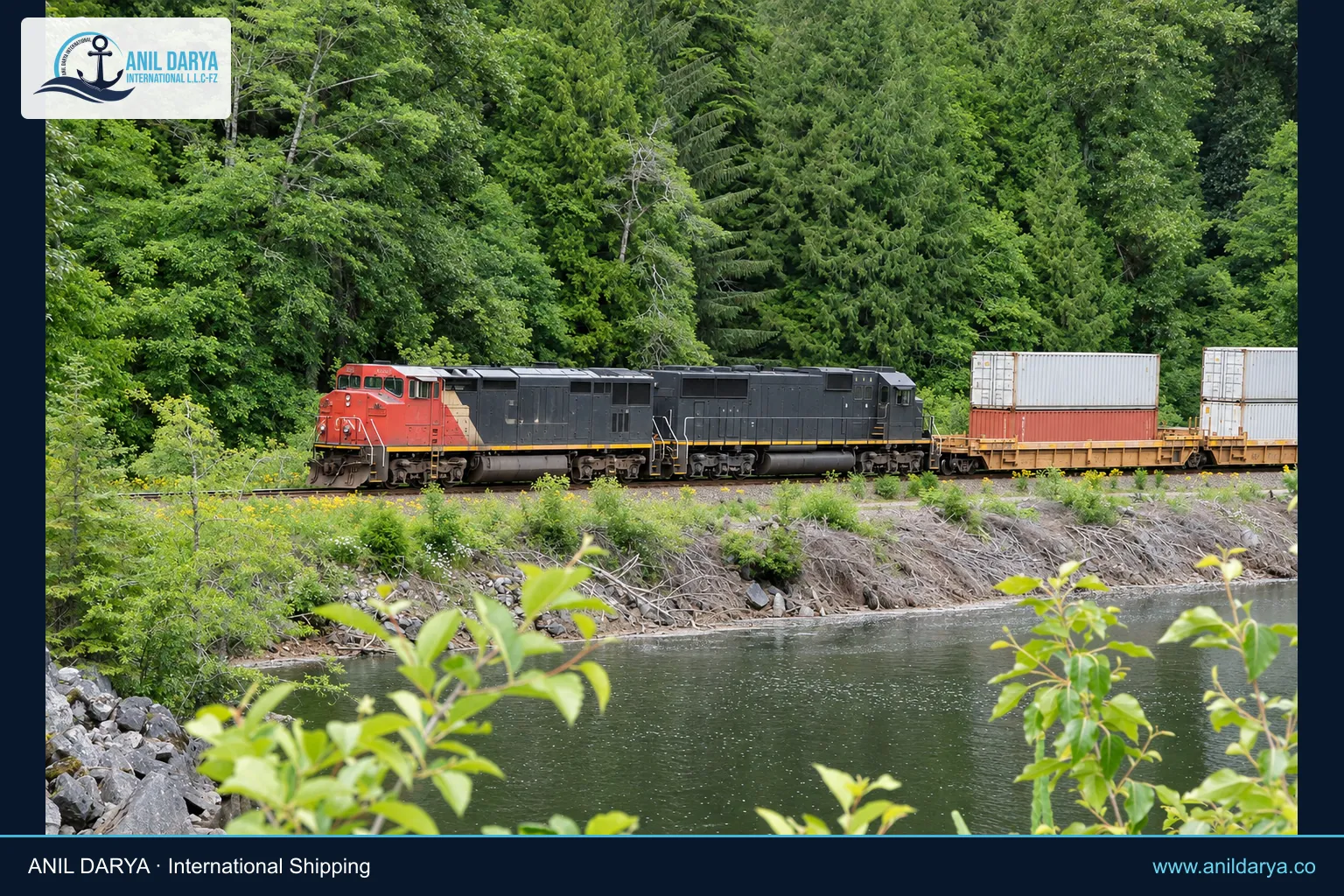
All PRPA facilities are served by CN. The CN line runs east from Prince Rupert through Prince George and joins the CN main line from Vancouver at Valemount. Freight on the line is mainly grain, coal, wood products, chemicals and, since 2007, containers.
By road, Prince Rupert sits at the western end of Highway 16 (the Yellowhead Highway). It is 144 km west of Terrace and 715 km west of Prince George. That is a long truck run for a single container, which is why rail is the default.
| Where your consignee is | Usual onward move | What to check |
|---|---|---|
| Prince Rupert or the north coast | Local truck from Fairview | Truck availability and terminal gate rules |
| Northern or central BC (Terrace, Prince George) | Truck on Highway 16, or rail to a CN inland terminal | Total truck cost against rail plus local delivery |
| Alberta, the Prairies, Ontario | CN intermodal rail | Through bill of lading to the inland ramp, inland free time |
| US Midwest | CN rail into the US | US customs entry and in-bond rules, which differ from a Canadian import |
Ask for the inland point to be on the bill of lading. When the carrier sells a through rate to an inland rail ramp, the box moves under the carrier's control and the importer deals with the container at the inland end, not at the coast.
FreightWaves reported that in 2018 Prince Rupert handled 568,995 loaded import TEU against 207,111 loaded export TEU. Imports far exceed exports, which is useful context when you ask carriers about equipment and space for the import leg.
What cargo can you ship to Prince Rupert from the UAE?
| Cargo | How it moves | What to plan |
|---|---|---|
| General goods (FCL) | Container to Fairview, then rail or truck | Inland destination on the booking, eManifest data |
| Small shipments (LCL) | Usually consolidated to a larger gateway, then trucked or railed | Ask where the box is unpacked; Prince Rupert is mainly a full-container rail port |
| Food and plant products | Containers, reefers if needed | CFIA import conditions before shipping |
| Chemicals and other DG | IMDG containers | PRPA pre-approval, carrier acceptance, class limits |
| Out-of-gauge machinery | Flat racks or open tops at Fairview | Terminal acceptance, rail clearances, road permits |
| Large project pieces | Breakbulk or barge to the project cargo Ro-Ro ramp | Ramp limits (7,000 tonne barges, 105 m LOA), lift plan |
FCL or LCL: which suits shipping from Dubai to Prince Rupert?
FCL is the natural fit. Fairview is a terminal built to move full containers onto trains, and most consignees are far inland. A full container booked through to an inland rail ramp avoids extra handling at the coast.
LCL to Prince Rupert is harder to buy, so ask first whether a consolidator runs boxes there. If you have a few pallets, ask us to compare LCL to Vancouver with a full container to Prince Rupert. Our guide to FCL vs LCL costs shows the break-even point. Whichever you choose, our sea freight service books the space and checks the routing before you commit.
Shipping from Dubai to Prince Rupert: routing and transit
Prince Rupert is a transpacific port. Services that call there link Asia with North America, so cargo from Jebel Ali reaches it after transshipment at an Asian hub. The routing, the hub and the transit time depend on the carrier.
[AMIR-FACT: our real Jebel Ali to Prince Rupert transit time door-to-port, the carrier we use and the transshipment hub]
Published third-party figures are broad: one forwarder directory quotes 30 to 40 days for UAE to Canada by sea in general, without separating Prince Rupert. Ask for the carrier's own schedule.
Three things affect the total time more than the ocean leg:
- The connection at the transshipment hub. A missed connection can add a week.
- The rail leg from Prince Rupert to the inland ramp, which is quoted separately by the carrier.
- CBSA release. If the cargo data was late or incomplete, the box can be held at the terminal.
Prince Rupert or Vancouver: which port fits your cargo?
| Question | Prince Rupert | Vancouver |
|---|---|---|
| Container terminals | One (Fairview) | Four |
| Local market | Small city; nearly all boxes go inland by rail | Large metro area; many boxes delivered by truck locally |
| Rail | CN | On-dock and near-dock rail to inland Canada |
| Best for | Full containers to Alberta, the Prairies, Ontario or the US Midwest on a carrier that calls Prince Rupert | Lower Mainland consignees, LCL, carriers that do not call Prince Rupert |
| Watch out for | Fewer services; LCL options limited | Four terminals, so check which one your carrier uses |
A useful rule: price both when the final destination is east of the Rockies. Compare the total cost to the door, not the ocean rate.
Dangerous goods at Prince Rupert: the port's own rules
On top of the IMDG Code and Canada's Transportation of Dangerous Goods rules, the Prince Rupert Port Authority runs its own approval step. The Port Information Guide says all dangerous goods that move through the port must be pre-approved by the PRPA, through an online permit application that ends with a confirmation email.
| Rule in the Port Information Guide | What it means for your shipment |
|---|---|
| All DG must be pre-approved by the PRPA | The vessel agent or carrier files the permit; your DG data must be complete before arrival |
| Class 1 and Class 7 may not be loaded or unloaded at anchorage or on barges | These classes are handled only at a berth |
| Class 1 divisions 1.1, 1.2 and 1.3: 49 tonnes and below acceptable | Larger explosive quantities need a different plan |
| Class 7 radioactive material: 2 tonne limit per operation | Split larger consignments or route elsewhere |
| Divisions 1.1, 1.2, 1.3 and 1.5 restricted to the south end of Fairview | Berth planning for explosives cargo |
| UN1935 (cyanide solution) and UN1942 (ammonium nitrate) not loaded or unloaded at any PRPA facility | These products cannot move through Prince Rupert |
| Ships carrying explosives need PRPA permission to enter, leave or stay in the harbour | The carrier must confirm acceptance before you book |
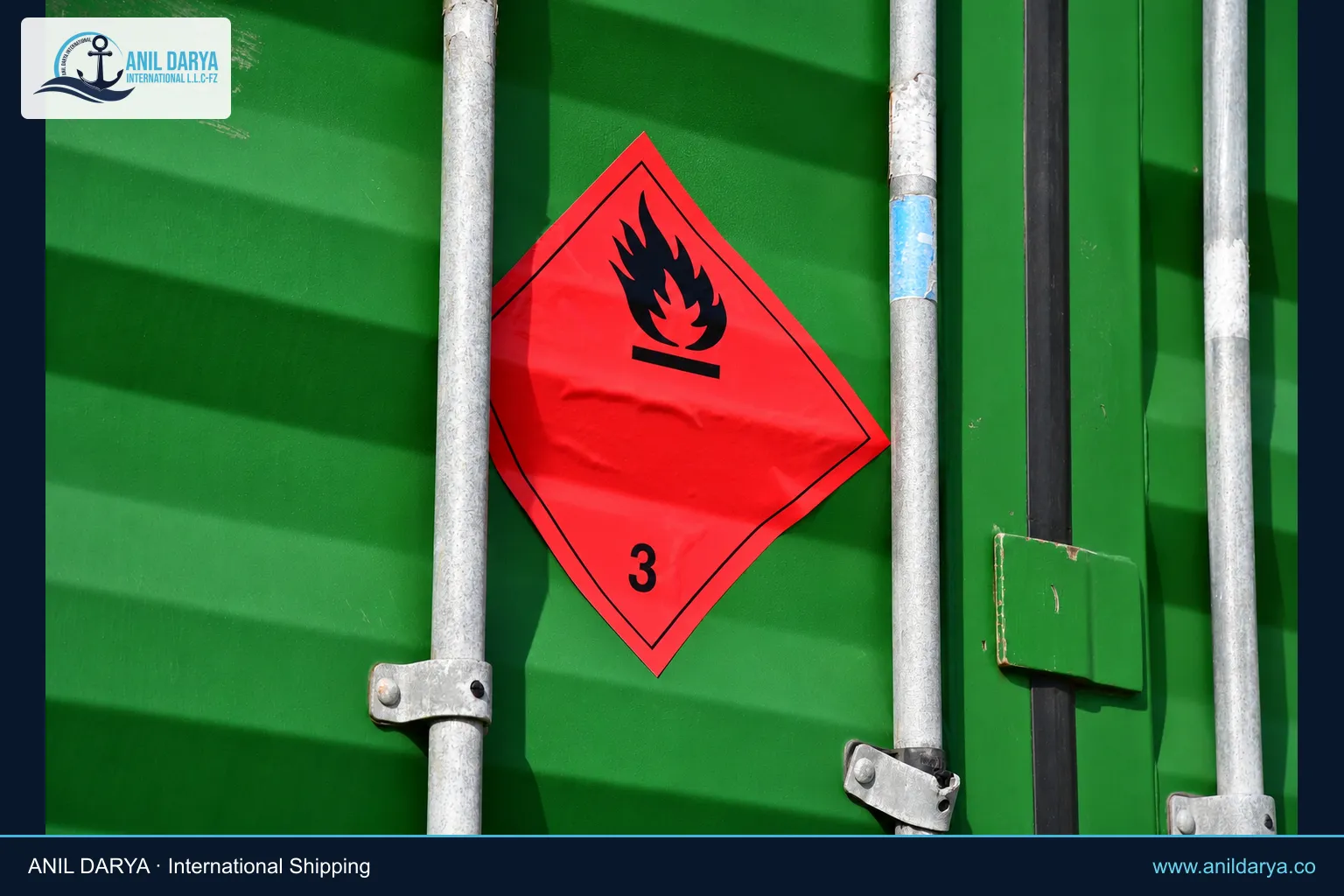
What you need to give us for any DG booking to Prince Rupert:
- UN number, proper shipping name, class and packing group for every product.
- A Safety Data Sheet in English for each product.
- A signed Dangerous Goods Declaration.
- UN-approved packaging, marks, labels and container placards.
- The quantity per class, so the carrier can check the port limits above.
Our dangerous goods shipping team checks carrier acceptance and the Prince Rupert limits before you commit to a sailing. If you are new to the classes, read our guide to dangerous goods classes.
Project and out-of-gauge cargo through Prince Rupert
Prince Rupert has a dedicated Project Cargo Ro-Ro Ramp. The port guide gives its limits: barges of up to 7,000 tonnes, 105 m length overall and 4.0 m draught, a ramp length of 49.35 m and an estimated ramp mass of 180 tonnes. It is a barge ramp, so heavy pieces usually arrive on an ocean vessel and are then moved by barge.
For cargo that fits a flat rack or open top, Fairview is the simpler option. The real limit is often the rail leg, since rail clearances on the line inland are tighter than the terminal's. We check both before booking.
- Send us drawings, dimensions, weights and centre of gravity for each piece.
- We check whether it fits a flat rack by size and weight, or needs breakbulk.
- We confirm acceptance with the carrier, Fairview or the project ramp, and the rail operator if the piece goes inland.
- We plan lashing and lifting at Jebel Ali and the onward road or rail move from the port.
See our break bulk and project cargo service and our article on flat racks, open tops and breakbulk for the decision points.
Customs at Prince Rupert: what is different from other Canadian ports
Customs rules at Prince Rupert are national. Our Vancouver guide covers the CBSA process in full; here is the short version and what changes when the box goes inland.
| Step | Rule |
|---|---|
| Cargo data (containers loaded outside the US) | To the CBSA 24 hours before loading at the origin port |
| Conveyance data (container ships) | 96 hours before arrival in Canada |
| Importer registration | Business number plus an import program account (BN15) and a CARM Client Portal account |
| Tariff number | 10 digits: the 6-digit HS code plus 4 Canadian digits |
| Duty for UAE-origin goods | Most-Favoured-Nation rate |
| GST | 5% on value for duty plus duty |
| Provincial sales tax in BC | 7% PST; your broker confirms if it applies at the border for your goods |
| Wood packaging | Must meet CFIA directive D-98-08; non-compliant packaging may be refused entry |
Canada and the UAE signed a trade agreement (CEPA) on 27 October 2026. It is not yet in force, so plan on MFN rates.
Two points matter at Prince Rupert in particular:
- Clearance at the port or inland. Most boxes go inland by rail, so ask your Canadian broker whether the goods will be released at Prince Rupert or moved in-bond to an inland office. It changes where an exam happens and where you collect the container.
- US-bound cargo. If the final destination is in the US, the box moves through Canada to a US entry point, and US filing rules apply instead of a Canadian import. Settle this before the bill of lading is issued.
We work with the consignee's customs broker or a licensed broker in Canada; we prepare and check the export documents on the UAE side.
How to ship from Dubai to the Port of Prince Rupert: step by step
- Tell us the cargo and the final destination. Commodity, HS code, weight, volume, Incoterm and the consignee's city. The city decides whether Prince Rupert makes sense.
- Check the importer is ready. The consignee needs a BN15, a CARM account and, if used, a broker with delegated access.
- Pick the routing. We ask carriers for a through rate to Prince Rupert or to an inland rail ramp and confirm the transshipment hub.
- Book space. For DG, out-of-gauge or reefer cargo, we get carrier acceptance first, and the PRPA pre-approval is set in motion for DG.
- Prepare documents at origin. Commercial invoice (or Canada Customs Invoice), packing list, certificate of origin and any CFIA paperwork. Our Jebel Ali port team handles the UAE export declaration.
- Send cargo data on time. The carrier needs an exact description, weight and parties so the CBSA receives data 24 hours before loading at Jebel Ali.
- Track the transshipment. We watch the connection at the hub and warn the consignee if the box rolls.
- Release and onward move. The broker obtains CBSA release; the container moves by rail or truck to the consignee, and the empty is returned where the line names.
How to ship from the Port of Prince Rupert to Dubai
We also handle the other direction: shipping from Prince Rupert to Dubai, with arrival at Jebel Ali, Khalifa Port or Sharjah port. We book the space with the carrier and run the UAE side. The Canadian export filings stay with the shipper or its Canadian agent.
The Canadian export side
- Export declaration. Commercial goods going to a country other than the US need one when they are worth CAN$2,000 or more, and restricted goods always need one. The exporter files it in the CBSA's Canadian Export Reporting System (CERS) or by G7 EDI. It can hand the filing to a customs service provider but stays responsible for the data.
- Timing. For marine shipments the declaration must be in at least 48 hours before the goods are loaded on the vessel. The exporter gives the carrier the proof-of-report number that CERS issues.
- Accounts and permits. The exporter needs a business number with an RM export program account, set up through the CARM Client Portal. Controlled, regulated or prohibited goods may need a permit, certificate or licence before export.
The UAE import side
On arrival in Dubai, the import declaration goes to Dubai Customs with the commercial invoice, the packing list, the certificate of origin and any permit for restricted goods. The carrier's agent also needs the bill of lading before it issues the delivery order. Customs duty in Dubai is 5% of the CIF value for most goods, with 50% on alcohol and 100% on cigarettes. Import VAT is 5% of the customs value, which includes insurance and freight. A VAT-registered importer whose customs number is registered with the Federal Tax Authority accounts for it on its VAT return. An importer that is not registered pays it before the goods are released.
- Send us the shipper's details in Prince Rupert, the cargo, the HS code and the UAE delivery address.
- We book space from Prince Rupert and send the booking, cut-offs and terminal details to the shipper.
- The shipper or its trucker delivers the cargo to Fairview Container Terminal or the terminal named on the booking inside the carrier's receiving window.
- The shipper or its Canadian agent files the export declaration in CERS at least 48 hours before loading and passes the proof-of-report number to the carrier.
- We check the draft bill of lading against the invoice and packing list before it is issued.
- We file the Dubai Customs declaration before the ship arrives.
- We arrange payment of the duty and VAT and collect the delivery order from the carrier's agent.
- We truck the cargo to your site and return the empty container inside the free time.
[AMIR-FACT: the carriers we actually use from Prince Rupert to Jebel Ali/Khalifa/Sharjah and our real transit days in this direction]
Free time, demurrage and detention on Prince Rupert shipments
Free time is set by the carrier, and on through-rail moves it often runs at the inland ramp as well as at the port. Read the free days for both points on your quote. Detention runs while you keep the container, so book delivery and empty return before it lands. Our article on demurrage and detention explains how the charges add up.
Checklist before you ship to Prince Rupert
- Final destination confirmed, and Prince Rupert priced against Vancouver.
- Importer has a BN15 and an active CARM account; broker delegated if used.
- 10-digit Canadian tariff number checked for each product.
- Exact cargo description ready for the CBSA 24 hours before loading.
- Wood packaging ISPM 15 marked, or no solid wood used.
- For DG: SDS, DG declaration, quantity per class checked against PRPA limits.
- Inland ramp and free time at both ends written on the quote.
- Clearance point agreed with the broker: port or inland.
Common mistakes on the Dubai to Prince Rupert lane
- Booking Prince Rupert for a Vancouver-area consignee. You pay for a long truck or rail move back south.
- Vague cargo descriptions. "General cargo" or "parts" can keep the box off the vessel at Jebel Ali.
- Assuming any DG is fine. Ammonium nitrate (UN1942) and cyanide solution (UN1935) cannot move through PRPA facilities at all.
- Forgetting the inland free time. Detention can start at the rail ramp while you wait for a truck.
- Expecting CEPA rates now. The Canada-UAE agreement is signed but not in force.
Frequently asked questions
Who runs the port at Prince Rupert?
The Prince Rupert Port Authority manages the port. DP World operates Fairview Container Terminal, and separate companies run the grain, bulk, energy and cruise terminals.
How big is the container terminal at Prince Rupert?
Fairview Container Terminal has an 800 m berth split into two 400 m berths, a controlling depth of 16.6 m and a capacity of 1.6 million TEU. The next expansion phase is planned to take it to 2.0 million TEU.
What is the port code for Prince Rupert?
The UN/LOCODE for Prince Rupert is CAPRR, used on bookings and bills of lading.
Can the largest container ships call at Prince Rupert?
Yes. The port guide says there is no maximum vessel size for the port, and Fairview accepts ships up to 400 m long with a 16 m draught.
Do dangerous goods need approval at Prince Rupert?
Yes. All dangerous goods moving through the Port of Prince Rupert must be pre-approved by the port authority through an online permit. Some classes have quantity limits, and UN1935 and UN1942 are not handled at any PRPA facility.
How does cargo get from Prince Rupert to the rest of Canada?
Mostly by CN rail, which serves all port facilities and runs east through Prince George. Highway 16 is the road link, but distances are long.
Is Prince Rupert better than Vancouver for cargo from Dubai?
It depends on the destination. Prince Rupert suits full containers going inland by rail on a carrier that calls there. For consignees near Vancouver, or for LCL, Vancouver is usually the better choice.
What duty do I pay on UAE goods entering through Prince Rupert?
UAE-origin goods pay the Most-Favoured-Nation rate for their 10-digit tariff number, plus 5% GST on value for duty plus duty. BC also has a 7% PST. The Canada-UAE CEPA, signed on 27 October 2026, is not yet in force.
Can you handle shipping from Prince Rupert to Dubai?
Yes. We book the space from Prince Rupert, check the bill of lading and run the UAE side: the Dubai Customs declaration, the 5% duty and 5% import VAT, which we arrange payment of, the delivery order and trucking. The shipper or its Canadian agent files the CBSA export declaration at least 48 hours before loading when one is required.
Get a quote for Port of Prince Rupert shipping
Send us the cargo details and the consignee's city, and we will price Prince Rupert and, where it makes sense, Vancouver for comparison. Use our freight rate inquiry form, or contact our team to talk through a DG or project shipment first. You can also read about our Dubai freight forwarding team.
Sources
- CBSA: Exporting goods from Canada (CAN$2,000 rule, CERS, 48 hours before loading for marine, permits)
- Dubai Customs: Submit customs declaration (invoice, packing list, certificate of origin, permits)
- UAE Government portal: Customs duty (5% of CIF in Dubai, alcohol 50%, cigarettes 100%)
- Federal Tax Authority: VAT (5% rate)
- Federal Tax Authority: VAT guide, section 3.5 (import VAT at 5% on customs value, VAT return or payment before release)
- Prince Rupert Port Authority: Port Information Guide, February 2025 (Fairview specs, terminal depths, DG rules, vessel size, harbour)
- Wikipedia: Port of Prince Rupert (governance, 2019 volumes, UN/LOCODE, CN rail, CANXPORT, LinX)
- Wikipedia: Prince Rupert, British Columbia (CN line, Highway 16 distances, population)
- Government of British Columbia: Prince Rupert terminal expansion (2017)
- FreightWaves: Prince Rupert plan shows potential for massive expansion (2018 import and export TEU)
- Hellenic Shipping News: Prince Rupert Port seeking to double capacity with a second container terminal (2022)
- Findaport: Port of Prince Rupert (location)
- CBSA: Memorandum D3-5-1, marine reporting timeframes (Appendix A)
- CBSA: Determining duties and taxes
- CBSA: Setting up your business to import (BN15, CARM)
- Canada Revenue Agency: GST/HST and PST rates by province
- Global Affairs Canada: Canada-UAE CEPA status
- CFIA: Wood packaging imports (D-98-08)
- FW Freight: UAE to Canada sea freight range
Reviewed: 10 November 2026