
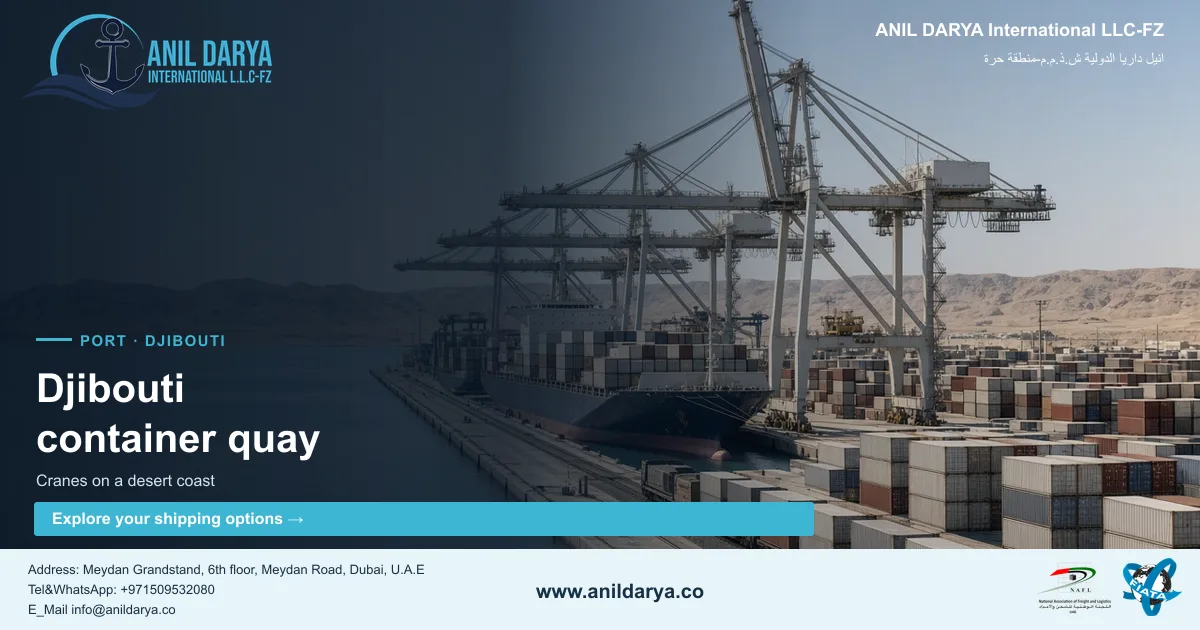
Djibouti port shipping covers more than one terminal: the SGTD container terminal and the Doraleh Multipurpose Port at Doraleh, the historic Port de Djibouti in the city, and specialist ports for petroleum, potash and salt. The ports are overseen by the Djibouti Ports and Free Zones Authority (DPFZA), and much of the cargo moves on by rail or road to Ethiopia. This guide covers the terminals, port free time, dangerous goods rules, the ECTN, customs, and how we ship your cargo there from Dubai. We ship both ways: from Dubai to Djibouti port, and from Djibouti to Dubai with clearance on arrival in the UAE.
Djibouti port guide: key facts at a glance
| Item | Detail |
|---|---|
| Port and free zone authority | Djibouti Ports and Free Zones Authority (DPFZA), created by decree in October 2003 |
| Investment arm | Great Horn Investment Holding (GHIH), a DPFZA subsidiary |
| Main container terminal | SGTD at Doraleh: 1.8 million TEU, 1,050 m quay, 18 to 20 m depth |
| Multipurpose terminal | Doraleh Multipurpose Port (DMP): 6 berths, 1,200 m quay, 15.3 m depth, vessels up to 100,000 DWT |
| Historic port | Port de Djibouti (PDSA): 350,000 TEU container terminal plus general cargo, Ro-Ro, bulk and livestock |
| Liquid bulk | Horizon Terminal: 371,000 m3 of petroleum and liquid storage |
| Mineral ports | Port of Tadjourah (potash) and Port of Ghoubet (salt) |
| Rail link | Djibouti to Addis Ababa railway, connected to SGTD and DMP |
| Free storage, containers (2018 tariff) | 3 days local import and export, 8 days transit and transhipment |
| Cargo tracking note | ECTN for containerised shipments loaded on or after 15 June 2023 |
| Port community system | Djibouti Port Community System, launched July 2018 |
| Free zones | Djibouti Free Zone (40 ha), Djibouti International Free Trade Zone (240 ha first phase), Damerjog |
| Djibouti to Dubai (import) | Export papers by the shipper or its agent; Dubai Customs declaration, 5% duty on CIF for most goods, 5% import VAT |
| UN/LOCODE | DJJIB (Djibouti), DJDCT (Doraleh) |
| Customs system | Sydonia World, with electronic declarations linked to the port and to Ethiopian customs |
What is the Port of Djibouti and who uses it?
"Port of Djibouti" is the name most shippers use, but in practice it means a group of terminals under one authority. DPFZA regulates the ports and free zones and sets the rules for port professions. GHIH, its investment arm, invests in the port and logistics projects. Port de Djibouti (PDSA) runs the historic port in the city, which opened Djibouti's first modern container terminal in 1985.
The port group serves two markets. One is Djibouti itself. The other is Ethiopia: Port de Djibouti says it has handled Ethiopia's maritime traffic since 1998, with cargo moving to and from Addis Ababa by truck and rail. That is why transit cargo has its own rules for free time, port dues and paperwork.
Which terminals does the Port of Djibouti have?
The terminal on your booking decides where your cargo lands, how it leaves and which free time applies. Here is what each one does.
| Terminal | Main cargo | Key figures |
|---|---|---|
| SGTD container terminal (Doraleh, formerly DCT) | Containers | Launched 2009; 1.8 million TEU; 1,050 m quay; 18 to 20 m depth; 33 ha main yard; 800 m rail station with 3 lines |
| Doraleh Multipurpose Port (DMP) | Bulk, breakbulk, containers, Ro-Ro | Opened May 2017; 6 berths; 1,200 m quay; 15.3 m depth; up to 100,000 DWT; direct rail connection |
| Port de Djibouti container terminal | Containers, Ro-Ro | Since 1985; 350,000 TEU a year; 2 berths on 400 m of quay; 126 reefer plugs |
| Port de Djibouti general cargo | Breakbulk, project cargo, vehicles, livestock, dry bulk | Silos of 30,000 t (wheat) and 40,000 t (fertilizer); 120 t weighbridge |
| Horizon Terminal | Petroleum and liquid bulk | 371,000 m3 storage; 2 berths of 30,000 and 80,000 DWT; 12 truck loading bays |
| Port of Tadjourah | Potash, Ro-Ro | Opened June 2017; 2 berths of 435 m; 12 m depth; 190 m Ro-Ro quay |
| Port of Ghoubet | Salt | Opened June 2017; 400 m quay; 15 m depth; up to 100,000 DWT |
| Damerjog livestock port | Livestock | Listed by Port de Djibouti as a new development |
SGTD: the Doraleh container terminal
SGTD (Société de Gestion du Terminal à Conteneurs de Doraleh) is the main container gateway. DPFZA lists 4 ship-to-shore cranes for ultra-large container vessels, 8 super post-Panamax twin-lift cranes, 40 RTGs and 2 RMGs, plus 25 ha of external yards. The rail station inside the terminal lets containers go straight onto trains for Ethiopia, which matters if your buyer is inland.
Doraleh Multipurpose Port: bulk, breakbulk and Ro-Ro
DMP was built to take pressure off the older port. It handles bulk, breakbulk, containers and Ro-Ro on 6 berths, and DPFZA quotes about 90 units an hour for Ro-Ro and 31 containers an hour for lift-on, lift-off work. It has a direct link to the railway and 690 ha of land set aside for industry.
Port de Djibouti: the historic port
The city port has a container terminal with two berths: Berth 1 is 180 m long with 9.5 m depth, and Berth 2 is 220 m long with 12 m depth. It takes ships of up to 8,000 TEU and has four ship-to-shore cranes of 50 tonnes each. Its general cargo side handles everything that is not containerised, from steel and project cargo to vehicles and livestock, and runs a 7,000-unit off-dock vehicle store.
What cargo can you ship through Djibouti port?
| Cargo type | Where it usually goes | What to plan |
|---|---|---|
| General goods in containers | SGTD, or the PDSA container terminal | ECTN, free time, local or transit status |
| Chilled and frozen food | Reefer plugs at the container terminals | Set temperature, health certificates |
| Vehicles | Ro-Ro berths at DMP or PDSA; off-dock vehicle storage | Free storage of 3 days local, 8 transit |
| Steel, machinery, project cargo | DMP or PDSA general cargo | Lift plan, inland route, no free time for out-of-gauge boxes |
| Grain, fertilizer, clinker | PDSA dry bulk quays and silos, or DMP | Discharge plan, receiving trucks or rail |
| Fuel and liquid bulk | Horizon Terminal | Tank allocation, truck loading |
| Dangerous goods | Container terminals under port approval | Written application, class limits, fast removal |
Container shipping to Djibouti port: FCL, LCL and free time
Most cargo from the UAE arrives in containers. With FCL you book a whole 20ft or 40ft box. With LCL your cargo shares a box and is unpacked at a container freight station; the port tariff lists separate charges for the CFS transfer and for stripping or stuffing. For cargo going on to Ethiopia, FCL is usually simpler, because the sealed box can go straight onto a train or truck. Our guide to FCL vs LCL costs explains the trade-off.
Free storage is short, and it depends on the cargo's status. The 2018 tariff book, the latest one posted by Port de Djibouti, sets these grace periods:
| Cargo | Local | Transit | Transhipment |
|---|---|---|---|
| Full containers | 3 days (import or export) | 8 days (import or export) | 8 days |
| Breakbulk in open yard or warehouse | 3 days | 8 days | 8 days |
| Vehicles | 3 days | 8 days | 15 days |
| IMDG, out-of-gauge and flat rack containers | None | None | None |
| Dangerous breakbulk cargo | None | None | None |
After the grace period, storage is charged per TEU per day, rising in steps the longer the box stays. The tariff also lets the port move cargo that overstays to storage at the owner's cost. Line free time for demurrage and detention is separate and set by the carrier. Our article on demurrage and detention shows how the two add up.
Breakbulk, Ro-Ro and project cargo at Djibouti
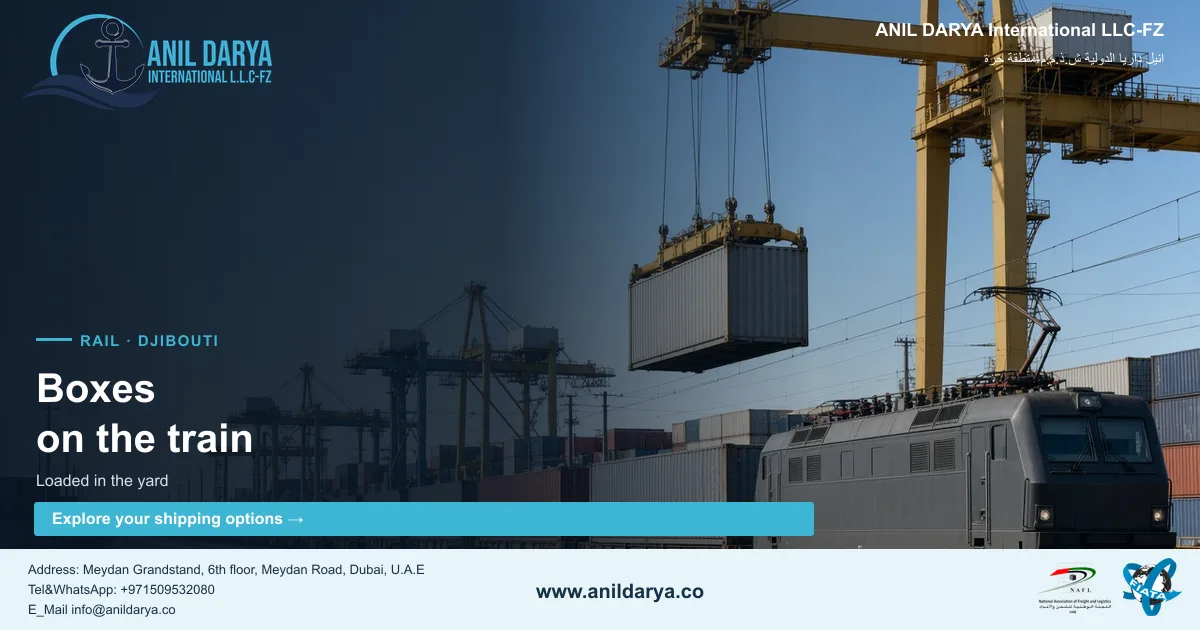
Heavy and oversized cargo can land at DMP or at the historic port's general cargo berths. PDSA lists breakbulk, heavy and over-dimensional project cargo among the cargo it handles, with yard space for breakbulk, 150,000 MT of open storage for steel and a 120-tonne weighbridge. Its berths have taken a Ro-Ro vessel of 232 m and a bulk carrier of 50,000 MT. The port also lists an 80-ton floating crane that stevedoring companies can use for heavy cargo.
Because out-of-gauge and flat rack containers get no free storage, the inland move has to be ready when the ship arrives. A practical rule: if a piece fits a 40ft flat rack by size and weight, a container service usually gives you more sailings. If not, you need breakbulk or heavy-lift tonnage, and the sailing date drives the plan. For Ethiopia, check the piece against rail and road limits before you book. See our break bulk and project cargo service and our article on flat rack, open top and breakbulk options.
Dangerous goods at Djibouti port: what the tariff says
The port accepts IMDG cargo, but on strict terms. These are the rules in the 2018 tariff book:
| Rule | Detail |
|---|---|
| Approval | Dangerous cargo is received only after a written application and approval by port management |
| Declaration | The ship agent shows DG in the EDI file and manifest, with a hazardous cargo declaration and SDS for the terminal and harbour office |
| Code | Handling follows the IMDG Code |
| Free storage | None for IMDG containers or dangerous breakbulk |
| Class 1, 2.1, 2.3 and flammable Class 3 | Direct delivery to inland transport |
| Class 7 | Not accepted unless the appropriate authority instructs otherwise |
| Class 5.2, 6.2 and 8 | Reshipped to the load port by the line if not physically cleared 15 days after discharge |
| Undeclared DG | Penalty per offence, higher for a repeat by the same operator in the same year |
The practical result: for DG, the consignee's clearing agent and the inland truck must be ready before the ship arrives. We confirm current rules with the carrier for each booking, since the tariff dates from 2018. Our dangerous goods shipping service covers how we plan DG from Dubai.
Customs and documents at Djibouti port
Import clearance in Djibouti is done by a licensed local clearing agent. DPFZA's permit rules require freight forwarders and clearing agents to be Djiboutian nationals or companies wholly owned by Djiboutians, so your consignee appoints the agent. The Djibouti Port Community System, launched in July 2018, works as an electronic single point of entry for the port and trade community and tracks cargo across sea, air, road and rail.
The ECTN for Djibouti port
CTN Djibouti, the agency that issues ECTNs, says an Electronic Cargo Tracking Note is mandatory for containerised shipments to Djibouti loaded on or after 15 June 2023, including free zone cargo. Goods in transit to Ethiopia are exempt when the bill of lading says so. The Ethiopian Maritime Authority reported that the ECTN number must be on the bill of lading and that the application needs the bill of lading, commercial invoice and freight invoice.
Documents checklist for cargo into Djibouti port
| Document | Local import | Transit to Ethiopia |
|---|---|---|
| Commercial invoice and packing list | Yes | Yes |
| Bill of lading | With ECTN number | With transit to Ethiopia wording |
| ECTN | Yes, for containers | Exempt if the bill says transit |
| Freight invoice | For the ECTN | Ask the consignee |
| Certificate of origin | Agree with the consignee | Agree with the consignee |
| DG declaration and SDS | For IMDG cargo | For IMDG cargo |
| Sanitary or phytosanitary certificate | For food and plant products | As the Ethiopian side requires |
Duties and taxes on cargo cleared at the port
The WTO's trade policy review of Djibouti says the country has no formal customs tariff. Its domestic consumption tax (TIC) works like one, in five bands of 0%, 8%, 10%, 20% and 23%, with 23% the most common rate. Imports also pay VAT, excise and some other taxes. All import declarations are filed electronically in Sydonia World, which is linked to the port system, the free zones and Ethiopian customs, with a module for regional transit. Ask the consignee's clearing agent for the band on your HS code before you ship. Transit cargo for Ethiopia is not cleared for local use in Djibouti.
Transit cargo to Ethiopia through Djibouti port
DPFZA describes two inland links. The Djibouti to Addis Ababa railway has run commercially since January 2018, takes about 12 hours against about 3 days by road, connects to the SGTD and DMP terminals, and runs up to 4 to 5 trains a day from the terminal to Ethiopia. The Djibouti Ports Corridor Road is a 567 km network built to connect the ports with neighbouring countries. Port de Djibouti also presents its general cargo operation as a central distribution point for all of Ethiopia.
Transit cargo gets 8 free storage days instead of 3, but that is still tight for an inland booking. Line up the rail or truck move, and the Ethiopian agent's paperwork, before the vessel arrives. Ethiopian customs and duty are handled by the buyer's licensed Ethiopian agent. On the Ethiopian side, rail containers are received at the Mojo (Modjo) dry port; Ethiopia's state shipping and logistics enterprise said in 2018 that trains were moving containers there 106 at a time.
Free zones next to Djibouti port
The Djibouti Free Zone has operated since October 2004 on 40 ha close to the ports and airport, for warehousing, processing and re-export. The Djibouti International Free Trade Zone opened its first phase of 240 ha in July 2018, and the Damerjog Industrial Development zone is a third DPFZA zone. Free zone cargo still needs an ECTN, and the tariff says port dues follow the cargo's final destination. DPFZA can issue sanitary, phytosanitary and origin certificates to free zone companies on request.
How to ship to Djibouti port from Dubai, step by step
This is how we handle a typical FCL shipment from Jebel Ali to Djibouti. We book space, prepare documents, arrange trucking and export clearance in the UAE, and work with your consignee's clearing agent in Djibouti.
- Confirm the cargo's status: local import, free zone, or transit to Ethiopia.
- Check the goods: HS code, permits, DG class, dimensions for out-of-gauge pieces.
- Pick the service and confirm the discharge terminal with the carrier.
- Book space, with carrier acceptance first for DG, reefer or out-of-gauge cargo.
- Arrange the ECTN, or agree the transit wording for the bill of lading.
- Prepare documents in Dubai and file the Dubai Customs export declaration.
- Stuff, seal and truck the box to Jebel Ali before the cut-off.
- Release the bill of lading and send documents to the consignee and their agent.
- On arrival, the agent clears local cargo, or the inland carrier collects transit cargo within the free days.
[AMIR-FACT: One real shipment we moved into Djibouti port: terminal (SGTD, DMP or PDSA), cargo type, local or Ethiopia transit, and what we did, cleared for publication]
For how the load end works, see our Jebel Ali port shipping guide.
How to ship from Djibouti to Dubai
We also handle the other direction: shipping from Djibouti to Dubai, with arrival at Jebel Ali, Khalifa Port or Sharjah port. We book the space with the carrier and run the UAE side. The export papers in Djibouti, and in Ethiopia for transit cargo, stay with the shipper or its agent there.
The Djibouti export side
- Customs system. Djibouti Customs runs import, export and transit declarations in ASYCUDAWorld (Sydonia World). Transit cargo for and from Ethiopia makes up most of its work: 85% of the declarations it processed were Ethiopian transit.
- Who files. The shipper or its licensed Djibouti agent lodges the export or transit declaration. Clearing agents need a DPFZA permit, so the shipper appoints one.
- Ethiopian cargo. Ethiopia sends most of its foreign trade through Djibouti. For Ethiopian exports, the shipper's Ethiopian agent handles the Ethiopian export papers before the box comes down by rail or road.
- Port free time. Under the 2018 tariff, full export containers get 3 free storage days and transit containers 8, so the box should reach SGTD close to the carrier's cut-off.
- Certificates. DPFZA can issue sanitary, phytosanitary and origin certificates to free zone companies on request.
The UAE import side
On arrival, the declaration goes to Dubai Customs with the commercial invoice, packing list, bill of lading, certificate of origin and any permit for restricted goods. The importer needs a Dubai Customs business code, or a licensed clearing agent with the owner's authorisation files for it. Customs duty in Dubai is 5% of the CIF value for most goods, with 50% on alcohol and 100% on cigarettes. Import VAT is 5%, charged on the customs value including freight and insurance. A VAT-registered importer that has linked its customs registration number with the Federal Tax Authority accounts for it on its VAT return instead of paying at the border.
- Send us the shipper's details in Djibouti, the cargo, the HS code and the UAE delivery address.
- We book space from Djibouti and send the booking and cut-off to the shipper.
- The shipper or its trucker delivers the box to the terminal, by rail or road for Ethiopian cargo.
- The shipper or its Djibouti agent files the export or transit declaration.
- We check the draft bill of lading against the invoice and the certificate of origin.
- We file the UAE declaration before the vessel arrives.
- We arrange payment of the duty and VAT and collect the delivery order.
- We truck the cargo to your site in the UAE.
- We return the empty container inside the carrier's free time.
[AMIR-FACT: the carriers we actually use from Djibouti to Jebel Ali/Khalifa/Sharjah and our real transit days in this direction]
Checklist before you ship to Djibouti port
- Local, free zone or Ethiopia transit status agreed with the buyer.
- ECTN arranged, or transit wording on the bill of lading.
- Consignee's licensed clearing agent named on the paperwork.
- HS code and duty rate confirmed with that agent.
- For DG: port approval, SDS, DG declaration, labels and an inland truck ready.
- For out-of-gauge cargo: lift plan and inland route checked.
- Rail or truck booked before arrival for Ethiopia cargo.
- Carrier free time agreed and cargo insurance arranged.
Common mistakes at Djibouti port
- Missing ECTN number on the bill of lading.
- Assuming 8 free days on local import containers, which get 3.
- Shipping DG without port approval or with missing labels, which brings a penalty.
- Leaving Class 5.2, 6.2 or 8 boxes uncleared, so they are sent back after 15 days.
- No inland plan for Ethiopia cargo, so storage runs while the box waits.
- Wrong cargo status, which changes port dues and free time.
Frequently asked questions
What is the port code for Djibouti?
The UN/LOCODE for the Port of Djibouti is DJJIB, and Doraleh has its own code, DJDCT. Check which one your carrier uses on the booking and bill of lading.
Who runs the ports in Djibouti?
The Djibouti Ports and Free Zones Authority (DPFZA) regulates the ports and free zones, and its subsidiary Great Horn Investment Holding invests in them. Port de Djibouti (PDSA) runs the historic port, and SGTD runs the Doraleh container terminal.
What is the difference between Doraleh and the Port of Djibouti?
Doraleh is the location of the newer terminals: the SGTD container terminal, the Doraleh Multipurpose Port and the Horizon petroleum terminal. The historic Port de Djibouti is in the city. Shippers often call all of them the Port of Djibouti.
How many free storage days does Djibouti port give?
Under the 2018 tariff, full containers get 3 days for local import or export and 8 days for transit or transhipment. Vehicles get 3, 8 or 15 days. DG, out-of-gauge and flat rack containers get none.
Is an ECTN required for Djibouti port?
Yes, for containerised shipments loaded on or after 15 June 2023, including free zone cargo. Goods in transit to Ethiopia are exempt if the bill of lading says so.
Can Djibouti port handle dangerous goods?
Yes, after written approval and under the IMDG Code. There is no free storage, Class 1, 2.1, 2.3 and flammable Class 3 go straight to inland transport, and Class 7 needs the authority's instruction.
How does cargo get from Djibouti port to Ethiopia?
By the Djibouti to Addis Ababa railway, which links to the SGTD and DMP terminals and takes about 12 hours, or by road on the corridor network. Transit containers get 8 free days at the port.
How does shipping from Dubai to Djibouti port work?
We book space from Jebel Ali, arrange the ECTN or the transit wording on the bill of lading, file the Dubai Customs export declaration and truck the box to the port. The consignee's licensed agent clears it in Djibouti, or the inland carrier collects transit cargo for Ethiopia within the 8 free days.
Can you handle shipping from Djibouti to Dubai?
Yes. We book the space with the carrier, the shipper or its Djibouti agent files the export or transit declaration, and we clear the cargo through Dubai Customs and deliver it in the UAE. Most goods pay 5% duty on the CIF value plus 5% import VAT.
Do I need a local agent at Djibouti port?
Yes. Clearing agents and forwarders need a DPFZA permit and must be Djiboutian-owned, so the consignee appoints one. We work with the consignee's agent or a destination agent they choose.
Get a quote for Djibouti port shipping
Send us the commodity, HS code, weight, volume or dimensions, and whether the cargo stays in Djibouti or goes on to Ethiopia. Use our freight rate inquiry form, or contact our team to plan a breakbulk, project or DG shipment. You can also read more about our Dubai freight forwarding team and our sea freight service.
Sources
- Djibouti Ports and Free Zones Authority: About us
- DPFZA: Ports, free zones and inland transport
- DPFZA: SGTD container terminal
- DPFZA: Doraleh Multipurpose Port
- DPFZA: Horizon Terminal
- DPFZA: Port of Tadjourah
- DPFZA: Port of Ghoubet
- DPFZA: Djibouti to Addis Ababa railway
- DPFZA: Djibouti Ports Corridor Road
- DPFZA: Djibouti Port Community System
- DPFZA: Djibouti Free Zone
- DPFZA: Djibouti International Free Trade Zone
- DPFZA: Maritime transport accreditation
- DPFZA: Goods services
- UNCTAD ASYCUDA: Compendium 2022, Djibouti (ASYCUDAWorld, transit share of declarations)
- US International Trade Administration: Ethiopia customs regulations (share of trade through Djibouti)
- Dubai Customs: Submit customs declaration (documents)
- Dubai Customs: FAQ (5% of CIF, business code, clearing agents)
- UAE Government portal: Customs duty (5% of CIF, alcohol 50%, cigarettes 100%)
- Federal Tax Authority: VAT guide (import VAT at 5%, deferral for registered importers)
- Port de Djibouti: Home
- Port de Djibouti: Container terminal
- Port de Djibouti: General cargo
- Port de Djibouti: Marine services
- Djibouti Ports: Tariff Book, 1 January 2018
- CTN Djibouti: ECTN requirement
- Ethiopian Maritime Authority: Djibouti ECTN scheme (June 2023)
- WTO: Trade policy review of Djibouti, summary (WT/TPR/S/430)
- Ethiopian News Agency: Ethio-Djibouti railway and Mojo dry port (July 2018)
- Cogoport: Port of Djibouti (DJJIB)
- Fluent Cargo: Doraleh (DJDCT)
Reviewed: 10 November 2026