
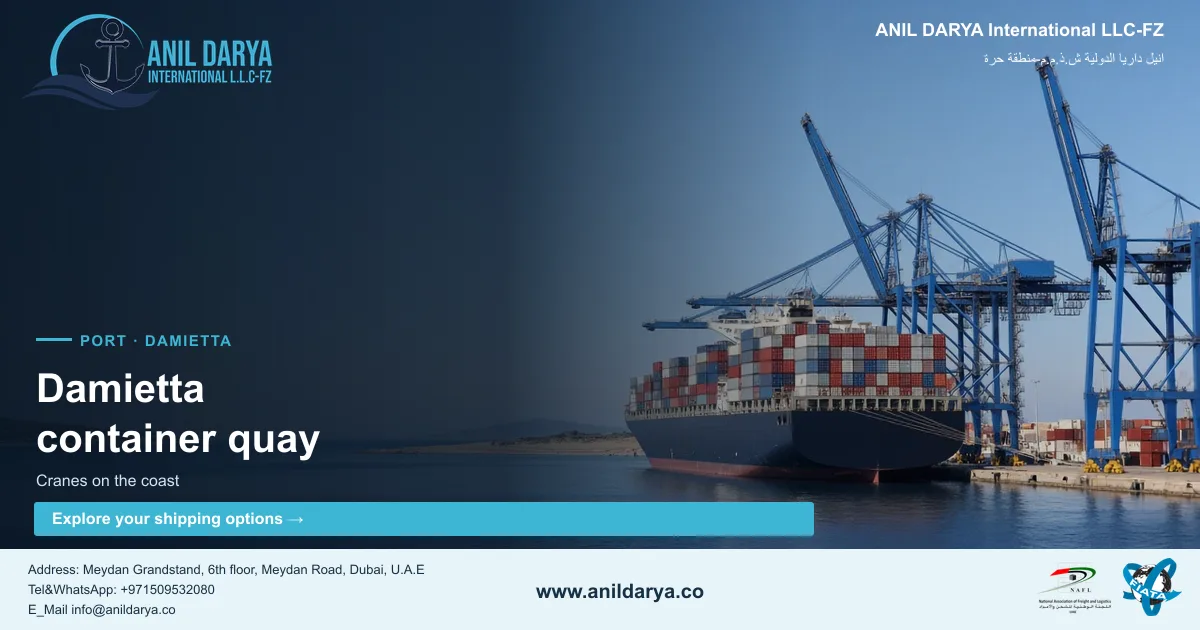
Damietta port shipping means using Egypt's eastern Mediterranean gateway, about 70 km west of Port Said, where a second container terminal run by Hapag-Lloyd, Eurogate and Contship opened in February 2026. The port also handles grain, general cargo, bulk and LNG, and it moved a record 46.4 million tonnes in the 2025-26 financial year. This guide covers the terminals, vessel limits, cargo types, the customs steps that matter at Damietta, and how we ship your cargo there from Dubai. We ship both ways: from Dubai to Damietta, and from Damietta to Dubai.
Damietta port guide: key facts at a glance
| Item | Detail |
|---|---|
| Port authority | Damietta Port Authority (Government of Egypt) |
| UN/LOCODE | EGDAM |
| Location | Mediterranean coast, about 70 km west of Port Said and about 200 km from Alexandria |
| Land area | 279 hectares |
| Berths | 24 (port directories list more than 22 main berths) |
| Entrance channel | 11.4 km long, 15 m deep, 300 m wide narrowing to 250 m |
| Container terminals | DCHC (original terminal) and Damietta Alliance Container Terminals (DACT, from 14 February 2026) |
| DACT quay and depth | 1,670 m quay, 18 m water depth, about 93 hectares |
| DACT final capacity | Up to 3.3 million TEU a year after the last construction phase |
| Throughput 2025-26 (financial year) | 46.4 million tonnes, 3,261 vessel calls |
| Cargo types | Containers, general cargo, grain and dry bulk, Ro-Ro, liquid bulk, LNG |
| Nile link | Barge channel to the Nile estuary |
| Pilotage | Compulsory |
| Customs pre-registration | ACI with an ACID number through Nafeza, required since October 2021 |
| Duty and VAT | Most duty rates 0% to 60% of CIF value; import VAT 14% |
| Damietta to Dubai | Egyptian export filing on Nafeza by the exporter or its broker; Dubai Customs declaration, 5% duty on CIF for most goods and 5% import VAT |
Where is Damietta port and why do shippers use it?
Damietta Port sits on Egypt's northern coast, about 10 km west of the Damietta branch of the Nile. Port Said and the Suez Canal entrance are about 70 km to the east, and Alexandria is about 200 km to the west. Cairo International Airport is about 180 km away, which matters if part of your shipment goes by air.
The port is protected by two breakwaters, a western one of 1,640 m and an eastern one of 738 m. A turning basin of 500 m diameter lets large ships swing inside the harbour.
Shippers pick Damietta for three main reasons:
- The consignee is in the eastern Delta, around Damietta, Mansoura, Port Said or the canal cities, so the truck leg is shorter than from Alexandria.
- The carrier's service calls Damietta and not Alexandria, which is common on transshipment-heavy Mediterranean loops.
- The cargo is grain, timber or furniture-industry cargo, which Damietta handles in volume.
Which terminals does Damietta port have?
Damietta now runs two container terminals plus general cargo, grain, bulk and LNG berths. The terminal on your booking decides where your truck collects or delivers, so check it on the arrival notice.
DCHC: the original container terminal
Damietta Container and Cargo Handling Company (DCHC) operates the first container terminal, with ship-to-shore cranes and rubber-tyred gantries. The port's turning basin has 14.5 m of water at the container berth and 12 m at the general cargo berth. Most import and export boxes for Egyptian consignees have traditionally moved through this terminal.
Damietta Alliance Container Terminals (DACT)
DACT is the new terminal in the port's second basin, also known as Tahya Misr 1. Commercial operations started on 14 February 2026, when Hapag-Lloyd's 13,117 TEU Essen Express made the first call.
| Item | DACT |
|---|---|
| Quay length | 1,670 m |
| Water depth | 18 m |
| Area | About 93 hectares |
| Quay cranes | 12 fully electric ship-to-shore cranes, 25-row outreach |
| Yard cranes | 40 hybrid rubber-tyred gantry cranes |
| Rail | Six train lanes, two working at launch |
| Capacity | Up to 3.3 million TEU a year after the final phase |
| Expected cargo mix | About 80% transshipment, 20% import and export |
| Shareholders | Hapag-Lloyd Damietta 39%, Eurogate 29.956%, Contship Italia 29.956%, two Egyptian partners hold the rest |
The engineering firm Dar describes the new basin as three container terminals: a 1,000 m south terminal and a 670 m north terminal with gantry cranes, plus a 300 m east terminal without them. The south and north quays together match DACT's 1,670 m.
A practical rule: if your carrier is Hapag-Lloyd or a partner line on a transshipment loop, expect DACT. If it is a direct service for Egyptian import cargo, ask whether it berths at DCHC or DACT before you book the truck.
General cargo, grain and bulk berths
Besides the container quays, Damietta has dedicated general cargo, grain and bulk berths with silos, and multipurpose berths. Port directories list grain ships at drafts of 14.5 m to 16.5 m depending on the berth. Imports are mainly grain, cement and general cargo, and exports include fertilisers, timber and furniture.
LNG and liquid bulk
An LNG terminal operated by SEGAS has a single-train liquefaction plant that exports mainly to Europe. The port also handles bulk liquids and tankers. This part of the port is not open to general cargo, but it explains why tanker traffic is part of the daily vessel mix.
Channel depth and vessel limits at Damietta
Vessel limits matter more for breakbulk and bulk charters than for container bookings, where the carrier has already checked them. The figures below come from port directories and the port's published description. Carriers confirm the current draft for each call.
| Item | Figure | Source type |
|---|---|---|
| Entrance channel | 11.4 km long, 15 m deep, 300 m wide | Port description |
| Container ships | LOA up to 400 m, draft up to 18 m at the newest berths | Port directory |
| Grain ships | Draft 14.5 m to 16.5 m by berth | Port directory |
| LNG carriers | LOA up to 300 m, draft 12.5 m | Port directory |
| Turning basin | 500 m diameter | Port description |
| Barge channel | 1,350 m to the sea, 3,750 m to the Nile estuary | Port description |
Pilotage is compulsory and an ETA message is required. If you charter a vessel for a bulk or project cargo, give the owner these limits early and ask the local agent to confirm the berth draft on the day.
What cargo can you ship through Damietta port?
In the 2025-26 financial year, Damietta handled 46.4 million tonnes, up 5% on the year before. General cargo was 31.6 million tonnes and containerised cargo 14.8 million tonnes, with 3,261 vessel calls.
| Cargo type | How it moves at Damietta | What to plan |
|---|---|---|
| General goods in containers | FCL or LCL through DCHC or DACT | Terminal on the booking, ACID on every document |
| Chilled and frozen food | Reefer containers | Set temperature, health certificates, food inspection |
| Grain and dry bulk | Bulk carriers at the grain berths with silos | Berth draft, discharge rate, surveys |
| Steel, machinery, equipment | Breakbulk on general cargo vessels, or flat racks | Lifting points, lashing, inland truck |
| Vehicles and trailers | Ro-Ro, or cars in containers | Vehicle documents, import rules for used vehicles |
| Chemicals and other DG | IMDG containers | Carrier acceptance, DG declaration, local approvals |
Damietta or Alexandria: which Egyptian port fits your cargo?
We already cover Alexandria and Dekheila in a separate guide. The table below helps you pick between the two Mediterranean gateways.
| Your situation | Usually better | Why |
|---|---|---|
| Consignee in the eastern Delta, Mansoura, Damietta, Port Said | Damietta | Shorter truck leg |
| Consignee in Alexandria or the western Delta | Alexandria or Dekheila | Shorter truck leg |
| Carrier loop that transships in Damietta | Damietta | Fewer extra moves for your box |
| Large grain or bulk parcels | Compare both | Both ports have grain berths, so berth draft and discharge rate decide |
| Consignee near Cairo | Compare both | Inland distance is similar, so sailings and price decide |
We can quote both ports for the same cargo so you compare the total cost to the door, not just the ocean freight.
Shipping from Dubai to Damietta: FCL and LCL containers
Most cargo from the UAE to Damietta moves in containers loaded at Jebel Ali Port. Port tracking sites list major carriers at Damietta, including Maersk, CMA CGM, COSCO, Hapag-Lloyd, ONE, MSC, OOCL and ZIM. Many sailings from the Gulf reach Egypt with a transshipment, so ask where the box changes ship and how that affects the arrival date.
[AMIR-FACT: our real Jebel Ali to Damietta transit time and the carriers we actually book on this lane]
- FCL (full container load). You book a whole 20ft or 40ft container. It suits larger shipments and cargo you do not want handled with other goods.
- LCL (less than container load). Your cargo shares a container with other shippers and is unpacked at a container freight station in Egypt. Every shipper in the box needs its own ACID, so one late file can slow the whole container.
If your volume sits near the break-even point, our guide to FCL vs LCL costs shows how to compare. For reefer cargo, give us the set temperature and ventilation at booking. Our sea freight service covers FCL, LCL and reefer bookings from the UAE.
Breakbulk, grain and project cargo at Damietta
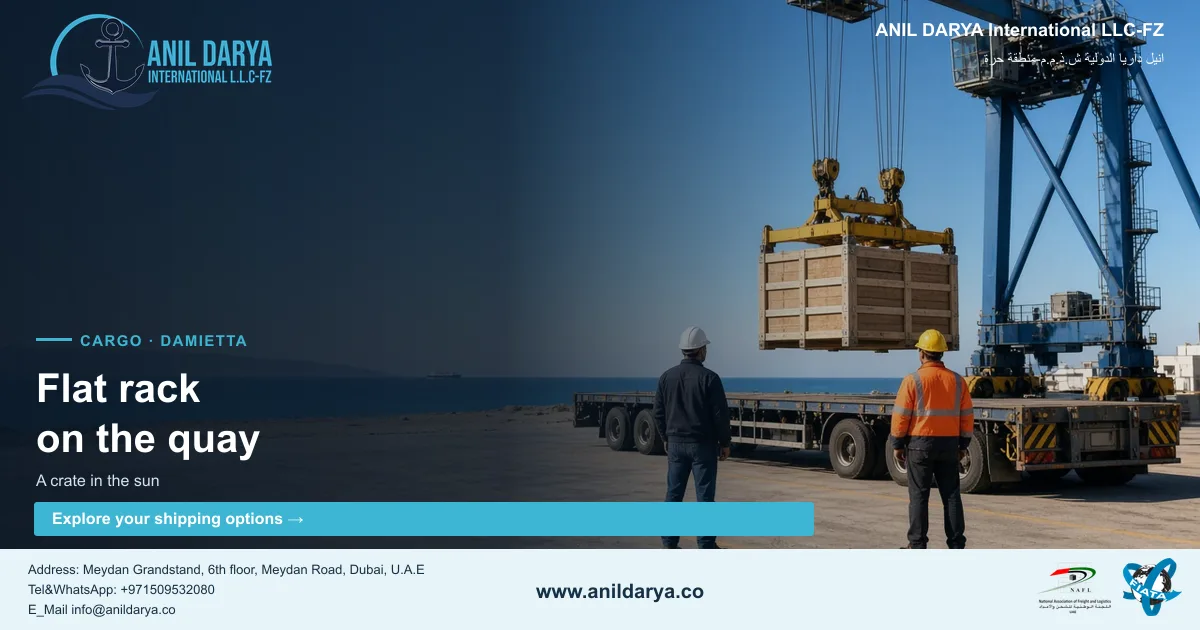
General cargo makes up most of Damietta's tonnage, and the port has berths for general cargo, grain and multipurpose work. Pieces that fit a container but are too tall or wide go on flat racks or open tops. Pieces that do not fit a container at all move as breakbulk on general cargo or heavy-lift vessels.
When we plan a project or breakbulk shipment to Damietta, we work in this order:
- Collect drawings, dimensions, weights and centre of gravity for each piece.
- Choose the vessel type: flat rack on a container service, or conventional breakbulk tonnage.
- Check the berth draft and the ship's gear against the heaviest lift.
- Agree lashing and discharge with the carrier and the consignee's local agent.
- Plan the inland move, including any oversize road permits in Egypt.
- Line up the ACID and customs file before loading, so the cargo does not sit on the quay.
For bulk parcels such as grain or fertiliser, the berth draft and the discharge rate drive the plan. Our break bulk and project cargo service and bulk cargo service explain what we handle from the UAE side.
Dangerous goods to Damietta port
Damietta handles dangerous goods in containers and in bulk, and the ship must lodge a dangerous goods declaration (FAL 7) with its arrival papers. For container cargo, the carrier's DG desk decides first whether it accepts the booking. Egyptian authorities then decide on the import side, so some products also need permits before shipment.
What you need to provide for any DG booking to Damietta:
- A correct UN number, proper shipping name, class and packing group.
- A Safety Data Sheet for each product.
- A signed Dangerous Goods Declaration.
- UN-approved packaging, marks and labels, and placards on the container.
- Any import permit Egypt requires for the product, arranged by the consignee before loading.
Our dangerous goods shipping team checks the documents and gets carrier acceptance before you commit to a sailing. Local storage and direct-delivery rules for DG at Damietta change, so the consignee's clearing agent should confirm them for each shipment.
Customs at Damietta: a short summary
Damietta follows Egypt's national customs rules, which our Alexandria guide covers in full. The points below are what you need for a Damietta shipment.
- ACI and ACID. The Egyptian importer, or a broker on its behalf, registers the shipment on the Nafeza platform and gets an ACID number. Use has been mandatory at seaports since October 2021.
- Timing. Documents must be submitted 48 hours before the shipment arrives, and customs issues the ACID within 48 hours of the importer's data entry. In practice, get the ACID before the cargo leaves Jebel Ali.
- ACID on every document. The exporter must put the ACID on the invoice, packing list and bill of lading.
- Core documents. Commercial invoice, certificate of origin, bill of lading, and a packing list, which is generally recommended.
- Duty and VAT. Most duty rates run from 0% to 60% of the CIF value, with up to 135% on passenger cars and some luxury goods. Import VAT is 14%.
Getting cargo in and out of Damietta: rail, road and Nile barges
Most containers leave Damietta by truck. Three other links are worth knowing:
- Rail. Egyptian National Railways is upgrading the Tanta to Mansoura to Damietta line, about 119 km, including doubling the 65 km Mansoura to Damietta section. The project can also include a freight yard and a freight link to the port. DACT was built with six train lanes, two working at launch.
- Nile barges. A barge channel runs 1,350 m from the barge dock to the sea and 3,750 m to the Nile estuary, so some bulk cargo can move by river.
- Logistics zone. In October 2025 the transport minister announced a logistics zone at the port to speed up cargo handling and customs clearance, alongside a Ro-Ro line between Damietta and Trieste in Italy.
Port directories also note a free-trade zone and an industrial zone next to the port. If your consignee works in the free zone, ask its clearing agent which declaration it needs before the goods ship.
How to ship from Dubai to Damietta port: step by step
This is how we handle a typical shipment from the UAE to Damietta. We book space, prepare documents, arrange trucking and export clearance in the UAE, and work with the consignee's clearing agent in Egypt.
- Send us the cargo details. Commodity, HS code, weight, volume or dimensions, and the Incoterm agreed with your buyer. Our guide to Incoterms 2020 for sea freight explains who pays what.
- The Egyptian importer requests the ACID. We send the importer the draft invoice and packing list so it can register the shipment on Nafeza.
- Get a quote and pick the routing. We compare services from Jebel Ali to Damietta and confirm the transshipment port and the arrival terminal.
- Book space. For DG, reefer or out-of-gauge cargo we get carrier acceptance first.
- Pick up and stuff the container. We arrange the empty, stuffing at your site or a warehouse, and the seal.
- Export clearance in the UAE. We file the export or re-export declaration and deliver the container to the terminal before the cut-off.
- Bill of lading. We check that the ACID, consignee, weights and HS codes match across all documents before the bill is issued.
- Arrival and clearance. The consignee's clearing agent clears the cargo at Damietta, pays duty and VAT, and arranges delivery inside free time.
How to ship from Damietta to Dubai
We also handle the other direction: shipping from Damietta to Dubai, with arrival at Jebel Ali, Khalifa Port or Sharjah port. We book the space with the carrier and run the UAE side. The Egyptian export papers stay with the shipper or its Egyptian agent.
The Egypt export side
- Exporters register. Under Article 39 of the Import and Export Regulation 770/2005, only companies listed in the exporters register may export. GOEIC, the General Organization for Export and Import Control, keeps the register and handles registration and renewal.
- Export filing on Nafeza. Egypt's single window runs an Advanced Export System to automate export procedures. Exporters and customs brokers issue a Unique Consignment Reference (UCR) for each shipment, and electronic documents replace paper. The shipper or its customs broker in Egypt handles this.
- Export inspection. For some goods, GOEIC branches at the ports inspect the shipment under the ministerial decree for that commodity. The list includes leather, marble, furniture, paints, some mining materials, fertilisers and textile scraps.
- Certificate of origin. GOEIC issues certificates under trade agreements, including the Arab League certificate and EUR.1; chambers of commerce issue the others. Exporters must keep the supporting records for five years. Dubai Customs asks for a certificate of origin with the declaration.
The UAE import side
On arrival, the declaration goes to Dubai Customs with the commercial invoice, packing list, bill of lading, certificate of origin and any permit for restricted goods. Customs duty in Dubai is 5% of the CIF value for most goods, with 50% on alcohol and 100% on cigarettes. Import VAT is 5% of the customs value including freight and insurance, and a VAT-registered importer can account for it through the reverse charge on its VAT return. The importer needs a Dubai Customs business code, or clears through a licensed clearing agent. If the shipper offers an Arab League origin certificate, we check with Dubai Customs whether a lower rate applies to your HS code before the cargo sails.
- Send us the shipper's details in Egypt, the cargo, the HS code and the UAE delivery address.
- We book space from DCHC or DACT and send the booking and cut-offs to the shipper.
- The shipper or its trucker stuffs the box and delivers it to the right terminal inside the cut-off.
- The shipper or its Egyptian broker issues the UCR, files the export on Nafeza, books any GOEIC inspection and gets the certificate of origin.
- We check the draft bill of lading against the invoice and packing list.
- We file the UAE declaration before arrival and arrange payment of the duty and VAT.
- We collect the delivery order, truck the box to your site and return the empty inside free time.
[AMIR-FACT: the carriers we actually use from Damietta to Jebel Ali/Khalifa/Sharjah and our real transit days in this direction]
Free time, demurrage and dwell time at Damietta
Each carrier sets its own free days at Damietta, and terminal storage runs on top. Read both on the quote and the arrival notice. One tracking site reported average dwell times in February 2026 of 5.4 days for imports, 5.3 days for exports and 9.3 days for transshipment boxes, so plan for clearance to take several days even when papers are complete.
Three habits cut these costs: get the ACID before loading, send clean documents before the ship arrives, and book the truck before free time starts. Our article on demurrage and detention shows how the charges build up.
Checklist before you ship to Damietta
- ACID issued and shown on the invoice, packing list and bill of lading.
- HS code confirmed for every item, so duty and VAT can be estimated.
- Certificate of origin issued, and legalised if the importer asks for it.
- Invoice, packing list and bill of lading show the same weights, piece counts and consignee.
- Arrival terminal confirmed: DCHC or DACT.
- For food: health certificates and the right reefer settings.
- For DG: SDS, DG declaration, packaging, labels and carrier acceptance.
- For project cargo: drawings, lifting points, berth draft and an inland route plan.
- Consignee's clearing agent appointed and briefed.
- Cargo insurance arranged.
Common mistakes at Damietta port
- Shipping before the ACID exists. Cargo without an ACID can be refused entry, and re-export costs fall on the shipper.
- ACID missing from one document. The bill of lading is the one people forget.
- Wrong terminal on the truck order. With two container terminals, a truck sent to the wrong one loses the day.
- Mixed LCL files. One shipper's missing documents can hold the whole consolidated container.
- Assuming all berths take the same draft. Grain and general cargo berths are shallower than DACT's 18 m.
- Treating DG like general cargo. Undeclared dangerous goods can be rejected or fined.
- Ignoring free time. Clearance in Egypt can take several days, so ask for extra free days at booking.
Frequently asked questions
Who runs Damietta port?
The Damietta Port Authority, part of the Egyptian government, manages the port. DCHC operates the original container terminal, and Damietta Alliance Container Terminals, owned mainly by Hapag-Lloyd, Eurogate and Contship Italia, operates the new one.
What is the port code for Damietta?
The UN/LOCODE for Damietta is EGDAM. You will see it on bookings, bills of lading and tracking systems.
How deep is Damietta port?
The entrance channel is 15 m deep. The new DACT container terminal has 18 m of water, while the older turning basin has 14.5 m at the container berth and 12 m at the general cargo berth.
When did the new Damietta container terminal open?
Damietta Alliance Container Terminals started commercial operations on 14 February 2026, with Hapag-Lloyd's Essen Express as the first ship. It has a 1,670 m quay and a planned final capacity of 3.3 million TEU a year.
Do I need an ACID to ship to Damietta?
Yes. Every shipment to Egypt needs an ACID number, requested by the Egyptian importer on the Nafeza platform. The ACID must appear on the invoice, packing list and bill of lading.
What is the import VAT and duty for goods arriving at Damietta?
Import VAT in Egypt is 14%. Customs duty depends on the HS code, with most rates between 0% and 60% of the CIF value and up to 135% on passenger cars and some luxury goods.
Can you handle shipping from Damietta to Dubai?
Yes. We book the space from Damietta and clear and deliver the cargo in the UAE. The Egyptian exporter must be on the GOEIC exporters register, and it or its broker handles the export filing on Nafeza. Dubai charges 5% duty on CIF for most goods and 5% import VAT.
Can I ship grain or bulk cargo to Damietta?
Yes. Damietta has dedicated grain berths with silos and handles large bulk parcels, and general cargo made up 31.6 million tonnes of its 2025-26 throughput.
Can I ship dangerous goods to Damietta?
Yes, with carrier acceptance, a signed DG declaration, an SDS and correct packaging and labels. Some products also need Egyptian import permits, which the consignee arranges before the cargo ships.
Get a quote for Damietta port shipping
Send us your cargo details and we will come back with a routing and a price from the UAE to Damietta. Use our freight rate inquiry form, or contact our team to talk through a breakbulk, bulk or DG shipment first. You can also read more about our Dubai freight forwarding team.
Sources
- Wikipedia: Damietta Port (land area, berths, channel, breakwaters, turning basin, barge channel)
- Baird Maritime: DACT launches commercial operations (quay, depth, cranes, shareholders, rail lanes)
- Dar: Damietta Port container terminals project (south, north and east terminals)
- Shipping Arabia: Damietta Port record 46.4 million tonnes (2025-26)
- ShipNext: Damietta port data (terminals, berths, vessel limits, cargo mix)
- Cogoport: Damietta (EGDAM) port information (pilotage, depths, carriers, dwell times)
- Find a Port: Port of Damietta (cargo types, free-trade zone, Cairo airport distance, arrival documents)
- Ruzave: Damietta port information (UN/LOCODE)
- European Investment Bank: Tanta-El Mansoura-Damietta railway upgrading
- FreshPlaza: Logistics zone at Damietta Port (October 2025)
- US International Trade Administration: Egypt import requirements and documentation (ACI, ACID, documents)
- PwC Worldwide Tax Summaries: Egypt, other taxes (customs duty, VAT)
- Nafeza, Egypt's national single window: Advanced Export System and UCR
- GOEIC: Exporters register (Article 39, Regulation 770/2005)
- GOEIC: Exports and origin (export inspection, certificates of origin)
- Dubai Customs: Submit customs declaration (invoice, packing list, certificate of origin, permits)
- Dubai Customs: FAQ (5% of CIF, alcohol 50%, cigarettes 100%, business code, licensed clearing agents)
- UAE Government portal: Clearing the customs and paying customs duty
- UAE Federal Tax Authority: VAT guide, import VAT at 5% and reverse charge
Reviewed: 10 November 2026