
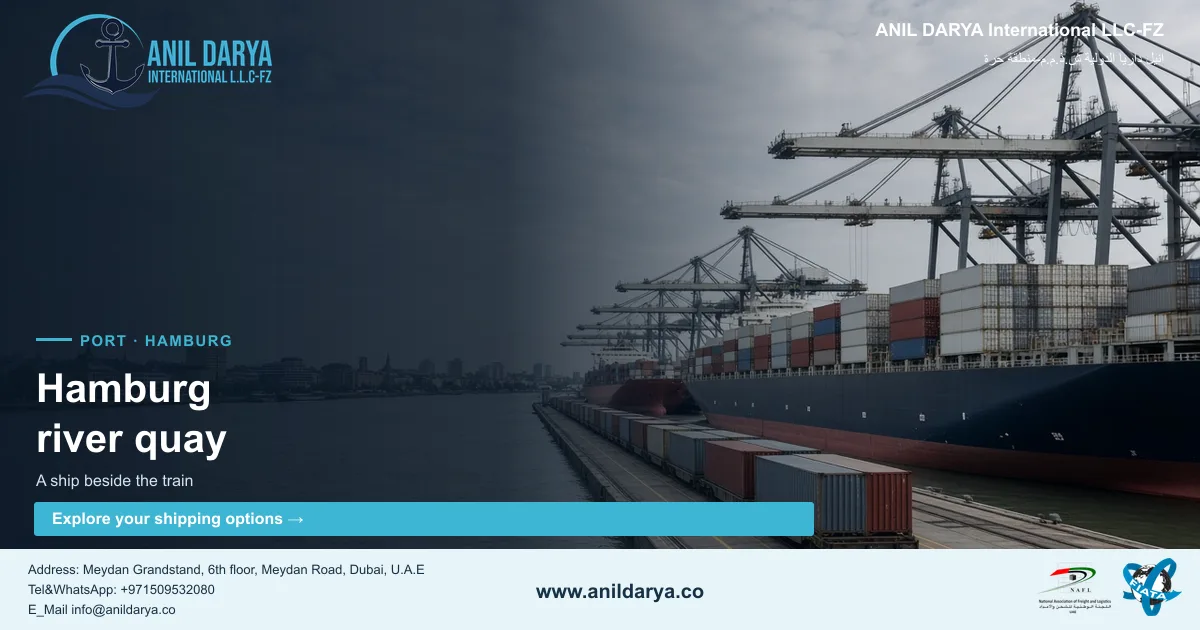
Port of Hamburg shipping covers more German import cargo than any other seaport: containers, breakbulk, project cargo, Ro-Ro and bulk. The port handled 8.3 million TEU and 114.6 million tonnes in 2025, sits on the river Elbe about 115 km from the North Sea, and clears cargo through German customs under EU law. This guide covers the terminals, cargo types, customs at the port and how we ship your cargo there from Dubai. We ship both ways: from Dubai to Hamburg, and from Hamburg to Dubai with clearance on arrival in the UAE.
Port of Hamburg at a glance
| Item | Detail |
|---|---|
| Port authority | Hamburg Port Authority (HPA), managing the port since 2005 |
| UN/LOCODE | DEHAM |
| Location | On the river Elbe, about 115 km from the North Sea |
| Containers handled in 2025 | 8.3 million TEU, up 7.3% on 2024 |
| Total seaborne cargo in 2025 | 114.6 million tonnes, up 2.6% |
| Bulk cargo in 2025 | 32.4 million tonnes |
| Container terminals | Four: EUROGATE CTH, HHLA Altenwerder (CTA), Burchardkai (CTB), Tollerort (CTT) |
| Container capacity | About 12 million TEU a year across the four terminals |
| Ranking | Germany's largest seaport; third-largest container port in Europe after Rotterdam and Antwerp-Bruges |
| Liner network | About 100 liner services |
| Rail | 2.0 million TEU moved by rail in January to September 2025 |
| Project cargo | Multipurpose terminals handle unit loads of up to just over 400 tonnes |
| Free port status | Free port closed on 1 January 2013; cargo is cleared under normal EU customs rules |
| Customs | German customs (Zoll): EORI, ATLAS declaration, EU TARIC duty, 19% or 7% import VAT |
| Hamburg to Dubai (import) | Electronic export declaration in ATLAS by the exporter or its agent; Dubai Customs declaration, 5% duty on CIF for most goods, 5% import VAT |
What is the Port of Hamburg and who runs it?
Hamburg is Germany's largest seaport and a mixed port: containers, general and project cargo, Ro-Ro, liquid bulk and dry bulk all move through it. The Hamburg Port Authority (HPA) plans and builds the port infrastructure and is responsible for the waterways, shipping traffic safety, the port railway and port land. The terminals themselves are run by private and listed operators.
The largest operator is HHLA, which handled 6.1 million TEU in 2025, or 72.9% of the port's container throughput. EUROGATE runs the fourth container terminal. Several companies run the multipurpose, breakbulk, Ro-Ro and bulk terminals.
HPA requires a written permit for very large vessels over 330 m long or 45 m wide, and ships apply for a berth permit at least 24 hours before arrival. The port area holds around 75 terminals, and about 1,500 companies run facilities there.
How deep can ships load into Hamburg?
The Elbe fairway was deepened and widened, and ships have used the new depths since the end of January 2022. The figures below are what the port publishes. They matter to you because they decide which vessel sizes carriers can bring in fully loaded.
| Ship type | Draught independent of tide | Incoming on the tide | Outgoing on the tide |
|---|---|---|---|
| Container ship, 350 m long, 46 m wide | 13.80 m | 16.10 m | 14.80 m |
| Megamax ship, 400 m long, up to 62.50 m wide | 13.10 m | 15.40 m | 14.10 m |
An 8 km passing box between Wedel and Blankenese, 385 m wide, lets two large ships meet on the river.
The port also keeps a link with the Gulf. The Hamburg Representative Office for the UAE and the Gulf region has been based in Dubai since 2006, and Port of Hamburg Marketing has supported it since January 2026. It connects businesses in the region with Hamburg companies and does not book cargo.
Which terminals does the Port of Hamburg have?
Your carrier's service decides the container terminal. Breakbulk and project cargo go to a multipurpose terminal agreed at booking.
Container terminals
| Terminal | Operator | Area | Berths | Container gantry cranes | Rail tracks |
|---|---|---|---|---|---|
| Container Terminal Burchardkai (CTB) | HHLA | 1.4 km² | 10 | 23 | 10 |
| Container Terminal Altenwerder (CTA) | HHLA | 1.0 km² | 4 | 14 | 9, each over 700 m |
| Container Terminal Tollerort (CTT) | HHLA | 0.7 km² | 4 | 14 | 5 |
| Container Terminal Hamburg (CTH) | EUROGATE | Gantry cranes and straddle carriers, with rail and road connections; figures not published on the operator page | |||
HHLA says Burchardkai handles almost one in three containers in the port, and Altenwerder has Europe's largest container rail terminal and a high degree of automation. Altenwerder's truck gate is open from Monday 6:00 to Saturday 14:30, so plan collections inside those hours.
Multipurpose, breakbulk and Ro-Ro terminals
| Terminal | Main use |
|---|---|
| C. Steinweg (Süd-West Terminal) | Breakbulk, project cargo up to just over 400 tonnes per unit |
| Wallmann & Co. | Breakbulk, project cargo up to just over 400 tonnes per unit |
| Rhenus Midgard Hamburg | Multipurpose and bulk, project cargo up to just over 400 tonnes per unit |
| UNIKAI | Ro-Ro and project cargo on rolling equipment; two waterside Ro-Ro ramps |
| HHLA Frucht- und Kühl-Zentrum | Fruit and refrigerated cargo |
| BLG Logistics Group | Multipurpose and general cargo |
HHLA describes UNIKAI as the largest terminal for rolling cargo in the port. Use it for machinery that rolls on its own wheels or on trailers, and the other multipurpose terminals for pieces that must be lifted.
What cargo can you ship to the Port of Hamburg?
| Cargo type | How it moves | What to plan |
|---|---|---|
| General goods in containers | FCL or LCL through the four container terminals | Terminal on the arrival notice, free time, truck or rail slot |
| Food and chilled goods | Reefer containers, or the fruit and cold store centre | Temperature setting, health certificates, official checks on arrival |
| Machinery and steel | Flat racks or open tops on container ships, or breakbulk to a multipurpose terminal | Lifting points, lashing, onward heavy transport permit |
| Oversized and heavy pieces | Project cargo to Steinweg, Wallmann or Rhenus Midgard | Drawings, weights, lift plan |
| Vehicles and rolling equipment | Ro-Ro, for example at UNIKAI | Vehicle documents, EU type approval |
| Chemicals and other DG | IMDG containers | Carrier acceptance, correct DG data for the port notification |
| Bulk | Dedicated dry and liquid bulk terminals | Receiver's terminal contract, surveys |
FCL and LCL shipping from Dubai to Hamburg
Most cargo from the UAE to Hamburg moves in containers loaded at Jebel Ali. Our Jebel Ali port shipping guide covers the export side. The two main options are:
- FCL. You book a whole 20ft or 40ft container. It suits larger loads and goods you do not want handled with other cargo. The box can go straight from the terminal to the consignee by truck or rail.
- LCL. Your cargo shares a container. It is unpacked at a container freight station in Hamburg, then released, so the consolidator's paperwork affects your release too.
For an FCL, ask whether the carrier service calls Hamburg directly or tranships elsewhere in Europe. Direct calls usually mean fewer handling steps; a transhipment can add days but may offer more sailings. Our sea freight service books both and compares them for you.
[AMIR-FACT: the carriers or services we actually use from Jebel Ali to Hamburg and our typical port-to-port and door-to-door transit days on recent shipments]
Breakbulk and project cargo at Hamburg
Hamburg's multipurpose terminals handle single pieces of up to just over 400 tonnes. Cargo that fits a flat rack or open top can go on a container ship to a container terminal. Cargo that does not fit needs breakbulk or heavy-lift tonnage to a multipurpose berth.
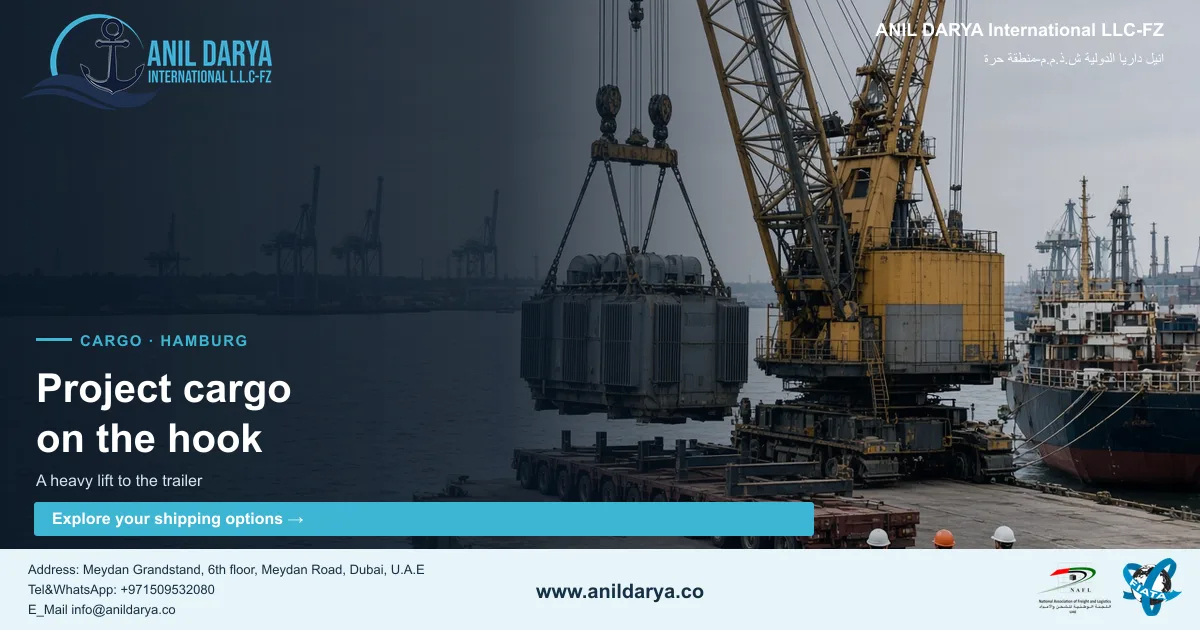
For a project shipment from Dubai to Hamburg we plan in this order:
- Collect drawings, dimensions, weights and centre of gravity for each piece.
- Choose flat rack on a container service or breakbulk or heavy-lift tonnage.
- Agree lifting, lashing and stowage with the carrier and the load terminal in the UAE.
- Send the piece list to the consignee's agent in Hamburg, who books the discharge terminal and the heavy road or barge transport and permits in Germany.
- Line up German customs so the cargo leaves the quay quickly.
Our guide to flat rack, open top and breakbulk options explains the choice, and our break bulk and project cargo service covers the UAE side.
Dangerous goods to the Port of Hamburg
Hamburg handles IMDG dangerous goods in containers under a Hamburg ordinance on the safe transport of dangerous goods in the port (GGBVOHH), which refers to the IMDG Code. The rules that affect your shipment:
| Rule | What the ordinance says |
|---|---|
| Who notifies | The vessel operator or its agent |
| Where | Electronically to the port's dangerous goods information system |
| When | At least 24 hours before the vessel reaches the port area; if the voyage from the last port is shorter, no later than departure from that port |
| Changes | Must be reported within one hour |
| Storage in the port | No fixed time limit; controlled by quantity limits, separation distances and fire protection |
The carrier makes the notification, but it uses your data. A missing or wrong entry stops the box at loading or on arrival, so send it early and correctly.
- UN number, proper shipping name, class, packing group and any subsidiary risk.
- Safety Data Sheet for each product.
- Dangerous goods declaration signed by a trained person.
- UN-approved packaging, labels and placards, and segregation inside the container.
The product must also be legal to sell in the EU, which the German importer checks. Our dangerous goods shipping team handles carrier acceptance in Dubai, and our article on IMDG segregation in containers covers packing.
Customs clearance at the Port of Hamburg
Hamburg was a free port from 1888 until it closed on 1 January 2013. Today all imports through the port are cleared by German customs under the EU Union Customs Code, the same as at any other German port.
How clearance works at Hamburg
- Before loading in Dubai, the carrier files the entry summary declaration at least 24 hours before a container is loaded. For bulk and breakbulk the limit is four hours before the vessel reaches the first EU port.
- On arrival the goods are presented to customs and go into temporary storage. They must be placed under a customs procedure or re-exported within 90 days.
- The importer or its broker files an electronic import declaration in ATLAS, quoting the importer's EORI number and the 11-digit tariff number.
- Customs may check documents or inspect the goods. Food, plant and animal products also need official checks.
- Duty and import VAT are settled and the goods are released for free circulation.
Which documents does German customs need?
| Cargo type | Core documents | Usually also needed |
|---|---|---|
| General cargo (FCL or LCL) | Commercial invoice, packing list, bill of lading, transport invoice | Customs value declaration for ad valorem goods (can be waived under 10,000 euros per delivery) |
| Goods needing origin proof | Core set | Certificate of origin |
| Licensed goods | Core set | Import licence from BAFA or BLE |
| Food and agricultural goods | Core set | Health or plant health certificates, BLE licence where needed |
| Dangerous goods | Core set | SDS, DG declaration |
| Breakbulk and project cargo | Core set with piece-by-piece packing list | Drawings and weights for the terminal and road permits |
Duty and import VAT
Customs duty is the EU rate shown in TARIC for your product code. There is no EU trade agreement with the UAE in force, so UAE goods pay the standard third-country rate. Duty is charged on the customs value, which includes freight and insurance up to the point where the goods enter the EU, not the truck from Hamburg to the consignee.
Import VAT is 19%, or 7% for selected goods such as food and books, charged on the customs value plus duty. A German business entitled to deduct input tax can reclaim it. Our route guide covers EORI, duty and product rules in more detail.
Who clears the cargo?
The German importer needs an EORI number. The declaration is usually filed by a customs broker or forwarder in Hamburg acting for the importer. We file the UAE export declaration and send the documents to the consignee's broker before the vessel arrives. A UAE exporter does not need an EORI number unless it acts as importer or declarant, for example when selling DDP.
Getting cargo out of Hamburg: rail, truck and barge
Hamburg calls itself Europe's largest rail port. In the first nine months of 2025, 2.0 million TEU moved by rail between the port and the hinterland. HHLA's rail company METRANS runs 20 terminals, more than 190 locomotives and over 4,000 railcars, linking the port with central and eastern Europe. HHLA's trucking company CTD handles container trucking in the port and the metropolitan area. The port counts around 2,000 container train connections a week, and over 90% of its shipments to the Czech Republic, Austria and Hungary go by rail.
| Consignee location | Usual onward mode | Decision rule |
|---|---|---|
| Hamburg and northern Germany | Truck | Short leg; book the slot with the terminal |
| Southern Germany, central and eastern Europe | Rail to an inland terminal, then truck | Rail usually makes sense for full containers over long distances |
| Heavy or oversized pieces | Special road transport or barge | Permits and route survey needed before arrival |
Hamburg or another port: when does Hamburg fit?
| Your situation | Hamburg fits? | Why |
|---|---|---|
| Consignee in northern or eastern Germany, Berlin | Usually yes | Short truck or rail leg from the port |
| Consignee in the Czech Republic, Austria or Hungary | Often yes | Most of the port's traffic to these countries already goes by rail |
| Consignee in north-west Germany | Compare with Bremerhaven | The closer port can cut the inland leg |
| Heavy project pieces | Yes, if a multipurpose terminal is booked | Unit loads up to just over 400 tonnes |
| Carrier service does not call Hamburg | Compare transhipment options | A direct service to another port may be faster door to door |
How to ship to the Port of Hamburg from Dubai: step by step
- Agree the Incoterm with your buyer. It sets who books freight, who clears in Hamburg and who pays duty and VAT.
- Check the importer has an EORI number and a customs broker in Hamburg.
- Send us the cargo details: commodity, HS code, weight, volume or dimensions, pickup address and final delivery address.
- We compare carrier services to Hamburg, direct and via transhipment, and confirm the terminal.
- Book space. For DG, reefer or out-of-gauge cargo we get carrier acceptance first.
- Pack and load in the UAE with ISPM 15 wooden packaging, correct marks and, for FCL, a sealed container.
- Send complete shipping instructions before the carrier's cut-off, so the entry summary declaration is filed on time.
- We file the UAE export declaration and gate the container in at the terminal before the cut-off.
- Documents go to the Hamburg broker before arrival, and the broker files the import declaration in ATLAS.
- The consignee's haulier or rail operator collects the cargo within free time and returns the empty container.
How to ship from the Port of Hamburg to Dubai
We also handle the other direction: shipping from Hamburg to Dubai, with arrival at Jebel Ali, Khalifa Port or Sharjah port. We book the space with the carrier and run the UAE side. The German export papers stay with the shipper or its German agent.
The Germany export side
- EORI. The exporter needs an EORI number. It is mandatory for all customs operations in the EU, exports included.
- Electronic declaration. Export declarations are electronic across the EU. In Germany they go into ATLAS-Ausfuhr, the German part of the EU Automated Export System, through certified software or the customs internet declaration service.
- Where. The exporter or its representative lodges the declaration at the customs office responsible for where the exporter is established, or where the goods are packed or loaded.
- Exit. The export office releases the goods, the office of exit at the port confirms they have left the EU, and the export office then sends the exit notice (Ausgangsvermerk) that closes the procedure. Exporters keep it as proof of export.
- Restrictions. Some goods, destinations and end users need an export authorisation or are prohibited, so the shipper checks this before booking.
The UAE import side
On arrival, the declaration goes to Dubai Customs with the commercial invoice, packing list, bill of lading, certificate of origin and any permit for restricted goods. The importer needs a Dubai Customs business code, or a licensed clearing agent with the owner's authorisation files for it. Customs duty in Dubai is 5% of the CIF value for most goods, with 50% on alcohol and 100% on cigarettes. Import VAT is 5%, charged on the customs value including freight and insurance. A VAT-registered importer that has linked its customs registration number with the Federal Tax Authority accounts for it on its VAT return instead of paying at the border.
- Send us the shipper's details in Germany, the cargo, the HS code and the UAE delivery address.
- We book space from Hamburg, confirm the terminal and send the booking and cut-off to the shipper.
- The shipper or its haulier delivers the box to the terminal by truck or rail before the cut-off.
- The shipper or its German agent files the export declaration in ATLAS and gets the goods released for export.
- We check the draft bill of lading against the invoice and the certificate of origin.
- We file the UAE declaration before the vessel arrives.
- We arrange payment of the duty and VAT and collect the delivery order.
- We truck the cargo to your site in the UAE.
- We return the empty container inside the carrier's free time.
[AMIR-FACT: the carriers we actually use from Hamburg to Jebel Ali/Khalifa/Sharjah and our real transit days in this direction]
Free time, demurrage and detention in Hamburg
Shipping lines give a number of free days for their container. After that, demurrage runs while the full container stays at the terminal, and detention while you keep it outside. Free days and daily rates differ by carrier and container type, so read them on your quote. Clearing early, booking rail or truck before arrival and returning the empty on time keep the cost down. Our article on demurrage and detention shows how the charges add up.
Checklist before you ship to Hamburg
- Importer's EORI number and Hamburg customs broker confirmed.
- HS code checked in TARIC for duty, anti-dumping and restrictions.
- CE marking, labels and permits in place where the product needs them.
- Invoice, packing list and bill of lading match on weights, pieces, value and consignee.
- Wooden packaging ISPM 15 marked.
- For DG: SDS, DG declaration, packaging and carrier acceptance.
- For project cargo: drawings, lift plan and German road permits arranged.
- Onward truck or rail booked before arrival.
- Free time agreed and cargo insurance arranged.
Common mistakes when shipping to Hamburg
- Assuming Hamburg is still a free port. It closed in 2013; goods are cleared like any other EU import.
- No EORI number on the consignee, which blocks the import declaration.
- Late shipping data, so the entry summary declaration misses the 24-hour limit and the box is not loaded.
- Booking a truck at the wrong terminal or outside gate hours.
- Leaving freight to the EU border out of the customs value on an FOB invoice.
- Choosing breakbulk without checking the discharge terminal and German road permits.
- Letting goods sit in temporary storage. Free time ends long before the 90-day customs limit.
Frequently asked questions
What is the port code for Hamburg?
The UN/LOCODE for the Port of Hamburg is DEHAM. You will see it on bookings, bills of lading and tracking systems.
How many container terminals does the Port of Hamburg have?
Four: EUROGATE Container Terminal Hamburg and HHLA's Altenwerder, Burchardkai and Tollerort terminals. Together they have a handling capacity of about 12 million TEU a year.
How big is the Port of Hamburg?
It is Germany's largest seaport. In 2025 it handled 114.6 million tonnes of cargo and 8.3 million TEU of containers, making it the third-largest container port in Europe after Rotterdam and Antwerp-Bruges.
Who runs the port of Hamburg?
The Hamburg Port Authority manages the port infrastructure, waterways and port railway. HHLA runs three container terminals and EUROGATE the fourth, with other companies running the multipurpose and bulk terminals.
Is Hamburg still a free port?
No. The Hamburg free port closed on 1 January 2013, so all imports are cleared by German customs under the normal EU rules.
Can the Port of Hamburg handle heavy project cargo?
Yes. Multipurpose terminals such as C. Steinweg, Wallmann and Rhenus Midgard handle unit loads of up to just over 400 tonnes, and UNIKAI handles project cargo on rolling equipment.
What import VAT applies to cargo arriving in Hamburg?
German import VAT is 19%, or 7% for selected goods such as food and books. It is charged on the customs value plus duty and can be reclaimed by businesses entitled to deduct input tax.
Can you handle shipping from Hamburg to Dubai?
Yes. We book the space with the carrier, the shipper or its German agent files the export declaration in ATLAS, and we clear the cargo through Dubai Customs and deliver it in the UAE. Most goods pay 5% duty on the CIF value plus 5% import VAT.
What draught can ships have when calling Hamburg?
A 350 m container ship can sail up to 13.80 m draught independent of the tide and up to 16.10 m coming in on the tide, according to the port's figures since the Elbe fairway adjustment was completed in January 2022.
How long can cargo stay at the port before customs clearance?
Under EU rules goods in temporary storage must be placed under a customs procedure or re-exported within 90 days. Carrier free time is usually much shorter, so clear early.
Get a quote for Port of Hamburg shipping
Send us your cargo details and we will come back with a routing and a price from the UAE to Hamburg. Use our freight rate inquiry form, or contact our team to talk through a project or DG shipment first. You can also read more about our Dubai freight forwarding team.
Sources
- Port of Hamburg: Throughput figures for 2025 at a glance (19 February 2026)
- Port of Hamburg: Throughput January to September 2025 (rail)
- Port of Hamburg: Terminals (capacity, multipurpose and project cargo terminals)
- Port of Hamburg: Liner services
- Port of Hamburg: Home (rail port)
- Port of Hamburg: Hamburg, your port (terminals, companies, rail connections)
- Port of Hamburg: Fairway adjustment (draughts)
- GGBVOHH: Hamburg port dangerous goods ordinance (legal text)
- Hamburg Port Authority: GGBVOHH (PDF)
- Port of Hamburg Marketing: Hamburg Representative Office UAE and Gulf Region
- Hamburg Port Authority: About HPA
- Hamburg Port Authority: Maritime shipping (permits for large vessels, berth permits)
- HHLA: Seaport terminals (CTA, CTB, CTT, UNIKAI)
- HHLA: Container Terminal Altenwerder
- HHLA: Container Terminal Burchardkai
- HHLA: Company overview (METRANS, CTD)
- HHLA Annual Report 2025: Market position
- EUROGATE: Container Terminal Hamburg
- German customs (Zoll): IT procedure ATLAS-Ausfuhr (AES)
- German customs (Zoll): Export restrictions by country, person and goods
- European Commission: What is exportation (export declaration, office of export and exit, AES)
- European Commission: EORI number
- Dubai Customs: Submit customs declaration (documents)
- Dubai Customs: FAQ (5% of CIF, business code, clearing agents)
- UAE Government portal: Customs duty (5% of CIF, alcohol 50%, cigarettes 100%)
- Federal Tax Authority: VAT guide (import VAT at 5%, deferral for registered importers)
- German customs (Zoll): Using the EORI number
- German customs (Zoll): Deadlines for the entry summary declaration
- German customs (Zoll): Import VAT rates and basis
- Hamburg Chamber of Commerce: Import of goods from third countries
- European Commission: EU customs tariff (TARIC)
- European Commission: Temporary storage
- European Commission: EU and UAE agree to launch free trade talks
- Spanish Tax Agency (EU customs): Transport costs in the customs value
- Wikipedia: Port of Hamburg (UN/LOCODE, free port closure)
Reviewed: 10 November 2026