
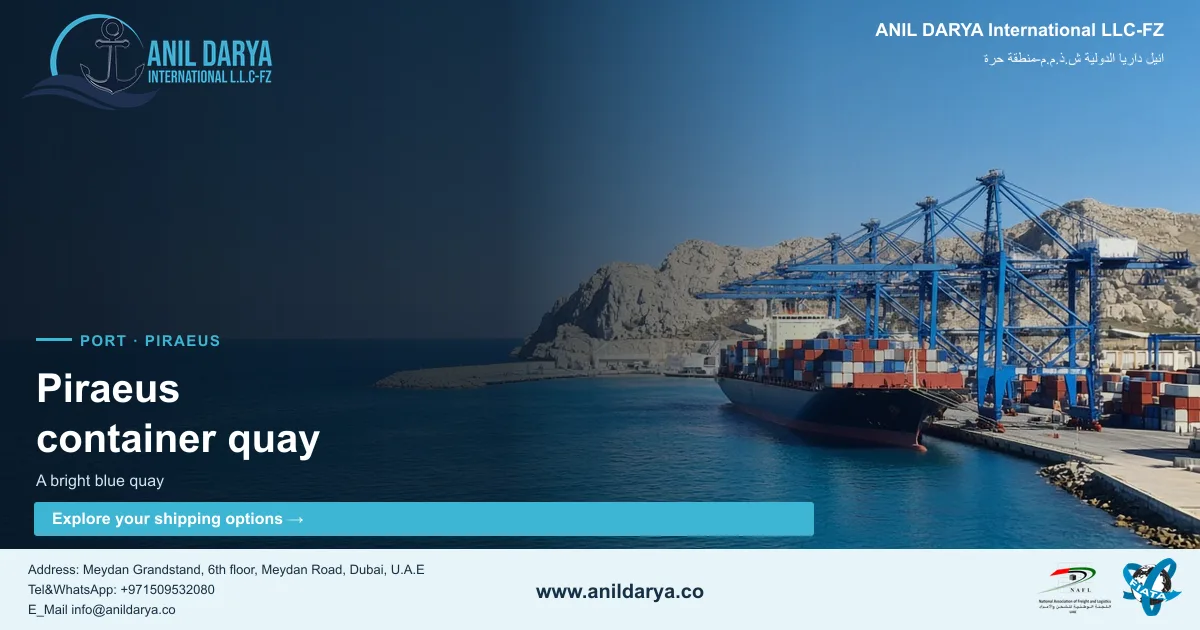
Port of Piraeus shipping is how most containers reach Athens and southern Greece, and a large share of Eastern Mediterranean transshipment runs through it too. The port has three container piers with about 7.2 million TEU of yearly capacity, a ro-ro terminal for vehicles and a customs free zone, and imports clear under EU rules with Greek customs. This guide covers the terminals, cargo types, customs, duty and VAT, and how we move your cargo from Dubai to Piraeus. We ship both ways: from Dubai to Piraeus and from Piraeus to Dubai.
Port of Piraeus guide: key facts at a glance
| Item | Detail |
|---|---|
| UN/LOCODE | GRPIR |
| Location | Piraeus, Attica, on the Saronic Gulf; the port of Athens |
| Port authority | Piraeus Port Authority S.A. (PPA, also OLP) |
| Container terminals | Pier I (run by PPA); Piers II and III (run by Piraeus Container Terminal, PCT) |
| Container capacity | Pier I 1.1 million TEU; Piers II and III 6.2 million TEU; about 7.2 million TEU in total |
| Deepest berth | 19.5 metres alongside, Pier III west side |
| Pier I record | 664,581 TEU handled in 2025 |
| Ro-ro and vehicles | Terminal G2, 5 berths, storage for 6,700 vehicles |
| Rail | PCT rail ramp, up to 10 trains a day to Central Europe and the Balkans |
| Customs | Greek customs (AADE) under EU law; Free Zone Type I at PCT |
| Import VAT | 24% standard rate in Greece |
| Working hours | PCT works 24/7 except Christmas and Greek Orthodox Easter |
| Shipping to Dubai | EU export declaration in AES by the shipper or its Greek agent; arrival at Jebel Ali, Khalifa Port or Sharjah |
Where is the Port of Piraeus and who runs it?
Piraeus is the natural port of Athens and Greece's main gateway. PPA describes it as the first major European port after the Suez Canal, with feeder links across the Mediterranean, the Black Sea and the Adriatic, and rail and road links to the Balkans and Central Europe.
Two companies handle containers. PPA runs Pier I directly. Piraeus Container Terminal S.A. (PCT) has held the concession for Piers II and III since 2009, for 35 years, after an international tender. PCT's terminal is at Neo Ikonio, Perama, and PPA's ro-ro terminal and logistics centre are in Keratsini. Piraeus is also a large passenger port: PPA reported a record 1.86 million cruise passengers in 2025.
Which terminals does the Port of Piraeus have?
Container Pier I (PPA)
Pier I is rated at 1.1 million TEU a year and works 24 hours a day, 365 days a year. PPA says it can take ships of up to 16,000 TEU, with a total pier length of 1,150 metres and a maximum depth of 18 metres. Container storage covers 72,400 square metres.
| Pier I equipment | Number |
|---|---|
| Ship-to-shore cranes (4 over super post-Panamax, 3 Panamax) | 7 |
| Harbour mobile crane, 100 tonnes under hook | 1 |
| Rail-mounted gantry cranes | 8 |
| Straddle carriers | 22 |
| Terminal tractors | 28 |
| Reach stackers | 2 |
Container Piers II and III (PCT)
PCT's terminal is at Neo Ikonio, Perama. Its published current capacity is 3.2 million TEU on Pier II and 3 million TEU on Pier III, a total of 6.2 million TEU. Pier III has the deepest water in the port.
| Berth | Quay length | Depth alongside | Quay cranes | Reefer plugs |
|---|---|---|---|---|
| Pier II east | 780 m | 14.5 m | 9 | 828 |
| Pier II west | 700 m | 16.5 m | 8 | |
| Pier III east | 600 m | 18.5 m | 5 | 360 |
| Pier III west | 762 m | 19.5 m | 8 | 1,035 |
PCT works three shifts, 07:00 to 15:00, 15:00 to 23:00 and 23:00 to 07:00, every day except Christmas and Greek Orthodox Easter. Your container can discharge at Pier I or at PCT, depending on the carrier's service. The carrier's arrival notice names the terminal, and your customs agent and haulier need to know it.
Ro-ro terminal for vehicles and wheeled cargo
PPA's ro-ro terminal G2 is in Keratsini-Drapetsona. It handles new cars, heavy machinery, trucks, roll trailers and general cargo. PPA says more than 260,000 vehicles a year pass through its ro-ro terminals, and lists these details for G2:
| G2 terminal | Detail |
|---|---|
| Surface area | 145,000 square metres |
| Quay length | 1,167 metres |
| Draft | 10 to 11 metres |
| Berthing slots | 4 to 5 |
| Vehicle storage | 6,700 vehicles |
| Annual handling capacity (G1 and G2) | 600,000 movements |
The terminal has roll trailers rated at 80 tonnes, ro-ro tractors with up to 180 tonnes pulling capacity and a mobile crane rated at 80 tonnes at 3 metres. It also has a rail connection for transit cars and a separate area for heavy vehicles.
PPA logistics centre in Keratsini
PPA runs a warehouse complex on a fenced site of 86,402 square metres in Keratsini. Warehouse G-3 has 5,500 square metres and G-5 has 2,500 square metres for imported goods. Services include unstuffing containers, storage, sorting, order picking and delivery, and customs offices are close by.
What cargo can you ship through Piraeus?
| Cargo | Where it is handled | Notes |
|---|---|---|
| Dry containers, FCL and LCL | Pier I or PCT | The main cargo type at the port |
| Reefer containers | Pier I or PCT | PCT lists reefer plugs on every berth of Piers II and III |
| Cars, trucks, machinery on wheels | Ro-ro terminal G2 | Roll trailers and tractors for heavy units |
| Out-of-gauge on flat racks or open tops | Container terminals | Needs carrier and terminal approval |
| Dangerous goods | Container terminals | Terminal notification through the carrier |
| Stored or unstuffed import cargo | PPA logistics centre or PCDC warehouse | PCDC sits inside the free zone |
FCL and LCL shipping to Piraeus
For full containers, Piraeus is a direct-call port for many deep-sea services. FCL suits larger volumes, heavy goods and cargo you want sealed from origin to door. LCL from the UAE is packed at a container freight station in Dubai, shipped to Piraeus and unpacked there before customs release. Each LCL shipment clears on its own, but the box is only unpacked when it reaches the station, so a hold on one shipment can slow the others.
A decision rule: once your cargo fills a large part of a box, price FCL as well as LCL, because one sealed container can cost less than the LCL charges and avoids extra handling. Our guide to FCL vs LCL costs shows how to compare them, and our sea freight service books both from Jebel Ali.
Pier I or PCT: what changes for your container?
For a shipper in Dubai, the terminal is chosen by the carrier, not by you. It still matters, because each terminal has its own gate, its own storage rules and its own contact for release. The table compares what the two operators publish.
| Point | Pier I (PPA) | Piers II and III (PCT) |
|---|---|---|
| Yearly capacity | 1.1 million TEU | 6.2 million TEU |
| Maximum depth | 18 m | Up to 19.5 m alongside |
| Largest ships | Up to 16,000 TEU | Not stated; deepest berths in the port |
| Working hours | 24/7, 365 days a year | 24/7 except Christmas and Greek Orthodox Easter |
| Rail | Land links by train or road to the Balkans and Central Europe | Own rail ramp, up to 10 trains a day |
| Warehouse nearby | PPA logistics centre in Keratsini | PCDC warehouse inside the free zone |
Practical rule: when the arrival notice comes in, pass the terminal name to the customs agent and the haulier the same day. Booking a truck at the wrong gate costs a day, and storage keeps counting.
Breakbulk, heavy-lift and ro-ro cargo at Piraeus
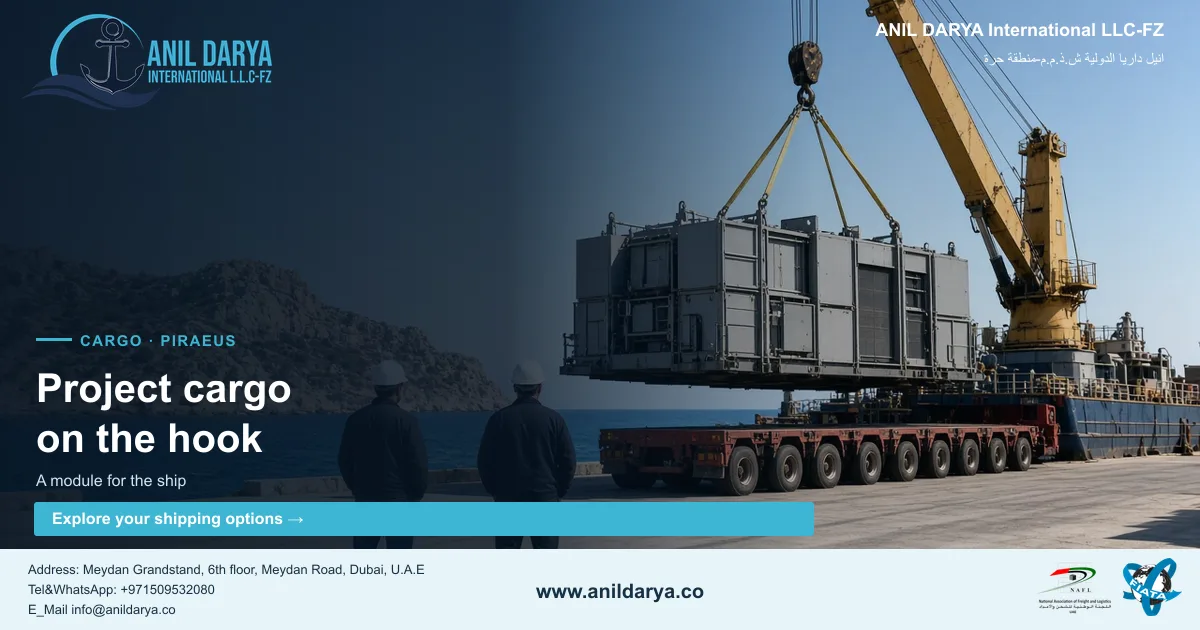
Piraeus handles out-of-gauge cargo in two ways. Pieces that fit a flat rack or open top move on container services and discharge at Pier I or PCT. Pier I's harbour mobile crane is rated at 100 tonnes under hook. Wheeled units and cargo on roll trailers go through the ro-ro terminal, where the heaviest trailers take 80 tonnes.
For a heavy or oversized piece, the order of decisions matters:
- Confirm dimensions, weight and lifting points from the shipper's drawings.
- Decide flat rack, ro-ro or breakbulk based on size and the sailings available.
- Get carrier approval and the terminal's handling plan before you confirm the cargo ready date.
- Plan the Greek road permit for the inland move to site with the consignee's haulier.
Our guide to flat rack, open top and breakbulk cargo explains the equipment, and our break bulk and project cargo service covers what we plan on the UAE side.
Dangerous goods at Piraeus port
DG containers to Piraeus are declared under the IMDG Code. PCT's published operating procedures include a separate notification procedure for dangerous cargo, so the carrier has to send the DG details to the terminal before the ship arrives.
- Give the UN number, proper shipping name, class, packing group and flash point at booking.
- Send a safety data sheet and a signed DG declaration.
- Use UN-approved packaging and the right labels and placards.
- Check segregation if the goods share a box with other DG cargo.
Our dangerous goods shipping team checks acceptance with the carrier before you book, so you do not pay for a box that the line or terminal will refuse.
Customs clearance at Piraeus: documents, duty and VAT
Greece applies EU customs law, run by the Independent Authority for Public Revenue (AADE). Cargo for Piraeus also falls under the EU's ICS2 safety filing, which went live for sea cargo on 3 June 2024. The carrier lodges the Entry Summary Declaration, and any party that holds data the carrier lacks, such as a forwarder issuing house bills, files that part.
How clearance works at Piraeus
- The ENS is lodged in ICS2 before the ship arrives.
- The container is discharged at Pier I or PCT and held in temporary storage.
- The importer's Greek customs agent files the import declaration with the importer's EORI.
- Customs releases on documents, asks for more papers or orders an inspection.
- Duty and VAT are paid or deferred, the carrier releases the delivery order and the terminal releases the box.
Who can clear goods at Piraeus?
The importer needs an EORI number. The European Commission says a business with no EU establishment applies for one in the country of its first customs declaration, and that one EORI works across the EU. Most importers use a licensed Greek customs agent. We work with the consignee's chosen agent or a Greek clearing agent they appoint.
Which documents do you need?
| Document | Who provides it | Why it matters at Piraeus |
|---|---|---|
| Commercial invoice | Shipper | Sets the customs value for duty and VAT |
| Packing list | Shipper | Used for inspection and LCL unpacking |
| Bill of lading | Carrier or forwarder | Needed for the delivery order |
| Certificate of origin | Shipper via UAE chamber | Proves the origin used for duty |
| EORI and Greek VAT number | Importer | Needed to file the declaration |
| DG declaration and SDS | Shipper | Needed for terminal notification |
| Health or plant certificates | Shipper's authority | Food and plant products face EU border checks |
| CBAM authorisation | Importer | Steel, aluminium and other CBAM goods above 50 tonnes a year |
Duty, import VAT and the free zone
Duty is the EU rate in TARIC for your goods code and origin. The EU has no trade agreement with the UAE, so UAE-origin goods pay the normal third-country rate. The EU's Your Europe portal lists Greece's standard VAT rate at 24%, with reduced rates for listed goods.
Two options can help your cash flow at Piraeus:
- Import VAT deferment. PCT explains that Greece lets companies move import VAT from the time of import to their periodic VAT return.
- Free Zone Type I. Non-EU goods held in PCT's free zone are treated as outside the EU customs territory, so duty, VAT and excise are suspended until release. The PCDC warehouse inside the zone handles dry, chilled, flammable and chemical cargo.
Ask your Greek customs agent which option fits the importer before the goods sail.
How to ship from Dubai to the Port of Piraeus, step by step
- Send us the goods description, HS code, weight, volume, packing and Incoterm. Our guide to Incoterms 2020 for sea freight helps you choose.
- Confirm the consignee's EORI, customs agent and any CBAM or health check needs.
- We compare carriers from Jebel Ali to Piraeus and book the sailing.
- We arrange trucking to the port or the container freight station and UAE export clearance.
- We send ICS2 data to the carrier and issue the bill of lading.
- We send document copies to the Greek agent before arrival.
- The agent clears the goods, and the container is released at Pier I or PCT for delivery.
Most cargo loads at Jebel Ali, covered in our Jebel Ali port shipping guide. Some Abu Dhabi cargo loads at Khalifa, covered in our Khalifa port guide.
How long does shipping from Dubai to Piraeus take?
Fluent Cargo's schedule data lists Jebel Ali to Piraeus at 35 days 17 hours with one transfer, with sailings every 2 to 4 weeks. Transit depends on the carrier's transshipment hub, so check the schedule on your booking.
[AMIR-FACT: our real port-to-port days from Jebel Ali to Piraeus and the carriers we book on this lane]
How to ship from the Port of Piraeus to Dubai
We also handle the other direction: shipping from Piraeus to Dubai, with arrival at Jebel Ali, Khalifa Port or Sharjah port. We book the space with the carrier and run the UAE side. The Greek export papers stay with the shipper or its Greek agent.
The Greek export side
- Export declaration. Greece is in the EU, so the declaration is filed electronically in the Automated Export System (AES), at the customs office where the exporter is established. In practice the shipper or its Greek customs agent files it with Greek customs (AADE).
- EORI. The exporter, or the representative that lodges the declaration, needs an EORI number. The EU calls it mandatory for all types of customs operations.
- Exit. The customs office of exit supervises the departure of the goods and tells the office of export that they have left the EU.
- Pickup. The shipper or its trucker delivers the box to Pier I or the PCT terminal inside the carrier's receiving window.
The UAE import side
For cargo landing at Jebel Ali, the import declaration goes to Dubai Customs with the commercial invoice, the packing list, the bill of lading, a certificate of origin and any permit needed for restricted goods. Customs duty is 5% of the CIF value for most goods, with 50% on alcohol and 100% on cigarettes. Import VAT is 5%, and a VAT-registered importer can account for it on its VAT return.
- Send us the shipper's details in Piraeus, the cargo, the HS code, the Incoterm and the UAE delivery address.
- We book space with a carrier from Pier I or PCT and send the booking and cut-offs to the shipper.
- The shipper or its trucker picks up the empty, stuffs it and delivers the box to the terminal before the cut-off.
- The shipper or its Greek customs agent files the export declaration in AES.
- We check the draft bill of lading against the invoice and packing list before it is issued.
- We file the UAE customs declaration before the vessel arrives.
- We arrange payment of the duty and VAT and collect the delivery order from the line.
- We truck the box to your site and return the empty inside the free time.
[AMIR-FACT: the carriers we actually use from Piraeus to Jebel Ali/Khalifa/Sharjah and our real transit days in this direction]
Who does what on a Dubai to Piraeus shipment?
| Party | Main tasks |
|---|---|
| Shipper in the UAE | Commercial invoice, packing list, certificate of origin, DG papers, cargo ready on time |
| Anil Darya | Carrier booking, UAE trucking and export clearance, bill of lading, ICS2 data to the carrier, document copies to Greece |
| Carrier | Sea transport, ENS filing, terminal notification for DG, arrival notice, delivery order |
| Greek customs agent | Import declaration, duty and VAT payment or deferment, inspections |
| Terminal (Pier I or PCT) | Discharge, storage, inspection moves, gate release |
| Importer in Greece | EORI, VAT number, CBAM status, product compliance file, payment of duty and VAT |
Most delays at Piraeus come from a gap between two of these parties, such as an agent waiting for an original invoice or a haulier who was not told the terminal. Send all copies to the Greek agent before the ship arrives and most of these gaps close.
Charges to expect when your cargo reaches Piraeus
We do not publish prices here because they change by carrier and by date, but you should expect these charge types on an import. Ask for each of them in your quote so the landed cost has no gaps.
- Destination terminal handling, charged by the carrier for discharge and handling at the terminal.
- Delivery order or documentation fee from the carrier's agent in Greece.
- Customs agent fee for the import declaration, plus any inspection charges if customs opens the box.
- Storage at the terminal after the free days, and container detention if the empty box comes back late. Our article on demurrage and detention charges explains the difference.
- LCL unpacking and warehouse charges at the station where the box is opened.
- Trucking from the terminal to your consignee.
- Duty and import VAT, set by the goods code, origin and value.
Under DAP and DPU terms the buyer usually pays the Greek clearance, duty and VAT. Under DDP the seller pays them, which means the seller also needs a way to clear goods in Greece. Agree this in writing before you book.
Reefer and food cargo to Piraeus
Both container operators publish reefer plugs on their berths, and PCDC handles refrigerated cargo inside the free zone. The harder part is paperwork. Food of animal origin and many plant products entering the EU go through official veterinary or plant health checks at a border control post, with certificates from the exporting country and a pre-notification before arrival. Ask the Greek agent to confirm the inspection point and the papers before the reefer sails, because a reefer held for missing papers keeps running up plug-in and storage costs.
Moving cargo inland from Piraeus
- Road. PPA says its Keratsini logistics centre links to the main avenues of Piraeus and on to the national roads towards Lamia and Corinth.
- Rail. PCT's own rail ramp can handle up to 10 trains a day to Central Europe and the Balkans.
- Onward by sea. Piraeus has feeder links across the Mediterranean, the Black Sea and the Adriatic for cargo to other ports.
Checklist before you ship to Piraeus
- Consignee's EORI and Greek VAT number on the invoice.
- HS code checked in TARIC for duty and any extra measures.
- Certificate of origin matches where the goods were made.
- CBAM status checked for steel and aluminium.
- DG papers ready and carrier acceptance received.
- Free zone or VAT deferment decided with the agent.
- Delivery address and truck access confirmed for the inland leg.
Common mistakes
- Assuming all containers discharge at the same terminal. Check whether it is Pier I or PCT.
- Filing a vague goods description that fails ICS2.
- Shipping before the importer has an EORI or a customs agent.
- Forgetting that UAE origin has no EU duty preference.
- Letting free time run out at the terminal while papers are fixed.
Piraeus or Thessaloniki?
Use Piraeus for Athens, Attica, southern Greece and the islands, and when you need the widest choice of carriers. Use Thessaloniki for northern Greece and the Balkans. Its container terminal on the 6th pier takes ships with up to 12 metres draft and has a double rail track to the national network.
Frequently asked questions
Who runs Piraeus port?
Piraeus Port Authority S.A. (PPA) runs the port and container Pier I. Piraeus Container Terminal S.A. (PCT) runs container Piers II and III under a 35-year concession that started in 2009.
What is the port code for Piraeus?
The UN/LOCODE for Piraeus is GRPIR. You will see it on bills of lading and carrier schedules.
How many containers can Piraeus handle?
About 7.2 million TEU a year: 1.1 million TEU at Pier I and 6.2 million TEU at Piers II and III. Pier I alone handled a record 664,581 TEU in 2025.
How deep is Piraeus port?
Depth alongside reaches 19.5 metres at the west side of Pier III. Pier I has a maximum depth of 18 metres, and the ro-ro terminal G2 has a draft of 10 to 11 metres.
How long does shipping from Dubai to Piraeus take?
Fluent Cargo lists Jebel Ali to Piraeus at 35 days 17 hours with one transfer and sailings every 2 to 4 weeks. Your carrier's schedule gives the exact arrival date.
Can I ship dangerous goods through Piraeus?
Yes. DG containers are declared under the IMDG Code, and the carrier must notify the terminal before arrival under PCT's dangerous cargo procedure.
What is the import VAT for goods arriving at Piraeus?
Greece's standard VAT rate is 24%, with reduced rates for listed goods. VAT can be deferred to the importer's VAT return, or suspended while goods stay in the Piraeus free zone.
Can Piraeus handle cars and heavy machinery?
Yes. Terminal G2 handles cars, trucks, machinery and roll trailers, with storage for 6,700 vehicles and trailers rated up to 80 tonnes.
Can you ship cargo from Piraeus to Dubai?
Yes. The shipper or its Greek agent files the EU export declaration in AES. We book the space, file the UAE declaration, arrange payment of the 5% duty and 5% VAT, and deliver from Jebel Ali, Khalifa Port or Sharjah.
Get a quote for Port of Piraeus shipping
Send us the cargo details, delivery address in Greece and Incoterm. Use our freight rate inquiry form or contact our team to plan DG, ro-ro or project cargo first. You can also read about our Dubai freight forwarding team.
Sources
- Piraeus Port Authority: Home
- Piraeus Port Authority: Container Terminal Pier I
- Piraeus Port Authority: Car Terminal
- Piraeus Port Authority: Logistics Center
- Hellenic Shipping News: PPA S.A. 2025 results
- Piraeus Container Terminal: Home and operating hours
- Piraeus Container Terminal: Specifications and layout
- Piraeus Container Terminal: Rail services
- Piraeus Container Terminal: Free Zone Type I
- Piraeus Container Terminal: PCDC warehouse
- Piraeus Container Terminal: Import VAT deferment
- Piraeus Container Terminal: Operational procedures
- Thessaloniki Port Authority: Container handling
- iContainers: Port of Piraeus (UN/LOCODE)
- Fluent Cargo: Dubai to Greece sea routes
- European Commission: EORI number
- European Commission: ICS2 live for maritime transport
- European Commission: EU Customs Tariff (TARIC)
- EU Access2Markets: United Arab Emirates
- Your Europe: VAT rates in EU countries
- European Commission: CBAM entered into force on 1 January 2026
- European Commission: What is exportation (export declaration, AES, exit)
- European Commission: EORI number
- Dubai Customs: Submit customs declaration (documents)
- UAE Government portal: Customs duty (5% of CIF, alcohol 50%, cigarettes 100%)
- Federal Tax Authority: VAT guide (5% rate, import VAT)
Reviewed: 10 November 2026