
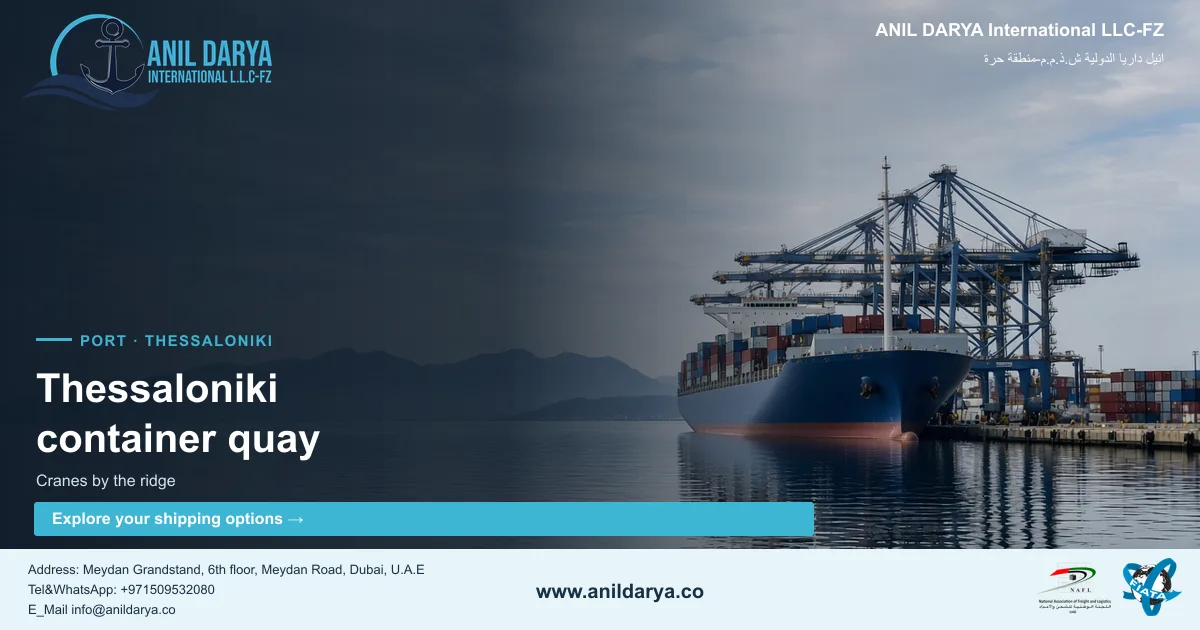
Port of Thessaloniki shipping means using Greece's northern gateway: a container terminal on Pier 6, conventional quays for steel, bulk and project cargo, and a customs free zone that covers most of the port. It is the port to choose when your cargo is going to northern Greece, Bulgaria, North Macedonia or Serbia rather than Athens. This guide covers the terminals, the port's dangerous goods and storage rules, the rail links inland and how we ship your cargo there from Dubai. We ship both ways: from Dubai to Thessaloniki, and from Thessaloniki to Dubai with UAE clearance on arrival.
Port of Thessaloniki at a glance
| Item | Detail |
|---|---|
| Operator | Thessaloniki Port Authority S.A. (ThPA), listed on the Athens Stock Exchange since 2001 |
| Main shareholder | South Europe Gateway Thessaloniki, 67% since 2018 |
| UN/LOCODE | GRSKG |
| Port area | About 1.5 million m², running about 3.5 km along the shore |
| Container terminal | Western part of Pier 6, about 550 m by 340 m |
| Maximum draught at the container terminal | 12 m |
| Container capacity today | 650,000 TEU a year |
| Containers handled in 2025 | 617,000 TEU, up 9.1% on 2024 |
| Conventional cargo in 2025 | 2.8 million tonnes |
| Conventional quays | 4,000 m with depths up to 12 m, on a 1 million m² land zone |
| Reefer plugs (container terminal) | 474 |
| Free zone | Control Type I, covering the container terminal and most of the conventional area |
| Rail | Double track to the national network, regular trains to Sofia and Nis |
| Distance to the airport | 16 km to Makedonia International Airport |
| Import VAT (Greece) | 24% standard rate |
| Thessaloniki to Dubai | We book from Thessaloniki and clear at Jebel Ali, Khalifa Port or Sharjah; the EU export declaration stays with the shipper or its agent |
Where is the Port of Thessaloniki and what does it handle?
The port sits on the Thermaic Gulf in the northern Aegean, right next to Thessaloniki city centre. ThPA describes it as part of the core network of the Trans-European Transport Network (TEN-T), with road and rail links to southeastern, central and eastern Europe. The passenger railway station is 1 km away and the airport 16 km.
In practice the port does three jobs. It is the container gateway for northern Greece. It is a conventional port for steel, marble, grain, fertiliser, scrap and liquid bulk. And it is a transit port for the Balkans, with goods moving on by truck or train to countries with no coast on the Aegean. ESPO, the European ports association, put the port's catchment at about 20 million people, covering northern Greece, North Macedonia, southwest Bulgaria and southern Serbia as its direct market.
How Thessaloniki fits into the shipping network
Most container ships calling at Thessaloniki are feeder and mid-size vessels. A 2021 study by the University of the Aegean found the average ship was 1,573 TEU and about 89% of calls were under 3,000 TEU. Piraeus was the most connected port, linked to 28% of calls, and MSC, CMA CGM, COSCO and X-Press Feeders made up most of the calls in that sample.
What this means for you: cargo from Dubai usually reaches Thessaloniki by transshipment at a larger Mediterranean hub, not on a direct ship from the Gulf. Schedule tools such as Fluent Cargo show Dubai to Thessaloniki routings through hubs like Piraeus. Ask for the transshipment port on every quote, because it drives the transit time and the risk of a missed connection.
Which terminals does the Port of Thessaloniki have?
ThPA runs two cargo terminals: the container terminal on Pier 6 and the conventional cargo terminal along Piers 2 to 6. Both handle project cargo. Piers 1 and 2 also host the passenger, ferry and cruise operations.
Container terminal on Pier 6
The container terminal sits in the western part of Pier 6, at quay 26, inside the free zone. ThPA's port details list quay 26 at 570 m long with 12.6 m of water at low water. The terminal can take ships with a draught of up to 12 m.
| Feature | Detail |
|---|---|
| Ship-to-shore cranes | 4, two of them New Panamax cranes delivered in 2022 |
| Yard equipment | Straddle carriers, reach stackers, tractors, trailers, front lifts and forklifts |
| Ground slots | 5,200 TEU |
| Reefer plugs | 474 (380V) |
| Rail | Double railway line to the national network, with a 50 t transtainer for wagons |
| Vessel operations | 24 hours a day, 361 days a year, according to ThPA |
| Yard (gate) operations | Confirm the current gate hours, holiday exceptions and truck appointment with ThPA before collection |
| Online tools | C.T.M.I.S. web portal, container search, vessel schedule, truck bookings (TAS) |
Vessel handling hours do not establish truck collection hours. Confirm the gate appointment and release before dispatching a truck, and allow for weekend or holiday restrictions in the storage plan.
Conventional cargo terminal
The conventional terminal covers about 1 million m² with 4,000 m of quays up to 12 m deep. Most of it lies in the free zone. ThPA's port details show depths from 6.1 m at the old inner quays to 10.6 m at quay 17 and 11.6 m at quay 24, so the berth your ship gets depends on its draught.
| Equipment and storage | Capacity |
|---|---|
| Mobile harbour cranes | 2 Gottwald at 100 t each, 1 Liebherr at 150 t |
| Mobile telescopic cranes | 120 t and 150 t |
| Rail-mounted quay cranes | 12, including two 100 t cranes on Pier 4 |
| Warehouses | 85,000 m², of which 21,500 m² in the free zone |
| Reefer warehouse | 4,000 m², in the free zone |
| Open sheds | 12,000 m² |
| Open storage | 500,000 m² |
| Grain silo | 20,000 tonnes |
The conventional terminal works two shifts on weekdays (07:00 to 15:00 and 15:00 to 23:00) and one on Saturdays. Work outside those hours is possible at an extra charge.
The Pier 6 expansion
In November 2025 ThPA signed a contract with the METKA and TEKAL joint venture to extend Pier 6. The project adds 513 m of new quay, dredges the channel and turning area, and has a budget of €195.6 million. ThPA says it will raise container capacity from 650,000 TEU to 1.5 million TEU and allow ships of up to 24,000 TEU. The build period is 40 months, and the first caisson of the new quay was placed in July 2026. Until it is finished, plan around the 12 m draught limit.
What cargo can you ship through Thessaloniki?
| Cargo | Where it is handled | What to plan |
|---|---|---|
| General goods in containers (FCL, LCL) | Pier 6 container terminal | Transshipment port, free days, truck slot |
| Chilled and frozen food | Reefer plugs at Pier 6, reefer warehouse | Set point, health certificates, EU border checks |
| Steel, palletised cargo, marble, timber | Conventional quays | Berth depth, lifting points, warehouse space |
| Grain, fertiliser, cement, scrap, ores | Conventional quays and silo | Discharge rate, surveys, storage |
| Liquid bulk (chemicals, mineral oils, asphalt) | Pipeline berths | Receiving tank, product approvals |
| Vehicles | Ro-ro at the conventional terminal | Vehicle documents, EU type rules |
| Project and heavy-lift cargo | Both terminals | Drawings, crane plan, road permits |
| Dangerous goods | Pier 6, by class | Class storage rules, electronic DG declaration |
FCL and LCL shipping to Thessaloniki
Most cargo from the UAE reaches Thessaloniki in containers. With FCL you book a whole 20ft or 40ft box. With LCL your cargo shares a box and is unpacked at a consolidator's warehouse after discharge, which adds a handling step and ties your release to the consolidator's paperwork. Our guide to choosing between FCL and LCL shows where the break-even usually falls.
Know how ThPA counts storage at Pier 6, because it differs by container status:
| Container status | How ThPA charges storage |
|---|---|
| Import, full, for Greece | First 3 days charged as one lump sum, then per day; the rate rises from day 11 |
| Export, full | First 6 days as one lump sum, then per day |
| Transit, full, moving by truck or rail to another country | First 10 days as one lump sum, then per day |
| Empty | First 5 days free under the standard empty-container tariff; separate rules apply after unstuffing in the free zone |
| Transshipment | First 15 days free; status lost after 30 days |
Two points matter here. Import storage starts on the day of discharge, not the day customs clears the box. And an import box later declared for re-export is still charged as an import. Terminal storage is separate from the shipping line's demurrage, which we explain in our demurrage and detention guide.
Breakbulk, heavy-lift and project cargo at Thessaloniki
ThPA handles project cargo at both terminals: turbines, generators, compressors, boilers, construction equipment and rolling or floating units. The heaviest single lifts on the quay come from the 150 t Liebherr mobile harbour crane and the 150 t telescopic crane. Nominal crane capacity is not the approved cargo weight for every lift. Have the terminal confirm capacity at the required outreach, rigging weight and lift configuration; arrange suitable ship's gear or specialist lifting equipment if needed before fixing the vessel.
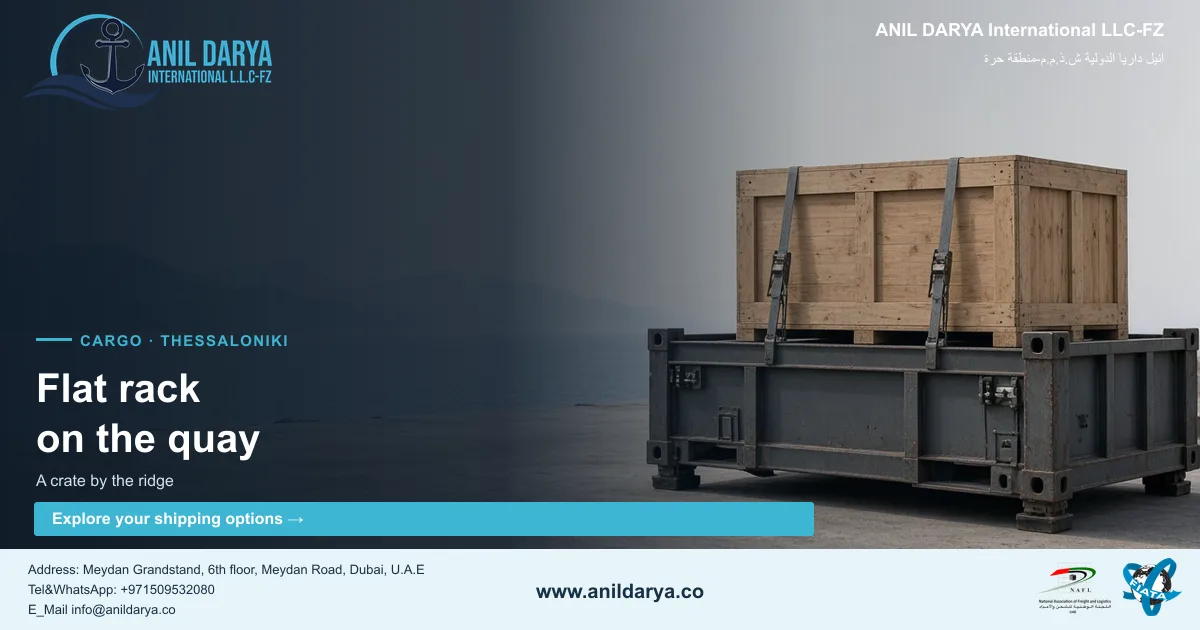
How we plan a project move to Thessaloniki:
- Collect drawings, weights, dimensions and centre of gravity for each piece.
- Decide between flat racks on a container service or breakbulk tonnage, based on size and weight.
- Check the berth depth against the ship's draught, using ThPA's quay table.
- Confirm crane capacity at the berth, or plan ship's gear.
- Agree storage in the free zone or open areas if the cargo waits for road permits.
- Line up the consignee's customs agent so the cargo can leave on arrival.
Decision rule: if each piece fits a 40ft flat rack by size and weight, a container service gives you more sailings via the hubs. If not, you need breakbulk tonnage and the sailing date drives the plan. See our guide to flat racks, open tops and out-of-gauge cargo and our break bulk and project cargo service.
Dangerous goods at the Port of Thessaloniki: storage rules by class
ThPA's container terminal tariff and general terms set clear rules on which IMO classes may wait in the yard. This matters more than the freight rate, because a class that cannot be stored must go straight from ship to truck.
| Cargo | Storage at Pier 6 | What it means for you |
|---|---|---|
| IMO classes 2 to 6, 8 and 9 | Storage allowed, with a 50% surcharge on storage | Normal clearance, but budget for the surcharge |
| Class 1.4S and class 7 | No storage | Direct delivery from the ship; truck and customs ready before berthing |
| IMO waste | No storage | Direct to or from the vessel only |
| Class 9 exports | Paid temporary-storage service in the free zone outside the terminal, including 30 storage-free days | Useful for export consolidation |
IMO classes 1 to 9 generally pay 1.5 times the applicable handling rates; IMO waste is charged at twice the applicable rate. If a DG box is not declared electronically in the ship's EDI or XML files, the terminal charges twice the normal rate. ThPA also states it will not handle or store hazardous cargo that Greek law does not permit.
What you need for any DG booking to Thessaloniki:
- UN number, proper shipping name, class and packing group where assigned.
- Safety Data Sheet for each product.
- A signed Dangerous Goods Declaration.
- Packaging, labels and container placards appropriate to the IMDG classification, with UN-approved packaging where required.
- Carrier acceptance for every leg, including the transshipment hub.
Our dangerous goods shipping team checks the class against the port rules and each carrier's acceptance before you commit to a sailing.
Customs at the Port of Thessaloniki: what is specific to this port
Greece applies EU customs law through its tax and customs authority, AADE. The general rules are the same as at Piraeus, which our Piraeus guide covers in full. Here is the short version, then what is different at Thessaloniki.
The short customs summary
| Rule | What it means for a Dubai shipment |
|---|---|
| Entry Summary Declaration (ICS2) | Live for sea cargo since 3 June 2024. The parties agree either a complete single ENS filing or linked partial filings. House-level data must be supplied to the carrier or filed separately under the agreed multiple-filing arrangement. |
| EORI number | The Greek importer needs one to file the import declaration |
| Customs duty | The EU rate in TARIC for your HS code and origin |
| Import VAT | 24% standard, with reduced rates of 13% and 6% for listed goods |
The Thessaloniki free zone
ThPA states that most of the port is a Control Type I free zone, a fenced area under customs supervision. The free zone is within EU customs territory. Non-Union goods may be held under the free-zone procedure without import duty and relevant import taxes becoming payable at entry to the zone; release for free circulation requires the applicable customs formalities and charges. The container terminal, 21,500 m² of warehouses and the 4,000 m² reefer store all sit inside it. This helps if your buyer is not fixed yet, or if goods may move on to a non-EU Balkan country.
Transit to the Balkans
ThPA gives full containers moving by truck or rail to another country their own transit status, with 10 days of storage charged as one lump sum. If your goods are for Serbia or North Macedonia, the consignee's agent can move them under transit and clear them at destination. Tell us at booking, so the bill of lading and the arrival notice match the plan.
Inspections at the port
ThPA publishes a live list of containers in its inspection area, and the terminal charges each actual move made for customs, sanitary or veterinary checks. Food and plant products face EU border checks, so send health certificates to the consignee's agent before the ship arrives.
Moving cargo inland from Thessaloniki by rail and road
ThPA runs its own intermodal product. It lists three regular weekly round trips between Thessaloniki and Sofia and two between Thessaloniki and Nis in Serbia, on fixed days. Trains carry all container types and conventional wagons, with loads above 1,200 tonnes. ThPA also operates a dry port in Sofia with temporary customs storage.
| Final destination | Usual onward mode |
|---|---|
| Thessaloniki and Central Macedonia | Truck from the port |
| Sofia and western Bulgaria | ThPA rail to the Sofia dry port, or truck |
| Serbia | ThPA rail to Nis, or truck |
| North Macedonia | Truck or rail |
| Athens and southern Greece | Usually better landed at Piraeus |
Book the onward leg early. The rail operator needs the container number and the release before it can load the box.
How to ship from Dubai to the Port of Thessaloniki, step by step
This is how we run a typical export from the UAE to Thessaloniki. We book space, prepare documents, handle UAE trucking and export clearance, and work with the consignee's customs agent in Greece.
- Send us the cargo details: commodity, HS code, weight, volume or dimensions, Incoterm and the final destination, including any onward Balkan leg.
- We compare carrier services from Jebel Ali Port and confirm the transshipment hub for each.
- We book space. For DG, reefer or out-of-gauge cargo, we get acceptance from the carrier for every leg first.
- We truck the cargo or empty container in the UAE and file the UAE export declaration.
- We check the invoice, packing list, certificate of origin and draft bill of lading, with the importer's EORI on the documents.
- We agree the ICS2 filing responsibilities with the carrier and any house-level filer, provide the required data and confirm the applicable filing deadline before dispatch.
- The consignee's Greek agent files the import, free zone or transit declaration before arrival.
- After release and payment of local charges, the consignee books the truck or train and collects within the free period.
How long does shipping from Dubai to Thessaloniki take?
It depends on the hub and the connection, not only on the sailing from Jebel Ali. Schedule tools show very different figures from one routing to the next, so judge each quote by its transshipment port and connection time.
Request a dated quotation identifying the carrier, entry and discharge ports, any transshipment hub, estimated transit time and cargo acceptance. Confirm the schedule and receiving window before dispatch.
How to ship from the Port of Thessaloniki to Dubai
We also handle the other direction: shipping from Thessaloniki to Dubai, with arrival at Jebel Ali, Khalifa Port or Sharjah port. We book the space with the carrier and run the UAE side. The Greek export filings stay with the shipper or its Greek agent.
The Greek export side
- Export declaration. The exporter or its declarant lodges an electronic export declaration in the EU Automated Export System (AES) at the customs office of export, usually where the exporter is established or where the goods are packed or loaded.
- Exit. The goods are then presented at the customs office of exit, which checks them against the export data and supervises their departure. If the two offices differ, the exit office tells the export office that the goods have left.
- Restricted goods. Goods under prohibitions or restrictions, or claiming export refunds, cannot be declared orally and always go on a full electronic declaration.
The UAE import side
On arrival in Dubai, the import declaration goes to Dubai Customs with the commercial invoice, the packing list, the certificate of origin and any permit for restricted goods. The carrier's agent also needs the bill of lading before it issues the delivery order. Customs duty in Dubai is 5% of the CIF value for most goods, with 50% on alcohol and 100% on cigarettes. Standard-rated import VAT is 5% of the customs value, including insurance and freight, plus applicable customs duty and excise tax. Exemptions and special customs arrangements can change the treatment. A VAT-registered importer whose customs number is registered with the Federal Tax Authority accounts for it on its VAT return. An importer that is not registered pays it before the goods are released.
- Send us the shipper's details in Thessaloniki, the cargo, the HS code and the UAE delivery address.
- We book space from Thessaloniki and send the booking, cut-offs and terminal details to the shipper.
- The shipper or its trucker delivers the cargo to the Thessaloniki container or conventional terminal named on the booking inside the carrier's receiving window.
- The shipper or its Greek customs agent lodges the export declaration in the AES and presents the goods at the office of exit.
- We check the draft bill of lading against the invoice and packing list before it is issued.
- We arrange the import declaration with the customs authority for the entry port: Dubai Customs for Jebel Ali, Abu Dhabi Customs for Khalifa Port, or Sharjah Customs for a Sharjah entry.
- We arrange payment of the duty and VAT and collect the delivery order from the carrier's agent.
- We truck the cargo to your site and return the empty container inside the free time.
Request a dated quotation identifying the carrier, entry and discharge ports, any transshipment hub, estimated transit time and cargo acceptance. Confirm the schedule and receiving window before dispatch.
Checklist before you ship to Thessaloniki
- HS code checked in TARIC for every line.
- Consignee's EORI and Greek VAT number on the documents.
- Declaration type agreed: import, free zone or transit to another country.
- Permitted vessel draught, tide and under-keel clearance confirmed for the assigned berth; the container terminal limit does not apply uniformly to conventional berths.
- For DG: class checked against the Pier 6 storage rules, SDS and DG declaration ready.
- For food: health certificates sent to the consignee's agent before arrival.
- Onward truck or rail booked, with yard hours in mind.
- Free time on the container agreed with the carrier.
- Cargo insurance arranged, especially for heavy lifts and transshipped cargo.
Common mistakes on Thessaloniki shipments
- Assuming a direct sailing. Most cargo from the Gulf transships, so ask where and for how long.
- Shipping class 1.4S or class 7 cargo without a direct delivery plan. Pier 6 will not store it.
- Forgetting the electronic DG declaration. Undeclared DG boxes pay double handling.
- Declaring transit cargo as a Greek import, which means paying Greek VAT you did not need to pay.
- Booking a ship deeper than the berth allows for breakbulk at the older quays.
- Dispatching a truck without confirming the current gate hours, appointment and release status.
Thessaloniki or Piraeus: which Greek port fits your cargo?
| Your situation | Port to choose | Why |
|---|---|---|
| Consignee in northern Greece | Thessaloniki | Short truck leg |
| Cargo for Bulgaria, Serbia or North Macedonia | Thessaloniki | ThPA rail to Sofia and Nis, and transit status in the yard |
| Consignee in Athens, southern Greece or the islands | Piraeus | Closer, and more carrier choice |
| Cargo needing the widest choice of carriers | Piraeus | A larger hub, with Thessaloniki fed from it |
| Heavy project cargo for northern Greece | Thessaloniki | Conventional quays with 100 t to 150 t cranes, close to site |
We can price both ports so you can compare the total cost to your door.
Frequently asked questions
Who runs the port in Thessaloniki?
Thessaloniki Port Authority S.A. (ThPA) operates the port. It is listed on the Athens Stock Exchange, and South Europe Gateway Thessaloniki has held 67% of it since 2018.
What is the port code for Thessaloniki?
The UN/LOCODE for Thessaloniki is GRSKG. Use it on bookings and bills of lading so cargo is not routed to another Greek port.
How deep is the water at Thessaloniki port?
The Pier 6 container terminal takes ships with a draught of up to 12 m, and quay 26 has 12.6 m of water at low water. The conventional quays have depths of up to 12 m, with older quays much shallower.
How many containers does Thessaloniki handle?
ThPA reported 617,000 TEU in 2025, up 9.1% on 2024. Capacity is 650,000 TEU a year, and the Pier 6 expansion aims to raise it to 1.5 million TEU.
Does the Port of Thessaloniki have a free zone?
Yes. Most of the port, including the container terminal and 21,500 m² of warehouses, is a Control Type I free zone. Non-EU goods can be stored there without paying duty or VAT until release.
Can I ship dangerous goods to Thessaloniki?
Yes. IMO classes 2 to 6, 8 and 9 can be stored at Pier 6 with a surcharge. Class 1.4S, class 7 and IMO waste cannot be stored and must be delivered directly from the ship.
Is there a direct ship from Dubai to Thessaloniki?
Usually not. Container cargo from Dubai normally transships at a larger Mediterranean hub, such as Piraeus, and arrives on a feeder service. Ask for the hub on every quote.
Can cargo go from Thessaloniki to Bulgaria or Serbia by train?
Yes. ThPA lists three weekly round trips to its dry port in Sofia and two to Nis in Serbia, for all container types and conventional wagons.
Can you handle shipping from Thessaloniki to Dubai?
Yes. We book the space from Thessaloniki, check the bill of lading and run the UAE side: the declaration with the customs authority at the UAE entry port, applicable duty and import VAT arrangements, the delivery order and trucking. The shipper or its Greek customs agent lodges the EU export declaration.
Get a quote for Port of Thessaloniki shipping
Send us your cargo details and we will come back with a routing and a price for shipping to Thessaloniki, including the transshipment hub. Use our freight rate inquiry form, or contact our team to talk through a DG, project or Balkan transit shipment. You can also read more about our Dubai freight forwarding team and our sea freight service.
Sources
- European Commission: Free zones within EU customs territory
- European Commission: ICS2 single and multiple filing
- Federal Tax Authority: VAT import declaration guide
- Abu Dhabi Customs: customs centres
- Sharjah Customs: import procedures
- European Commission: Exportation (export declaration in AES at the office of export, exit at the office of exit)
- Dubai Customs: Submit customs declaration (invoice, packing list, certificate of origin, permits)
- UAE Government portal: Customs duty (5% of CIF in Dubai, alcohol 50%, cigarettes 100%)
- Federal Tax Authority: VAT (5% rate)
- Federal Tax Authority: VAT guide, section 3.5 (import VAT at 5% on customs value, VAT return or payment before release)
- ThPA: The port (area, TEN-T status, distances)
- ThPA: Container handling (Pier 6, cranes, reefer plugs, rail)
- ThPA: Conventional cargo handling (quays, cranes, storage, free zone)
- ThPA: Port details (quay lengths and depths, cranes)
- ThPA: Project cargo handling
- ThPA: Logistics and real estate (storage)
- ThPA: Intermodal rail services (Sofia, Nis)
- ThPA: 2025 results (TEU and conventional cargo)
- ThPA: Contract signed for the expansion of Pier 6
- ThPA: First caisson of the new Pier 6 quay (July 2026)
- ThPA: Container terminal tariff book, valid from 26 June 2026 (storage, DG rules)
- ThPA: Container terminal general terms and conditions (working hours, hazardous cargo)
- ThPA: Conventional terminal general terms and conditions (shifts)
- Wikipedia: Port of Thessaloniki (UN/LOCODE, ownership)
- ESPO: Port of the month, Port of Thessaloniki (hinterland)
- PortEconomics: Thessaloniki port in the maritime transport networks (2021 call data)
- Fluent Cargo: Dubai to Thessaloniki routes
- European Commission: ICS2 live for maritime transport
- European Commission: EU Customs Tariff (TARIC)
- Your Europe: VAT rates in EU countries
Reviewed: 17 November 2026