
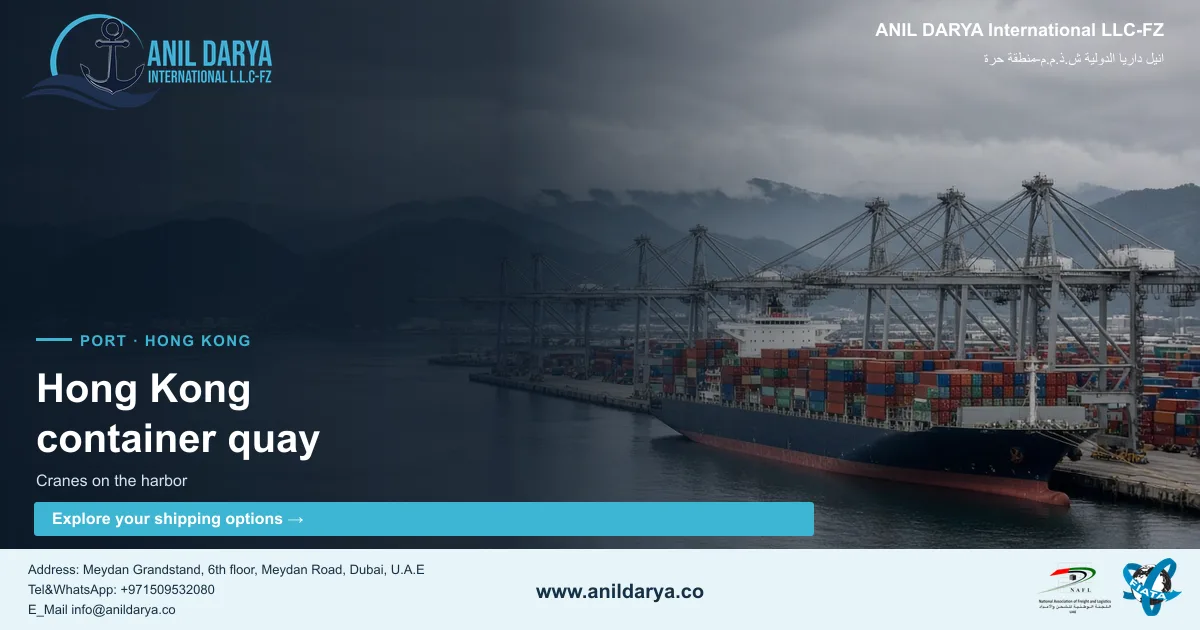
Port of Hong Kong shipping runs through the Kwai Tsing Container Terminals for almost every deep-sea container, with mid-stream sites, a river trade terminal and anchorages handling barge, breakbulk and Pearl River Delta cargo. Hong Kong charges no import tariff, so the main tasks at the port are release, an import declaration within 14 days, and licences for a short list of goods. This guide covers the terminals, the cargo each facility takes, DG rules, customs and how we ship your cargo there from Dubai. We ship both ways: from Dubai to Hong Kong, and from Hong Kong to Dubai with UAE clearance on arrival.
Port of Hong Kong guide: key facts at a glance
| Item | Detail |
|---|---|
| Port administration | Marine Department (navigation, safety, public cargo working areas) |
| Customs authority | Customs and Excise Department (C&ED) |
| Licensing authority | Trade and Industry Department (TID) |
| UN/LOCODE on bookings | HKHKG |
| Main container facility | Kwai Tsing Container Terminals, in the Kwai Chung and Tsing Yi basin |
| Terminals and operators | 9 terminals run by 5 operators |
| Berths and quay | 24 berths, 7,794 m of deep-water frontage, 279 ha of land |
| Basin depth | 15 m; a deepening project to 17 m was substantially completed in April 2016 |
| Terminal capacity | Over 20 million TEU a year |
| Containers handled in 2025 | About 13.0 million TEU, of which Kwai Tsing about 9.7 million (74%) |
| Other cargo facilities | Mid-stream sites, River Trade Terminal at Tuen Mun, 6 public cargo working areas, buoys and 28 anchorages |
| Import tariff | None. Excise duty only on liquor, tobacco, certain hydrocarbon oil and methyl alcohol |
| Import declaration | Within 14 days after import, filed electronically |
| Hong Kong to Dubai | Export declaration within 14 days after export; UAE duty 5% of CIF for most goods plus 5% import VAT |
What is the Port of Hong Kong made up of?
The Port of Hong Kong is not one terminal but a group of facilities around the harbour. The Hong Kong Maritime and Port Development Board describes it as the Kwai Tsing Container Terminals plus a river trade terminal, anchorages and private berths for other cargo. It sits on the Far East trade routes and acts as a gateway to South China, with large volumes moving daily to and from the region by land or river.
In 2025 the port handled about 13.0 million TEU. Kwai Tsing handled about 74% of that. The other 26% moved through mid-stream sites, the river trade terminal, public cargo working areas, buoys, anchorages and other wharves. For a shipper from Dubai, that split matters: a container on a deep-sea service lands at Kwai Tsing, while barge-fed and some breakbulk cargo can be worked elsewhere in the harbour.
Kwai Tsing container terminals: which terminal will your box use?
The nine Kwai Tsing terminals are run by five private operators: Modern Terminals (MTL), Hongkong International Terminals (HIT), COSCO-HIT Terminals (CHT), Goodman DP World Hong Kong and Asia Container Terminals (ACT). The table shows which operator runs which terminal, based on the terminal list published on Wikipedia.
| Terminal | Operator | First commissioned |
|---|---|---|
| CT1, CT2 | Modern Terminals | 1972 |
| CT3 | Goodman DP World Hong Kong | 1972 |
| CT4 | Hongkong International Terminals | 1976 |
| CT5 | Modern Terminals | 1988 |
| CT6, CT7 | Hongkong International Terminals | 1989 and 1990 |
| CT8 East | COSCO-HIT Terminals | 1993 |
| CT8 West | Asia Container Terminals | 1993 |
| CT9 North | Hongkong International Terminals | 2003 |
| CT9 South | Modern Terminals | 2003 |
Your carrier's service decides the terminal, not you. The arrival notice names it. Check it before you book a truck, because collecting from the wrong operator wastes a trip.
Depth and vessel size
The official basin depth is 15 metres, and the deepening project to 17 metres, including the approach channel, was substantially completed in April 2016. That lets the terminals take large container ships on Asia-Europe and Asia-Middle East loops.
Port back-up land, depots and empty return
About 425 hectares of port back-up land is in use, around 100 hectares inside the port and the rest mainly in the New Territories, for example Yuen Long and Lok Ma Chau. This land holds container depots, yards, vehicle parks and repair workshops. Your empty container will usually go back to a depot the shipping line names, which may not be next to the terminal. Check the return address on the delivery order.
Other cargo facilities in the Port of Hong Kong
Not every shipment goes through Kwai Tsing. These facilities handle the rest of the port's cargo.
| Facility | Size | What it handles |
|---|---|---|
| Mid-stream sites | About 33 ha, 3,310 m of water frontage | Cargo moved between barges and trucks, for ocean and river cargo |
| River Trade Terminal, Tuen Mun | 65 ha, 3,000 m of quay | Containers, breakbulk and bulk between Hong Kong and Pearl River Delta ports |
| Public cargo working areas (PCWAs) | 6 sites, 4,828 m of quay | Short-term berths for loading and unloading barges, run by the Marine Department |
| Government mooring buoys | Class A for ships up to 183 m, Class B up to 137 m | Ship-to-barge cargo transfer, typhoon mooring |
| Anchorages | 28 anchorages, 5,396 ha | About 26.8 million tonnes of cargo in 2025 across buoys and anchorages |
| Typhoon shelters | 14 shelters, 422 ha | Shelter for smaller craft up to 75 m |
What cargo can you ship through the Port of Hong Kong?
| Cargo type | How it usually moves | What to plan |
|---|---|---|
| General goods in containers | FCL or LCL through Kwai Tsing | Terminal on the arrival notice, free time, truck collection |
| Chilled and frozen food | Reefer containers through Kwai Tsing | Health certificates, import licence for meat and poultry, food importer registration |
| Steel, machinery, equipment | Flat racks at Kwai Tsing, or breakbulk worked at mid-stream sites or buoys | Lifting points, lashing, barge or truck from ship's side |
| Oversized and heavy-lift pieces | Heavy-lift or breakbulk vessels | Drawings, lift plan, local road permits |
| Chemicals and other DG | IMDG containers | DG manifest 48 hours before arrival, storage arrangements at destination |
| Liquor over 30%, tobacco, fuel oils | Containers under Customs licence | Bonded warehouse or duty payment before release to the market |
| Cargo for the Pearl River Delta | Barge via the River Trade Terminal, or truck | Onward filing: advance cargo information for trucks, re-export declarations |
FCL and LCL shipping to the Port of Hong Kong from the UAE
Most cargo from the UAE to Hong Kong moves in containers. You have two main options.
- FCL (full container load). You book a whole 20ft or 40ft box. It suits larger shipments and goods you do not want handled with other cargo.
- LCL (less than container load). Your cargo shares a box with other shippers. It is unpacked at a container freight station in Hong Kong before your part is released, so release also depends on the consolidator's paperwork.
For LCL, make sure carton marks match the packing list and that the consignee knows which freight station holds the cargo. Our guide to FCL vs LCL costs shows where the break-even usually falls.
Sailings and transit from the UAE
Fluent Cargo's schedule data lists a fastest option of 19 days 3 hours from Khor Fakkan to Hong Kong with one transfer, sailing 1 to 2 times a week. Its fastest listed Jebel Ali option is 31 days 1 hour, also with one transfer. These are published indications, not our times. Check the estimated arrival on your booking.
[AMIR-FACT: the carriers we book from Jebel Ali or Khor Fakkan into Kwai Tsing, which terminal they use, and our typical port-to-port days]
Breakbulk, heavy-lift and project cargo in Hong Kong
Hong Kong handles a share of its non-container cargo away from the quay. At mid-stream sites, buoys and anchorages, cargo is lifted between the ship and barges, then landed at a wharf or a public cargo working area. This suits steel, machinery and other breakbulk when the vessel's own gear can work it.
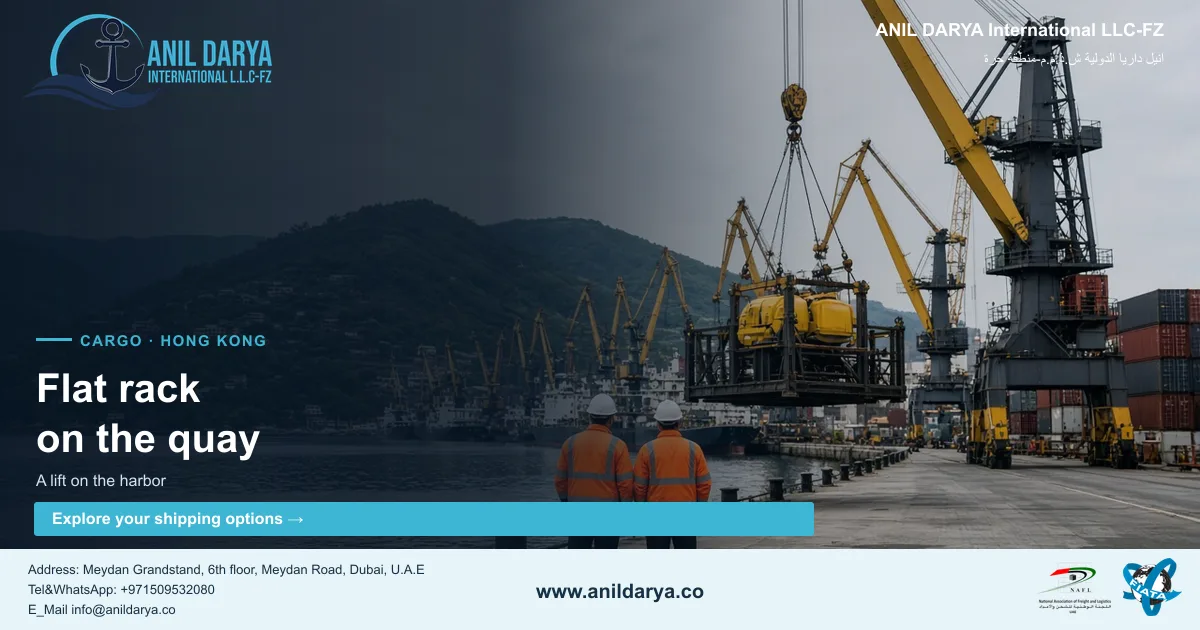
When you ship project cargo to Hong Kong with us, we plan it in this order:
- Collect drawings, dimensions, weights and centre of gravity for each piece.
- Choose the vessel type: flat rack on a container ship into Kwai Tsing, or breakbulk or heavy-lift tonnage.
- Agree with the carrier and the consignee's agent where the cargo will be worked: at a terminal berth, a buoy or by barge.
- Agree lifting, lashing and securing with the carrier, and plan the UAE road move to the quay.
- Pass the piece list to the consignee early, so the Hong Kong side can book the barge, crane or truck.
A decision rule: if a piece fits a 40ft flat rack by size and weight, a container service gives you more sailings and a terminal berth. If it does not, the breakbulk sailing date and the working point in Hong Kong drive the plan. Our article on flat racks, open tops and out-of-gauge cargo explains the options, and our break bulk and project cargo service covers what we arrange.
Dangerous goods at the Port of Hong Kong
Dangerous goods arriving by sea are controlled by the Marine Department, and the vessel's master must make sure carriage complies with the IMDG Code or the IMSBC Code. The port rules below come from the Marine Department's arrival procedures.
| Step | Rule | Who does it |
|---|---|---|
| Before arrival | DG manifest at least 48 hours before the vessel's estimated arrival, through the Marine Department's electronic system or on paper | Owner, agent or master of the vessel |
| If the 48-hour deadline cannot be met for reasonable cause | Manifest furnished immediately after the vessel arrives | Owner, agent or master |
| Carriage on board | Must comply with the IMDG Code or IMSBC Code | Master |
| Local barges carrying DG | Declaration of Fitness and a Conveyance Permit | Local vessel operator |
The carrier files the DG manifest, but it uses the data you give at booking. You need a correct UN number, proper shipping name, class and packing group, a safety data sheet, a signed DG declaration and UN-approved packaging. Segregation inside the box also matters, and our guide to IMDG segregation in containers covers it. Our dangerous goods shipping team confirms carrier acceptance before you commit to a sailing.
Customs clearance at the Port of Hong Kong
Customs controls cargo entering and leaving by sea, air and land, and selects cargo for examination using risk management. For containers on ocean-going vessels, it issues detention notices to shipping agents, terminal operators and consignees for the boxes it wants to examine. Consignees can book examination appointments for detained sea cargo online.
Manifests
Ocean, air and river carriers must submit cargo manifests electronically, in one submission to Customs, the Census and Statistics Department and TID. Customs encourages carriers to submit electronic manifests before arrival. For licensed goods, carriers must not release imports to the importer until valid import licences are produced, and licences and manifests go to TID within 14 days.
Import declarations
Anyone who imports articles other than exempted articles must lodge an import declaration with Customs within 14 days after import. It is filed electronically through Brio Electronic Commerce, Global e-Trading Services or Tradelink Electronic Commerce.
| Declaration item | What applies |
|---|---|
| Forms | Form 1 for non-food imports, Form 1A for food, Form 2 for exports and re-exports |
| Charge on non-food imports | HK$0.20 for the first HK$46,000 of value, plus HK$0.125 per further HK$1,000, capped at HK$200 |
| Charge on food imports | HK$0.20 per declaration |
| Late penalty | HK$20 to HK$200 depending on value and delay |
| Short-paid charge | Up to 20 times the shortfall, maximum HK$10,000 per declaration |
Which documents do you need at the Port of Hong Kong?
Customs lists the documents it may ask for at clearance: the manifest, an import or export licence or removal permit if one is needed, a copy of the detention notice if one was issued, and supporting papers such as the bill of lading, invoice and packing list.
| Cargo type | Core documents | Usually also needed |
|---|---|---|
| General cargo (FCL or LCL) | Invoice, packing list, bill of lading, delivery order | Nothing more if the goods are not licensed |
| Meat, poultry, eggs | Core set | Health certificate from a recognised issuing entity; import licence for frozen or chilled beef, mutton, pork and poultry |
| Other food | Core set | Importer registered with the Food and Environmental Hygiene Department |
| Dutiable goods | Core set | Customs licence, then a removal permit after duty is paid |
| Strategic commodities | Core set | TID licence for each shipment, including re-exports and transshipments |
| Dangerous goods | Core set | DG declaration, SDS, data for the DG manifest |
Duty and licences at the Port of Hong Kong
A Hong Kong government fact sheet states there are no import tariffs. Excise duty is charged on four types of goods for local consumption: liquor, tobacco, hydrocarbon oil and methyl alcohol. Tax is also payable on the first registration of motor vehicles.
| Commodity | Duty (C&ED published rates) |
|---|---|
| Wine, liquor at 30% alcohol or less | 0% |
| Liquor over 30%, bottles of 1 litre or less | 100% on the first HK$200 of value, 10% on the rest |
| Cigarettes | HK$3,306 per 1,000 |
| Other manufactured tobacco | HK$4,005 per kg |
| Unleaded petrol | HK$6.06 per litre |
| Methyl alcohol | HK$840 per hectolitre, plus HK$28.10 per hectolitre for each 1% above 30% strength |
Dutiable goods must be stored in a licensed bonded warehouse unless the full duty is paid. Duty is due when the goods leave the importing carrier or the bonded warehouse for the local market. Strategic commodities, such as some integrated circuits, information security equipment and drones, need a TID licence for every import, export, re-export or transshipment.
How to ship to the Port of Hong Kong from Dubai: step by step
This is how we handle a typical shipment from the UAE to Hong Kong. We book space, prepare documents and arrange origin trucking and export clearance in the UAE. The consignee, or a clearing agent it appoints, handles the Hong Kong end.
- Tell us about the cargo. Commodity, HS code, weight, volume or dimensions, the Hong Kong address and the Incoterm you agreed.
- Check licences. We flag dutiable goods, strategic commodities, food and DG so the consignee can apply before sailing.
- Pick the routing. We compare services from Jebel Ali and Khor Fakkan and the Kwai Tsing terminal each uses.
- Book space. For DG, reefer or out-of-gauge cargo we get carrier acceptance first.
- Prepare and check documents. Invoice, packing list and bill of lading must match on names, weights and descriptions.
- Truck, export clearance and loading. We move the cargo to the UAE port, file the export declaration and load the container.
- Pre-arrival. We send the documents and arrival notice to the consignee, and the carrier files the manifest and any DG manifest.
- Release and delivery. The consignee pays local charges, takes the delivery order, collects from the terminal and returns the empty.
- Declaration. The consignee lodges the import declaration within 14 days.
Loading in Dubai? Our Jebel Ali port shipping guide covers the export side.
How to ship from the Port of Hong Kong to Dubai
We also handle the other direction: shipping from Hong Kong to Dubai, with arrival at Jebel Ali, Khalifa Port or Sharjah port. We book the space with the carrier and run the UAE side. The Hong Kong export formalities stay with the shipper or its Hong Kong agent.
The Hong Kong export side
- Export declaration. Anyone who exports articles other than exempted articles lodges it with Customs within 14 days after export. It goes electronically through Brio, Global e-Trading Services or Tradelink. Form 2 covers most exports.
- Declaration charge. It is value-based and capped at HK$200 per declaration for goods moved on or after 1 August 2018.
- Strategic commodities. An export licence from the Trade and Industry Department is needed before export. It is valid for three months, covers one consignment, and the exporter hands it to the carrier before the goods leave.
- Pickup. The shipper or its trucker delivers the box to the Kwai Tsing terminal named on the booking, inside the carrier's cut-off.
The UAE import side
On arrival in Dubai, the declaration goes to Dubai Customs with the commercial invoice, the packing list, a certificate of origin and any permit for restricted goods. The carrier releases the cargo against the bill of lading. Customs duty in Dubai is 5% of the CIF value for most goods, with 50% on alcohol and 100% on cigarettes. Import VAT is 5%, and a VAT-registered importer accounts for it on its VAT return under the reverse charge.
- Send us the shipper's details in Hong Kong, the cargo, the HS code and the UAE delivery address.
- We book space from Kwai Tsing and send the booking, terminal and cut-offs to the shipper.
- The shipper or its trucker collects the empty, loads it and delivers it to the terminal.
- The shipper or its agent arranges any TID export licence before sailing and lodges the export declaration within 14 days.
- We check the draft bill of lading against the invoice and packing list.
- We file the UAE declaration before the vessel arrives.
- We arrange payment of the duty and VAT and collect the delivery order.
- We truck the box to your site and return the empty inside free time.
[AMIR-FACT: the carriers we actually use from Hong Kong to Jebel Ali, Khalifa Port or Sharjah, and our real port-to-port transit days in this direction]
Hong Kong as a hub: onward cargo and re-exports
- River cargo. The River Trade Terminal at Tuen Mun is the only dedicated river trade terminal in Hong Kong and links to Pearl River Delta ports.
- Truck cargo. Since 1 May 2026, registered shippers or their agents file advance cargo information for road cargo through the Trade Single Window, which replaced the Road Cargo System (ROCARS).
- Re-exports. Re-exports need a Form 2 declaration within 14 days. Licensed goods, including strategic commodities, need export licences as well.
Free time, demurrage and detention in Hong Kong
Shipping lines give free days for their container. After that, demurrage runs while the full container sits at the terminal, and detention while you keep it outside. Free days and rates differ by carrier, so read them on your quote and arrival notice. Customs examination or a missing licence can eat into free time. Our article on demurrage and detention shows how the charges build up.
Checklist before you ship
- HS code and a precise description for every line.
- Invoice, packing list and bill of lading match on weights, pieces and consignee.
- Licences applied for: Customs licence for dutiable goods, TID licence for strategic commodities, FEHD licence and health certificates for meat and poultry.
- Food importer registration confirmed for food cargo.
- DG data complete at booking for the 48-hour DG manifest.
- Kwai Tsing terminal and empty return depot known.
- Working point agreed for breakbulk: terminal, buoy or barge.
- Consignee or agent ready to lodge the import declaration within 14 days.
- Onward leg planned for Pearl River Delta or re-export cargo.
- Free time agreed with the carrier, and cargo insurance in place.
Common mistakes
- Treating "free port" as "no paperwork". The 14-day import declaration still applies, with penalties for late or wrong filing.
- Shipping spirits or tobacco without a licence. Customs can fine up to HK$2,000,000 and seven years in prison for missing licences or permits.
- Missing a strategic commodity. Electronics and chemicals are the usual surprises.
- Late DG data. The 48-hour DG manifest is missed and the cargo waits.
- Wrong terminal or depot. The truck goes to the wrong operator, or the empty goes to the wrong yard.
- No plan for breakbulk working. Nobody has booked the barge or crane when the ship arrives.
Frequently asked questions
How many container terminals does the Port of Hong Kong have?
Kwai Tsing has nine container terminals run by five operators, with 24 berths and 7,794 metres of deep-water frontage. They handled about 74% of the port's containers in 2025.
How long does shipping from Dubai to Hong Kong take?
Fluent Cargo's schedule data lists a fastest option of about 19 days from Khor Fakkan with one transfer, and about 31 days from Jebel Ali. These are published indications, so check the arrival date on your booking.
How much cargo does the Port of Hong Kong handle?
It handled about 13.0 million TEU in 2025, with about 9.7 million at Kwai Tsing. Terminal capacity is over 20 million TEU a year.
What is the port code for Hong Kong?
Bookings and tracking systems use the UN/LOCODE HKHKG for the Port of Hong Kong.
Is there import duty at the Port of Hong Kong?
Not for most goods, because Hong Kong has no import tariff. Excise duty applies only to liquor over 30% alcohol, tobacco, certain hydrocarbon oil and methyl alcohol.
When must I file the import declaration?
Within 14 days after import, electronically through Brio, Global e-Trading Services or Tradelink. The charge is value-based and capped at HK$200 per declaration.
Can the Port of Hong Kong handle dangerous goods?
Yes, under the IMDG Code. The vessel's owner, agent or master must give the Marine Department a dangerous goods manifest at least 48 hours before arrival.
Can you handle shipping from Hong Kong to Dubai?
Yes. We book the space, check the bill of lading and clear the cargo in Dubai. The shipper lodges the Hong Kong export declaration within 14 days after export. In Dubai, duty is 5% of CIF for most goods, plus 5% import VAT.
What is the River Trade Terminal used for?
It consolidates containers, breakbulk and bulk cargo moving between Hong Kong and Pearl River Delta ports. It is at Tuen Mun, with 65 hectares of land and 3,000 metres of quay.
Get a quote for Port of Hong Kong shipping
Send us your cargo details and we will come back with a routing and a price from the UAE to Hong Kong. Use our freight rate inquiry form, or contact our team to talk through a breakbulk, DG or licensed shipment first. You can also read more about our Dubai freight forwarding team.
Sources
- Hong Kong Maritime and Port Development Board: Port of Hong Kong (terminals, depth, throughput, facilities)
- Hong Kong Maritime and Port Development Board: Hub port
- Wikipedia: Kwai Tsing Container Terminals (terminal operators and years)
- iContainers: Port of Hong Kong (UN/LOCODE)
- Fluent Cargo: Dubai to Hong Kong sea routes
- Marine Department: Arrival procedures and dangerous goods manifest
- Customs and Excise Department: Cargo clearance
- Customs and Excise Department: Electronic cargo clearance and Trade Single Window
- Customs and Excise Department: Import and export declarations
- Customs and Excise Department: Types and duty rates
- Customs and Excise Department: Dutiable commodities licences
- Customs and Excise Department: Strategic trade controls
- Trade and Industry Department: Manifest requirements
- GovHK fact sheet: Trade and Industry
- Centre for Food Safety: Guide for food importers
- Trade and Industry Department: Strategic commodities export licence
- Dubai Customs: Submit customs declaration (documents)
- UAE Government portal: Customs duty (5% of CIF, alcohol 50%, cigarettes 100%)
- Federal Tax Authority: VAT guide (5% rate, import VAT, reverse charge)
Reviewed: 10 November 2026