
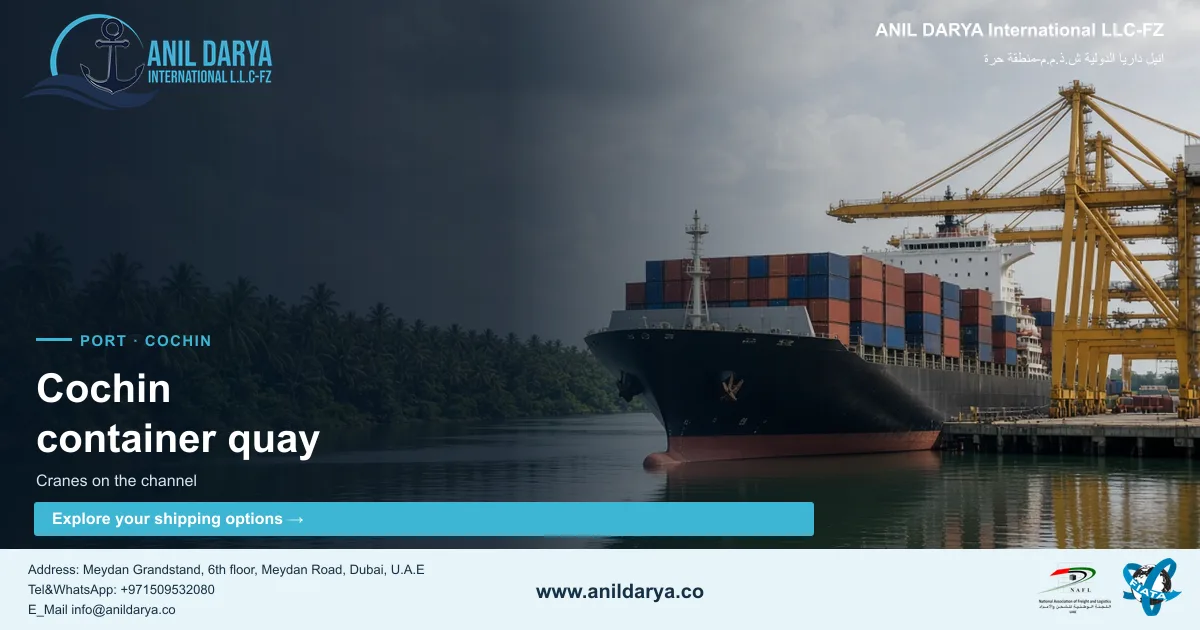
Cochin port shipping means moving cargo through Kochi in Kerala, where the Cochin Port Authority runs the harbour and DP World runs the International Container Transshipment Terminal (ICTT) at Vallarpadam. Containers go through Vallarpadam, while breakbulk, cement, liquids and personal effects are handled on Willingdon Island. This guide covers both sites, cargo types, the port's own CFS, customs at Cochin and how we ship your cargo there from Dubai. We ship both ways: from Dubai to Cochin, and from Cochin to Dubai.
Cochin port at a glance
| Item | Detail |
|---|---|
| Port authority | Cochin Port Authority (CoPA), a major port under the Ministry of Ports, Shipping and Waterways |
| Location | Willingdon Island and Vallarpadam, Kochi, Ernakulam district, Kerala |
| UN/LOCODE | INCOK |
| Opened | 26 May 1928 |
| Distance from main sea routes | 11 nautical miles from the Gulf to Singapore and Far East route; 74 nautical miles from the Suez to Singapore route |
| Container terminal | ICTT Vallarpadam, run by DP World: 950 m quay, 17.6 m alongside, 16 m maximum draft |
| Cargo handled, FY 2025-26 | 38.06 million tonnes |
| Containers, FY 2025-26 | 767,944 TEU (834,665 TEU in FY 2024-25) |
| Main cargo by weight | Crude oil (17.8 million tonnes in FY 2025-26), petroleum products, LNG |
| Port-run CFS | Willingdon Island: 10,000 sq m covered, 20,000 sq m open, LCL and FCL |
| Rail | Regular trains to inland container depots at Coimbatore and Bangalore |
| Free trade warehousing | DP World FTWZ at ICTT, 1.5 lakh sq ft |
| Customs filing | Indian Customs (CBIC) through ICEGATE, with port documents on the Port Community System |
| Cochin to Dubai | Shipping bill filed in India by the shipper or its broker; Dubai Customs declaration, 5% duty on CIF for most goods and 5% import VAT |
What is Cochin port and how is it laid out?
Cochin, also called Kochi, is a natural harbour inside the backwaters of central Kerala. The Cochin Port Authority, renamed from Cochin Port Trust in 2022, owns the channels and the older berths. The port opened in 1928, and its headquarters sit on Willingdon Island, an artificial island built from material dredged for the harbour.
For a shipper, the port is really two sites a short distance apart:
| Site | Who runs it | What it handles |
|---|---|---|
| ICTT Vallarpadam | DP World | All mainline and feeder containers, gateway and transshipment |
| Willingdon Island wharves (Ernakulam and Mattancherry channels) | Cochin Port Authority | General cargo, breakbulk, cement, fertiliser raw materials, liquids at oil berths, the port CFS |
| Kochi LNG terminal | Petronet LNG | LNG tankers of up to 216,000 cubic metres |
| Single point mooring | BPCL Kochi Refinery | Crude oil tankers |
Unlike Nhava Sheva, which has five container terminals, Cochin has one. Every box on your booking goes to Vallarpadam, so you do not need to check which terminal the carrier uses.
Vallarpadam ICTT: Cochin's container terminal
DP World's ICTT at Vallarpadam opened in 2011 and was India's first container transshipment terminal. It also sits in a special economic zone, the first Indian container terminal to do so. DP World publishes these figures:
| Item | ICTT Vallarpadam |
|---|---|
| Quay length | 950 m |
| Depth alongside | 17.6 m |
| Maximum draft | 16 m |
| Maximum vessel length | 400 m LOA |
| Terminal area | 107 hectares |
| Yard | 10,000 ground slots |
| Quay cranes | 7 |
| RTGs | 21 |
| Reefer points | 486 |
| Rail tracks | 2 |
| Full capacity | 2.5 million TEU |
| Free trade warehousing | 1.5 lakh sq ft |
A word of care on depth. The terminal berth is deep, but the approach channel is the limit for the largest ships. In July 2026 The Week reported the port's existing draft as 14.5 m, with plans to deepen it to 16 m. For normal services from the Gulf this rarely matters, but if you are chartering a large vessel, check the current channel draft first.
Maritime Gateway reported that ICTT handled 834,665 TEU in FY 2024-25, of which 169,562 TEU was transshipment, across 640 container vessel calls. The port's own figures show 767,944 TEU in FY 2025-26. For April to September 2026 the same outlet reported container growth of 22%, the highest among India's major ports, and a monthly record of 97,952 TEU in August 2026.
Containers move fast at Vallarpadam. Cochin Port Authority's figures for FY 2025-26 show an average pre-berthing wait of 4.16 hours and an average turnaround of 1.06 days for container ships.
Willingdon Island: berths, CFS and the Ro-Ro link
The older part of Cochin port lines two channels off the main harbour entrance. The Cochin Port Authority publishes these details:
| Channel | Length and draft | Berths |
|---|---|---|
| Entrance channel | 16,500 m long, 260 m wide, 15.95 m deep | Leads to all sites |
| Ernakulam channel | 4.90 km, 12.5 m draft | 5 general cargo, 1 fertiliser and 3 oil berths |
| Mattancherry channel | 4.08 km, 9.14 m draft | 1 general cargo berth, the Boat Train Pier and 2 jetties for other cargo |
The port's own container freight station
Cochin Port runs a CFS on Willingdon Island with 10,000 sq m covered and 20,000 sq m open space. It stuffs and de-stuffs both LCL and FCL containers, including on-wheel stuffing and palletising, from 7 am to 9:15 pm every day except Sundays and holidays. Port equipment there includes a 40 t mobile harbour crane at Ernakulam Wharf, a 45 t reach stacker and forklifts of 3 t and 5 t.
Moving boxes between ICTT and the island
Containers can move between ICTT and the port CFS through the port's Ro-Ro terminal on Willingdon Island. This matters for LCL and for boxes picked for examination, because the box may be discharged at Vallarpadam and opened on the island.
A decision rule: if your FCL goes straight to a factory and is unlikely to be examined, plan delivery from ICTT. If it is LCL, mixed cargo or personal effects, expect it to pass through a CFS.
What cargo moves through Cochin besides containers?
By weight, Cochin is mainly a liquid bulk port. These are the port's FY 2025-26 figures, in thousand tonnes:
| Cargo | FY 2024-25 | FY 2025-26 |
|---|---|---|
| Crude oil | 17,256 | 17,806 |
| Petroleum products (POL) | 6,302 | 6,503 |
| LNG | 1,087 | 1,323 |
| Cement | 836 | 1,072 |
| Rock phosphate | 182 | 198 |
| Methanol | 158 | 176 |
| Breakbulk, all types | 149 | 103 |
| Containers (by weight) | 11,267 | 10,303 |
Pipelines at several berths carry liquid ammonia, petrochemicals, petroleum products, edible oil and carbon black feedstock. Bunkers can be supplied at all berths by barge, truck or pipeline.
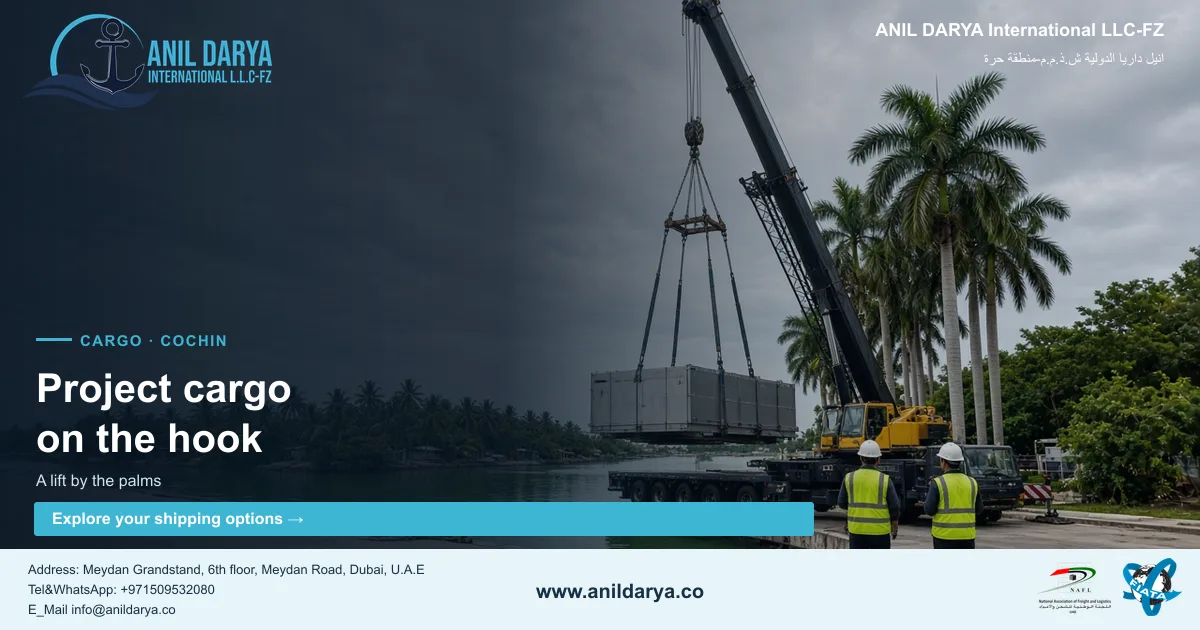
Breakbulk is a small trade at Cochin, about 0.1 million tonnes a year. That does not stop you shipping machinery or steel there, but heavy pieces need early planning because shore cranes are limited. Out-of-gauge pieces that fit a flat rack usually go through ICTT on a container service. Larger pieces need a geared vessel. Our break bulk and project cargo service plans the lift, lashing and survey, and our guide to flat rack, open top and out-of-gauge cargo helps you pick the equipment.
Shipping from Dubai to Cochin: FCL, LCL, reefer and personal effects
Most cargo from Dubai to Cochin sails from Jebel Ali in containers. Pick the option by volume and what you are shipping.
| Option | Best for | What happens at Cochin |
|---|---|---|
| FCL (20ft or 40ft) | One consignee, full loads | Discharged at ICTT, cleared and delivered by road or rail |
| LCL | A few pallets or cartons | Box is de-stuffed at a CFS and each consignee clears its own part |
| Reefer | Chilled and frozen food | Plugged at one of ICTT's 486 reefer points, then fast food-safety clearance |
| Unaccompanied personal effects | Household goods sent by a returning resident | De-stuffed at the port CFS and examined by customs |
| Flat rack or open top | Machinery, tall or wide pieces | Lifted at ICTT, moved out on low-bed trailers |
LCL adds CFS charges at both ends, so a full container can be cheaper sooner than you expect. Our FCL vs LCL cost guide walks through the maths. We book space with the carrier, prepare the documents and arrange trucking and export clearance in the UAE through our sea freight service.
[AMIR-FACT: Our typical port-to-port transit Jebel Ali to Cochin in days and the carriers we usually book on this lane, direct or via transshipment]
Personal baggage in containers
Cochin Port has a set process for unaccompanied personal baggage that arrives in containers:
- The importer, directly or through a customs broker, gives the port a copy of the bill of lading, the cargo charges and the delivery order.
- The port issues an appraisal ticket for customs examination.
- The container is de-stuffed at the port CFS and customs examines and clears the goods.
- The importer hands in the baggage declaration stamped "Out of Charge" by customs and takes delivery.
Customs allowances for baggage are set by Indian Customs, not the port, so check them with your broker before you pack.
Rail, road and the Kerala hinterland
Cochin's hinterland is Kerala, southern Tamil Nadu and southern Karnataka. The port lists national highway links to Salem, Madurai and Mumbai, Indian Railways connections to south and central India, and National Waterway 3 for south Kerala. Inland container depots at Coimbatore and Bangalore are linked to the port by regular trains, and ICTT has two rail tracks of its own.
In July 2026 The Week reported that a rail service of nearly 500 km between Bengaluru and ICTT was being planned, subject to demand. Treat that as a plan, not a service you can book today.
A practical rule: for consignees in Kerala, Cochin is usually the shortest and cheapest route. For Bangalore or Coimbatore, compare Cochin by rail with the east coast ports and price both to the door.
Customs clearance at Cochin port: a short summary
Cochin uses the same national customs law as every Indian seaport, and our Nhava Sheva and Mundra guides cover it in full. In short, the importer needs an Import Export Code (IEC) and must declare its GSTIN on the Bill of Entry. The Bill of Entry is filed on ICEGATE before the end of the day before the vessel arrives, under Section 46 of the Customs Act, 1962, and a prior Bill of Entry is valid if the ship arrives within 30 days. Goods that meet the India-UAE CEPA origin rules, in force since 1 May 2022, can claim a lower duty rate with a valid certificate of origin.
What is specific to Cochin is the port-side paperwork. The Cochin Port Authority lists these documents, all submitted online through the Port Community System and the customs system:
| Import at Cochin | Export from Cochin |
|---|---|
| Import General Manifest approved by customs | Shipping bill approved by customs |
| Bill of Entry with cargo charges, filed through a customs broker | Cargo charges through a customs broker |
| Customs Out of Charge certificate | Customs Let Export Order for the vessel |
| Steamer agent's delivery order or bill of lading |
Supporting documents go up through e-Sanchit as PDF files under 1 MB each. We work with your customs broker or a destination clearing agent. We do not file Indian customs entries ourselves.
Dangerous goods at Cochin port
Cochin handles large volumes of hazardous liquids at its oil berths, the LNG terminal and the refinery's single point mooring. For containerised DG, note two port-specific points:
- IMO Class 1 cargo (explosives) follows a standard operating procedure published by the port and approved by the Chief Controller of Explosives. Ask us before you quote any Class 1 cargo.
- Liquid chemicals in bulk, such as ammonia or methanol, use dedicated pipelines at named berths, so the receiving terminal must accept the product before the ship is fixed.
For any DG booking you need the UN number, proper shipping name, class, packing group, an SDS, a signed DG declaration and UN-approved packaging. The carrier must accept the booking, and the Indian importer must hold any licence the product needs. Our dangerous goods shipping team checks this before you commit to a sailing.
How to ship from Dubai to Cochin: step by step
We handle the UAE side and coordinate with your consignee's broker in Kochi.
- Share the cargo details. Commodity, HS code, weight, volume, Incoterm and the delivery address in India.
- Choose FCL, LCL, reefer or flat rack, and decide whether the box goes straight from ICTT or through a CFS.
- Book space from Jebel Ali. For DG, reefer or out-of-gauge cargo we get carrier acceptance first.
- Match the documents. Invoice, packing list, certificate of origin and draft bill of lading must agree.
- Export from the UAE. We arrange trucking and the export or re-export declaration in Dubai, as set out in our Jebel Ali port guide.
- File in India. The importer's broker files the Bill of Entry on ICEGATE before arrival.
- Release. Duty and IGST are paid, customs gives Out of Charge and the line issues the delivery order.
- Deliver and return. The box goes to the consignee or the CFS, and the empty goes back within the line's free time.
[AMIR-FACT: A real shipment we handled from Dubai to Cochin: cargo, FCL or LCL, and how clearance and delivery went]
How to ship from Cochin to Dubai
We also handle the other direction: shipping from Cochin to Dubai, with arrival at Jebel Ali, Khalifa Port or Sharjah port. We book the space with the carrier and run the UAE side. The Indian export papers stay with the shipper or its Indian agent.
The India export side
- Shipping bill. Under Section 50 of the Customs Act, 1962, the exporter makes entry of goods leaving by sea by presenting a shipping bill electronically on the customs automated system. The exporter is responsible for the accuracy of the information and the documents behind it. In practice the shipper or its customs broker in Kochi files it on ICEGATE.
- Exporter details. The exporter needs an Import Export Code (IEC), must quote its GSTIN, and registers its bank's AD code online through its ICEGATE profile before the first export.
- Let Export Order. Under Section 51, customs makes an order permitting clearance and loading once it is satisfied the goods are not prohibited and any duty is paid. Cochin Port asks for the approved shipping bill and the Let Export Order before loading.
- CEPA certificate of origin. Since 1 May 2022, DGFT issues the preferential certificate of origin for exports to the UAE under the India-UAE CEPA on its eCoO platform. The exporter applies with a Class III digital signature. Without it, the goods pay the normal UAE duty.
The UAE import side
On arrival, the declaration goes to Dubai Customs with the commercial invoice, packing list, bill of lading, certificate of origin and any permit for restricted goods. Customs duty in Dubai is 5% of the CIF value for most goods, with 50% on alcohol and 100% on cigarettes, unless a valid CEPA certificate gives a lower rate. Import VAT is 5% of the customs value including freight and insurance, and a VAT-registered importer can account for it through the reverse charge on its VAT return. The importer needs a Dubai Customs business code, or clears through a licensed clearing agent.
- Send us the shipper's details in Kerala, the cargo, the HS code and the UAE delivery address.
- We book space from ICTT Vallarpadam and send the booking and cut-offs to the shipper.
- The shipper or its trucker stuffs the box and delivers it to ICTT inside the cut-off.
- The shipper or its Indian broker files the shipping bill, gets the Let Export Order and, if the goods qualify, the CEPA certificate.
- We check the draft bill of lading against the invoice and packing list.
- We file the UAE declaration before arrival and arrange payment of the duty and VAT.
- We collect the delivery order, truck the box to your site and return the empty inside free time.
[AMIR-FACT: the carriers we actually use from Cochin to Jebel Ali/Khalifa/Sharjah and our real transit days in this direction]
Checklist before you ship to Cochin
- Consignee has an active IEC, GSTIN and a customs broker in Kochi.
- HS code and duty line checked; CEPA certificate arranged if the goods qualify.
- Delivery route agreed: direct from ICTT, port CFS or rail to an inland depot.
- Reefer plug, flat rack or DG acceptance confirmed if needed.
- Bill of Entry ready to file before the vessel arrives.
- For personal effects: baggage declaration and broker lined up.
- Free time on the container agreed and insurance arranged.
Our article on demurrage and detention shows how charges build up when a box sits too long.
Common mistakes on shipments to Cochin
- Sending heavy breakbulk without checking crane capacity, since Cochin handles little breakbulk.
- Assuming the deepest draft figures apply to the approach channel for a chartered ship.
- Booking a planned rail service, such as the Bengaluru link, before it runs.
- Packing personal effects without checking baggage allowances with customs first.
- Claiming CEPA duty for goods that only passed through Dubai.
Frequently asked questions
Is Cochin port the same as Kochi port?
Yes. Cochin and Kochi are the same port in Kerala, run by the Cochin Port Authority. Its UN/LOCODE is INCOK.
Which terminal handles containers at Cochin?
All containers go through the International Container Transshipment Terminal (ICTT) at Vallarpadam, run by DP World. It has a 950 m quay and 486 reefer points.
How many containers does Cochin port handle?
The Cochin Port Authority reports 767,944 TEU in FY 2025-26 and 834,665 TEU in FY 2024-25. Total cargo in FY 2025-26 was 38.06 million tonnes.
What is the draft at Cochin port?
DP World gives 17.6 m alongside and a 16 m maximum draft at ICTT. Press reports in July 2026 put the working channel draft at 14.5 m, with deepening to 16 m planned.
Does Cochin port have its own CFS?
Yes. The Cochin Port Authority runs a CFS on Willingdon Island with 10,000 sq m covered and 20,000 sq m open space, handling both LCL and FCL containers.
Can I ship personal effects from Dubai to Cochin?
Yes. Unaccompanied baggage in containers is de-stuffed at the port CFS and examined by customs. You need the bill of lading, delivery order and a baggage declaration.
Can I ship dangerous goods to Cochin?
Yes, with full DG papers and carrier acceptance. Class 1 explosives follow a port procedure approved by the Chief Controller of Explosives, so check with us before quoting.
Can you handle shipping from Cochin to Dubai?
Yes. We book the space from ICTT and clear and deliver the cargo in the UAE. The shipper or its Indian broker files the shipping bill and, for CEPA duty rates, gets the preferential certificate of origin from DGFT. Dubai charges 5% duty on CIF for most goods and 5% import VAT.
Is Cochin close to the main shipping routes?
The Cochin Port Authority says the port is 11 nautical miles from the Gulf to Singapore route and 74 nautical miles from the Suez to Singapore route.
Get a quote for Cochin port shipping
Send us your cargo details and we will come back with a routing and a price from Dubai to Cochin. Use our freight rate inquiry form, or contact our team to talk through a reefer, DG or project shipment. You can also read more about our Dubai freight forwarding team.
Sources
- Cochin Port Authority: Home, facilities at port (channels, berths, location)
- Cochin Port Authority: Overview (sea routes, connectivity, ICDs, climate)
- Cochin Port Authority: Cargo services (documents, CFS, baggage, Class 1 SOP, Ro-Ro, pipelines, equipment)
- Cochin Port Authority: PPP operators (Kochi LNG terminal, BPCL SPM)
- Cochin Port Authority: Performance reports (cargo traffic for 10 years, FY 2025-26 performance)
- DP World: Cochin ICTT infrastructure (quay, depth, cranes, reefer points, capacity)
- DP World: Cochin ICTT (first transshipment terminal in India)
- Maritime Gateway: Cochin port container growth tops major ports at 22% (October 2026)
- The Week: Cochin Port's gateway cargo push at Vallarpadam ICTT (July 2026)
- ICEGATE: FAQs (IEC, prior Bill of Entry, e-Sanchit, GSTIN, AD code registration)
- CBIC: Customs Act, 1962 (Sections 46, 50 and 51)
- DGFT Trade Notice 05/2022-23: India-UAE CEPA from 1 May 2022, preferential certificates of origin on the eCoO platform
- Dubai Customs: Submit customs declaration (invoice, packing list, certificate of origin, permits)
- Dubai Customs: FAQ (5% of CIF, alcohol 50%, cigarettes 100%, business code, licensed clearing agents)
- UAE Government portal: Clearing the customs and paying customs duty
- UAE Federal Tax Authority: VAT guide, import VAT at 5% and reverse charge
- Wikipedia: Cochin Port (opening date, renaming, Willingdon Island)
- Wikipedia: ICTT Kochi (opening in 2011, first terminal in an SEZ)
- iContainers: Port of Cochin (UN/LOCODE INCOK)
Reviewed: 10 November 2026