
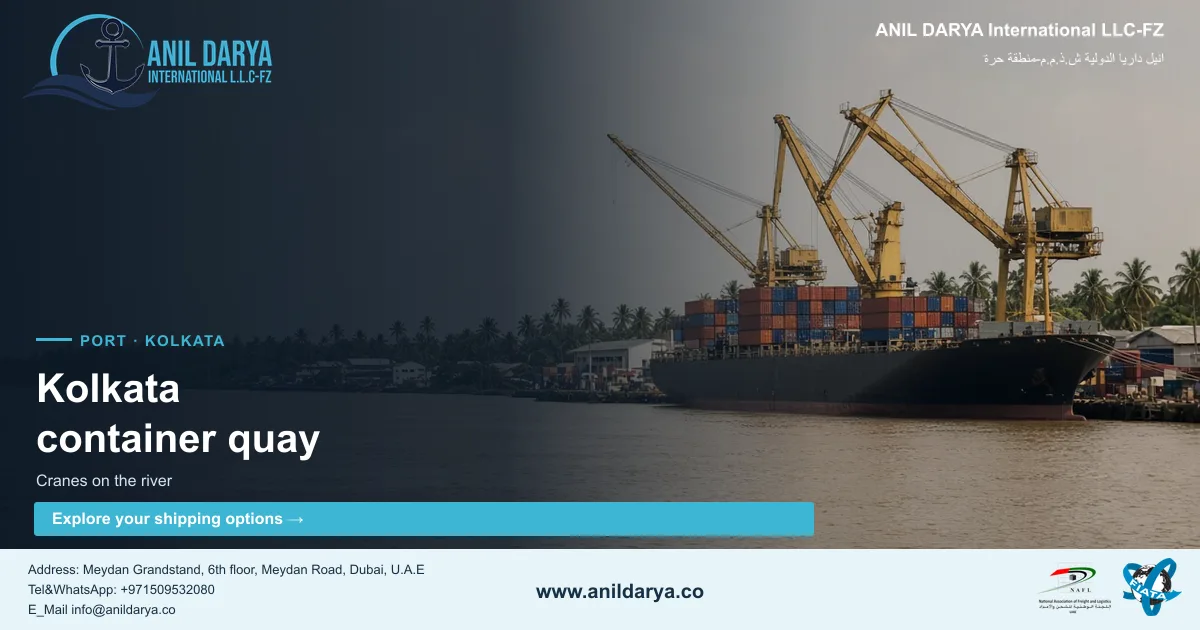
Kolkata port shipping works differently from almost any other Indian port, because the port is on a river, not the open sea. Syama Prasad Mookerjee Port runs two separate dock systems: the Kolkata Dock System up the Hooghly in the city and the Haldia Dock Complex further downstream. This guide explains which dock suits your cargo, the draft limits that shape every booking, customs at Kolkata and how to ship there from Dubai. We ship both from Dubai to Kolkata and from Kolkata to Dubai.
Kolkata port at a glance
| Item | Detail |
|---|---|
| Official name | Syama Prasad Mookerjee Port, Kolkata (formerly Kolkata Port Trust / Port of Calcutta), renamed 12 January 2020 |
| Authority | Statutory body under the Ministry of Ports, Shipping and Waterways |
| Commissioned | 1870 |
| UN/LOCODE (Kolkata) | INCCU |
| Port type | India's only riverine major port; fresh water |
| Dock systems | Kolkata Dock System (KDS) and Haldia Dock Complex (HDC) |
| River channel | 232 km pilotage channel from the sea |
| Max draft at high tide | About 8.5 m to Kolkata, about 9 m to Haldia |
| Cargo 2025-26 (whole port) | 70.872 million tonnes |
| Containers 2025-26 (whole port) | 960,549 TEU |
| Haldia share 2025-26 | 51.855 million tonnes and 226,378 TEU |
| Customs | Kolkata Customs, Commissionerate of Customs (Port), covering Kolkata and Haldia |
| Hinterland | East and northeast India, plus transit cargo for Nepal and Bhutan |
| Kolkata to Dubai | Shipper or its Indian agent files the shipping bill; arrival at Jebel Ali, Khalifa Port or Sharjah, 5% UAE duty on CIF for most goods plus 5% VAT |
What is Kolkata port and why is it different?
Kolkata is India's oldest operating port and its only major port on a river. Ships sail up the Hooghly through a long pilotage channel, and the river silts up. That gives two practical results for you as a shipper.
- Vessel size is limited. Maximum draft at high tide is about 8.5 m for Kolkata and about 9 m for Haldia, far less than at a deep-sea port. Big mainline ships do not call; cargo comes on smaller feeder ships, usually after transshipment.
- Timing depends on tides. Ships move up and down the river on the tide, and pilotage is compulsory for seagoing ships of 200 GT and above. Plan for a schedule that can slip by a tide or a day.
The port also has wide inland reach. It links to National Waterway 1 on the Ganga, it has its own railway systems at both docks, and Kolkata Customs runs separate sections for transit cargo to Nepal and Bhutan.
Kolkata Dock System or Haldia: which one handles your cargo?
This is the first question on any booking to "Kolkata". The two dock systems are about 104 km apart by river, and your bill of lading should say which one.
| Item | Kolkata Dock System (KDS) | Haldia Dock Complex (HDC) |
|---|---|---|
| Location | In the city, far up the Hooghly | Downstream at Haldia, Purba Medinipur, about 104 km below Kolkata |
| Main parts | Kidderpore Dock, Netaji Subhas Dock, Budge Budge oil moorings | Impounded dock, oil jetties, outer terminals |
| Container berths | Netaji Subhas Dock: 5-berth container terminal (berths 3, 4, 5, 7 and 8) | Berths 10 and 11, run by Haldia International Container Terminal; 432 m quay, about 0.3 million TEU a year |
| Draft on the river | About 8.5 m at high tide | About 9 m at high tide |
| Lock | Kidderpore Dock lock barrel 176.8 m; ships up to 157 m long and 21.35 m wide, daylight moves only | Lock 330 m long and 39 m wide |
| Typical cargo | Containers for the city, general cargo, petroleum at Budge Budge | Bulk, liquid bulk and POL, industrial cargo, some containers |
| Best for | Consignees in and around Kolkata | Bulk and liquid cargo, industries near Haldia |
Decision rule: containers for a city consignee usually go to the Kolkata Dock System. Bulk liquids, chemicals and larger tankers usually go to Haldia. If your carrier offers both, compare the trucking leg from each dock to the final address, not only the sea freight.
Kolkata Dock System in detail
The city docks sit behind locks. Kidderpore Dock has 18 berths, three dry docks and a lock that limits ships to 157 m in length, with ship movements only in daylight. Netaji Subhas Dock has 10 berths, two dry docks and most of the container traffic. Petroleum goes to the six wharves at Budge Budge on the river. The port's five dry docks are spread across Kidderpore and Netaji Subhas Dock.
Haldia Dock Complex in detail
Haldia is an impounded dock reached through a 330 m lock, with a turning basin of 545 m. Three Haldia oil jetties take tankers: HOJ-I up to 89,000 DWT, and HOJ-II and HOJ-III up to 150,000 DWT, with a combined capacity of 10.7 million tonnes a year. Haldia handled 51.855 million tonnes in 2025-26, most of the port's total, but only 226,378 TEU, which shows its bulk focus.
Shipping from Dubai to Kolkata: FCL, LCL and bulk
From the UAE, most Kolkata cargo is containerised and moves from Jebel Ali via a transshipment hub onto a feeder ship that fits the river draft. Fewer services run direct, and feeder schedules change, so check the full routing on your booking. Liquid and dry bulk moves on parcel tankers or bulk carriers sized for Haldia.
| Mode | When it fits | Kolkata-specific point |
|---|---|---|
| FCL 20' or 40' | Full loads, trading and factory cargo | Confirm KDS or Haldia and the transshipment port on the booking |
| LCL | Small shipments | Fewer consolidations reach Kolkata than west coast ports; check that an LCL service exists before you sell |
| Reefer | Food and chilled goods | Feeder legs add handling; ask for plug-in arrangements at the hub |
| Liquid bulk | Chemicals, oils, POL | Haldia oil jetties take up to 150,000 DWT; Budge Budge serves the city |
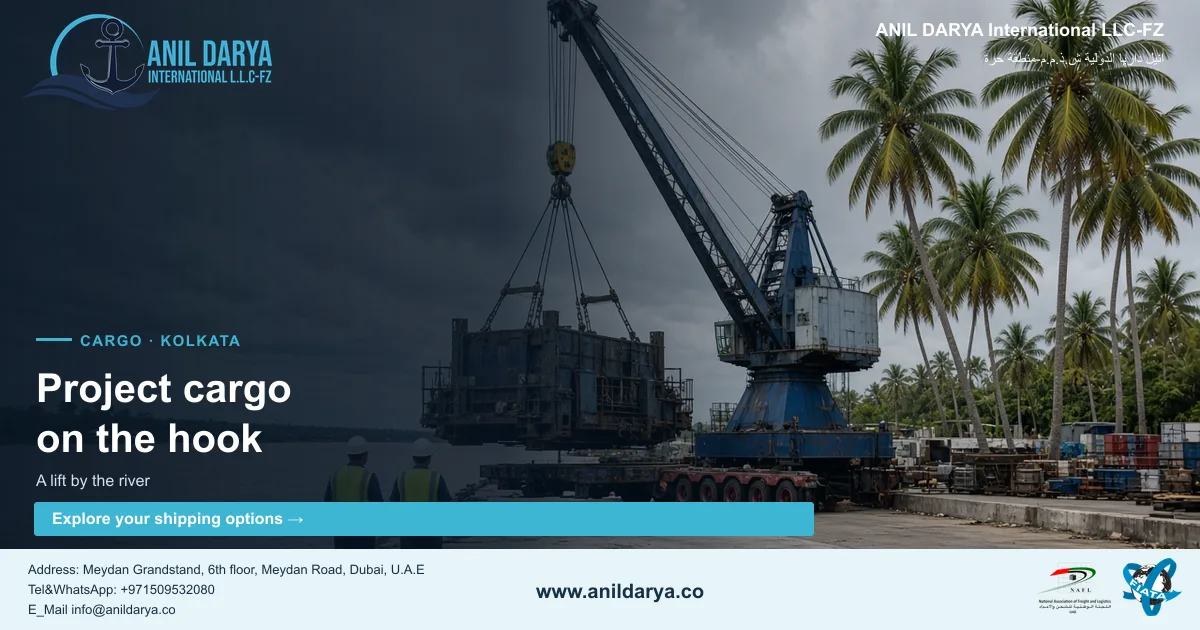
| Breakbulk and project | Steel, machinery, heavy lifts | Check lock dimensions and berth depth before you fix a vessel |
[AMIR-FACT: Our typical transit Jebel Ali to Kolkata (KDS) and to Haldia in days, the transshipment hub used and the carriers we usually book]
In the UAE, we book the space, truck the cargo to the load port, handle export clearance and lodge the documents. See our sea freight service, loading at Jebel Ali Port, and our bulk cargo service for liquid and dry bulk.
Draft, tides and vessel limits at Kolkata port
The river decides what can call. These are the numbers to check before you plan a breakbulk or bulk shipment.
| Limit | Figure | What it means for you |
|---|---|---|
| Pilotage channel | 232 km; Eastern Channel to Kolkata, Western Channel to Haldia | Long river passage adds hours to every call |
| Max draft to Kolkata | About 8.5 m at high tide | Feeder and small vessels only |
| Max draft to Haldia | About 9 m at high tide | Larger ships may need to lighten or part-load |
| Kidderpore Dock vessel size | 157 m length, 21.35 m beam | Check LOA and beam for breakbulk ships |
| Haldia lock | 330 m by 39 m | Wider vessels can enter Haldia than the city docks |
| Compulsory pilotage | Ships of 200 GT and above | Moves follow pilot and tide windows |
The port publishes draft forecasts for Kolkata, Haldia, Sagar Road and Diamond Harbour on its website. Ask your carrier or ship agent for the forecast for your arrival month, because depths change with the season and dredging.
How cargo leaves Kolkata port: road, rail and river
- Road: National Highways 116, 16, 19 and 12 serve the port area. Haldia links to NH 116, which joins NH 16 at Kolaghat.
- Rail: the Kolkata Dock System has about 18 km of port railway with a marshalling yard at East Dock Junction. The Haldia port railway has 115 km of track.
- River: National Waterway 1 links the port to Varanasi and Sahebganj, and Haldia also links to the Indo-Bangladesh Protocol Waterway.
Decision rule: for city consignees, road from the Kolkata Dock System is usually fastest. For heavy bulk going to the steel and power belt inland, rail from Haldia often makes sense. For cargo for Nepal or Bhutan, the consignee's agent must use the transit procedure that Kolkata Customs runs for those countries.
Customs at Kolkata port: a short summary
Indian import rules are the same at every port, so this is a short version. Our other India port guides go through the full Bill of Entry process.
- The importer needs an Import Export Code (IEC), a 10-digit number issued by DGFT.
- The Bill of Entry is filed on ICEGATE. A prior Bill of Entry is valid only if the vessel arrives within 30 days.
- Supporting documents go up through e-Sanchit as PDF files under 1 MB each.
- GSTIN and state code go on the Bill of Entry for IGST credit.
- Deferred duty payment is open only to AEO T2 and T3 importers who declare "D" on the Bill of Entry.
What is specific to Kolkata is the office. The Commissionerate of Customs (Port), Kolkata covers both the Port of Kolkata and the Port of Haldia, so one commissionerate handles both dock systems. It has separate sections for Nepal transit and Bhutan transit cargo, and it publishes its own public notices and standing orders for the port. Ask your consignee's customs broker to check them for your commodity.
On duty, the India-UAE CEPA has applied since 1 May 2022. Goods that meet the origin rule can get a lower rate with a valid certificate of origin; goods only re-exported through Dubai usually do not qualify. We do not file Indian customs entries. We work with your customs broker or a destination clearing agent.
Dangerous goods and chemicals through Kolkata port
Kolkata's DG traffic splits by dock. Bulk petroleum and liquid chemicals go to the Haldia oil jetties or the Budge Budge petroleum wharves. Packaged DG such as paints, resins, lubricants and batteries comes in containers through the container berths at Netaji Subhas Dock or Haldia.
- The carrier must accept the UN number on the mother vessel and on the feeder. Feeder operators on the river leg can be stricter than the mainline carrier.
- Send the DG declaration, safety data sheet and container packing certificate early, as transshipment adds a second acceptance check.
- Plan clearance before arrival, as port and CFS rules may limit how long some classes stay in the yard.
We plan DG from the UAE side, including classification and segregation checks. See our dangerous goods shipping service and our guide to dangerous goods classes.
How to ship from Dubai to Kolkata: step by step
- Ask the consignee whether the cargo should land at the Kolkata Dock System or Haldia, based on the delivery address and cargo type.
- Confirm the HS code, duty and CEPA eligibility with the consignee before you sell.
- Pick FCL, LCL, breakbulk or bulk. For breakbulk, check vessel length, beam and draft against the dock limits.
- Agree the Incoterm. Our Incoterms 2020 guide shows who books and pays each leg.
- We book space with a carrier that serves the chosen dock and confirm the transshipment port and feeder.
- We arrange UAE trucking, stuffing and export clearance, and issue the bill of lading showing the correct port of discharge.
- Get the certificate of origin from the UAE issuing authority if CEPA duty will be claimed.
- Send documents to the consignee's broker so the Bill of Entry can be filed before the feeder arrives.
- Track the mother vessel and the feeder. The broker clears the goods, and the consignee collects and returns the empty within free time.
[AMIR-FACT: A real Dubai to Kolkata or Haldia shipment we handled: cargo, mode, transshipment port and how clearance and delivery went]
How to ship from Kolkata to Dubai
We also handle the other direction: shipping from Kolkata or Haldia to Dubai, with arrival at Jebel Ali, Khalifa Port or Sharjah port. We book the space with the carrier and run the UAE side. The Indian export filing stays with the shipper or its Indian agent.
The India export side
- Shipping bill. Under Section 50 of the Customs Act, 1962, the exporter enters the goods by presenting a shipping bill electronically on the customs automated system, ICEGATE. The shipper files it itself or through its customs broker, with the Commissionerate of Customs (Port), Kolkata, which covers both Kolkata and Haldia.
- Let export order. Under Section 51, customs permits clearance and loading once it is satisfied the goods are not prohibited and any export duty is paid. The order can be given electronically on a risk basis.
- Certificate of origin. Since 1 May 2022, the preferential certificate of origin for exports to the UAE under the India-UAE CEPA is issued on DGFT's eCoO platform. It supports a claim for CEPA preferential duty at Dubai Customs, so ask the shipper early whether the goods qualify.
The UAE import side
On arrival, the declaration goes to Dubai Customs with the commercial invoice, the packing list, the certificate of origin and any permit from the authority that controls restricted goods. The carrier then releases the cargo against the bill of lading with a delivery order. Customs duty in Dubai is 5% of the CIF value for most goods, with 50% on alcohol and 100% on cigarettes. Import VAT is 5%, charged on the customs value including freight, insurance and customs fees. A VAT-registered importer that meets the Federal Tax Authority conditions accounts for it on its VAT return instead of paying at the border.
- Send us the shipper's details in Kolkata or Haldia, the cargo, the HS code and the UAE delivery address.
- We book space from Kolkata or Haldia to Jebel Ali, Khalifa Port or Sharjah and send the booking and cut-offs to the shipper.
- The shipper or its trucker delivers the container to the dock or CFS named on the booking, at the Kolkata Dock System or Haldia, before the cut-off.
- The shipper or its Indian agent files the shipping bill on ICEGATE before the cut-off.
- We check the draft bill of lading against the invoice and packing list before it is issued.
- We file the UAE declaration before the vessel arrives, so clearance can start when it berths.
- We arrange payment of the duty and VAT and collect the delivery order from the carrier.
- We truck the cargo to your site and return the empty container inside the free time.
[AMIR-FACT: the carriers and transshipment hub we actually use from Kolkata or Haldia to Jebel Ali, Khalifa Port or Sharjah, and our real port-to-port transit days in this direction]
Free time, demurrage and detention at Kolkata
Storage at the port or CFS and the carrier's demurrage and detention start after their free days. At Kolkata, transshipment and tide-dependent feeder calls make arrival dates less certain, so a late Bill of Entry hurts more here than at a deep-sea port. Cogoport's port data for Kolkata showed an average import dwell time of 6.2 days in February 2026. Ask for free days in writing and read our guide to demurrage and detention.
Checklist before you ship to Kolkata
- Port of discharge fixed: Kolkata Dock System or Haldia
- Transshipment port and feeder known from the booking
- HS code, duty and CEPA eligibility confirmed by the consignee
- IEC and GSTIN correct on the invoice
- Vessel size checked against lock and draft limits for breakbulk or bulk
- Draft forecast for the arrival month checked for bulk ships
- For DG: acceptance on mother vessel and feeder, SDS and DG declaration ready
- For Nepal or Bhutan cargo: transit procedure agreed with the consignee's agent
- Free days agreed in writing
Common mistakes on shipments to Kolkata
- Writing "Kolkata" on the documents when the cargo is booked to Haldia, or the other way round. The goods land 104 km from where the consignee expects them.
- Fixing a breakbulk vessel without checking the Kidderpore Dock lock and the river draft.
- Assuming a direct sailing. Most container cargo from the UAE is transshipped, which adds days and a second DG acceptance.
- Quoting a firm arrival date without allowing for tides and pilot windows.
- Sending transit cargo for Nepal or Bhutan on normal import documents.
- Using a CEPA certificate for goods that do not meet the origin rule.
Kolkata or a west coast port: which fits your cargo?
Kolkata is the right gateway for consignees in West Bengal, the northeast and nearby eastern states, and for Nepal and Bhutan transit cargo. For north and west India, a west coast port such as Nhava Sheva or Mundra is usually faster from the UAE because big ships call direct. For Tamil Nadu and the south, Chennai is the natural choice.
Frequently asked questions
Is Kolkata port the same as Syama Prasad Mookerjee Port?
Yes. Kolkata Port Trust was renamed Syama Prasad Mookerjee Port on 12 January 2020. It runs both the Kolkata Dock System and the Haldia Dock Complex.
What is the port code for Kolkata?
The UN/LOCODE for Kolkata is INCCU. Haldia is a separate port of discharge on bookings, so check which one appears on your bill of lading.
How far is Haldia from Kolkata?
Haldia Dock Complex is about 104 km downstream of Kolkata by river. Choose the dock closest to your consignee to keep the trucking leg short.
What is the maximum draft at Kolkata port?
Maximum draft at high tide is about 8.5 m for the Kolkata Dock System and about 9 m for Haldia. Ships also need pilots and must follow tide windows on the 232 km channel.
Can large container ships call at Kolkata?
No. River draft and lock sizes limit vessel size, so most containers reach Kolkata on feeder ships after transshipment at a larger hub port.
How much cargo does Kolkata port handle?
The port handled 70.872 million tonnes and 960,549 TEU in 2025-26, with Haldia handling 51.855 million tonnes of that total.
Which customs office clears cargo at Kolkata and Haldia?
The Commissionerate of Customs (Port), Kolkata covers both the Port of Kolkata and the Port of Haldia. The importer or its customs broker files the Bill of Entry on ICEGATE.
Can I ship dangerous goods to Kolkata?
Yes. Packaged DG moves in containers, and bulk petroleum and chemicals go to the Haldia oil jetties or Budge Budge. The UN number must be accepted on both the mother vessel and the feeder.
How do I ship from Dubai to Kolkata?
Pick the dock first, Kolkata or Haldia, then book a carrier whose feeder calls there. We handle UAE trucking, export clearance and the bill of lading, and the consignee's customs broker files the Bill of Entry on ICEGATE before the feeder arrives.
How do I ship from Kolkata to Dubai?
The shipper or its Indian agent files the shipping bill on ICEGATE and delivers the box before the cut-off. We book the space, file the Dubai Customs declaration before arrival, arrange payment of the 5% duty and 5% VAT, and deliver to your site. A CEPA certificate of origin from DGFT's eCoO platform supports a preferential duty claim.
Get a quote for Kolkata port shipping
Tell us the cargo, the volume and whether the delivery is near Kolkata or Haldia, and we will come back with a routing and price from the UAE. Use our freight rate inquiry form, or contact our team to discuss bulk, DG or project cargo first.
Sources
- Syama Prasad Mookerjee Port, Kolkata: official site (statutory body, KDS and HDC, commissioned 1870)
- Syama Prasad Mookerjee Port: Draft forecast (Kolkata, Haldia, Sagar Road, Diamond Harbour)
- Wikipedia: Port of Kolkata (rename date, docks, berths, locks, channel, drafts, 2025-26 traffic, rail, road, waterway)
- Wikipedia: Haldia Dock Complex (distance, lock, container terminal, oil jetties, 2025-26 traffic, links)
- Kolkata Customs: Port Commissionerate, Nepal and Bhutan transit sections
- Kolkata Customs: Port Commissionerate jurisdiction (Kolkata and Haldia)
- Cogoport: Port of Kolkata (INCCU) port info and dwell times
- ICEGATE: FAQs (IEC, prior Bill of Entry, e-Sanchit, deferred duty, GSTIN)
- DGFT Trade Notice 05/2022-23: India-UAE CEPA from 1 May 2022
- CBIC: Customs Act, 1962 (Section 50 shipping bill, Section 51 clearance for export)
- Dubai Customs: Submit customs declaration (invoice, packing list, certificate of origin, permits)
- Dubai Customs: FAQ (5% of CIF value, alcohol and cigarettes)
- UAE Government portal: Clearing customs and paying customs duty (5% of CIF in Dubai)
- Federal Tax Authority: VAT guide, section 3.5 on import VAT (5%, customs value, registered importers)
Reviewed: 10 November 2026