
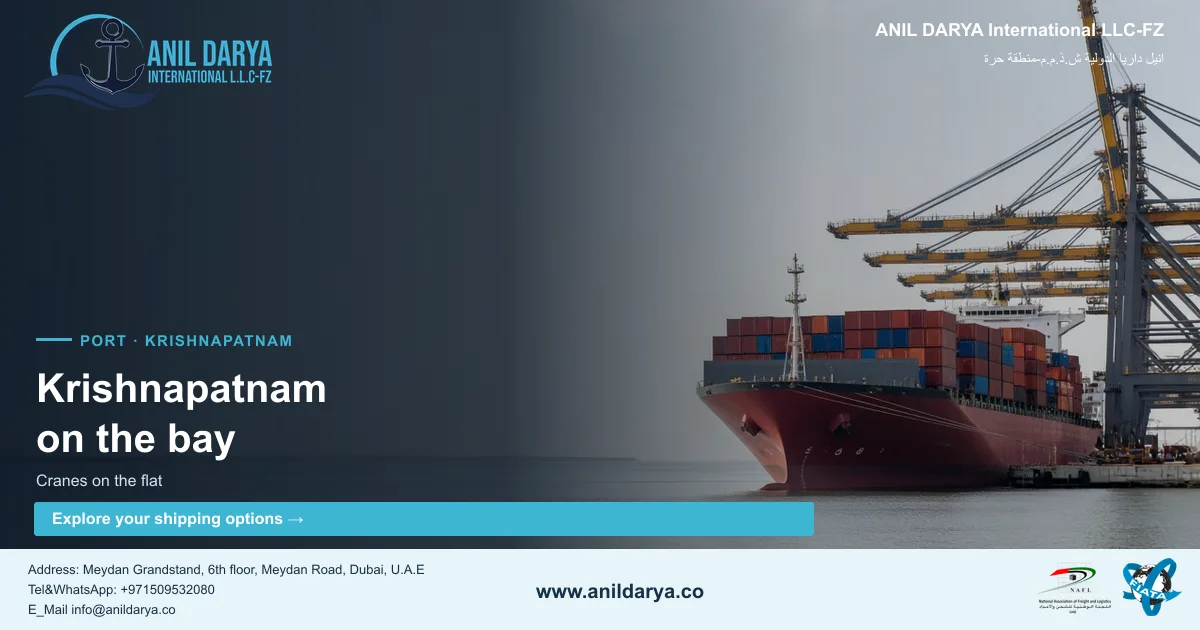
Krishnapatnam port shipping today is mostly bulk, breakbulk and liquid cargo. Adani Krishnapatnam Port in Nellore district, Andhra Pradesh, works capesize ships at a 17.7 m berth draft and handled a record 59.22 million tonnes in FY2025-26, but its container terminal has stopped handling boxes. This guide covers what the port takes, the berth limits, the dangerous goods rules, the short version of Indian customs and how we plan a shipment from Dubai to Krishnapatnam. We ship in both directions: from Dubai to Krishnapatnam, and from Krishnapatnam to Dubai with clearance in the UAE.
Krishnapatnam port at a glance
| Item | Detail |
|---|---|
| Operator | Adani Krishnapatnam Port Limited (AKPL), part of Adani Ports and SEZ |
| Port type | Private, non-major port, all weather, 365 days of operations |
| Location | Nellore district, Andhra Pradesh, about 70 nautical miles north of Chennai on the Bay of Bengal |
| Port code | INKRI |
| Operational berths | 13, built for post-Panamax and capesize ships |
| Deepest berth draft | 17.70 m at the mechanised bulk berths |
| Largest ships | Up to 300 m LOA and 190,000 tonnes displacement at the deep berths |
| Cargo in FY2025-26 | 59.22 million tonnes, up 8%, from 1,071 vessels |
| Main cargo | Coal, iron ore, fertiliser, cement, granite, edible oil, POL, project and breakbulk cargo |
| Containers | Container terminal not handling boxes (see below) |
| Rail | 19 km double line to the Chennai-Kolkata main line, plus a 91 km line towards south-east Karnataka |
| Port area | 6,800 acres |
| Customs | Customs office inside the port, EDI connected |
| Krishnapatnam to Dubai | Bulk and breakbulk to Jebel Ali, Khalifa Port or Sharjah; shipping bill filed in India, Dubai Customs declaration on arrival |
What is Krishnapatnam port and who runs it?
Krishnapatnam is a private deep-water port on the east coast of India, about 18 km east of Nellore city. It was built by Navayuga Engineering under a build-operate-share-transfer deal with the Government of Andhra Pradesh and was inaugurated in July 2008. AKPL's own berthing policy says the port has been operational since 2009.
Adani Ports and SEZ bought 75% of the port in October 2020 and the remaining 25% in April 2021. Since then it has run as Adani Krishnapatnam Port Limited. Because it is a private port and not one of India's major ports, the operator publishes its own Berthing Policy and Tariff Structure (BPTS). That document sets berth priorities, port charges and the cargo rules your agent works to.
The port is open all year with round-the-clock navigation. Pilotage is compulsory, and stevedores work 24 hours a day with no holiday breaks, according to agent port data.
Does Krishnapatnam port still handle containers?
Not at the moment. This is the first thing to check if you planned to send a container to Nellore. The container terminal opened in September 2012 with two berths totalling 725 m, and it was built for about 1.2 million TEU a year. For several years it handled transshipment boxes, including a Maersk service.
Volumes then fell. Maritime Gateway reported in December 2023 that the terminal handled 92,081 TEU from April to November 2023, against about 40,000 TEU a month in its transshipment years. In October 2024, India Seatrade News reported that the terminal had not handled a single container for several months. A carrier advisory from Portcast in August 2026 listed a complete halt of container operations at Krishnapatnam.
What that means for you:
- Do not book a container to Krishnapatnam on the strength of an old schedule or a rate site that still lists the port.
- For containerised cargo to Nellore and south Andhra Pradesh, the usual answer is a container port near Chennai plus a truck run north.
- For bulk, breakbulk, project cargo and liquid parcels, Krishnapatnam is still a strong option because of its draft and berth length.
Krishnapatnam berths, draft and ship size limits
AKPL lists 13 operational berths in its BPTS. The maximum permissible draft at each berth is announced to the trade every quarter, or sooner if the depth changes, so always check the latest draft notice before you fix a ship. The table combines the berth lengths from the BPTS with draft figures published by a port agent.
| Berth | Length | Max LOA | Max displacement | Draft (agent data) | Typical cargo |
|---|---|---|---|---|---|
| N1, N2 | 325 m each | 300 m | 100,000 t | 13.5 to 14.5 m | Container-priority berths in the BPTS; agent data lists bagged rice, corn, coal and granite |
| N3, N4 | 250 m each | 225 m | 95,000 t | 14.5 m | Coal, iron ore, granite, fertiliser, limestone, barytes |
| N5, N6, N7 | 325 m each | 300 m | 190,000 t | 17.7 m | Mechanised coal and bulk |
| N8 | 250 m | 300 m | 190,000 t | 17.7 m | Mechanised coal and bulk |
| NW1 | 200 m | 175 m | 35,000 t | 10.5 m | Cement, crude palm oil and other edible oils |
| NW2, NW3 | 200 m each | 190 m | 35,000 to 50,000 t | 11.0 m | Edible oil, agri cargo, steel coils, multipurpose |
| S4 | 300 m | 225 m | 95,000 t | 14.0 m | Granite, barytes, wind turbine blades, fly ash |
| LB (liquid berth) | 300 m | 285 m | 180,000 t | Check current notice | Liquid cargo |
Berth priorities matter when you plan a parcel. N4 gives priority to fertiliser ships, N7 and N8 to ships delivering to the nearby power plants, and NW1 to one cement exporter. N3, N5, N6, NW2, NW3, S4 and the liquid berth work first come, first served. A breakbulk ship for S4 or N3 can wait at anchor if bulk ships are ahead of it, so build a margin into your delivery date.
The deep berths are the port's main selling point. In August 2026 AKPL discharged 195,128 tonnes of iron ore from the 300 m capesize ship Mineral Deutschland at 17.70 m draft, and the port says it can work five deep-draft capesize ships at the same time.
What cargo moves through Krishnapatnam port?
Coal and iron ore make up the heavy end of the trade, but the berth list is wider than most shippers expect. In FY2025-26 the port added laterite, soda ash, rock phosphate and yellow peas to its cargo mix, and its record month was 5.85 million tonnes in June 2025.
| Cargo | Where it usually goes | What to plan from the UAE side |
|---|---|---|
| Dry bulk (coal, ore, limestone, rock phosphate) | Mechanised berths N5 to N8, or N3 and N4 | Full ship or part cargo, survey, stockpile space at the port |
| Fertiliser and bagged agri cargo | N4 (fertiliser priority), N2, NW2 | Bag counts, moisture, fumigation and phytosanitary papers |
| Steel coils and plates | NW2 and multipurpose berths | Lashing, dunnage, coil weights per lift |
| Project and wind energy cargo | S4 and multipurpose berths | Drawings, lift plan, road route from the port |
| Edible oil and other vegetable oils | NW1 to NW3 | Tank space at the port, surveyor, quality certificates |
| POL and other liquids | Liquid berth | Terminal acceptance and tank booking before loading |
Edible oil tankers are worked side by side when berths are busy. In May 2026 the port discharged two edible oil tankers, AU Libra and Spica, at the same time in a double-banking operation. If you ship a vegetable oil parcel, ask your surveyor and the receiver's tank operator how they handle that setup.
Shipping from Dubai to Krishnapatnam: which mode fits?
With containers off the table at Krishnapatnam itself, the question is not FCL or LCL but which port and which ship type. From the UAE we usually look at Jebel Ali Port for breakbulk and project parcels on liner or multipurpose ships, and at the loading port nearest the cargo for full bulk parcels.
| Your shipment | Best fit | Why |
|---|---|---|
| A full shipload of bulk cargo | Voyage charter direct to Krishnapatnam | Deep berths take large bulk carriers at full draft |
| A part cargo of bagged goods, steel or minerals | Multipurpose or breakbulk ship calling Krishnapatnam | No container leg, direct discharge at the berth |
| Oversized machinery or wind energy parts | Heavy-lift or multipurpose ship to S4 or a multipurpose berth | Space on the quay and a road link with no fixed obstruction |
| A few pallets or one or two containers | Container to a Chennai-area port, then truck to Nellore | No container service at Krishnapatnam |
| A liquid parcel | Tanker or parcel tanker to the liquid or edible oil berths | Tank storage and terminal approval needed first |
[AMIR-FACT: Our real experience on Dubai or UAE to Krishnapatnam: typical transit days for a breakbulk or bulk parcel, the ship operators we have booked, and whether we routed container cargo for Nellore via Chennai, Kattupalli or Ennore instead]
Our bulk cargo service covers dry and liquid bulk from the UAE, and our sea freight service handles the container option through a Chennai-area port.
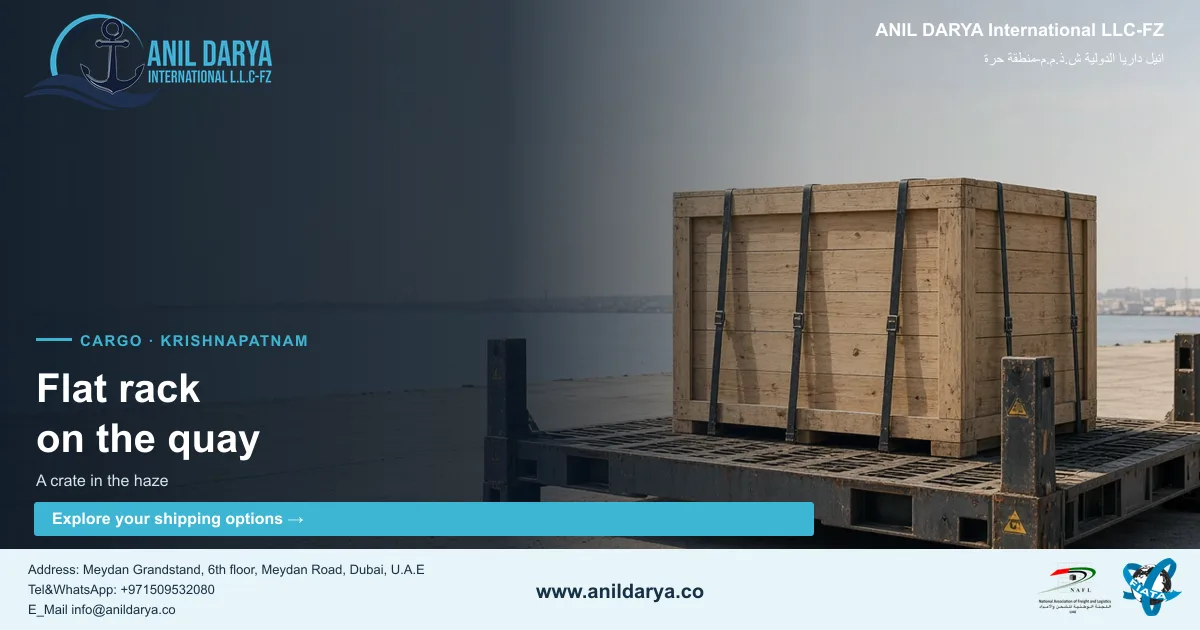
Breakbulk, heavy-lift and project cargo at Krishnapatnam
Krishnapatnam suits project cargo for a simple reason: space. The port covers 6,800 acres, and AKPL says its dedicated 26 km four-lane road to the national highway has no obstruction for the free passage of project cargo. Agent data lists wind turbine blades among the cargo at berth S4.
The BPTS also has a rule that catches shippers out. If the actual weight or dimensions of project cargo or over-dimensional pieces are more than 5% higher than declared, the port adds a stevedoring charge equal to the normal tariff. So the packing list has to be exact. Here is how we plan a project parcel to Krishnapatnam:
- We collect weight, dimensions, centre of gravity and lifting points for every piece.
- We choose the ship type: multipurpose with its own cranes, heavy-lift, or a breakbulk liner call.
- We check the current berth draft notice and which berth the carrier expects, usually S4 or a multipurpose berth.
- The consignee's transporter plans the road move from the port gate, including any permits for the over-dimensional pieces.
- The consignee's customs broker files the Bill of Entry before arrival so the cargo can leave the quay quickly.
For more detail, read our heavy-lift shipping guide and see what our break bulk and project cargo team covers on the UAE side.
Dangerous goods at Krishnapatnam port
Adani's BPTS states that IMDG Class 1 (explosives) and Class 7 (radioactive material) are not acceptable for handling at the port. Other classes depend on the berth, the terminal and the ship, and the port charges for fire crew standby during hazardous cargo handling. The liquid jetty has fire fighting systems for LPG and POL products, according to Adani.
- We send the safety data sheet, UN number, class and packing group to the carrier and confirm the port will accept the class.
- The shipper prepares the dangerous goods declaration and the packaging, marks and labels to the IMDG Code.
- The consignee's clearing agent checks whether the product needs an Indian licence before the ship sails.
- The consignee plans fast clearance and pickup so the cargo does not wait on the quay.
Our dangerous goods shipping service handles classification checks and carrier approval before you commit to a ship.
Customs at Krishnapatnam: the short version
Indian customs rules are the same at every port, and our Nhava Sheva port guide covers them in full. What is specific to Krishnapatnam is that Customs has an office inside the port headed by a Joint Commissioner, the port is EDI connected, and AKPL offers single-window handling from stevedoring to customs documentation. The core rules:
- The importer needs an Import Export Code (IEC), a 10-digit number issued by DGFT.
- The Bill of Entry is filed on ICEGATE. One filed before arrival stays valid if the ship arrives within 30 days.
- Supporting documents go up through e-Sanchit first. The Bill of Entry cannot be submitted until they are in.
- To claim IGST credit, the Bill of Entry must show the importer's GSTIN and state code.
- Deferred duty payment is open to importers with AEO T-2 or T-3 status.
The India-UAE CEPA has been in operation since 1 May 2022. Goods made in the UAE that meet the origin rule can claim lower Indian duty with a valid certificate of origin. Goods only stored in or re-exported through Dubai usually do not qualify.
We do not file Indian customs entries. We prepare the UAE export side and work with the consignee's customs broker or a destination clearing agent at Krishnapatnam.
Which documents should travel with a Krishnapatnam shipment?
| Document | Who provides it | Krishnapatnam tip |
|---|---|---|
| Commercial invoice | Shipper in the UAE | Value and HS code must match the Bill of Entry |
| Packing list | Shipper | Real weights more than 5% above declared trigger an extra stevedoring charge |
| Bill of lading | Carrier, via us | Port of discharge must read Krishnapatnam, not a nearby container port |
| Certificate of origin | UAE issuing authority | Needed to claim CEPA preference |
| Draft and quality survey reports | Independent surveyor | Usual for bulk and edible oil parcels |
| DG declaration and SDS | Shipper | Class 1 and Class 7 are not accepted at the port |
| IEC, GSTIN and any licence | Importer in India | Declared on the Bill of Entry |
How does cargo leave Krishnapatnam port?
Rail is a big part of the story here. A dedicated 19 km double line links the port to the Chennai-Kolkata main line, and a 91 km broad-gauge line between Venkatachalam and Obulavaripalle cut the distance to south-east Karnataka and south-west Andhra Pradesh by 70 km. Adani says the port can handle 40 rakes a day, and it sent out 6,006 rakes in FY2025-26, its highest ever.
By road, the 26 km port road connects to the Chennai-Kolkata highway, now NH 16. Chennai International Airport is about 180 km away and Tirupati airport about 120 km.
| Consignee location | Usual inland mode | Check before you ship |
|---|---|---|
| Nellore and the port area | Truck, short haul | Gate timing and stockpile release |
| Rest of Andhra Pradesh and Telangana | Rail rake or truck | Rake booking and siding at the receiving end |
| South-east Karnataka | Rail via the Obulavaripalle line | Rake size against your parcel size |
| North Tamil Nadu | Truck | Compare with discharging at a Chennai-area port |
How to ship from Dubai to Krishnapatnam: step by step
- Send us the cargo details: commodity, HS code, total weight, piece list or bulk quantity, packing and the consignee's city.
- We confirm whether the cargo should go to Krishnapatnam as bulk or breakbulk, or by container through a Chennai-area port.
- The importer confirms the IEC, GSTIN and any licence, and appoints a customs broker at Krishnapatnam.
- We book the ship space or work with the charterer, and check the current berth draft notice against the ship's draft.
- We arrange trucking to the UAE loading port, export clearance and any survey or certificate the buyer needs.
- The carrier issues the bill of lading. We send copies to the consignee and the broker.
- The broker files the Bill of Entry on ICEGATE before the ship arrives.
- The ship berths in turn under the port's berthing policy, cargo is discharged and customs releases it.
- The consignee's transporter or rail operator moves the cargo out before storage charges build up.
How to ship from Krishnapatnam to Dubai
We also handle the other direction: cargo from Krishnapatnam to Dubai, with arrival at Jebel Ali, Khalifa Port or Sharjah port. Because the container terminal is not handling boxes, this usually means a bulk or breakbulk parcel such as granite or steel, or a container routed through a Chennai-area port. We book the space or work with the charterer and run the UAE side. The Indian export papers stay with the shipper or its Indian agent.
The India export side
- Import Export Code. The exporter needs an IEC from DGFT, and registers an authorised foreign exchange dealer code through which the export proceeds will come in.
- Shipping bill. The exporter or its customs broker files the shipping bill electronically, by upload on ICEGATE or through a customs service centre. The system then gives a shipping bill number.
- Examination and Let Export Order. Customs selects goods for checking on risk. When the check is clear, the shed appraiser gives the Let Export Order.
- Loading. No export goods can be loaded until the ship has its entry outward order, so the shipper's agent watches both dates.
- Certificate of origin. Indian goods that meet the India-UAE CEPA origin rules can travel with a preferential certificate of origin, which DGFT has issued online since 1 May 2022. Ask the shipper to apply before the ship sails.
The UAE import side
On arrival, the declaration goes to Dubai Customs with the commercial invoice, packing list, bill of lading, certificate of origin and any permit for restricted goods. A company with a Dubai Customs business code can file it, or a licensed clearing agent with the owner's authorisation. Customs duty is 5% of the CIF value for most goods, with 50% on alcohol and 100% on cigarettes. Import VAT is 5%, and a VAT-registered importer whose customs number is linked to its tax registration accounts for it on the VAT return instead of paying at the border.
- Send us the shipper's details in India, the cargo, the HS code, the quantity and the UAE delivery address.
- We book space or fix the ship with the charterer, and send the booking, laycan or cut-offs to the shipper.
- The shipper or its trucker or rail operator brings the cargo to the port before the loading window.
- The shipper or its customs broker files the shipping bill and gets the Let Export Order.
- We check the draft bill of lading against the invoice and packing list.
- We file the UAE declaration before the ship arrives.
- We arrange payment of the duty and VAT, and collect the delivery order.
- We truck the cargo to your site and, for containers, return the empty inside free time.
[AMIR-FACT: the carriers or ship types we actually use from Krishnapatnam (or via Chennai for containers) to Jebel Ali, Khalifa Port or Sharjah, and our real transit days in this direction]
Free time, storage and demurrage at Krishnapatnam
For bulk and breakbulk, the costs that bite are ship demurrage while waiting for a berth and storage at the port after discharge. Berth waiting depends on the priority rules above. Port storage, stevedoring and rail haulage charges are set in AKPL's BPTS and trade notices, which are reviewed in April and October each year. For container cargo routed via Chennai, carrier free time applies instead. Our article on demurrage and detention explains both.
Checklist before you ship to Krishnapatnam
- You have confirmed the cargo is not containerised, or you have a Chennai-area routing for it.
- The importer's IEC and GSTIN are confirmed and a broker is appointed.
- The HS code and duty, including any CEPA preference, are checked.
- The ship's draft and LOA fit the latest berth draft notice.
- Piece weights and dimensions on the packing list are exact.
- DG class is checked against the port's ban on Class 1 and Class 7.
- Rail rakes or trucks are booked for the inland leg.
- Surveyor appointed for bulk or edible oil parcels.
Common mistakes on shipments to Krishnapatnam
- Booking a container to Krishnapatnam because an old rate site still lists it.
- Using an old draft figure instead of the quarterly berth draft notice.
- Assuming a breakbulk ship berths on arrival when priority berths are busy.
- Declaring piece weights more than 5% below the real weight, which adds an extra stevedoring charge.
- Offering Class 1 or Class 7 cargo that the port will not handle.
- Claiming CEPA preference on goods that only passed through Dubai.
Krishnapatnam or another east coast port: which fits your cargo?
| Your situation | Port to look at first | Why |
|---|---|---|
| Large bulk parcel for south Andhra Pradesh or Karnataka by rail | Krishnapatnam | 17.7 m berths and dedicated rail lines |
| Containers for Nellore, Chennai or north Tamil Nadu | Chennai | Container services that Krishnapatnam no longer offers |
| Containers or bulk for north Andhra Pradesh | Visakhapatnam | Closer to the northern districts |
| Containers for western India | Nhava Sheva | Largest container port in the west |
If you are unsure which ship type suits your parcel, our project cargo logistics process walks through the decision.
Frequently asked questions
Who owns Krishnapatnam port?
Adani Ports and SEZ owns and runs it through Adani Krishnapatnam Port Limited. Adani bought 75% in October 2020 and the remaining 25% in April 2021.
Can I ship a container from Dubai to Krishnapatnam?
Not at present. Trade press reported in October 2024 that the container terminal had stopped handling boxes, and a carrier advisory in August 2026 listed a complete halt. Containers for the Nellore area usually go to a Chennai-area port and then by truck.
What is the maximum draft at Krishnapatnam port?
The mechanised bulk berths work to 17.70 m, and the port has discharged a 300 m capesize ship at that draft. Draft is declared berth by berth every quarter, so check the current notice.
How much cargo does Krishnapatnam port handle?
It handled a record 59.22 million tonnes in FY2025-26, 8% more than the year before, from 1,071 vessels. Its best month was 5.85 million tonnes in June 2025.
What cargo does Krishnapatnam handle?
Coal and iron ore are the largest flows, alongside fertiliser, cement, granite, limestone, steel, edible oil, POL products, project cargo and wind turbine blades.
Can I ship dangerous goods to Krishnapatnam?
Some classes, yes, with carrier and terminal approval. The port's berthing policy says IMDG Class 1 and Class 7 cargo is not accepted.
How is Krishnapatnam connected by rail?
A 19 km double line joins the Chennai-Kolkata main line, and a 91 km line to Obulavaripalle shortens the route to south-east Karnataka by 70 km. The port says it can handle 40 rakes a day.
Who clears my cargo at Krishnapatnam?
The importer or its customs broker files the Bill of Entry on ICEGATE using the importer's IEC and GSTIN. Anil Darya handles the UAE export side and works with the broker at Krishnapatnam.
Can you ship cargo from Krishnapatnam to Dubai?
Yes. The shipper or its customs broker files the shipping bill in India. We book the space, file the Dubai Customs declaration before arrival, arrange payment of the 5% duty and 5% VAT, and deliver to your site.
Get a quote for Krishnapatnam port shipping
Send your cargo details through our freight rate inquiry form and we will come back with a routing for your bulk, breakbulk or project parcel to Krishnapatnam, or a container routing via Chennai. For DG or heavy-lift cargo, contact our team first. You can also read more about our Dubai freight forwarding team.
Sources
- AKPL Berthing Policy and Tariff Structure, issue from 1 May 2024 (13 berths, berth lengths and limits, berth priorities, Class 1 and 7 rule, 6,800 acres, rail and road links)
- Adani Ports: Krishnapatnam Port (cargo services, 40 rakes a day, customs office, AEO, EDI)
- Dredgewire: AKPL handles highest ever cargo of 59.22 MMT (April 2026)
- Deccan Chronicle: AKPL record 195,128 MT iron ore import (August 2026)
- India Shipping News: Double-banking of edible oil tankers (May 2026)
- Maritime Gateway: Adani Ports may shut Krishnapatnam box terminal (December 2023)
- India Seatrade News: APSEZ positions Krishnapatnam as a bulk cargo port (October 2024)
- Portcast: Carrier advisory on Adani Ports container network (August 2026)
- Wikipedia: Krishnapatnam Port (history, ownership, container terminal 2012, location)
- Delta Group: Krishnapatnam port details (berth drafts and cargo, pilotage, airports)
- Findaport: Port of Krishnapatnam (location, maximum ship size by type)
- Shipnext: Krishnapatnam port restrictions
- ICEGATE: FAQ (IEC, Bill of Entry, e-Sanchit, GSTIN, deferred duty)
- DGFT Trade Notice 05/2022-23: India-UAE CEPA certificates of origin from 1 May 2022
- Chennai Customs: Export procedure (IEC, shipping bill, examination, Let Export Order)
- Dubai Customs: Submit customs declaration (required documents)
- Dubai Customs: FAQ (5% of CIF, alcohol and cigarettes, business code, clearing agents)
- UAE Government portal: Clearing the customs and paying customs duty
- Federal Tax Authority: Taxable person guide for VAT (5% import VAT, reverse charge for registered importers)
Reviewed: 10 November 2026