
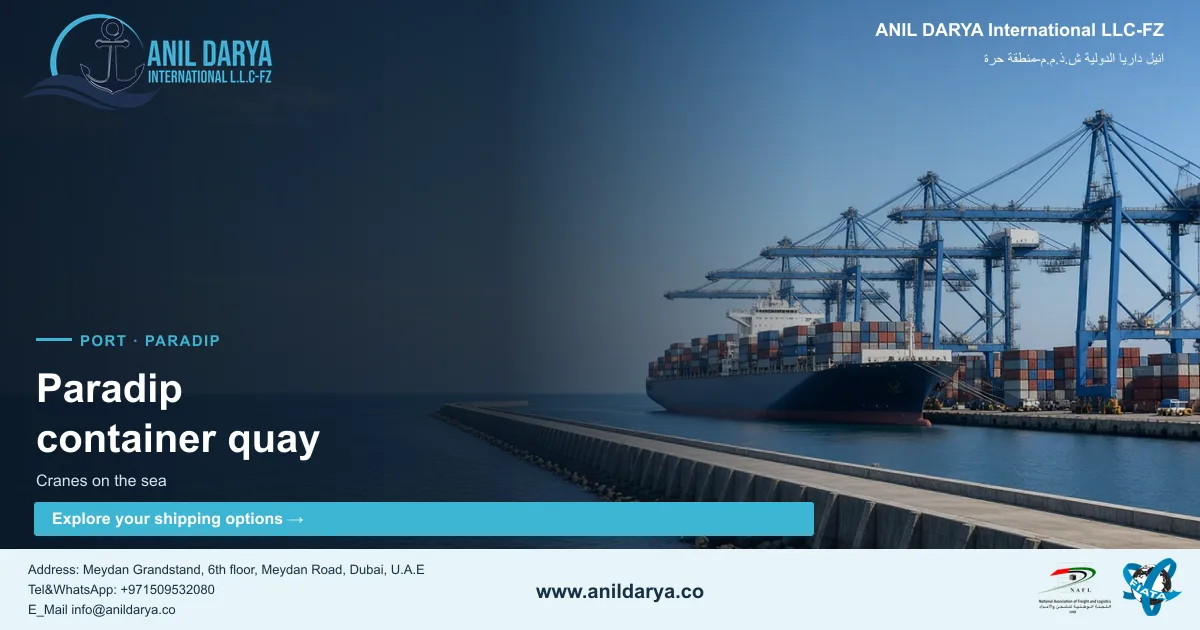
Paradip port shipping means using one of India's largest cargo ports, a deep-water major port in Odisha that handled 156.45 million tonnes in FY2025-26. Most of that is coal, ore, crude oil and fertiliser, while containers and clean cargo go through one multipurpose terminal, PICT. This guide covers the berths and their draft limits, which cargo fits where, the short version of Indian customs at this port, and how we ship to Paradip from Dubai. We ship both ways: from Dubai to Paradip, and from Paradip to Dubai with UAE clearance on arrival.
Paradip port at a glance
| Item | Detail |
|---|---|
| Port authority | Paradip Port Authority, a major port under the Ministry of Ports, Shipping and Waterways |
| Location | Paradip, Jagatsinghpur district, Odisha, near the mouth of the Mahanadi river on the Bay of Bengal |
| Distance by sea | About 210 nautical miles from Kolkata and 260 nautical miles from Visakhapatnam |
| Major port since | 18 April 1966 |
| Berths | 18 berths, 3 single point moorings (SPMs) and 1 Ro-Ro jetty |
| Channel depth | Approach channel 18.7 m, entrance channel at least 17.1 m |
| Largest ship | Cape-size up to 300 m LOA, 46 m beam, 155,000 DWT and 16.5 m draft |
| Rated capacity | 289 million tonnes a year |
| Cargo in FY2025-26 | 156.45 million tonnes, second among India's major ports |
| Cargo in FY2024-25 | 150.41 million tonnes, first among India's major ports |
| Container and clean cargo terminal | Paradip International Cargo Terminal (PICT), Berth 17 |
| Port railway | 84 km of track, 19 full-rake and 5 half-rake sidings |
| Hinterland | Odisha, Jharkhand, Chhattisgarh, Madhya Pradesh, Uttar Pradesh, Bihar and West Bengal |
| Paradip to Dubai | We book from Paradip and clear at Jebel Ali, Khalifa Port or Sharjah; the shipping bill stays with the shipper or its broker |
What is Paradip port and who runs it?
Paradip is a deep-water port on the east coast of India, run by the Paradip Port Authority. Jawaharlal Nehru laid the foundation stone on 3 January 1962. The Government of India took over the port from the Government of Odisha on 1 June 1965, the first ship berthed on 12 March 1966, and on 18 April 1966 it was declared India's eighth major port. It was the first major port on the east coast built after independence.
The harbour is an artificial lagoon protected by two breakwaters. The port works 24 hours a day, all year. It is a landlord port for a large part of its cargo: the port authority runs many berths itself, while private operators run terminals such as PICT and the JSW coal terminal at East Quay. The operator on your booking sets the berthing rules and much of the tariff you pay.
Scale is the headline. Paradip handled 150.41 million tonnes in FY2024-25, the first time since it opened that it ranked first among India's major ports. It handled 156.45 million tonnes in FY2025-26, with a record 7,73,462 tonnes in a single day on 29 March 2026 and 14.44 million tonnes in January 2026. The port authority lists rated capacity of 289 million tonnes a year and plans 300 million tonnes or more by 2027.
Which berths handle which cargo at Paradip?
Draft is the first thing to check. The port authority's berth specifications set a maximum LOA, beam and draft for each berth. Ships above these limits need the port's prior approval. Ships over 260 m LOA with a draft over 12.5 m are berthed and sailed in daylight, in good weather.
Main cargo berths
| Berth | Cargo | Max LOA | Max beam | Max draft |
|---|---|---|---|---|
| New Iron Ore Berth | Iron ore, mechanised | 300 m | 46 m | 16.0 m |
| New Coal Import Berth | Coking coal, mechanised | 300 m | 46 m | 16.0 m |
| Iron Ore Berth | Iron ore, mechanised | 230 m | 38 m | 13.0 m |
| Coal Berths 1 and 2 | Thermal coal, mechanised | 300 m | 46 m | 14.5 m |
| East Quay 1 to 3 | Thermal coal | 230 to 300 m | 38 to 46 m | 12.5 to 14.5 m |
| Central Quay 1 to 3 | General dry bulk, iron ore pellets | 230 to 300 m | 33 to 46 m | 14.5 m |
| South Quay | General dry bulk | 260 m | 46 m | 12.5 m |
| Multi-Purpose Berth | General dry bulk | 230 m | 33 m | 14.5 m |
| Fertilizer Berths 1 and 2 | Phosphates and sulphur, mechanised | 230 m | 33 m | 14.5 m |
| PICT (Berth 17) | Clean cargo and containers | 300 m | 46 m | 14.5 m |
| North Quay 2 and 3 | General dry bulk, non-mechanised | 130 to 170 m | 22 to 33 m | 6.0 to 7.5 m |
On the two 16.0 m berths, the deepest ships berth or sail at high tide. The JSW-run East Quay coal terminal lists 686 m of berth, a 15 m draft, 30 million tonnes a year of capacity and ships up to 110,000 DWT.
Oil jetties and SPMs
| Facility | Cargo | Max LOA | Max draft | Note |
|---|---|---|---|---|
| North Oil Jetty | Petroleum products | 260 m | 13.5 m | Opened 2003, 7.5 million tonnes a year |
| South Oil Jetty | Petroleum products | 260 m | 14.0 m | Ships of 120 to 148 m LOA not allowed |
| SPM 1 | Crude oil | 370 m | 21.0 m | 80,000 to 320,000 DWT, daylight berthing only |
| SPM 2 and 3 | Crude oil | 370 m | 23.0 m | Offshore, by pipeline to shore |
A simple rule: if your bulk parcel needs more than 14.5 m of draft, only the two 16.0 m mechanised berths or the East Quay coal terminal will work, and those are dedicated to ore and coal. Ask the carrier which berth it plans before you fix the cargo size.
What cargo moves through Paradip port?
Paradip is mainly a bulk port. The port authority lists crude oil, petroleum products, iron ore, thermal and coking coal, chrome and manganese ore, ferro chrome, ferro manganese, limestone, hard coke, steel billets, finished steel, scrap, fertiliser and its raw materials, clinker, gypsum, project cargo and containers. Coal is the largest single group.
The hinterland is the mining and steel belt of eastern and central India. Steel plants, power stations, refineries and fertiliser plants in Odisha, Jharkhand and Chhattisgarh drive most of the tonnage. Recent port figures show how mixed the smaller trades are: 8,17,290 tonnes of LPG from April to August of FY2026-27, up 4.45%, and 43,401 tonnes of ferro chrome in August 2026, up 44.67%.
For a shipper in the UAE, the usual cargo to Paradip is either containerised (machinery, spares, chemicals and industrial inputs), breakbulk such as steel and plant equipment, or a bulk parcel such as gypsum, limestone or sulphur.
Containers at Paradip: the PICT terminal
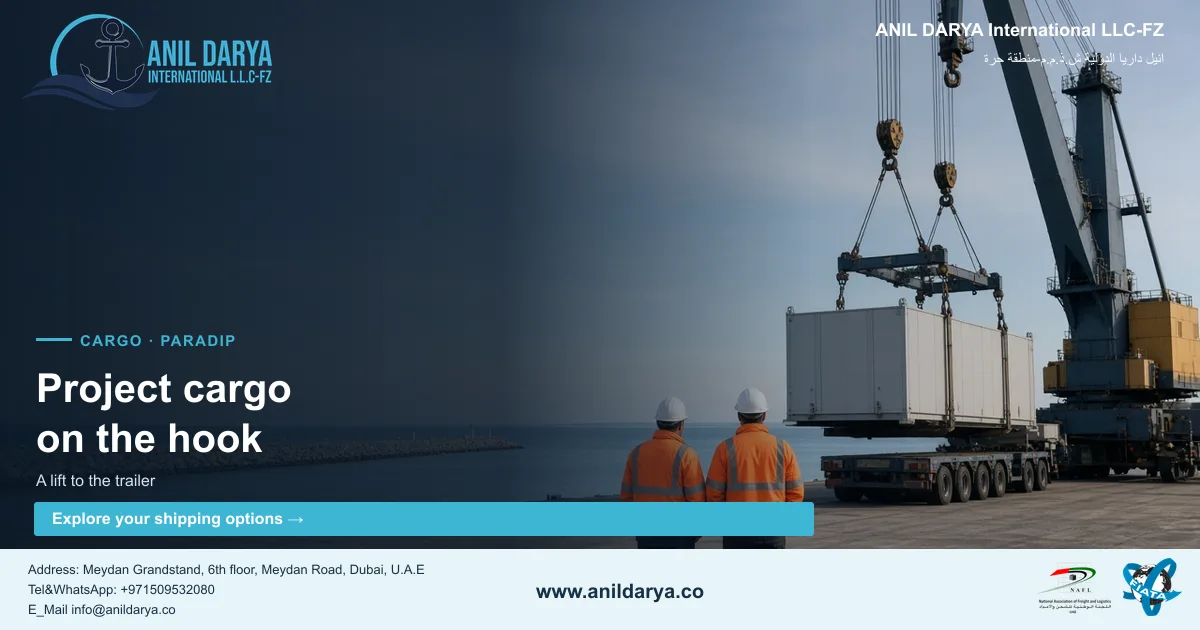
Containers at Paradip go to Paradip International Cargo Terminal (PICT) at Berth 17. The port authority lists PICT as a 5 million tonne a year terminal for clean bulk, breakbulk and containers, with a 450 m berth, 4 shore cranes, 636 ground slots and 2 rail sidings. The berth takes ships up to 300 m LOA, 46 m beam and 14.5 m draft, and two ships can lie there together if their combined length is 420 m or less.
PICT is operated by a J M Baxi group company, and its berthing policy has a few rules that affect your booking:
- Container ships berth in the windows agreed between the shipping line and PICT.
- Container and fertiliser ships get priority over general and dry bulk ships, but only one container ship gets priority at a time.
- Export ships berth only when the Shipping Bill and Let Export Order cover the full cargo already inside the terminal.
- If an importer has not cleared the Bill of Entry within 30 days of an earlier ship's discharge, its next ship can be refused a berth.
- Regular bulk importers must clear at least 80% of the previous shipment from the terminal before the next ship berths.
- Berth hire must be paid in full before the ship berths or sails.
The container trade here is small next to the bulk tonnage, so fewer carriers call. Before you promise a delivery date, check that a service actually calls Paradip on your dates. If none fits, compare a call at Visakhapatnam or Kolkata with the inland leg to the consignee.
Shipping from Dubai to Paradip: FCL, LCL and breakbulk
Containers from Dubai normally load at Jebel Ali Port. Paradip has a single container terminal, so check whether your service calls it direct or relays the box through a transshipment hub. The routing changes with the carrier and the week, so we confirm it at booking, not from an old schedule.
[AMIR-FACT: Our real Jebel Ali to Paradip transit time in days, the transshipment hub we usually use, and the carriers or feeders we book on this lane]
| Your shipment | Best fit at Paradip | Why |
|---|---|---|
| Full container of general cargo | FCL to PICT | One terminal handles all containers at the port |
| A few pallets | LCL, only if a consolidation runs to Paradip | If not, LCL to a larger east coast port plus trucking |
| Steel, machinery, project pieces | Breakbulk to PICT or a general cargo quay | Harbour mobile cranes at the quay, berth set by ship size |
| Small project cargo from a Ro-Ro or landing craft | Ro-Ro jetty | Built for project cargo, 5.0 m draft |
| Bulk parcel, for example gypsum or sulphur | Bulk carrier to a dry bulk or fertiliser berth | Berth set by cargo and draft |
See our guide to FCL vs LCL if you are not sure which mode pays off for your volume. Our sea freight service covers both from the UAE.
Breakbulk, bulk and project cargo at Paradip
Paradip has 8 harbour mobile cranes of 100 tonnes each, working bulk cargo at 4 berths. The general cargo quays, PICT and the Multi-Purpose Berth handle steel and breakbulk. For project cargo there is also a Ro-Ro jetty, opened on 26 November 2009, with a 50 m berth that takes vessels up to 90 m long, 20 m wide and 5.0 m draft. The port authority says it is used mainly for project cargo.
Storage helps with long lead projects. The port lists about 1.67 million sq m of open stack yards, including 7,43,200 sq m along the rail sidings, plus mechanised ore and coal stackyards.
How we plan a project or breakbulk move to Paradip:
- We collect weight, dimensions and lifting points for every piece.
- We choose the ship type and check the berth limits in the table above.
- We confirm the lifting gear: ship's cranes, the port's 100-tonne mobile cranes or a combination.
- The consignee's transporter checks the road or rail route from the port to site.
Our break bulk shipping service and bulk cargo service cover the UAE side of these moves.
Dangerous goods at Paradip port
Paradip handles a lot of hazardous cargo in bulk: crude oil through three offshore SPMs, petroleum products through the North and South Oil Jetties, LPG, and fertiliser raw materials such as sulphur at the fertiliser berths. The port runs a dedicated fire and safety department with regular drills.
Containerised DG to Paradip goes through PICT, and the carrier and terminal must accept the UN number and class first. In practice:
- We send the safety data sheet and UN number to the carrier for approval before booking.
- The shipper prepares the dangerous goods declaration, and the box carries the right IMDG labels and placards.
- The consignee's clearing agent checks whether the goods need an Indian licence or permit.
- The consignee plans quick clearance, as terminals limit how long DG boxes can stay.
Our dangerous goods shipping service covers classification, packing checks and carrier approval on the UAE side.
Customs at Paradip: the short version
Indian customs rules are the same at every port, and our Nhava Sheva port guide covers them in full. Here is what you need for Paradip:
- The importer needs an Import Export Code (IEC), a 10-digit number issued by DGFT.
- The Bill of Entry is filed on ICEGATE. A Bill of Entry filed before arrival stays valid if the ship arrives within 30 days.
- Supporting documents go up through e-Sanchit first. The Bill of Entry cannot be submitted until they are uploaded.
- The Bill of Entry must show the importer's GSTIN and state code to claim IGST credit.
- Deferred duty payment is open only to importers with AEO T-2 or T-3 status.
At PICT a slow Bill of Entry costs more than demurrage: under the terminal's berthing policy it can delay the importer's next ship. Bulk importers should plan clearance before the ship arrives.
Preferential certificates of origin under the India-UAE CEPA have been issued since 1 May 2022. If your goods are made in the UAE and meet the origin rule, the certificate can cut the duty. Goods only stored in or re-exported through Dubai usually do not qualify.
We do not file Indian customs entries. We prepare the export side in the UAE and work with the consignee's customs broker or a destination clearing agent at Paradip.
Which documents should travel with a Paradip shipment?
| Document | Who provides it | Paradip tip |
|---|---|---|
| Commercial invoice | Shipper in the UAE | Value and HS code must match the Bill of Entry |
| Packing list | Shipper | Piece weights matter for crane lifts at the quay |
| Bill of lading | Carrier, via us | Port of discharge must read Paradip, not the transshipment hub |
| Certificate of origin | UAE issuing authority | Needed only to claim CEPA preference |
| Dangerous goods declaration and SDS | Shipper | For any DG cargo |
| IEC, GSTIN and any licence | Importer in India | Declared on the Bill of Entry |
How does cargo leave Paradip port?
Rail is the big one. The port has a 7.4 km route and 84 km of track, with 19 full-rake and 5 half-rake sidings, linked to the broad-gauge, electrified East Coast Railway. In March 2025 it averaged 70.16 rakes a day. Road access is by National Highway 5A and State Highway 12. The nearest international airport is Biju Patnaik International Airport in Bhubaneswar, about 85 to 95 km away.
| Consignee location | Usual inland mode | Check before you ship |
|---|---|---|
| Paradip, Cuttack, Bhubaneswar | Truck | Delivery order and gate timing at PICT |
| Odisha steel and mining belt | Rail for bulk, truck for containers | Rake availability and siding allocation |
| Jharkhand, Chhattisgarh | Rail or truck | Compare against Visakhapatnam or Kolkata plus inland |
| Oversized project pieces | Truck with route survey | Road permits and bridge limits on the route |
How to ship from Dubai to Paradip: step by step
- Send us the cargo details: commodity, HS code, weight, dimensions, number of pieces and the consignee's city.
- We check which carriers can deliver to Paradip from Jebel Ali and through which hub.
- The importer confirms the IEC, GSTIN and any licence, and appoints a clearing agent at Paradip.
- We book space, release the empty container or fix the breakbulk booking, and send the cut-off dates.
- We arrange trucking from the shipper's site to Jebel Ali and handle UAE export clearance.
- The carrier issues the bill of lading. We send copies to the consignee and the clearing agent.
- The clearing agent files the Bill of Entry on ICEGATE before the ship arrives.
- The ship berths at PICT or the assigned berth, duty is paid and customs releases the cargo.
- The consignee's transporter or the railway collects the cargo within free time.
How to ship from Paradip port to Dubai
We also handle the other direction: shipping from Paradip to Dubai, with arrival at Jebel Ali, Khalifa Port or Sharjah port. We book the space with the carrier and run the UAE side. The Indian export filings stay with the shipper or its Indian agent.
The Indian export side
- IEC. The exporter needs an Import Export Code from the DGFT. No export or import can be made without one unless it is specifically exempted.
- Shipping bill. The exporter, usually through its customs broker, files the shipping bill electronically on ICEGATE, the CBIC customs system, and quotes the GSTIN of the exporting entity. Those who cannot file on ICEGATE use the customs service centre.
- Loading. Export goods cannot be loaded until the proper officer grants the vessel Entry Outward, and the carrier then files the Export General Manifest (EGM).
The UAE import side
On arrival in Dubai, the import declaration goes to Dubai Customs with the commercial invoice, the packing list, the certificate of origin and any permit for restricted goods. The carrier's agent also needs the bill of lading before it issues the delivery order. Customs duty in Dubai is 5% of the CIF value for most goods, with 50% on alcohol and 100% on cigarettes. Import VAT is 5% of the customs value, which includes insurance and freight. A VAT-registered importer whose customs number is registered with the Federal Tax Authority accounts for it on its VAT return. An importer that is not registered pays it before the goods are released.
- Send us the shipper's details in Paradip, the cargo, the HS code and the UAE delivery address.
- We book space from Paradip and send the booking, cut-offs and terminal details to the shipper.
- The shipper or its trucker delivers the cargo to PICT or the Paradip berth named on the booking inside the carrier's receiving window.
- The shipper or its customs broker files the shipping bill on ICEGATE and clears the cargo for export.
- We check the draft bill of lading against the invoice and packing list before it is issued.
- We file the Dubai Customs declaration before the ship arrives.
- We arrange payment of the duty and VAT and collect the delivery order from the carrier's agent.
- We truck the cargo to your site and return the empty container inside the free time.
[AMIR-FACT: the carriers we actually use from Paradip to Jebel Ali/Khalifa/Sharjah and our real transit days in this direction]
Free time, demurrage and detention at Paradip
Free time at PICT, at the port's own berths and on the carrier's container is set by each tariff and each carrier, not by one port rule. The Paradip Port Authority publishes its port charges, and PICT has its own. Ask for the free days in writing at booking. Our article on demurrage and detention explains how the charges build up.
Checklist before you ship to Paradip
- The importer's IEC and GSTIN are confirmed.
- A clearing agent at Paradip has the documents.
- The HS code and duty, including any CEPA preference, are checked.
- A service that calls PICT on your dates is confirmed, with its transshipment port.
- For breakbulk and bulk: the ship fits the berth's LOA, beam and draft limits.
- For DG: carrier approval, SDS and DG declaration are ready.
- The bill of lading names Paradip as the port of discharge.
- Free time at the terminal and on the container is agreed in writing.
Common mistakes on shipments to Paradip
- Assuming every container service calls Paradip direct. It is a bulk-led port with one container terminal, so check the routing.
- Planning a 16 m draft ship for a 14.5 m berth.
- Booking a 120 to 148 m tanker for the South Oil Jetty, where that size is not allowed.
- Leaving a Bill of Entry open, which can block the importer's next ship at PICT.
- Claiming CEPA preference on goods that only passed through Dubai.
- Shipping DG without checking whether the goods need an Indian licence or permit.
Paradip or another east coast port: which fits your cargo?
| Your situation | Port to look at first | Why |
|---|---|---|
| Bulk parcel for Odisha's steel, power or fertiliser plants | Paradip | Deep bulk berths and port rail |
| Breakbulk or project cargo for Odisha | Paradip | Shortest inland leg, mobile cranes, Ro-Ro jetty |
| Regular containers to Andhra Pradesh or south Odisha | Visakhapatnam | Larger container terminal, more services |
| Containers to Kolkata or West Bengal | Kolkata | Closest port to the city |
Frequently asked questions
Where is Paradip port?
Paradip port is in Jagatsinghpur district, Odisha, near where the Mahanadi river meets the Bay of Bengal. It is about 210 nautical miles from Kolkata and 260 nautical miles from Visakhapatnam.
How much cargo does Paradip port handle?
Paradip handled 156.45 million tonnes in FY2025-26, second among India's major ports, and 150.41 million tonnes in FY2024-25, when it ranked first. Its rated capacity is 289 million tonnes a year.
How deep is Paradip port?
The approach channel is 18.7 m deep and the entrance channel at least 17.1 m. The deepest cargo berths allow 16.0 m draft, most others 12.5 to 14.5 m, and the offshore SPMs 21 to 23 m.
Does Paradip port handle containers?
Yes. Containers go through Paradip International Cargo Terminal (PICT) at Berth 17, which also handles clean bulk and breakbulk. It has a 450 m berth, 4 shore cranes and 636 ground slots.
Is there a direct ship from Dubai to Paradip?
It depends on the carrier and the week. Paradip has one container terminal, so some routings use a transshipment hub. We confirm the route and any hub when we quote.
Can I ship project cargo to Paradip?
Yes. Paradip has 100-tonne harbour mobile cranes, general cargo quays and a Ro-Ro jetty used mainly for project cargo. The heaviest piece and the ship type decide which berth fits.
Can I get lower duty on goods shipped from Dubai to Paradip?
Possibly. Under the India-UAE CEPA, goods that meet the UAE origin rule can claim preferential duty with a valid certificate of origin. Goods only re-exported through Dubai usually do not qualify.
Who clears my cargo at Paradip?
The importer or its customs broker files the Bill of Entry on ICEGATE using the importer's IEC and GSTIN. Anil Darya handles the UAE export side and works with the broker at Paradip.
Can you handle shipping from Paradip to Dubai?
Yes. We book the space from Paradip, check the bill of lading and run the UAE side: the Dubai Customs declaration, the 5% duty and 5% import VAT, which we arrange payment of, the delivery order and trucking. The shipper or its Indian customs broker files the shipping bill on ICEGATE.
Get a quote for Paradip port shipping
Send your cargo details through our freight rate inquiry form and we will come back with a routing and price from Jebel Ali to Paradip. For a breakbulk, bulk, project or DG shipment, contact our team first so we can check the berth limits and carrier options. You can also read more about our Dubai freight forwarding team.
Sources
- DGFT: IEC (no export or import without an IEC unless exempted)
- Dubai Customs: Submit customs declaration (invoice, packing list, certificate of origin, permits)
- UAE Government portal: Customs duty (5% of CIF in Dubai, alcohol 50%, cigarettes 100%)
- Federal Tax Authority: VAT (5% rate)
- Federal Tax Authority: VAT guide, section 3.5 (import VAT at 5% on customs value, VAT return or payment before release)
- Paradip Port Authority: Know your port (berths, channel depth, capacity, rail, hinterland, commodities)
- Paradip Port Authority: Berth specifications (LOA, beam, draft and cargo per berth)
- Paradip Port Authority: Major achievements (cargo by year, rankings, records)
- Paradip Port Authority: Home page (PICT figures, Cape-size limits, recent cargo figures)
- Paradip Port Authority: Port history
- Paradip Port Authority: Connectivity (road and rail)
- Paradip Port Authority: Port railways
- Paradip Port Authority: Storage
- Paradip Port Authority: Ro-Ro jetty
- Paradip Port Authority: North Oil Jetty and fire and safety
- Paradip International Cargo Terminal: Berthing policy (PICT/MISC/96/2018-19)
- JSW Infrastructure: Paradip East Quay coal terminal
- Wikipedia: Paradip Port (location, harbour, SPMs)
- Falcon Freight: Paradip port nearest international airport
- ICEGATE: FAQ (IEC, Bill of Entry, e-Sanchit, GSTIN, deferred duty)
- DGFT Trade Notice 05/2022-23: India-UAE CEPA certificates of origin from 1 May 2022
Reviewed: 10 November 2026