
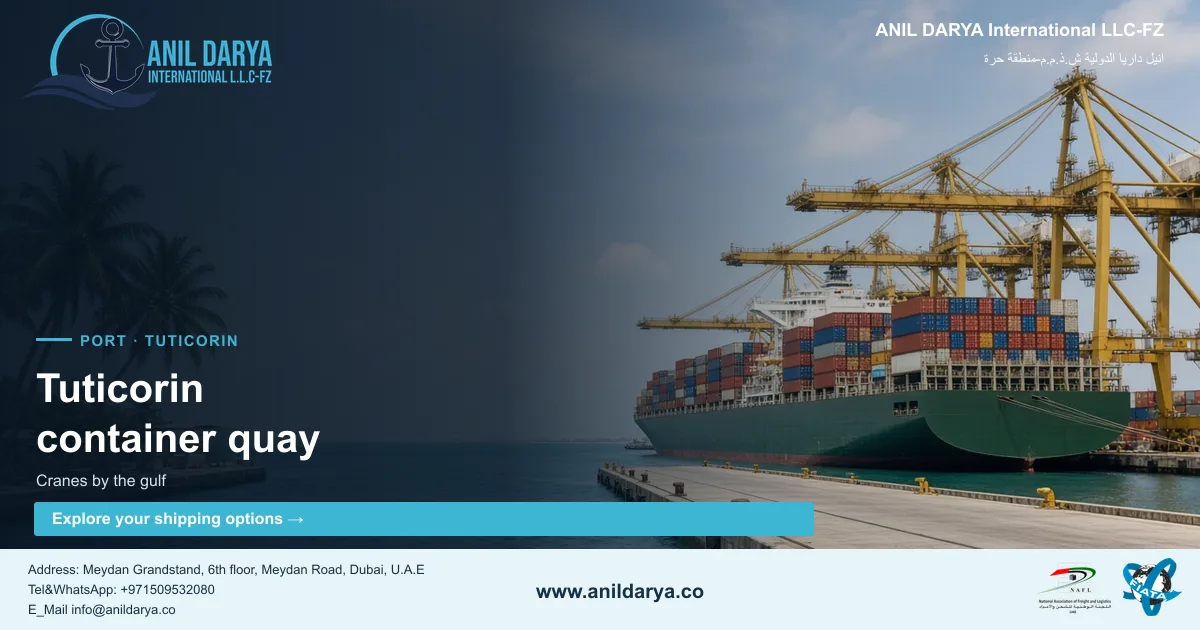
Tuticorin port shipping means using V.O. Chidambaranar Port (VOC Port) in Thoothukudi, the main container gateway for southern Tamil Nadu and a busy bulk port on the Gulf of Mannar. Two private container terminals work inside a breakwater-protected harbour with a 14.2 m maximum draft, next to coal, fertiliser and general cargo berths. This guide covers which berth your cargo will use, the draft and ship size limits, the short version of Indian customs at this port, and how we ship to Tuticorin from Dubai. We ship both ways: from Dubai to Tuticorin, and from Tuticorin to Dubai with UAE clearance on arrival.
Tuticorin port at a glance
| Item | Detail |
|---|---|
| Official name | V.O. Chidambaranar Port, run by the V.O. Chidambaranar Port Authority |
| Other names | Tuticorin Port, Thoothukudi Port, VOC Port |
| UN/LOCODE | INTUT |
| Location | Thoothukudi, Tamil Nadu, on the Gulf of Mannar, southeast coast of India |
| Major port since | 11 July 1974 |
| Harbour | Artificial harbour inside two breakwaters (north 4,098.66 m, south 3,873.37 m) |
| Inner harbour berths | 20, including container berths, coal and oil jetties and captive berths |
| Maximum draft | 14.2 m |
| Operating container terminals | Dakshin Bharat Gateway Terminal (Berth 8) and Tuticorin International Container Terminal (Berth 9) |
| Cargo in FY2025-26 | 43.3 million tonnes, up from 34.1 million tonnes in FY2021-22 |
| Containers, April to August 2025 | 361,991 TEU, up 7.72% on the same period a year earlier |
| Hinterland | Southern Tamil Nadu, parts of Kerala and parts of Karnataka |
| Customs filing | Bill of Entry on ICEGATE, same rules as every Indian port |
| Shipping Tuticorin to Dubai | Shipping Bill on ICEGATE by the shipper or its customs broker; UAE entry at Jebel Ali, Khalifa Port or Sharjah |
What is Tuticorin port and who runs it?
Tuticorin port is the old name most shippers still use. The official name is V.O. Chidambaranar Port, after the freedom fighter V. O. Chidambaram Pillai. It became one of India's major ports on 11 July 1974. The Union Cabinet approved the change of name from Tuticorin Port Trust in 2011, and since 2022 it has been the V.O. Chidambaranar Port Authority under the Ministry of Ports, Shipping and Waterways.
The harbour is man-made. Two rubble-mound breakwaters run up to about 4 km into the sea, with a 1,275 m gap between them, and they enclose about 400 hectares of protected water. The approach channel is 2,400 m long and 183 m wide. The port works round the clock, all year.
Like most Indian major ports, VOC Port is a landlord port for much of its cargo. The port authority owns the berths, and private companies run the container terminals and several bulk berths under long concessions. For you, that means the terminal operator on your booking sets the gate process, the tariff and the free time, not the port authority alone.
Which container terminals operate at Tuticorin port?
Container traffic at VOC Port runs through Berths 8 and 9. Berth 7, the oldest container berth, is being turned into a new terminal. Here is how they compare.
| Berth | Operator | Status | Key figures |
|---|---|---|---|
| Berth 8 | Dakshin Bharat Gateway Terminal Pvt Ltd (DBGT) | Operating, more than 12 years in service | Has taken ships up to 300 m long and 48.20 m wide (MSC Silvia, 9,411 TEU, July 2026) |
| Berth 9 | Tuticorin International Container Terminal Pvt Ltd (TICT), part of the J M Baxi Group | Operating since September 2024 | 600,000 TEU a year, 370 m quay, up to 14.2 m draft, 3 quay cranes, 9 RTGs, about 10 hectares |
| Berth 7 | New operator under tender | Container BOT operations ran from December 1999 to February 2025 | Planned 4.2 lakh TEU a year, berth pocket to be dredged to 16.5 m for ships up to 12,100 TEU |
Berth 8: the DBGT container terminal
DBGT runs Berth 8 around the clock and offers vessel schedules, container tracking and reefer monitoring through its website and app. In July 2026 it berthed the widest ship in its history, the MSC Silvia, a 9,411 TEU vessel with a 48.20 m beam that arrived from Onne in Nigeria. MSC uses the terminal for mainline services, which matters if your cargo moves on a long-haul MSC loop rather than a feeder.
Berth 9: the newest terminal, TICT
TICT is the newest terminal. The port signed the concession on 3 September 2022 on a design, build, finance, operate and transfer basis, and the terminal opened on 16 September 2024 at a cost of about ₹434 crore. It has a 370 m quay with up to 14.2 m draft, three rail-mounted quay cranes and nine rubber-tyred gantry cranes. By November 2026 it had handled 500,000 TEU in total. The operator says the terminal sits within 14 nautical miles of the east-west international shipping lanes, which helps feeder and mainline calls.
Berth 7 conversion
Berth 7 handled containers under a BOT concession from December 1999 to February 2025, when PSA left after a royalty dispute. In May 2026 the port authority floated a ₹517 crore global tender to rebuild it as a container terminal on a 30-year concession. The plan is 4.2 lakh TEU a year, a berth pocket dredged to 16.5 m and room for ships up to 12,100 TEU. Until a new operator starts, do not expect a booking to name Berth 7.
In January 2025, with three terminals still working, the port's combined container capacity was put at 1.6 million TEU a year. Treat that as a ceiling until the Berth 7 project finishes.
Berths, draft and ship size limits at VOC Port
The port has 20 inner harbour berths. Maximum draft across the main deep berths is 14.2 m. Third-party port data lists the overall limits as 330 m LOA, 48 m beam and about 93,000 DWT. Older figures of 12.8 m draft and 3,000 TEU ships are out of date, so ignore them if you see them in older guides.
| Berth or terminal | Draft | Length or ship limit | Main cargo |
|---|---|---|---|
| TICT, Berth 9 | 14.2 m | 370 m quay | Containers |
| DBGT, Berth 8 | Not published by the terminal | Ships up to 300 m LOA and 48.20 m beam handled | Containers |
| North Cargo Berth III (JSW) | 14.2 m | 306 m quay, ships up to 260 m LOA, 48 m beam, 95,000 DWT | Coal, limestone, gypsum, rock phosphate, copper concentrate |
| Berth 7 (being rebuilt) | 11.85 m now, 16.5 m planned | 370 m | Non-container cargo until conversion |
A simple rule: a vessel's draft at Tuticorin tops out at 14.2 m, so very large bulk ships arrive part-loaded or go elsewhere. For containers from the Gulf, the limit rarely matters, because feeders and mid-size mainline ships fit easily.
What cargo moves through Tuticorin port?
VOC Port is a mixed port. Containers are the headline, but bulk tonnage is large. The port's main imports include coal, cement, fertilisers, rock phosphate, petroleum products, petroleum coke and edible oils. Its exports include general cargo, building materials, liquid cargo, sugar, granite and limonite ore. Port profiles also list salt, ilmenite and garnet sand, cotton yarn and coffee among exports, and timber logs and copper concentrate among the trades.
Bulk handling grew in May 2025, when JSW Tuticorin Multipurpose Terminal started work at North Cargo Berth III with two 120-tonne harbour mobile cranes for dry bulk.
| Your cargo from the UAE | Where it lands at Tuticorin | Check first |
|---|---|---|
| Machinery, spares, chemicals in drums, plastics, consumer goods | Container terminal (DBGT or TICT) | Which terminal your carrier's service calls |
| Reefer cargo | Container terminal | Reefer plug availability and the terminal's reefer tariff |
| Dry bulk such as gypsum or limestone | Bulk berth, for example North Cargo Berth III | Ship size against the 260 m LOA and 14.2 m draft limits |
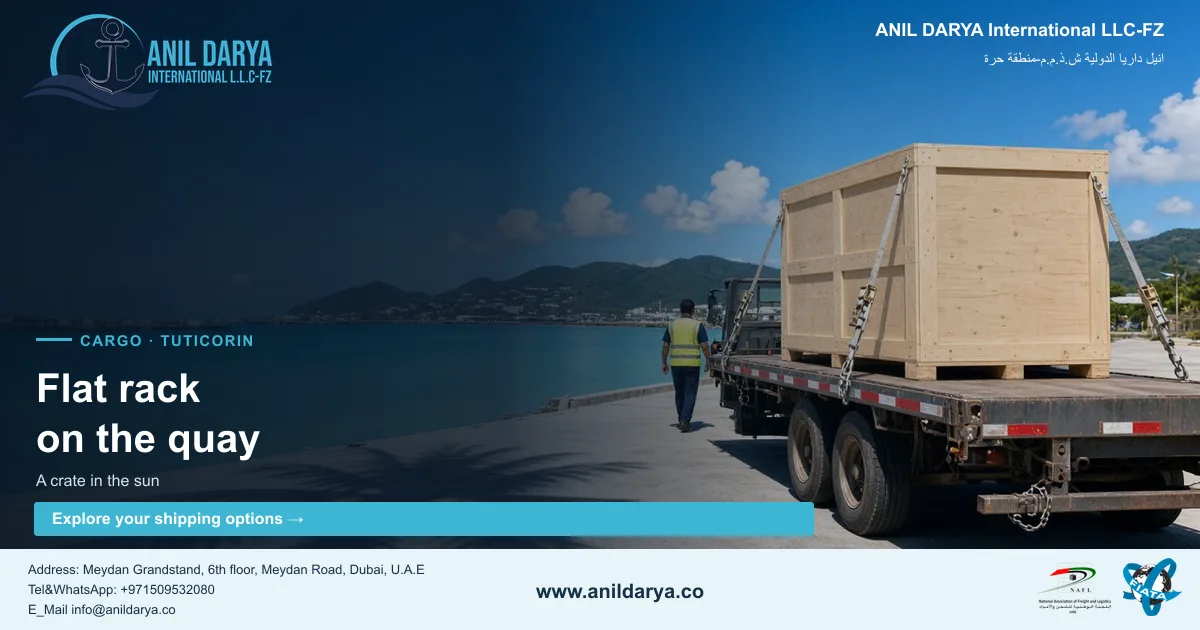
| Steel, project pieces, heavy lifts | General cargo berth or flat rack via a container terminal | Piece weight, crane capacity and inland road route |
Shipping from Dubai to Tuticorin: FCL, LCL and carriers
Most cargo from Dubai to Tuticorin moves in containers from Jebel Ali Port. Cogoport's lane data lists Jebel Ali as an import lane into Tuticorin, so the trade is active. Whether your box goes direct or through a hub such as Colombo depends on the carrier's loop on the day you book.
Container capacity at Tuticorin is spread across feeder and mainline operators. Cogoport's March 2026 snapshot tracked 23,876 TEU of capacity: Wan Hai 26.6%, Unifeeder 24.5%, Samudera Shipping 5.8%, and others 43.1%. That is a snapshot of capacity, not a schedule. It tells you feeders carry a big share, so ask whether your booking is direct or transshipped.
[AMIR-FACT: Our real Jebel Ali to Tuticorin transit time in days, whether it is direct or via Colombo or another hub, and the carriers or feeders we book on this lane]
| Your shipment | Best fit | Why |
|---|---|---|
| Enough cargo to fill a 20ft or 40ft box | FCL to DBGT or TICT | One container, one Bill of Entry, no shared risk |
| A few pallets | LCL, if a consolidation service runs to Tuticorin | If not, compare LCL to Chennai or Cochin plus trucking |
| Temperature-controlled goods | Reefer FCL | Check reefer plug and power charges with the terminal |
| Oversized or heavy pieces | Flat rack, open top or breakbulk | Depends on piece size and the carrier's equipment |
Not sure whether FCL or LCL pays off for your volume? Read our guide to FCL vs LCL. Our sea freight service covers both from the UAE.
Dwell time is worth watching. Cogoport's February 2026 data showed an average import dwell of 2.6 days and an export dwell of 4.6 days at Tuticorin. Clearing quickly keeps your box inside free time.
Breakbulk, bulk and project cargo at Tuticorin
Breakbulk and project cargo use the general cargo and multipurpose berths, while dry bulk goes to the mechanised or crane-served bulk berths. The 14.2 m draft and the turning space inside the breakwaters set the size of ship that can come in. JSW's North Cargo Berth III takes ships up to 260 m long and 48 m wide, and its two 120-tonne mobile cranes suit heavy grabs and some heavy lifts.
For project cargo, the heaviest piece decides the plan:
- We collect the weight, dimensions and centre of gravity of every piece.
- We match the cargo to a ship type: container ship with flat racks, multipurpose ship with its own gear, or a breakbulk call.
- We confirm which berth and which cranes the carrier or stevedore will use at Tuticorin.
- The consignee's transporter checks the road route and permits from the port to site.
Our break bulk shipping service and bulk cargo service cover the UAE side of these moves.
Dangerous goods at Tuticorin port
VOC Port handles petroleum products and other liquid cargo through its oil jetties, and coal, fertiliser and chemical raw materials across its bulk berths. Containerised DG moves through DBGT or TICT like any other box, but each carrier and terminal must accept the UN number and class before booking.
- We send the safety data sheet, UN number, class and packing group to the carrier for approval.
- The shipper prepares the dangerous goods declaration, and the container gets the right IMDG labels and placards.
- The consignee's clearing agent checks whether the goods need an Indian licence or permit before the ship sails.
- The consignee plans fast clearance and pickup, because terminals limit how long DG boxes can stay.
Our dangerous goods shipping service handles classification checks, packing checks and carrier approval from the UAE.
Customs at Tuticorin: the short version
Indian customs rules are the same at every port, and our Nhava Sheva port guide covers them in full. Here is what you need for Tuticorin:
- The importer needs an Import Export Code (IEC), a 10-digit number issued by DGFT.
- The Bill of Entry is filed on ICEGATE. A Bill of Entry filed before arrival stays valid if the ship arrives within 30 days.
- Supporting documents are uploaded through e-Sanchit first. The Bill of Entry cannot be submitted until they are in.
- The Bill of Entry must show the importer's GSTIN and state code to claim IGST credit.
- Deferred duty payment is open only to importers with AEO T-2 or T-3 status.
Preferential certificates of origin under the India-UAE CEPA have been issued since 1 May 2022. If your goods are made in the UAE and meet the origin rule, the certificate can cut the Indian duty. Goods only stored in or re-exported through Dubai usually do not qualify.
We do not file Indian customs entries. We prepare the export side in the UAE and work with the consignee's customs broker or a destination clearing agent at Tuticorin.
Which documents should travel with a Tuticorin shipment?
| Document | Who provides it | Tuticorin tip |
|---|---|---|
| Commercial invoice | Shipper in the UAE | Value and HS code must match the Bill of Entry |
| Packing list | Shipper | Piece weights matter for breakbulk lifts and flat racks |
| Bill of lading | Carrier, via us | Port of discharge must read Tuticorin (INTUT), not Colombo or Chennai |
| Certificate of origin | UAE issuing authority | Needed only to claim CEPA preference |
| Dangerous goods declaration and SDS | Shipper | For any DG cargo |
| IEC, GSTIN and any licence | Importer in India | Declared on the Bill of Entry |
How does cargo leave Tuticorin port?
The port has road and rail links to its hinterland, and most containers leave by truck. The districts it serves run from Thoothukudi, Tirunelveli and Kanniyakumari in the far south to Madurai, Virudhunagar, Dindigul, Erode, Tiruppur, Salem, Coimbatore and Tiruchirappalli further north. TICT also notes road and rail links to industrial corridors in Tamil Nadu, Karnataka and Kerala.
| Consignee location | Usual inland mode | Check before you ship |
|---|---|---|
| Thoothukudi, Tirunelveli, Kanniyakumari | Truck, short haul | Delivery order and gate timing at the terminal |
| Madurai, Virudhunagar, Sivakasi, Dindigul | Truck | Weight limits and overnight trucking rules |
| Coimbatore, Tiruppur, Erode, Salem | Truck or rail | Compare Tuticorin plus inland against Cochin or Chennai |
| Southern Kerala | Truck | Interstate paperwork and the road route for big pieces |
A simple rule: if the consignee is in the southern districts of Tamil Nadu, Tuticorin usually gives the shortest inland leg. For Chennai or the north of the state, look at Chennai port first.
How to ship from Dubai to Tuticorin: step by step
- Send us the cargo details: commodity, HS code, weight, dimensions, number of pieces and the consignee's city.
- We check which carriers serve Tuticorin from Jebel Ali, which terminal they call, and whether the service is direct or via a hub.
- The importer confirms the IEC, GSTIN and any licence, and appoints a clearing agent at Tuticorin.
- We book space, release the empty container or fix the breakbulk booking, and send you the cut-off dates.
- We arrange trucking from the shipper's site to Jebel Ali and handle UAE export clearance.
- The carrier issues the bill of lading. We send copies to the consignee and the clearing agent.
- The clearing agent files the Bill of Entry on ICEGATE before the ship arrives.
- The ship berths at DBGT, TICT or the assigned cargo berth, duty is paid and customs releases the cargo.
- The consignee's transporter collects the cargo within free time.
How to ship from Tuticorin to Dubai
We also handle the other direction: shipping from Tuticorin to Dubai, with arrival at Jebel Ali, Khalifa Port or Sharjah port. We book the space with the carrier and run the UAE side. The Indian export papers stay with the shipper or its Indian agent.
The India export side
- IEC. No goods may be exported from India without an Importer-Exporter Code issued by DGFT, unless the exporter is specifically exempted.
- Shipping bill. Under section 50 of the Customs Act, the exporter presents a shipping bill electronically on the customs automated system and declares that its contents are true. In practice the shipper or its customs broker files it through ICEGATE, quoting the GSTIN of the exporting entity.
- Let export. Once the officer is satisfied that the goods are not prohibited and any duty and charges are paid, customs orders clearance and loading. The order can be made electronically on a risk basis.
- CEPA certificate of origin. For exports to the UAE under the India-UAE CEPA, the exporter applies for a preferential certificate of origin on the DGFT eCoO platform, in use since 1 May 2022. The UAE importer needs it to claim the CEPA rate.
The UAE import side
On arrival, the declaration goes to Dubai Customs with the commercial invoice, packing list, certificate of origin and any permit for restricted goods, and we match it against the bill of lading. Customs duty in Dubai is 5% of the CIF value for most goods, with 50% on alcohol and 100% on cigarettes, unless a CEPA preference applies. Import VAT is 5% of the customs value including freight and insurance. A VAT-registered importer whose customs number is linked with the Federal Tax Authority accounts for it on its VAT return instead of paying at the port. The importer needs a Dubai Customs business code, or clears through a licensed clearing agent with the owner's authorization.
- Send us the shipper's details in southern Tamil Nadu, the cargo, the HS code and the UAE delivery address.
- We book space from Tuticorin and send the booking and cut-offs to the shipper.
- The shipper or its trucker stuffs the box and delivers it to the terminal inside the cut-off.
- The shipper or its customs broker files the shipping bill on ICEGATE, gets the let export order and, where it applies, the CEPA certificate of origin.
- We check the draft bill of lading against the invoice and packing list, and track the hub connection.
- We file the UAE declaration before arrival and arrange payment of the duty and VAT.
- We collect the delivery order, truck the box to your site and return the empty inside free time.
[AMIR-FACT: the carriers we actually use from Tuticorin to Jebel Ali/Khalifa/Sharjah and our real transit days in this direction]
Free time, demurrage and detention at Tuticorin
Free time at the terminal and on the carrier's container is set by each terminal tariff and each carrier, not by a single port rule. DBGT publishes its own tariff, and TICT and the port authority publish theirs. Ask for the free days in writing at booking and compare them with how long your clearing agent usually needs. Our article on demurrage and detention explains how these charges build up.
Checklist before you ship to Tuticorin
- The importer's IEC and GSTIN are confirmed.
- A clearing agent at Tuticorin has the documents.
- The HS code and duty, including any CEPA preference, are checked.
- The carrier's service, terminal (Berth 8 or 9) and any transshipment port are confirmed.
- For breakbulk: piece weights and dimensions are on the packing list, and the ship fits the 14.2 m draft.
- For DG: carrier approval, SDS and DG declaration are ready.
- The bill of lading names Tuticorin as the port of discharge.
- Free time at the terminal and on the container is agreed in writing.
Common mistakes on shipments to Tuticorin
- Assuming every service calls Tuticorin direct. Some reach it through a hub, which adds days.
- Quoting old draft or ship size figures. The port now works to 14.2 m, not 12.8 m.
- Expecting Berth 7 to handle containers while the conversion is under tender.
- Filing the Bill of Entry late, which eats into free time.
- Claiming CEPA preference on goods that only passed through Dubai.
- Shipping DG without checking whether the goods need an Indian licence or permit.
Tuticorin or another Indian port: which fits your cargo?
| Your situation | Port to look at first | Why |
|---|---|---|
| Consignee in southern Tamil Nadu | Tuticorin | Shortest inland leg |
| Consignee in Chennai or northern Tamil Nadu | Chennai | Closer to the city and its industrial belt |
| Consignee in Kerala, near Kochi | Cochin | Direct port for central Kerala |
| Consignee in Mumbai, Pune or western India | Nhava Sheva | Largest container port for the west |
Frequently asked questions
Is Tuticorin port the same as V.O. Chidambaranar Port?
Yes. Tuticorin port, Thoothukudi port and VOC Port all mean V.O. Chidambaranar Port in Tamil Nadu, run by the V.O. Chidambaranar Port Authority. Its UN/LOCODE is INTUT.
How many container terminals does Tuticorin port have?
Two are operating: Dakshin Bharat Gateway Terminal at Berth 8 and Tuticorin International Container Terminal at Berth 9. Berth 7, a container berth until February 2025, is being rebuilt as a third terminal under a new concession.
What is the maximum draft at Tuticorin port?
The deep berths work to a maximum draft of 14.2 m, including TICT at Berth 9 and North Cargo Berth III. The planned Berth 7 container terminal is due to be dredged to 16.5 m.
How much cargo does Tuticorin port handle?
VOC Port handled 43.3 million tonnes of cargo in FY2025-26, up from 34.1 million tonnes in FY2021-22. From April to August 2025 it handled 361,991 TEU of containers, 7.72% more than a year earlier.
Is there a direct ship from Dubai to Tuticorin?
It depends on the carrier and the week. Jebel Ali appears as an import lane into Tuticorin, but some services go through a hub. We confirm the routing when we quote.
Can I ship dangerous goods to Tuticorin?
Yes. Containerised DG moves through the container terminals once the carrier and terminal accept the UN number and class, and the consignee should check Indian licence rules first.
Can I get lower duty on goods shipped from Dubai to Tuticorin?
Possibly. Under the India-UAE CEPA, goods that meet the UAE origin rule can claim preferential duty with a valid certificate of origin. Goods only re-exported through Dubai usually do not qualify.
Who clears my cargo at Tuticorin?
The importer or its customs broker files the Bill of Entry on ICEGATE using the importer's IEC and GSTIN. Anil Darya handles the UAE export side and works with the broker at Tuticorin.
Can you handle shipping from Tuticorin to Dubai?
Yes. We book space with the carrier from Tuticorin, the shipper or its customs broker files the shipping bill, and we clear the cargo through UAE customs and deliver it in the UAE. Most goods pay 5% duty on the CIF value plus 5% import VAT.
Get a quote for Tuticorin port shipping
Send your cargo details through our freight rate inquiry form and we will come back with a routing and price from Jebel Ali to Tuticorin. For a breakbulk, project or DG shipment, contact our team first so we can check the berth and carrier options. You can also read more about our Dubai freight forwarding team.
Sources
- Wikipedia: V. O. Chidambaranar Port (history, names, breakwaters, channel, cargo, hinterland districts, UN/LOCODE)
- India Shipping News: VOC Port floats ₹517 crore tender for Berth 7 (May 2026; 20 berths, Berths 8 and 9, Berth 7 history and plan)
- Maritime Gateway: Tuticorin container terminal crosses 500,000 TEU (November 2026)
- Dakshin Bharat Gateway Terminal: Berth VIII, VOC Port
- Maritime Gateway: DBGT handles widest ever vessel, MSC Silvia (July 2026)
- Indian Infrastructure: Record containerised cargo, April to December FY2024-25 (1.6 million TEU combined capacity)
- Indian Infrastructure: New berth at V.O. Chidambaranar Port commences operation (North Cargo Berth III)
- JSW Infrastructure: NCB III terminal, VOC Port
- Maritime Gateway: VOC Port cargo throughput 43.3 million tonnes in FY2025-26
- Maritime Gateway: VOC Port cargo and container traffic up to August 2025
- Shipnext: Tuticorin port restrictions and cargo lists
- Cogoport: Port of Tuticorin (operator capacity snapshot March 2026, dwell times, lanes)
- iContainers: Port of Tuticorin (names, cargo types, hinterland)
- ICEGATE: FAQ (IEC, Bill of Entry, e-Sanchit, GSTIN, deferred duty)
- DGFT Trade Notice 05/2022-23: India-UAE CEPA certificates of origin from 1 May 2022
- CBIC: Customs Act, 1962 (sections 50 and 51, shipping bill and clearance for export)
- DGFT: Foreign Trade Policy 2023, chapter 2, paragraph 2.05 (IEC)
- Dubai Customs: Submit a customs declaration (invoice, packing list, certificate of origin, permits)
- Dubai Customs: FAQ (5% of CIF value, business code, licensed clearing agents)
- UAE Government portal: Clearing customs and paying customs duty (alcohol 50%, cigarettes 100%)
- Federal Tax Authority: VAT guide, section 3.5 (import VAT at 5% and deferral to the VAT return)
Reviewed: 10 November 2026