
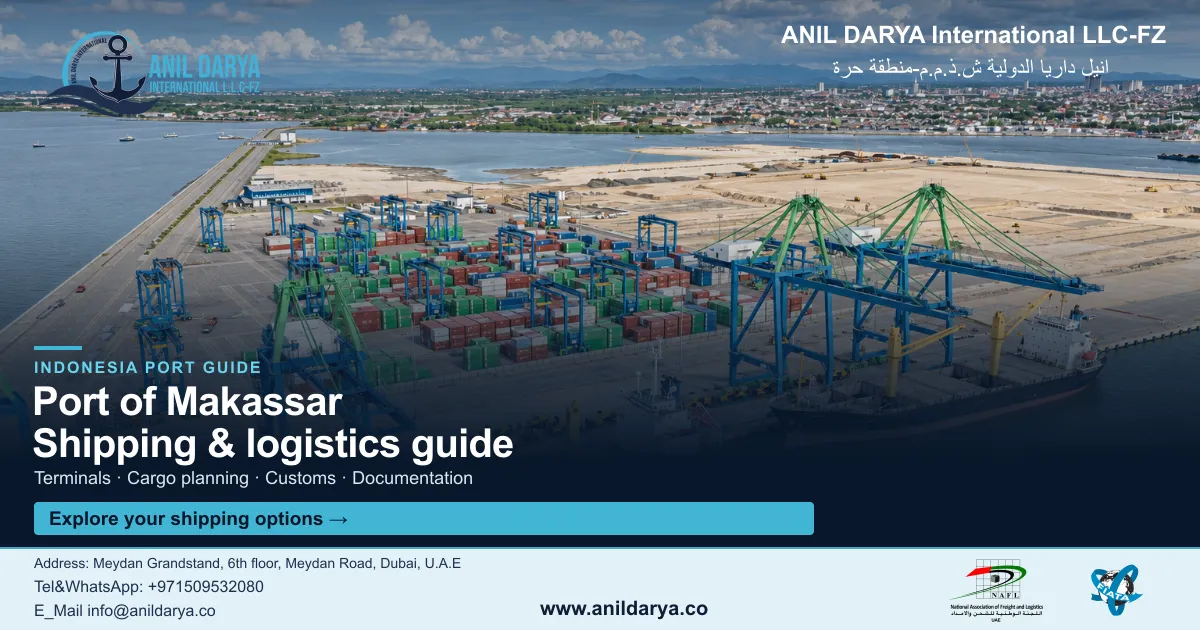
Port of Makassar shipping means shipping through the main gateway of eastern Indonesia, on the south-west coast of Sulawesi. Containers from the UAE now land at one of two Pelindo terminals: the old Soekarno-Hatta container terminal in the city, or Makassar New Port, a deep-water terminal with -16 m LWS at the berth that opened in phases from 2018. This guide covers the two terminals, depths, cargo types and local customs points, then the steps for shipping from Dubai to Makassar and for shipping from Makassar to Dubai.
Port of Makassar at a glance
| Item | Detail |
|---|---|
| Official names | Pelabuhan Soekarno-Hatta (old port) and Makassar New Port (MNP) |
| UN/LOCODE | IDMAK |
| Location | Makassar, capital of South Sulawesi |
| Port class | Primary port (Pelabuhan Kelas Utama), with Tanjung Priok, Tanjung Perak and Belawan |
| Port operator | PT Pelabuhan Indonesia (Pelindo) |
| Container terminal operator | TPK New Makassar, part of PT Pelindo Terminal Petikemas |
| Container volume 2024 | 743,321 TEU, up about 3.5% on 2023 (717,883 TEU) |
| Terminal 1 (TPM, Soekarno-Hatta) | Capacity 700,000 TEU a year; about 55% of Makassar's containers in 2025 |
| Terminal 2 (Makassar New Port) | Capacity 2.5 million TEU a year; about 45% of containers in 2025 |
| MNP depth | -16 m LWS |
| MNP quay (phases 1A to 1C) | 1,280 m on 52 hectares |
| MNP equipment | 6 quay container cranes, 16 RTGs, 392 reefer plugs |
| Move to MNP | All container work at TPM planned to move to MNP by 2027 |
| Import VAT | Effective 11% for most goods, 12% for luxury goods |
| Trade agreement with the UAE | UAE-Indonesia CEPA, in force since 1 September 2023 |
Where is the Port of Makassar and why does it matter?
Makassar sits on the south-west coast of Sulawesi, facing the Makassar Strait. The port is the largest cargo hub in Sulawesi, and the government classes it as a primary port, the same tier as Tanjung Priok in Jakarta, Tanjung Perak in Surabaya and Belawan in Medan.
For a shipper in the UAE, Makassar is the door to eastern Indonesia. Cargo for South Sulawesi, and much of the trade feeding smaller ports further east, passes through it. Before Makassar New Port opened, exports such as cocoa, coffee and processed wood often went out through Surabaya or Jakarta first. Pelindo built the new terminal to change that and make Makassar a hub in its own right.
In April 2025 ANTARA reported that the government was drafting a policy to make Makassar an export hub alongside Tanjung Priok and Surabaya. Treat that as a plan, not a service you can book.
Soekarno-Hatta or Makassar New Port: which terminal handles your container?
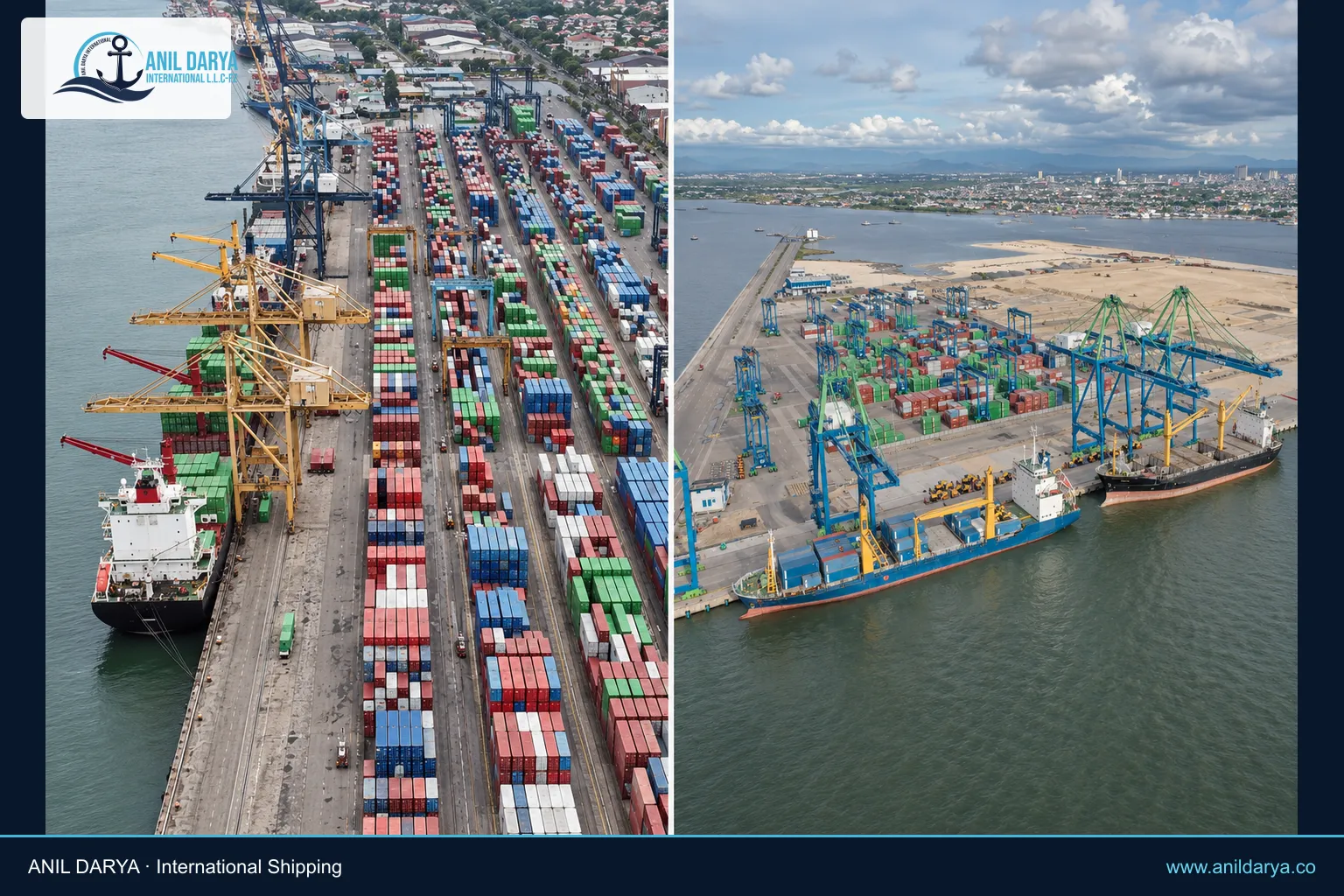
Since 2019, Makassar has run container work at two sites under one operator, TPK New Makassar. Your arrival notice and the carrier's berth plan tell you which one your box will use. This matters for trucking, for the customs inspection area and for the time it takes to collect the box.
| Point | Terminal 1: TPM (Soekarno-Hatta) | Terminal 2: Makassar New Port |
|---|---|---|
| Location | Old port area in Makassar city | Separate new terminal site |
| Capacity | 700,000 TEU a year | 2.5 million TEU a year |
| Share of containers (2025) | About 55% | About 45% |
| Depth | Container berths about 10 m to 12 m (directory estimate) | -16 m LWS |
| Ship size | Hatta Quay listed for ships up to 220 m LOA and 12 m draft | Ships over 3,000 TEU; post-panamax cranes |
| Future | Container work to move out by 2027 | Main container terminal for Makassar |
Makassar New Port in figures
President Joko Widodo opened Makassar New Port on 22 February 2024, after phases 1A, 1B and 1C were finished. Phase 1A had been working since November 2018. Pelindo's own figures for the terminal are below.
| MNP item | Figure |
|---|---|
| Quay length, phases 1A to 1C | 1,280 m |
| Land area | 52 hectares |
| Depth at the berth | -16 m LWS |
| Capacity | 2.5 million TEU a year, up from 750,000 TEU before phases 1B and 1C |
| Quay container cranes | 6, of which 2 post-panamax |
| Rubber-tyred gantries | 16 |
| Reach stackers and terminal tractors | 2 and 15 |
| Reefer plugs | 392 |
| Investment | Rp5.4 trillion so far, rising in stages to Rp10 trillion with phase 1D |
Some reports give the MNP quay as 1,600 m. Pelindo's own release for the opening states 1,280 m for the three finished phases, so we use that figure.
The terminal has run the TOS Nusantara system since 9 December 2023, and Kontan reported crane productivity up from 20 to 34 boxes per ship per hour.
The move from TPM to Makassar New Port
The old Soekarno-Hatta terminal is close to its limit, so Pelindo Terminal Petikemas plans to move all container work from TPM to MNP by 2027. The move is gradual. In May 2025 Okezone reported that four more RTGs were planned for MNP and that a customs inspection area (longroom) was being prepared there. Carriers such as SITC said they would shift once those facilities are ready.
For you, this means the terminal named on the arrival notice can change from one shipment to the next until 2027. Check it every time and tell the consignee's trucker before the ship arrives.
How deep is the water at the Port of Makassar?
Depth figures for Makassar depend on which berth you look at. The new terminal is far deeper than the old general cargo piers.
| Source | Figure | What it covers |
|---|---|---|
| Pelindo | -16 m LWS | Makassar New Port berth |
| Cogoport port data | Channel 17.1 m to 18.2 m; anchorage 12.5 m to 13.7 m | Approach and anchorage |
| Cogoport port data | Cargo pier and oil terminal 7.1 m to 9.1 m | Older general piers |
| ShipNext | Hatta Quay: 220 m LOA, 12 m draft, 30,000 DWT | Old port quay |
| ShipNext | Pertamina oil wharf: 160 m LOA, 18,000 DWT | Fuel berth |
| MarineLink | Container berths about 10 m to 12 m; general cargo berths about 7 m to 9 m | Directory estimate |
Pilotage is compulsory, according to Cogoport. For containers the depth limit is rarely your problem, because the ships that call are regional vessels. For breakbulk on a chartered ship, check the loaded draft against the actual berth, since the old general piers are shallow.
How cargo from the UAE reaches Makassar
Makassar has some direct international calls, but most cargo from the Gulf reaches it through a hub. The Makassar customs office noted back in 2020 that the port had a direct call, and the government wants more. In June 2024 detikFinance reported that SITC was calling Makassar New Port weekly with one ship, while CMA CGM and Maersk had visited the terminal to study the cargo base but had not committed to a service.
Okezone reported in May 2025 that SITC handled about 350 boxes per weekly call, rising to about 500 in the seaweed export season. That gives you a sense of scale: this is a regional port with a few strong services, not a mainline hub.
Cogoport's lane data for Makassar shows inbound port pairs from Nhava Sheva and Mundra in India, which points to the same pattern of hub and feeder. Published transit times for Dubai to Makassar are not available from carriers' public pages. Fluent Cargo gives about 23 days 21 hours by container ship from Fujairah to Jakarta with two transfers, departing every one to two weeks. Treat that as a rough guide for western Indonesia only; Makassar adds a further leg.
[AMIR-FACT: the carriers and transhipment hub we normally use from Jebel Ali to Makassar, and our real port-to-port days on this lane]
What cargo can you ship through the Port of Makassar?
| Cargo type | Where it goes | What to plan |
|---|---|---|
| Dry containers (FCL) | TPM or MNP | Which terminal, hub connection, trucking |
| LCL | Unpacked at a container freight station | Release waits for the whole consolidation box |
| Reefer containers | MNP has 392 reefer plugs | Food permits and quarantine checks |
| Machinery and project cargo | Flat racks via the container terminal, or breakbulk at general berths | Berth depth, crane capacity, road route |
| Liquid bulk and fuel | Oil wharf | Receiving tanks and surveys |
| Dry bulk and general cargo | General cargo berths | Draft limits of 7 m to 9 m at older piers |
| Dangerous goods | Container terminal, by prior acceptance | Short yard stay, direct delivery for some classes |
FCL and LCL shipping to Makassar
FCL is the usual choice for commercial cargo from Dubai to Makassar. The sealed box goes from Jebel Ali to a hub, then on a regional service to Makassar, and the importer clears it under one declaration. Use 20ft boxes for dense cargo such as steel parts or bagged chemicals, and 40ft high cubes for light, bulky goods.
LCL to Makassar is possible but slower. The cargo travels in a consolidation box, often to Jakarta or Surabaya first, and then onward. The customs office in Makassar has long called for a local consolidator because small lots were being routed through Tanjung Priok or Tanjung Perak. If your cargo fills more than about half a 20ft box, price FCL first. Our guide to FCL vs LCL shipping sets out the trade-offs.
| Point | FCL to Makassar | LCL to Makassar |
|---|---|---|
| Routing | Jebel Ali, hub, then a regional service | Often via a Java port, then onward |
| Who clears | Importer or its PPJK broker, one PIB | Importer, after the box is unpacked |
| Best for | Factory inputs, building materials, regular trade | Samples, spare parts, first orders |
| Main risk | Missed connection at the hub | Delay if a co-loaded shipment is held |
We book space with carriers that serve Makassar through our sea freight service and confirm the hub, the final carrier and the discharge terminal before you commit.
Dwell times and delays at Makassar
Containers can sit for a long time at Makassar, mostly because of clearance and collection rather than the quay. Cogoport's monthly data shows import dwell of 15.5 days in August 2025, 8.3 days in September, 12.0 days in October and 6.0 days in January 2026. Export dwell was 4.0 days in July and August 2025 and 13.0 days in December 2025.
How to keep your box moving:
- Have the import declaration ready before the ship arrives, so release does not wait on paperwork.
- Confirm the discharge terminal, TPM or MNP, and tell the trucker in advance.
- Book collection for the day of release, especially for reefers and DG.
Breakbulk and project cargo to Makassar
Heavy pieces for South Sulawesi, such as plant equipment, generators or industrial machinery, reach Makassar either on flat racks through the container terminal or as breakbulk. The old port lists mobile and floating cranes and lift capacity in the 25 to 49 tonne range, according to Cogoport, so anything heavier usually needs ship's gear or a hired crane.
Before you ship a heavy or oversized piece to Makassar, check:
- The loaded draft against the berth, since older general piers have only 7 m to 9 m.
- Who discharges the piece: ship's gear, a mobile crane or a floating crane.
- Weight, dimensions, centre of gravity and lifting points for each item.
- The road route to site. A 3.21 km toll road links Makassar New Port to the old port and to Sultan Hasanuddin Airport.
- Import permits for used machinery or capital goods before the ship sails.
See our break bulk and project cargo service, and our guide to flat rack, open top and breakbulk options for cargo too big for a standard box.
Dangerous goods to Makassar
DG cargo to Makassar must be packed, marked and declared under the IMDG Code, and both the carrier and the terminal must accept it before loading. The hub port must accept it too, since most boxes change ship on the way.
Indonesian container terminals keep DG yard time short. At NPCT1 in Jakarta, for example, Class 1 and Class 7 go straight to a truck, Classes 2.1, 2.3, 5.1, 5.2 and 6.1 may stay up to 24 hours, and Classes 2.2, 3, 4, 5, 6.2, 8 and 9 up to 72 hours on import, counted from berthing. Boxes that overstay are moved to an outside depot at the cargo owner's cost. TPK New Makassar sets its own limits, so get the window for your class from the carrier before you ship.
Our dangerous goods shipping team prepares the DG declaration, checks the SDS and gets carrier approval from the UAE.
Customs at the Port of Makassar: the short version
Customs at Makassar follows the same national rules as every Indonesian port, run by the Directorate General of Customs and Excise (DJBC) through its Makassar office. Our Tanjung Priok guide covers the full process. Here is what matters for Makassar.
- The importer, or a licensed customs broker (PPJK), lodges the import declaration (PIB) through the DJBC system.
- Restricted goods need the right permit on the PIB before release.
- Duty, excise and import taxes are paid, or guaranteed, before the release note (SPPB) is issued.
- Import VAT is an effective 11% for most goods and 12% for luxury goods, under PMK 131/2024 from 1 January 2025.
- The UAE-Indonesia CEPA has been in force since 1 September 2023 and covers more than 90% of tariff lines and 94% of trade value. A valid certificate of origin is needed to claim the rate.
One point is specific to Makassar: until the customs longroom at MNP is fully running, physical inspections may still take place at the old port. Ask the importer's broker where an inspection would happen before you plan trucking.

| Document | Why it matters at Makassar |
|---|---|
| Commercial invoice and packing list | Value and HS codes for the PIB; must match each other |
| Bill of lading | Must match the manifest and the importer's registered name |
| CEPA certificate of origin | Preferential duty for qualifying UAE-origin goods |
| Import permit | Needed for restricted goods before release |
| DG declaration and SDS | Carrier, hub and terminal acceptance |
| Delivery order | From the carrier's agent, to collect the box from TPM or MNP |
In the UAE we handle export clearance. In Makassar, the importer or its broker clears the cargo, and we work with them so the documents match before arrival.
How to ship from Dubai to the Port of Makassar, step by step
- Agree the Incoterm and who pays terminal charges at Makassar. Our guide to Incoterms 2020 for sea freight explains the split.
- Check that the Indonesian importer is registered and holds any permit your goods need.
- Send us the HS code, weight, volume and cargo type. We book a service from Jebel Ali with a hub and a final carrier that reach Makassar.
- We truck the cargo to the UAE port, file the export declaration and submit the VGM. Our Jebel Ali port guide covers the export side.
- Your shipper issues the invoice, packing list and, if the goods qualify, the CEPA certificate of origin.
- We send the draft bill of lading for checking. The consignee name must match the importer's registration.
- The box sails to the hub, transfers and is discharged at TPM or MNP.
- The importer or its PPJK lodges the PIB, pays duty and taxes and receives the SPPB.
- The importer's trucker collects the box within free time and returns the empty.
How to ship from Makassar to Dubai
We also handle the import direction, shipping from Makassar to Dubai and other UAE ports. South Sulawesi exports farm and forest goods: Kontan names cocoa, coffee and processed wood, and Okezone notes that seaweed exports drive peak volumes on SITC's Makassar call. Makassar New Port was built so these goods could leave from Makassar rather than going first to Surabaya or Jakarta.
- Agree the Incoterm with your Indonesian supplier. On FOB, the supplier delivers to the terminal and you control the ocean freight.
- Send us the supplier's details, the HS code, weight and volume. We book space with a carrier serving Makassar, with a hub connection to Jebel Ali, Khalifa Port or Sharjah.
- The supplier or its agent in Makassar arranges pickup, packing and the Indonesian export declaration (PEB). We do not have an office in Indonesia; we work with the supplier's forwarder or a local agent they appoint.
- For small lots, ask whether a consolidator in Makassar can take the cargo, since the customs office has pushed for local consolidation instead of routing through Java.
- We check the draft bill of lading, invoice, packing list and certificate of origin before the ship sails.
- On arrival we clear the cargo with UAE customs. Dubai Customs asks for the invoice, packing list, certificate of origin and any permit from a controlling authority.
- We deliver to your warehouse in the UAE, or move the cargo into a free zone.
Indonesian-origin goods may also qualify for preferential rates under the UAE-Indonesia CEPA, so ask your supplier for the CEPA certificate of origin.
See our Khalifa Port guide if your cargo is for Abu Dhabi.
Makassar, Surabaya or Jakarta: which port should you choose?
| Your consignee is in | Port to price first | Reason |
|---|---|---|
| South Sulawesi and nearby islands | Makassar | Local customs office, short truck leg |
| East Java | Surabaya | More services, inter-island hub |
| Jakarta and western Java | Tanjung Priok | Main import port, most direct calls |
Checklist before you ship to Makassar
- Importer registration and any import permit confirmed.
- HS code agreed between shipper and importer.
- CEPA certificate of origin arranged if the goods qualify.
- Invoice, packing list and bill of lading match on names, weights and values.
- Hub, final carrier, discharge terminal and free time confirmed.
- Trucker told whether the box lands at TPM or MNP.
- DG documents and acceptance from carrier, hub and terminal.
- Vessel draft checked against the berth for any breakbulk shipment.
Common mistakes
- Assuming every box lands at Makassar New Port while the move from TPM is still under way.
- Booking LCL for a large shipment and losing time in consolidation at a Java port.
- Consignee name on the bill of lading differing from the importer's registered name.
- Shipping restricted goods before the permit is issued.
- Forgetting the CEPA certificate and paying full duty on qualifying goods.
Frequently asked questions
Is the Port of Makassar the same as Soekarno-Hatta port?
Yes. Pelabuhan Soekarno-Hatta is the name of Makassar's old seaport. Makassar New Port is the newer container terminal, and both run under Pelindo, with containers handled by TPK New Makassar.
What is the port code for Makassar?
The UN/LOCODE for Makassar is IDMAK. You will see it on bookings, bills of lading and tracking systems.
How deep is the water at Makassar New Port?
Pelindo gives a depth of -16 m LWS at the Makassar New Port berth. That lets ships of more than 3,000 TEU berth directly, which the old terminal cannot match.
When will all containers move to Makassar New Port?
Pelindo Terminal Petikemas plans to move all container work from the old TPM terminal to Makassar New Port by 2027. Until then, check which terminal is named on each arrival notice.
Is there a direct sailing from Dubai to Makassar?
Expect a transhipment. The services calling Makassar are mostly regional, so cargo from the UAE usually changes ship at a hub before the final leg.
Can you ship from Makassar to Dubai?
Yes. We book space with carriers calling Makassar, the supplier or its local agent handles pickup and the Indonesian export declaration, and we clear and deliver the cargo in the UAE. Most cargo changes ship at a hub on the way.
Can I ship dangerous goods to Makassar?
Yes, with acceptance from the carrier, the hub port and the terminal. Indonesian terminals allow short DG yard times, and some classes must go straight to a truck, so the importer must be ready to collect on arrival.
Does the UAE-Indonesia CEPA lower duty on cargo to Makassar?
For qualifying UAE-origin goods, yes. The CEPA has been in force since 1 September 2023 and covers more than 90% of tariff lines. You need a valid certificate of origin to claim the rate.
Get a quote for Port of Makassar shipping
Send us your cargo details and we will come back with a routing and a price for shipping from Dubai to Makassar. Use our freight rate inquiry form, or contact our team to talk through a DG or project shipment first.
Sources
- Pelindo: Makassar New Port opening release, 23 February 2024 (quay, area, depth, capacity, equipment, investment)
- Okezone: Pelindo targets move of TPM to Makassar New Port by 2027, 7 May 2025 (volumes, shares, capacities, SITC)
- Kontan: Pelindo pushes cargo flow at Makassar New Port, 8 January 2024 (phases, productivity, TOS, toll road)
- detikFinance: Makassar New Port draws global shipping lines, 26 June 2024
- ANTARA: Indonesia to develop Makassar Port as new export hub, 30 April 2025
- Wikipedia: Port of Makassar (names, LOCODE, port class)
- Cogoport: Port of Makassar (depths, pilotage, lifts, dwell times, weekly volumes, lanes)
- ShipNext: Makassar port data (quays, draft, facilities)
- MarineLink: Makassar port directory (berth depths, terminals)
- DDTCNews: Makassar customs office export support and consolidator proposal, 4 June 2020
- Fluent Cargo: UAE to Indonesia routes (published transit indication)
- NPCT1: Dangerous goods handling (Indonesian DG storage periods example)
- Directorate General of Taxes: PMK 131/2024 VAT rates
- Dubai Customs: Import declaration documents
- UAE Ministry of Foreign Trade: UAE-Indonesia CEPA
Reviewed: 10 November 2026