
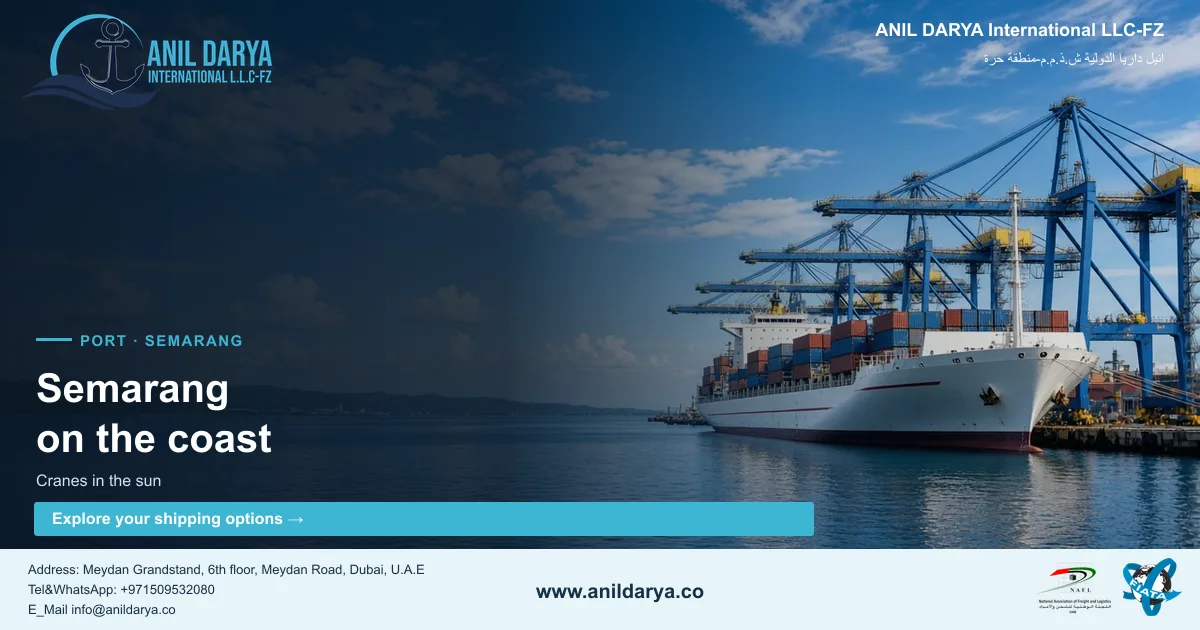
Port of Semarang shipping means shipping through Tanjung Emas, the main seaport of Central Java on the north coast of the island. Containers from the UAE land at TPK Semarang (TPKS), Pelindo's container terminal, which handled 895,904 TEU in 2024 and now runs 10 quay cranes. This guide covers the terminals, berth depths, cargo rules, congestion risks, local customs and the steps to ship from Dubai. We ship both from Dubai to Semarang and from Semarang to Dubai.
Port of Semarang at a glance
| Item | Detail |
|---|---|
| Official name | Pelabuhan Tanjung Emas (Port of Tanjung Emas), Semarang |
| UN/LOCODE | IDSRG |
| Port operator | PT Pelabuhan Indonesia (Pelindo) |
| Container terminal | TPK Semarang (TPKS), run by Pelindo's container subholding, PT Pelindo Terminal Petikemas |
| Location | North coast of Central Java, about 4.6 km from Semarang city |
| Container volume 2024 | 895,904 TEU, up 15% on 2023 (781,841 TEU) |
| International share 2024 | 766,914 TEU foreign trade, 128,990 TEU domestic |
| Quay cranes at TPKS | 10, after four post-panamax cranes arrived in March 2026 |
| Approach channel | -15 m LWS, 800 m long, up to 100 m wide |
| Samudera (ocean) pier | 575 m, -11 m LWS |
| Nusantara pier | 320 m, -8 m to -10 m LWS |
| Volume target | 1.2 million TEU by 2029 |
| Import VAT | Effective 11% for most goods, 12% for luxury goods (since 1 January 2025) |
| Trade agreement with the UAE | UAE-Indonesia CEPA, in force since 1 September 2023 |
| Semarang to Dubai | Also handled: PEB filed by the shipper or its PPJK, UAE clearance at Jebel Ali, Khalifa Port or Sharjah by us |
Where is the Port of Semarang and what does it serve?
Tanjung Emas lies on the north coast of Java at Semarang, the capital of Central Java. The Ministry of Tourism's port profile puts it 4.6 km from the city. It is the main seaport for Central Java, so most containers for factories in the province come through it rather than through Jakarta or Surabaya.
The port is old. The Dutch colonial government built it in the 19th century to export sugar and farm produce. The first dredging took place in 1868, a new harbour canal opened in 1872, and the Willem 3 lighthouse has worked since 1884. Pelindo has run the port since 1985.
Today the hinterland is manufacturing. Pelindo names three industrial estates driving growth: Kawasan Industri Terpadu Batang, Kendal Industrial Park and Jatengland. ANTARA reports that furniture and shoes lead TPKS exports, with 2024 export growth of 14% to Taiwan, 26% to America, 21% to Germany and 15% to China.
That export pull matters for importers from the UAE. TPKS moved 385,224 TEU of exports and 381,689 TEU of imports in 2024, almost an even split. Balanced trade means carriers have a reason to bring boxes in, which helps equipment supply on the lane.
Which terminals handle your cargo at Tanjung Emas?
Tanjung Emas is a set of terminals inside one port. The berth on your arrival notice decides where the truck goes.
| Terminal or berth | Operator | Cargo |
|---|---|---|
| TPK Semarang (TPKS) | PT Pelindo Terminal Petikemas | International and domestic containers, reefers |
| Samudera (ocean) pier | Pelindo | Non-container cargo; a 150 m section planned for containers |
| Nusantara pier | Pelindo | Domestic and inter-island cargo |
| Liquid bulk and general cargo berths | Pelindo | Liquid bulk, LPG, general cargo, breakbulk, Ro-Ro |
| Passenger terminal | Pelindo | Ferries and cruise calls |
TPKS, the container terminal
TPKS has grown fast: 717,062 TEU in 2020, 781,841 TEU in 2023 and 895,904 TEU in 2024. Shipping lines asked for at least 12 extra services in early 2025, which Kontan put at about 200,000 TEU a year of potential volume.
To keep up, Pelindo brought in four post-panamax quay container cranes, which arrived on 14 March 2026. That lifts the TPKS total to 10 cranes. Pelindo says each has about 60 m of outreach, reaching more than 16 container rows across a ship, and can lift about 65 tonnes under the spreader. The cranes must be installed and commissioned before full use, so allow for a settling-in period through 2026.
| TPKS item | Figure |
|---|---|
| 2020 volume | 717,062 TEU |
| 2023 volume | 781,841 TEU |
| 2024 volume | 895,904 TEU |
| 2024 exports / imports | 385,224 TEU / 381,689 TEU |
| Quay cranes after March 2026 | 10 |
| New crane outreach and lift | About 60 m and about 65 tonnes |
| Target | 1.2 million TEU by 2029 |
The ocean wharf and its new container role
Pelindo planned to open a 150 m section of the ocean wharf to container ships in 2025, worked by two harbour mobile cranes. Before that, the ocean wharf was used for non-container cargo. Pelindo is also raising the wharf and the container yard to head off congestion at the berth and in the yard.
How deep is the Port of Semarang, and which ships fit?
Published depth figures for Tanjung Emas vary, because each source measures a different berth. The official tourism port profile gives the channel and two main piers; the rest come from directories.
| Source | Figure | What it covers |
|---|---|---|
| Ministry of Tourism port profile | Channel -15 m LWS, 800 m long, 100 m wide | Approach channel |
| Ministry of Tourism port profile | Samudera pier 575 m, -11 m LWS; Nusantara pier 320 m, -8 m to -10 m LWS | Main general piers |
| Ministry of Tourism port profile | Reserve berth, maximum LOA 300 m | Longest ship listed |
| FreightAmigo | Maximum draft 10.8 m and length 265 m in 2024 | Container vessels in practice |
| MarineLink | Container terminal draught about 10 m to 12 m | Directory estimate |
For planning, assume regional container ships with a draft of about 10 m to 11 m. Mainline ships from the Gulf do not call. For breakbulk or bulk, check the loaded draft against the berth named on the fixture, not against the channel depth.
How cargo from the UAE reaches Semarang
Semarang's container trade is mostly intra-Asian. Cogoport's March 2026 capacity snapshot for the port shows CMA CGM with about 22% of the capacity calling, Wan Hai 20%, SITC 12%, Maersk 11%, Samudera 6%, Evergreen 3% and Cosco 2%, with others making up the rest. These are carriers with feeder and regional networks, which tells you how a box from Dubai usually arrives: a mainline ship to a hub, then a regional service into Semarang.
Published transit times for Semarang are scarce. Fluent Cargo's country-level data gives about 23 days 21 hours by container ship from Fujairah to Jakarta, with departures every one to two weeks. Treat that as a rough guide for Java, not a Semarang schedule. Ask which hub the carrier uses and how often its feeder sails to Semarang before you book.
[AMIR-FACT: the carriers and hub we normally use from Jebel Ali to Semarang, and our real port-to-port days on this lane]
What cargo can you ship through the Port of Semarang?
| Cargo type | Where it goes | What to plan |
|---|---|---|
| Dry containers (FCL) | TPKS | Hub and feeder connection, terminal booking slot |
| LCL | Unpacked at a container freight station | Release can wait on co-loaded cargo |
| Reefer containers | TPKS reefer points | Food import permits and quarantine |
| Factory inputs and machinery parts | TPKS, mostly FCL | Import permits for restricted inputs |
| Liquid bulk and LPG | Liquid bulk berths | Receiving tanks, surveys |
| Breakbulk and project cargo | Samudera pier and general berths | Draft, crane capacity, road route |
| Dangerous goods | TPKS, by prior acceptance | Short yard stay, permits |
FCL and LCL shipping options for Semarang
FCL is the default for commercial cargo from Dubai to Semarang. The sealed box goes from Jebel Ali via a hub to the TPKS yard, and the importer clears it under one declaration. Use 20ft boxes for heavy, dense cargo and 40ft high cubes for light, bulky goods.
LCL to Semarang works, but it passes through more hands: a consolidation box to a hub, a feeder and unpacking at a container freight station. If your cargo fills more than about half a 20ft box, price FCL first. Our guide to FCL vs LCL shipping sets out the trade-offs.
| Point | FCL to Semarang | LCL to Semarang |
|---|---|---|
| Who clears | Importer or its PPJK broker, one PIB | Importer, after the box is unpacked |
| Handling | Sealed from Jebel Ali to the TPKS yard | Packed, transhipped and unpacked with other cargo |
| Best for | Factory inputs, machinery, regular trade | Samples, spare parts, small first orders |
| Main risk | Missed feeder at the hub | Delay if one co-loaded shipment is held |
We book space with carriers that serve Semarang through our sea freight service and confirm the hub and the feeder before you commit.
Congestion at Tanjung Emas: what happened and how to avoid delays
Semarang can clog quickly. Kuehne+Nagel reported a surge in cargo at the end of December 2025: import flows jumped, road restrictions over the year-end holidays slowed clearance, and a backlog carried into the new year. Yard occupancy rose, feeders ran late, and nine vessels were waiting at anchorage, some since 17 January 2026.
The terminal responded with extra yard space for empties, and it stopped taking containers before opening hours or accepting early stacking. Its Terminal Booking System was at full capacity, and Kuehne+Nagel noted that traffic jams or flooding on the roads to the port could still cause setbacks.
How to protect your shipment:
- Avoid arrivals in the last two weeks of December and the first weeks of January if you can.
- Have the truck company generate terminal booking barcodes in advance.
- Clear customs before the box is discharged, so the truck can collect at once.
- Ask the carrier for extra free time on peak-season bookings.
- Allow time for road delays, since traffic and flooding on the access roads are known risks.
Cogoport's monthly data shows import dwell at Semarang between 2.4 and 4.5 days from September 2025 to February 2026, and export dwell between 3.6 and 5.0 days. The longest import dwell fell in January 2026, at the height of the backlog.
Breakbulk, project and bulk cargo at Semarang
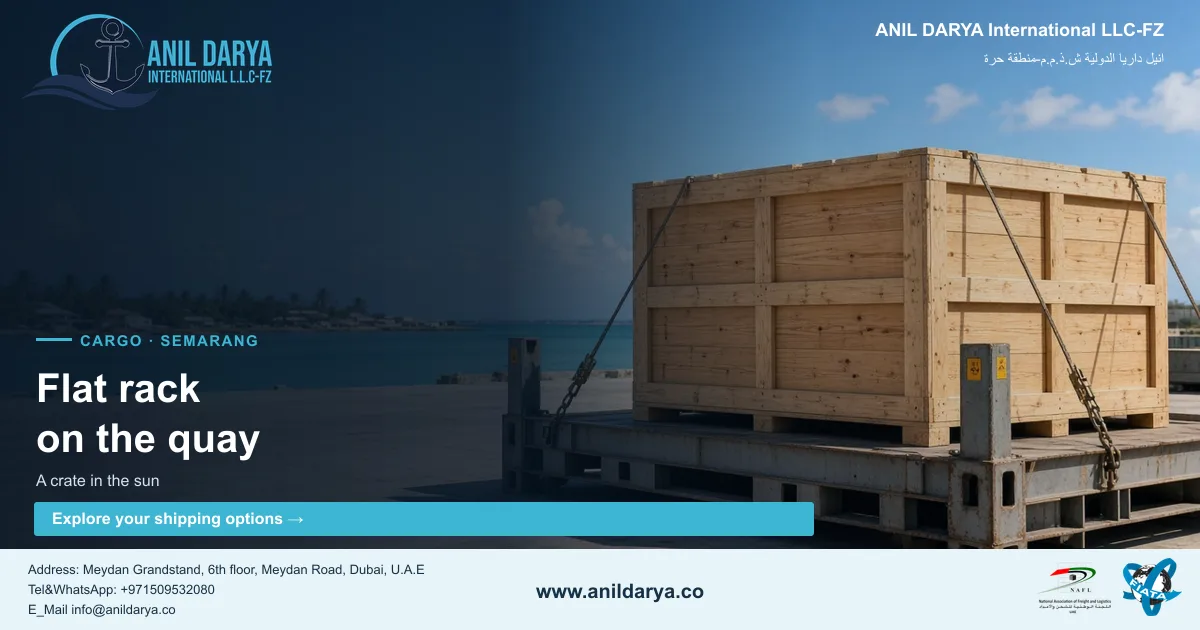
Most of Semarang's trade is containerised, but the port also takes general cargo, breakbulk, liquid bulk, LPG and Ro-Ro, according to iContainers. Heavy or oversized pieces for Central Java's factories, such as production lines or plant equipment, usually come in on flat racks through TPKS or as breakbulk to the Samudera pier.
Before you ship a heavy or oversized piece to Semarang, check:
- The loaded draft of the vessel against the -11 m LWS depth at the Samudera pier.
- Whether ship's gear, a mobile harbour crane or a hired crane will discharge the piece.
- Weight, dimensions and lifting points for each item.
- The road route from the port to Kendal, Batang or the factory site, including city traffic.
- Import permits for used machinery or capital goods before the vessel sails.
See our break bulk and project cargo service for heavy pieces, and our guide to flat rack, open top and breakbulk options for cargo that is too big for a standard box.
Dangerous goods to Semarang
DG cargo to Semarang must be packed, marked and declared under the IMDG Code, and the carrier and terminal must accept it before loading. Indonesian container terminals keep DG yard time short. At NPCT1 in Jakarta, for example, Class 1 and Class 7 must go direct to truck, Classes 2.1, 2.3, 5.1, 5.2 and 6.1 may stay up to 24 hours, and Classes 2.2, 3, 4, 5, 6.2, 8 and 9 up to 72 hours on import, counted from vessel berthing. Boxes that overstay are moved to an outside depot at the cargo owner's cost.
TPKS sets its own limits, so get the window for your class from the carrier before you ship. With the booking system and the congestion risk at Semarang, the importer must have a truck and a slot ready for the day of discharge. Our dangerous goods shipping team prepares the DG declaration, checks the SDS and gets carrier approval from the UAE.
Customs at Tanjung Emas: the short version
Customs at Semarang follows the same national rules as every Indonesian port, run by the Directorate General of Customs and Excise (DJBC). Our Tanjung Priok guide covers the full process. Here is what matters for Semarang.
- The importer, or a licensed customs broker (PPJK), lodges the import declaration (PIB) through the DJBC system.
- Restricted goods (lartas) need the right permit on the PIB before release.
- The importer pays duty, excise and import taxes, or lodges a guarantee.
- On the green lane, DJBC's service standard is a release note (SPPB) within 15 minutes of PIB registration.
- Import VAT is an effective 11% for most goods and 12% for luxury goods, under PMK 131/2024 from 1 January 2025.
- The UAE-Indonesia CEPA has been in force since 1 September 2023 and covers more than 90% of tariff lines and 94% of trade value. A valid certificate of origin is needed to claim the rate.
| Document | Why it matters at Semarang |
|---|---|
| Commercial invoice and packing list | Value and HS codes for the PIB; must match each other |
| Bill of lading | Must match the manifest and the importer's registered name |
| CEPA certificate of origin | Preferential duty for qualifying UAE-origin goods |
| Import permit | Needed for restricted goods before release |
| DG declaration and SDS | Terminal acceptance and yard time planning |
| Delivery order | From the carrier's agent, to collect the box from TPKS |
In the UAE we handle export clearance. In Semarang, the importer or its broker clears the cargo, and we work with them so the documents match before arrival.
How to ship from Dubai to the Port of Semarang, step by step
- Agree the Incoterm and who pays TPKS terminal and port charges. Our guide to Incoterms 2020 for sea freight explains the split.
- Check that the Indonesian importer is registered and holds any permit your goods need.
- Send us the HS code, weight, volume and cargo type. We book a service from Jebel Ali with a hub and a feeder that reach Semarang.
- We truck the cargo to the UAE port, file the export declaration and submit the VGM. Our Jebel Ali port guide covers the export side.
- Your shipper issues the invoice, packing list and, if the goods qualify, the CEPA certificate of origin.
- We send the draft bill of lading for checking. The consignee name must match the importer's registration.
- The box sails to the hub, transfers to the feeder and is discharged at TPKS.
- The importer or its PPJK lodges the PIB, pays duty and taxes and receives the SPPB.
- The importer's trucker books a terminal slot, collects the box within free time and returns the empty.
How to ship from the Port of Semarang to Dubai
We also handle the other direction: shipping from Semarang to Dubai, with arrival at Jebel Ali, Khalifa Port or Sharjah port. We book the space with the carrier and run the UAE side. The export papers at origin stay with the shipper or its Indonesian customs broker (PPJK).
The Indonesian export side
- The export declaration is the PEB (Pemberitahuan Ekspor Barang). The exporter or its PPJK signs it and files it with Bea Cukai at the customs office of loading, here Tanjung Emas.
- What it carries. The PEB shows the invoice, the HS code, the FOB value, the container numbers and any export licence. Where export duty applies, it is calculated on the PEB and the payment proof is attached.
- Corrections. Bea Cukai runs a formal service to correct PEB data within set time limits, and some fields, such as the exporter's name and identity, cannot be corrected at all. Check the PEB against the invoice and packing list before it is filed.
- Pickup. The shipper or its trucker delivers the box to TPKS inside the carrier's receiving window and cut-off.
The UAE import side
On arrival, the declaration goes to Dubai Customs with the commercial invoice, packing list, certificate of origin and any permit for restricted goods. The bill of lading is what the line needs before it issues the delivery order. Customs duty in Dubai is 5% of the CIF value for most goods, with 50% on alcohol and 100% on cigarettes. Import VAT is 5% of the customs value, which includes freight and insurance. A VAT-registered importer whose customs number is linked with the Federal Tax Authority accounts for that VAT on its VAT return instead of paying it at release.
- Send us the shipper's details in Central Java, the cargo, the HS code and the UAE delivery address.
- We book space on a feeder from TPKS and the main-line ship from the hub, and send the cut-offs to the shipper.
- The shipper or its trucker delivers the box to TPKS before the cut-off.
- The shipper or its PPJK files the PEB with Bea Cukai.
- We check the draft bill of lading against the invoice and packing list before the carrier issues it.
- We file the Dubai Customs declaration before the ship arrives.
- We arrange payment of the duty and VAT, or the VAT deferral if you are VAT-registered, and collect the delivery order from the line.
- We truck the cargo to your site in the UAE and return the empty inside free time.
[AMIR-FACT: the carriers and hub we actually use from Semarang to Jebel Ali, Khalifa Port or Sharjah, and our real port-to-port transit days in this direction]
Semarang, Jakarta or Surabaya: which port should you choose?
| Your consignee is in | Port to price first | Reason |
|---|---|---|
| Semarang, Kendal, Batang and the rest of Central Java | Semarang | Short truck leg, local customs office |
| Jakarta and western Java | Tanjung Priok | Main import port, more services |
| East Java and the eastern islands | Surabaya | Inter-island hub for the east |
Do not send Central Java cargo to Jakarta and truck it east to save on ocean freight. The extra trucking along Java's north coast and the second set of handling charges usually cost more than the feeder into Semarang.
What drives the cost of shipping to Semarang?
- Ocean freight to the hub and the feeder into Semarang.
- Number of transhipments and how often the feeder sails.
- Terminal handling at TPKS, usually for the consignee's account.
- DG, reefer or out-of-gauge surcharges.
- Duty, VAT and income tax, which depend on the HS code, CEPA eligibility and the importer's status.
- Storage, demurrage and detention if clearance or trucking is slow.
- Peak-season congestion at the turn of the year.
We do not publish fixed rates because they change with each sailing. Our article on demurrage and detention explains how delay charges build up.
Checklist before you ship to Semarang
- Importer registration and any import permit confirmed.
- HS code agreed between shipper and importer.
- CEPA certificate of origin arranged if the goods qualify.
- Invoice, packing list and bill of lading match on names, weights and values.
- Hub, feeder and free time confirmed with the carrier.
- Trucker ready with terminal booking barcodes before discharge.
- DG documents, carrier approval and yard time for hazardous cargo.
- Vessel draft checked against the berth for any breakbulk shipment.
Common mistakes
- Routing Central Java cargo through Jakarta and paying for a long truck leg.
- Planning an arrival in late December without extra free time.
- Leaving the terminal booking until the box is on the quay.
- Not asking which hub the carrier uses, then losing a week on a missed feeder.
- Consignee name on the bill of lading differing from the importer's registered name.
- Shipping restricted goods before the permit is issued.
- Forgetting the CEPA certificate and paying full duty on qualifying goods.
Frequently asked questions
Is the Port of Semarang the same as Tanjung Emas?
Yes. Tanjung Emas is the name of Semarang's seaport, and the container terminal inside it is TPK Semarang (TPKS). You will see all three names on shipping documents.
What is the port code for Semarang?
The UN/LOCODE for Semarang is IDSRG. You will see it on bookings, bills of lading and tracking systems.
Who operates the port and its container terminal?
Pelindo operates the Port of Tanjung Emas. The container terminal, TPKS, is run by PT Pelindo Terminal Petikemas, Pelindo's container subholding.
How many containers does Semarang handle?
TPKS handled 895,904 TEU in 2024, up 15% on 2023. Pelindo's target is 1.2 million TEU by 2029, backed by four new quay cranes that arrived in March 2026.
How deep is the water at the Port of Semarang?
The official port profile gives an approach channel of -15 m LWS and a 575 m ocean pier at -11 m LWS. Container ships calling in practice draw about 10 m to 11 m.
Is there a direct sailing from Dubai to Semarang?
Expect a transhipment. The carriers calling Semarang run mostly regional and feeder services, so cargo from the UAE usually changes ship at a hub before the final leg.
Can you ship from Semarang to Dubai?
Yes. The shipper or its PPJK files the PEB export declaration with Bea Cukai. We book the feeder and main-line legs, clear the cargo with Dubai Customs and arrange payment of the 5% duty on most goods and the 5% import VAT.
Can I ship dangerous goods to Semarang?
Yes, with carrier and terminal approval. Indonesian terminals allow short DG yard times and some classes must go straight to a truck, so the importer must be ready to collect on arrival.
Does the UAE-Indonesia CEPA lower duty on cargo to Semarang?
For qualifying UAE-origin goods, yes. The CEPA has been in force since 1 September 2023 and covers more than 90% of tariff lines. You need a valid certificate of origin to claim the rate.
Get a quote for Port of Semarang shipping
Send us your cargo details and we will come back with a routing and a price for shipping from Dubai to Semarang. Use our freight rate inquiry form, or contact our team to talk through a DG or project shipment first.
Sources
- Pelindo: Four quay container cranes added at TPK Semarang (16 March 2026)
- Indonesia Travel (Ministry of Tourism): Port of Tanjung Emas technical information (channel, piers, LOA, distance)
- Kontan: Pelindo TPK adds equipment at TPK Semarang (volumes 2020 to 2024, new services), 24 February 2025
- ANTARA: Pelindo Terminal Petikemas adds capacity at TPK Semarang (2024 split, export goods, 2029 target), 20 February 2025
- Kuehne+Nagel: Semarang Port faces congestion and disrupted operations (January 2026)
- Wikipedia: Port of Tanjung Emas (history, operator)
- iContainers: Port of Semarang (LOCODE, terminal, cargo types)
- Cogoport: Port of Semarang (carrier capacity, dwell times)
- FreightAmigo: Port of Semarang guide 2026 (vessel draft and length)
- MarineLink: Semarang port directory (container terminal draught)
- Fluent Cargo: UAE to Indonesia routes (published transit indication)
- NPCT1: Dangerous goods handling (Indonesian DG storage periods example)
- DJBC service standard: import release on the green lane
- Directorate General of Taxes: PMK 131/2024 VAT rates
- UAE Ministry of Foreign Trade: UAE-Indonesia CEPA
- Bea Cukai: Service standard for PEB correction (KEP-233/BC/2024)
- Directorate General of Taxes: PEB (BC 3.0) export declaration form and fields
- Dubai Customs: Submit customs declaration (documents for import, export and re-export declarations)
- UAE Government portal: Customs duty (5% of CIF in Dubai, alcohol 50%, cigarettes 100%)
- Federal Tax Authority: VAT guide, section 3.5 (5% import VAT, customs value, deferral to the VAT return)
Reviewed: 10 November 2026