
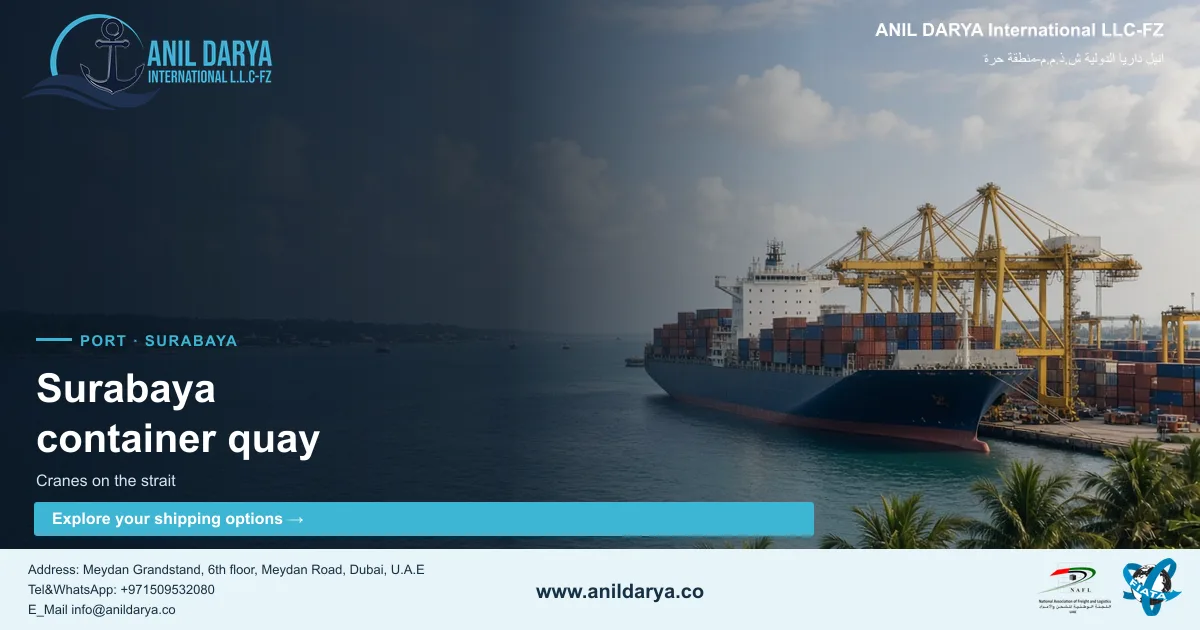
Port of Surabaya shipping means shipping through Tanjung Perak, Indonesia's second-busiest port and the main sea gateway for East Java and the islands to the east. Containers from the UAE land at Terminal Petikemas Surabaya (TPS) or the newer Terminal Teluk Lamong, while bulk, breakbulk and project cargo use the multipurpose quays. This guide covers the terminals, depth limits, cargo rules and the steps to ship from Dubai. We ship both ways: from Dubai to Surabaya, and from Surabaya to Dubai.
Port of Surabaya at a glance
| Item | Detail |
|---|---|
| Official name | Pelabuhan Tanjung Perak (Port of Tanjung Perak), Surabaya |
| UN/LOCODE | IDSUB |
| Owner and port operator | PT Pelabuhan Indonesia (Pelindo) |
| Location | North shore of East Java, on the Madura Strait |
| Main international container terminal | Terminal Petikemas Surabaya (TPS): 1,000 m international wharf, 450 m domestic wharf, 12 electric container cranes |
| Second container terminal | Terminal Teluk Lamong: 500 m international wharf, -14 m LWS, semi-automated, opened 2014 |
| Approach channel | About 43 km long, 13 m deep (LWS), at least 150 m wide; pilotage compulsory |
| Container throughput 2025 | 4.49 million TEU, up 4.4% on 2024 (Lloyd's List) |
| Cargo types | Containers, breakbulk, dry bulk, liquid bulk, gas, Ro-Ro, passengers |
| Customs office | KPPBC TMP Tanjung Perak (Directorate General of Customs and Excise, DJBC) |
| Import VAT | Effective 11% for most goods, 12% for luxury goods (since 1 January 2025) |
| Trade agreement with the UAE | UAE-Indonesia CEPA, in force since 1 September 2023 |
| Surabaya to Dubai | Indonesian export declaration (PEB) by the exporter or its customs broker before the box enters the port; Dubai duty 5% of CIF for most goods, plus 5% VAT |
Where is the port of Surabaya and what does it serve?
Tanjung Perak sits on the north coast of East Java, inside Surabaya city, facing the Madura Strait that separates Java from Madura island. Pelindo owns and runs the port. Wikipedia lists a harbour area of 1,029 ha and a land area of 545 ha.
The port has two jobs. It is the import and export gate for East Java's factories and consumers, and it is the hub for inter-island shipping to eastern Indonesia. DP World calls it "a key import gateway for East Java and the broader eastern island chain". That second role matters to you if your buyer is in Bali, Nusa Tenggara, Kalimantan or Sulawesi. Cargo for those islands often lands at Surabaya first and moves on by domestic feeder.
By road, the port links to the Surabaya-Gresik and Surabaya-Porong toll roads, which tie into the wider Java toll network. If your consignee is in Surabaya, Gresik or Sidoarjo, the inland leg is short.
A simple rule: if your consignee is east of Semarang, price Surabaya before you accept a Jakarta routing. A long truck run across Java often costs more than the sea freight difference.
Which terminals handle your cargo at Tanjung Perak?
Tanjung Perak is a group of terminals, not a single quay. The terminal on your bill of lading or arrival notice decides where your truck goes and which yard rules apply.
TPS, the main international container terminal
TPS is the main international container terminal, finished in 1992 and now part of Pelindo's container business. In the first nine months of 2025 it held 83% of the international container market at Tanjung Perak, so most boxes from the UAE end up here.
| TPS item | Figure |
|---|---|
| International wharf | 1,000 m |
| Domestic wharf | 450 m |
| Quay cranes | 12 electric container cranes (e-CC) |
| International volume, Jan-Sep 2025 | 1,115,827 TEU, up 0.66% year on year |
| Export and import split | 49% exports, 51% imports |
| Ship calls, Jan-Sep 2025 | 946, up 3.61% |
| Average crane productivity | 52 boxes per ship per hour (government minimum: 48) |
The near 50/50 split between exports and imports is useful to know. Empty equipment is usually available for East Java exporters, and import boxes do not pile up waiting for return cargo the way they do at some one-way ports.
Teluk Lamong, the semi-automated terminal
Terminal Teluk Lamong opened in 2014 as a semi-automated "green" terminal supporting the main port. At launch it had a 500 m by 80 m international wharf with 14 m of water at low water spring, five container cranes, ten automated stacking cranes, two ship unloaders and two conveyors for dry bulk. The first phase was designed for about 1.5 million TEU and 5 million tonnes of dry bulk a year.
The terminal lists services for reefer containers, dangerous goods containers, uncontainerised cargo, a weighbridge for verified gross mass (VGM), a container freight station, and warehousing and distribution. Some mainline and feeder services call here instead of TPS, so check the terminal on the arrival notice.
Multipurpose and conventional terminals
The older inner port has several named quays. iContainers lists Jamrud, Nilam, Mirah and Kalimas as cargo areas, and Teluk Lamong's own facilities page also lists Terminal Nilam (with a container crane, RTGs, reach stackers and a multipurpose yard) and Terminal Berlian. These handle conventional general cargo, bags, steel, project pieces and domestic containers.
| Your cargo | Terminal to expect | What to check |
|---|---|---|
| International FCL, dry or reefer | TPS, sometimes Teluk Lamong | Terminal named on the arrival notice |
| Dry bulk (grain, fertiliser, raw materials) | Teluk Lamong dry bulk berth or multipurpose quays | Discharge rate and draft on arrival |
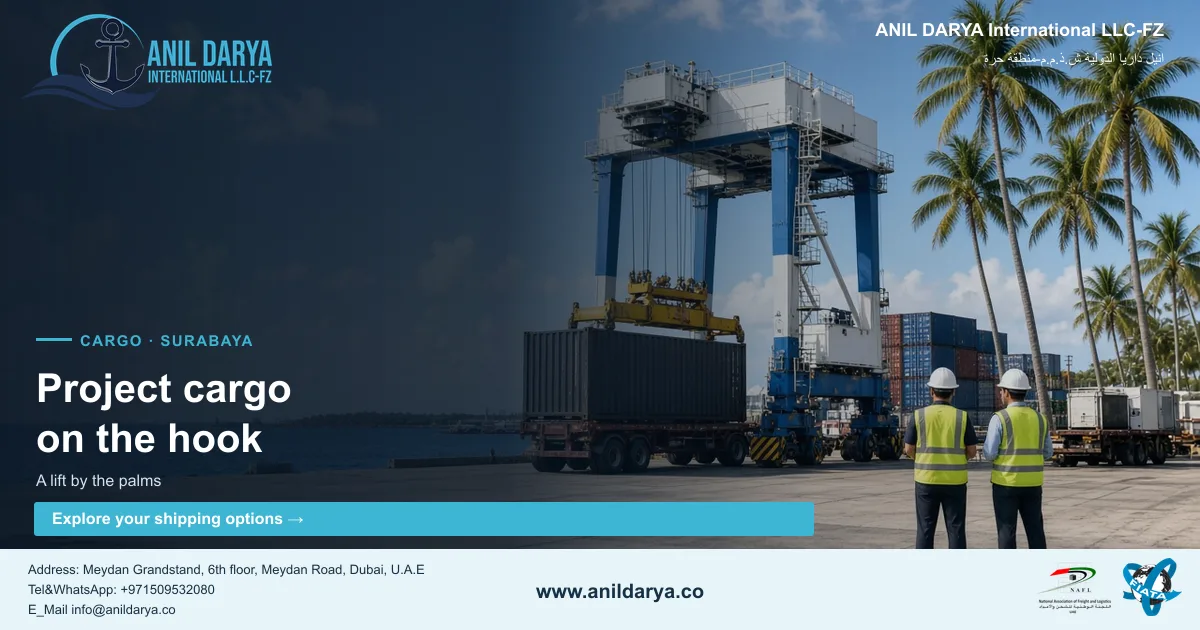
| Breakbulk, steel, project cargo | Multipurpose quays such as Jamrud or Nilam | Berth depth and lifting plan |
| Containers for eastern islands | Domestic wharves at TPS, Nilam, Berlian | Domestic feeder booking and transfer |
How deep is the port of Surabaya, and which ships fit?
Water depth is the main limit at Surabaya. Ships reach the port from the north through the West Surabaya channel in the Madura Strait. Port information published by Indonesia's tourism ministry gives the channel as about 43 km long, 13 m deep at low water spring and at least 150 m wide, with pilotage compulsory around the clock.
| Berth type | Depth | Draft |
|---|---|---|
| Containers | 14.0 m (LWS) | 12.0 m (high water) |
| Dry bulk | 14.0 m (LWS) | 12.0 m (high water) |
| Breakbulk | Not published | 10.0 m (high water) |
| Ro-Ro | 9.6 m (LWS) | Not published |
| Tankers | 12.0 m (tidal) | Not published |
Source: Findaport port listing. Treat the figures as planning limits and get the berth draft from the carrier or the terminal for a specific vessel.
What this means for you: the largest ships on Asia-Europe loops do not call at Surabaya. Most cargo from the Gulf arrives on mid-size vessels, often after transshipment at a hub. For heavy-lift and bulk, the vessel's loaded draft must fit the berth draft on arrival, so tell us the cargo weight early.
How busy is the port of Surabaya?
Lloyd's List ranks Tanjung Perak 49th in its Top 100 Ports 2026, with 4.49 million TEU in 2025, up 4.4% from 4.3 million TEU in 2024. That figure includes a large share of domestic containers moving between Java and the eastern islands.
For international boxes, TPS handled 1,115,827 TEU from January to September 2025. Pelindo's container arm runs TPS and reported crane productivity of 52 boxes per ship per hour in that period, above the 48-box minimum set through the harbour master (KSOP Utama Tanjung Perak).
Volume tells you two things. First, there is regular international service, so you are not waiting weeks for a vessel. Second, the port is busy enough that yard dwell time and gate slots matter, which is why your documents must be ready before the vessel berths.
FCL and LCL shipping to Surabaya
Full container load (FCL) is the default for most commercial cargo from Dubai to Surabaya. You get a sealed box from Jebel Ali to the TPS or Teluk Lamong yard, and your importer clears it under one declaration. Use 20ft boxes for heavy, dense cargo and 40ft or 40ft high cube for light, bulky goods.
Less than container load (LCL) works for small consignments, but the route matters. LCL from the UAE to Surabaya usually travels in a consolidated box to a hub, then on to Surabaya, where it is unpacked at a container freight station. Each extra handling adds time and a chance of damage. If your cargo is above roughly half a 20ft box by volume, compare FCL first. Our guide to FCL vs LCL sets out the trade-offs in detail.
| Point | FCL to Surabaya | LCL to Surabaya |
|---|---|---|
| Who clears | Your importer, one PIB declaration | Your importer, after the box is unpacked at the CFS |
| Handling | Sealed from Jebel Ali to the yard | Packed, unpacked and stored with other cargo |
| Best for | Factory inputs, machinery, regular trade | Samples, spare parts, small first orders |
| Main risk | Demurrage if clearance is slow | Delay if one co-loaded shipment is held |
We book space with the carriers that serve this lane through our sea freight service, and we plan the box type, weight and cut-off at Jebel Ali.
Breakbulk, project and bulk cargo at Tanjung Perak
Surabaya handles breakbulk, dry bulk and project cargo on its multipurpose quays and at the Teluk Lamong dry bulk berth. Bulk carriers, gas carriers, tankers and general cargo ships all call, serving the industrial area around Surabaya, Gresik and Sidoarjo.
For breakbulk the published draft limit is 10 m at high water, which rules out some larger general cargo ships. For out-of-gauge units on a container service, flat racks and open tops discharge at the container terminals. Plan these points before you book:
- Exact dimensions and weight of each piece, with lifting points marked.
- Whether ship's gear or shore cranes will discharge the cargo.
- Route survey for the truck from the port to site, including toll road limits.
- Import permits for used machinery or capital goods before the vessel sails.
Read more about our break bulk and project cargo service if you are moving heavy pieces. For bagged or loose commodities, see our bulk cargo service.
Dangerous goods to Surabaya
Teluk Lamong lists dangerous goods containers among its services, and IMDG cargo is accepted at Tanjung Perak under carrier and terminal approval. Indonesian container terminals keep DG dwell time short. At NPCT1 in Jakarta, for example, Class 1 and Class 7 must go direct to truck, Classes 2.1, 2.3, 5.1, 5.2 and 6.1 may stay 24 hours, and other classes 72 hours on import, counted from vessel berthing. Ask the carrier for the TPS or Teluk Lamong window that applies to your class before you ship, because the importer must be ready to collect at once.
On our side we prepare the DG declaration, check the safety data sheet (SDS) and UN number, and get carrier approval before the booking is confirmed. Labels must be visible on the container, and the consignee must hold any import licence the product needs. See our dangerous goods shipping service for how we plan DG from the UAE.
Customs at Tanjung Perak: the short version
Customs at Surabaya follows the same national rules as every Indonesian port. The local office is KPPBC TMP Tanjung Perak, under the Directorate General of Customs and Excise (DJBC). The full step-by-step process, including the green and red lanes, is on our Tanjung Priok page, so here is only what you need for Surabaya.
- The importer must be registered (NIB with importer status) and files the import declaration (PIB) electronically, directly or through a licensed customs broker (PPJK).
- Duty, VAT and income tax are paid through a billing code before release.
- Import VAT is an effective 11% for most goods and 12% for luxury goods, under PMK 131/2024 from 1 January 2025.
- Restricted goods need their import approval before release, so get it before the vessel sails.
- The UAE-Indonesia CEPA has been in force since 1 September 2023 and covers more than 90% of tariff lines. A valid certificate of origin is needed to claim the preferential rate on UAE-origin goods.
| Document | Why it matters at Surabaya |
|---|---|
| Commercial invoice and packing list | Value and HS codes for the PIB; must match each other |
| Bill of lading | Must match the vessel manifest and the importer's name |
| CEPA certificate of origin | Preferential duty for qualifying UAE-origin goods |
| Import approval or permit | Needed for restricted goods before release |
| DG declaration and SDS | Terminal acceptance and dwell planning |
| Delivery order | From the carrier's local agent, to collect the box |
In the UAE, we handle export clearance at Jebel Ali or your loading port. In Surabaya, your importer or its customs broker clears the cargo. We work with the consignee's clearing agent so the documents line up before arrival.
How to ship from Dubai to Surabaya, step by step
- Confirm the Incoterm and who pays the Surabaya terminal and port charges.
- Check that the Indonesian importer holds an NIB with importer status and any permit your goods need.
- Send us the HS code, weight, volume and cargo type. We book space from Jebel Ali or another UAE port on a service that reaches Surabaya.
- We arrange trucking to the port in the UAE, the export declaration and the VGM.
- Your shipper issues the commercial invoice and packing list. Get the CEPA certificate of origin if the goods qualify.
- We send the draft bill of lading for checking. The consignee name must match the importer's registration exactly.
- The vessel sails, usually with transshipment at a hub, and the box is discharged at TPS or Teluk Lamong.
- The importer or its broker files the PIB, pays duty and taxes, and receives release.
- The importer collects the delivery order from the carrier's agent and trucks the box out within free time.
[AMIR-FACT: our real port-to-port transit Jebel Ali to Surabaya in 2026 (days), the hub used, and the carriers we usually book on this lane]
Published transit indications from the UAE
There is no simple direct sailing to quote from aggregator data. Fluent Cargo, which builds estimates from carrier schedules, shows these options:
| Origin | Estimated time to Surabaya | Transfers | Frequency |
|---|---|---|---|
| Khor Fakkan (AEKLF) | About 23 days | 1 transfer | Every 1-2 weeks |
| Jebel Ali (AEJEA) | About 27 days | 2 transfers | Every 2-4 weeks |
These are planning figures, not commitments. Real times depend on the hub connection and the season. Add customs clearance and trucking on top for your door date.
How to ship from Surabaya to Dubai
We also handle the other direction: shipping from Surabaya to Dubai, with arrival at Jebel Ali, Khalifa Port or Sharjah port. We book the space with the carrier and run the UAE side. The Indonesian export papers stay with the shipper or its Indonesian customs broker.
The Indonesia export side
- Goods for export must be declared to the customs office on an export customs declaration, known as the PEB. The rule is set in Ministry of Finance Regulation PMK 155/PMK.04/2022.
- The exporter fills in the PEB completely and correctly and is responsible for it. It may authorise a licensed customs broker (PPJK) to file it.
- For containers, the PEB is lodged before the goods enter the customs area at the loading port. Bulk cargo may be declared up to the departure of the ship.
- Goods count as exported once the PEB has a registration number and the goods are loaded on the outbound ship.
- If the goods are of Indonesian origin, ask the shipper whether a UAE-Indonesia CEPA certificate of origin applies to your HS code.
The UAE import side
On arrival in Dubai, the declaration goes to Dubai Customs with the commercial invoice, packing list, bill of lading, certificate of origin and any permit for restricted goods. Customs duty in Dubai is 5% of the CIF value for most goods, with 50% on alcohol and 100% on cigarettes. Import VAT is 5%.
- Send us the shipper's details in East Java, the cargo, the HS code and the UAE delivery address.
- We book space from TPS or Teluk Lamong and send the booking and cut-offs to the shipper.
- The shipper or its trucker picks up the cargo and brings the box to the terminal.
- The shipper or its PPJK files the PEB before the box enters the port.
- We check the draft bill of lading against the invoice and packing list.
- We file the Dubai Customs declaration before arrival, and we arrange payment of the duty and VAT.
- We collect the delivery order, truck the box to your site and return the empty inside free time.
[AMIR-FACT: the carriers and hub we actually use from Surabaya to Jebel Ali, Khalifa Port or Sharjah and our real transit days in this direction]
Surabaya or Jakarta: which port should you choose?
Many shippers default to Tanjung Priok in Jakarta because more direct services call there. That is not always cheaper to the door.
| Your consignee is in | Port to price first | Reason |
|---|---|---|
| Surabaya, Gresik, Sidoarjo, Malang | Surabaya (Tanjung Perak) | Short truck leg, local customs office |
| Bali, Nusa Tenggara, eastern islands | Surabaya, then domestic feeder | Surabaya is the inter-island hub for the east |
| Jakarta and western Java | Tanjung Priok | Main import port, more sailings |
| Central Java | Compare both | Trucking cost decides |
We can price both ports and show the full cost to your door, so you choose on numbers rather than habit.
When air cargo makes more sense
For urgent spare parts, samples or high-value goods, air cargo beats a three to four week sea transit. Surabaya has its own airport, Juanda International (SUB), but Fluent Cargo's fastest air routing from Dubai runs to Soekarno-Hatta (CGK) in Jakarta. Plan the domestic leg if your consignee is in East Java. See our air cargo service for options from Dubai.
Free time, storage and demurrage at Surabaya
Every day a box sits in the TPS or Teluk Lamong yard costs storage, and every day the carrier's container stays out beyond free time costs demurrage or detention. Free time is set by the carrier and the terminal, not by the port as a whole, so ask for it in writing at booking.
The main cause of extra days at Surabaya is a missing permit or a mismatch between the bill of lading and the PIB. Both are fixed before sailing, not after arrival. Our article on demurrage and detention explains how the charges build up.
What drives the cost of shipping to Surabaya?
- Ocean freight from the UAE, which moves with the hub connection and season.
- Transshipment: the number of hub stops affects both cost and transit.
- Terminal handling and port charges at TPS or Teluk Lamong, usually for the consignee's account.
- DG, reefer or out-of-gauge surcharges.
- Duty, VAT and income tax, which depend on the HS code, CEPA eligibility and the importer's status.
- Storage and demurrage if clearance is slow.
- Trucking from the port to the consignee, or a domestic feeder to the eastern islands.
We do not publish fixed rates because they change with every sailing. Send us the cargo details for a real quote.
Checklist before you ship to Surabaya
- Importer's NIB and importer status confirmed.
- HS code agreed between shipper and importer.
- Import permits for restricted goods in hand.
- CEPA certificate of origin arranged if goods qualify.
- Invoice, packing list and bill of lading match on names, weights and values.
- DG documents and carrier approval for any hazardous cargo.
- Terminal (TPS or Teluk Lamong) and free time confirmed with the carrier.
- Truck or domestic feeder booked for the final leg.
Common mistakes
- Routing all Indonesian cargo through Jakarta when the buyer is in East Java.
- Shipping before the importer has its registration and permits ready.
- Consignee name on the bill of lading differs from the importer's registered name.
- Booking a breakbulk or bulk vessel without checking the berth draft at Surabaya.
- Assuming DG can sit in the terminal yard like normal cargo.
- Forgetting the CEPA certificate and paying full duty on qualifying goods.
- Not checking whether the box will discharge at TPS or Teluk Lamong before booking the truck.
Frequently asked questions
Is the port of Surabaya the same as Tanjung Perak?
Yes. Tanjung Perak is the name of the port of Surabaya in East Java. It includes several terminals, mainly Terminal Petikemas Surabaya (TPS) for international containers and Terminal Teluk Lamong.
What is the port code for Surabaya?
The UN/LOCODE for Surabaya is IDSUB. You will see it on bookings, bills of lading and tracking systems.
Who operates the port of Surabaya?
PT Pelabuhan Indonesia (Pelindo) owns and runs Tanjung Perak. Its container business runs TPS, and its Teluk Lamong unit runs Terminal Teluk Lamong and other quays.
How many containers does Surabaya handle?
Lloyd's List puts Tanjung Perak at 4.49 million TEU in 2025, up 4.4% on 2024. That total includes a large share of domestic inter-island containers.
How deep is the port of Surabaya?
The approach channel is about 13 m deep at low water spring. Container and bulk berths are listed at 14 m, with a 12 m draft at high water, so very large ships do not call.
Can I ship dangerous goods to Surabaya?
Yes, with carrier and terminal approval. Indonesian terminals allow only short DG dwell times, and some classes must go straight to a truck, so your importer must be ready to collect on arrival.
Does the UAE-Indonesia CEPA lower duty on cargo to Surabaya?
For qualifying UAE-origin goods, yes. The CEPA has been in force since 1 September 2023 and covers more than 90% of tariff lines. You need a valid certificate of origin to claim the rate.
How long does shipping from Dubai to Surabaya take?
Fluent Cargo's schedule-based estimates show about 23 days from Khor Fakkan with one transfer and about 27 days from Jebel Ali with two transfers. Add clearance and trucking for the door date.
How does shipping from Surabaya to Dubai work?
The shipper or its customs broker files the PEB before the box enters the port. We book space to Jebel Ali, Khalifa or Sharjah, file the Dubai Customs declaration before arrival and arrange payment of the 5% duty and 5% VAT.
Should I ship to Surabaya or Jakarta?
Ship to Surabaya if your consignee is in East Java or the eastern islands. Use Jakarta for western Java. For Central Java, compare the total cost to the door.
Get a quote for port of Surabaya shipping
Send us your cargo details and we will come back with a routing and a price for shipping from Dubai to Surabaya. Use our freight rate inquiry form, or contact our team to talk through a DG, breakbulk or project shipment first. You can also read more about our Dubai freight forwarding team and how we load at Jebel Ali Port.
Sources
- Wikipedia: Port of Tanjung Perak (operator, area, terminals, history, toll roads)
- DP World: Shipping routes to Indonesia (Surabaya IDSUB, second-largest container port)
- Lloyd's List: Top 100 Ports 2026, 49 Tanjung Perak (2025 throughput)
- Suara Surabaya: TPS international container flow to September 2025 (wharves, cranes, volumes, market share), 8 October 2025
- Suara Surabaya: Terminal Teluk Lamong wharf, depth, equipment and design capacity, 17 October 2015
- PT Terminal Teluk Lamong: Services
- PT Terminal Teluk Lamong: Facilities (Teluk Lamong, Nilam, Berlian)
- Indonesia Travel (Ministry of Tourism): Port of Tanjung Perak technical information (channel, pilotage)
- Findaport: Port of Surabaya (size limits by berth type, cargo types)
- iContainers: Port of Surabaya, Tanjung Perak (terminal areas)
- NPCT1: Dangerous goods handling (Indonesian DG storage periods example)
- Ministry of Finance learning centre: KPPBC TMP Tanjung Perak
- Directorate General of Taxes: PMK 131/2024 VAT rates
- Ministry of Finance Regulation PMK 155/PMK.04/2022 on export customs (PEB, PPJK, timing)
- Dubai Customs: import declaration documents
- Dubai Customs: FAQ (5% of CIF, 50% alcohol, 100% cigarettes)
- UAE Federal Tax Authority: VAT (5%)
- UAE Ministry of Foreign Trade: UAE-Indonesia CEPA
- Abu Dhabi Customs: UAE-Indonesia CEPA (certificate of origin)
- Fluent Cargo: Dubai to Surabaya (published transit indications)
Reviewed: 10 November 2026