
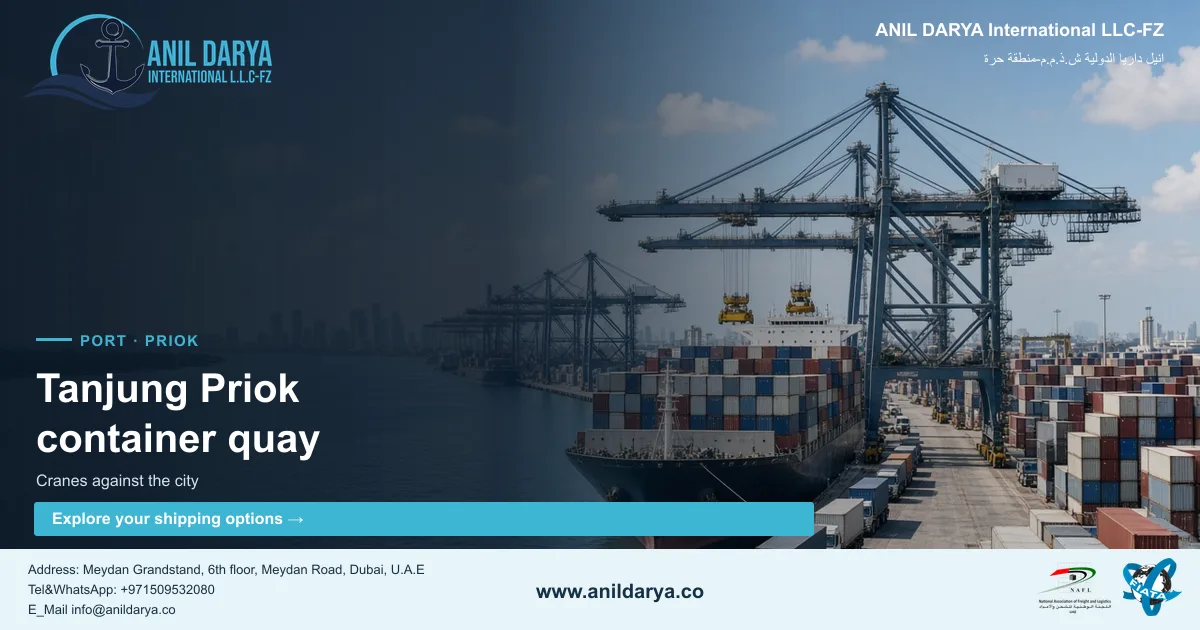
Tanjung Priok port shipping covers most container cargo entering Indonesia: the port in North Jakarta handles more than half of the country's container volume, according to NPCT1, one of its terminals. Containers land at terminals such as JICT, TPK Koja and NPCT1 and are cleared by Indonesian customs (DJBC). This guide covers the terminals, the dangerous goods rules, customs and documents, and how to ship to Tanjung Priok from Dubai. We ship both from Dubai to Tanjung Priok and from Tanjung Priok to Dubai.
Tanjung Priok port guide: key facts at a glance
| Item | Detail |
|---|---|
| Location | Tanjung Priok, North Jakarta, Indonesia |
| Port operator | PT Pelabuhan Indonesia (Pelindo), state-owned |
| UN/LOCODE | IDTPP (carriers often book it as Jakarta, IDJKT) |
| Customs authority | Directorate General of Customs and Excise (DJBC, Bea Cukai) |
| Share of Indonesian volume | More than half (NPCT1) |
| Containers handled in 2025 | 8.30 million TEU (Pelindo Regional 2) |
| Vessel calls in 2025 | 14,163 |
| Main customs office | KPU Bea dan Cukai Tipe A Tanjung Priok |
| Container terminals covered here | JICT, TPK Koja, NPCT1 |
| JICT yard capacity | 2.5 million TEU a year |
| NPCT1 capacity | 1.5 million TEU |
| TPK Koja capacity | More than 1 million TEU a year |
| Deepest berth listed | 16 m (JICT and NPCT1) |
| Reefer plugs | 880 at JICT, 990 at NPCT1 |
| Cargo types | Dry and reefer containers, dangerous goods, out-of-gauge and un-containerised cargo |
| Import declaration | PIB, filed by the importer or a licensed customs broker (PPJK) |
| Tanjung Priok to Dubai | Exporter submits the PEB to DJBC; UAE duty 5% of CIF for most goods plus 5% import VAT |
Where is Tanjung Priok port?
The port sits on the north coast of Jakarta, in the Tanjung Priok district of North Jakarta. It is Indonesia's busiest port and the main gateway for imports into the capital and the industrial areas of western Java.
The newer terminals are at Kalibaru, in Cilincing. NPCT1, which opened on 18 August 2016, describes itself as the first terminal of the New Priok development. TPK Koja's office is in Koja, North Jakarta. If your booking says "Jakarta" or "IDJKT", the port of discharge is Tanjung Priok, and the terminal on the arrival notice tells your consignee's trucker which gate to use.
How busy is Tanjung Priok port?
Pelindo Regional 2 Tanjung Priok reported these figures for 2025, covering January to 30 December:
| Measure | 2025 |
|---|---|
| Container throughput | 8.30 million TEU, about 5.69 million boxes |
| Vessel calls | 14,163, totalling 149.95 million GT |
| Non-containerised cargo | 21.51 million tonnes |
| Vehicles | About 860,000 units |
Volume at this level means busy yards and gates. In June 2026 Indonesia's Finance Minister asked DJBC to add field staff and run 24-hour shifts at Tanjung Priok after the queue of import documents reached about 3,000 containers, with a target of bringing it back to about 500. For you, the lesson is simple: send documents early so your container is not in that queue.
Which container terminals operate at Tanjung Priok?
Several terminal companies run container berths at the port. Your carrier's service decides which one your container uses. The table compares the three we could check on the operators' own websites.
| Item | JICT | TPK Koja | NPCT1 |
|---|---|---|---|
| Full name | Jakarta International Container Terminal | Terminal Petikemas Koja | New Priok Container Terminal One |
| Owners | Joint venture of Hutchison Ports and Pelabuhan Indonesia | Joint operation of Pelabuhan Indonesia II and Hutchison Ports Indonesia | Pelindo II (IPC), Mitsui & Co., PSA International, Ocean Network Express |
| Operating since | 1999 | Developed after the early 1990s; describes service since 1998 | 18 August 2016 |
| Berths and quay | 6 berths, 1,635 m quay | Not published on the site | 850 m berth |
| Depth | 12 to 16 m alongside | Not published on the site | 16 m maximum draft |
| Quay cranes | 14 | Not published on the site | 9, twin-lift capable |
| Yard equipment | 60 rubber-tyred gantries | Not published on the site | 29 electric RTGs |
| Yard area | 83.5 ha | Not published on the site | 32 ha |
| Capacity | 2.5 million TEU a year (yard); 2.2 million TEU (berth) | More than 1 million TEU a year | 1.5 million TEU |
| Reefer plugs | 880 | Not published on the site | 990 |
| DG yard | 846 TEU | Not published on the site | DG handling with storage limits by class |
JICT calls itself the largest container terminal in Indonesia and lists 18 weekly services. All three terminals run online tools for container tracking, vessel schedules, VGM and tariff simulation, which your consignee's broker uses to plan collection.
[AMIR-FACT: our real port-to-port transit time from Jebel Ali to Tanjung Priok, the carriers we usually book, and which Tanjung Priok terminal those services use]
What cargo can you ship through Tanjung Priok?
| Cargo type | How it moves | What to plan |
|---|---|---|
| General goods | FCL or LCL in dry containers | Terminal on the booking, importer's permits, free time |
| Chilled and frozen goods | Reefer containers on plug-in points (880 at JICT, 990 at NPCT1) | Set temperature, food permits in Indonesia |
| Machinery and steel | Flat racks, open tops or un-containerised cargo | Lifting points, crane capability, trucking from the quay |
| Chemicals and other DG | IMDG containers under terminal storage limits | Clearance ready before berthing; some classes direct delivery only |
FCL and LCL shipping to Tanjung Priok port
FCL means you book a whole 20ft or 40ft container. It is the simplest way to ship to Tanjung Priok because the box is cleared and collected as one unit. LCL means your cargo shares a container. The container is cleared and unpacked at a warehouse first, and only then is your part released, so another shipper's paperwork can affect your timing.
For reefer cargo, tell us the set temperature and ventilation at booking. JICT lists 880 reefer plugs. NPCT1's reefer platforms have 198 ground slots for about 990 reefer containers, with technicians on duty around the clock and spare parts kept on site for quick repairs. Food and agricultural goods also need the importer's Indonesian permits before release, so a reefer that waits for a permit keeps running up plug-in and storage charges. Our sea freight service books FCL, LCL and reefer space from the UAE.
Out-of-gauge and project cargo at Tanjung Priok
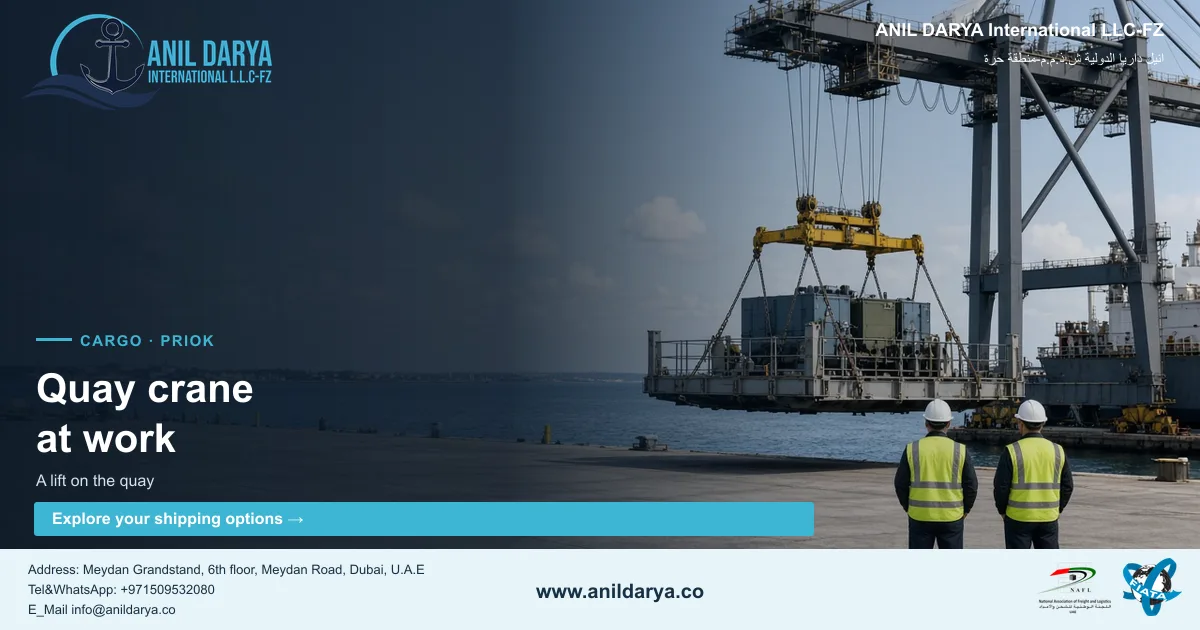
NPCT1 lists out-of-gauge (OOG) and un-containerised (UC) cargo handling among its services and says it has quay cranes and tools for it. In January 2017 it handled 54 import OOG units from a single vessel. That makes flat rack and open top shipments to Tanjung Priok a practical option for machinery and steel.
When you ship OOG cargo to Tanjung Priok with us, we plan it in this order:
- Collect drawings, dimensions, weights and lifting points for each piece.
- Choose flat rack, open top or a breakbulk vessel, and confirm the carrier and terminal accept it.
- Agree lashing and securing for loading in the UAE.
- Make sure the importer has a trucking plan from the terminal, since oversized pieces need special trailers.
- Line up customs so the cargo leaves the terminal before storage charges grow.
Our article on flat rack, open top and OOG cargo explains how to choose, and our break bulk and project cargo service covers the UAE end.
Dangerous goods at Tanjung Priok: storage limits by class
NPCT1 publishes clear rules on how long DG containers may stay in the terminal. Limits are counted from the vessel's berthing time.
| IMDG class | Import | Export |
|---|---|---|
| 1 and 7 | Direct delivery from the ship, no storage | Direct loading, no storage |
| 2.1, 2.3, 5.1, 5.2, 6.1 | 24 hours | 24 hours |
| 2.2, 3, 4, 5, 6.2, 8, 9 | 72 hours | 96 hours |
Import containers that overstay are moved to an appointed temporary storage depot (TPS) at the cargo owner's cost. Containers without IMDG labels, or that do not match the DG notification, are charged 200% of the handling and storage tariffs. DG containers must show IMDG labels, the UN number and the proper shipping name on all sides.
On import, the shipping line sends the terminal a DG list with UN and class numbers and the Safety Data Sheet. ISO tanks need a printed SDS attached to the tank. On export, the line sends the same data electronically, and the exporter attaches its export approval at the gate.
The practical rule: for Class 1, 2.1, 2.3, 5.1, 5.2, 6.1 and 7 cargo, the importer must have customs release and a truck waiting when the ship berths. Our dangerous goods shipping team checks carrier acceptance and paperwork in the UAE, and our guide to dangerous goods classes explains what each class covers.
Customs clearance at Tanjung Priok: documents and lanes
DJBC clears imports at Tanjung Priok through its main customs office at the port, KPU Bea dan Cukai Tipe A Tanjung Priok. The importer, or a licensed customs broker (PPJK) acting for it, files the import declaration (PIB) electronically. The customs system checks the importer's status, the manifest, the bill of lading, the tariff code and import restrictions, then issues a billing code for duty and taxes. After payment, the PIB is registered and given a lane.
Green lane and red lane
| Lane | What happens | DJBC service standard |
|---|---|---|
| Green | Release (SPPB) without physical inspection; documents checked after release | SPPB within 15 minutes of registration |
| Red | Red lane notice (SPJM), goods-ready notice, physical inspection and possible samples | Up to 30 days from PIB registration to decision |
At NPCT1, customs and quarantine share an inspection area inside the common gate, with a container inspection centre and gamma-ray and X-ray equipment. A red lane container is moved there for examination.
Which documents are needed?
| Document | Why it matters at Tanjung Priok |
|---|---|
| Commercial invoice and packing list | Customs value and HS code; must match each other |
| Bill of lading | Validated against the PIB and the vessel manifest |
| Importer's NIB with API and customs access | Lets the importer or broker file the PIB |
| Import approval (PI) or other permit | Needed for restricted (lartas) goods before release |
| CEPA certificate of origin | Preferential duty for qualifying UAE-origin goods |
| DG list, SDS and DG declaration | Terminal acceptance and storage planning |
| Delivery order | From the shipping line, to collect the container |
If the importer has no NIB registered as an importer, it cannot clear commercial cargo. Check this before you ship. Import duty, VAT and income tax article 22 are paid through the billing code. Since 1 January 2025, VAT is an effective 11% for most goods (12% on a base of 11/12 of the value) and the full 12% for luxury goods. Duty depends on the HS code, and income tax on the importer's status.
How to ship from Dubai to Tanjung Priok step by step
- Check the importer. Confirm the consignee's NIB works as API and customs access, and that its broker is ready.
- Classify the goods. Agree the HS code and check whether an import approval is needed.
- Get a quote and book. We compare carrier services from Jebel Ali or Khalifa Port to Tanjung Priok and note the terminal each uses.
- Get carrier acceptance for DG, reefer or out-of-gauge cargo before you confirm.
- Prepare documents. Invoice, packing list, certificate of origin and draft bill of lading, all with matching data.
- Export from the UAE. We truck the cargo to the terminal, file the export declaration and meet the cut-off.
- Send the pre-alert so the broker can prepare the PIB before the vessel berths.
- Clear and collect. The broker files the PIB, pays duty and taxes, collects the delivery order and books the truck at the right terminal.
Our guides to shipping through Jebel Ali Port and shipping through Khalifa Port cover the UAE side.
How to ship from Tanjung Priok to Dubai
We also handle the other direction: shipping from Tanjung Priok to Dubai, with arrival at Jebel Ali, Khalifa Port or Sharjah. We book the space with the carrier and run the UAE side. The Indonesian export side stays with the shipper or its Indonesia agent, because we have no office in Indonesia.
The Indonesia export side
- PEB. The exporter submits the export notification, the PEB (Pemberitahuan Ekspor Barang), to Indonesian customs (DJBC). The steps run from preparing the goods, through the PEB, a physical check if risk management selects the cargo, and a document review, to loading.
- Export duty. Some goods pay export duty under PMK 106/PMK.04/2022, and those goods can be selected for physical inspection.
- Restricted goods. Goods under export bans or restrictions need the permit from the technical agency, under PMK 141/PMK.04/2020.
- Accuracy. DJBC fines a wrong declaration of the type or quantity of goods at 100% to 1,000% of the duty underpaid.
The UAE import side
The import declaration goes to Dubai Customs. A company with a Dubai Customs business code can file it, or a licensed clearing agent with the owner's authorisation. Dubai Customs asks for the commercial invoice, packing list, certificate of origin and any permit from the authority that controls restricted goods, and the carrier's agent needs the bill of lading before it issues the delivery order. Customs duty in Dubai is 5% of the CIF value for most goods, with 50% on alcohol and 100% on cigarettes. Import VAT is 5% of the customs value, and a VAT-registered importer accounts for it on its VAT return through the reverse charge.
The UAE-Indonesia CEPA has been in force since 1 September 2023. Ask the shipper for a CEPA certificate of origin and check the preferential rate for your HS code before you rely on it.
- Send us the shipper's details in Indonesia, the cargo, the HS code, the Incoterm and the UAE delivery address.
- We book space from Tanjung Priok to Jebel Ali, Khalifa Port or Sharjah and send the booking and cut-offs to the shipper.
- The shipper or its trucker collects the empty, stuffs it and delivers the box to the Tanjung Priok terminal on the booking before the cut-off.
- The shipper or its Indonesian customs broker submits the PEB to DJBC and gets clearance before loading.
- We check the draft bill of lading against the invoice and packing list before the carrier issues it.
- We file the UAE import declaration before the ship arrives.
- We arrange payment of the duty and VAT.
- We collect the delivery order from the carrier's agent in the UAE.
- We truck the cargo to your site and return the empty container inside free time.
[AMIR-FACT: the carriers we actually use from Tanjung Priok to Jebel Ali/Khalifa/Sharjah and our real transit days in this direction]
Tracking your container at Tanjung Priok
Each terminal runs its own online tools, so your consignee or broker checks the terminal named on the arrival notice.
| Terminal | Online services listed |
|---|---|
| JICT | Container tracking, e-DO (electronic delivery order), vessel schedule, VGM certificate, EIR reprint, tariff simulator |
| TPK Koja | E-billing, container tracking and history, VGM declaration, vessel progress and schedule, yard occupancy ratio, tariff simulation |
| NPCT1 | Container tracking, vessel schedule, VGM, EIR, ePORTAL, tariff simulation |
Tanjung Priok or another Indonesian port?
Tanjung Priok is the default for Jakarta and western Java. For other regions, compare these gateways:
| Your consignee is in | Port to compare | Why |
|---|---|---|
| Jakarta and western Java | Tanjung Priok | Busiest port, handles most of Indonesia's imports |
| Surabaya and East Java | Tanjung Perak, Surabaya | Indonesia's second largest container port, per DP World |
| Medan and northern Sumatra | Belawan, Medan | Main import port for northern Sumatra |
| Urgent or light cargo anywhere | Soekarno-Hatta airport (CGK), Jakarta | Main air freight gateway |
Discharging at the port nearest the consignee usually beats a long truck or domestic sea leg from Jakarta. We can price more than one port so you compare the total cost to the door.
Free time, storage and demurrage at Tanjung Priok
Shipping lines give free days on their containers. After that, demurrage runs while the full container stays in the terminal and detention while the importer keeps it outside. Terminals also charge storage, and DG cargo has the short limits shown above. Rates and free days differ by carrier and terminal, so read them on the quote and arrival notice. JICT, Koja and NPCT1 all publish tariff simulators.
Three steps keep costs down: send documents early so the PIB is ready at berthing, get any import approval before loading, and agree extra free time at booking if clearance may be slow. Our article on demurrage and detention shows how these charges add up.
What drives the cost of shipping to Tanjung Priok?
We do not publish rates because they change with every sailing. These are the parts of a Tanjung Priok shipment that move the total:
| Cost element | What changes it |
|---|---|
| Ocean freight | Container type, carrier, direct or transshipment service, season |
| UAE origin charges | Trucking distance to Jebel Ali or Khalifa Port, terminal handling, export declaration |
| Terminal charges at Tanjung Priok | Terminal tariff, storage days, reefer plug-in, extra moves for inspection |
| Customs and taxes | HS code, CEPA eligibility, importer's API status, red lane inspection |
| Special cargo | DG surcharges, 200% penalty for unlabelled DG, flat rack and OOG handling |
| Delays | Missing permits, late documents, demurrage and detention |
Ask your consignee's broker to run the terminal's tariff simulator for the expected storage days. It turns a vague "port charges" line into a number you can plan for.
When air cargo to Jakarta makes more sense
For samples, spare parts or stock that cannot wait for a sailing, Soekarno-Hatta airport (CGK) in Jakarta is the main air freight gateway into Indonesia. Import rules are the same as by sea: the importer needs its NIB, any import approval and a customs declaration. If a sea shipment has a part that is late, splitting it and sending the urgent part by air is often cheaper than holding the whole container.
Checklist before you ship to Tanjung Priok
- Importer's NIB active as API and customs access, with a broker appointed.
- HS code agreed and import approval issued if the goods are restricted.
- Invoice, packing list and bill of lading show the same names, weights and piece counts.
- CEPA certificate of origin issued, if the goods are UAE-origin.
- For DG: SDS, DG declaration, IMDG labels on all sides and a plan for the class storage limit.
- For OOG: drawings, lifting points and a trailer booked for collection.
- Pre-alert sent before arrival and free time agreed with the carrier.
- Cargo insurance arranged, especially for machinery and high-value goods.
Common mistakes
- DG cargo with no release plan. Class 1 and 7 must leave straight from the ship, and some classes have only 24 hours.
- Missing IMDG labels. The terminal charges 200% of handling and storage tariffs.
- Shipping restricted goods without a permit. Customs will not release them until the permit is produced.
- Mismatched documents, which can lead to a red lane and physical inspection.
- Wrong terminal on the truck booking. Check the terminal on the arrival notice.
- Ignoring free time. Every extra day adds demurrage, storage or detention.
Frequently asked questions
Who operates Tanjung Priok port?
The port is run by state-owned PT Pelabuhan Indonesia (Pelindo). Container terminals such as JICT, TPK Koja and NPCT1 are run by companies in which Pelindo partners with private terminal operators.
What is the port code for Tanjung Priok?
The UN/LOCODE is IDTPP. Many carriers book cargo to Jakarta under IDJKT, and the terminal on the arrival notice shows where the container will be discharged.
How big is Tanjung Priok port?
NPCT1 says Tanjung Priok handles more than half of Indonesia's container volume. JICT has a yard capacity of 2.5 million TEU a year, NPCT1 1.5 million TEU and TPK Koja more than 1 million TEU a year.
How deep are the container berths at Tanjung Priok?
JICT lists 12 to 16 metres alongside its berths, and NPCT1 lists a maximum draft of 16 metres. Check the depth at your terminal if you charter a large breakbulk vessel.
Can I ship dangerous goods to Tanjung Priok?
Yes. NPCT1 handles DG cargo under storage limits by class: direct delivery for Class 1 and 7, 24 hours for classes such as 2.1 and 6.1, and 72 hours on import for classes such as 3 and 8.
What documents do I need to clear cargo at Tanjung Priok?
The importer's broker files a PIB with the commercial invoice, packing list and bill of lading. Add an import approval for restricted goods, a CEPA certificate for preferential duty and the shipping line's delivery order.
How long does customs clearance take at Tanjung Priok?
DJBC's service standard gives 15 minutes from registration to release in the green lane. In the red lane, with physical inspection, it allows up to 30 days from PIB registration to the decision.
How do I ship from Dubai to Tanjung Priok?
Send us the cargo details and the consignee's address. We book space from Jebel Ali or Khalifa Port, clear the UAE export and send the pre-alert, and the importer's broker files the PIB and collects the container.
Can Tanjung Priok handle out-of-gauge cargo?
Yes. NPCT1 handles out-of-gauge and un-containerised cargo with suitable quay cranes, and in January 2017 it handled 54 import OOG units from one vessel.
Can you ship from Tanjung Priok to Dubai?
Yes. We book space from Tanjung Priok to Jebel Ali, Khalifa Port or Sharjah, the shipper or its Indonesian broker submits the PEB, and we clear the cargo through UAE customs and deliver it. Most goods pay 5% customs duty on the CIF value plus 5% import VAT.
Get a quote for Tanjung Priok port shipping
Send us your cargo details and we will come back with a routing and a price from the UAE to Tanjung Priok. Use our freight rate inquiry form, or contact our team to talk through a DG or out-of-gauge shipment first. You can also read more about our Dubai freight forwarding team.
Sources
- JICT: Facilities and operations (berths, quay, depth, cranes, yard, reefer, DG yard)
- JICT: About (established 1999, ownership)
- JICT: Home (weekly services, capacity)
- NPCT1: Introduction (shareholders, start of operations, share of Indonesian volume)
- NPCT1: Terminal information (berth, draft, cranes, capacity, reefer plugs)
- NPCT1: Dangerous goods handling (storage limits, surcharges, documents)
- NPCT1: OOG and UC cargo handling
- NPCT1: Reefer handling
- NPCT1: Integrated facilities for customs and quarantine
- TPK Koja: About us (joint operation, capacity)
- TPK Koja: Home (service since 1998, online services)
- DJBC service standard KEP-168/BC/2021: import release, green lane
- DJBC service standard KEP-168/BC/2021: import release, red lane
- DP World: Shipping routes to Indonesia (Tanjung Priok as main import port, IDJKT code)
- The Shipping Gazette: Pelindo Regional 2 Tanjung Priok 2025 traffic figures (1 January 2026)
- DDTCNews: Finance Minister asks DJBC for more staff and 24-hour shifts at Tanjung Priok (8 June 2026)
- Ministry of Finance learning centre: KPU BC Tipe A Tanjung Priok
- Directorate General of Taxes: PMK 131/2024 VAT rates
- Wikipedia: Port of Tanjung Priok (location, operator, UN/LOCODE)
- DJBC (Indonesian Customs): Export procedures (PEB, export duty, sanctions, regulations)
- UAE Ministry of Economy: UAE-Indonesia CEPA (in force 1 September 2023)
- Dubai Customs: Submit customs declaration (invoice, packing list, certificate of origin, permits)
- Dubai Customs: FAQ (customs business code, clearing agents with owner authorisation)
- UAE Government portal: Customs duty (5% of CIF, alcohol 50%, cigarettes 100%)
- Federal Tax Authority: VAT guide (5% import VAT on the customs value, reverse charge)
Reviewed: 10 November 2026