
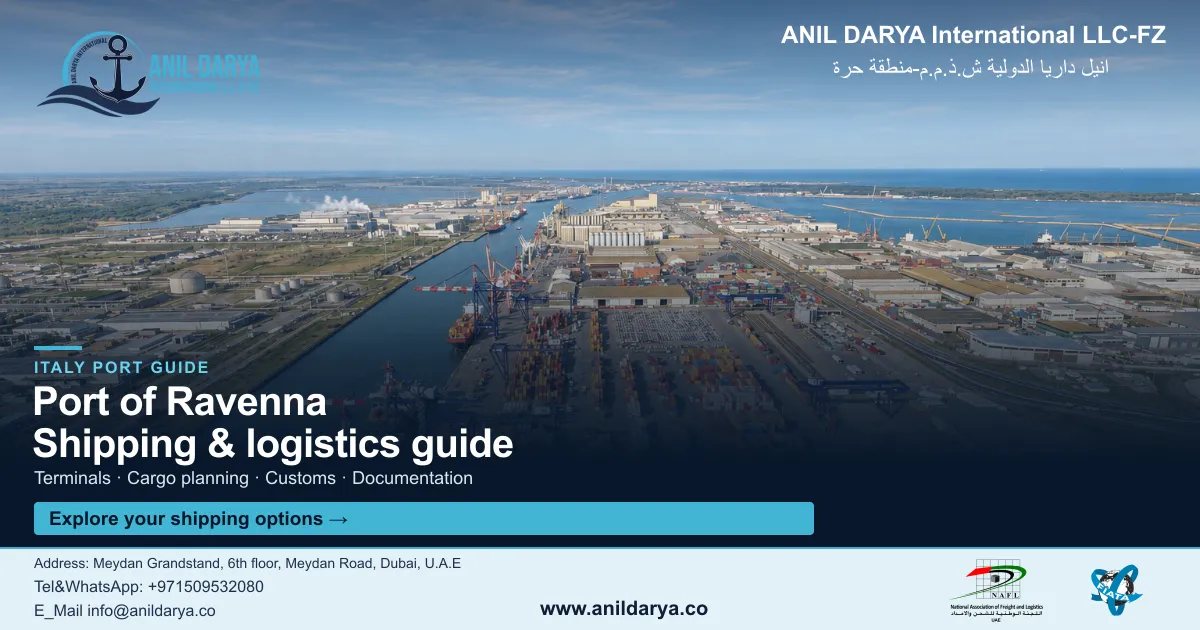
Port of Ravenna shipping is mostly about bulk and general cargo for factories in northern Italy: clay for the ceramics industry, cereals, fertilisers, steel coils and timber, plus a steady container trade. In 2025 the port set a record of 28,096,272 tonnes and handled over 212,000 TEU. This guide covers the canal terminals, the draft limits, what moves through the port and customs in short. It covers both directions: shipping from Dubai to Ravenna and shipping from Ravenna to Dubai.
Port of Ravenna at a glance
| Item | Detail |
|---|---|
| Port authority | Port System Authority of the Central-Northern Adriatic Sea (AdSP del Mare Adriatico centro-settentrionale) |
| UN/LOCODE | ITRAN |
| Location | Adriatic coast, Emilia-Romagna; the region's only port |
| Layout | A canal port 14 km long, inland from the sea |
| Terminals and quays | 27 private terminals, 10.5 km of operational quays |
| Storage | 846,000 sq m of warehouses, 1,414,000 sq m of yards, 1,018,000 cubic m of silos and tanks |
| Rail | 35 km of track, 10 terminals with rail links, over 9,000 trains a year |
| Seabed depth | 11.5 m today; 12.5 m planned in phase 1 and 14.5 m in phase 2 of the Port Hub project |
| Deepest permitted draft at a berth | 10.50 m; 9.60 m at the TCR container terminal |
| Maximum air draught | 55 m above the waterline (with some exceptions) |
| Total cargo, 2025 | 28,096,272 tonnes, a record, up 10% on 2024 |
| Containers, 2025 | Over 212,000 TEU, up 5.1% |
| Trailers, 2025 | Almost 70,000 units, 1.7 million tonnes of ro-ro cargo |
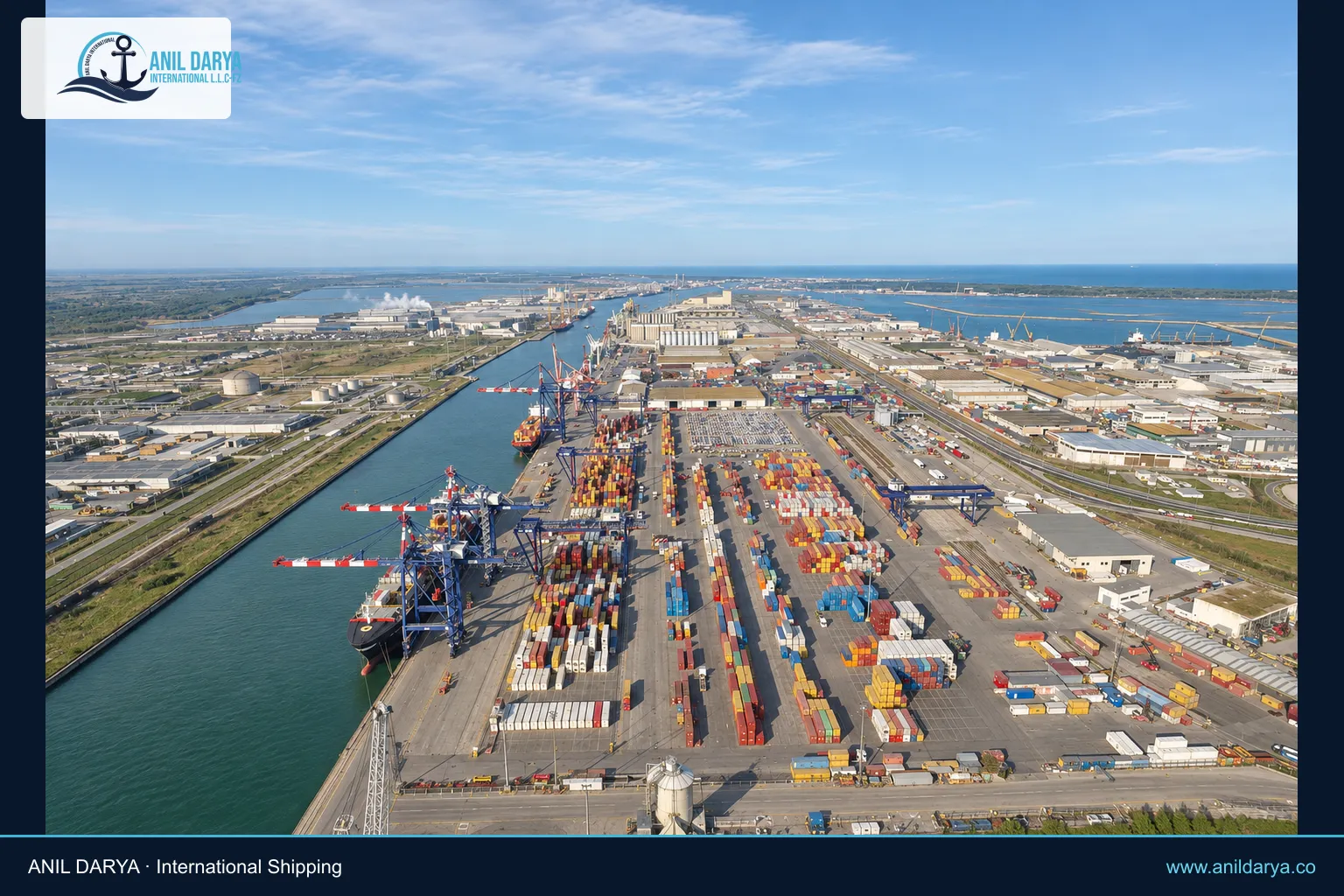
| Container terminal | Terminal Container Ravenna (TCR): 670 m quay, 4 gantry cranes, 380,000 TEU capacity |
| Motorways | A14 and E45 |
| Nearest airports | Bologna 80 km, Rimini 60 km |
What moves through the Port of Ravenna?
Ravenna is a bulk and general cargo port first. The port authority calls it the national leader in dry bulk and general cargo, and says it handles almost 40% of Italy's trade with the eastern Mediterranean and Black Sea, leaving out coal and oil products. Containers matter, but they are a smaller share than at Italy's west coast gateways.
The official figures for January to April 2026 show the mix well:
| Cargo group (January to April 2026) | Tonnes | Change on 2025 |
|---|---|---|
| Dry cargo (all) | 7,412,121 | +3.4% |
| Metallurgical products (coils, plates, steel) | 1,939,396 | -3% |
| Agri-food products (total) | 1,925,253 | Stable |
| of which cereals | 970,709 | +10.6% |
| Building materials | 1,527,357 | +4.9% |
| of which raw materials for the Sassuolo ceramics district | 1,331,951 | +2.7% |
| Fertilisers | 760,554 | +15.5% |
| Liquid products | 1,854,935 | +16.6% |
| Containerised cargo | 830,989 | +4.4% |
| Ro-ro cargo | 549,111 | +7.3% |
| Total | 9,267,056 | +5.8% |
Over the same four months the port handled 74,969 TEU from 148 container ship calls. In plain terms, Ravenna is the port for raw materials and heavy goods going to factories in Emilia-Romagna and the Po Valley. If your cargo is steel, minerals, fertiliser or project equipment for that area, Ravenna is often the natural landing point.
Which terminals does the Port of Ravenna have?
All terminals sit along the canal and are privately run. The port authority's map lists 27 of them, from bulk and chemical berths to shipyards. The ones a UAE shipper is most likely to meet are these:
| Terminal | Main cargo | Maximum permitted draft |
|---|---|---|
| TCR (Terminal Container Ravenna) | Containers, some ro-ro | 9.60 m |
| SAPIR | Port terminal group; TCR's parent company | Check with the line |
| Setramar | Bulk and general cargo, pier over 600 m | 9.60 m |
| Docks Cereali | Cereals and agri-bulk, 810 m quay | 9.60 m, or 10.50 m at bollards 8 to 18 |
| Eurodocks | Ceramics raw materials and glass materials | 9.60 m, or 10.50 m at the seaward end |
| Lloyd Ravenna | Bulk cargo, 320 m pier | 10.50 m |
| IFA, T&C, Terminal Nord, Bunge | Various; check the terminal for your cargo | 10.50 m |
| Marcegaglia | Steel products | 9.60 m (new berth) or 8.53 m |
| Fosfitalia, Yara | Fertilisers | 9.60 m (Fosfitalia); 7.32 to 8.53 m (Yara) |
| Petra, Versalis | Liquid and chemical products | Petra 7.62 to 9.14 m by section |
| Ferry terminal | Ro-ro to Sicily and southern Italy | Ships up to 261 m and 9.6 m draft |
The drafts above are the port authority's mooring limits by berth. The harbour master can delay or stop moves in bad weather, and the official depth reference is the nautical chart. If your cargo depends on a particular ship, check its draft against the berth before you fix the sailing.
Terminal Container Ravenna (TCR)
TCR is the port's container terminal, run under the direction of SAPIR. The operator gives these figures:
| Item | TCR today | Planned new terminal |
|---|---|---|
| Quay length | 670 m | 1,000 m |
| Water depth | 11.5 m | 14.5 m |
| Area | 250,000 sq m | Not confirmed |
| Quay cranes | 4 gantry cranes | 7 |
| Yard equipment | 5 RMG cranes, 7 reach stackers | Not published |
| Reefer plugs | 280 | Not published |
| Rail | 5 tracks of 420 m | Not published |
| Capacity | 380,000 TEU a year | Not published |
TCR says 60% of its traffic is on intra-Mediterranean services (nine services) and 40% on longer routes, with the Middle East at 6% of that longer-haul share. It also runs shuttle services to Trieste and Gioia Tauro, and rail links to Melzo and Segrate near Milan and Marzaglia near Modena.
Tracked carrier capacity at Ravenna in March 2026 (Cogoport, 3,465 TEU tracked) was CMA CGM at 55.8%, MSC at 31.7% and Evergreen at 12.5%. Those are the networks to ask first for a Jebel Ali to Ravenna booking.
Port of Ravenna draft limits and the Port Hub project
The canal is the main constraint. The port authority gives the current seabed at 11.5 m, while the deepest permitted draft at any berth is 10.50 m and the container terminal allows 9.60 m. Port data sites list a maximum ship length of about 261 m and beam of about 36 m. That is enough for feeders, mid-size container ships, many bulk carriers and general cargo ships, but not for the large container ships on Asia to Europe services.
The Ravenna Port Hub project is meant to change that. According to the port authority's brochure:
- Phase 1 dredges the seabed to 12.5 m, adapts 6.5 km of existing quays, builds 1,000 m of new quays for a new container terminal on the Trattaroli peninsula, and opens about 200 hectares of new logistics land linked to quays, rail yards and motorways.
- Phase 2 deepens the seabed to 14.5 m by upgrading the remaining quays and building a sediment treatment plant.
Progress shows up in operations. In October 2026, Ports Europe reported a trial allowing ships with up to 11 m draught at five quays. Until the limits change in the official rules, plan your shipment on the current berth drafts and ask the line for the berth and the draft limit at booking.
Bulk, steel and project cargo at Ravenna
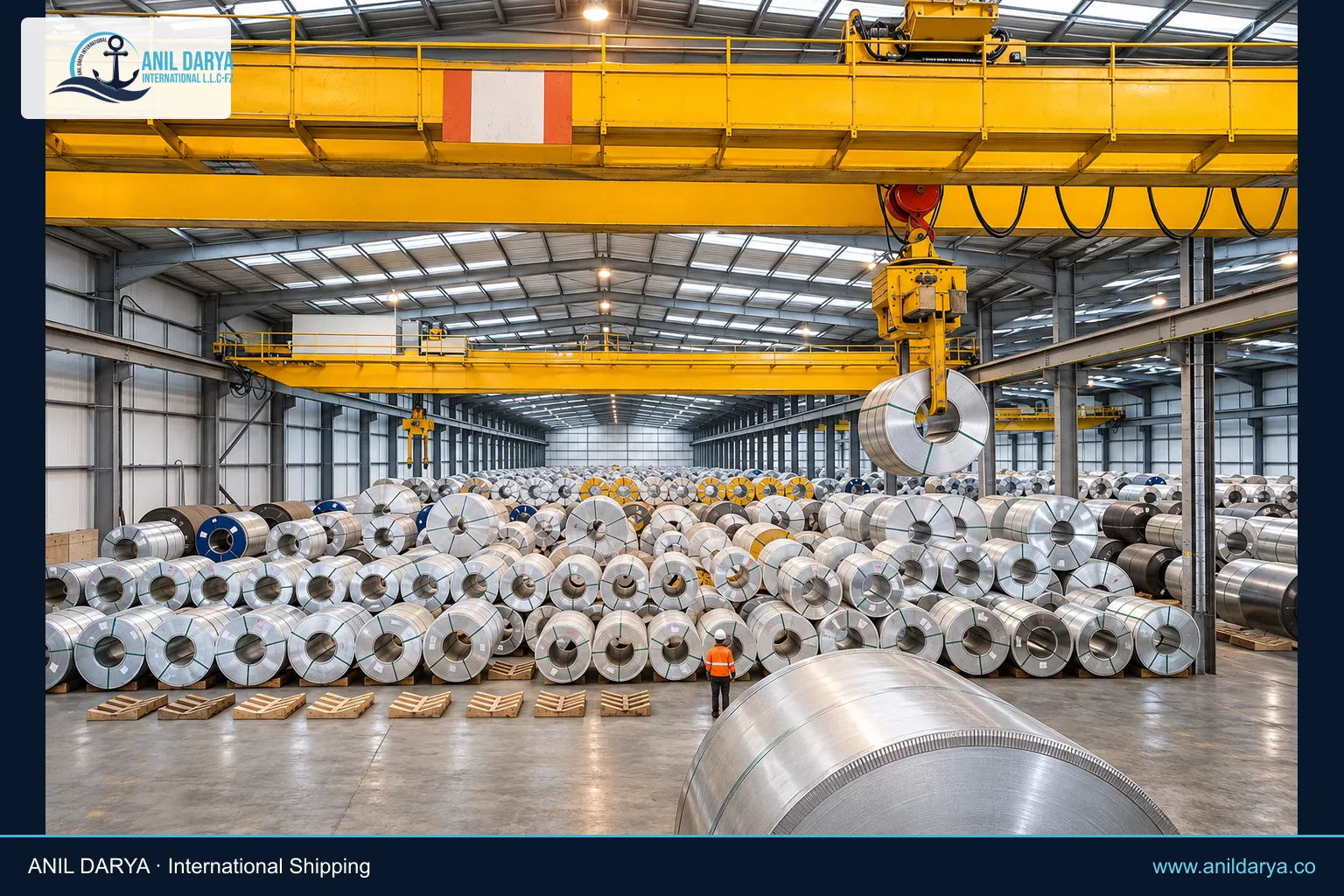
This is where Ravenna is strongest. The port authority describes it as Italy's leader for unloading raw materials for the ceramics industry, plus cereals, fertilisers and flour products, and an important call for metal products, especially coils, and timber.
| Your cargo | Usual way into Ravenna | Decision rule |
|---|---|---|
| Clay, feldspar, minerals for ceramics | Dry bulk ship to a specialised terminal | Full shiploads go bulk; small lots go in containers or big bags |
| Fertilisers and urea | Bulk ship to a fertiliser terminal, or bagged in containers | Check the receiver's storage and the berth draft |
| Steel coils and plates | Breakbulk ship or containers | Coil weight and lashing decide; check TARIC for anti-dumping duty |
| Project and heavy equipment | Flat racks on container services, or breakbulk ships | If it fits a 40ft flat rack, use a container service |
| Liquid chemicals | Tanker to a chemical terminal | Tanker cargo only, handled by the depot operators |
For bulk and breakbulk from the UAE, the draft limit is the first check. A bulk carrier loaded deep at origin may need to arrive part-loaded or discharge partly elsewhere first. We plan this with the carrier and your receiver before the fixture. See our dry and liquid bulk service and our break bulk and project cargo service.
Containers and dangerous goods at Ravenna
FCL and LCL
Your FCL from Jebel Ali will most likely reach Ravenna after transhipment at a larger Mediterranean hub, on a feeder or an intra-Mediterranean service into TCR. With 280 reefer plugs at TCR, chilled and frozen cargo is possible, but book the plug early. For LCL, ask whether the box is devanned at Ravenna or at another Italian port with a truck leg after. Our guide to FCL vs LCL costs explains when a full box pays off.
Dangerous goods
Ravenna has a large chemical and petrochemical area, with liquid and chemical terminals along the canal. Packaged DG in containers follows the IMDG Code, as at any EU port. You need a correct UN number, proper shipping name, class and packing group, a safety data sheet, a signed DG declaration, IMDG segregation in the box, and carrier acceptance for every leg, including the transhipment port. Some lines limit certain classes on feeders. Our dangerous goods shipping team handles the UAE side.
Moving cargo inland from Ravenna
The port authority says over 9,000 trains a year use the port, the highest of any Italian port by its count, and about 12% of goods can move by rail. Ten terminals have their own rail links. For trucks, the port is connected to the A14 and E45 motorways.
| Delivery area | Usual leg from Ravenna | Point to check |
|---|---|---|
| Ravenna, Faenza, Forli | Truck | Terminal on the arrival notice |
| Bologna, Modena, Sassuolo ceramics district | Truck, or rail to Marzaglia | Rail slot and last-mile truck |
| Milan area | Rail to Melzo or Segrate, or truck | Compare with a Ligurian port |
| Bulk receivers in the Po Valley | Truck or rail wagons from the bulk terminal | Discharge rate and receiver storage |
Emilia-Romagna has also set up a Simplified Logistics Zone of about 4,500 hectares, with about 1,700 hectares in the port, offering faster permits and tax and customs incentives for new businesses. An enclosed customs free zone is planned for the port. Neither changes the clearance of a normal import shipment today.
Customs at the Port of Ravenna: a short summary
Italian customs rules are the same at every port, and our Genoa guide covers them in detail. The short version:
- The carrier lodges the EU entry summary declaration at least 24 hours before your container is loaded at Jebel Ali.
- On arrival the goods sit in temporary storage under customs supervision for no longer than 90 days.
- The importer needs an EORI number and usually appoints a customs broker to lodge the import declaration with the Customs and Monopolies Agency (ADM).
- Duty comes from the EU tariff (TARIC). There is no EU-UAE trade agreement in force; talks were formally launched on 28 May 2025, so UAE goods pay the standard rate.
- Italian import VAT is 22%, with reduced rates of 10% and 5%.
What is specific to Ravenna is the cargo type. Steel products often carry EU trade defence measures, so check the full TARIC code, including any anti-dumping duty, before you price the sale. Fertilisers and chemicals may need REACH registration by the EU importer and the right labels. Cereals and food go through EU border checks before release. Over 50 forwarding firms work in the port, so your buyer will have no trouble finding a local broker.
How long does shipping between Dubai and Ravenna take?
We could not find a published carrier schedule between Jebel Ali and Ravenna that we could verify, so we do not quote a transit time here. Container routings are usually transhipped, and TCR's own shuttle links to Gioia Tauro and Trieste show the kind of connection your box may use.
[AMIR-FACT: the carriers or services we actually book between Jebel Ali and Ravenna in each direction, the transhipment port, and our typical port-to-port days]
Ask for the full routing, the transhipment port and the connecting vessel, not only the first ETA. For urgent parts, air freight to Bologna is the other option, through our air cargo service.
How to ship from Dubai to the Port of Ravenna: step by step
For Ravenna cargo, we book the space, prepare the documents, and look after UAE export clearance and trucking in the UAE. The Italian clearance stays with your buyer's customs broker at Ravenna or a clearing agent the buyer appoints.
- Send us the details: goods, HS code, weight, volume or dimensions, UAE pickup address, delivery address in Italy and Incoterm.
- Confirm the buyer's side: importer of record, EORI number, customs broker, and any permits for chemicals, fertilisers or food.
- Choose the mode. Containers for most goods; bulk or breakbulk for full shiploads or heavy pieces.
- Check the draft. For bulk and breakbulk ships, we confirm the berth and the permitted draft at Ravenna with the carrier.
- Book space. DG, reefer and out-of-gauge cargo need carrier acceptance for every leg first.
- Pack and stuff. We arrange the empty, stuffing, seal and VGM, ISPM 15 marked wood and IMDG packing for DG.
- Clear UAE export. We file the export or re-export declaration with Dubai Customs and gate in before the cut-off. Our Jebel Ali port shipping guide covers that end.
- Send documents early to the buyer's broker: bill of lading, commercial invoice, packing list, certificate of origin, and any DG or product papers.
- The broker lodges the import declaration with ADM and pays duty and VAT.
- The haulier or rail operator collects from the terminal, and the empty goes back to the depot within free time.
How to ship from Ravenna to Dubai
Shipping from Ravenna to Dubai runs the same lane in reverse, and we handle it with the same care as exports. Ravenna's TCR terminal runs rail links to Melzo and Segrate near Milan and Marzaglia near Modena and sea shuttles to Trieste and Gioia Tauro, so export boxes from Emilia-Romagna and Lombardy can reach a deep-sea connection. We book space with the carrier from the UAE side. The shipper, or the forwarder it uses in Italy, handles pickup and export formalities at origin.
- Send us the details: goods, HS code, weights and dimensions, pickup address in Italy, Incoterm and the delivery address in the UAE.
- We book space with the carrier from Ravenna to Jebel Ali, or to Khalifa Port in Abu Dhabi or Sharjah port if that is closer to your site, and send the shipper the booking, the terminal and the cut-off times.
- Origin pickup and export. The shipper or its origin agent trucks the cargo to the terminal and lodges the EU export declaration with ADM before the cut-off.
- Documents. The shipper sends the commercial invoice, packing list, certificate of origin and any permit or DG papers. We check them against the draft bill of lading before sailing.
- UAE customs clearance on arrival. We file the declaration with Dubai Customs, or arrange it through a licensed clearing agent with your authorisation, so it is ready when the ship berths.
- Delivery in the UAE. We collect the delivery order, book the truck and deliver to your site, warehouse or free zone, then return the empty within free time.
When the cargo from Ravenna arrives, Dubai Customs needs an invoice, a packing list and a certificate of origin from the Italian shipper, plus a permit from the relevant authority if the goods are restricted. Customs duty is 5% of the CIF value for most goods; alcohol pays 50% and cigarettes 100%. On top comes 5% import VAT, which a VAT-registered importer with its customs registration linked to the Federal Tax Authority does not pay at the border, accounting for it in the VAT return instead. Whoever clears the goods needs a customs business code, or the importer can use a licensed clearing agent.
Dwell time and free time at Ravenna
Cogoport's monthly data shows import containers at Ravenna staying 4.5 to 6.0 days on average between September 2025 and January 2026, and export boxes 6.1 to 9.4 days. Free time and waiting charges are set by each line, so read them on the quote and arrival notice. Our note on demurrage and detention shows how the charges build up.
Checklist before you ship to Ravenna
- Buyer's EORI number on the commercial documents.
- Full TARIC code checked, including anti-dumping duty for steel.
- Customs broker appointed and permits ready for chemicals, fertilisers or food.
- Ship draft checked against the berth limit (10.50 m maximum, 9.60 m at TCR).
- Terminal confirmed on the arrival notice.
- Reefer plug booked at TCR for chilled or frozen cargo.
- ISPM 15 marks on all wood packaging.
- DG documents and carrier acceptance for every leg.
- Free time agreed with the carrier.
- Cargo insurance arranged if the Incoterm puts the risk on you.
Common mistakes with Ravenna shipments
| Mistake | What happens | How to avoid it |
|---|---|---|
| Fixing a bulk ship loaded too deep | Ship cannot reach the berth fully loaded | Check the berth draft before the fixture |
| Expecting a direct call from the UAE | Missed dates when the box waits at a hub | Ask for the transhipment port and connecting vessel |
| Ignoring trade defence duty on steel | An extra duty bill at clearance | Check the full TARIC code before pricing |
| Planning on future depths | Wrong expectations on ship size | Use the current official drafts until they change |
| Missing chemical paperwork | Goods held at import | Confirm REACH and labelling with the buyer early |
| Untreated wood pallets | Cargo held or re-packed | Use ISPM 15 marked pallets and crates |
Frequently asked questions
What is the port code for Ravenna?
The UN/LOCODE for the Port of Ravenna is ITRAN. You will see it on bookings, bills of lading and tracking systems.
Who runs the port at Ravenna?
The Port System Authority of the Central-Northern Adriatic Sea runs the port. The 27 terminals along the canal are run by private companies.
How many containers does Ravenna handle?
Ravenna handled over 212,000 TEU in 2025, up 5.1% on 2024. From January to April 2026 it handled 74,969 TEU, up 3.9%.
How deep is the water at Ravenna port?
The port authority gives the seabed at 11.5 m today. The deepest permitted draft at a berth is 10.50 m, and the TCR container terminal allows 9.60 m.
What is the Port of Ravenna known for?
Dry bulk and general cargo. It leads Italy in unloading raw materials for the ceramics industry and handles large volumes of cereals, fertilisers and steel coils.
Is the Port of Ravenna being deepened?
Yes. The Port Hub project plans 12.5 m in phase 1 and 14.5 m in phase 2, with a new 1,000 m container quay. Plan on the current official drafts until the rules change.
Can I ship dangerous goods to Ravenna?
Yes, with full IMDG documents, correct segregation and carrier acceptance for every leg, including the transhipment port. Ask early, because some lines limit certain classes on feeders.
How do I arrange shipping from Dubai to Ravenna?
Send us the cargo details, the buyer's EORI number and the delivery address. We book space from Jebel Ali, clear UAE export and send the documents to the buyer's customs broker, who clears the goods with ADM at Ravenna.
How does shipping from Ravenna to Dubai work?
We book space from Ravenna to Jebel Ali, the shipper or its origin agent handles pickup and the EU export declaration, and we clear the goods with Dubai Customs on arrival. Duty is 5% of the CIF value for most goods, plus 5% import VAT.
What duty and VAT apply to goods from the UAE at Ravenna?
There is no EU-UAE trade agreement in force, so UAE goods cleared at Ravenna pay the standard EU tariff rate. Italian import VAT then applies at 22%, or at the reduced 10% or 5% rate where the goods qualify.
Get a quote for Port of Ravenna shipping
Send us your cargo details and we will come back with a routing and a price to or from Ravenna, by container, bulk or breakbulk. Use our freight rate inquiry form, or contact our team to talk through a bulk, project or DG shipment first. You can also read more about our Dubai freight forwarding team.
Sources
- AdSP Mare Adriatico centro-settentrionale: 2025 record year press release (January 2026)
- AdriaPorts: Ravenna traffic January to April 2026
- Port of Ravenna Authority: The Port of Ravenna brochure (terminals, quays, storage, rail, Port Hub project, SLZ)
- Port of Ravenna Authority: Drafts and dimensions by berth
- Port of Ravenna Authority: Port characteristics (rail share, motorways, airports, forwarders)
- Port of Ravenna Authority: Traffic and goods
- Port of Ravenna Authority: Port of Ravenna overview
- Terminal Container Ravenna: terminal facts
- Terminal Container Ravenna: services and rail links
- Cogoport: Ravenna (ITRAN) dwell times and operator capacity
- Shipnext: Ravenna port data (vessel limits, terminals)
- Ports Europe: Ravenna news (draught trial, October 2026)
- Wikipedia: Port of Ravenna
- European Commission Access2Markets: Customs clearance documents and procedures
- European Commission: TARIC
- European Commission: EU-UAE agreement negotiations
- Your Europe: VAT rates in EU countries (Italy)
- Dubai Customs: Submit customs declaration (required documents)
- Dubai Customs: Frequently asked questions (duty rate, business code, clearing agents)
- Federal Tax Authority: VAT guide (5% import VAT and deferral for registered importers)
Reviewed: 10 November 2026