
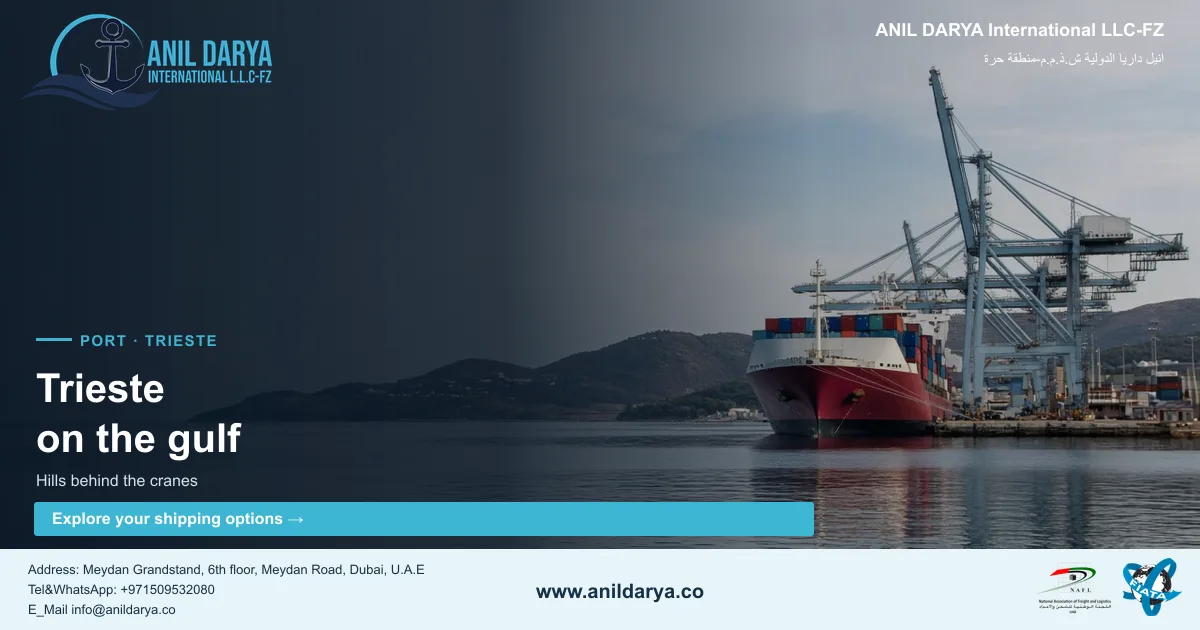
Trieste port shipping is about two things you will not find together at any other Italian port: a free port regime that lets you store, process and defer duty on goods, and a rail network that sends thousands of trains a year to Austria, Germany, Hungary and the Czech Republic. The port handled around 60 million tonnes in 2025 and moved 7,939 trains. This guide covers what is specific to Trieste: the free port, terminals, rail, dangerous goods, customs in short and how we ship your cargo there from Dubai. We ship both ways: from Dubai to Trieste, and from Trieste to Dubai with UAE clearance on arrival.
Trieste port guide: key facts at a glance
| Item | Detail |
|---|---|
| Port authority | Port Network Authority of the Eastern Adriatic Sea (AdSP Mare Adriatico Orientale), covering Trieste and Monfalcone |
| UN/LOCODE | ITTRS |
| Location | Northern Adriatic, eastern shore of the Gulf of Trieste, about 60 nautical miles east-northeast of Venice |
| Total cargo, 2025 | Around 60 million tonnes, up 0.7%, of which over 43 million tonnes liquid bulk |
| Containers, 2025 | 681,733 TEU, down 19%; hinterland containers stable at 536,930 TEU |
| Ro-ro, 2025 | 317,296 units, up 7.4% |
| Trains, 2025 | 7,939, up 1.6% |
| Port area | About 2.3 million sq m, of which about 1.8 million sq m free zones |
| Quays and berths | 12 km of docks, 58 berths |
| Maximum depth | 18 m (natural depth at the container terminal) |
| Rail inside the port | 70 km of track reaching every dock |
| Free port legal basis | Annex VIII of the 1947 Paris Peace Treaty |
| Main container terminal | Trieste Marine Terminal (TMT), Pier VII |
| Import VAT in Italy | 22% standard, with reduced rates of 10%, 5% and 4% |
| Shipping Trieste to Dubai | EU export declaration in AES by the shipper or its declarant; UAE entry at Jebel Ali, Khalifa Port or Sharjah |
Where is Trieste port and why do shippers use it?
Trieste is the northernmost port in the Mediterranean, at the top of the Adriatic in the Friuli Venezia Giulia region, close to the Slovenian border. It sits where two EU TEN-T core corridors meet, the Baltic-Adriatic and the Mediterranean. The port authority says the route saves about five days of sailing on Europe-Asia services compared with Northern European ports.
The cargo mix is unusual. Crude oil arrives at the SIOT oil terminal, over 41.9 million tonnes in 2025, which is why Trieste ranks as Italy's largest port by tonnage. Containers, ro-ro trailers from Turkey, coffee, timber, steel and fruit make up most of the rest.
For a shipper in the UAE, Trieste makes sense when your buyer is in northeast Italy, Austria, southern Germany, Hungary, Slovakia or the Czech Republic, or when your buyer wants to hold goods in a free zone before deciding where to sell them.
How the Trieste free port works
This is what sets Trieste apart. The free port goes back to 1719, and today it rests on Annex VIII of the 1947 Paris Peace Treaty. Italy runs it under the 1954 London Memorandum and later decrees. Under these rules, Italian and EU law cannot restrict the customs freedoms that the treaty guarantees.
The five free zones
| Free zone | Use |
|---|---|
| Old Free Zone (Porto Franco Vecchio) | Commercial |
| New Free Zone (Porto Franco Nuovo), home of Pier VII and TMT | Commercial |
| Timber Terminal (Scalo Legnami) | Commercial |
| Mineral Oils Free Zone | Industrial |
| Zaule Channel Free Zone | Industrial |
The perimeter can move with traffic. In September 2026 the port authority extended the free port at Scalo Legnami to 300 new semi-trailer bays on the former steelworks site. The Interporto di Trieste inland terminal also runs a free zone area, FREEeste, which made up 76% of its volumes in 2025.
What you can do inside the free zones
| Free port benefit | What it means for your cargo |
|---|---|
| No customs formalities and no duty to pay or guarantee while goods stay in the zones | Your buyer does not need to clear the goods on arrival |
| Storage with no time limit | Unlike normal temporary storage, which is limited to 90 days |
| Repacking, labelling, sampling and industrial processing without a customs bond | Goods can be finished or relabelled before sale |
| Duty payment deferred up to six months after clearance, at 50% of the 6-month Euribor rate | Cash flow for the importer |
| Change of customs status without moving the goods | Decide later whether to import into the EU or re-export |
| Lower harbour dues than other Italian ports | Lower port costs on the ship side |
| Goods tracked through the online Black Box system since 2009 | Customs sees entries and exits electronically |
Two limits to know. Some goods, such as monopoly products, weapons and drugs, must go to customs-supervised warehouses. And the free port does not cancel EU duty if the goods are finally imported into the EU. It delays the moment you pay and lets you decide where the goods go.
A simple rule: if your buyer will sell all goods in Italy straight away, the free port adds little. If they will split the cargo between EU and non-EU buyers, process it, or hold stock for months, ask their broker to use the free zone.
Which terminals handle cargo at Trieste port?
The port lists 17 terminals run by private operators. These are the ones most UAE shippers will use.
| Terminal | Location | Operator | Cargo |
|---|---|---|---|
| Container terminal | Pier VII, New Free Zone | Trieste Marine Terminal (TMT) | Containers, reefers, rail, CFS |
| HHLA PLT Italy | Former ironworks area | HHLA | Containers, ro-ro, general cargo |
| Multipurpose terminal | Pier VI | Europa Multipurpose Terminals (EMT) | General cargo, multipurpose |
| Ro-ro terminal | Riva Traiana and Pier V | Samer Seaports and Terminals | Ro-ro trailers, heavy lift |
| Ro-ro terminal | Berths 47-48 | Trieste Intermodal Maritime Terminal (TIMT) | Ro-ro |
| Coffee terminal | Pier VII | Pacorini Silocaf | Green coffee |
| Fruit terminal | Pier V | Terminal Frutta Trieste | Fruit, reefer |
| General cargo | Adria Terminal and warehouses 58-66 | Romani and C. | General cargo |
| Timber terminal | Scalo Legnami | General Cargo Terminal | Timber, multipurpose |
| Oil terminal | Mineral Oils Free Zone | SIOT | Crude oil |
The container terminal at Pier VII (TMT)
| Item | TMT figure |
|---|---|
| Operational quay | 770 m, plus 600 m supporting berth |
| Natural depth | 18 m minimum along the quay |
| Quay cranes | 7 post-panamax, outreach 16 to 21 rows |
| Stacking area | 400,000 sq m |
| Capacity | 900,000 TEU a year |
| Reefer points | 425 |
| IMDG stacking positions | 450 TEU |
| Rail | 5 tracks of 600 m, capacity 7,000 trains a year |
| Working days | 362 a year, 24 hours |
TMT handled 434,149 TEU in January to September 2026, up 9.6% on the same period of 2025. In January 2026 MSC added a direct TMT call on its Dragon service from Asia to the Mediterranean, cutting transit times to Trieste by five days. TMT also runs a container freight station (CFS), which it took over from Adria Distripark in May 2024, so LCL can be unpacked inside the terminal.
HHLA PLT Italy and the ro-ro terminals
HHLA PLT Italy covers 27 ha in the free zone with 2 berths, 4 mobile harbour cranes and 4 rail tracks linked to HHLA's European rail network. It handles containers, ro-ro and general cargo, plus yard and packing services.
Ro-ro is Trieste's other big business: 317,296 units in 2025. The Riva Traiana terminal run by Samer covers 185,000 sq m with three ro-ro ramps, three ro-ro berths and one general cargo berth, plus 44,000 sq m of warehouses and a veterinary border check point. Turkish ro-ro lines use it heavily, and trains leave the same terminal for Wels, Bettembourg, Duisburg, Ludwigshafen and Munich.
Which shipping lines call at Trieste?
Port data for March 2026 shows MSC with 66.8% of deployed container capacity, CMA CGM 25.8%, Maersk 3.4% and Evergreen 3.0%. Import lanes tracked into Trieste include Nhava Sheva, Mundra, Kolkata, Cochin and Shekou. Jebel Ali does not appear as a direct lane in that data, so a UAE booking usually involves a transhipment port. Ask for the full routing at quote stage.
Rail from Trieste to Central Europe
Rail is why many Central European importers choose Trieste. All 70 km of track inside the port reach the docks, so trains are made up at the terminals. Adriafer runs the last-mile rail service inside the port.
| Rail fact | Detail |
|---|---|
| Trains, 2025 | 7,939 at Trieste, up 1.6% |
| International destinations | Austria, Germany, Hungary, Czech Republic, Slovakia, Switzerland, Luxembourg |
| Domestic destinations | Milan Certosa, Padua, Bologna |
| Austria's share of rail volumes | 22%, the port's second-largest rail market |
| Combined transport | Unaccompanied semi-trailers on trains, plus a rail link for trucks to Salzburg from Riva Traiana |
| Recent trend | Rail traffic down 14.01% in January to September 2026 |
| Your consignee is in | Usual inland leg from Trieste | Decision rule |
|---|---|---|
| Friuli, Veneto, Trieste area | Truck | Book the truck before the vessel berths |
| Austria, Bavaria, Czech Republic | Rail, last mile by truck | Ask for a rail-inclusive price at quote stage |
| Hungary, Slovakia | Rail or truck | Compare with Koper or Rijeka routings if the carrier calls there |
| Milan, Lombardy | Rail to Milan or truck | Compare with Genoa or La Spezia |
FCL and LCL shipping to Trieste port
Most container cargo from the UAE moves to Trieste in FCL. The box lands at TMT or HHLA PLT, and the buyer's broker clears it at the port, keeps it in the free zone, or sends it inland under transit. If the goods go by rail to Austria or Germany, the box can be cleared at destination under EU transit rather than in Trieste.
LCL works better here than at many Italian ports because TMT has its own CFS inside the terminal. Even so, your release still depends on the consolidator and on every other shipper's papers in the box. Our guide to FCL and LCL costs helps you decide.
For reefer cargo, TMT has 425 reefer points, and food and feed are checked at the border control post before release. Get the health certificates into the documents before the ship arrives.
Breakbulk, project cargo and coffee at Trieste
Trieste handles much more than containers. Port guides list maximum drafts of about 12.8 m for breakbulk and 13.1 m for ro-ro, against 17.9 m for containers. Riva Traiana handles non-standard cargo and heavy lifts, and EMT on Pier VI and HHLA PLT handle general cargo.
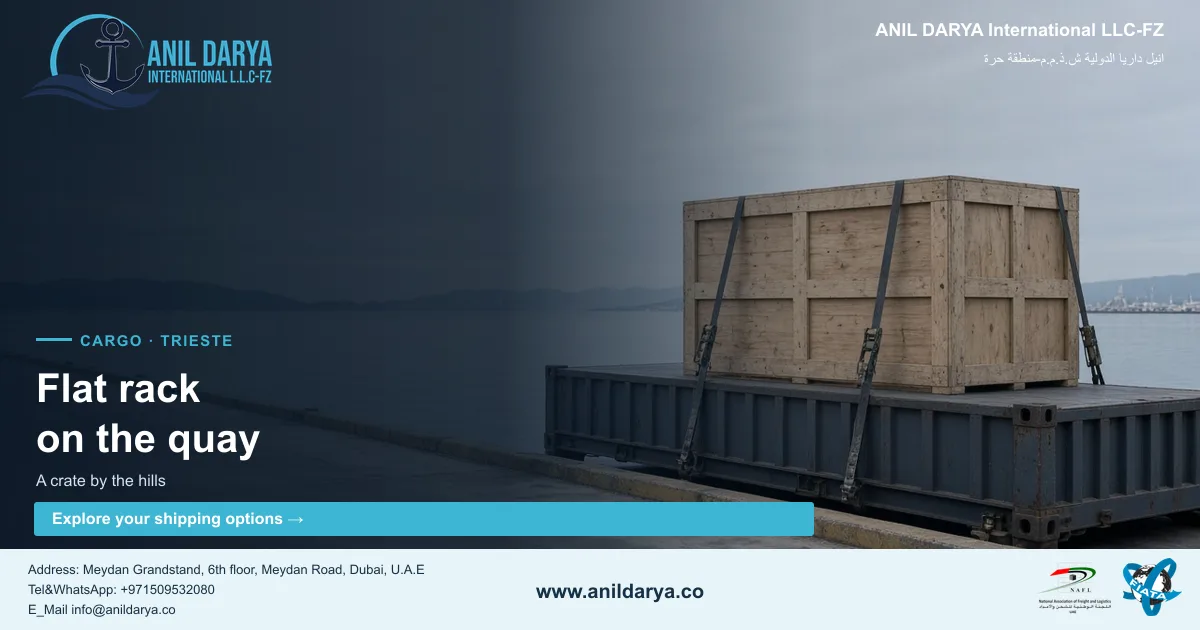
- If the piece fits a flat rack or open top, ship it on a container service into TMT. You get more sailings and the rail option inland.
- If it needs breakbulk or ro-ro tonnage, ask whether the carrier calls EMT, HHLA PLT or Riva Traiana.
- For a unit on wheels or a trailer, ro-ro to Riva Traiana with rail on to Central Europe is a common route.
Coffee deserves a mention because Trieste is one of the Mediterranean's coffee ports. The port handled 108,000 tonnes in the first nine months of 2026 and was on course for its highest total since 2019. Pacorini Silocaf runs the coffee terminal on Pier VII. Our break bulk and project cargo team collects drawings, weights and lifting points before asking a carrier for acceptance.
Dangerous goods at Trieste port
Trieste accepts IMDG dangerous goods. TMT has 450 TEU of stacking positions set aside for IMDG cargo, which limits how many DG boxes it can hold at once. Each terminal also has its own acceptance rules for some classes, and goods such as weapons must go to customs-supervised warehouses. We confirm acceptance with the carrier and the terminal for every DG booking.
What you need for any DG shipment to Trieste:
- UN number, proper shipping name, class and packing group.
- A Safety Data Sheet for each product.
- A Dangerous Goods Declaration signed by a trained person.
- UN-approved packaging, labels and placards.
- If the box goes on by rail, acceptance for the rail leg under the rail dangerous goods rules.
- Any EU permit the product needs, for example under REACH for chemicals.
Our dangerous goods shipping team checks paperwork and carrier acceptance before you commit to a sailing.
Customs at Trieste: a short summary
Italian customs rules are the same at every port, and our Genoa guide covers them in detail. At Trieste the main difference is the free port.
- Goods arriving by sea can enter the free zones with no customs formalities, no duty and no guarantee, and stay with no time limit.
- When the goods leave the free zone into the EU, the importer files the import declaration and pays duty and import VAT. Duty payment can be deferred for up to six months.
- Goods sent on to another EU country can travel under EU external transit and be cleared at destination, for example in Austria or Germany.
- EU goods entering the free zones are treated as exports not subject to VAT.
The rest follows normal EU rules. The carrier files the entry summary declaration at least 24 hours before loading at Jebel Ali, and every importer needs an EORI number. There is no EU-UAE trade agreement in force (talks launched on 28 May 2025), so UAE-origin goods pay the standard third-country duty from the EU tariff. Italy's import VAT is 22%, with reduced rates of 10%, 5% and 4%.
How to ship from Dubai to Trieste port: step by step
This is how we handle a typical shipment from the UAE to Trieste. We book space, prepare documents, and handle UAE clearance and trucking. In Italy we work with your buyer's customs broker or a clearing agent they appoint.
- Send us the details. Commodity, HS code, weight, volume, pickup point, Incoterm and the final destination, including the country if it is outside Italy.
- Confirm the buyer's plan. Import in Italy, free zone storage, or transit to Austria, Germany or another country. This decides who the broker is and where duty is paid.
- Choose the service. We check which carriers deliver to Trieste, the transhipment port, and whether the box lands at TMT or HHLA PLT.
- Book space. For DG, reefer or out-of-gauge cargo we get carrier, terminal and rail acceptance first.
- Pick up and stuff. We arrange the empty, stuffing, seal and VGM, and IMDG packing for DG.
- Clear UAE export. We file the export or re-export declaration with Dubai Customs and gate the box in at Jebel Ali port before the cut-off.
- Send documents early. Bill of lading, invoice, packing list, certificate of origin and any health or DG papers go to the buyer and its broker before arrival.
- Release and delivery. The broker clears the goods, places them in the free zone or opens transit, and the box leaves Trieste by train or truck.
[AMIR-FACT: the carriers or services we actually book from Jebel Ali to Trieste, the transhipment port used, whether they land at TMT or HHLA PLT, and our typical port-to-port days]
How to ship from Trieste port to Dubai
We also handle the other direction: shipping from Trieste to Dubai, with arrival at Jebel Ali, Khalifa Port or Sharjah port. We book the space with the carrier and run the UAE side. The Italian export papers stay with the shipper or its Italian agent.
The Italy export side
- Export declaration. In the EU the export declaration must be lodged electronically in the Automated Export System (AES). Italy's customs agency ADM runs AES in its AIDA system. The exporter, or a declarant acting for it, lodges it at the customs office of export.
- EORI number. Every business established in the EU needs an EORI number for customs operations such as export, and gives it to customs on its filings.
- Office of export and office of exit. If the shipper declares the goods inland or in another EU country, Trieste acts as the customs office of exit. That office checks the goods against the declaration, supervises their departure and confirms the exit to the office of export.
- Licences. Goods under export restrictions need their export licence, which is presented as part of the exit formalities.
The UAE import side
On arrival, the declaration goes to Dubai Customs with the commercial invoice, packing list, certificate of origin and any permit for restricted goods, and we match it against the bill of lading. Customs duty in Dubai is 5% of the CIF value for most goods, with 50% on alcohol and 100% on cigarettes. Import VAT is 5% of the customs value including freight and insurance. A VAT-registered importer whose customs number is linked with the Federal Tax Authority accounts for it on its VAT return instead of paying at the port. The importer needs a Dubai Customs business code, or clears through a licensed clearing agent with the owner's authorization.
- Send us the shipper's details in Italy or Central Europe, the cargo, the HS code and the UAE delivery address.
- We book space from Trieste and send the booking and cut-offs to the shipper.
- The shipper or its trucker, or a rail operator, delivers the stuffed box to the terminal inside the cut-off.
- The shipper or its declarant lodges the export declaration in AES, and the goods clear exit at Trieste.
- We check the draft bill of lading against the invoice and packing list, and track the hub connection.
- We file the UAE declaration before arrival and arrange payment of the duty and VAT.
- We collect the delivery order, truck the box to your site and return the empty inside free time.
[AMIR-FACT: the carriers we actually use from Trieste to Jebel Ali/Khalifa/Sharjah and our real transit days in this direction]
Checklist for Trieste port shipping
- Final destination known: Italy, free zone or another EU country.
- HS code confirmed and duty checked in the EU tariff.
- Buyer's EORI number and customs broker named before sailing.
- Invoice, packing list and bill of lading show the same weights, pieces and consignee.
- Certificate of origin issued in the UAE.
- Arrival terminal (TMT or HHLA PLT) and transhipment port confirmed.
- Rail or truck chosen for the inland leg, with rail acceptance for DG.
- For food: health certificates ready for the border control post.
- For DG: SDS, DG declaration, packaging and terminal acceptance.
- Wood packaging treated and marked to ISPM 15.
- Free time on the container agreed with the line.
Common mistakes when shipping to Trieste
- Assuming the free port means no duty. Duty and VAT are still due when goods enter the EU market. The free port delays and simplifies, it does not exempt.
- Clearing in Italy when the buyer is in Austria. Transit to the buyer's country is often simpler for the buyer's own VAT and accounting.
- Expecting a direct call from Jebel Ali. Most routings tranship, which adds days.
- Booking DG without checking TMT's IMDG space or the rail leg.
- Ignoring free time on a box that waits for a train slot. Our article on demurrage and detention shows how the charges grow.
Trieste or another Italian port?
| Your situation | Port to look at first | Why |
|---|---|---|
| Buyer in Austria, Bavaria, Czech Republic or Hungary | Trieste | Direct trains from the docks, shortest sea route from Suez |
| Goods to be stored, processed or split before sale | Trieste | Free zones with no time limit and deferred duty |
| Buyer in Liguria, Piedmont or Lombardy | Genoa or La Spezia | Short inland leg, more direct calls |
| Buyer in Southern Italy | Gioia Tauro or a southern port | MSC network and rail to Nola and Bari |
| Heavy-lift breakbulk | Genoa | Wider choice of breakbulk berths |
Frequently asked questions
Is Trieste a free port?
Yes. Trieste's free port rests on Annex VIII of the 1947 Paris Peace Treaty. Goods arriving by sea can stay in its five free zones with no customs formalities, no duty and no time limit, and duty can be deferred for up to six months after clearance.
Who runs Trieste port?
The Port Network Authority of the Eastern Adriatic Sea manages Trieste and Monfalcone. Private operators run the terminals, including Trieste Marine Terminal on Pier VII, HHLA PLT Italy, Samer at Riva Traiana and EMT on Pier VI.
What is the port code for Trieste?
The UN/LOCODE for Trieste is ITTRS. It appears on bookings, bills of lading and tracking tools.
How deep is Trieste port?
Trieste has a maximum depth of 18 m. The container quay at Trieste Marine Terminal has a natural minimum depth of 18 m, among the deepest in the Mediterranean.
How many containers does Trieste handle?
Trieste handled 681,733 TEU in 2025, down 19% as transhipment fell, while hinterland containers held at 536,930 TEU. In January to September 2026 the port handled 528,125 TEU, up 2.5%.
Which countries can I reach by rail from Trieste?
Trains from Trieste run to Austria, Germany, Hungary, the Czech Republic, Slovakia, Switzerland and Luxembourg, and inside Italy to Milan, Padua and Bologna. Austria takes 22% of the port's rail volumes.
Can I ship dangerous goods to Trieste?
Yes. Trieste accepts IMDG dangerous goods, and Trieste Marine Terminal has 450 TEU of stacking positions for them. Acceptance must be confirmed with the carrier, the terminal and, if the box goes on by train, the rail operator.
What import VAT applies at Trieste?
Italy's standard VAT rate is 22%, with reduced rates of 10%, 5% and 4%. It is due when goods enter the EU market, not while they stay in the free zones.
How do I ship from Dubai to Trieste port?
Send us the cargo details and the buyer's plan: import in Italy, free zone storage or transit. We book space, clear UAE export at Jebel Ali and send the documents to the buyer's broker, who clears the goods at Trieste.
Can you handle shipping from Trieste to Dubai?
Yes. We book space with the carrier from Trieste, the shipper or its declarant files the EU export declaration, and we clear the cargo through UAE customs and deliver it in the UAE. Most goods pay 5% duty on the CIF value plus 5% import VAT.
Get a quote for Trieste port shipping
Send us your cargo details and your buyer's final destination, and we will come back with a routing and a price from the UAE to Trieste. Use our freight rate inquiry form, or contact our team to talk through a DG, reefer or free zone shipment first. You can also read about our Dubai freight forwarding team.
Sources
- Port Network Authority of the Eastern Adriatic Sea: Free Port
- Port Network Authority of the Eastern Adriatic Sea: The Port (rail, corridors, depth)
- Port Network Authority of the Eastern Adriatic Sea: Technical information (area, docks, berths, depth, rail)
- Port Network Authority of the Eastern Adriatic Sea: Terminal operators
- Port Network Authority of the Eastern Adriatic Sea: Rail intermodal network
- Trieste Marine Terminal: TMT in numbers
- Trieste Marine Terminal: Cranes and quays
- Trieste Marine Terminal: Rail park
- Trieste Marine Terminal: New direct call for the Asia-Mediterranean trade (January 2026)
- HHLA: HHLA PLT Italy
- DFDS: Trieste terminal (Riva Traiana)
- AdriaPorts: Port system 2025 results, Monfalcone surges, Trieste holds steady (January 2026)
- AdriaPorts: Interporto Trieste 2025 results (June 2026)
- Ports Europe: TMT January-September 2026
- Ports Europe: Trieste cargo January-September 2026
- Ports Europe: Austria takes 22% of Trieste's rail volumes (September 2026)
- Ports Europe: Free port extension at Scalo Legnami (September 2026)
- Ports Europe: Trieste coffee volumes 2026
- Findaport: Port of Trieste (maximum drafts by cargo type, location)
- Cogoport: Trieste (ITTRS) port data (lanes, capacity by line)
- Marine Insight: Top 14 major ports in Italy (Trieste largest by tonnage, free zones)
- Wikipedia: Port of Trieste (history, free zones)
- European Commission Access2Markets: Customs clearance documents and procedures (ENS, temporary storage, EORI, transit)
- Your Europe: VAT rates in EU countries (Italy)
- European Commission: EU-UAE agreement negotiations
- European Commission: Exportation (AES, customs office of export and exit, export licences)
- European Commission: EORI number for economic operators
- ADM: Note 297845/RU of 8 June 2023, new AIDA export system (AES)
- Dubai Customs: Submit a customs declaration (invoice, packing list, certificate of origin, permits)
- Dubai Customs: FAQ (5% of CIF value, business code, licensed clearing agents)
- UAE Government portal: Clearing customs and paying customs duty (alcohol 50%, cigarettes 100%)
- Federal Tax Authority: VAT guide, section 3.5 (import VAT at 5% and deferral to the VAT return)
Reviewed: 10 November 2026