
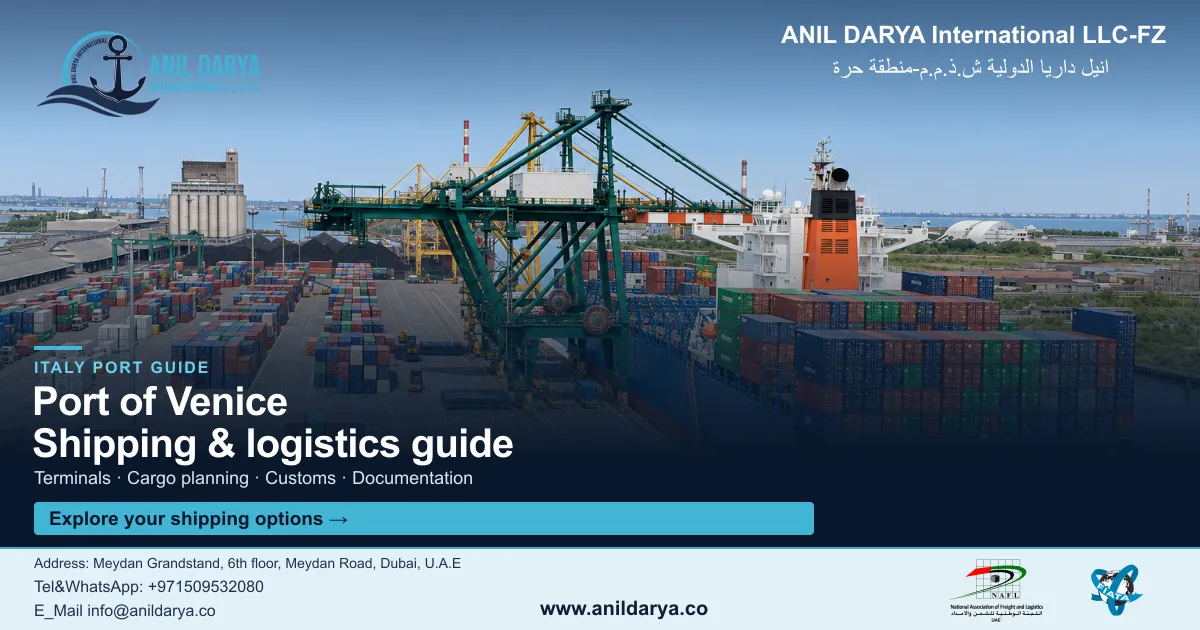
Port of Venice shipping happens at Porto Marghera, the industrial and commercial port on the mainland side of the Venetian lagoon, not in the historic city. Ships reach it through the Malamocco inlet with a draft limit of 11.5 m, and in 2025 Venice handled 25.3 million tonnes and 532,762 TEU. This guide covers the terminals, what the port is good at, customs in short, and how we handle shipping from Dubai to Venice and shipping from Venice to Dubai.
Port of Venice at a glance
| Item | Detail |
|---|---|
| Port authority | North Adriatic Sea Port Authority (also runs Chioggia) |
| Customs authority | Agenzia delle Dogane e dei Monopoli (ADM) |
| UN/LOCODE | ITVCE |
| Where cargo is handled | Porto Marghera, on the mainland edge of the lagoon |
| Sea entrance for cargo ships | Malamocco inlet, then the Malamocco-Marghera canal |
| Maximum draft at Porto Marghera quays | 11.5 m |
| Total port area | Over 2,045 ha |
| Quays and berths | Over 30 km of quays, 163 berths, 27 terminals (10 commercial, 1 passenger, 16 industrial) |
| Rail tracks inside Porto Marghera | Over 135 km |
| Total cargo, 2025 | 25,289,943 tonnes (+4.9%) |
| Containers, 2025 | 532,762 TEU (+11.2%) |
| Main container terminals | PSA Venice (Vecon) and TIV, Terminal Intermodale Venezia |
| Import VAT in Italy | 22% standard rate |
Where is the Port of Venice and how do ships get in?
The Port of Venice sits at the top of the Adriatic. The port authority's own description is a multipurpose port where no single cargo dominates: containers, dry and liquid bulk, steel, chemicals, project cargo and Ro-Ro all have their own terminals. Cargo work happens at Porto Marghera, founded in 1917, which covers over 1,447 hectares of industrial and commercial land.
Venice has two sea entrances. Cargo ships use the Malamocco inlet and follow the Malamocco-Marghera canal, which was dug in 1969. Passenger ships use the Lido entrance. The table shows the draft limits the port authority publishes.
| Area | Access | Maximum draft |
|---|---|---|
| Porto Marghera cargo terminals | Malamocco inlet and Malamocco-Marghera canal | 11.5 m |
| Passenger quays (Marittima, S. Basilio, S. Marta) | Lido entrance and Giudecca Canal | 8.7 m |
| Chioggia (Isola Saloni, Val da Rio) | Chioggia entrance | 7 m |
The port brochure gives a maximum channel depth of 12 m. In practice the 11.5 m draft decides which ships can call. That rules out the largest container ships, so deep-sea boxes for Venice usually arrive on a feeder or a mid-size ship after transshipment at a Mediterranean hub. Wind limits also apply in the lagoon channels. In 2024 the harbour master extended the cruise-ship wind limits to Ro-Ro, ro-pax and container ships, so bad weather can delay arrivals.
A simple rule: Venice suits cargo whose consignee is in the Veneto, Friuli, Lombardy east of Milan or southern Austria, and cargo that needs a lagoon port's heavy-lift and bulk berths. If your shipment needs a direct deep-sea call, a larger Adriatic or Tyrrhenian port may give you more sailings.
Which terminals handle cargo at Porto Marghera?
The port authority lists 10 commercial terminals. Your carrier's booking or your charter decides which one your cargo uses.
| Commercial terminal | What we know about it |
|---|---|
| PSA Venice (Vecon), Molo B | Main container terminal: containers, reefers, out-of-gauge cargo such as marble and steel |
| TIV, Terminal Intermodale Venezia | Second container terminal, 50% owned by MSC |
| Venice Ro-Port MoS | Ro-Ro and ro-pax terminal for Motorways of the Sea traffic |
| Adriatic Multimodal Terminal | Shown in the 2025 port brochure as a project in development |
| Euroports Terminal Rinfuse Venezia, FHP Terminal Venice, FHP Venezia Transped, Decal, San Marco Petroli, Interporto Rivers Venezia, Vezzani-Tencara | Other commercial terminals on the port authority's list; ask us which one fits bulk, liquid or general cargo |
Next to these sit 16 industrial terminals run by companies such as Fincantieri, Cereal Docks, Grandi Molini Italiani, Acciaierie d'Italia, Eni and Versalis. They mainly serve their own plants.
PSA Venice (Vecon)
PSA Venice, also called Vecon, is the main container facility of the port. It sits on Molo B at Porto Marghera and has been controlled by the PSA group of Singapore since 1997.
| PSA Venice facility | Figure |
|---|---|
| Container berths | 5 |
| Quay length | 852 m |
| Area | 28.3 ha |
| Maximum depth at chart datum | 11.5 m |
| Quay cranes | 4 |
| Designed capacity | 430,000 TEU |
The terminal offers stuffing and stripping, covered storage, container inspection and repair, and reefer preparation. Its own site names Piraeus, Malta and Damietta as the hub ports for its East Mediterranean services.
The TIV container terminal
TIV is the second container terminal. In 2025 the port authority extended its concession by 25 years, and the operators plan over 100 million euros of investment, including rail work, with a target of about 400,000 TEU by 2050.
What cargo moves through the Port of Venice?
Here is the 2025 traffic picture from the port's annual figures.
| Cargo (Port of Venice, 2025) | Volume | Change on 2024 |
|---|---|---|
| Total cargo | 25,289,943 t | +4.9% |
| Containers | 532,762 TEU | +11.2% |
| Liquid bulk | 6,988,710 t | -1.9% |
| Minerals, cement and lime | 2,373,758 t | +23.1% |
| Ro-Ro | 2,361,293 t | +0.7% |
| Animal feed and oilseeds | Over 1,530,822 t | Slight fall |
| Cereals | Not published as a figure | +42.5% |
The trend has held into 2026. In the first quarter, container traffic rose 5.7% in TEU and full containers 13.6%, and the port authority put the 12 months to March 2026 at over 25 million tonnes and close to 540,000 TEU.
What this means for you: Venice is strong in agri-food bulk, steel products, chemicals and project cargo. The port authority says thousands of project cargo items pass through Venice every year to more than 50 countries, including the Middle East.
Container shipping at Venice: FCL, LCL and reefers
- FCL (full container load). You book a whole 20ft or 40ft box. This is the usual choice for machinery, building materials and food cargo moving between the UAE and the Veneto.
- LCL (less than container load). Your cargo shares a box with other shippers and is unpacked at a container freight station after arrival. Release depends on the other shippers' paperwork too, so send documents early.
PSA Venice handles refrigerated containers and can inspect, repair and pre-trip reefer units. Tell us the set temperature and ventilation at booking. Our guide to FCL vs LCL costs shows where the break-even sits, and our sea freight service page explains what we book.
Line names change, so check the terminal on every booking. Schedule data compiled by Cogoport for March 2026 showed MSC, CMA CGM, Evergreen, Maersk and X-Press Feeders as the largest capacity providers at Venice.
Project cargo, steel and bulk at Venice
Heavy and oversized pieces are a Venice speciality. The port has bulk and multipurpose berths, the steel plants and engineering firms of the northeast close by, and inland waterway links on the Po river to Mantua and Cremona for class V barges.
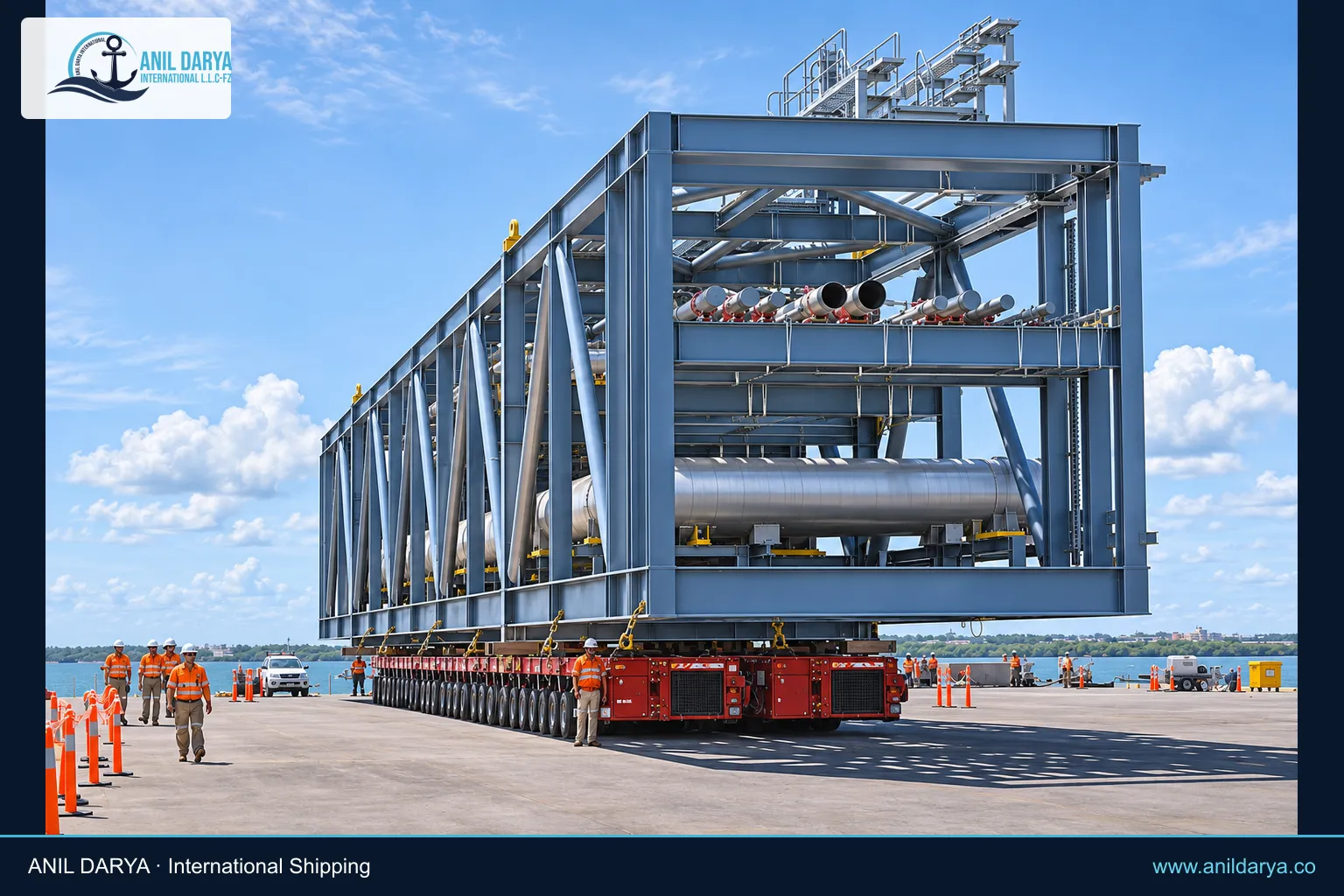
When we plan a project or breakbulk move between Venice and the UAE, we work in this order:
- Collect drawings, dimensions, weights and centre of gravity for each piece.
- Check the ship against the 11.5 m draft limit and the wind rules for the lagoon channels.
- Choose the vessel: flat rack or open top on a container service, or conventional breakbulk or heavy-lift tonnage.
- Agree lifting, lashing and securing with the carrier and the Marghera terminal.
- Plan the road or barge leg to or from the quay, with any permits it needs.
- Line up customs so the cargo can leave the quay quickly.
A useful rule: if a piece fits a 40ft flat rack by size and weight, a container service gives you more sailing options. Our guide to flat rack, open top and breakbulk cargo explains the choice, and our break bulk and project cargo service covers what we arrange.
Dangerous goods at the Port of Venice
Venice handles IMDG dangerous goods, including a large chemical cluster around Porto Marghera. The harbour master (Capitaneria di porto) sets local rules through the port safety regulation, and it has issued separate ordinances for single cargoes in the past. Since the 2024 changes, ships up to 180 m long carrying dangerous goods may transit at night when the channels are marked with approved aids.
What you need for any DG shipment to or from Venice:
- UN number, proper shipping name, class and packing group.
- A Safety Data Sheet for each product.
- A Dangerous Goods Declaration signed by a trained person.
- UN-approved packaging, marks, labels and container placards.
- Carrier acceptance and terminal acceptance before the box is booked.
Our dangerous goods shipping team checks the paperwork and gets carrier acceptance before you commit to a sailing.
Customs at the Port of Venice: a short summary
Italian customs rules are the same at every port, and our Genoa guide covers them in detail. Here is what you need to know for Venice.
- ADM clears the cargo under EU customs law. Every importer needs an EORI number.
- For containers, the carrier files the EU entry summary declaration at least 24 hours before loading at the port of origin.
- On arrival, goods sit in temporary storage under customs control for no longer than 90 days until a procedure is chosen.
- Duty comes from the EU tariff (TARIC). The EU and the UAE launched free trade talks on 28 May 2025, but no agreement is in force, so UAE goods pay the standard third-country rate.
- Italian import VAT is 22% at the standard rate, with reduced rates for some goods.
One Venice-specific point: the Simplified Logistics Zone "Porto di Venezia - Rodigino" covers Porto Marghera and inland areas. It offers tax credits and simplified administrative procedures for companies that set up there, which matters if your buyer is building a distribution site near the port.
How to ship from Dubai to Venice: step by step
This is how we handle shipping from Dubai to Venice. We book space, prepare documents, and arrange UAE trucking and export. A customs representative in Italy, appointed by the consignee, clears the goods.
- Tell us about the cargo. Commodity, TARIC code, weight, volume or dimensions, and the Incoterm agreed with your buyer.
- Confirm the importer. EORI number and customs representative in Italy.
- Pick the service. We compare carrier routings from Jebel Ali into Venice and confirm the hub and the Marghera terminal for each.
- Book space. DG, reefer and out-of-gauge cargo need carrier acceptance first.
- Send shipping instructions early, with a full goods description and real buyer and seller details, so the carrier can file its entry summary declaration before loading.
- Stuff, seal and export. We arrange pickup, stuffing, the UAE export declaration and gate-in. Our Jebel Ali port shipping guide covers this end.
- Pre-lodge in Italy. The consignee's customs representative prepares the import declaration before the feeder arrives.
- Clear and deliver. Duty and VAT are paid, the box leaves Marghera by truck or train, and the empty goes back within free time.
How long does shipping from Dubai to Venice take?
Venice has no direct deep-sea service from the UAE. The port authority's March 2025 sailing list shows container services leaving Venice for the Gulf and Far East via hub ports: MSC via Gioia Tauro, Maersk via Trieste, Hapag-Lloyd via Piraeus. The same hubs work in the other direction. The schedule data we checked did not publish a Jebel Ali to Venice transit time, so plan on one transshipment and confirm the days on your booking.
[AMIR-FACT: the carriers and hub ports we actually use between Jebel Ali and Venice in both directions, which Marghera terminal (Vecon or TIV) each uses, and our typical port-to-port days]
How to ship from Venice to Dubai
Shipping from Venice to Dubai is the reverse lane: Italian machinery, steel products, building materials and food leaving the northeast for the UAE. We book the space with the carrier, coordinate the origin side with the shipper or its agent in Italy, and clear and deliver the cargo in the UAE. We do not have an office in Italy, so the export customs work at origin is done by the seller or the seller's agent.
- Agree the Incoterm. Under FOB Venice the seller delivers the cargo to the ship and handles export clearance. Under EXW you take on more of the Italian side. Our guide to Incoterms 2020 for sea freight explains the split.
- Book space. We book with the carrier from Venice to Jebel Ali or Khalifa Port and confirm the hub port, the Marghera terminal and the cut-offs.
- Pickup and stuffing. The empty is released at Marghera, stuffed at the factory or a warehouse in the Veneto, and returned full to the terminal before the cut-off.
- Export declaration in Italy. The shipper or its customs agent files it electronically in the EU's Automated Export System, and the goods exit at the port.
- Documents for the UAE. Commercial invoice, packing list, certificate of origin and bill of lading, plus any permit needed for restricted goods.
- UAE clearance. We file the import declaration, or a licensed clearing agent does it with your authorisation. Customs duty in Dubai is 5% of the CIF value for most goods, and import VAT is 5%.
- Delivery. We collect the delivery order, book the truck and deliver to your site, Jafza or another free zone.
A VAT-registered UAE importer that has linked its customs registration number with the Federal Tax Authority pays no VAT at import and reports it on the next VAT return instead. If your site is in Abu Dhabi, compare a routing into Khalifa Port in Abu Dhabi to cut the inland truck leg.
Moving cargo inland from Venice
| Mode | What the port offers |
|---|---|
| Rail | Over 135 km of tracks inside Porto Marghera, rail links to Europe, three Motorways of the Sea terminals with 7 berths linked to the railway |
| Road | Motorway connections to the Veneto, Lombardy and the Alpine passes |
| Inland waterway | Po river connections to Mantua and Cremona for class V barges carrying bulk and containers |
| Short sea and Ro-Ro | Ro-Ro terminal of 36 ha able to serve 1,200 ferries a year, daily links with Greece |
The port sits where the Mediterranean and Baltic-Adriatic European transport corridors meet, which is why rail to Austria, Germany and central Europe is a real option for some boxes.
Checklist for Port of Venice shipping
- TARIC code confirmed for every item going to Italy, or the UAE HS code for cargo coming to Dubai.
- Importer named, with an EORI number in Italy or a customs business code in the UAE.
- Ship and hub port checked against the 11.5 m draft limit.
- Marghera terminal (Vecon, TIV or a bulk terminal) confirmed on the booking.
- Invoice, packing list and bill of lading show the same weights, piece counts and parties.
- Full goods description ready before loading for the EU entry summary declaration.
- Certificate of origin and any permits ready for UAE-bound cargo.
- For DG: SDS, DG declaration, carrier and terminal acceptance.
- For project cargo: drawings, lifting points and a road or barge plan.
- Free time on the container agreed with the carrier at both ends.
Common mistakes with Venice shipments
- Sending a haulier to the historic city instead of Porto Marghera. Cargo terminals are on the mainland.
- Assuming a direct call. Venice is reached through a hub, so the hub's connection decides the transit time.
- Ignoring the weather. Wind limits in the lagoon channels can push a feeder arrival back by a day or more.
- Late shipping data. Without a full goods description before loading, the box can be held at the hub or origin.
- Assuming a preferential EU duty rate for UAE goods. No agreement is in force.
- Wrong Incoterm on the Venice to Dubai leg, so nobody files the Italian export declaration in time.
- Ignoring free time. Every extra day adds demurrage or detention. Our article on demurrage and detention shows how it builds up.
Frequently asked questions
Where do cargo ships dock in Venice?
Cargo ships dock at Porto Marghera, the industrial and commercial port on the mainland side of the Venetian lagoon. They enter through the Malamocco inlet and the Malamocco-Marghera canal, not past the historic city.
What is the port code for Venice?
The UN/LOCODE for the Port of Venice is ITVCE. You will see it on bookings, bills of lading and tracking systems.
What is the maximum draft at the Port of Venice?
The port authority sets a maximum draft of 11.5 m for ships berthing at Porto Marghera's cargo terminals. Passenger quays take up to 8.7 m and Chioggia up to 7 m.
How many containers does the Port of Venice handle?
Venice handled 532,762 TEU in 2025, up 11.2% on 2024. The main container terminals are PSA Venice (Vecon) and TIV at Porto Marghera.
How long does shipping from Dubai to Venice take?
There is no direct service, so cargo from Jebel Ali reaches Venice through a Mediterranean hub such as Gioia Tauro, Piraeus or Trieste. The transit time depends on the hub connection, so confirm it on your booking.
Can you arrange shipping from Venice to Dubai?
Yes. We book the space from Venice to Jebel Ali or Khalifa Port, work with the shipper or its agent on the Italian export side, then clear the goods through UAE customs and deliver them in the UAE.
What duty and VAT apply to goods from Venice arriving in Dubai?
Dubai Customs charges 5% of the CIF value for most goods, with higher rates for alcohol and cigarettes. Import VAT is 5%, and a VAT-registered importer with a linked customs registration number can account for it on its VAT return.
Can the Port of Venice handle project cargo?
Yes. The port authority says thousands of project cargo items pass through Venice every year to more than 50 countries. Check each piece against the 11.5 m draft limit for the ship and the terminal's lifting capacity.
Get a quote for Port of Venice shipping
Send us your cargo details, the delivery city and the direction (Dubai to Venice or Venice to Dubai), and we will come back with a routing and a price. Use our freight rate inquiry form, or contact our team to talk through a project, breakbulk or DG move first. You can also read more about our Dubai freight forwarding team.

Sources
- North Adriatic Sea Port Authority: Port of Venice (area, quays, berths, terminals, rail, 11.5 m draft)
- North Adriatic Sea Port Authority: Nautical accessibility
- North Adriatic Sea Port Authority: Terminals and operators
- North Adriatic Sea Port Authority: Port brochure 2025 (channel depth, project cargo, intermodal, Simplified Logistics Zone)
- North Adriatic Sea Port Authority: First quarter 2026 traffic (April 2026)
- North Adriatic Sea Port Authority: Venice container sailing list, March 2025
- Shipping Italy: 2025 traffic at the ports of Venice and Chioggia (January 2026)
- PSA: PSA Venice terminal factsheet (April 2026)
- PSA Venice - Vecon: Company and services
- Shipping Italy: TIV concession extension at Marghera (April 2025)
- Shipping Italy: New nautical access rules in Venice (March 2024)
- Cogoport: Port of Venice (ITVCE) port information and carrier capacity
- European Commission Access2Markets: Customs clearance documents and procedures
- European Commission: What is exportation (Automated Export System)
- European Commission: EU-UAE agreement negotiations
- Your Europe: VAT rates in EU countries (Italy)
- Dubai Customs: Frequently asked questions (duty rate, business code, clearing agents)
- Federal Tax Authority: VAT guide (5% rate, import VAT and deferral)
Reviewed: 10 November 2026