
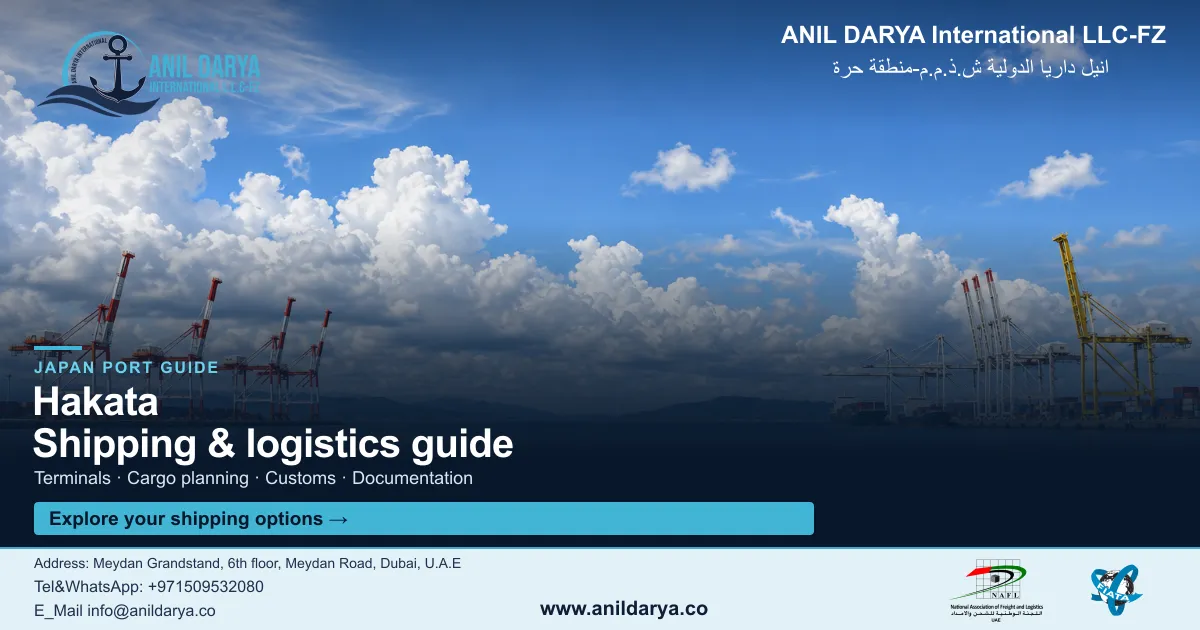
Hakata port shipping means moving cargo through the Port of Hakata in Fukuoka, the main container gateway for northern Kyushu. The port is run by Fukuoka City, handled about 880,000 TEU of international containers in 2024, and its liner network is built around short sea links to Korea, China and Southeast Asia. This guide covers the terminals, the routes that connect it to Dubai, customs at the port and how we ship your cargo there step by step. We ship both from Dubai to Hakata and from Hakata to Dubai.
Hakata port shipping: key facts at a glance
| Item | Detail |
|---|---|
| Port management body | Fukuoka City Port and Airport Bureau |
| Customs office | Moji Customs, whose area covers Fukuoka Prefecture |
| UN/LOCODE | JPHKT |
| Location | Hakata Bay, Fukuoka, northern Kyushu; about 10 km from Fukuoka International Airport |
| Main container terminals | Island City (opened 2003) and Kashii Park Port (opened 1994) |
| Deepest container berths | Island City Nos. 7 and 8, 15 m, 560 m of quay |
| Vessel calls in 2024 | 24,484, about 73.5 million gross tons |
| Total cargo in 2024 | About 32.12 million tons |
| International containers in 2024 | About 880,000 TEU (96.9% of 2023) |
| Liner network (November 2026) | 202 monthly services on 41 international routes, plus domestic feeders |
| Main export item | Automobiles, the main cargo at Kashii Park Port |
| Port IT system | HiTS (Hakata Port Logistics IT System), with real-time container status online |
| Import consumption tax | 10%, or 8% at the reduced rate, on customs value plus duty |
| Hakata to Dubai | Japanese export declaration by the shipper or its broker; UAE duty 5% of CIF for most goods, plus 5% VAT |
Where is Hakata port and which consignees does it suit?
The Port of Hakata sits on Hakata Bay, on the north coast of Kyushu. Busan in Korea is only about 180 km away, closer than Osaka. That short distance shapes the whole port: most of its container services run to Busan, China and Southeast Asia rather than straight to the Gulf.
Fukuoka City says the sea, coastal, rail, air and truck terminals are close together. In practice that means:
- Fukuoka International Airport is about 10 km from the port, which helps when you split a shipment between sea and air.
- Two Fukuoka Urban Expressway exits lead straight to Hakozaki Wharf, with links to the Kyushu Expressway.
- The JR Fukuoka Freight Terminal sits next to Hakozaki Wharf, for rail moves to the rest of Japan.
A simple rule: if your consignee is in Fukuoka, Saga or the northern half of Kyushu, Hakata saves a long truck or rail leg from Kobe or Osaka. If the consignee is in Tokyo or Osaka, a main-line port is usually cheaper and faster.
Which container terminals does Hakata have?
Hakata has two international container terminals on reclaimed land on the east side of the bay. Fukuoka City says the two together handle about 90% of the port's international containers, and both run on the same HiTS system.
| Item | Island City Container Terminal | Kashii Park Port |
|---|---|---|
| Opened | 2003 | 1994 |
| Deep-sea container berths | No. 6: 14 m, 330 m; Nos. 7-8: 15 m, 560 m | Nos. 4-5: 13 m, 600 m |
| Other berths | No. 5: 11 m, 190 m; Nos. 1-4: 7.5 m, 520 m | No. 6: 11 m, 190 m; Nos. 1-3 and 7-9: 7.5 m |
| Container cranes | 6 | 4 |
| Yard handling | 26 transfer cranes (electrified RTGs) | 17 straddle carriers |
| Open storage yard | 672,853 m2 | 372,717 m2 |
| Cargo handled (city figure) | About 10.39 million tons | About 9.00 million tons |
| Share of port containers | About 70% | The rest of the terminal volume |
| Main items | Furniture, rubber products, automobiles, auto parts, clothes and shoes | Automobiles, mixed lots, feed and fertiliser, processed food |
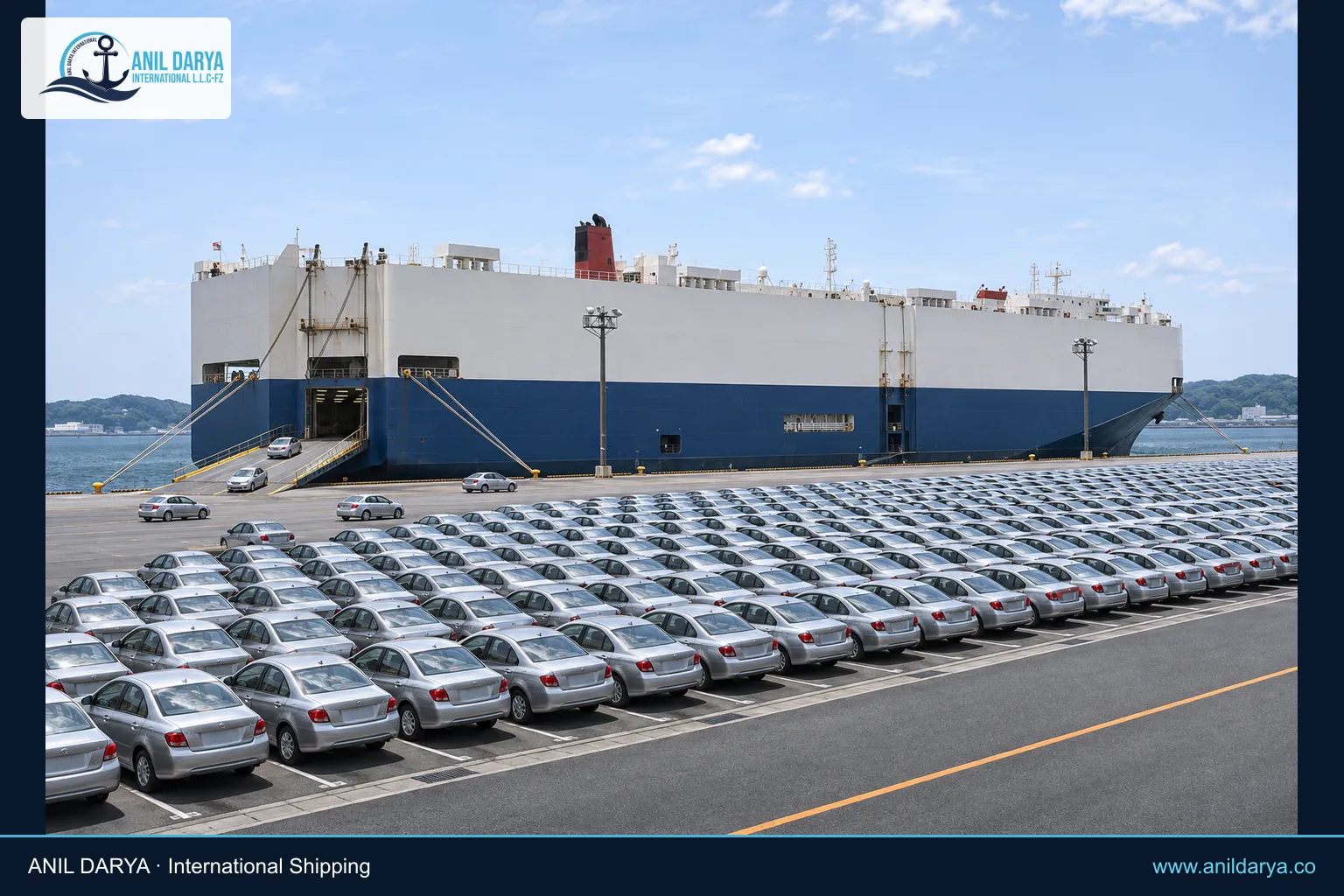
Island City takes the larger ships and most of the boxes. Kashii Park Port's main cargo is automobiles, which the city says make up the majority of Hakata's exports. Your carrier's service decides the terminal, so check it on the arrival notice before the truck is booked.
HiTS shows the status of import and export containers online, including location and customs progress. Ask your consignee's broker to watch it, because it shows whether a box is free to collect.
Other wharves at Hakata for bulk, Ro-Ro and breakbulk
Containers are only part of the port. The city lists several public wharves, each with its own cargo profile.
| Wharf | Main cargo | Deepest berth | Equipment and notes |
|---|---|---|---|
| Hakozaki | Automobiles, transport machinery, grain, fruit and vegetables, rice | 12 m | Largest wharf (263.5 ha); Ro-Ro shed; multistorey car storage; two 400 t/h unloaders; next to the rail freight terminal |
| Suzaki | Corn, wheat, steel products, beans | 12 m | Kyushu's grain base; 14 general cargo sheds; three 400 t/h unloaders |
| Chuo | Automobiles, auto parts, dyes, paints, resins and other chemicals | 10.5 m | International passenger terminal and cruise centre |
| Higashihama | Gravel, sand, cement, petroleum products | 7.5 m | Coastal bulk |
| Aratsu | Petroleum products and LPG | n/a | Nine private landing bridges |
Findaport lists the largest ships by cargo type as 15.0 m draft for containers, 12.0 m for Ro-Ro and bulk, 11.0 m for breakbulk and only 6.5 m for tankers and gas carriers. Hakata is not a deep-water liquid bulk port, so large tanker parcels go elsewhere in Japan.
What cargo can you ship through Hakata?
In 2024 Hakata's foreign trade was 18.17 million tons, with imports at 53.8% and exports at 46.2%. The city says most imports are daily necessities consumed in the region, while exports are mainly industrial products and recycled materials. Automobiles are the largest export item.
| Cargo type | How it moves at Hakata | What to plan |
|---|---|---|
| General cargo from the UAE | FCL or LCL, usually transhipped at Busan or another Asian hub | Hub and feeder on the booking, free time, terminal |
| Food and chilled goods | Reefer containers | Food Sanitation Law notification, plug-in on every leg |
| Steel, machinery, equipment | Flat racks or open tops on container services, or general cargo ships at Suzaki or Hakozaki | Lifting points, lashing, out-of-gauge acceptance at the hub |
| Chemicals and other DG | IMDG containers on lines that accept the class | Acceptance on every leg, Japanese chemical law permits |
| Vehicles (export to the UAE) | Car carriers from Kashii Park Port or Hakozaki, or cars in containers | Export papers, shipper's own vehicle documents |
| Grain and dry bulk | Bulk carriers at Suzaki or Hakozaki | Discharge rate, unloader booking, surveys |
The UAE matters to Hakata in the other direction too. The city's 2024 port statistics list the UAE as one of Hakata's export markets, at 5.5% of export tonnage, and name it among the main destinations for automobiles and auto parts. If you import vehicles or parts from Kyushu into Dubai, Hakata may be your origin port.
Shipping from Dubai to Hakata: routes and transit
Fukuoka City's November 2026 list shows 202 monthly services on 41 international routes at Hakata, not counting feeders. None of them sails to the Gulf. The routes run to:
- Korea: 10 routes, all calling Busan, including a daily Ro-Ro ferry service. Carriers include Dong-Jin, Namsung, CMA CGM, KMTC, MSC, Ocean Network Express, Heung-A and Sinokor.
- China: 14 routes to ports such as Shanghai, Ningbo, Qingdao, Taicang, Tianjin and Dalian.
- Southeast Asia and Taiwan: 15 routes, including Kaohsiung, Hong Kong, Hai Phong, Ho Chi Minh, Laem Chabang and Manila. One Maersk route links Hakata with Shanghai, Ningbo, Sihanoukville, Laem Chabang, Hai Phong and Busan.
- North America and Guam: one route each.
- Domestic feeders: Imoto Lines and Suzuyo Marine link Hakata with Kobe, Keihin (Tokyo Bay) and Moji.
So cargo from Jebel Ali Port reaches Hakata by transhipment. The usual patterns are:
| Routing | How it works | When it fits |
|---|---|---|
| Via Busan | Mainline ship from Jebel Ali to Busan, then a Korea-Hakata feeder | Most FCL; the densest connection to Hakata |
| Via a Chinese or Southeast Asian hub | Mainline to a hub such as Shanghai, Kaohsiung or Hong Kong, then an intra-Asia service | When the carrier's own network runs that way |
| Via Kobe or Keihin | Mainline to a Japanese main port, then a domestic feeder | Carriers that feed Japan from their own hub |
| Main port plus truck or rail | Land at Kobe or Osaka and move inland | When the feeder date does not suit; compare the total cost |
Shipa Freight publishes about 24 days from Jebel Ali to Busan for FCL, so add the feeder leg and connection time on top for Hakata. Treat any published figure as a guide, not a promise.
[AMIR-FACT: our real Jebel Ali to Hakata transit time, the hub we usually route through and the carriers we use on this lane]
FCL, LCL and reefer shipping to Hakata
FCL is the simpler choice. The box stays sealed from Jebel Ali to Island City or Kashii Park, and only the carrier's transhipment adds handling. LCL to Hakata is harder, because few consolidators run a direct box to Fukuoka. Many LCL services unpack in Busan, Kobe or Tokyo and send the cargo on, which adds days and a second handling. Ask where the LCL box is unpacked before you book. Our article on FCL vs LCL costs explains where the break-even point sits.
For reefers, confirm the set point and that the hub and the feeder can plug the box in. Every extra connection is another place where a reefer can wait without power, so a direct feeder from Busan is usually safer than a two-hop routing.
Breakbulk, project and dangerous goods to Hakata
Breakbulk and out-of-gauge cargo
Hakata's general cargo berths at Suzaki and Hakozaki go to 12 m, and findaport gives 11.0 m draft for breakbulk ships. For machinery or steel from the UAE, the practical choices are:
- A flat rack or open top on a container service, if the piece fits by size and weight. You get more sailings, but the hub and the feeder must both accept the out-of-gauge box.
- A conventional general cargo ship into Suzaki or Hakozaki, for pieces too big for a flat rack. Sailings are fewer, so the ship date drives the plan.
- Breakbulk into a larger Japanese port, then coastal or road on to Fukuoka, when no ship serves Hakata in time.
We collect drawings, weights and the centre of gravity, then agree lifting and lashing with the carrier. See our guides on flat rack, open top and breakbulk options and our break bulk and project cargo service.
Dangerous goods
You can ship IMDG dangerous goods to Hakata on lines that accept the class. Because the cargo changes ship at least once, you need carrier acceptance for every leg, including the feeder. Before loading in Dubai you need:
- The UN number, proper shipping name, class and packing group.
- A Safety Data Sheet and a signed Dangerous Goods Declaration.
- UN-approved packaging, labels and container placards.
- Any Japanese permit for the product, held by the importer before the declaration.
Japan Customs checks 30 other laws at import. For chemicals and gases the usual ones are the High Pressure Gas Safety Act, the Poisonous and Deleterious Substance Control Act, the chemical substances act and the Industrial Safety and Health Act. Our dangerous goods shipping team checks classification and acceptance before you commit to a sailing.
Customs at Hakata port: the short version
Hakata follows the same Japan Customs rules as every Japanese port. The port sits in the area of Moji Customs, which covers Fukuoka Prefecture. Here is the summary.
| Rule | What it means for you |
|---|---|
| Advance filing | The carrier or NVOCC files container cargo data through NACCS, no later than 24 hours before the ship leaves the port of loading. Give a precise cargo description at booking. |
| Pre-arrival examination | Once the bill of lading is issued, the importer can file early with the customs office for the bonded area and learn whether the box faces an inspection. |
| Import declaration | Customs Form C-5020, filed by the importer, usually through a customs broker, normally after the goods enter a bonded (Hozei) area. |
| Documents | Invoice and bill of lading; where needed a certificate of origin, packing list, freight and insurance papers, and licences under other laws. |
| Duty | The lowest applicable rate among the general, temporary, WTO and any EPA rate for your HS code. |
| Consumption tax | 10%, or 8% at the reduced rate, on the customs value plus duty plus any excise tax. |
One Hakata point: a box that changed ship in Busan was filed for Japan by the carrier at the first load port, so a vague description in Dubai follows the cargo all the way. The UAE and Japan concluded CEPA negotiations in March 2026, but we found no confirmation that the agreement is in force, so plan on standard duty rates.

Hakata, Kobe or Tokyo: which Japanese port fits your cargo?
| Your situation | Better fit | Why |
|---|---|---|
| Consignee in Fukuoka or northern Kyushu | Hakata | Short delivery leg from Island City or Kashii Park |
| Consignee in Kansai | Kobe or Osaka | More deep-sea services and a short truck leg |
| Consignee in Tokyo or Yokohama | Tokyo or Yokohama | Hakata adds a long domestic leg |
| Fewest handlings for a reefer | Compare a Busan-Hakata feeder with a main port plus truck | Each connection is a risk for temperature control |
| Vehicles or parts from Kyushu to Dubai | Hakata | Loads near the source |
| Large tanker parcel | Another Japanese port | Hakata's tanker draft is only 6.5 m |
We can price a Hakata routing and a main-port routing side by side, so you compare the total cost to the door.
How to ship to Hakata port from Dubai: step by step
- Send us the commodity, HS code, weight, dimensions, packing, DG status and the consignee's full address.
- We compare routings into Hakata, usually via Busan, and a main-port option if it helps.
- Agree the Incoterm with your buyer, so duty, consumption tax and Japanese charges are clear. Our Incoterms 2020 guide for sea freight explains the options.
- We book space and confirm DG, reefer or out-of-gauge acceptance on the mainline and the feeder.
- Your exporter prepares the commercial invoice, packing list and, if useful, a certificate of origin.
- We give the carrier a precise cargo description, because it goes into the Japanese advance filing.
- We truck the cargo to Jebel Ali and handle the UAE export declaration.
- We send the bill of lading and copies to the consignee's customs broker in Japan.
- The broker files the pre-arrival examination and then the C-5020 declaration.
- The consignee pays duty and consumption tax, collects the box from Island City or Kashii Park and returns the empty within free time.
How to ship from Hakata port to Dubai
We also handle shipping from Hakata to Dubai, with arrival at Jebel Ali, Khalifa Port or Sharjah port. This is the busier direction for the UAE trade at Hakata: Fukuoka City's 2024 statistics name the UAE among the main destinations for automobiles and auto parts from the port. We book space with the carrier and run the UAE side. The Japanese export papers stay with the shipper or its Japanese agent, as we have no office in Japan.
The Japan export side
- Export declaration. The exporter, or a customs broker acting for it, declares the nature, quantity and value of the goods to Customs, with the invoice and supporting documents. At Hakata this is Moji Customs.
- Bonded area. The goods must be brought into a Customs (hozei) area or a specially permitted place before export. Customs decides whether to examine them, and the export permit is issued after any examination.
- Other permits. Some cargo needs a permit or approval under other laws first, for example strategically sensitive items controlled by the Ministry of Economy, Trade and Industry. Customs will not permit export until that is proven.
- Pickup. The shipper or its trucker delivers the box or the vehicles to Island City or Kashii Park inside the carrier's receiving window.
The UAE import side
Dubai Customs takes the import declaration with the commercial invoice, the packing list, the certificate of origin and any permit from the authority that controls restricted goods. The carrier releases the cargo against the bill of lading. The importer needs a Dubai Customs business code, or a licensed clearing agent files with its own code and the owner's authorisation. Customs duty in Dubai is 5% of the CIF value for most goods, with 50% on alcohol and 100% on cigarettes. Import VAT is 5%. A VAT-registered importer that has linked its customs registration number with the Federal Tax Authority reports the VAT on its return instead of paying it at release; other importers pay it before the goods are released.
- Send us the shipper's details in Fukuoka or northern Kyushu, the cargo, the HS code, the Incoterm and the UAE delivery address.
- We book space from Hakata to Jebel Ali, Khalifa Port or Sharjah through a transshipment hub such as Busan, and send the booking and cut-offs to the shipper.
- The shipper or its trucker delivers the cargo to the terminal before the cut-off.
- The shipper or its Japanese customs broker files the export declaration and gets the export permit.
- We check the draft bill of lading against the invoice and packing list, with the UAE consignee named correctly.
- We file the UAE declaration before the vessel arrives.
- We arrange payment of the duty and VAT.
- We collect the delivery order from the carrier.
- We truck the cargo to your site, free zone or warehouse, and return the empty within free time.
[AMIR-FACT: the carriers and hub we actually use from Hakata to Jebel Ali, Khalifa Port or Sharjah, and our real port-to-port transit days in this direction]
Checklist before you ship to Hakata
- HS code checked against the Japanese tariff and the applied rate confirmed.
- Consignee's customs broker in Fukuoka named and given the documents early.
- Invoice, packing list and bill of lading agree on description, weight and pieces.
- Licences under other Japanese laws held for food, chemicals, gases or plants.
- Transhipment port and feeder named on the booking.
- DG, reefer or out-of-gauge acceptance confirmed for every leg.
- Arrival terminal (Island City or Kashii Park) passed to the trucker.
- Free time at Hakata agreed with the carrier.
- Cargo insurance arranged, which matters more when the box changes ship.
Common mistakes on Hakata shipments
- Assuming a direct sailing from Jebel Ali. Every Gulf box to Hakata changes ship somewhere.
- Booking LCL without asking where the box is unpacked. A Kobe or Busan unpack adds days.
- Getting DG acceptance for the mainline but not the feeder.
- Vague cargo descriptions. They feed the Japanese advance filing and can trigger a hold.
- Sending the wrong terminal to the trucker. Island City and Kashii Park are separate sites.
- Forgetting the empty return. Our guide to demurrage and detention explains the charges.
Frequently asked questions
What is the port code for Hakata?
The UN/LOCODE for the Port of Hakata is JPHKT. You will see it on bookings, bills of lading and tracking systems.
Who runs Hakata port?
Fukuoka City manages the port through its Port and Airport Bureau. The two international container terminals are Island City and Kashii Park Port.
How many containers does Hakata handle?
Hakata handled about 880,000 TEU of international containers in 2024, according to Fukuoka City. Total cargo that year was about 32.12 million tons.
Is there a direct ship from Dubai to Hakata?
No. Fukuoka City's November 2026 route list shows no Gulf service at Hakata. Cargo from Jebel Ali usually tranships at Busan, or at a Chinese, Taiwanese or Japanese hub.
How long does sea freight from Dubai to Hakata take?
There is no published direct transit. Shipa Freight gives about 24 days from Jebel Ali to Busan for FCL, and the feeder to Hakata comes on top of that.
Which terminal will my container use at Hakata?
The carrier's service decides. Island City handles about 70% of the port's containers and has the deepest berths, at 15 m. Kashii Park Port handles the rest of the terminal volume, and automobiles are its main cargo.
Which customs office clears cargo at Hakata?
Hakata is in the area of Moji Customs, which covers Fukuoka Prefecture. Japan Customs rules are the same at every port, and the importer usually files through a customs broker.
How much consumption tax is charged on imports at Hakata?
Japan charges consumption tax at 10%, or 8% at the reduced rate. It is calculated on the customs value plus duty plus any excise tax.
Can I ship dangerous goods to Hakata?
Yes, on lines that accept the class. Because the cargo changes ship, you need acceptance for each leg, plus any Japanese permit for the product before the import declaration.
Can you handle shipping from Hakata to Dubai?
Yes. We book the space from Hakata, the shipper or its Japanese broker files the export declaration with Moji Customs, and we clear the cargo through UAE customs and deliver it. Most goods pay 5% duty on the CIF value plus 5% import VAT in Dubai.
Get a quote for Hakata port shipping
Send us your cargo details and we will come back with a routing and a price to Hakata, with a main-port comparison if it helps. Use our freight rate inquiry form, or contact our team to talk through DG, reefer or out-of-gauge cargo first.
Sources
- Fukuoka City: Public wharves of Hakata Port (berths, depths, cranes, cargo by wharf)
- Fukuoka City: Port of Hakata pamphlet (status of the port 2024, container terminals, Island City and Kashii Park, Hakozaki, Suzaki and Chuo wharves)
- Fukuoka City: Status of Hakata Port (2024 vessels, cargo, TEU, foreign trade by country and item)
- Fukuoka City: Island City and Kashii Park Port
- Fukuoka City: Hakata Port cargo page
- Fukuoka City: International liner container routes at Hakata (November 2026)
- Fukuoka City: Hakata Port navigation control guidelines
- Findaport: Port of Hakata (maximum vessel size by cargo type, airport distance)
- Hakata Unyu: Shipping (expressway ramp, airport link, rail freight terminal)
- Wikipedia: Fukuoka (location, distance to Busan)
- iContainers: Port of Hakata (UN/LOCODE)
- Moji Customs: Jurisdiction and organization
- Japan Customs: Import procedures
- Japan Customs: Advance Filing Rules on maritime container cargo
- Japan Customs: Pre-arrival examination system
- Japan Customs: Tariff rates and consumption tax
- Japan Customs: Other laws checked at import
- Gulf Business: UAE concludes CEPA negotiations with Japan (March 2026)
- Shipa Freight: UAE to Korea (Jebel Ali to Busan transit)
- Japan Customs: Export procedures (declaration, hozei area, examination, export permit, other laws)
- Dubai Customs: Submit customs declaration (invoice, packing list, certificate of origin, permits)
- Dubai Customs: FAQ (customs business code, clearing agents with owner authorisation, 5% of CIF)
- UAE Government portal: Clearing customs and paying customs duty (5% of CIF in Dubai, alcohol 50%, cigarettes 100%)
- UAE Federal Tax Authority: VAT guide, import VAT at 5% and deferral for registered importers
Reviewed: 10 November 2026