
Port of Shimizu shipping is the sea route into Shizuoka Prefecture, halfway between Tokyo and Nagoya on Suruga Bay. Containers use the Shin-Okitsu terminal, with 700 m of 15 m deep quay, and the older Sodeshi terminal, while other wharves handle pulp, timber, grain, chemicals and fish. This guide explains the terminals, the cargo each wharf takes, and how we handle shipping from Dubai to Shimizu and shipping from Shimizu to Dubai, with the customs steps at each end.
Port of Shimizu guide: key facts at a glance
| Item | Detail |
|---|---|
| Port manager | Shimizu Port Authority, Shizuoka Prefecture |
| Location | Shimizu-ku, Shizuoka City, on Suruga Bay |
| UN/LOCODE | JPSMZ |
| Open port since | 1899 |
| Main container terminal | Shin-Okitsu: 2 berths, 700 m, 15.0 m deep, opened 2003 |
| Largest container ships | About 14,000 TEU class at Shin-Okitsu berths 1 and 2 (since February 2024) |
| Second container terminal | Sodeshi No. 1: 720 m at 12.0 m, containers and timber |
| Container gantry cranes | 6 at Shin-Okitsu (largest reaches 23 rows) plus cranes at Sodeshi |
| Containers handled October 2026 | 43,178 TEU |
| Monthly range January to October 2026 | 38,994 to 47,564 TEU (September not yet posted) |
| Liner network | Service to 129 countries and regions; direct liner calls to 45 ports in 15 countries (April 2024) |
| Average truck time in terminal | About 12 minutes from gate in to gate out (port survey) |
| Other cargo | Pulp, plywood, timber, grain, wood chips, cement, chemicals, oil products, fish |
| Customs authority | Japan Customs |
| Consumption tax on imports | 10% standard, 8% reduced rate |
Where is the Port of Shimizu, and which consignees does it suit?
The port sits in Shimizu-ku, Shizuoka City, in the middle of Shizuoka Prefecture on the Pacific coast. It faces Suruga Bay, which is up to 2,550 m deep, so the approach is open water rather than a long dredged river. The port authority says the Tomei Expressway's Shimizu interchange is about 3 km, or 15 minutes, from the port by the port road, and that the Shin-Tomei and Chubu-Odan expressways open routes to Yamanashi, Nagano and Tokyo.
The port authority itself says most of its cargo comes from the surrounding Shizuoka area. That is the simple rule for choosing it: if your consignee is in Shizuoka Prefecture, Shimizu usually gives the shortest truck leg. If the consignee is in Greater Tokyo, Yokohama or Tokyo is often closer. If it is around Aichi, price Nagoya first.
| Consignee location | Port to price first |
|---|---|
| Shizuoka Prefecture | Shimizu |
| Yamanashi or Nagano | Shimizu, compared with the Tokyo Bay ports |
| Kanagawa or Tokyo | Yokohama or Tokyo |
| Aichi and central Japan | Nagoya |
| Kansai | Osaka or Kobe |
Which container terminals does the Port of Shimizu have?
Shimizu has two container terminals next to each other on the north side of the harbour: Shin-Okitsu and Sodeshi No. 1. Your carrier's service decides which one your box uses, and the arrival notice names it.
Shin-Okitsu container terminal
Shin-Okitsu opened in 2003 and is now the main container terminal. It has two continuous, earthquake-resistant berths, and since February 2024 the port says they can take container ships of about 14,000 TEU class.
| Item | Shin-Okitsu |
|---|---|
| Berths | 2, total 700 m |
| Depth | 15.0 m |
| Berth capacity | 60,000 DWT each |
| Area | 278,591 m² (January 2025) |
| Ground slots | 5,013 TEU |
| Gantry cranes | Cranes 1 to 5: 40.6 t rated, 18 rows; crane 6: 61.0 t rated, 23 rows |
| Yard equipment | 25 rubber-tyred transfer cranes (40.6 t), 6 container forklifts |
| Gates | 10 lanes in (shared with Sodeshi, with a 40ft container scale), 5 lanes out |
Sodeshi No. 1 container terminal
Sodeshi No. 1 was Shimizu's first full container terminal, completed in 1982. Its main 720 m quay has 12.0 m of water and takes three ships of 30,000 DWT, handling containers and timber.
| Item | Sodeshi No. 1 |
|---|---|
| Container quay | 720 m at 12.0 m, 30,000 DWT x 3 |
| Other quays | 240 m at 12.0 m, 350 m at 9.0 m, 655 m at 7.5 m, 240 m at 4.5 m |
| Ground slots | 1,656 TEU |
| Gates | 8 lanes |
| Yard cranes | 7 rubber-tyred transfer cranes, 40.6 t |
| Reefer | Reefer plugs provided |
| Fumigation store | 900 m² |
| Inspection station for imported farm products | 654 m² |
| Crane hours | Container cranes work 24 hours |
The fumigation store and the farm-products inspection station sit at Sodeshi. If your cargo needs plant quarantine or fumigation on arrival, ask whether the carrier discharges there or at Shin-Okitsu, because it changes where the box goes for checks.
The port also runs a shared information system, Port of Shimizu VAN, which it says has a 94% usage rate among local businesses for loading paperwork and container transport bookings.
What cargo moves through the Port of Shimizu?
Beyond containers, Shimizu has seven public wharf areas, each with its own cargo. Knowing which one handles your cargo tells you what kind of ship and berth to look for.
| Wharf | Main berth | Main cargo |
|---|---|---|
| Shin-Okitsu | 700 m at 15.0 m | Containers |
| Okitsu No. 1 | 556 m at 10.0 m, 15,000 DWT x 3 | Marine products and steel |
| Okitsu No. 2 | 440 m at 12.0 m, 30,000 DWT x 2 | Plywood, pulp, marine products |
| Sodeshi No. 1 | 720 m at 12.0 m, 30,000 DWT x 3 | Containers, timber |
| Sodeshi No. 2 | 330 m at 10.0 to 12.0 m, 30,000 DWT | Chemicals, oil products |
| Hinode | 820 m at 12.0 m, 30,000 DWT x 2 | Paper pulp, marine products; 19,286 m² of warehouses |
| Fujimi | 480 m at 12.0 m, 30,000 DWT x 2 | Grain, paper pulp, wood chips, cement |
| Ejiri | 682 m at 6.5 m and 801 m at 4.5 m | Ferry and marine products |
Fujimi has bulk unloaders: a 400 t/h chip unloader, two 300 t/h pneumatic unloaders and a 600 t/h automatic unloader, plus a silo. A new transit shed at Okitsu wharf began operating in July 2025. Shimizu is also a domestic Ro-Ro port, with a line the port promotes as a gateway between Kyushu and the Tokyo area.
How busy is the container side?
The port authority posts monthly container figures. In 2026 they ran from 38,994 TEU in January to 47,564 TEU in March, and October came in at 43,178 TEU, about 95% of October 2025. That makes Shimizu a regional port, much smaller than the Tokyo Bay ports. For you it means fewer direct services, but short truck queues and a compact terminal.
Shipping from Dubai to Shimizu: FCL, LCL and reefer
Most cargo from the UAE reaches Shimizu in containers from Jebel Ali, either on a service that calls Shimizu or via a transshipment hub in Asia with a connecting call. The port says its liners link directly with 45 ports in 15 countries, so check which hub your carrier uses.
- FCL (full container load). You book a whole 20ft or 40ft box. It is discharged at Shin-Okitsu or Sodeshi and trucked to the consignee once cleared.
- LCL (less than container load). Your cargo shares a box. Direct LCL boxes from the Gulf to a port this size are rare, so LCL is often unpacked at a bigger Japanese port and trucked on. Ask where the box is unpacked before you book.
- Reefer. Sodeshi lists reefer plugs, and the container terminals handle reefer boxes for chilled and frozen food. Food still needs the importer's food notification before release.
If your LCL would be unpacked in Tokyo or Nagoya, compare that total with a full box to Shimizu. Our article on FCL vs LCL costs walks through the maths, and our sea freight service covers the container types we book from Jebel Ali Port.
[AMIR-FACT: the carrier or service we actually book from Jebel Ali to Shimizu, the transshipment hub it uses, and our typical port-to-port days]
Breakbulk, project and bulk cargo into Shimizu
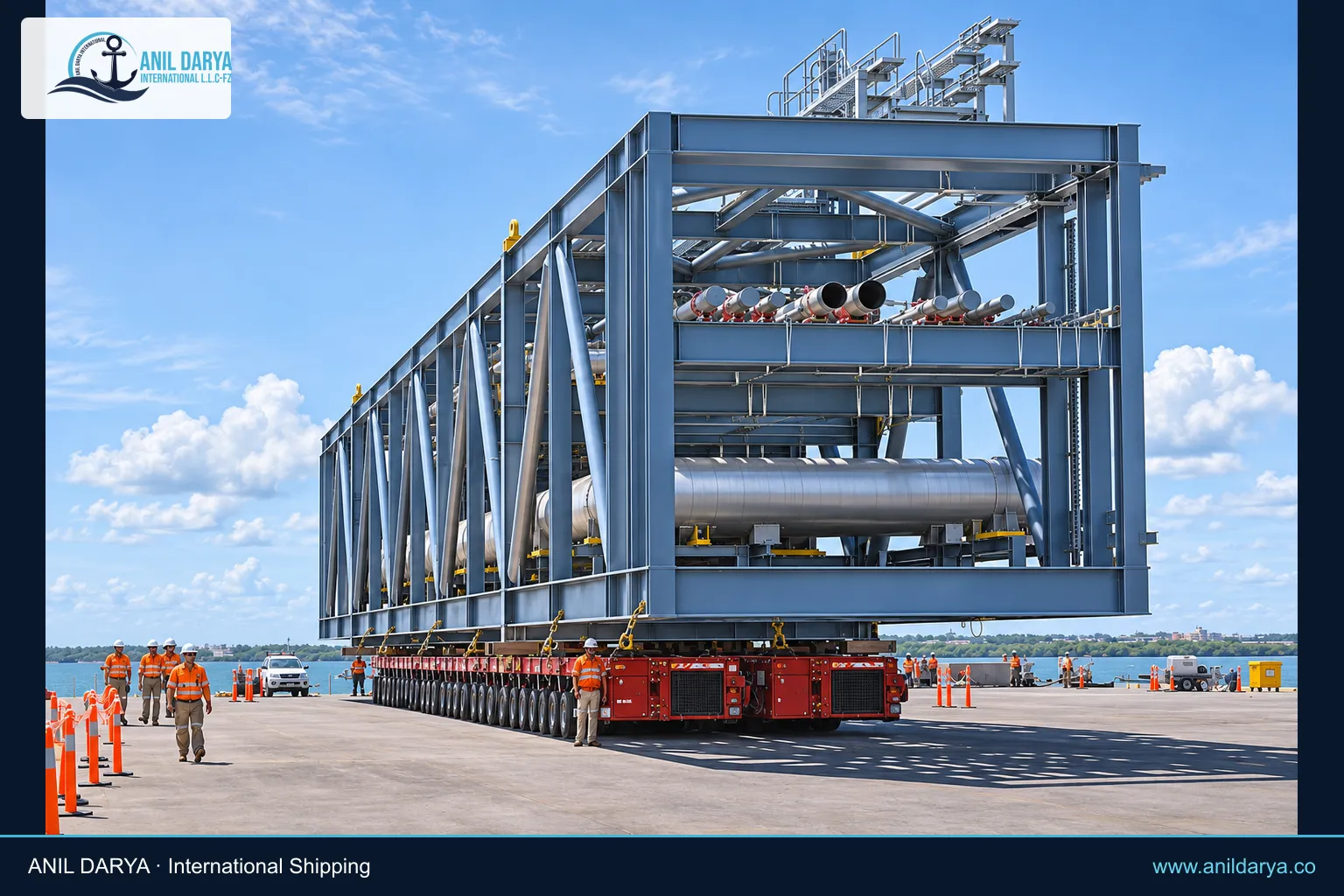
Shimizu has many conventional berths at 12.0 m depth taking 30,000 DWT ships, at Okitsu No. 2, Sodeshi, Hinode and Fujimi. Steel goes over Okitsu No. 1, and pulp, plywood and timber over Okitsu No. 2, Hinode and Sodeshi. That suits breakbulk on general cargo and multipurpose ships.
- Collect drawings, dimensions, weights and centre of gravity for each piece.
- Decide between a flat rack on a container service and breakbulk tonnage. If it fits a 40ft flat rack, the container service gives you more sailings to Shin-Okitsu.
- For breakbulk, confirm the discharge wharf and whether the ship's own gear or a shore crane lifts the piece.
- Check the road route from the wharf to the site with the consignee's trucker, including permits for oversized loads.
- Line up customs and any approvals before arrival so the cargo leaves the quay quickly.
For dry bulk such as grain or wood chips, Fujimi is the wharf with unloaders and a silo, so match the ship's size and the discharge rate to that berth. Our break bulk and project cargo service plans the UAE end, and our guide to flat rack, open top and breakbulk cargo explains the equipment choices.
Dangerous goods to the Port of Shimizu
You can ship IMDG dangerous goods to Shimizu on container services that accept the class. Sodeshi No. 2 handles chemicals and oil products in bulk, but most UAE chemical cargo arrives in containers or ISO tanks. If your box transships at a hub, both carriers and the hub's rules apply, so we confirm acceptance for every leg.
Before loading in Dubai you need:
- UN number, proper shipping name, class and packing group.
- A Safety Data Sheet for each product.
- A signed Dangerous Goods Declaration.
- UN-approved packaging, labels and container placards.
- Carrier acceptance for each leg of the route.
On the Japanese side, some products need approvals under laws Japan Customs checks at import, such as the High Pressure Gas Safety Act, the Explosives Control Act, the Poisonous and Deleterious Substance Control Act and the chemical substances law. The importer must hold any approval before the declaration. Our dangerous goods shipping team checks classification and carrier acceptance before you commit to a sailing.
Customs at the Port of Shimizu: the short version
Shimizu follows the same Japan Customs rules as every Japanese port. The importer declares, usually through a customs broker, once the goods are in a bonded (Hozei) area. The permit follows any examination and payment of duty and consumption tax.
- Advance filing. The carrier or NVOCC must file container cargo data with Japan Customs, in principle 24 hours before the ship leaves the port of loading. Give a precise description and full consignee details at booking.
- Pre-arrival examination. Once the bill of lading is issued, the importer can lodge documents early with the customs office for the bonded area where the box will land, and learn whether it faces a physical, document or simplified check.
- Documents. Import declaration with invoice and bill of lading, plus, where needed, packing list, freight and insurance documents, certificate of origin and licences under other laws.
- Other laws. Japan Customs checks 30 laws at import, including the Food Sanitation Law, the Plant Protection Act and the fertiliser and agricultural chemicals acts.
- Duty and tax. Customs value includes freight and insurance to Japan. Consumption tax is 10%, or 8% at the reduced rate, charged on the customs value plus duty and any excise tax.
The UAE concluded CEPA negotiations with Japan in 2026, but we found no confirmation that the agreement is in force, so plan on standard rates. Our Yokohama guide covers Japan Customs in more depth.

How to ship from Dubai to the Port of Shimizu, step by step
We book space with carriers, prepare documents and handle trucking and export clearance in the UAE. The importer's customs broker clears the goods in Japan.
- Send us the cargo details: commodity, HS code, weight, volume or dimensions, value, Incoterm and the consignee's address.
- Confirm Japanese controls. The importer checks food, plant, chemical or gas approvals and starts them early.
- Pick the routing. We compare services into Shimizu, the hub each uses, and whether Shin-Okitsu or Sodeshi is the discharge terminal.
- Book space. For DG, reefer or out-of-gauge cargo we get carrier acceptance first.
- Prepare documents. Names, weights, marks and HS codes must match across invoice, packing list and bill of lading.
- Export from Dubai. We truck the cargo to Jebel Ali, file the export declaration with Dubai Customs and gate in before the cut-off.
- Carrier files the advance data with Japan Customs before the ship sails.
- The importer's broker lodges the pre-arrival documents, files the declaration, pays duty and consumption tax, and books the truck from the terminal.
Our Dubai freight forwarding team runs the UAE side and keeps the Japanese importer updated on the connection at the hub.
How to ship from Shimizu to Dubai
We also handle the import direction: cargo from Shimizu and Shizuoka to Jebel Ali, Khalifa Port in Abu Dhabi or Sharjah. The routing mirrors the export lane: a service from Shin-Okitsu or Sodeshi, usually via a transshipment hub in Asia, then a main line into the UAE.
We book the space with the carrier and plan the UAE end. The shipper in Japan, or its customs broker, handles the Japanese export side. We do not have an office in Japan, so the origin paperwork stays with the shipper's side.
- Send us the cargo details, the shipper's address, the ready date and the Incoterm. On FOB terms the shipper delivers to the terminal and we book the ocean leg. On EXW terms the shipper's broker or a local trucker must handle pickup and export clearance.
- We book space from Shimizu to the UAE port nearest your site and confirm the terminal, the hub and the cut-offs.
- The goods go into the customs area or a permitted storage place, and the exporter or its broker files the export declaration (Customs Form C-5010) with the invoice.
- Japan Customs checks the declaration, may inspect the goods, and issues the export permit. Goods that need a licence under other laws, such as the Export Trade Control Order, cannot leave until that licence is shown.
- The shipper sends the commercial invoice, packing list and certificate of origin, and we check the draft bill of lading.
- Before arrival we file the UAE import declaration through a licensed clearing agent, using your customs business code or your authorisation.
- Duty and import VAT are settled, the line issues the delivery order, and we truck the cargo to your site in the UAE.
| UAE import item | What applies |
|---|---|
| Documents | Invoice, packing list, certificate of origin, bill of lading, delivery order, permit for restricted goods |
| Customs duty in Dubai | 5% of CIF value for most goods (alcohol 50%, cigarettes 100%) |
| Japanese-origin goods | No UAE-Japan CEPA in force that we could confirm, so plan on the standard rate |
| Who files | Holder of a Dubai Customs business code, or a licensed clearing agent with the owner's authorisation |
| Goods for re-export or temporary import | A deposit equal to the duty, refunded when the goods leave on time |
A planning rule for this direction: ask the shipper to start any Japanese export licence before booking, because the export permit waits for it and a missed cut-off costs a week on a regional port's schedule.
Port charges, free time and demurrage at Shimizu
The port authority says Shimizu has the cheapest dockage in Japan and lower facility fees than the five major ports of Tokyo, Yokohama, Nagoya, Osaka and Kobe. It also runs incentives, including a container cargo support subsidy for shippers of up to 20 million yen through the Shimizu Port Promotion Association. Ask the importer whether it qualifies. Port fee unit prices changed from 1 April 2026 under an amended port ordinance.
Each carrier sets its own free days for containers. After that, demurrage runs while the full box stays in the terminal, and detention while you keep it outside. Late food notifications and missing approvals are the usual reasons boxes overstay. Our article on demurrage and detention explains how the charges add up.
Checklist before you ship to the Port of Shimizu
- Consignee location checked: Shimizu gives the shortest truck leg for Shizuoka.
- Routing and transshipment hub confirmed.
- Discharge terminal named: Shin-Okitsu or Sodeshi.
- HS code checked against Japan's current tariff.
- Importer and customs broker in Japan confirmed.
- Food, plant, chemical or gas approvals started before sailing.
- Precise cargo description given at booking for the advance filing.
- Invoice, packing list and bill of lading match.
- For breakbulk: wharf, lifting gear and road permits confirmed.
- For DG: SDS, DG declaration, packaging, labels and acceptance for every leg.
- For imports to the UAE: shipper's broker named, export licence checked, UAE customs code or agent authorisation ready.
- Free time agreed and cargo insurance in place.
Common mistakes on Shimizu shipments
- Choosing Shimizu for a consignee in Tokyo or Aichi. The truck leg can wipe out any saving.
- Assuming LCL ends at Shimizu. It may be unpacked at a bigger port and trucked on.
- Getting DG acceptance from the main carrier only, without the connecting service.
- Vague cargo descriptions that cause trouble under the advance filing rules.
- Starting the food or plant checks after arrival, which leaves the box in the terminal.
- Pricing duty on the invoice value alone. Freight and insurance are part of the customs value.
Frequently asked questions
Who manages and runs the port of Shimizu?
The Shimizu Port Authority of Shizuoka Prefecture manages the port. Its office is in Hinodecho, Shimizu-ku, Shizuoka City.
What is the port code for Shimizu?
The UN/LOCODE for the Port of Shimizu is JPSMZ. You will see it on bookings, bills of lading and tracking systems.
How deep is the Shin-Okitsu container terminal?
Shin-Okitsu has two berths with a combined 700 m of quay at 15.0 m depth. Since February 2024 the port says they can take container ships of about 14,000 TEU class.
How many containers does the Port of Shimizu handle?
The port authority's monthly figures for 2026 range from 38,994 TEU to 47,564 TEU a month. October 2026 was 43,178 TEU.
What is the difference between Shin-Okitsu and Sodeshi?
Shin-Okitsu is the newer, deeper terminal with 15.0 m berths and six gantry cranes. Sodeshi No. 1 is the older terminal with a 12.0 m quay, reefer plugs, a fumigation store and an inspection station for imported farm products.
Can I ship breakbulk to Shimizu?
Yes. Several wharves have 12.0 m berths for 30,000 DWT ships, and Okitsu No. 1 handles steel. Confirm the wharf, the lifting gear and the road route before booking.
Can I ship dangerous goods to Shimizu?
Yes, on container services that accept the class, with full IMDG documents and acceptance for every leg. Some products also need approvals under Japanese law before import.
How much consumption tax is charged on imports at Shimizu?
Consumption tax is 10%, or 8% at the reduced rate. It is charged on the customs value, which includes freight and insurance, plus duty and any excise tax.
How do I ship from Dubai to Shimizu?
We book a container service from Jebel Ali to Shimizu, usually via a hub in Asia, and handle export clearance in Dubai. The importer's broker in Japan clears the goods and pays duty and consumption tax.
Can you ship from Shimizu to Dubai?
Yes. We book the space from Shimizu to Jebel Ali, Khalifa Port or Sharjah, the shipper's broker clears Japanese export, and we arrange UAE clearance and delivery. Dubai duty is 5% of CIF for most goods.
Get a quote for Port of Shimizu shipping
Send us your cargo details and the consignee's address, and we will come back with a routing and a price from Dubai to Shimizu or from Shimizu to the UAE. Use our freight rate inquiry form, or contact our team to talk through a breakbulk, DG or reefer shipment first.
Sources
- Shimizu Port Authority: Port of Shimizu home page (October 2026 TEU, address)
- Shimizu Port Authority: Monthly container statistics posts (December 2025 to October 2026)
- Shimizu Port Authority: Container terminal features (truck time, dockage, Port of Shimizu VAN)
- Shimizu Port Authority (Japanese): Shin-Okitsu and Okitsu No. 1 wharf (cranes, area, 14,000 TEU class)
- Shimizu Port Authority (Japanese): News (14,000 TEU class, Okitsu transit shed, port fee change)
- Shimizu Port Authority (Japanese): Port overview (Suruga Bay depth, expressway access)
- Shimizu Port Authority: Sodeshi No. 1 wharf
- Shimizu Port Authority: Sodeshi No. 2 wharf
- Shimizu Port Authority: Okitsu No. 2 wharf
- Shimizu Port Authority: Hinode wharf
- Shimizu Port Authority: Fujimi wharf
- Shimizu Port Authority: Ejiri wharf
- Shimizu Port Authority: History
- Shimizu Port Authority: Business (liner network)
- Shimizu Port Authority: Ideal distribution center (expressways, cargo sources)
- Shimizu Port Authority: RORO shipping line
- Shimizu Port Authority: Incentives
- Japan Customs: Import procedures
- Japan Customs: Advance Filing Rules on maritime container cargo
- Japan Customs: Pre-arrival examination system
- Japan Customs: Other laws checked at import
- Japan Customs: Tariff rates and consumption tax
- Japan Customs: Customs valuation details
- Japan Customs: Export procedures
- Dubai Customs: Submit Customs Declaration (documents)
- Dubai Customs: Frequently asked questions (duty rate, business code, clearing agents, deposits)
- UAE Government portal: Customs duty and tariff
- Gulf Business: UAE concludes CEPA negotiations with Japan (March 2026)
- Cogoport: Shimizu (JPSMZ) port information (UN/LOCODE, port authority)
Reviewed: 10 November 2026