
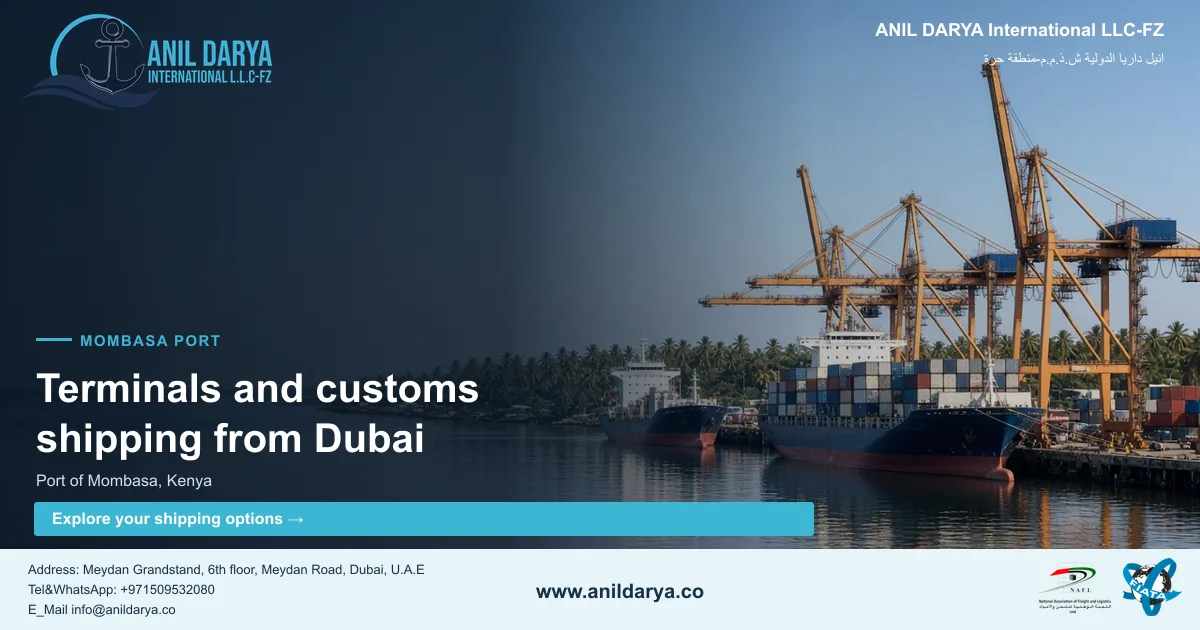
Port of Mombasa shipping covers almost every sea shipment into Kenya and a large share of cargo for Uganda, Rwanda and the other inland markets. The port is run by the Kenya Ports Authority (KPA), clears cargo through the Kenya Revenue Authority (KRA), and links by rail to inland container depots at Nairobi and Naivasha. This guide covers the berths and terminals, what cargo each part of the port handles, clearance at the port, and how to ship to Mombasa from Dubai. We ship both ways: from Dubai to Mombasa, and from Mombasa to Dubai.
Port of Mombasa at a glance
| Item | Detail |
|---|---|
| Operator | Kenya Ports Authority (KPA), established in 1978 |
| Customs authority | Kenya Revenue Authority (KRA) |
| Port code on bookings | KEMBA |
| Position | Latitude 4°03' S, longitude 39°39' E, East African coast |
| Berths | 22, split between conventional cargo and container terminals |
| Container terminals | Two, with 2.3 million TEU of annual capacity |
| Planned capacity | 3.1 million TEU once Berth 23/19B is complete |
| Containers handled in 2025 | 2.11 million TEU, up 5.5% on 2.00 million TEU in 2024 |
| Total cargo in 2025 | 45.45 million tonnes, up 10.9% on 40.99 million tonnes |
| Transit cargo in 2025 | 15.88 million tonnes, up 19.5% |
| Connectivity | Direct links to over 80 ports, over 40 major shipping lines |
| Deepest allowable draft at container berths | 14.5 m (berths 21 and 22) |
| Inland depots | Nairobi, Naivasha, Kisumu and Eldoret |
| Pilotage and tugs | Compulsory for all vessels |
| Tidal range | Highest astronomical tide 4.1 m, lowest 0.1 m |
| Shipping Mombasa to Dubai | Export entry in iCMS by the shipper's clearing agent; import declaration with Dubai Customs, 5% duty and 5% VAT for most goods |
What the Port of Mombasa is and who it serves
Mombasa is Kenya's main sea gateway and one of the largest ports in East and Central Africa. KPA describes its hinterland as Uganda, Rwanda, Burundi, eastern DR Congo, northern Tanzania and South Sudan, reached through road, rail and pipeline. That is why transit cargo grew faster than total cargo in 2025.
KPA is a state corporation that runs Kenya's seaports and inland logistics sites, including the ports of Mombasa, Lamu, Kisumu and Shimoni and the inland container depots. Port operations run 24 hours a day, seven days a week.
For a shipper, three facts shape every booking. Mombasa handles containers and conventional cargo on separate berth groups. Containers for Nairobi can travel inland on a through bill of lading. And clearance runs through KRA systems, not through the port authority.
Berths and terminals at the Port of Mombasa
KPA publishes a berth list with lengths and allowable drafts. The table below groups the main berths by use. Allowable draft is the deepest a loaded ship can sit at that berth, which decides the size of vessel a service can bring.
| Berth | Use | Length | Allowable draft |
|---|---|---|---|
| 1 | Cruise, Ro-Ro, general cargo | 333 m | 10.0 m |
| 3 and 4 | Grain bulk, general cargo | 237 m and 213 m | 10.0 m |
| 5, 8 and 9 | Bulk, general cargo (tidal) | 111 m, 139 m, 215 m | 9.75 m to 11.0 m |
| 7 | General cargo, bulk crude palm oil and vegetable oil (tidal) | 211 m | 10.0 m |
| 10, 13 and 14 | Multi-purpose | 187.5 m, 292 m, 240 m | 10.0 m |
| 11 | Coasters | 216 m | 10.0 m |
| 16, 17 and 18 | Container | 250 m, 252 m, 337 m | 12.5 m |
| 20 | Container | 220 m | 10.0 m |
| 21 and 22 | Container | 350 m and 300 m | 14.5 m |
Specialised terminals
| Terminal | Cargo | Key limits |
|---|---|---|
| Mbaraki Wharf | Multi-purpose, bulk clinker and coal | 306.3 m, 10.5 m draft |
| Base Titanium berth | Titanium bulk cargo | 189 m, 12.5 m draft, 66,000 DWT (tidal) |
| Shimanzi Oil Terminal | Bulk liquids | 198 m, 9.75 m draft, 35,000 DWT (tidal) |
| Kipevu Oil Terminal I | Oil products | 259 m, 13.25 m draft, 85,000 DWT |
| Kipevu Oil Terminal II, berths 1 to 3 | Crude, fuel oil, LPG, jet fuel, diesel, petrol | 300 m each, 14.5 m draft, 120,000 DWT |
| AGOL gas terminal | Gas | 225 m, 9.0 m draft, 25,000 DWT (tidal) |
The new Kipevu Oil Terminal is an offshore island facility with four berths totalling 770 m. KPA says it can take three ships at once, with a capacity of 170,000 DWT, and six onshore pipelines link it to storage tanks.
Capacity work continues at berths 19B, 23 and 24, which KPA figures put at an extra 1.4 million TEU, alongside a terminal operating system upgrade and automated gates.
What cargo can you ship through Mombasa?
| Cargo | Where it is handled | What to plan |
|---|---|---|
| Containers (dry and reefer) | Container berths 16 to 22 | Free days, release order, inland leg |
| Steel and general breakbulk | Berths 1 and 2, multi-purpose berths | Lashing, discharge rate, trucks at the quay |
| Vehicles and Ro-Ro | Berths 1 and 2 | Age rule, inspection, storage |
| Bulk grain | Dedicated grain berths | Conveyor to silos or bagging at ship side |
| Soda ash, clinker, coal, titanium | Specialised berths and Mbaraki Wharf | Receiving facility, berth priority |
| Edible oils | Berth 7 | Tank reception, survey |
| Petroleum products and gas | Kipevu and Shimanzi oil terminals, AGOL | Terminal acceptance, DG rules |
| Project and heavy-lift cargo | Multi-purpose berths | Lift plan, road permits, route survey |
Container shipping at Mombasa
Containers work at berths 16 to 22. The deepest, berths 21 and 22, allow a 14.5 m draft, so the largest container services call there. Reefers are plugged in and monitored, and KPA offers container stripping and restuffing as shore handling services.
Storage charges start when a container stays in the terminal beyond the free period. The fastest way to avoid them is to have the customs entry ready before the ship berths. With LCL, your goods are unpacked at a container freight station, so the release also depends on the other consignees in the same box. Our guide to FCL vs LCL costs covers when sharing a box stops making sense.
Breakbulk, bulk and project cargo at Mombasa
Mombasa is a strong conventional cargo port. KPA says berths 1 and 2 serve steel, container and Ro-Ro ships, and berths 5, 11 and 12 take conventional and container ships with their own gear. Grain is discharged either by conveyor to silos outside the port or by grabs into bagging plants alongside the ship.
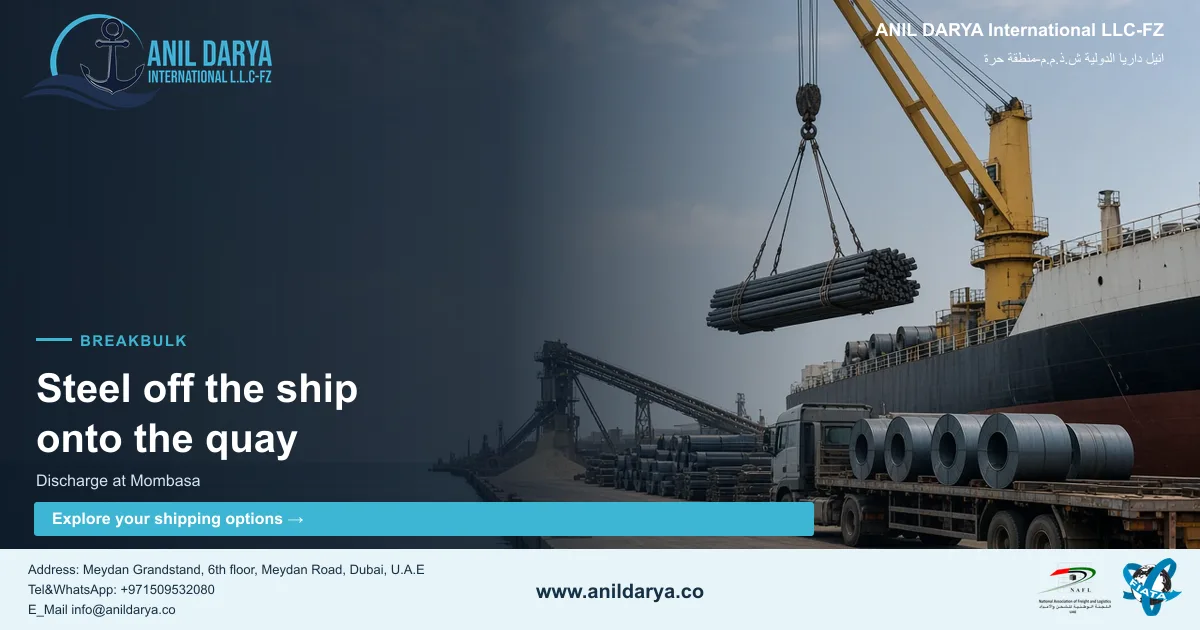
A decision rule for big pieces: if the item fits a 40ft flat rack, a container service usually sails more often. If it does not, book breakbulk or heavy-lift tonnage and plan the road move from the quay before the ship arrives. We cover flat racks and open tops in our guide to out-of-gauge cargo, and our break bulk and project cargo service explains what we arrange in Dubai.
Vehicles at Mombasa: Ro-Ro or container?
Vehicles reach Mombasa two ways. Ro-Ro ships drive cars, trucks and plant on and off at berths 1 and 2, which KPA lists for Ro-Ro. Smaller units can also travel inside containers, which protects them and lets you ship spare parts in the same box. Either way, KRA states that vehicles over 8 years old are not allowed into Kenya under the KS 1515 standard, so check the year of first registration before the vehicle leaves Dubai.
Dangerous goods at Mombasa
KPA says dangerous cargo is handled under international maritime regulations and its own safety procedures. In practice, the carrier must accept the class before loading, and the documents must be right before the ship sails from Dubai. You need the UN number, proper shipping name, class and packing group, a Safety Data Sheet, a signed Dangerous Goods Declaration, UN packaging and correct labels and placards. Fuels and gases go through the oil and gas terminals, not the container berths. Our dangerous goods shipping team checks classification and carrier acceptance first.
Marine services: pilotage, tugs and anchorages
Pilotage is compulsory for every vessel calling at Mombasa unless management exempts it, and KPA runs four pilot boats around the clock. Tugs and mooring boats are compulsory too, from a fleet of six tugs. Shipping agents send vessel arrival information and berth requests before arrival, and KPA allocates berths by vessel type, cargo and availability.
KPA lists three anchorages, Kilo, Sierra and Uniform, with available depths of 12.5 m, 15.4 m and 7.6 m. Shipping lines handle these steps through their agents. For you they matter in one way: berth waiting time adds days to the arrival date, so leave a margin before the consignee's deadline.
Inland links: SGR, Nairobi and Naivasha depots
Most containers landing at Mombasa are going somewhere else in Kenya or beyond. KPA runs inland container depots at Nairobi, Naivasha, Kisumu and Eldoret.
| Depot | Rail link | Facts from KPA | Best for |
|---|---|---|---|
| ICD Nairobi | Standard Gauge Railway and metre gauge railway | 43.5 hectares, over 450,000 TEU a year, 4 warehouses and 3 sheds | Consignees in and around Nairobi |
| ICD Naivasha | Standard Gauge Railway | 3,588 ground slots | Transit cargo for Uganda, Rwanda, DR Congo, northern Tanzania, South Sudan, and the Rift Valley |
Imports move from Mombasa to the depots on a through bill of lading, and exports can be consolidated at a depot and railed to the port. Decide before you book whether the consignee wants the box cleared at a container freight station near the port or at an inland depot. It changes the bill of lading, the customs entry and the delivery plan.
Customs clearance at the Port of Mombasa
KRA, not KPA, clears goods. A licensed clearing agent lodges the entry in KRA's Integrated Customs Management System (iCMS), and permits from other government agencies run through KenTrade's National Electronic Single Window System. After clearance and payment of duties and port charges, the terminal issues a container release order and the line issues the delivery order.
Container freight stations: nominate one before loading
Domestic containers are no longer cleared inside the port. A KPA customer notice of 4 December 2025, passed on to customers by Maersk, says clearance of domestic containerised cargo at the Port of Mombasa stopped from 10 December 2025. Containers now move to a container freight station (CFS) for clearance.
- Pre-nominate a CFS at the port of loading. For cargo from Dubai, that means at booking in Jebel Ali.
- Cargo with no nomination goes to the Container Freight Station Association, which allocates a nearby CFS. You lose the choice of operator.
- Cargo on a through bill of lading to an inland depot is not affected.
Ask the consignee or its clearing agent which CFS they use before you book, and we put it on the booking and the bill of lading instructions.
Which agencies can check cargo at Mombasa?
Besides KRA customs, other government bodies work in the port and can hold cargo for checks. The Logistics Cluster port assessment lists the Kenya Bureau of Standards (KEBS), the Kenya Plant Health Inspectorate Service (KEPHIS), the National Biosafety Authority, Port Health Services and the Anti-Counterfeit Authority. Plants and food may need KEPHIS or port health clearance, branded goods can draw an anti-counterfeit check, and regulated products are checked against their KEBS certificate.
Documents for clearance at Mombasa
| Document | Why it matters at Mombasa |
|---|---|
| Bill of lading | Consignee must match the importer on the customs entry |
| Commercial invoice and packing list | Value, weights and package count are checked against the entry |
| Import Declaration Form (IDF) | Filed by the importer's agent with KRA |
| KEBS certificate of conformity | Needed for regulated products shipped from a PVoC country such as the UAE |
| Certificate of origin | Required on imports since 1 July 2025, enforced from 1 October 2025 |
| Marine insurance certificate | From an insurer licensed in Kenya, submitted digitally to iCMS |
| Permits | From the agency that regulates the product |
KPA lists the usual causes of slow clearance as incomplete documents, customs queries, unpaid charges, inspection delays and permit problems. Customs and other agencies may inspect cargo, and cargo verification checks that the goods match the declaration.
Duty and taxes on goods landed at Mombasa
Kenya applies the EAC Common External Tariff, with bands of 0% for raw materials and capital goods, 10% and 25% for intermediate goods, and 35% for finished products available in the region. Sensitive products listed in Schedule 2 pay more than 35%. Import VAT is 16%. The Import Declaration Fee and the Railway Development Levy are both charged on the customs value. Their rates have been amended several times, so confirm the current figures with the clearing agent.
How to ship from Dubai to Mombasa, step by step
This is how we move a typical shipment from the UAE to Mombasa. We handle the Dubai side and work with the consignee's clearing agent in Kenya.
- Send the cargo details. Commodity, HS code, weight, dimensions, value, Incoterm and the final delivery point.
- Confirm the Kenyan requirements. The consignee's agent checks the tariff band, permits and PVoC status.
- Pick the mode and service. FCL, LCL, breakbulk, bulk or DG, sailing from Jebel Ali Port on a service that calls Mombasa.
- Choose the clearance point. A nominated CFS at Mombasa, or ICD Nairobi or Naivasha on a through bill of lading.
- Get the certificates in the UAE. Certificate of conformity from the KEBS partner and the certificate of origin.
- Stuff and gate in. The PVoC inspector attends before the seal goes on; we deliver to the terminal before cut-off.
- File the UAE export declaration and release the bill of lading. We send the full document set to Kenya before arrival.
- Arrival and clearance. The agent lodges the entry in iCMS, pays duties and charges, and collects the release order.
- Delivery. Truck from the port or rail to the inland depot, then the empty goes back within free time.
[AMIR-FACT: Our real Jebel Ali to Mombasa transit time and the carrier services we book, plus one real Mombasa shipment we handled, cleared for publication]
How to ship from the Port of Mombasa to Dubai
We also handle the other direction: shipping from Mombasa to Dubai, with arrival at Jebel Ali, Khalifa Port or Sharjah port. We book the space with the carrier and run the UAE side. The Kenyan export papers stay with the shipper or its Kenya clearing agent. As one published example, Emirates Shipping Line's GIA service sails Mombasa, Dar es Salaam, Nhava Sheva, Mundra and then Jebel Ali, and its July 2025 schedule lists 21 days from Mombasa to Jebel Ali.
The Kenya export side
- Export entry. The shipper's clearing agent sends the export declaration (C17B) to KRA electronically, lodged against the manifest the shipping agent has registered.
- Documents. KRA lists the commercial invoice, the bill of lading, the packing list, the certificate of origin and all necessary permits.
- VAT link. Since May 2026 the exporter's PIN and a valid TIMS or eTIMS zero-rated invoice number must be captured in iCMS when the export documents are lodged.
- Release. Customs processes the entry, an officer verifies or supervises stuffing before release, and a Certificate of Export is issued once the export is confirmed.
The UAE import side
We file the import declaration with Dubai Customs before the vessel arrives. Dubai Customs asks for the commercial invoice, the packing list, the certificate of origin and a permit from the relevant authority for restricted goods, and the carrier releases the cargo against the bill of lading. Customs duty in Dubai is 5% of the CIF value for most goods, with 50% on alcohol and 100% on cigarettes. Import VAT is 5%. A VAT-registered importer accounts for it on its VAT return under the reverse charge; anyone else pays it before the goods are released.
- Send us the shipper's details in Mombasa, the cargo, the HS code and the UAE delivery address.
- We book space from Mombasa and send the booking and cut-offs to the shipper.
- The shipper or its trucker stuffs the container and delivers it to the Mombasa terminal or the inland depot named on the booking.
- The shipper or its Kenya agent files the export declaration in iCMS.
- We check the draft bill of lading against the invoice, packing list and certificate of origin.
- We file the UAE declaration with Dubai Customs before the vessel arrives.
- We arrange payment of the duty and VAT and collect the delivery order from the carrier.
- We truck the container to your site and return the empty to the depot the line names within free time.
[AMIR-FACT: the carriers we actually use from Mombasa to Jebel Ali/Khalifa/Sharjah and our real transit days in this direction]
Checklist for shipping to the Port of Mombasa
- Consignee name identical on the bill of lading, IDF and invoice.
- HS code and tariff band confirmed for every item.
- PVoC certificate issued before the container was sealed, where the product is regulated.
- Certificate of origin from the UAE in the document set.
- Kenyan marine insurance bought by the importer.
- CFS nominated at booking, or a through bill of lading to an inland depot.
- For DG: SDS, DG declaration, packaging, labels, carrier and terminal acceptance.
- For breakbulk: piece list with weights and dimensions, lifting points and the road route from the quay.
- Free days on the container agreed with the line.
Common mistakes at Mombasa
- No CFS nomination. The container is allocated to a CFS you did not choose, and the agent has to work with an unfamiliar operator.
- Booking the wrong delivery point. A box consigned to Mombasa cannot simply be railed to Nairobi on a through bill of lading later.
- Waiting for arrival to start the entry. Storage begins after the free period whether or not the papers are ready.
- Missing PVoC. Regulated goods from the UAE need the certificate before shipment.
- No certificate of origin. It has been enforced since October 2025.
- Vague cargo descriptions. They invite classification and valuation queries.
- Ignoring tidal berths. Some bulk and liquid berths are tidal, so discharge plans must allow for it.
Frequently asked questions
Who operates the port of Mombasa?
The Kenya Ports Authority operates the Port of Mombasa. KPA also runs the ports of Lamu, Kisumu and Shimoni and the inland container depots, while the Kenya Revenue Authority handles customs.
How many berths does the Port of Mombasa have?
KPA says the port has 22 berths divided between conventional cargo and container terminals. It also has specialised oil, gas and bulk terminals, including the Kipevu Oil Terminal and Mbaraki Wharf.
What is the container capacity of Mombasa port?
Mombasa has two container terminals with a combined capacity of 2.3 million TEU a year. KPA plans to raise this to 3.1 million TEU once Berth 23/19B is complete. The port handled 2.11 million TEU in 2025.
What is the maximum draft at Mombasa container berths?
KPA lists an allowable draft of 14.5 m at container berths 21 and 22, and 12.5 m at berths 16 to 18. Berth 20 allows 10.0 m.
How do I ship from Dubai to Mombasa?
We book space from Jebel Ali on a service that calls Mombasa, arrange the PVoC certificate of conformity and certificate of origin, file the UAE export declaration and send the documents to Kenya. The consignee's agent lodges the entry in iCMS, pays duties and collects the release order. Bookings use the port code KEMBA.
Where are containers cleared at Mombasa?
Since 10 December 2025, domestic containers are cleared at a container freight station, not inside the port. Nominate the CFS at the port of loading. Containers on a through bill of lading to an inland depot are cleared at that depot instead.
Can containers go from Mombasa to Nairobi by rail?
Yes. ICD Nairobi links to the port by the Standard Gauge Railway and the metre gauge railway. Imports can move to the depot on a through bill of lading and be cleared there.
What documents are needed to clear cargo at Mombasa?
You need the bill of lading, commercial invoice, packing list, Import Declaration Form and customs entry, plus a certificate of origin, a Kenyan marine insurance certificate, a KEBS certificate of conformity for regulated goods and any permits.
Can I ship dangerous goods to Mombasa?
Yes. KPA handles dangerous cargo under international maritime rules. Fuels and gases use the oil and gas terminals, and containerised DG needs carrier acceptance, a DG declaration, an SDS and correct packaging.
Can you ship from Mombasa to Dubai?
Yes. The shipper's clearing agent lodges the export entry in iCMS. We book the space, file the Dubai Customs declaration, arrange payment of the 5% duty and 5% import VAT where due, and deliver from Jebel Ali, Khalifa Port or Sharjah.
Get a quote for Port of Mombasa shipping
Send us your cargo details and we will come back with a routing and a price from Dubai to Mombasa. Use our freight rate inquiry form, or contact our team about breakbulk, bulk or DG cargo. You can also read more about our Dubai freight forwarding team or bulk shipping from Dubai to Africa.
Sources
- Kenya Ports Authority: Port of Mombasa (berths, container capacity, terminals, Kipevu Oil Terminal)
- Kenya Ports Authority: Marine information (berth list, drafts, anchorages, pilotage, tugs, tides)
- Kenya Ports Authority: Ports and terminals (connectivity, shipping lines, ICDs)
- Kenya Ports Authority: Inland Container Depots
- Kenya Ports Authority: Services (stevedoring, shore handling)
- Kenya Ports Authority: FAQ (operator, hours, clearance, DG, storage)
- Khusoko: Port of Mombasa 2025 volumes, KPA figures (January 2026)
- KRA: How to import
- KRA: Importation (clearing agents and iCMS)
- KRA: Customs FAQ (VAT, vehicle age limit)
- KRA public notice: Mandatory certificate of origin on imports
- East African Community: Four-band Common External Tariff
- KenTrade: National Electronic Single Window System
- SGS: Kenya PVoC mandate 2026 to 2029, UAE zone
- Clyde and Co: Local marine cargo insurance in Kenya (June 2026)
- Maersk: Mombasa domestic cargo clearance moved to CFS (KPA notice of 4 December 2025)
- Logistics Cluster: Kenya port assessment, Port of Mombasa (agencies in the port)
- Cogoport: Port of Mombasa (KEMBA)
- Dubai Customs: Submit customs declaration (invoice, packing list, certificate of origin, permits)
- UAE Government portal: Customs duty (5% of CIF in Dubai, alcohol 50%, cigarettes 100%; GCC-origin goods and the 40% test)
- Federal Tax Authority: VAT Taxable Person Guide, chapter 9 Import of goods (5% rate, reverse charge, payment before release)
- KRA: Customs brochure, import and export processes (C17B export entry, documents, Certificate of Export)
- KRA public notice, 23 April 2026: export process in iCMS linked to the VAT return
- Emirates Shipping Line: GIA service advisory and schedule, July 2025 (rotation and transit days)
Reviewed: 10 November 2026