
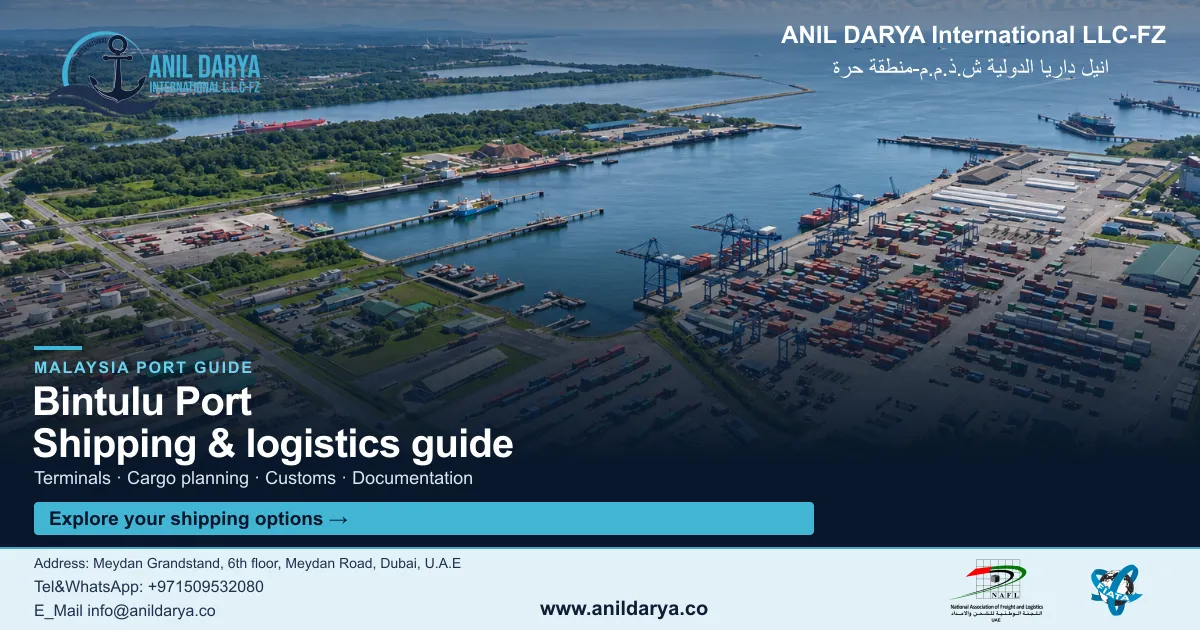
Bintulu Port shipping covers far more than containers: the port in Sarawak exports LNG, palm oil, fertiliser and metals, and its container terminal (BICT) is the main box gateway for central Sarawak. The port group handled 52 million tonnes and 313,000 TEU in 2025. This guide explains the terminals, what each one takes, the local free storage and DG rules, and how we handle shipping from Dubai to Bintulu and shipping from Bintulu to Dubai.
Bintulu Port shipping: key facts at a glance
| Item | Detail |
|---|---|
| Port authority | Bintulu Port Authority (Sarawak), a state port since 1 September 2026 |
| Port operator | Bintulu Port Sdn Bhd (BPSB), part of Bintulu Port Holdings Berhad (BPHB) |
| Other group ports | Samalaju Industrial Port (dry bulk and breakbulk); Biport Bulkers (palm oil bulking) |
| UN/LOCODE | MYBTU |
| Port opened | 1 January 1983 |
| Group cargo 2025 | 52 million tonnes, 313,000 TEU, more than 7,600 vessel calls |
| Share of Sarawak trade | Over 80% of the state's trade movements |
| Container terminal | Bintulu International Container Terminal (BICT), commissioned 1999 |
| BICT berths (authority data) | 2 berths, 450 m, 14 m alongside, ships up to 55,000 DWT |
| LNG terminal | 3 berths, 15 m alongside, carriers up to 80,000 DWT |
| Free storage at BICT | Laden 7 days, empty 12 days, transhipment 28 days, DG 2 days |
| Direct services to the Gulf | None on the port's published list; cargo relays through a hub |
| Customs authority | Royal Malaysian Customs Department, import declaration on Form K1 |
Where is Bintulu Port and who runs it?
Bintulu Port sits on the coast of central Sarawak, on the island of Borneo, facing the South China Sea. Port limits run in a 10 nautical mile radius from Tanjung Kidurong, and Bintulu airport is under 30 km away.
The Bintulu Port Authority was set up on 15 August 1981 and the port opened on 1 January 1983. Port operations were privatised on 1 January 1993, when Bintulu Port Sdn Bhd became the licensed operator. On 1 September 2026 the port changed from a federal port to a Sarawak state port, and the authority was renamed Bintulu Port Authority (Sarawak). The authority regulates; BPSB handles the cargo.
BPHB calls Bintulu East Malaysia's largest container port. Its group handled more than 80% of Sarawak's trade movements in 2025. Main cargo includes LNG, aluminium, pulp and paper, silicon, manganese, fertiliser, downstream timber and agro products.
Bintulu Port terminals: which one handles your cargo?
Bintulu is a set of specialised terminals around an inner harbour basin, plus the separate Samalaju port to the north-east. The figures below come from the port authority's facility pages, which were last updated in 2013. Confirm current limits for your vessel with the carrier.
| Terminal | Berths and length | Depth alongside | Max vessel | Main cargo |
|---|---|---|---|---|
| BICT container terminal | 2 berths, 450 m | 14 m | 55,000 DWT | Containers, dry and reefer |
| General cargo wharves | 3 berths, 514.5 m | 10.5 m | 25,000 DWT | Mainly breakbulk, some dry and liquid bulk |
| Dry bulk terminal | 3 berths | 14 m | 55,000 DWT | Dry bulk |
| Dangerous goods facility | 1 berth, 270 m | 13.5 m | 60,000 DWT | Urea and liquid ammonia from the fertiliser plant |
| Liquid bulk terminal | Dual-faced jetty | 11 m | 30,000 DWT | Petroleum and chemicals |
| LNG terminal | 3 berths | 15 m | 80,000 DWT | LNG, piped from the MLNG plants |
BICT: the container terminal
BICT was commissioned in 1999 as an extension of the general cargo berths. It handles the port's container traffic, which was 313,000 TEU for the group in 2025. In 2026 up to the end of September, BPSB moved 4.32 million tonnes of containerised cargo. BPHB said in 2025 that BICT is being upgraded to align with international standards, so equipment and yard space are changing.
Stevedoring and handling run in three shifts. Handling is done directly by BPSB, and stevedoring by appointed companies under BPSB supervision.
LNG, liquid bulk and palm oil
The LNG terminal has three berths with loading arms, piped to the MLNG plants, and is separate from the cargo berths. Unless you are shipping LNG plant spares, it will not affect your booking. Petroleum and chemicals use the dual-faced liquid jetty, with 60 hectares of back-up land for bulking installations.
Palm oil goes through Biport Bulkers. Up to 30 September 2026 it handled 3.09 million tonnes: 75.84% crude palm oil, 21.26% refined palm oil and 2.90% acid and sludge oil.
Samalaju: the bulk and heavy industry port
Samalaju Industrial Port started operating in April 2014 and covers 393 hectares. It serves the heavy industries of Samalaju under the Sarawak Corridor of Renewable Energy (SCORE). Up to 30 September 2026 it handled 4.27 million tonnes of dry bulk, 0.98 million tonnes of breakbulk and 0.11 million tonnes of containers. The Ministry of Finance has given in-principle approval for Samalaju to become Sarawak's first free zone port, and BPHB is extending the free zone idea to Bintulu Port as well.
A simple rule: if your consignee is a Samalaju plant and the cargo is bulk or heavy breakbulk, ask whether the vessel can discharge at Samalaju. For containers, plan on BICT.
What cargo can you ship to Bintulu from the UAE?
Most UAE cargo for Bintulu is equipment, spares and materials for the energy and process plants, plus general goods for the local market. Here is how each type usually moves.
| Cargo | How it moves | Terminal | What to plan |
|---|---|---|---|
| General goods, spares, building materials | FCL or LCL, relayed via a hub | BICT | Hub choice, total days, LCL deconsolidation point |
| Food and chilled goods | Reefer containers via a hub | BICT | Reefer plugs on both legs, health permits |
| Machinery and plant equipment | Flat racks or breakbulk | BICT or general cargo wharves | Drawings, lifting points, feeder acceptance |
| Heavy breakbulk for Samalaju | Breakbulk vessel | Samalaju or general cargo wharves | Discharge port, road route to site |
| Chemicals, oils, gases (DG) | IMDG containers via a hub | BICT | 2-day DG free storage, carrier acceptance on both legs |
| Bulk liquids | Tanker parcels or ISO tanks | Liquid jetty or BICT | Receiving tank, surveys |
How containers get from Dubai to Bintulu
No line on Bintulu Port's published list runs a direct service to the Gulf. The port's own list shows Intra Asia, regional feeder and coastal services only, so cargo from Jebel Ali is carried to a hub on a mainline service and relayed to Bintulu on a feeder. The hub on your booking decides much of your transit time and cost.
| Hub | Calls per week to and from Bintulu | Published feeder sailing time from Bintulu |
|---|---|---|
| Port Klang | 8 | 108 hours (4.5 days) |
| Pasir Gudang (Johor Port) | 8 | 96 hours (4 days) |
| Singapore | 7 | 96 hours (4 days) |
| Tanjung Pelepas | 2 | 96 hours (4 days) |
The port lists these lines calling Bintulu: Evergreen, Harbour Link Lines, SITC Container Lines, Shin Yang Line, MCC Transport, MTT Shipping, Perkapalan Dai Zhun, Advance Container Lines, Superior Shipping, MCC Shipping and SSJ Coastal. The sailing times above are port-to-port feeder times only. Add the mainline leg from Jebel Ali and the waiting time at the hub.
[AMIR-FACT: the hub we actually route Jebel Ali to Bintulu cargo through (Port Klang, Singapore or Tanjung Pelepas), the carriers we book on each leg, and our real door-to-port days]
A decision rule: a single bill of lading from Jebel Ali to Bintulu, with the carrier handling the relay, is usually simpler than two separate bookings. Two bookings only make sense if you need to re-sort cargo at the hub.
FCL and LCL to Bintulu
For FCL, you book a whole 20ft or 40ft container through to Bintulu on one bill of lading. The box stays sealed through the hub and is delivered from BICT. This is the cleanest option for anything above a few pallets. Our sea freight service books through bills of lading with the relay included.
LCL to Bintulu is harder. Few consolidators load direct boxes from the UAE to Borneo, so LCL is often unpacked at a hub in Peninsular Malaysia or Singapore and moved again. Each extra handling adds time, cost and damage risk. Ask where your cargo will be deconsolidated before you book.
A practical cut-off: if your cargo is more than about half a container, price FCL as well. On a relayed route the LCL handling charges add up quickly. Our article on FCL vs LCL costs shows how to compare them.
Breakbulk and project cargo for Bintulu and Samalaju
Project cargo is common here because of the LNG, fertiliser, aluminium and silicon plants. Pieces that fit a 40ft flat rack can move on container services through a hub, provided the feeder accepts out-of-gauge units. Bigger pieces need a breakbulk or heavy-lift vessel, discharged at the general cargo wharves or at Samalaju.
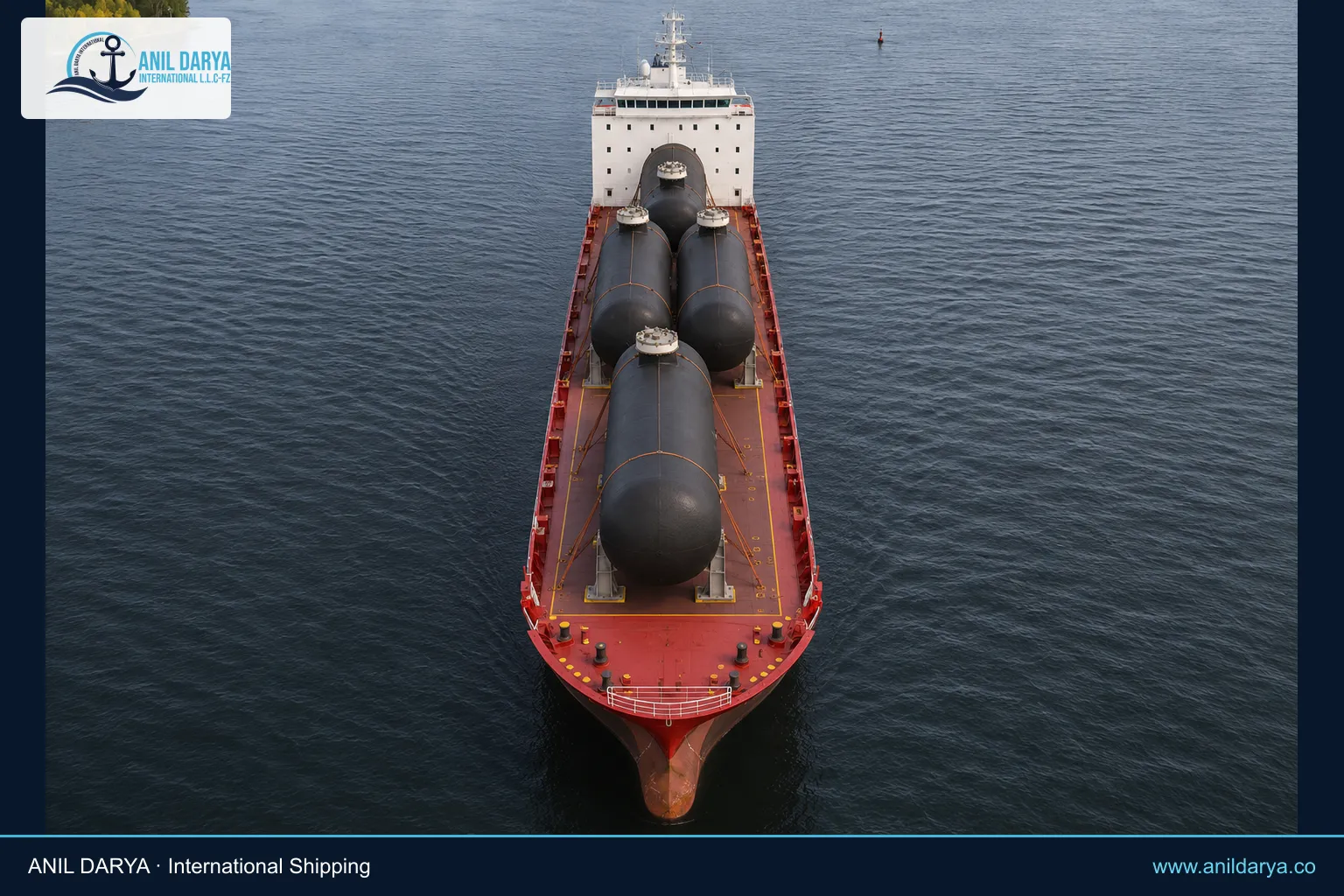
How we plan a project shipment to Bintulu:
- Collect drawings, weights, dimensions and centre of gravity for each piece.
- Decide flat rack via a hub, or breakbulk direct, based on size and the sailing dates available.
- Confirm the discharge port (Bintulu or Samalaju) with the consignee and the vessel operator.
- Agree lifting and lashing with the carrier and check the berth depth for the vessel.
- Share the full piece list with the consignee's clearing agent so the K1 can be filed before arrival.
See our break bulk and project cargo service for what we cover on the UAE side.
Dangerous goods to Bintulu: the local rules
Bintulu handles hazardous cargo every day: its dedicated DG berth exports urea and liquid ammonia from the fertiliser plant. For containerised DG from the UAE, the rule that matters most is in the BICT tariff: free storage for DG containers is only 2 days, counting Sundays and public holidays. After that, DG containers pay a higher daily storage rate than dry boxes, and DG out-of-gauge cargo has its own rate.
That gives you a simple rule: your consignee's agent must have the K1 filed and any permits approved before the vessel berths, and a truck ready to collect. Any delay costs money from day three.
What you need for a DG booking from Jebel Ali:
- UN number, proper shipping name, class and packing group.
- A Safety Data Sheet for each product.
- A signed Dangerous Goods Declaration.
- UN-approved packaging, labels and container placards to the IMDG Code.
- Acceptance from both the mainline carrier and the feeder operator.
The feeder leg is often the hardest acceptance to get, so we check it first. Our dangerous goods shipping team handles the UAE export side and the carrier approvals.
Malaysian customs at Bintulu: a short summary
Customs rules are national, so Sarawak follows the same rules as Peninsular Malaysia. Our Port Klang guide covers them in more detail. Here is the short version for Bintulu.
| Topic | Rule |
|---|---|
| Customs authority | Royal Malaysian Customs Department (RMCD) |
| Import declaration | Customs Form No. 1 (K1), with invoice, bill of lading and supporting documents |
| Prohibited and restricted goods | Customs (Prohibition of Imports) Order 2023, P.U. (A) 117/2023 |
| Sales tax | 5% or 10% on discretionary and non-essential goods since 1 July 2025; essential goods unchanged |
| Trade agreement with the UAE | UAE-Malaysia CEPA, signed January 2025, in force 1 October 2025 |
| Late proof of origin | Notify in the K1; goods can be released on MFN duty, with a bank guarantee for the difference |
In the UAE we handle export clearance. In Bintulu, the consignee's licensed agent files the K1. We send them a complete, matching document set before the feeder arrives.

Free storage and charges at BICT
The BICT tariff sets these free storage periods for containers:
| Container | Free storage |
|---|---|
| Laden | 7 days |
| Empty | 12 days |
| Transhipment | 28 days |
| Dangerous goods | 2 days, including Sundays and public holidays |
Port storage is separate from the shipping line's free time on the container. The line's demurrage and detention follow its own tariff, which you will see on the quote and arrival notice. Our guide to demurrage and detention explains how the two add up.
Shipping from Dubai to Bintulu: step by step
- Send us the cargo details. Commodity, HS code, weight, volume or dimensions, Incoterm and the consignee's site (Bintulu town, Kidurong or Samalaju).
- We price the routing. We compare relays via Port Klang, Singapore and Tanjung Pelepas and quote the total transit, not just the mainline leg.
- Book the space. For DG, reefer or out-of-gauge cargo we get acceptance from both carriers first.
- Prepare documents. Invoice, packing list, certificate of origin and permits, with names, weights and HS codes matching across all of them.
- Load and export from the UAE. We arrange trucking to Jebel Ali, UAE export clearance and the gate-in before cut-off.
- Send the pre-alert. The consignee's agent gets the full set early so the K1 and any permits are ready before the feeder berths.
- Track the relay. We watch the transhipment at the hub and tell you if the feeder connection changes.
- Delivery from BICT. The consignee's agent clears and collects within the 7-day laden free period, or 2 days for DG.
How to ship from Bintulu to Dubai
Shipping from Bintulu to Dubai is the same relay in reverse. A feeder carries the container from BICT to a hub such as Port Klang, Singapore or Tanjung Pelepas, and a mainline service brings it to Jebel Ali. The port's cargo list shows what Bintulu exports most: LNG, palm oil products, fertiliser, timber products, aluminium, silicon and manganese. Much of that moves in bulk, but bagged, drummed and palletised cargo for the UAE goes in containers.
We do not have an office in Bintulu. We book the space with the carriers from Bintulu to the UAE, and the shipper or its agent in Bintulu handles the Malaysian side.
| Task | Who handles it |
|---|---|
| Ocean booking Bintulu to Jebel Ali, Khalifa or Sharjah | We book it with the carrier, including the hub relay |
| Packing, stuffing and trucking to BICT | The shipper or its agent in Bintulu |
| Malaysian export declaration and any export permit | The shipper or its licensed agent, filed with RMCD |
| Certificate of origin | The shipper, so you can check CEPA preference in the UAE |
| UAE import declaration, duty and delivery | We arrange clearance through a licensed clearing agent and deliver to your site |
On arrival, Dubai Customs asks for an invoice, packing list, certificate of origin and any permit for restricted goods, plus the bill of lading and delivery order. Customs duty in Dubai is 5% of the CIF value for most goods. To file the declaration you need a customs business code, or a licensed clearing agent with its own code and your authorisation.
Steps for an import from Bintulu:
- Agree the Incoterm with the supplier. Under FOB Bintulu, the supplier delivers to BICT and clears export; we book the sea leg.
- Send us the supplier's details, cargo, HS code and ready date. We book the space and give the supplier the booking, cut-offs and the empty release.
- The supplier stuffs the container, files the export declaration and gates in at BICT within the laden free period.
- We check the draft bill of lading and the invoice, packing list and certificate of origin before the ship sails.
- We track the relay at the hub and file the UAE declaration before the mainline vessel arrives.
- Duty is paid, the line issues the delivery order, and we truck the cargo to your door.
Pick the UAE port by your delivery point: Khalifa Port for Abu Dhabi, Sharjah port for the northern emirates, and Jebel Ali for Dubai and most relays.
Checklist before you ship to Bintulu
- HS code confirmed and import permit need checked against the Prohibition of Imports Order.
- Consignee has a licensed customs agent in Bintulu.
- Invoice, packing list and bill of lading match on weights, pieces and consignee name.
- Certificate of origin ready if you want CEPA preferential duty.
- Hub and total transit agreed in writing on the quote.
- Feeder acceptance for DG, reefer or out-of-gauge cargo.
- Discharge port confirmed for Samalaju-bound project cargo.
- Truck booked to collect DG containers within 2 days.
- Container free time with the line agreed before shipping.
- Cargo insurance arranged for the full door-to-door route, including the relay.
Common mistakes on Bintulu shipments
- Quoting only the mainline transit. The relay adds hub waiting time plus about 4 days of feeder sailing.
- Assuming the feeder accepts what the mainline accepts. DG and out-of-gauge cargo can be refused on the second leg.
- Late K1 for DG cargo. With 2 days of free storage, a slow clearance turns straight into charges.
- Sending project cargo to the wrong port. A piece meant for a Samalaju plant may be better discharged there.
- LCL without asking where it is unpacked. An unplanned extra handling at a hub adds days and risk.
- Missing proof of origin. Without it, CEPA preference cannot be claimed at import.
Frequently asked questions
What is the port code for Bintulu?
The UN/LOCODE for Bintulu is MYBTU. It appears on bookings, bills of lading and tracking systems.
Who operates the port in Bintulu?
Bintulu Port Sdn Bhd, part of Bintulu Port Holdings Berhad, operates the port. The Bintulu Port Authority (Sarawak) regulates it, and since 1 September 2026 Bintulu has been a Sarawak state port.
Is there a direct ship from Dubai to Bintulu?
No. The port's published service list shows only Intra Asia, regional feeder and coastal services. Cargo from Jebel Ali is relayed at a hub such as Port Klang, Singapore, Pasir Gudang or Tanjung Pelepas.
How long does the feeder take from the hubs to Bintulu?
Bintulu Port publishes 108 hours from Port Klang and 96 hours from Singapore, Tanjung Pelepas and Pasir Gudang. Add the mainline leg from Jebel Ali and the waiting time at the hub.
How much container traffic does Bintulu handle?
The Bintulu Port group handled 313,000 TEU in 2025, alongside 52 million tonnes of total cargo and more than 7,600 vessel calls.
How many free storage days does BICT give?
The BICT tariff gives 7 days for laden containers, 12 for empties, 28 for transhipment and 2 days for dangerous goods, with Sundays and public holidays counted for DG.
Can I ship dangerous goods to Bintulu?
Yes. Bintulu has a dedicated DG berth and accepts IMDG containers at BICT. Plan clearance before arrival, because DG containers get only 2 days of free storage.
What is the port at Samalaju?
It is the Bintulu Port group's second port, operating since April 2014 on 393 hectares. It mainly handles dry bulk and breakbulk for the Samalaju heavy industries and is set to become a free zone port.
How do I ship cargo from Bintulu to Dubai?
We book the space from Bintulu to Jebel Ali, Khalifa or Sharjah, with a relay at a hub such as Port Klang or Singapore. The supplier or its agent clears Malaysian export, and we arrange UAE customs clearance and delivery.
Does the UAE-Malaysia CEPA cover cargo to Bintulu?
Yes. The CEPA came into force on 1 October 2025 and applies at every Malaysian port, in both directions. You need valid proof of origin that matches the K1, invoice and bill of lading to claim preferential duty.
Get a quote for Bintulu Port shipping
Send us your cargo details and we will come back with a routing, the hub, and a price for shipping from Dubai to Bintulu. Use our freight rate inquiry form, or contact our team to talk through a project or DG shipment first. You can also read more about our Dubai freight forwarding team and how we handle cargo through Jebel Ali port.
Sources
- Bintulu Port Authority (Sarawak): History (1981, 1983, 1993 privatisation, state port from 1 September 2026)
- Bintulu Port Authority: Container facilities (BICT)
- Bintulu Port Authority: General cargo facilities
- Bintulu Port Authority: Dry bulk facilities
- Bintulu Port Authority: Liquid bulk facilities
- Bintulu Port Authority: Dangerous goods facility
- Bintulu Port Authority: LNG facilities
- Bintulu Port Sdn Bhd: Company profile (cargo handled)
- Bintulu Port: Marine services (pilotage, tugs)
- Bintulu Port: Stevedoring and handling
- Bintulu Port: BICT charges (free storage, DG storage)
- Bintulu Port: List of shipping services
- Bintulu Port: Shipping transit time
- Bintulu Port: BPSB operational highlights (2026 cargo by type)
- Bintulu Port: Samalaju Industrial Port operational highlights
- Bintulu Port: Biport Bulkers operational highlights (palm oil)
- Samalaju Industrial Port: Company profile
- DayakDaily: Bintulu Port records 52 million tonnes throughput (15 April 2026)
- The Star: BPHB plans for Bintulu and Samalaju (BICT upgrade, free zones), 22 April 2025
- Findaport: Port of Bintulu (port limits, airport distance)
- Cogoport: Port of Bintulu (MYBTU)
- Dubai Customs: Submit customs declaration (documents)
- Dubai Customs: FAQ (business code, clearing agents)
- UAE Government portal: Customs duty
- Royal Malaysian Customs: Prohibition of imports
- Royal Malaysian Customs: Rules of origin FAQ
- Ministry of Finance Malaysia: Sales tax revision effective 1 July 2025
- Gulf Today: UAE trade deals with Malaysia and Australia come into force (2 October 2025)
Reviewed: 10 November 2026