
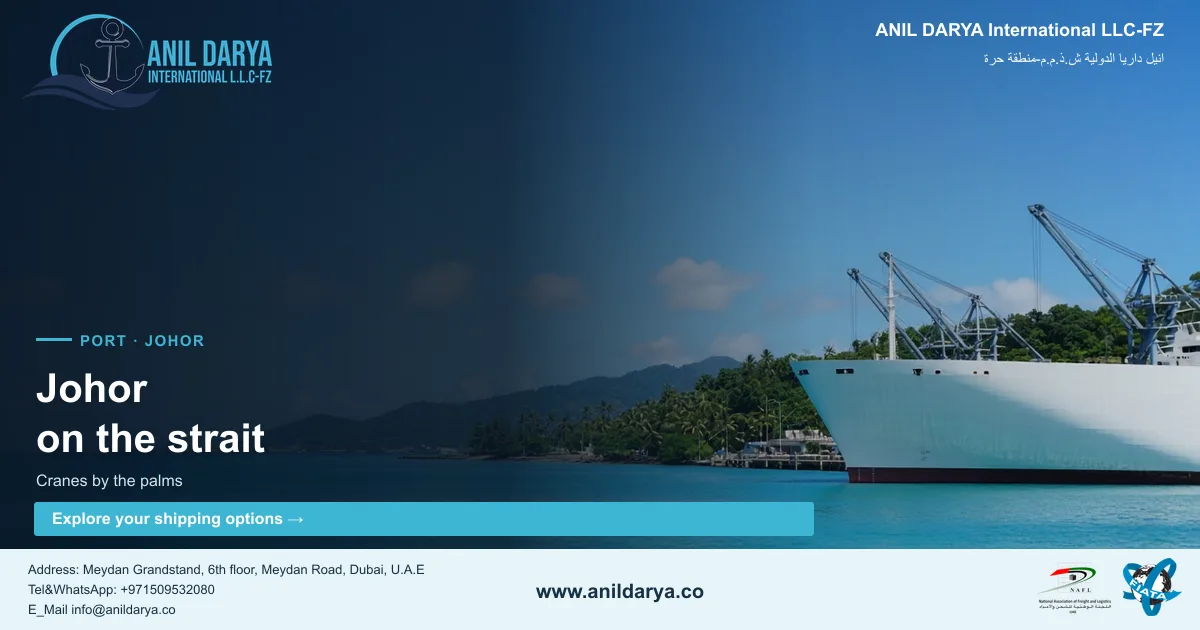
Johor Port shipping means Pasir Gudang, a multi-purpose port in southern Johor run by Johor Port Berhad. It has 24 berths, one of the world's largest palm oil terminals, a three-berth container terminal that handled a record 1.08 million TEU in 2025, and Malaysia's first port free zone. This guide covers the terminals, what each handles, local storage and DG rules, and how we handle shipping from Dubai to Johor Port and shipping from Johor Port to Dubai.
Johor Port shipping: key facts at a glance
| Item | Detail |
|---|---|
| Operator | Johor Port Berhad, a member of MMC Group |
| Location | Pasir Gudang, Johor, inside the 8,000-acre Pasir Gudang Industrial Area |
| UN/LOCODE | MYPGU |
| Operating since | 1977 |
| Port area | 1,000 acres, of which 660 acres are free zone |
| Berths | 24 berths, 4.9 km in total |
| Designed capacity | 40 million tonnes a year |
| Container terminal | 3 berths, 730 m, 13.5 m depth, 1.45 million TEU capacity |
| Containers 2025 | 1.08 million TEU, a record |
| Liquid bulk | Tank farm of almost 1.4 million tonnes; two new jetties for ships up to 120,000 DWT |
| Free storage, containers | 5 days (120 hours); DG containers 24 hours |
| Rail | Dedicated rail depot linked to the national rail network |
| Customs authority | Royal Malaysian Customs Department, import declaration on Form K1 |
Where is Johor Port and how is it different from Tanjung Pelepas?
Johor Port is at Pasir Gudang, on the Straits of Johor in the south of Peninsular Malaysia. It sits inside the Pasir Gudang Industrial Area, so many importers are a short truck ride from the gate. It began operating in 1977 as Malaysia's first southern multi-purpose port.
People often confuse it with the Port of Tanjung Pelepas (PTP), which is on the other side of Johor and is also part of MMC Group. The difference is the cargo. PTP is a large container transhipment hub. Johor Port is a gateway port for Johor industry, handling containers next to large volumes of liquid bulk, dry bulk and breakbulk.
A second port, Tanjung Langsat, is also in Pasir Gudang. It is run by Johor Corporation and focuses on petroleum-based liquid bulk such as LPG and chemicals. Check that your bill of lading names Johor Port (MYPGU) and not a nearby terminal.
Johor Port terminals: which one handles your cargo?
Johor Port has four main areas. Your cargo type decides which one you use.
| Terminal | Size | Depth | Main cargo |
|---|---|---|---|
| Container terminal | 3 berths (CT1 to CT3), 730 m | 13.5 m alongside, 13.0 m draft | Dry and reefer containers, LCL at the CFS |
| Bulk and breakbulk terminal | 8 berths, 2.4 km | Up to 13.5 m | Fertiliser, cement, rice, cocoa, metals, project cargo |
| Liquid terminal | 4 jetties, edible and non-edible kept apart | Up to 13.5 m at CT3A | Palm and other edible oils, petroleum, petrochemicals |
| JPB Free Zone | 267 hectares, plus Terminal 2 about 7 km away | n/a | Storage, repacking, processing, re-export |
The container terminal
The container terminal has three berths of 236 m each, 730 m in total, with 13.5 m depth and 13.0 m draft for ships up to 80,000 DWT. The yard covers 291,150 sq m and the terminal lists a handling capacity of 1.45 million TEU. Equipment includes 9 quay cranes, 30 rubber-tyred gantries, 6 reach stackers and 216 reefer points. A container freight station next to the yard handles stuffing, unstuffing and LCL consolidation.
The terminal handled a record 1.08 million TEU in 2025. August 2025 set a monthly record of 103,159 TEU. Two new post-Panamax quay cranes, a RM71.2 million investment, arrived in September 2025, and two more are planned for 2027. Volumes are rising year on year, so plan collections early in peak months.
Bulk and breakbulk
The conventional terminal has 8 berths along 2.4 km, with draught up to 13.5 m and over 230,000 sq m of storage. It uses a dedicated conveyor system and rail-mounted quay cranes. Johor Port says it is one of the largest discharge points in Malaysia for rice and cocoa, one of the biggest terminals for fertiliser and cement, and one of the region's largest hubs for London Metal Exchange (LME) cargo. It also handles project, heavy-lift and oil and gas cargo.
The main conventional berths (W4 to W10) are 192 to 217 m long, 12.3 to 13.4 m deep, and take ships of about 60,000 DWT. In June 2025 Johor Port bought four new level luffing cranes for this terminal, worth RM72.3 million.
Liquid bulk and palm oil
Johor Port started life as a palm oil terminal and still calls itself one of the world's largest, with 740,340 tonnes of edible oil storage. The liquid terminal's tank farm holds almost 1.4 million tonnes in total, for edible oil, petroleum and petrochemicals. Edible and non-edible cargo use separate jetties.
In 2025 the port finished a RM140 million expansion with two more liquid jetties for ships up to 120,000 DWT. They are built for Class 3 flammable liquids, with room to add Class 1 later. Liquid volumes peaked at 14.5 million tonnes in 2022, close to the previous 15.0 million tonne capacity.
What cargo can you ship to Johor Port from the UAE?
| Cargo from the UAE | How it moves | Terminal | What to plan |
|---|---|---|---|
| General goods, building materials, spares | FCL or LCL | Container terminal | Routing, 5-day free storage, truck booking |
| Food and chilled goods | Reefer containers | Container terminal (216 plugs) | Set temperature, health permits |
| Steel, aluminium and metals | Breakbulk or containers | Conventional terminal | Marks, piece list, storage days |
| Fertiliser, sulphur, other dry bulk | Bulk vessel or bagged in containers | Conventional terminal | Discharge rate, 3 free days on import |
| Base oils, chemicals, petroleum products | Tanker parcels, ISO tanks, drums | Liquid terminal or container terminal | Receiving tank, DG paperwork |
| Plant and oil and gas equipment | Flat racks or breakbulk | Conventional terminal | Lift plan, road route, permits |
Containers from Dubai to Johor Port: FCL or LCL?
Johor Port is not a mainline hub, so most cargo from Jebel Ali reaches Pasir Gudang through a relay at a larger hub such as Singapore, Tanjung Pelepas or Port Klang. Ask on every quote whether the service is direct or relayed, and where.
[AMIR-FACT: our real port-to-port transit time Jebel Ali to Pasir Gudang, whether our usual service calls Johor Port direct or relays via Singapore, Tanjung Pelepas or Port Klang, and the carriers we book on this lane]
For FCL, you book a 20ft or 40ft container on a through bill of lading. The box is discharged at the container terminal and trucked or railed to the consignee. With most industry inside Pasir Gudang, the last mile is short. Our sea freight service books FCL and LCL to Johor Port.
For LCL, your cargo is unpacked at the CFS next to the yard. The CFS gives 48 hours of free storage for a container from the time it arrives there, so the consignee's agent needs the K1 filed early. If LCL is unpacked at a hub instead, it may be trucked in from Singapore or another port, which adds a step. Our article on FCL vs LCL costs helps you choose.
A decision rule: if your consignee is in Pasir Gudang or eastern Johor, ask for Johor Port as the discharge port, not Tanjung Pelepas. A cheaper freight rate to PTP can be eaten up by a cross-state truck move.
Breakbulk and project cargo at Johor Port
The conventional terminal handles project, heavy-lift and oil and gas cargo, and its main berths take ships of about 60,000 DWT. Johor Port lists oil and gas customers such as offshore contractors, so the port is used to large structures and pipe.
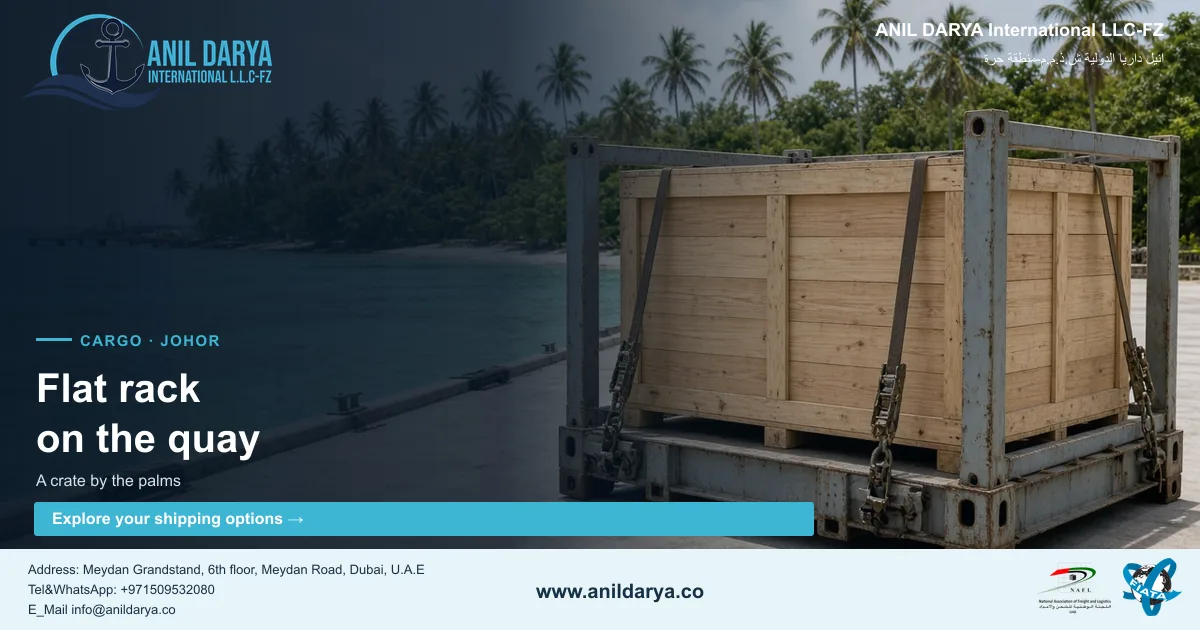
How we plan a breakbulk or project shipment to Johor Port:
- Collect drawings, weights, dimensions and lifting points for each piece.
- Decide flat rack via a hub, or a breakbulk vessel, based on size and sailing dates.
- Check the berth depth and the ship's draught against the berth list.
- Agree lifting, lashing and discharge with the carrier and the terminal.
- Book the road move from the quay, with any permits the load needs.
- Get the K1 filed before arrival, because import breakbulk only gets 3 free days.
See our break bulk and project cargo service for the UAE side of the job.
Dangerous goods at Johor Port: storage and charges
The Johor Port scale of charges (version 2.0, 28 January 2026) treats dangerous goods separately. DG containers get only 24 hours free in the terminal; storage is charged from the second day. Normal containers get 5 days.
The port's by-laws, amended in 2025 under P.U. (A) 379/2025, split DG into Groups I, II and III. Containers with Group I or Group II goods pay for stand-by, surveillance and patrolling services, so expect extra charges on those boxes. Class 3 liquids in bulk use the new liquid jetties.
The rule is simple: DG import containers should be cleared and collected on the day they land. That means permits approved and the K1 filed before the vessel berths.
What you need for a DG booking from Jebel Ali:
- UN number, proper shipping name, class and packing group.
- A Safety Data Sheet for each product.
- A signed Dangerous Goods Declaration.
- UN-approved packaging, labels and placards to the IMDG Code.
- Acceptance from every carrier on the route, including any feeder.
Our dangerous goods shipping team prepares the UAE export side and gets the carrier approvals before you commit.
The JPB Free Zone: when to deliver there
Johor Port was the first port in Malaysia to get free zone status, and it is the Free Zone Authority for its own zone. The free zone covers 267 hectares inside the port, plus Terminal 2, a satellite site about 7 km away that offers customs clearance and warehousing.
Activities allowed in the zone include:
- Changing cargo form, such as break-bulking, containerising, or moving liquids into drums or containers.
- Packaging and labelling.
- Processing, manufacturing and assembly.
- Import, re-export and trading.
Declarations and activity approvals go through the online FZIPS system. Use the free zone if your goods will be stored, repacked or re-exported. If they will be used in Malaysia, clear them on a normal K1 import.
Malaysian customs at Johor Port: a short summary
Customs rules are national, and our Port Klang guide covers them in full. Here is what matters for Johor Port.
| Topic | Rule |
|---|---|
| Customs authority | Royal Malaysian Customs Department (RMCD) |
| Import declaration | Customs Form No. 1 (K1) |
| Prohibited and restricted goods | Customs (Prohibition of Imports) Order 2023, P.U. (A) 117/2023 |
| Sales tax | 5% or 10% on discretionary and non-essential goods since 1 July 2025; essential goods unchanged |
| Trade agreement with the UAE | UAE-Malaysia CEPA, signed January 2025, in force 1 October 2025 |
| Customs inspection | Containers sent to the Customs Inspection Bay get 48 hours free |
If proof of origin is not ready at import, the importer can say so in the K1, pay the MFN duty and give a bank guarantee for the difference. In the UAE we handle export clearance. At Pasir Gudang, the consignee's licensed agent files the K1, and we send them a full, matching document set before arrival.
Road, rail and trucking at Pasir Gudang
Most Johor Port cargo leaves by truck. In 2025 the port handled an average of about 1,750 truck movements a day, peaking at 1,800, and 639,011 haulier movements in the year, up 7% on 2024. Automated gate and weighbridge systems are due by the end of 2026.
The container terminal also has a dedicated rail depot linked to the national rail network. Rail can make sense for heavy, regular flows to inland Peninsular Malaysia. Ask us to check it against trucking.
Free storage at Johor Port
| Cargo | Free storage |
|---|---|
| Containers (import and export) | 120 hours (5 days) |
| Dangerous goods containers | 24 hours |
| Containers at the CFS or Customs Inspection Bay | 48 hours |
| Import bulk and breakbulk | 3 days from end of discharge |
| Export bulk and breakbulk | 6 days from receipt |
| Transhipment or re-export bulk and breakbulk | 21 days |
For bulk and breakbulk, the free days include Sundays and public holidays. Port storage is separate from the shipping line's own free time on the container. Our guide to demurrage and detention explains both.
Shipping from Dubai to Johor Port: step by step
- Send us the cargo details. Commodity, HS code, weight, volume or dimensions, Incoterm and the delivery address.
- We price the routing. We check direct and relayed services, and compare Johor Port with Tanjung Pelepas for your delivery point.
- Book the space. DG, reefer and out-of-gauge cargo need carrier acceptance first.
- Prepare documents. Invoice, packing list, certificate of origin and permits that match each other.
- Export from the UAE. We arrange trucking to Jebel Ali, export clearance and gate-in before cut-off.
- Pre-alert the consignee's agent. They file the K1, or the FZIPS declaration for free zone cargo, before arrival.
- Discharge and collection. The agent collects within 5 days for normal containers, or 24 hours for DG.
- Return the empty. The container goes back to the line's depot within its free time.
How to ship from Johor Port to Dubai
Shipping from Johor Port to Dubai covers the cargo Pasir Gudang is known for: edible oils and other liquids, fertiliser, cement, metals, and the factory output of the Pasir Gudang Industrial Area. Containers leave from the container terminal, often relayed at a hub, and arrive at Jebel Ali, Khalifa or Sharjah. Goods held in the JPB Free Zone can also be re-exported to the UAE.
We do not have an office in Malaysia. We book the space with the carriers from Johor Port to the UAE, and the supplier or its agent in Johor handles the Malaysian side.
| Task | Who handles it |
|---|---|
| Ocean booking Johor Port to Jebel Ali, Khalifa or Sharjah | We book it with the carrier, including any hub relay |
| Stuffing and trucking to the container terminal | The supplier or its agent in Johor |
| Malaysian export declaration, or FZIPS for free zone cargo | The supplier or its licensed agent |
| Certificate of origin | The supplier, so you can check CEPA preference in the UAE |
| UAE import declaration, duty and delivery | We arrange clearance through a licensed clearing agent and deliver to your site |
Timing at the Malaysian end matters. For export containers, Johor Port's 5 free days run from gate-in until the vessel arrives, and export bulk and breakbulk get 6 days from receipt. Ask the supplier to gate in close to the cut-off.
On arrival in the UAE, Dubai Customs asks for an invoice, packing list, certificate of origin and any permit for restricted goods, plus the bill of lading and delivery order. Customs duty in Dubai is 5% of the CIF value for most goods. You need a customs business code to file, or a licensed clearing agent with its own code and your authorisation.
Steps for an import from Johor Port:
- Agree the Incoterm. Under FOB Pasir Gudang, the supplier delivers to the terminal and clears export; we book the sea leg.
- Send us the supplier's details, cargo, HS code and ready date. We book the space and pass the supplier the booking and cut-offs.
- For liquids such as edible oil, confirm ISO tank or flexitank and the carrier's acceptance first.
- The supplier stuffs, files the export declaration and gates in before cut-off.
- We check the draft bill of lading against the invoice, packing list and certificate of origin.
- We file the UAE declaration before arrival, pay duty, collect the delivery order and deliver to your door.
Pick the UAE port by your delivery point: Khalifa Port for Abu Dhabi, Sharjah port for the northern emirates, and Jebel Ali for Dubai.
Checklist before you ship to Johor Port
- Bill of lading shows Johor Port, Pasir Gudang (MYPGU) as discharge port.
- HS code checked against the Prohibition of Imports Order and any permit need.
- Consignee has a licensed customs agent, or free zone approval if delivering to the zone.
- Invoice, packing list and bill of lading agree on weights, pieces and consignee.
- Certificate of origin ready for CEPA preferential duty.
- Routing and relay hub confirmed on the quote.
- DG collection planned within 24 hours.
- For breakbulk: piece list, lifting plan and 3-day import storage window.
- Cargo insurance arranged.
Common mistakes on Johor Port shipments
- Booking to Tanjung Pelepas for a Pasir Gudang consignee. The cheaper sea rate can cost more after trucking.
- Confusing Johor Port with Tanjung Langsat. They are different ports in the same town.
- Late K1 on DG cargo. DG containers get only 24 hours free.
- Slow breakbulk collection. Import bulk and breakbulk get 3 free days, Sundays and holidays included.
- Using the free zone by default. Goods sold in Malaysia still need a full import declaration.
- No proof of origin. CEPA preference cannot be claimed without it.
Frequently asked questions
What is the port code for Johor Port?
The UN/LOCODE for Johor Port in Pasir Gudang is MYPGU. Use it on bookings and bills of lading to avoid confusion with other Johor ports.
Is Johor Port the same as Pasir Gudang port?
Yes. Johor Port is the port at Pasir Gudang, run by Johor Port Berhad. Tanjung Langsat is a separate liquid bulk port in the same area, and Tanjung Pelepas is a different port in western Johor.
How many containers does Johor Port handle?
Johor Port handled a record 1.08 million TEU in 2025. Its container terminal lists a capacity of 1.45 million TEU across three berths.
How deep are the berths at Johor Port?
The container berths are 13.5 m deep with a 13.0 m draft. The conventional berths go up to 13.5 m, and the new liquid jetties take tankers up to 120,000 DWT.
How many free storage days does Johor Port give?
Containers get 120 hours (5 days) and DG containers 24 hours. Import bulk and breakbulk get 3 days, export 6 days and transhipment or re-export cargo 21 days.
Can I ship dangerous goods to Johor Port?
Yes. The port tariff covers DG in Groups I, II and III, with extra stand-by and surveillance charges for Group I and II containers. Plan to clear and collect DG containers within 24 hours.
Does Johor Port have a free zone?
Yes. Johor Port was Malaysia's first port with free zone status. The zone covers 267 hectares plus a satellite Terminal 2, and allows storage, repacking, processing and re-export.
How do I ship from Dubai to Johor Port?
We book a container from Jebel Ali to Pasir Gudang, usually with a relay at a hub, and handle UAE export clearance. The consignee's licensed agent in Johor files the K1 before the ship arrives.
Can you bring cargo from Johor Port to Dubai?
Yes. We book the space from Johor Port to Jebel Ali, Khalifa or Sharjah. The supplier or its agent clears Malaysian export, and we arrange UAE customs clearance and delivery.
Does the UAE-Malaysia CEPA apply at Johor Port?
Yes. The CEPA came into force on 1 October 2025 and applies at all Malaysian ports. You need valid proof of origin that matches the K1 and the shipping documents.
Get a quote for Johor Port shipping
Send us your cargo details and we will come back with a routing and a price for shipping from Dubai to Johor Port. Use our freight rate inquiry form, or contact our team to discuss a breakbulk, liquid or DG shipment. You can also read about our Dubai freight forwarding team and how we export through Jebel Ali port.
Sources
- Johor Port: Overview (1977, area, free zone, berths, capacity, cargo specialities)
- Johor Port: Container terminal (berths, depth, capacity, equipment, reefer points, CFS)
- Johor Port: Container services (berth length, rail depot, JCTS)
- Johor Port: Bulk and breakbulk terminal (berth list, storage, LME)
- Johor Port: Bulk and breakbulk services (8 berths, oil and gas cargo)
- Johor Port: Liquid bulk services (jetties, tank farm)
- Johor Port: JPB Free Zone (267 ha, Terminal 2, FZIPS)
- Johor Port press release: RM140 million liquid jetty expansion (29 July 2025)
- Johor Port press release: Two new quay cranes (19 September 2025)
- Johor Port: Scale of charges, version 2.0 (28 January 2026)
- Johor Port Authority (Pasir Gudang Port) (Scale of Charges) (Amendment) By-Laws 2025, P.U. (A) 379/2025
- The Star: Johor Port handles up to 1,800 trucks daily in 2025 (27 January 2026)
- Wikipedia: Tanjung Langsat Port
- Cogoport: Pasir Gudang, Johor (MYPGU)
- Dubai Customs: Submit customs declaration (documents)
- Dubai Customs: FAQ (business code, clearing agents)
- UAE Government portal: Customs duty
- Royal Malaysian Customs: Prohibition of imports
- Royal Malaysian Customs: Rules of origin FAQ
- Ministry of Finance Malaysia: Sales tax revision effective 1 July 2025
- Gulf Today: UAE trade deals with Malaysia and Australia come into force (2 October 2025)
Reviewed: 10 November 2026