
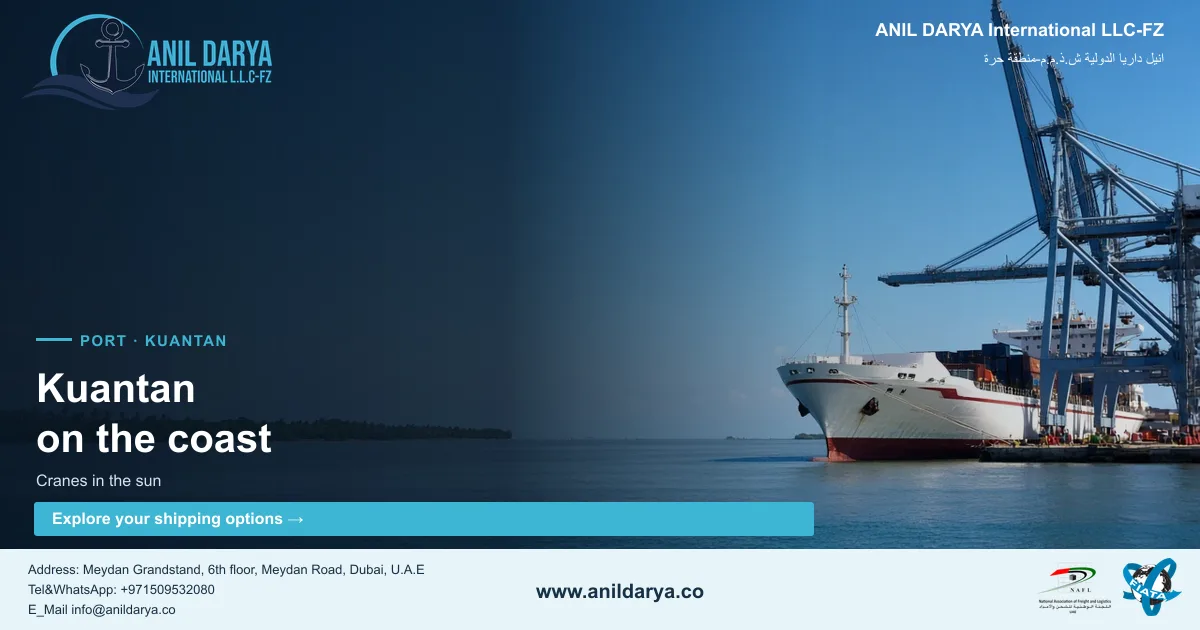
Kuantan port shipping means moving cargo through the main seaport on the east coast of Peninsular Malaysia, in Pahang, facing the South China Sea. Kuantan Port is a bulk and petrochemical port first and a container port second: its New Deep Water Terminal takes ships of up to 180,000 DWT, while the container berths at Kuantan Port 1 take ships of up to 55,000 DWT. This guide covers the terminals, cargo rules, free storage, customs basics and the steps to ship from Dubai. We ship both from Dubai to Kuantan and from Kuantan to Dubai.
Kuantan Port shipping: key facts at a glance
| Item | Detail |
|---|---|
| Official name | Kuantan Port (Pelabuhan Kuantan), Pahang, Malaysia |
| UN/LOCODE | MYKUA |
| Operator | Kuantan Port Consortium Sdn Bhd, 60:40 owned by IJM Corporation Berhad and Beibu Gulf Holding (Hong Kong) Co. Ltd. |
| Port authority | Kuantan Port Authority, established 1 September 1974; privatised to the consortium from 1 January 1998 |
| Location | Gebeng, Kuantan District, on the east coast of Peninsular Malaysia |
| Terminals | Kuantan Port 1 (containers, multipurpose, liquid) and the New Deep Water Terminal (NDWT) |
| Container berths | 3 berths, 600 m, 12 m maximum draught, ships up to 55,000 DWT |
| Container capacity | 500,000 TEU a year (operator figure) |
| Container throughput | 34,626 TEU in Q1 2026 (Ministry of Transport) |
| NDWT Phase 1 | 1 km berth, 16 m depth, ships up to 180,000 DWT, 19 million FWT capacity |
| Free storage (port tariff) | Import containers 3 days, export containers 14 days, transhipment containers 21 days |
| Main cargo | Dry bulk (iron ore, coal), steel, petrochemicals, palm oil, liquid chemicals, containers |
| Rail | Kuantan-Kerteh Railway, 75 km; East Coast Rail Link diversion into the port due by end of 2026 |
| Trade agreement with the UAE | UAE-Malaysia CEPA, in force since 1 October 2025 |
| Shipping from Kuantan to Dubai | K2 export declaration by the shipper or its agent; UAE duty 5% of CIF for most goods, import VAT 5% |
Where is Kuantan Port and what does it serve?
Kuantan Port sits at Gebeng in the Kuantan District of Pahang, on the eastern seaboard of Peninsular Malaysia. The operator places it in the middle of the east coast petrochemical industry and the East Coast Industrial Corridor. IJM, the majority owner, gives a drive of about 3 hours to Kuala Lumpur and puts Kuantan Airport 35 km away.
Three industrial zones feed the port:
- Gebeng Industrial Park, about 5 km from the port, with a cluster of chemical producers.
- The Malaysia-China Kuantan Industrial Park (MCKIP), next to the port. MIDA says it has grown from 1,200 acres in 2013 to about 3,000 acres, with steel, ceramics, tyres, aluminium and fertiliser plants.
- The Kerteh petrochemical complex, linked to the port by the 75 km Kuantan-Kerteh Railway.
The biggest single tenant story is steel. MIDA reports that Alliance Steel in MCKIP is raising annual output from 3.5 million to 10 million tonnes, with the expanded plant due to start in 2026. That means more iron ore and coal in, and more steel out.
Most of the port's business is not in boxes. Its chief executive told GBR in 2023 that about 90% of business is non-containerised, and that imports are mostly iron ore and coal from Australia. If you ship containers from the UAE to Pahang, you are using the smaller side of the port, so plan the routing with that in mind.
Kuantan Port 1 and the New Deep Water Terminal: which one handles your cargo?
Kuantan Port has two ports in one. The berth on your booking decides the equipment, the depth and the storage rules that apply.
| Terminal | Berths | Depth / draught | Largest ship | Cargo |
|---|---|---|---|---|
| Kuantan Port 1, container berths | 3 berths, 600 m | 12 m maximum draught | 55,000 DWT | FCL, LCL, reefer containers |
| Kuantan Port 1, multipurpose berths | 11 berths | 12 m maximum draught | 55,000 DWT | Breakbulk and dry bulk |
| Kuantan Port 1, liquid berths | 4 liquid berths and 4 liquid chemical berths | 12 m maximum draught | 55,000 DWT | Petrochemicals, chemicals, oils |
| New Deep Water Terminal, Phase 1 | 1 km berth (Phase 1A 400 m, Phase 1B 600 m) | 16 m | 180,000 DWT | Dry bulk and breakbulk |
| New Deep Water Terminal, Phase 2 (planned) | 1 km berth | 18 m | 180,000 DWT | Conventional cargo and containers |
Kuantan Port 1: the container and liquid side
The container terminal has 6 container cranes and 10 rubber-tyred gantry cranes. Its yard has 1,750 ground slots and 114 reefer points, and a 9,600 sqm container freight station handles LCL stuffing and unstuffing. There is also a Class 2 dangerous goods yard with a maximum capacity of 16 TEU.
For conventional cargo, the operator lists five 5,000 sqm warehouses and two 3,375 sqm warehouses (32,500 sqm in total), level luffing cranes, portable hoppers and conveyors, and a ship loading system with a design capacity of 2,000 tonnes per hour. The first container vessel called in 1988, and new container cranes and hybrid rubber-tyred gantries arrived in 2020.
The deep-water terminal (NDWT)
Work on the NDWT began in April 2015. Phase 1A opened in 2018 and Phase 1B in 2019. The terminal focuses on dry bulk and breakbulk, runs on semi-automation, and handles about 7 million tonnes of cargo a year, according to the operator. Its equipment includes a conveyor belt system rated at 4,000 tonnes per hour, two ship unloaders at 2,000 tonnes per hour each, and two stacker reclaimers. Phase 1 has a 42.5 hectare storage yard.
In 2022 the port received the deepest and heaviest ship in its history, a 180,000 DWT vessel. GBR reported its draught as 16.4 m.
What Phase 2 will add
The operator's plan for Phase 2 is a second 1 km berth at 18 m, with capacity for 19 million FWT of conventional cargo and 1.5 million TEU of containers, plus a 47 hectare yard. IJM says full completion will double the port's handling capacity to 52 million FWT. No opening date is published, so do not plan around Phase 2 yet.
How busy is Kuantan Port for containers?
Kuantan is a small container port. Ministry of Transport figures for the first quarter of 2026 show this:
| Port (Q1 2026) | Export TEU | Import TEU | Transhipment TEU | Total TEU |
|---|---|---|---|---|
| Kuantan | 18,129 | 16,497 | 0 | 34,626 |
| Penang | 164,493 | 165,070 | 13,473 | 343,036 |
| Port Klang | 832,231 | 850,628 | 2,029,571 | 3,712,430 |
| Malaysia, all ports | 2,098,282 | 1,492,022 | 5,494,984 | 9,085,287 |
Two things follow. Kuantan's container trade is almost all local import and export, with no transhipment. And because volumes are thin, sailings are few, so one missed connection can cost you a week.
Cogoport's monthly data shows import container dwell at Kuantan between 4.4 and 12.3 days from September 2025 to February 2026, and export dwell between 4.0 and 7.5 days. That is long against a 3-day free storage period for imports, so clearance must be ready before the box lands.
Shipping from Dubai to Kuantan: which services call?
No deep-sea service from the Gulf calls at Kuantan. The port's own direct-call list for January 2026 shows only regional services:
| Day | Service rotation | Carrier |
|---|---|---|
| Tuesday | Kuantan, Jakarta, Laem Chabang, Qinzhou, Hai Phong, Laem Chabang | SITC (JTH) |
| Tuesday | Kuantan, Songkhla, Kuantan, Singapore | Samudera (SGX) |
| Tuesday | Singapore, Kuantan, Singapore | Samudera (KUS) |
| Wednesday | Kuantan, Singapore, Port Klang, Haiphong, Danang, Kuantan | Evergreen (CVM) |
| Thursday | Kuantan, Hong Kong, Kaohsiung, Incheon, Qingdao, Ningbo, Fuqing, Hong Kong, Yantian, Pasir Gudang, Port Klang, Penang, Kuantan | Evergreen (NCS) |
| Thursday | Kuantan, Shanghai, Ningbo, Shekou, Batam, Yangon, Belawan | SITC (MIM) |
| Saturday | Kuantan, Tanjung Pelepas, Songkhla, Kuantan | Maersk (TH9) |
| Saturday | Kuantan, Singapore, Kuantan, Songkhla | Samudera (SGX) |
So a box from Jebel Ali reaches Kuantan in one of two ways:
- By sea all the way. A mainline service carries it to Singapore, Tanjung Pelepas or Port Klang, and a feeder from the list above brings it to Kuantan. IJM gives a sailing time of about 1 day from Singapore.
- To Port Klang, then by land. The box clears at Port Klang and travels east by truck. Once the East Coast Rail Link carries freight, rail may become a third option.
A simple rule: if the consignee is in Gebeng, MCKIP or Kerteh, price the feeder to Kuantan first. If the cargo is going to Kuala Lumpur or the west coast anyway, Port Klang is usually the better discharge port.
[AMIR-FACT: the carriers and hub (Singapore, Tanjung Pelepas or Port Klang) we use from Jebel Ali to Kuantan, and our real port-to-port days on this lane]
What cargo can you ship through Kuantan Port?
| Cargo type | Where it goes | What to plan |
|---|---|---|
| Dry containers (FCL) | Kuantan Port 1 container berths | Hub and feeder connection, 3-day import free storage |
| LCL | 9,600 sqm CFS at Kuantan Port 1 | Low volume to Kuantan; consolidation may go via Port Klang |
| Reefer containers | 114 reefer points | Food permits, plug-in time, feeder reliability |
| Dry bulk (iron ore, coal, fertiliser, grain) | NDWT or multipurpose berths | Ship size against 16 m or 12 m, discharge rate |
| Steel, pipes, structures | Multipurpose berths and NDWT | Lifting gear, open storage, road route |
| Liquid chemicals, petrochemicals, palm oil | Liquid and liquid chemical berths | Receiving tanks, surveys, product approvals |
| Dangerous goods in containers | Container terminal, Class 2 DG yard | Carrier and port acceptance, short yard stay |
FCL and LCL to Kuantan Port
FCL is the normal choice for commercial cargo from Dubai to Kuantan. The sealed box moves from Jebel Ali to the hub and on to Kuantan, and your consignee clears it under one declaration. Use 20ft boxes for dense cargo such as chemicals in drums or machinery parts, and 40ft high cubes for light, bulky goods.
LCL is harder on this lane. Volumes into Kuantan are small, so few consolidators run a direct box from the Gulf. LCL cargo often goes to Port Klang and is trucked across, which adds handling and a second set of charges. If your cargo fills more than about half a 20ft box, price FCL first. Our guide to FCL vs LCL shipping sets out the trade-offs.
We book container space from the UAE through our sea freight service and confirm the hub and the feeder before you commit.
Bulk, breakbulk and project cargo at Kuantan
This is where Kuantan is strong. The NDWT takes bulk carriers of up to 180,000 DWT at 16 m, three times the size Kuantan Port 1 can take. Findaport lists cargo such as steel pipes, logs, sawn timber, fertiliser, wheat, flour, iron ore, coal, palm oil and petroleum products, and the local agent Liraship lists timber, steel pipe, iron ore, bauxite and steel structures among the bulk vessels it handles.
From the UAE, typical cargo for Pahang includes steel products, plant equipment for the Gebeng and Kerteh industries, and bagged or loose minerals. Before you fix a ship or book a breakbulk parcel to Kuantan, check:
- The ship's loaded draught against 12 m at Kuantan Port 1 or 16 m at the NDWT.
- Whether shore cranes or ship's gear will lift each piece.
- Weight, dimensions and lifting points for every item.
- Open or covered storage needs, and how long the cargo will stay.
- The road route to Gebeng, MCKIP or Kerteh for oversized pieces.
The port tariff gives import general cargo 3 free storage days, and dry bulk 14 days. Cargo discharged direct at the wharf into temporary storage gets no free days. See our bulk cargo service for loose and bagged commodities, and our break bulk and project cargo service for heavy pieces.
Dangerous goods at Kuantan Port: what the port rules say
Kuantan handles a lot of chemical cargo, but its container yard for dangerous goods is small. The operator lists a Class 2 DG yard with a maximum capacity of 16 TEU. The gazetted tariff, the Kuantan Port Authority (Scale of Rates, Dues and Charges) By-Laws 2023, prices DG containers and DG cargo apart from general cargo, using the port's own Class I, II and III categories from the Kuantan Port Authority By-Laws 1980. Expect DG handling charges above the general rate.
What this means for your shipment:
- Pack, mark and declare the cargo under the IMDG Code, with a correct UN number, proper shipping name, class and packing group.
- Send the Safety Data Sheet and the DG declaration with the booking.
- Get acceptance from the carrier for every leg, including the feeder from the hub.
- Ask the carrier how long the box may stay in the Kuantan yard, and have the consignee ready to collect.
- Check whether the product needs a Malaysian import permit before the ship sails.
Our dangerous goods shipping team prepares the DG declaration in the UAE and checks carrier acceptance before you commit.
Malaysian customs at Kuantan Port: a short summary
Customs rules are national, so they are the same at Kuantan as at any Malaysian port. Our Port Klang guide covers them in full. Here is what matters for Kuantan.
| Topic | Rule |
|---|---|
| Customs authority | Royal Malaysian Customs Department (RMCD) |
| Import declaration | Customs Form No. 1 (K1), with invoice, bill of lading and supporting documents |
| Prohibited and restricted goods | Customs (Prohibition of Imports) Order 2023, P.U. (A) 117/2023; check before you ship |
| Sales tax | 5% or 10% on discretionary and non-essential goods since 1 July 2025; essential goods keep their existing rate |
| Preferential duty | Proof of origin that matches the K1, invoice and bill of lading |
| Trade agreement with the UAE | UAE-Malaysia CEPA, signed January 2025, in force 1 October 2025 |
If the proof of origin is not ready at import, RMCD lets the importer give written notice and submit it within one year. The goods can be released on the normal (MFN) duty, and the importer may give a bank guarantee for the difference.
In the UAE we handle export clearance. In Kuantan, the consignee's licensed agent files the K1, and we send them a complete, matching set of documents before the ship arrives.
Free storage and dwell time at Kuantan Port
The 2023 port tariff, gazetted as P.U. (A) 65/2023, sets the free storage periods:
| Cargo | Free storage |
|---|---|
| Import containers | 3 days |
| Export containers | 14 days |
| Transhipment containers | 21 days |
| Import general cargo, and cargo unstuffed from FCL imports at the CFS | 3 days |
| Export general cargo and LCL export cargo at the CFS | 14 days |
| Dry bulk, import or export | 14 days |
| Shut-out cargo or direct-wharf cargo needing temporary storage | None |
Port storage is separate from the carrier's demurrage and detention. Get the carrier's free days in writing at booking. Our article on demurrage and detention shows how the charges build up.
How to ship from Dubai to Kuantan Port, step by step
- Agree the Incoterm and who pays the Kuantan port charges. Our guide to Incoterms 2020 for sea freight explains the split.
- Check with the consignee that the goods are not prohibited and that any import permit is in place.
- Send us the HS code, weight, volume and cargo type. We compare routings via Singapore, Tanjung Pelepas or Port Klang, and the Port Klang plus truck option.
- We book space, arrange UAE trucking, file the export declaration and submit the VGM. Our Jebel Ali port guide covers the export side.
- The shipper issues the invoice, packing list and, if the goods qualify, the CEPA proof of origin.
- We send the draft bill of lading for checking against the consignee's details.
- The box sails to the hub, connects to a feeder and is discharged at Kuantan Port 1.
- The consignee's agent files the K1 and pays duty and sales tax.
- The consignee collects within 3 free storage days and returns the empty to the carrier's depot.
How to ship from Kuantan Port to Dubai
We also handle the other direction: shipping from Kuantan to Dubai, with arrival at Jebel Ali, Khalifa Port or Sharjah port. We book the space with the carrier and run the UAE side. The export papers at origin stay with the shipper or its agent there.
The Malaysian export side
- Export declaration. The exporter or its forwarding agent files the K2 export declaration online with the Royal Malaysian Customs Department, and the Customs Information System (SMK) validates it.
- Strategic goods. On every K2 the filer must answer a self-declaration on whether the goods need a permit under the Strategic Trade Act 2010. If they do, the permit number goes on the K2 and the system checks it before the export is confirmed.
- Permits. Strategic goods permits come from MITI and other agencies and are applied for online through MyTradeLink. Ask the shipper to check this early for chemicals and petrochemicals from the Gebeng plants.
The UAE import side
For cargo discharged at Jebel Ali, the import declaration goes to Dubai Customs. It asks for the commercial invoice, the packing list, a certificate of origin and, for restricted goods, the approval of the authority that controls them. The carrier's agent releases the cargo against the bill of lading with a delivery order. Customs duty in Dubai is 5% of the CIF value for most goods, with 50% on alcohol and 100% on cigarettes. Import VAT is 5% of the customs value, which takes in insurance and freight, plus customs fees and any excise tax. A VAT-registered importer whose customs number is registered with the Federal Tax Authority can account for that VAT on its VAT return instead of paying it at clearance.
- Send us the shipper's details in Kuantan, the cargo, the HS code and the delivery address in the UAE.
- We book space from Kuantan with the carrier and send the booking and cut-off dates to the shipper.
- The shipper or its trucker delivers the cargo to Kuantan Port 1 inside the receiving window.
- The shipper or its Malaysian forwarding agent files the K2 export declaration.
- We check the draft bill of lading against the invoice and packing list before the carrier issues it.
- We file the UAE import declaration before the ship arrives.
- We arrange payment of the duty and VAT and collect the delivery order from the carrier's agent.
- We truck the cargo to your site in the UAE.
- We return the empty container to the carrier's depot inside free time.
[AMIR-FACT: the carriers and hub we actually use from Kuantan to Jebel Ali, Khalifa or Sharjah, and our real port-to-port transit days in this direction]
Kuantan or Port Klang: which port should you choose?
| Your situation | Port to price first | Why |
|---|---|---|
| Consignee in Gebeng, MCKIP or Kuantan town | Kuantan | Shortest land leg, local clearance |
| Petrochemical site at Kerteh | Kuantan | Linked to the port by the 75 km Kuantan-Kerteh Railway |
| Bulk carrier over 55,000 DWT | Kuantan NDWT | 16 m depth, ships up to 180,000 DWT |
| Consignee in Kuala Lumpur or Selangor | Port Klang | Far more direct services |
| Small LCL shipment to Pahang | Compare both | Port Klang LCL plus truck may beat a feeder |
The East Coast Rail Link may change this. The Star reported in March 2026 that the diversion into Kuantan Port should be finished by the end of 2026, and the line runs from Kelantan to Port Klang. Until freight trains run, treat rail between the two ports as a future option.
Checklist before you ship to Kuantan
- HS code agreed between shipper and consignee.
- Goods checked against the 2023 import prohibition order, and any permit issued.
- CEPA proof of origin arranged if the goods qualify.
- Invoice, packing list and bill of lading match on names, weights and values.
- Hub, feeder and sailing day confirmed with the carrier.
- Collection planned inside the 3-day import free storage.
- DG documents and carrier acceptance for every leg.
- Ship draught checked against 12 m or 16 m for bulk and breakbulk.
Common mistakes
- Booking to Kuantan without asking which hub and feeder the carrier uses.
- Assuming a direct sailing from the Gulf. None calls Kuantan.
- Letting an import box sit past 3 free days while paperwork catches up.
- Sending a bulk carrier too deep for Kuantan Port 1 instead of the NDWT.
- Shipping DG cargo without checking how long the Kuantan yard will hold it.
- Forgetting the CEPA proof of origin and paying full duty on qualifying goods.
- Sending Kuala Lumpur cargo to Kuantan and paying for a long truck leg west.
Frequently asked questions
What is the port code for Kuantan?
The UN/LOCODE for Kuantan Port is MYKUA. You will see it on bookings, bills of lading and tracking systems.
Who runs the port in Kuantan?
Kuantan Port Consortium Sdn Bhd runs the port. It is 60% owned by IJM Corporation Berhad and 40% by Beibu Gulf Holding (Hong Kong) Co. Ltd., and the port was privatised from the Kuantan Port Authority in 1998.
How deep is the water at Kuantan Port?
Kuantan Port 1 has a 12 m maximum draught for ships of up to 55,000 DWT. The New Deep Water Terminal has 16 m of depth and takes ships of up to 180,000 DWT.
Is there a direct sailing from Dubai to Kuantan?
No. Kuantan's direct-call services are regional, so cargo from the UAE is transhipped at a hub such as Singapore, Tanjung Pelepas or Port Klang, or discharged at Port Klang and moved east by road.
How many free storage days does Kuantan Port give?
The 2023 port tariff gives import containers 3 free days, export containers 14 days and transhipment containers 21 days. Carrier demurrage and detention are separate.
Can I ship dangerous goods to Kuantan Port?
Yes, with carrier and port acceptance. The container side has a Class 2 DG yard of 16 TEU, and the port tariff charges DG cargo separately, so plan a quick collection.
What cargo does Kuantan Port handle most?
Mostly bulk. The operator's chief executive said in 2023 that about 90% of business is non-containerised, with iron ore and coal the main imports, plus liquid chemicals, petrochemicals and palm oil.
Does the UAE-Malaysia CEPA lower duty on cargo to Kuantan?
For qualifying UAE-origin goods, it can. The CEPA has been in force since 1 October 2025, and you need a valid proof of origin that matches the K1 to claim the rate.
Can you ship from Kuantan to Dubai?
Yes. We book the space out of Kuantan, the shipper or its Malaysian forwarding agent files the K2 export declaration, and we clear the cargo in the UAE and deliver it. Duty in Dubai is 5% of CIF value for most goods, and import VAT is 5%.
Get a quote for Kuantan Port shipping
Send us your cargo details and we will come back with a routing and a price for shipping from Dubai to Kuantan. Use our freight rate inquiry form, or contact our team to talk through a bulk, DG or project shipment first.
Sources
- Kuantan Port: About us (ownership, milestones, Kuantan Port 1 and NDWT)
- Kuantan Port: Container services (berths, cranes, capacity, storage, Class 2 DG yard)
- Kuantan Port: Conventional services (multipurpose and liquid berths, warehouses, equipment)
- Kuantan Port: New Deep Water Terminal (phases, depth, equipment, yard)
- Kuantan Port: Vessel window time, direct-call services (January 2026)
- Kuantan Port: List of container box operators
- Kuantan Port Authority (Scale of Rates, Dues and Charges) By-Laws 2023, P.U. (A) 65/2023 (free storage, DG charges)
- Ministry of Transport Malaysia: Container throughput by port, Q1 2026
- IJM Corporation: Kuantan Port (NDWT phases, 52 million FWT, sailing times, distances, MCKIP)
- MIDA: Kuantan Port to benefit from Malaysia-China bilateral ties (MCKIP, Alliance Steel), July 2024
- GBR: Kuantan Port interview, Southeast Asia Chemicals 2023 (cargo mix, 2022 vessel call, Gebeng)
- The Star: ECRL diversion into Kuantan Port to be ready by end of 2026 (11 March 2026)
- Wikipedia: Kuantan Port (location, Kuantan-Kerteh Railway)
- Cogoport: Port of Kuantan (MYKUA, dwell times)
- Findaport: Port of Kuantan (cargo types)
- Liraship: Shipping and forwarding at Kuantan Port (bulk cargo handled)
- Royal Malaysian Customs: Prohibition of imports
- Royal Malaysian Customs: Rules of origin FAQ
- Ministry of Finance Malaysia: Sales tax revision effective 1 July 2025
- Gulf Today: UAE trade deals with Malaysia and Australia come into force (2 October 2025)
- Royal Malaysian Customs: Export procedure (K2 declaration, Strategic Trade Act self-declaration, SMK, MyTradeLink)
- MATRADE: Beginner's guide to exporting (K2 export declaration, export licence)
- Dubai Customs: Submit customs declaration (import documents)
- UAE Government portal: Customs duty (5% of CIF, alcohol 50%, cigarettes 100%, GCC-origin goods)
- Federal Tax Authority: VAT (5% rate)
- Federal Tax Authority: VAT guide, section 3.5 (import VAT at 5%, accounting on the VAT return)
Reviewed: 10 November 2026