
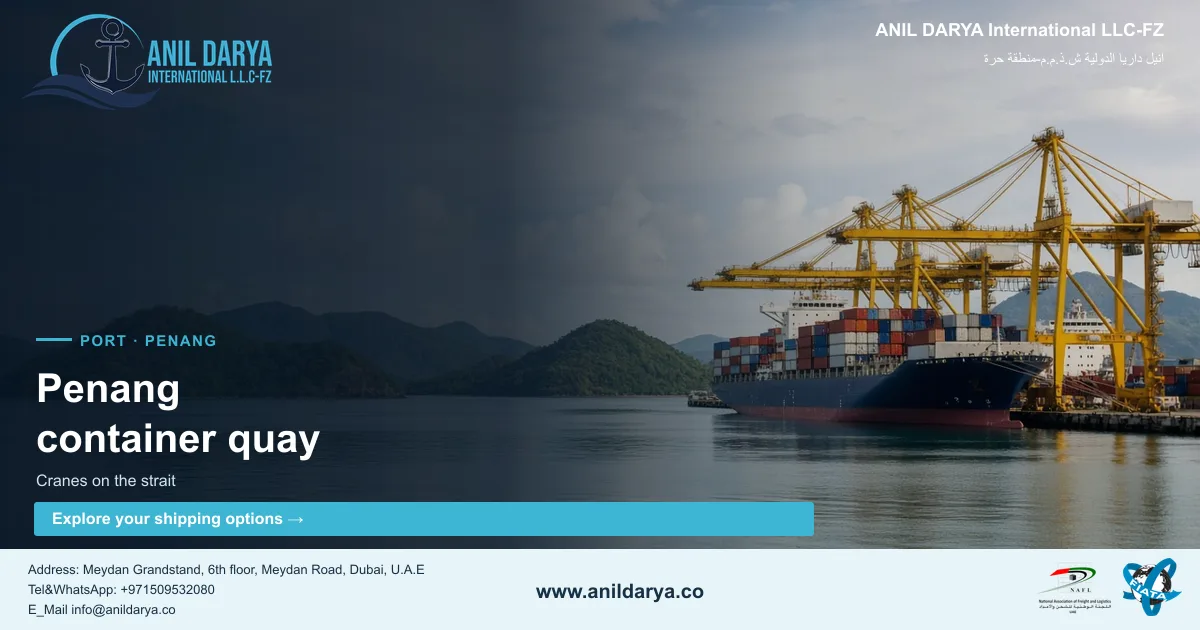
Penang Port shipping means shipping to the main gateway for northern Peninsular Malaysia. The port handled about 1.35 million TEU and 30.7 million tonnes of cargo in 2025 across several terminals on the Butterworth and Prai side of the Penang Strait. This guide explains which terminal takes which cargo, what the port's depth means for your booking, the local rules for dangerous goods, and how we ship from Dubai to Penang step by step. We ship both ways: from Dubai to Penang, and from Penang to Dubai with UAE clearance on arrival.
Penang Port shipping: key facts at a glance
| Item | Detail |
|---|---|
| UN/LOCODE | MYPEN |
| Location | Penang Strait; cargo terminals in Seberang Perai (Butterworth and Prai), cruise terminal in George Town |
| Regulator and free zone authority | Penang Port Commission |
| Operator | Penang Port Sdn Bhd, owned by MMC |
| Main container terminal | North Butterworth Container Terminal (NBCT) |
| NBCT berths | Six main berths (N1 to N6) plus an inner berth |
| NBCT berth depth | 11 to 12 m (inner berth 7.5 m) |
| NBCT capacity | 2.3 million TEU a year |
| Containers in 2025 (NBCT) | 1,351,454 TEU (2024: 1,416,450; 2023: 1,443,506) |
| Total cargo in 2025 | 30,724,187 tonnes (2024: 32,333,266) |
| Breakbulk | Butterworth Deep Water Wharves: 6 berths, 1.05 km |
| Dry bulk and DG berth | Prai Bulk Cargo Terminal |
| Liquid bulk | Vegetable Oil Tanker Pier: 2 berths, 108-tank farm |
| Free zone | Free Commercial Zone at NBCT and Butterworth Deep Water Wharves, 140+ hectares |
| Rail | Freight rail station at NBCT, on the KTM network |
| Customs authority | Royal Malaysian Customs Department |
| Penang to Dubai | Exporter or its agent files the K2 export declaration; UAE entry at Jebel Ali, Khalifa Port or Sharjah with 5% duty on CIF for most goods and 5% import VAT |
Where is Penang Port and who runs it?
Penang is Malaysia's oldest port, founded in 1786 at George Town. In 1974 cargo operations moved across the strait to Seberang Perai on the mainland so the port could take larger ships. Today five terminals sit on the Butterworth and Prai side, and only Swettenham Pier, now a cruise terminal, is in George Town.
Two bodies matter to you:
- Penang Port Commission. The port regulator. It issues port notices, licences and the port tariff, and acts as the Free Zone Authority.
- Penang Port Sdn Bhd (PPSB). The operator, owned by MMC. It runs the terminals and handles your cargo on the quay.
The port mainly links the northern Malaysian states with the southern provinces of Thailand. For a consignee in Penang, Kedah, Perlis or northern Perak, it is usually the closest container port. For the Klang Valley or southern Johor, other Malaysian ports are closer.
Penang Port terminals: which one handles your cargo?
Penang is a multipurpose port. Unlike a single container terminal, each installation takes a different type of cargo, so the cargo type on your booking decides where it goes.
| Terminal | Cargo | Berths and depth |
|---|---|---|
| North Butterworth Container Terminal (NBCT) | Containers only, including reefers; CFS for LCL | N1 to N3: 200 m, 11 m; N4 to N6: 300 m, 12 m; inner berth 120 m, 7.5 m |
| Butterworth Deep Water Wharves (BDWW) | Breakbulk and general cargo: steel, palm oil products, fibre board, modular houses, manufactured goods | 6 berths, 158 to 198 m each, 9 to 10 m |
| Prai Bulk Cargo Terminal (PBCT) | Dry bulk such as grains, soybeans and raw sugar; liquid bulk; dangerous goods | BCT1 to BCT3, an inner berth and a DG berth |
| Vegetable Oil Tanker Pier (VOTP) | Vegetable oil, crude and refined palm oil | Dolphin berth 90 m, 8 m; W2 190 m, 10 m |
| Swettenham Pier Cruise Terminal | Cruise ships | Not used for cargo |
NBCT: the container terminal
NBCT opened in 1995 with a 350 m wharf and was extended in stages to its current six main berths. The Penang Port Commission states a capacity of 2.3 million TEU a year. Services listed for the terminal are container handling, storage, reefer services, a container freight station, customs clearance and rail intermodal links.
The berth depth is the fact to note. At 11 to 12 m, NBCT is much shallower than the deep-water hubs further south. Ships that call here are smaller, and some services reach Penang by a feeder from a larger hub. Ask whether your service is a direct call or a relay before you compare transit times.
BDWW: the breakbulk wharf
BDWW is the breakbulk wharf, completed in 1968, with 6 berths over 1.05 km and a stated capacity of 2.5 million tons of cargo a year. It handles steel products, palm oil products, fibre board, modular houses and manufactured goods, with storage for commodities. This is where conventional breakbulk and project pieces usually go.
Prai Bulk Cargo Terminal and the vegetable oil pier
PBCT near the Penang Bridge takes dry bulk such as grains, soybeans and raw sugar, plus liquid bulk, and it has a dedicated DG berth with godown storage. The commission has proposed a 40 m extension of the DG berth for larger vessels. The Vegetable Oil Tanker Pier, south of BDWW, connects by pipeline to a 108-tank farm holding about 136,970 tons.
What cargo can you ship to Penang Port?
| Cargo | Terminal | What to plan |
|---|---|---|
| General goods in dry containers | NBCT | Direct call or relay, free time, truck to the consignee |
| Small shipments (LCL) | NBCT container freight station | Where the consolidator unpacks, marks matching the packing list |
| Chilled and frozen food | NBCT reefer services | Set temperature, food permits in Malaysia |
| Steel, machinery, modular buildings | BDWW | Piece list, lifting points, trailer type, vehicle weight limits |
| Grains, sugar and other dry bulk | PBCT | Receiving facility, storage, surveys |
| Dangerous goods | NBCT in containers, PBCT DG berth for bulk or breakbulk DG | DG declaration through the port system, permits, IMDG documents |
| Vegetable and palm oils | VOTP | Tank farm booking, pipeline discharge |
Shipping from Dubai to Penang: containers, FCL or LCL
Most cargo from the UAE to Penang moves in containers to NBCT. Boxes usually load at Jebel Ali Port, which has the widest choice of carrier services from the UAE.
- FCL suits most commercial loads, reefers and goods you do not want handled with other cargo.
- LCL works for small volumes. NBCT has a container freight station, but the consolidator may unpack at another Malaysian port and truck the cargo north, so ask before you book.
Our article on FCL vs LCL costs shows where the break-even usually sits.
[AMIR-FACT: our real port-to-port transit time Jebel Ali to Penang, whether our usual service calls Penang direct or relays via another hub, and the carriers we book on this lane]
A decision rule for the north: if the consignee is within trucking distance of Butterworth, book to Penang. If the only service on offer relays through another Malaysian port anyway, compare the total cost of discharging there and trucking or railing north.
Breakbulk and project cargo at Penang Port
Penang has what a container hub lacks: a dedicated breakbulk wharf. BDWW takes steel, modular houses, machinery and other non-containerised cargo on general cargo vessels. Berth depths of 9 to 10 m mean the vessel's draft must be checked against the berth early.
When we plan breakbulk or project cargo to Penang, we work in this order:
- Collect drawings, dimensions, weights and centre of gravity for each piece.
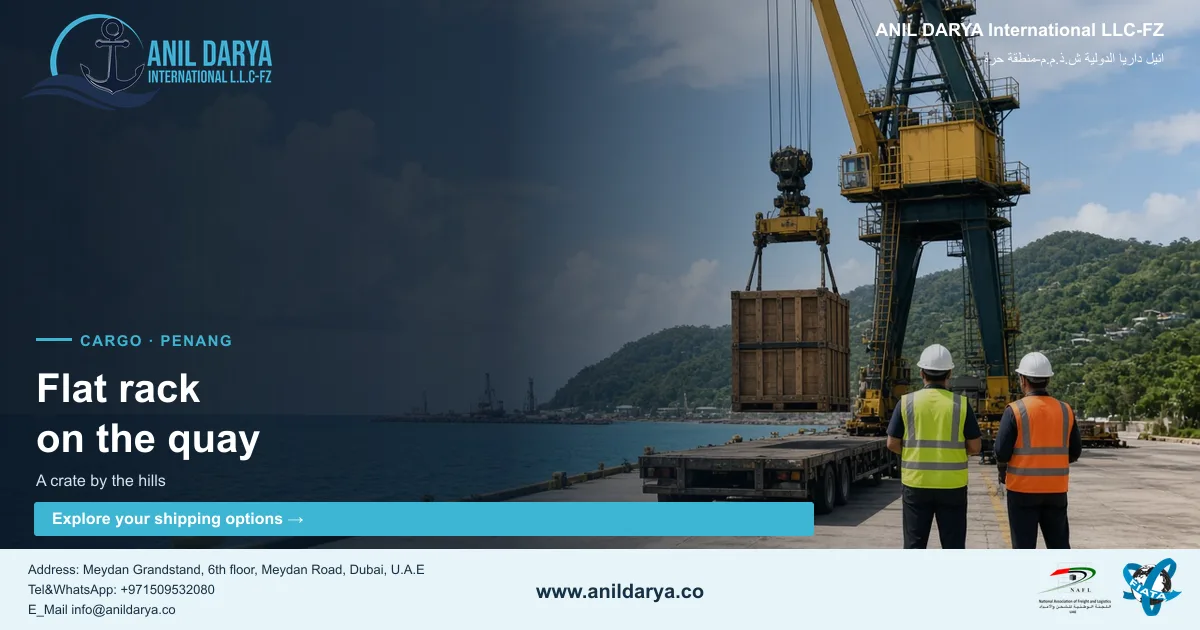
- Choose the vessel: flat rack on a container service to NBCT, or a general cargo or heavy-lift vessel to BDWW.
- Check the vessel's draft against the berth depth at the discharge wharf.
- Agree lifting, lashing and securing with the carrier and the terminal.
- Plan the road leg from the wharf. The Penang Port Commission issued a notice in 2025 on enforcing combined vehicle weight limits on cargo leaving the port, so heavy pieces need the right trailer and permits.
See our break bulk and project cargo service for what we cover, and our guide to flat rack, open top and out-of-gauge cargo for the container options.
Dangerous goods at Penang Port: the local rules
Penang handles DG in containers at NBCT and has a dedicated DG berth at the Prai Bulk Cargo Terminal. The Penang Port Commission regulates DG through its by-laws and port notices. Recent notices you should know about:
| Notice | Subject | What it means for you |
|---|---|---|
| 2/2026 | Dangerous goods declaration module moved to the e-PDCFZ system; the Pelkon III DG module ended | The DG declaration for Penang is filed in the new system, so your local agent must be set up on it |
| 7/2025 | Application of IMDG Code amendment 42-24 | Documents and packaging must follow the current IMDG Code edition |
| 8/2025 | Gazettement of the Penang Port Commission by-laws | Local DG handling rules are set in the by-laws |
| 13/2024 | Designated area at Butterworth Deep Water Wharves for ships in transit carrying dangerous cargo | Vessels with DG in transit use a specific area of the port |
We could read the notice titles but not the full text of each notice, so we confirm the current procedure with the carrier and the local agent for every DG booking. What you need to provide:
- UN number, proper shipping name, class and packing group for each product.
- A Safety Data Sheet for each product.
- A signed Dangerous Goods Declaration, UN-approved packaging, and marks, labels and placards to the IMDG Code.
- Any Malaysian permit the product needs.
Our dangerous goods shipping team gets carrier acceptance and checks the paperwork before you commit to a sailing.
Malaysian customs at Penang Port: a short summary
Customs rules are national and the same at every Malaysian port. Here is the short version, with the full detail in our Port Klang guide.
| Topic | Rule |
|---|---|
| Import declaration | Customs Form No. 1 (K1), usually filed by a Malaysian customs or forwarding agent |
| Core documents | K1, commercial invoice, bill of lading, packing list |
| Preferential duty | Proof of origin that matches the K1, invoice and bill of lading |
| Import duty | Set per HS code, can be zero |
| Sales tax | 5% or 10% on discretionary and non-essential goods since 1 July 2025; essential goods exempt |
| Prohibited and restricted goods | Customs (Prohibition of Imports) Order 2023, P.U. (A) 117/2023 |
NBCT lists customs clearance among its services, so the agent can complete clearance at the terminal. We do not file Malaysian declarations. We send the consignee's agent a complete, matching set of documents before the vessel arrives.
The Penang Port free commercial zone
Penang Port has a Free Commercial Zone (FCZ) on two sites, at NBCT and at Butterworth Deep Water Wharves, covering more than 140 hectares. The NBCT zone was gazetted on 1 February 2021. It allows import, export, transshipment and value-added work under customs-free status, and the Free Zone Authority of the Penang Port Commission manages it. Foreign goods tax is deferred while the goods stay in the zone.
When an FCZ delivery makes sense:
- The goods will be stored, repacked or labelled, then sent on to other markets.
- You want stock near the port and pay duty only when goods enter the Malaysian market.
- The cargo is for re-export to southern Thailand or other regional markets.
In 2026 the commission moved FCZ procedures to the e-PDCFZ system, so your agent must file free zone movements there.
Road and rail links from Penang Port
NBCT has its own freight rail station, owned by Penang Port and operated by KTM Berhad, which moves containers between ships and the rail network. Most import boxes still leave by truck to industrial areas in Seberang Perai, Penang island, Kedah and northern Perak.
| Final delivery | Usual port choice | Why |
|---|---|---|
| Penang island, Seberang Perai, Kedah, Perlis | Penang Port | Shortest truck leg |
| Northern Perak | Compare Penang and Port Klang | Depends on services and truck cost |
| Klang Valley, Selangor, Kuala Lumpur | Port Klang | Avoids a long truck or rail leg north to south |
| Johor and the far south | Tanjung Pelepas or Johor Port | Closer to the consignee |
How to ship from Dubai to Penang: step by step
- Tell us about the cargo. Commodity, HS code, weight, volume or dimensions, the delivery address and the Incoterm agreed with your buyer.
- Pick the terminal by cargo type. Containers to NBCT, breakbulk to BDWW, bulk to PBCT.
- Check permits. For controlled goods or DG, the consignee applies for the Malaysian licence or permit before we book.
- Get a quote and choose the service. We compare direct calls and relays from Jebel Ali or Khalifa Port, and check vessel draft for breakbulk.
- Book space. For reefer, DG or out-of-gauge cargo we get carrier acceptance first.
- Stuff, seal and clear UAE export. We arrange the empty, stuffing, VGM, the export or re-export declaration and gate-in before the cut-off.
- Check the bill of lading. Consignee, HS codes, weights and marks must match the invoice and packing list.
- Send documents to the Malaysian agent. Invoice, packing list, bill of lading, proof of origin and any permit, before arrival. For DG, the agent files the declaration in the port's system.
- Arrival and release. The agent files the K1, pays duty and tax, collects the delivery order and books the truck or rail move.
Our Incoterms 2020 guide helps you agree who pays for each step at Penang.
How to ship from Penang to Dubai
We also handle the reverse lane: shipping from Penang to Dubai, with arrival at Jebel Ali, Khalifa Port or Sharjah port. Much of this cargo is factory output from the northern states, loaded at NBCT. We book the space with the carrier and run the UAE side. The Malaysian export filing stays with the shipper or its Malaysian agent.
The Malaysia export side
- Export declaration. The exporter or its shipping agent files the K2 (or K8) export declaration online, and the Customs Information System (SMK) checks it.
- Strategic goods. In the declaration, the exporter states whether the goods need a permit under the Strategic Trade Act 2010. If they do, the permit number goes on the declaration and SMK validates it. A wrong number gets the declaration rejected.
- Who issues the permits. MITI, the Atomic Energy Licensing Board, MCMC and the Pharmaceutical Services Division of the Ministry of Health, through the myTRADELINK system. The exporter needs the permit before the goods are exported, so check the product against the strategic goods list before booking.
- Free zone cargo. Goods leaving the Penang Port Free Commercial Zone move under the FCZ procedures in the e-PDCFZ system, filed by the shipper's agent.
The UAE import side
On arrival, the import declaration goes to Dubai Customs with the commercial invoice, the packing list, the certificate of origin and a permit from the relevant authority for restricted goods. The carrier releases the delivery order against the bill of lading. Customs duty in Dubai is 5% of the CIF value for most goods, with 50% on alcohol and 100% on cigarettes. Import VAT is 5%, and a VAT-registered importer accounts for it through the reverse charge on its VAT return.
- Send us the shipper's address, the cargo, the HS code and the UAE delivery address.
- We book space from NBCT, or from BDWW for breakbulk, and send the booking and cut-offs to the shipper.
- The shipper or its haulier collects the empty, loads it and gates it in full at NBCT.
- The shipper or its Malaysian agent files the K2, with any strategic trade permit number.
- We check the draft bill of lading against the invoice and packing list.
- We file the UAE declaration before the vessel arrives.
- We arrange payment of the duty and VAT, and collect the delivery order from the carrier.
- We truck the container to your site and return the empty inside free time.
[AMIR-FACT: the carriers we actually use from Penang to Jebel Ali, Khalifa Port or Sharjah and our real transit days in this direction]
Free time and demurrage at Penang Port
Carriers set free days and daily charges for containers at Penang, and the Penang Port Commission publishes the port tariff. Charges differ by line and box type, so read them on the quote and the arrival notice. File the K1 before arrival, get permits approved before the vessel berths, and book the truck and empty return in advance. Our article on demurrage and detention explains the charges.
Checklist before you ship to Penang
- Terminal matched to cargo type: NBCT, BDWW or PBCT.
- Direct call or relay confirmed for your service.
- Vessel draft checked against berth depth for breakbulk.
- HS code confirmed by the Malaysian agent for every item.
- Import licence or permit approved for goods in the 2023 prohibition order.
- Proof of origin ready if you claim a preferential rate, with details that match the invoice and bill of lading.
- DG declaration route agreed with the local agent, plus SDS, labels and carrier acceptance.
- Delivery route checked against vehicle weight limits for heavy pieces.
- FCZ or mainland delivery decided before the vessel sails.
- Free time agreed, and truck and empty return planned.
Common mistakes on Penang shipments
- Assuming every service calls Penang direct. Some relay through a larger hub, which adds time and a transshipment.
- Booking a deep-draft breakbulk vessel without checking berth depth at BDWW.
- Overloaded trucks out of the port. The commission enforces combined vehicle weight limits.
- Using an old DG filing route. DG declarations moved to e-PDCFZ in 2026.
- Late permits for controlled goods, which keep the cargo in the port while storage runs.
- Mismatched proof of origin, which costs you the preferential duty rate.
Frequently asked questions
What is the port code for Penang?
The UN/LOCODE for Penang Port is MYPEN. Some systems label it Penang (Georgetown), and container cargo is handled at North Butterworth Container Terminal on the mainland.
Who operates the port in Penang?
Penang Port Sdn Bhd, owned by MMC, operates the terminals. The Penang Port Commission is the regulator and also the Free Zone Authority.
How much cargo does Penang Port handle?
In 2025 NBCT handled 1,351,454 TEU and the port handled 30.7 million tonnes of cargo in total, according to the Penang Port Commission. Both figures were slightly lower than in 2024.
How deep are the container berths at Penang?
The six main NBCT berths are 11 to 12 m deep, and the inner berth is 7.5 m. That is shallower than Malaysia's large southern hubs, so ships calling here are smaller.
Can I ship breakbulk and project cargo to Penang?
Yes. Butterworth Deep Water Wharves has 6 berths over 1.05 km for breakbulk, including steel, machinery and modular houses. Check the vessel draft against the 9 to 10 m berth depths.
Can I ship dangerous goods to Penang Port?
Yes. DG moves in containers at NBCT and there is a DG berth at the Prai Bulk Cargo Terminal. Since 2026 the DG declaration is filed through the e-PDCFZ system, and the current IMDG Code edition applies.
Does Penang Port have a free zone?
Yes. The Free Commercial Zone covers more than 140 hectares at NBCT and Butterworth Deep Water Wharves. Goods can be stored, processed and re-exported without paying import duty while in the zone.
What documents do I need when shipping from Dubai to Penang?
Malaysian Customs needs the K1 declaration, commercial invoice, bill of lading and packing list. Add a proof of origin for a preferential duty rate, and any licence for controlled goods.
Can you handle shipping from Penang to Dubai?
Yes. We book the space from Penang, the shipper or its Malaysian agent files the K2 export declaration, and we clear the cargo through UAE customs and deliver it. Most goods pay 5% duty on the CIF value plus 5% import VAT.
Is Penang Port connected by rail?
Yes. NBCT has a freight rail station on the KTM network that moves containers to and from ships, so boxes can move inland by rail as well as by truck.
Get a quote for Penang Port shipping
Send us the cargo details, the delivery address and the cargo type, and we will come back with a routing and price from the UAE to Penang. Use our freight rate inquiry form, or contact our team to talk through a breakbulk or DG shipment first. You can also read more about our Dubai freight forwarding team.
Sources
- Penang Port Commission: North Butterworth Container Terminal (berths, depths, capacity, FCZ, services)
- Penang Port Commission: Butterworth Deep Water Wharves
- Penang Port Commission: Prai Bulk Cargo Terminal
- Penang Port Commission: Vegetable Oil Tanker Pier
- Penang Port Commission: Port statistics (NBCT TEU and total cargo, 2023 to 2025)
- Penang Port Commission: Free Commercial Zone
- Penang Port Commission: Home (contact, port tariff, permits and notices menus)
- Penang Port Commission: Port notices (DG declaration, IMDG, by-laws, vehicle weight)
- The Star: Port forging ahead with RM250mil expansion (NBCT history, operator)
- Baird Maritime: Penang Port expansion (MMC ownership)
- Wikipedia: Port of Penang (history, terminal locations)
- iContainers: Shipping to Penang (hinterland: northern states and southern Thailand)
- Cogoport: Penang port info (UN/LOCODE MYPEN)
- RailTravel Station: NBCT freight rail station
- Royal Malaysian Customs: Rules of origin FAQ
- Royal Malaysian Customs: Prohibition of imports
- Ministry of Finance Malaysia: Sales tax revision effective 1 July 2025
- Royal Malaysian Customs: Export procedure (K2/K8 declaration, SMK, Strategic Trade Act permits)
- MATRADE: Guide to exporting (K2 export declaration, export licence)
- Dubai Customs: Submit customs declaration (invoice, packing list, certificate of origin, permits)
- UAE Government portal: Customs duty (5% of CIF, alcohol 50%, cigarettes 100%)
- Federal Tax Authority: VAT guide (5% import VAT, reverse charge)
Reviewed: 10 November 2026