
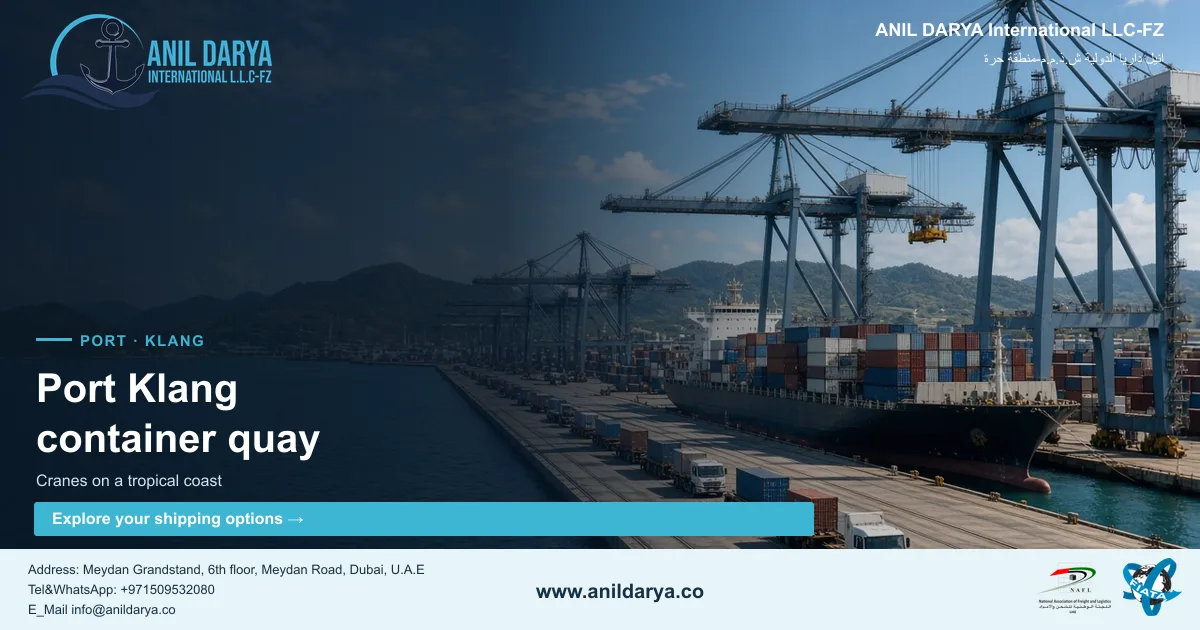
Port Klang shipping means one of two operators: Westports, which handles about three quarters of the port's containers, or Northport, a multi-purpose port with its Southpoint conventional cargo wharves. It handled a record 15.14 million TEU in 2025, and Westports describes itself as the main gateway for cargo to central Peninsular Malaysia. This guide covers the terminals, the cargo each one takes, Malaysian customs, duty and sales tax, and how we ship your cargo from Dubai to Port Klang. We ship both ways: from Dubai to Port Klang and from Port Klang to Dubai.
Port Klang shipping: key facts at a glance
| Item | Detail |
|---|---|
| Port authority | Port Klang Authority |
| Terminal operators | Westports Malaysia; Northport (Malaysia) Bhd, which also runs Southpoint |
| Customs authority | Royal Malaysian Customs Department |
| UN/LOCODE | MYPKG |
| Location | About 38 km southwest of Kuala Lumpur |
| Containers handled in 2025 | 15.14 million TEU, a record, up 3.4% on 2024 |
| Transhipment in 2025 | 8.41 million TEU, up 6.2% |
| Westports containers 2025 | 11.33 million TEU |
| Northport containers 2025 | 3.8 million TEU |
| Westports berths | 34 berths, 10,071 m in total, container berths along a 5.8 km straight quay |
| Westports container capacity | 13.8 million TEU a year |
| Conventional cargo | Westports 12.83 million tonnes in 2025; Northport 12.69 million freight weight tonnes in 2024 |
| Free zone | 405 hectare customs-free zone at Westports |
| Import declaration | Customs Form No. 1 (K1) |
| Sales tax on imports | 5% or 10% on non-essential goods; essential goods exempt |
| Shipping from Port Klang to Dubai | Also handled: arrival at Jebel Ali, Khalifa Port or Sharjah, cleared by UAE customs with 5% duty on most goods and 5% VAT |
Where is Port Klang and who runs it?
Port Klang sits on the west coast of Peninsular Malaysia, about 38 km southwest of Kuala Lumpur. It is not one terminal. The Port Klang Authority administers three port areas: Westports on Pulau Indah, Northport, and Southpoint. Westports and Northport are both privately run.
The 2025 total of 15.14 million TEU was the port's highest since operations began in 1973, and it is now among the world's top 10 container ports. More than half, 8.41 million TEU, was transhipment. For 2026 the port is targeting 15.37 million TEU.
Westports, Northport and Southpoint: which terminal handles your cargo?
Your carrier's service decides the terminal, and the terminal is printed on your booking and arrival notice. Use the table to see what each one does.
| Terminal | Operator | Main cargo | What to know |
|---|---|---|---|
| Westports container terminal | Westports Malaysia | Containers, gateway and transhipment; 62% intra-Asia trade | About 75% of Port Klang's containers; handles 24,000 TEU ships |
| Westports conventional terminals | Westports Malaysia | Breakbulk, dry bulk, cement, liquid bulk, Ro-Ro | Separate breakbulk, dry bulk, cement jetty and liquid bulk berths |
| Northport | Northport (Malaysia) Bhd | Containers, cars, breakbulk, liquid and dry bulk | Multi-purpose gateway port, part of MMC Ports |
| Southpoint | Northport (Malaysia) Bhd | Conventional cargo | 8 berths, the former South Port |
Westports: the main container gateway
Westports handled 11.33 million TEU in 2025, about 75% of Port Klang's container market. Its 2025 sustainability report lists 34 berths with a combined length of 10,071 m, container berths on one 5.8 km straight line, and a container handling capacity of 13.8 million TEU. Average berth occupancy was 84% in 2025, so the quay runs busy. Westports says it connects to more than 350 ports.
Westports also runs conventional terminals: a main breakbulk terminal, dry bulk berths, a cement jetty, a liquid bulk terminal and Ro-Ro. They handled 12.83 million tonnes in 2025. That cargo included mixed steel, steel coils, project cargo, animal feed, fertilisers, building materials, palm oil, petroleum, chemicals and LPG.
Northport and Southpoint: the multi-purpose option
Northport is one of Malaysia's largest multi-purpose gateway ports and part of MMC Ports. It handles containers, cars, breakbulk, and liquid and dry bulk at two locations. Northport has container and conventional facilities, and Southpoint handles conventional cargo only.
Northport handled 3.8 million TEU in 2025. On the conventional side it moved a record 12.69 million freight weight tonnes in 2024. In September 2025 it set a monthly record of 1.33 million freight weight tonnes. Iron and steel led the breakbulk segment, chemicals the liquid bulk segment and maize the dry bulk segment, and Ro-Ro grew as well.
What is being built: Westports 2
Westports holds a concession for eight new container berths, CT10 to CT17. The first phase, CT10 to CT13, runs from 2024 to 2038. Reclamation for CT10 is due to finish at the end of 2026, and Westports expects CT10 to start operating in 2028. The Ministry of Transport says it will eventually lift capacity to 28 million TEU.
What cargo can you ship through Port Klang?
| Cargo type | Where it is usually handled | What to plan |
|---|---|---|
| General goods in containers | Westports or Northport container terminal | Terminal on the arrival notice, K1 declaration, haulage slot |
| Chilled and frozen food | Container terminals, reefer boxes | Set temperature, import permits from the relevant agency |
| Steel, coils, machinery | Westports breakbulk terminal or Northport | Lifting points, piece list, trailer type |
| Project and out-of-gauge cargo | Westports conventional terminal, Northport | Drawings, lift plan, road permits from the port |
| Chemicals, petroleum, LPG | Liquid bulk terminals at Westports and Northport | Receiving facility, surveys, DG paperwork |
| Grain, fertiliser, cement | Dry bulk berths and cement jetty | Discharge plan and receiver |
| Cars and vehicles | Ro-Ro at Westports or Northport | Import approval and vehicle documents |
Shipping from Dubai to Malaysia by container: FCL or LCL?
Most cargo shipped from Dubai to Malaysia moves in containers to Port Klang. You choose between two options.
- FCL (full container load). You book a whole 20ft or 40ft box. It suits larger shipments and goods you do not want handled with other cargo.
- LCL (less than container load). Your cargo shares a box with other shippers and is unpacked at a consolidator's warehouse after discharge. Release depends on the consolidator's paperwork as well as yours.
A useful rule: once your cargo fills most of a 20ft box, FCL is usually cheaper per cubic metre and safer for fragile goods. Our guide to FCL vs LCL costs walks through the maths, and our sea freight service covers both.
Your cargo usually leaves from Jebel Ali Port. Some services run direct and others relay the box through a transhipment hub, so ask which one you are booking.
[AMIR-FACT: our real port-to-port transit time Jebel Ali to Port Klang and the carriers we usually book on this lane]
Online aggregators publish very different sailing times for this lane, so we quote transit from the carrier's own schedule at the time of booking. Ask for the cut-off date as well as the sailing date.
Breakbulk, bulk and project cargo at Port Klang
Port Klang moves a lot of non-container cargo. Westports handled 12.83 million tonnes of conventional cargo in 2025, and Northport 12.69 million freight weight tonnes in 2024. Steel is the biggest breakbulk item at both. Westports also lists project cargo among its conventional cargo.
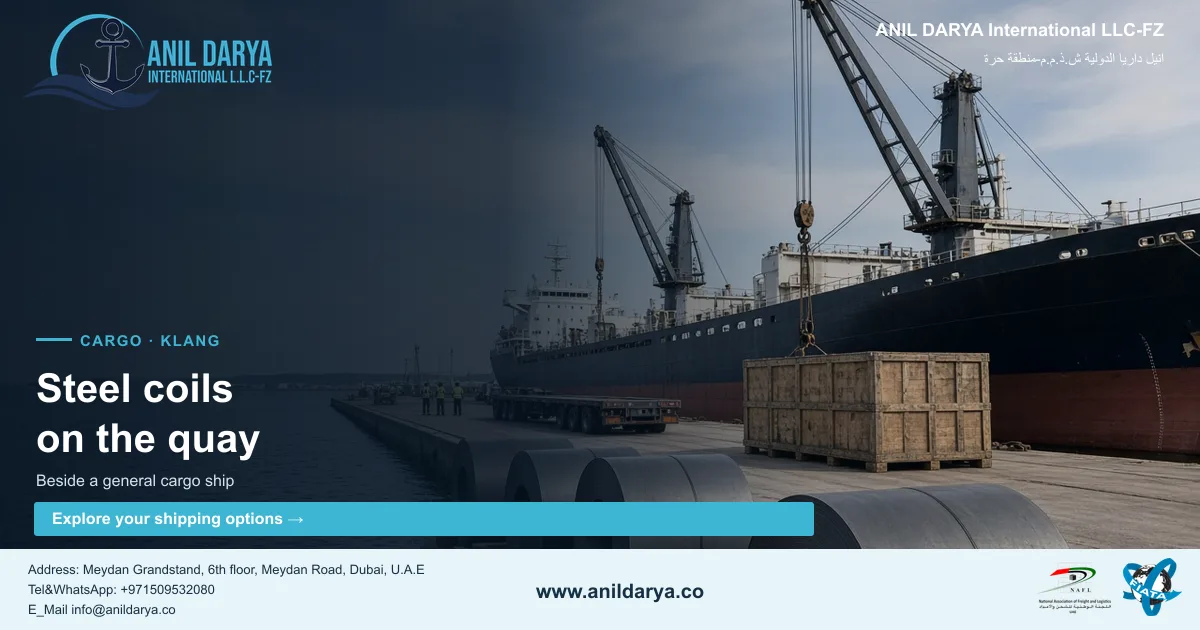
When we plan breakbulk or project cargo from the UAE to Port Klang, we work in this order:
- Collect drawings, dimensions, weights and centre of gravity for every piece.
- Choose the equipment: flat rack or open top on a container service, or conventional breakbulk tonnage. Our guide to flat rack, open top and out-of-gauge cargo shows how to decide.
- Confirm which terminal will receive the cargo, Westports or Northport, and agree lifting and lashing with the carrier.
- Get the consignee's customs agent ready to file the K1 before discharge.
- Check the road move from the port, including any permits for oversized loads.
For dry or liquid bulk, Port Klang has dedicated berths at both operators, including a cement jetty and liquid bulk terminal at Westports. We plan bulk and breakbulk from the UAE side through our break bulk and project cargo service and our bulk cargo service.
Dangerous goods to Port Klang
Both operators handle dangerous cargo. Northport's liquid bulk volume is driven mainly by chemicals, and Westports' conventional cargo includes chemicals, petroleum and LPG. Container DG moves under the IMDG Code like on any other lane. On top of that, each carrier and terminal applies its own acceptance rules and, for some classes, Malaysian permits.
We did not find a current official port rule we could quote class by class, so we confirm the rules for every booking with the carrier and terminal. What you need to provide:
- UN number, proper shipping name, class and packing group for each product.
- A Safety Data Sheet for each product.
- A signed Dangerous Goods Declaration, UN-approved packaging, and marks and labels to the IMDG Code.
- Any import licence or permit the Malaysian authorities require for the product.
Our dangerous goods shipping team gets carrier acceptance and checks the paperwork before you commit to a sailing.
Malaysian customs clearance at Port Klang: K1, duty and sales tax
Goods imported into Malaysia are declared to the Royal Malaysian Customs Department on Customs Form No. 1, known as the K1. Usually a customs or forwarding agent in Malaysia files it for the importer, and the importer pays any duty and tax before release.
Who files the import declaration?
The importer in Malaysia is responsible, and a forwarding agent usually files the K1 on its behalf. We do not file Malaysian declarations. We send the agent a full, matching set of documents before the vessel arrives so the K1 can be lodged on time.
Which documents do you need?
Malaysian Customs lists the K1, the invoice, the bill of lading and the packing list as the core documents, plus a proof of origin if you claim a preferential duty rate. The table shows how this changes by cargo type.
| Cargo type | Core documents | Usually also needed |
|---|---|---|
| General cargo (FCL or LCL) | K1, commercial invoice, packing list, bill of lading | Proof of origin if claiming preferential duty |
| Controlled goods | Core set | Import licence or permit from the relevant agency |
| Dangerous goods | Core set | DG declaration, SDS, any product permit |
| Breakbulk and project cargo | Core set, with piece-by-piece packing list | Drawings and weights for the terminal, road permits |
| Temporary import (exhibitions, testing, repair) | Written application, invoice, packing list, bill of lading | End-user certificate and a bank guarantee for the duty and tax |
How much import duty and sales tax will you pay?
Malaysia sets import duty per HS code, so there is no single rate. The official HS code lookup and the duty order give the rate for your product. On top of duty, sales tax applies at import. Since 1 July 2025, the Ministry of Finance applies sales tax at 5% or 10% to discretionary and non-essential goods, and essential goods stay exempt.
| Charge | Rate | How to check |
|---|---|---|
| Import duty | Set per HS code, can be zero | HS code lookup with the customs agent |
| Sales tax, essential goods | Exempt | Sales tax exemption order |
| Sales tax, non-essential goods | 5% or 10% | Sales tax rate order for your tariff code |
| Preferential duty | Lower or zero under a trade agreement | Valid proof of origin that matches the K1, invoice and bill of lading |
A simple rule: get the HS code confirmed by the Malaysian agent before you ship. A wrong code changes both the duty and the sales tax.
Preferential duty and proof of origin
To claim a preferential rate, Malaysian Customs asks for the K1, a proof of origin such as a certificate of origin or declaration of origin, and the invoice, bill of lading and packing list. The details on the proof of origin must match the K1 and the supporting documents. If they do not, expect the claim to be refused.
Prohibited and restricted goods: the 2023 import order
Malaysian Customs tells importers and agents to check every shipment against the Customs (Prohibition of Imports) Order 2023, P.U. (A) 117/2023, in force since 15 April 2023. If the goods are listed, every condition in the order must be met. The order has four main schedules.
| Schedule | What it means | Examples from the order |
|---|---|---|
| First | Absolutely prohibited, also for goods in transit | Lightning arresters containing radioactive material, PCBs and listed asbestos types, CFCs and carbon tetrachloride, mixed waste paper, pens resembling syringes |
| Second | Prohibited except under an import licence from the named ministry or agency | Motor vehicles (MITI), sugar (Ministry of Domestic Trade and Cost of Living), radar and radio navigation apparatus (SIRIM), some hot-rolled steel products (MITI) |
| Third | Prohibited except in the manner provided, such as a permit or inspection | Plants, animals, food and wildlife products regulated by agencies such as MAQIS and the Department of Veterinary Services |
| Fourth | Prohibited unless the goods meet the Malaysian Standard or another approved standard | Goods listed with the standard they must meet |
The licence must be shown at the time of import, so apply before the vessel sails. Some licence requirements do not apply inside listed free zones, which include West Port on Pulau Indah and South Point at Port Klang. The licence is needed when the goods move out of the zone into the main customs area. This matters for steel: some hot-rolled steel products need a MITI licence when they enter the local market.
Temporary import for exhibitions, testing or repair
Malaysia lets you import goods temporarily without paying duty or tax, as long as they go back out. This covers research and demonstration, exhibitions and performances, sports and conferences, evaluation and testing, and repair.
| Rule | Detail |
|---|---|
| Time limit | Re-export within 3 months of import |
| Extension | Up to 12 more months from the customs station, for valid reasons |
| Security | Bank guarantee equal to the duty and tax, before release |
| Conditions | No sale or change of ownership; same goods re-exported to the country of origin |
| Refund of security | Copy of Customs Form No. 2 as proof of export |
Goods covered by the 2023 import order still need their licence or permit under this facility.
Using the Westports free zone
Westports has a 405 hectare customs-free zone. If your buyer stores, repacks or re-exports goods rather than selling them locally, ask its agent whether delivery into the zone defers duty, tax and some licences. Confirm it before the K1 is filed.
How to ship from Dubai to Port Klang: step by step
Here is how we handle a typical shipment from the UAE to Port Klang. We book the space, prepare the documents and handle the UAE side. A customs agent in Malaysia, appointed by the consignee, handles the import.
- Tell us about the cargo: commodity, HS code, weight, volume or dimensions, pickup point and the Incoterm agreed with your buyer.
- Check the Malaysian side early. Confirm the consignee's customs agent, the duty and sales tax on the HS code, and any import licence.
- Book space. We compare carrier services to Port Klang and confirm whether they call Westports or Northport. For DG, reefer or out-of-gauge cargo we get carrier acceptance first.
- Stuff and seal the container. We arrange the empty, origin trucking and stuffing at your site or a warehouse.
- File the UAE export or re-export declaration with Dubai Customs and gate the box in before the cut-off.
- Release the bill of lading. We check the draft against the invoice and packing list and release the final bill, or a sea waybill, after sailing. We send copies and the proof of origin to the Malaysian agent.
- K1 and payment. The agent files the K1 and the importer pays duty and sales tax.
- Delivery order and haulage. The agent collects the delivery order from the line, and a haulier moves the container from Westports or Northport to the consignee.
How to ship from Port Klang to Dubai
We also handle the other direction: shipping from Port Klang to Dubai, with arrival at Jebel Ali, Khalifa Port or Sharjah port. We book the space with the carrier and run the UAE side. The Malaysian export papers stay with the shipper or its Malaysian agent.
The Malaysian export side
- Export declaration. MATRADE describes Customs Form No. 2 (K2) as the standard export document for goods shipped out of Malaysia, issued by the freight forwarder.
- Export licences. Some goods need an export licence from the government for specified goods and countries. MATRADE points exporters to MITI and the Royal Malaysian Customs for the rules.
The UAE import side
For cargo cleared in Dubai, the import declaration goes to Dubai Customs with the commercial invoice, packing list, certificate of origin and any permit from the authority that controls restricted goods. The bill of lading is what releases the cargo from the shipping line. Customs duty in Dubai is 5% of the CIF value for most goods, with 50% on alcohol and 100% on cigarettes. Import VAT is 5%, charged on the customs value including freight and insurance. A VAT-registered importer that has registered its customs number with the Federal Tax Authority pays no VAT at the border and accounts for it on its next VAT return.
- Send us the shipper's details in Port Klang, the cargo, the HS code and the UAE delivery address.
- We book space with the carrier from Port Klang to Jebel Ali, Khalifa Port or Sharjah and send the booking and cut-offs to the shipper.
- The shipper or its trucker picks up the cargo and delivers the container to the Westports or Northport terminal named in the booking before the cut-off.
- The shipper or its Malaysian agent files the K2 export declaration with Malaysian customs.
- We check the draft bill of lading against the invoice and packing list before the line issues it.
- We file the UAE import declaration before the vessel arrives.
- We arrange payment of the duty and VAT and collect the delivery order from the shipping line.
- We truck the container to your site in the UAE.
- We return the empty container to the line's depot within free time.
[AMIR-FACT: the carriers we actually use from Port Klang to Jebel Ali, Khalifa Port or Sharjah and our real port-to-port transit days in this direction]
Free time, demurrage and haulage at Port Klang
Shipping lines give a set number of free days for their containers. After that, demurrage runs while the full box stays in the terminal, and detention while the consignee keeps it outside. Terminal storage can also apply. Free days and daily rates differ by carrier, so read them on the quote and the arrival notice.
Three things keep these costs down: send documents to the Malaysian agent before arrival, have any import licence ready before the vessel berths, and book haulage from the right terminal before free time starts. Our article on demurrage and detention shows how the charges add up.
What affects your cost on this lane?
We do not publish fixed rates because they change with every sailing. These are the factors that move the price.
| Cost factor | Why it changes the price | What you can do |
|---|---|---|
| FCL or LCL | LCL adds warehouse handling at both ends | Ask us to price both when you are close to filling a box |
| Direct or relay service | Transhipment adds handling and time | Ask whether the service is direct to Port Klang |
| Equipment | Reefers, flat racks and open tops cost more | Book special equipment early |
| Cargo class | DG adds surcharges and acceptance checks | Send the SDS with the enquiry |
| Destination charges | Terminal handling, delivery order, agent and haulage in Malaysia | Agree who pays them in the Incoterm |
| Duty and sales tax | Set by HS code; 5% or 10% sales tax on non-essential goods | Confirm the HS code before shipping |
Checklist before you ship to Port Klang
- HS code confirmed with the Malaysian agent, with duty and sales tax checked.
- Consignee's customs agent named and in contact with us.
- Goods checked against the Customs (Prohibition of Imports) Order 2023, with any licence in hand.
- Invoice, packing list and bill of lading show the same weights, piece counts and consignee.
- Proof of origin issued, if you claim a preferential rate, with details that match the invoice.
- Terminal confirmed: Westports or Northport.
- For DG: SDS, DG declaration, packaging and labels, carrier acceptance.
- For breakbulk: drawings, lifting points and the road route from the port.
- Free time agreed with the carrier and haulage booked.
- Cargo insurance arranged.
Common mistakes on Port Klang shipments
- Wrong terminal on the haulage booking. Westports and Northport are separate ports, and a truck sent to the wrong one wastes the slot.
- Mismatched documents. A different weight or consignee on the invoice and the bill of lading can hold the K1.
- Origin details that do not match. A proof of origin that differs from the K1 or invoice loses the preferential rate.
- Guessing the HS code. The code sets both duty and sales tax, so a wrong one costs money or triggers an amendment.
- Late licences. Applying for an import permit after arrival runs up demurrage and storage.
- Treating DG like general cargo. Undeclared dangerous goods can be rejected, delayed or fined.
Frequently asked questions
Which terminals make up Port Klang?
Port Klang has three port areas run by two operators: Westports on Pulau Indah, and Northport, which also runs the Southpoint conventional cargo wharves. The Port Klang Authority administers all three.
How much cargo does Port Klang handle?
Port Klang handled a record 15.14 million TEU of containers in 2025, up 3.4% on 2024. Westports handled 11.33 million TEU of that and Northport about 3.8 million.
Is Westports or Northport better for my cargo?
For containers, your carrier's service decides the terminal. For breakbulk, bulk and Ro-Ro, both operators have conventional berths, so it depends on which line or vessel you book and where the consignee is.
What documents do I need to clear cargo at Port Klang?
Malaysian Customs needs the import declaration on Customs Form No. 1 (K1), the commercial invoice, the bill of lading and the packing list. Add a proof of origin if you claim a preferential duty rate, and a licence for controlled goods.
What import tax applies to goods shipped from Dubai to Malaysia?
Import duty is set per HS code and can be zero. Sales tax of 5% or 10% applies to non-essential goods, while essential goods are exempt. Your Malaysian customs agent can confirm the exact rates for your tariff code.
Can I import goods into Malaysia temporarily without paying duty?
Yes, for exhibitions, testing, demonstration or repair. You give a bank guarantee equal to the duty and tax and re-export within 3 months, which customs can extend by up to 12 months.
Can I ship dangerous goods to Port Klang?
Yes. Both operators handle DG, including chemicals and petroleum products. The carrier and terminal must accept the cargo first, and you need an SDS, a DG declaration and any Malaysian permit for the product.
Which goods are prohibited from import into Malaysia?
The Customs (Prohibition of Imports) Order 2023 lists them. Some goods are banned outright, such as listed asbestos types and CFCs. Others, such as motor vehicles, sugar and some steel products, need an import licence, and food, plants and animals need agency approval.
Does Port Klang have a free zone?
Yes. Westports has a 405 hectare customs-free zone. Ask the Malaysian buyer's agent whether delivery into the zone suits the buyer's licence before you ship.
How do I ship from Port Klang to Dubai?
The Malaysian shipper's forwarder or customs agent files the K2 export declaration and gets any export licence. We book the space to Jebel Ali, Khalifa Port or Sharjah, file the UAE import declaration and arrange payment of the 5% duty (on the CIF value of most goods) and the 5% import VAT.
Get a quote for Port Klang shipping
Send us your cargo details and we will come back with a routing and a price for shipping from Dubai to Port Klang. Use our freight rate inquiry form, or contact our team to talk through a breakbulk, bulk or DG shipment first. You can also read more about our Dubai freight forwarding team.
Sources
- The Star, reporting the Ministry of Transport: Port Klang 2025 container records (Westports and Northport volumes)
- Malay Mail: Port Klang hits record 15.14 million TEUs in 2025 (transhipment, 2026 target, Westports 2 capacity)
- Westports Holdings: Sustainability Report 2025 (berths, capacity, conventional cargo, free zone, CT10 to CT17)
- Westports Malaysia: corporate overview presentation 2026 (CT10 timing)
- Westports: Conventional terminals
- Northport (Malaysia) Bhd: Facilities and services
- Northport: New record in conventional cargo handling (2025 press release)
- Royal Malaysian Customs: Rules of origin FAQ (K1, proof of origin, supporting documents)
- Royal Malaysian Customs: Temporary import facility
- Royal Malaysian Customs: Prohibition of imports
- Customs (Prohibition of Imports) Order 2023, P.U. (A) 117/2023
- Ministry of Finance Malaysia: Sales tax revision effective 1 July 2025
- Wikipedia: Port Klang (location, Port Klang Authority, Southpoint)
- iContainers: Port Kelang (UN/LOCODE)
- MATRADE: Guide to exporting, export documents (K2 export declaration, export licence)
- Dubai Customs: Submit customs declaration (invoice, packing list, certificate of origin, permits)
- UAE Government portal: Clearing customs and paying customs duty (5% of CIF, alcohol 50%, cigarettes 100%)
- Federal Tax Authority: VAT (5% rate)
- Federal Tax Authority: VAT guide, section 3.5 on VAT on imports (5%, deferral for VAT-registered importers)
Reviewed: 10 November 2026