
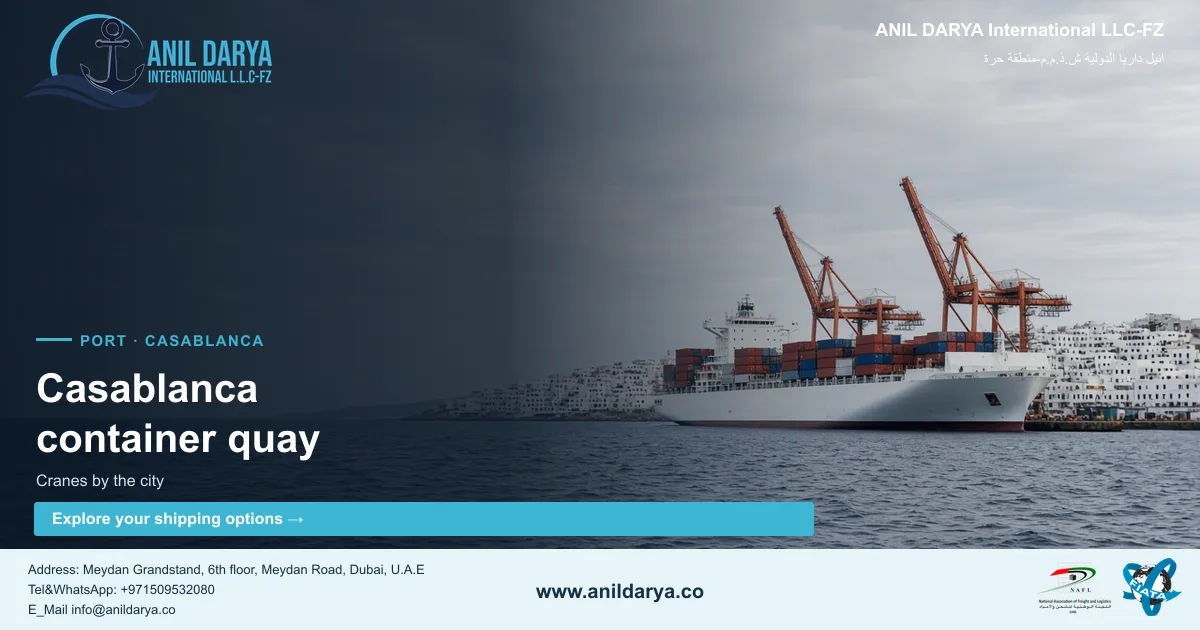
Casablanca port shipping means moving cargo through Morocco's main Atlantic city port, right next to the country's biggest consumer and industrial market. The port is run by Marsa Maroc and other operators under the National Ports Agency (ANP), with three container terminals. Marsa Maroc’s two container terminals account for about 1.3 million TEU of annual capacity; Somaport operates a separate terminal. This guide covers the terminals, depths, breakbulk berths, customs at the port and how we ship cargo from Dubai to Casablanca. We ship both from Dubai to Casablanca and from Casablanca to Dubai.
Casablanca port at a glance
| Item | Detail |
|---|---|
| Location | Casablanca, Atlantic coast of Morocco, next to the city centre |
| UN/LOCODE | MACAS |
| Regulator | Agence Nationale des Ports (ANP) |
| Main operator | Marsa Maroc (formerly ODEP), plus Somaport and specialist bulk operators |
| Container terminals | Three: Marsa Maroc east terminal, TC3 (Marsa Maroc subsidiary TC3PC) and Somaport |
| Container capacity | Marsa Maroc terminals: about 1.3 million TEU, with expansion toward 2.2 million TEU; Somaport capacity is separate |
| Container berth depths | 10 m (Somaport) to 12-14 m (TC3), per 2019 terminal data |
| Quays | About 8 km (2019 presentation) |
| Other terminals | Multipurpose, Ro-Ro, ore, cereals, phosphates, cruise |
| Multipurpose berth upgrade | Operator reports 12 m draft after the first deepening phase; confirm berth-specific acceptance with the terminal. |
| Carrier availability | Confirm the current carrier, routing and terminal in the booking |
| Customs | ADII, customs declarations in BADR, with related trade formalities through PortNet |
| Import VAT | Normally 20%; 10% or exemptions for eligible goods. Confirm additional import taxes by HS code in ADIL. |
| Shipping to Dubai | We also ship from Casablanca to Jebel Ali, Khalifa Port or Sharjah. Dubai duty is 5% of CIF for most goods, plus 5% import VAT |
What is the port of Casablanca?
The Port of Casablanca is an artificial harbour built behind a long breakwater, with works starting in 1906 and the main layout completed in 1938. Tanger Med, opened in 2007, has since become the bigger container hub.
The ANP regulates the port. Commercial operations were reorganised in 2006 under Law 15-02, when the state company ODEP was replaced by Marsa Maroc. Today Marsa Maroc runs most terminals, Somaport runs a container and multipurpose terminal, and private operators handle cereals and phosphates.
The key difference from Tanger Med is the market. Tanger Med is a transshipment hub on the Strait of Gibraltar. Casablanca is a gateway port: most boxes landing here are imports for consignees in Casablanca and the industrial belt around it, so the road leg after discharge is short.
Container terminals at Casablanca port
Casablanca has three container terminals. The figures below come from a 2019 terminal presentation by Somaport, with the operator’s later capacity expansion programme noted separately. Somaport’s current operator page lists 450,000 TEU annually, compared with 400,000 TEU in the historical presentation. Confirm current berth and draft limits before booking. Your carrier decides the terminal, and it shows on the arrival notice.
| Terminal | Operator | Quay | Berths | Depth | Area | Capacity |
|---|---|---|---|---|---|---|
| East container terminal | Marsa Maroc | 600 m | 3 | 12 m | 60 ha | 700,000 TEU |
| TC3 | TC3PC (Marsa Maroc subsidiary) | 560 m | 2 to 3 | 12 to 14 m | 30 ha | 600,000 TEU (2019 baseline) |
| Somaport container terminal | Somaport | 700 m | 3 Lo-Lo and 1 Ro-Ro ramp | 10 m (draft 9.2 m) | 21 ha | 400,000 TEU in 2019; operator now lists 450,000 TEU |
Somaport’s 2019 presentation lists 420 reefer plugs, a covered customs inspection area of 8,800 m² and a rail service centre with two 150 m tracks. Somaport handled 317,956 TEU in 2018.
Marsa Maroc’s investment programme targets an increase in its Casablanca container capacity from 1.3 million TEU to about 2.2 million TEU; this is not an aggregate including Somaport.
What this means for you: Casablanca takes feeder and mid-size container ships, not the largest vessels. Many services from the Gulf reach Casablanca after one or two transshipments at hub ports.
Breakbulk, Ro-Ro and bulk at Casablanca
Casablanca is a busy breakbulk and bulk port. Wikipedia's Marsa Maroc entry lists a multipurpose terminal with 1,500 m of quay across 12 berths and 14,000 m² of covered storage, a Ro-Ro terminal with two 100 t cranes and storage for 5,000 units, and an ore terminal with 390 m of quay.
Marsa Maroc reports that the first phase of multipurpose-terminal deepening provides a 12 m draft and enabled a 200 m bulk carrier carrying nearly 55,000 tonnes of raw sugar to call. Confirm the assigned berth, permissible draft, under-keel clearance and current works with the terminal before fixing a vessel; acceptance depends on the vessel and berth conditions.
Somaport's multipurpose terminal is smaller: 490 m of berths, four berths and a maximum draft of 8.2 m in 2019 data.
| Cargo type | Where it usually goes | What to plan from Dubai |
|---|---|---|
| FCL and LCL containers | Marsa Maroc east terminal, TC3 or Somaport | Terminal on the arrival notice, free time, truck slot |
| Reefer containers | Container terminals with reefer plugs | Set temperature, plug-in confirmed by the carrier |
| Steel, machinery, project pieces | Multipurpose terminals | Ship draft against the berth depth, crane capacity |
| Vehicles and rolling plant | Ro-Ro terminal or flat racks | Ro-Ro service availability, storage time |
| Cereals and feed | Specialist cereal terminals | Bulk ship berth window, discharge plan |
| Dangerous goods | Container terminals under IMDG rules | Carrier acceptance for every leg, consignee's agent checks |
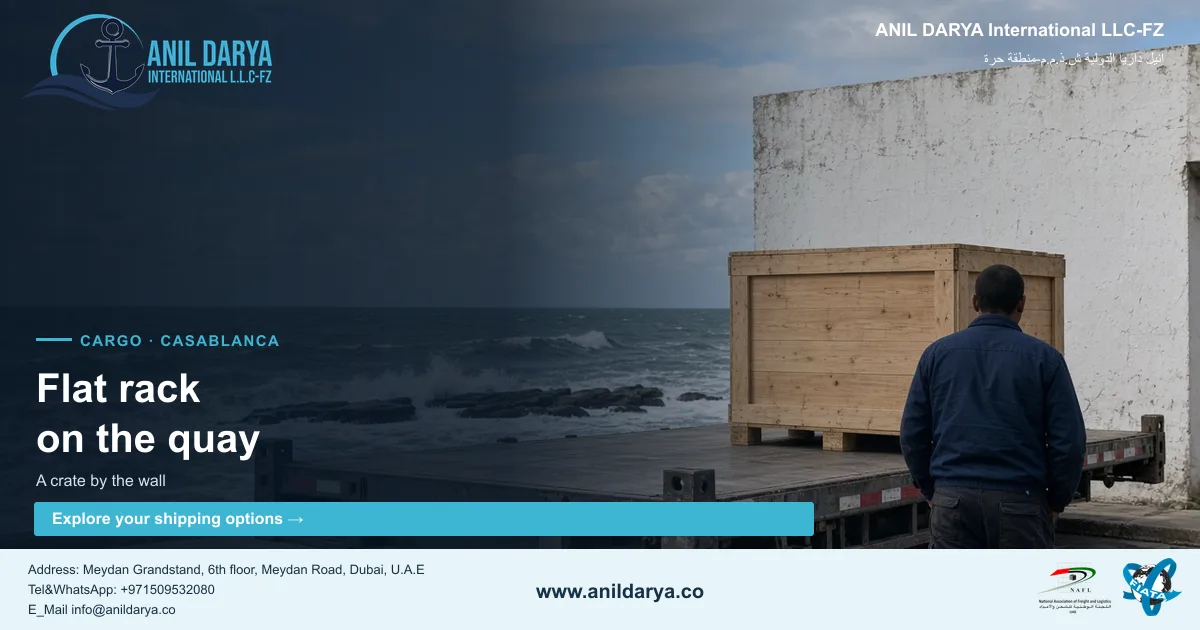
Decision rule for project cargo: a piece that fits a 40ft flat rack may be suitable for a container service from Jebel Ali, subject to weight, dimensions, securing arrangements and carrier acceptance for every leg. If it needs a breakbulk ship, check the ship's draft against the berth depth at Casablanca before you book, because the deeper berths are still being finished. Our break bulk and project cargo service and our guide to flat rack, open top and breakbulk options explain the choice.
Shipping from Dubai to Casablanca
Which services connect Jebel Ali and Casablanca?
On 9 November 2026, Maersk reported a 48% increase in the capacity deployed through its Casablanca network. This describes the carrier’s network, not an increase in the port’s physical terminal capacity; confirm the sailing frequency when booking.
Routing and transit depend on the carrier, sailing date and connecting service. Compare the available Jebel Ali and Khor Fakkan options, including each transshipment, connection time, destination charges and free time. For urgent cargo, compare air freight to Casablanca Mohammed V airport with the complete door-to-door sea option.
Request a dated quotation confirming the carrier, transshipment ports, scheduled port-to-port transit and available discharge port for your cargo. Confirm the schedule and cut-offs again when booking.
For urgent parts, air freight into Casablanca's Mohammed V airport is the faster choice. Our air cargo service covers DXB departures.
Should your cargo go to Casablanca or Tanger Med?
| Your situation | Port to use | Why |
|---|---|---|
| Consignee in Casablanca or central Morocco | Casablanca | Short truck leg, no long road move from the north |
| Consignee in Tangier or the north | Tanger Med | Delivery close to the port |
| Fastest sea transit matters most | Compare both | Hub calls at Tanger Med can be quicker than feeders to Casablanca |
| Bulk cereals or feed | Casablanca | Specialist cereal terminals; confirm berth and discharge arrangements |
Containers through Casablanca: FCL and LCL
FCL is the simplest way to ship to Casablanca. The container is allocated to your shipment, subject to customs inspection and any authorised opening during transit. LCL works through consolidators with a Morocco service, and the shared box is unpacked at a customs warehouse before your cargo is released. That adds days and a second handling, so send the full document set early. Our FCL vs LCL guide shows where the break-even usually sits, and our sea freight service covers both.
Plan around weather and port pressure. Obtain a current congestion update from the carrier and terminal before booking, and confirm free time against the expected customs and delivery timetable. Ask about additional free days where winter weather or connecting services could affect the shipment.
Dangerous goods to Casablanca
DG requirements depend on classification and applicable exemptions. Confirm the dangerous-goods transport declaration, packaging required by the relevant packing instruction, labels and placards, UN number and proper shipping name, class, packing group where assigned, and safety data sheet where required for assessment. Because most routings transship, the carrier must accept the class at every port of call, not only Casablanca.
We did not find a published Casablanca port circular on DG storage time that we could verify. The consignee's customs agent should confirm the port's admission and storage rules and any Moroccan permit before you commit to a sailing. Our dangerous goods shipping team gets carrier acceptance first, and our guide to IMDG segregation in containers covers mixed loads.
Customs at Casablanca port: PortNet, documents and taxes
Customs at Casablanca is handled by Morocco's Administration des Douanes et Impots Indirects (ADII). The national rules are the same at every Moroccan port, so here we focus on how clearance works at Casablanca.
PortNet: the single window at Casablanca
PortNet is Morocco's national single window for foreign-trade formalities, including import titles and exchanges with control agencies. The customs declaration itself is registered in ADII's BADR system. The consignee's customs agent follows customs clearance, while the shipping agent manages the delivery order; the connected systems exchange the relevant control information.
Containers that are unpacked or cleared inland go through customs warehouses and clearance areas, known in Morocco as MEAD, which also run on PortNet.
Which documents does the Moroccan importer need?
| Document | Notes |
|---|---|
| Commercial invoice | On the supplier's letterhead, goods described in French, HS code, value, currency, buyer's address, dates as dd/mm/yyyy |
| Packing list | Weights, dimensions and marks per package |
| Bill of lading | Consignee must match the importer of record |
| Import licence or commitment | Import licence where needed, and the import commitment for the foreign currency transfer |
| Customs declaration | Filed by the importer's customs agent |
| Certificate of origin | Use the agreed certificate when claiming Morocco-UAE preference, subject to the applicable origin rules and exclusions |
| Conformity certificate | For industrial products subject to inspection at origin, obtain the required certificate from an approved body; other listed products are inspected on arrival. Check the current product list before shipment. |
Duty and VAT
Customs duty is ad valorem and depends on the HS code and origin. Import VAT is normally 20%, with 10% or exemptions for eligible goods. Have the broker confirm all applicable taxes, including any parafiscal import tax and exemptions, in ADIL for the HS code, origin and customs regime. Eligible originating goods may receive preferential import-duty treatment under the Morocco-UAE agreement, applied since 9 July 2003, with the agreed certificate of origin. Qualification depends on the product-specific origin rule or applicable value-addition requirement and the agreement’s exclusions, including products manufactured in free zones. VAT remains payable where applicable. Goods merely re-exported through Dubai do not acquire UAE origin.
How to ship from Dubai to Casablanca port: step by step
We book space, prepare documents, arrange trucking and export clearance in the UAE, and work with the consignee's customs agent in Morocco.
- Confirm with your buyer that Casablanca is the right discharge port for the delivery address.
- Agree the Incoterm, so both sides know who books freight and who clears in Morocco. Our guide to Incoterms 2020 for sea freight explains the split.
- Check the HS code and whether the goods qualify as UAE origin for the trade agreement.
- Send us the cargo details: goods, HS codes, weights, dimensions and packing.
- We compare services and transshipment ports from Jebel Ali and Khor Fakkan, and book space with the carrier.
- We check the invoice wording in French, prepare the packing list and bill of lading data, and file the UAE export declaration.
- We truck the cargo to the port, load and seal the box, and send the documents to the consignee's agent before arrival.
- The agent files the customs declaration in BADR and completes the related PortNet formalities; duty and VAT are paid, and the box leaves the Casablanca terminal.
How to ship from Casablanca port to Dubai
We also handle the other direction: shipping from Casablanca to Dubai, with arrival at Jebel Ali, Khalifa Port or Sharjah port. We book the space with the carrier and run the UAE side. The Moroccan export papers stay with the shipper or its Moroccan agent.
The Moroccan export side
- System. Moroccan customs clearance runs online through BADR, for exports as well as imports.
- Who declares. Under the Moroccan customs code, only the owner of the goods, an approved customs broker (transitaire agréé) or a person holding a clearance authorisation may make the detailed declaration. So the shipper or its Moroccan transitaire files it.
- Terminal. The shipper or its trucker delivers the box to the Casablanca terminal the carrier names, before the cut-off.
The UAE import side
On arrival, the import declaration goes to Dubai Customs with the commercial invoice, packing list and certificate of origin, plus a permit from the relevant authority for restricted goods. The carrier releases the delivery order against the bill of lading. Customs duty in Dubai is 5% of the CIF value for most goods, with 50% on alcohol and 100% on cigarettes. Import VAT is normally 5% on the customs value including freight and insurance, plus applicable customs duty and excise tax; exemptions and zero-rating depend on the goods.
- Send us the shipper's details in Morocco, the cargo, the HS code and the UAE delivery address.
- We book space to Jebel Ali, Khalifa Port or Sharjah and send the booking and cut-offs to the shipper.
- The shipper or its trucker delivers the cargo to the Casablanca terminal the carrier names before the cut-off.
- The shipper or its Moroccan agent files the export declaration in BADR.
- We check the draft bill of lading against the invoice and packing list before it is issued.
- We file the UAE declaration with Dubai Customs before the ship arrives.
- We arrange payment of the duty and VAT and collect the delivery order from the carrier.
- We truck the cargo to your site in the UAE and return the empty container within free time.
Request a dated quotation confirming the carrier, transshipment ports, scheduled port-to-port transit and available discharge port for your cargo. Confirm the schedule and cut-offs again when booking.
Checklist before you ship to Casablanca
- Delivery address confirmed as closer to Casablanca than to Tanger Med.
- Invoice in French with HS codes, value, currency and dd/mm/yyyy dates.
- Origin of each product confirmed; preferential certificate and eligibility checked against the Morocco-UAE agreement where claimed.
- Importer's customs agent appointed and the import commitment ready.
- Applicable conformity procedure confirmed: origin certificate or arrival inspection according to the current product list.
- Breakbulk ship draft checked against the berth depth.
- DG acceptance confirmed for every leg and port of call.
- Terminal, free time and transshipment ports read on the booking.
- Cargo insurance arranged.
Common mistakes when shipping to Casablanca
| Mistake | What happens | How to avoid it |
|---|---|---|
| Expecting a direct service from Dubai | Longer transit than planned | Check transfers and transit on the booking |
| Invoice in English only | Queries from customs and delay | Describe the goods in French |
| Claiming the trade agreement for re-exported goods | Preference refused and full duty charged | Declare the real country of manufacture |
| Breakbulk ship too deep for the berth | Ship waits or diverts | Check the draft against the berth before fixing |
| Short free time in winter | Demurrage during weather delays | Ask for extra free time at booking |
Our note on demurrage and detention shows how these charges add up.
Frequently asked questions
Who operates the port of Casablanca?
The National Ports Agency (ANP) regulates the port. Marsa Maroc runs most terminals, including the east container terminal and, through its subsidiary TC3PC, Container Terminal 3. Somaport runs a third container terminal.
What is the port code for Casablanca?
The UN/LOCODE for the Port of Casablanca is MACAS. You will see it on bookings, bills of lading and tracking systems.
How many container terminals does Casablanca port have?
Three: the Marsa Maroc east terminal, TC3 and Somaport. The roughly 1.3 million TEU figure refers to Marsa Maroc’s two terminals, whose expansion programme targets about 2.2 million TEU. Somaport’s capacity is separate.
How deep is Casablanca port?
2019 terminal data gives 12 m at the Marsa Maroc container terminal, 12 to 14 m at TC3 and 10 m at Somaport. Marsa Maroc reports a 12 m draft following the first multipurpose-terminal deepening phase. Confirm current limits for the assigned berth.
How long does shipping from Dubai to Casablanca take?
Request a dated carrier itinerary showing the transshipment ports and estimated arrival. Port-to-port schedules exclude customs clearance and final delivery, and connections may change.
Who clears customs at Casablanca port?
Morocco's customs authority, ADII, clears the goods. The importer's customs agent files the customs declaration in BADR; PortNet supports the related foreign-trade formalities and exchanges.
What import taxes apply at Casablanca?
Customs duty depends on the HS code and origin. Import VAT is normally 20%, with 10% or exemptions for eligible goods. Confirm additional import taxes and exemptions in ADIL for the product, origin and customs regime.
Should I ship to Casablanca or Tanger Med?
Use Casablanca if the consignee is in Casablanca or central Morocco, because the road leg is short. Use Tanger Med for the north or when a hub call gives a faster transit.
Can you handle shipping from Casablanca to Dubai?
Yes. We book the space from Casablanca to Jebel Ali, Khalifa Port or Sharjah, file the Dubai Customs declaration and arrange the applicable customs duty and import VAT. Rates, exemptions and the VAT accounting method depend on the goods and importer. The shipper or its Moroccan agent handles the export declaration in BADR at origin.
Ship your cargo to Casablanca
Send us your cargo details, the delivery address in Morocco and the Incoterm, and we will come back with a routing and a price. Use our freight rate inquiry form, or contact our team to plan a breakbulk or DG shipment first.
Sources
- Moroccan government: ADIL tariff and import requirements lookup
- Marsa Maroc: multipurpose terminal deepening and bulk vessel call
- Somaport: current terminal capacity and infrastructure
- Somaport presentation, Casablanca, June 2019 (container terminals, depths, capacities)
- Maersk: Morocco network update (9 November 2026)
- Wikipedia: Port of Casablanca (history and UN/LOCODE)
- Wikipedia: Marsa Maroc (Law 15-02, terminals)
- PortNet: Morocco's national single window for foreign trade
- International Trade Administration: Morocco import requirements and documentation
- International Trade Administration: Morocco customs regulations (ADII)
- PwC Worldwide Tax Summaries: Morocco other taxes (VAT, TPI)
- WIPO Lex: Morocco-UAE free trade agreement (entry into force)
- ADII (Moroccan customs): BADR online clearance for imports and exports
- ADII: Code des douanes et impots indirects, article 67 (who may make the detailed declaration)
- Dubai Customs: Submit customs declaration (invoice, packing list, certificate of origin, permits for restricted goods)
- Dubai Customs: FAQ (duty 5% of CIF value, 50% alcohol, 100% cigarettes)
- UAE Government portal: Clearing the customs and paying customs duty (5% of CIF)
- UAE Federal Tax Authority: VAT (5% rate)
- Moroccan Ministry of Finance: BADR declarations and PortNet control exchanges
- Moroccan Ministry of Industry and Trade: Morocco-UAE agreement and origin conditions
- Moroccan Ministry: industrial product conformity controls
- Marsa Maroc annual report 2016: Casablanca operator capacity
- Marsa Maroc half-year report 2025: capacity investment programme
Reviewed: 16 November 2026