
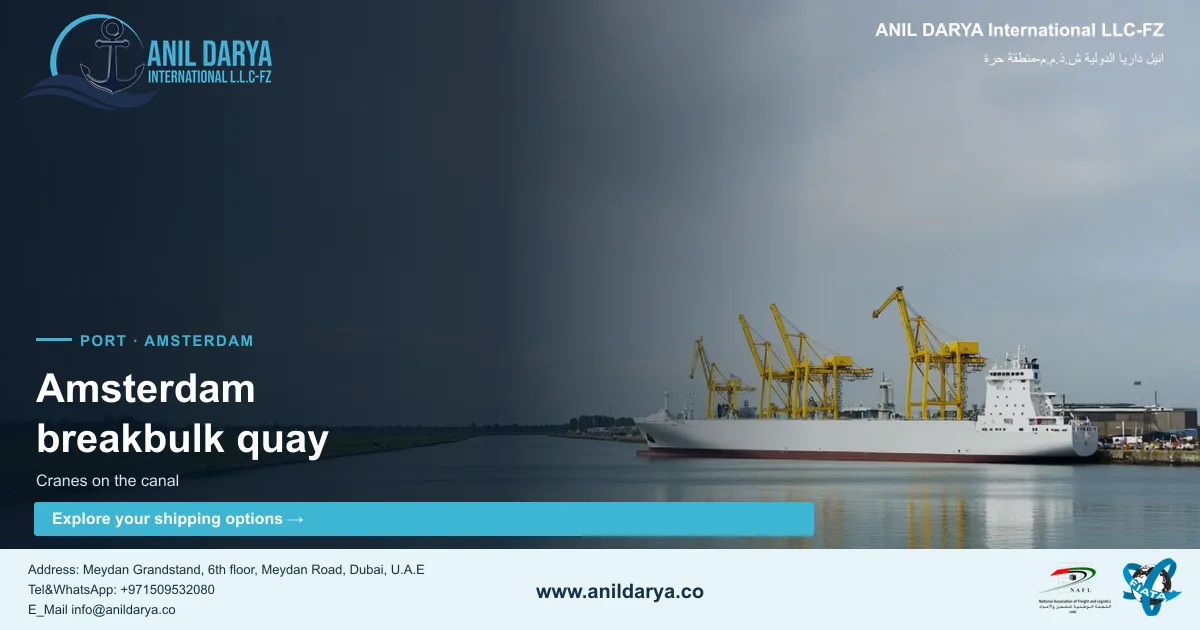
Port of Amsterdam shipping is mostly about bulk, breakbulk and Ro-Ro cargo, not big container ships. The port sits on the North Sea Canal behind the IJmuiden locks, handled 62.1 million tonnes in 2025, and has covered terminals where steel and project cargo are loaded and discharged in any weather. This guide explains how ships reach the port, which cargo fits it, the port rules for dangerous goods, a short customs summary and how we ship cargo from Dubai to Amsterdam. We ship both ways: from Dubai to Amsterdam, and from Amsterdam to Dubai.
Port of Amsterdam guide: key facts at a glance
| Item | Detail |
|---|---|
| Port authority | Port of Amsterdam (NV Haven Amsterdam), owned by the City of Amsterdam |
| UN/LOCODE | NLAMS |
| Location | On the North Sea Canal and the IJ, inland from the IJmuiden locks |
| Port area | 620 ha of water and 1,995 ha of land |
| Total throughput 2025 | 62.1 million tonnes, largely stable on 2024 |
| Containers 2025 | About 54,500 TEU (small next to Rotterdam) |
| General and project cargo | More than 2.8 million tonnes a year over eight terminals |
| All-weather terminals | Four |
| Sea access | IJmuiden sea lock, 500 m long and 70 m wide, opened in January 2022, works 24/7 regardless of tide |
| Maximum arrival draught | 13.75 m in seawater via the North Lock and the canal, subject to conditions |
| Canal depth | 15 m below NAP from the locks to Mercuriushaven, 11 m further east |
| Main cargo | Liquid bulk (fuels), dry bulk, cocoa beans, breakbulk and project cargo, steel and non-ferrous metals, Ro-Ro, short sea containers |
| Customs authority | Dutch Customs (Douane), declarations in DMS |
| Import VAT | 21% standard, 9% reduced rate |
| Amsterdam to Dubai | EU export declaration in DMS or AGS by the exporter or its representative; Dubai duty 5% of CIF for most goods |
Where is the Port of Amsterdam and how do ships reach it?
The port lies along the North Sea Canal and the IJ, west of Amsterdam city. Ships enter from the North Sea at IJmuiden, pass the locks and then sail about 20 km along the canal. Wikipedia counts eleven harbour areas, from Afrika Harbour in the west to the Eastern Harbour Area. Most cargo terminals sit in the western part of the port, closest to the locks.
The locks decide what can come in. The IJmuiden sea lock opened on 26 January 2022 and is 500 m long and 70 m wide. The Port of Amsterdam says it works independently of the tide, 24 hours a day. The port also lists these draught limits:
| Section or move | Limit |
|---|---|
| Canal depth, locks to Mercuriushaven | 15 m below NAP |
| Canal depth, Mercuriushaven to Passenger Terminal Amsterdam | 11 m below NAP |
| Maximum arrival draught via the North Lock and canal | 13.75 m in seawater, subject to conditions |
| Maximum departure draught via the canal and North Lock | 14.05 m in fresh water, subject to conditions |
| Deeper ships | Up to 17.80 m draught can be lightered at a facility west of the IJmuiden locks |
For a shipper this means one thing: the vessel's draught and the berth's position along the canal matter more here than in a coastal port. Breakbulk and handysize or supramax bulk ships fit easily. A fully loaded large bulk carrier may have to lighten first.
The Port of Amsterdam also lists the North Sea Canal region as its wider port area. Upply reports a further 16.7 million tonnes in 2025 for IJmuiden, Beverwijk and Zaanstad, the other ports along the same canal.
What cargo does the Port of Amsterdam handle?
Amsterdam's cargo mix is very different from Rotterdam's. Fuels and bulk carry the tonnage, while breakbulk and project cargo are the niche the port is now building. In its 2025 annual report the port says the share of non-fossil activities in its revenue grew to 70%.
| Cargo flow | What the port says | What to plan from the UAE |
|---|---|---|
| Liquid bulk | Describes itself as the largest petrol port in the world | Tanker charter, receiving terminal, surveys |
| Dry bulk | A leading player in dry bulk | Vessel size against draught, discharge rate, storage |
| Cocoa | Largest harbour in the world for cocoa bean imports | Mostly not a UAE export lane |
| Breakbulk and project cargo | Eight terminals, over 2.8 million tonnes a year, four all-weather terminals, heavy-lift cranes | Lifting points, drawings, covered storage if cargo must stay dry |
| Steel and non-ferrous metals | Covered handling and dehumidified storage at Waterland Terminal | Mill certificates, EU steel measures, dry handling |
| Ro-Ro and automotive | An excellent location for roll-on roll-off logistics | Self-propelled or on Mafi trailers, vehicle documents |
| Containers and short sea | About 54,500 TEU in 2025 | Usually via Rotterdam or Antwerp, then barge or truck |
| Offshore | Base for offshore wind, oil and gas, repair and decommissioning | Project cargo for offshore sites |
Breakbulk and project cargo at the Port of Amsterdam
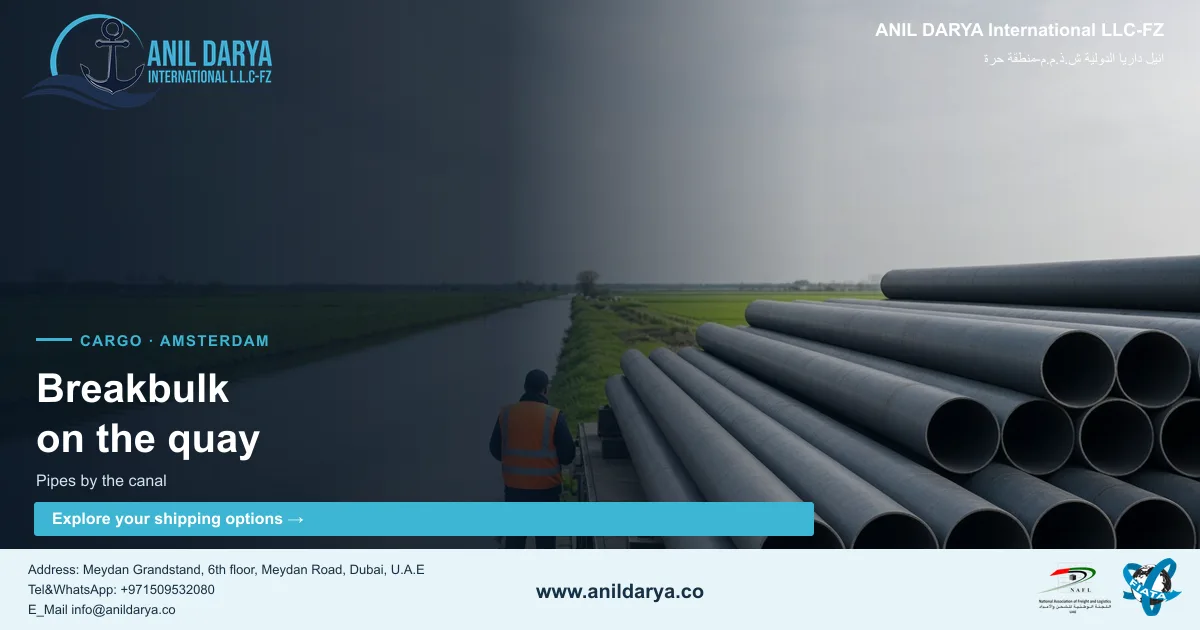
Breakbulk is where Amsterdam competes with its bigger neighbours. The port says eight terminals handle more than 2.8 million tonnes of general and project cargo a year, and four of them are all-weather terminals. It also points to ample temporary storage, a port with no congestion, and 24/7 access at low or high tide.
Waterland Terminal and covered handling
Waterland Terminal, part of VCK Port Logistics, is described as the only terminal in Europe that can load and unload vessels under cover. That lets work run 24 hours a day in rain or wind, which matters for steel, paper and pulp that must not get wet.
| Feature | Waterland Terminal |
|---|---|
| Covered berths | 3 all-weather berths for lift-on lift-off |
| Open berths | 2 Ro-Ro berths |
| Hours | 24/7 multimodal operations |
| Storage | Dehumidified warehouse for steel; storage for aluminium, zinc, steel, paper, wood and pulp; open areas for Ro-Ro cargo and containers |
| Ownership | Taken over in January 2026 by Nova Marine Carriers, Aug. Bolten and Ership through Dutch company Maja Stuwadoorsgroep |
The new owners say they plan to grow VCK's breakbulk and dry bulk business. Expect the terminal's service offer to change over the next year, so confirm handling and storage at booking.
When Amsterdam fits your breakbulk better than a container
Use this rule. If your cargo fits a 40ft flat rack by size and weight, a container service to Rotterdam or Antwerp usually gives you more sailings. If it is too big, too heavy or must stay dry under cover, a breakbulk or multipurpose vessel into an Amsterdam all-weather terminal is worth pricing. Our guide to flat rack, open top and breakbulk options sets out the size limits.
How we plan breakbulk from the UAE to Amsterdam
- Collect dimensions, weights, centre of gravity and lifting points for each piece.
- Check whether the piece fits a flat rack. If not, look for breakbulk or heavy-lift tonnage calling Amsterdam.
- Check the vessel's draught against the 13.75 m arrival limit and the berth's position on the canal.
- Agree lashing, securing and covered storage with the carrier and the receiving terminal.
- Line up the consignee's customs representative so cargo can leave the terminal quickly.
- Plan the onward leg: barge on the Amsterdam-Rhine Canal, rail or road, with any permits for oversized loads.
Our break bulk and project cargo service covers the UAE end: packing, lashing at origin, port handling and the documents. For heavy pieces, read our heavy-lift shipping guide first.
Dry and liquid bulk shipping to Amsterdam
Bulk cargo is the base of Amsterdam's tonnage. For dry bulk such as aggregates, fertiliser or minerals, the questions are vessel size, draught on arrival and discharge rate at the receiving berth. For liquids, you need a receiving tank terminal and agreed quantity and quality surveys at both ends.
Because the canal and locks limit draught, a cargo that needs a capesize ship is not a fit. Handysize and supramax ships usually are. If your parcel is near the draught limit, ask the owner whether partial lightering west of the locks is planned and who pays for it. See our dry and liquid bulk cargo service for how we work bulk from the UAE.
Ro-Ro and vehicles at the Port of Amsterdam
The port markets itself for Ro-Ro and automotive logistics, and Upply reports that Grimaldi runs Ro-Ro and container-on-Mafi-trailer services there. Waterland Terminal has two open Ro-Ro berths. For machinery that can be driven or towed, Ro-Ro can avoid a heavy lift altogether.
If you ship a used machine or vehicle from the UAE, have the ownership documents, a clean declaration of the engine and fuel state, and the EU conformity paperwork your buyer needs. Vehicles count as dangerous goods for some carriers if fuel or batteries are not handled to their rules, so check with the line at booking.
Container shipping from Dubai to Amsterdam: how it really works
Amsterdam handled about 54,500 TEU in 2025. Upply reports the container terminal is run by a joint venture with Hutchison Ports, and that it and Grimaldi share 80 ha and 1,200 m of quay. That is small for deepsea lines.
In practice, most containers from the Gulf to Amsterdam arrive at another North Sea port first. Fluent Cargo's ocean option for Dubai to Amsterdam ends at Rotterdam, with one transshipment on the way. From Rotterdam or Antwerp the box moves on by barge, rail or truck. The port says Schiphol and Amsterdam are within 15 minutes by road without traffic jams, and inland shipping links to the Rhine.
| Your cargo | Usual routing to Amsterdam | Why |
|---|---|---|
| FCL general cargo | Deepsea to Rotterdam or Antwerp, then barge or truck | Many more Gulf sailings than direct calls |
| LCL | Consolidation into Rotterdam or Antwerp, deconsolidation, then truck | Consolidators run from the main hubs |
| Steel, project and OOG cargo | Breakbulk or multipurpose vessel direct into Amsterdam | Covered terminals and storage, no flat rack size limit |
| Bulk parcels | Bulk carrier direct, within draught limits | Bulk berths and tank terminals in the port |
| Urgent goods | Air cargo to Schiphol | The port is close to the airport |
For containers the import customs work usually happens where the box is discharged. That is why our sea freight service from the UAE prices both the deepsea leg and the final delivery into Amsterdam.
[AMIR-FACT: our real transit time and usual carrier or vessel operator for breakbulk or containers from Jebel Ali to Amsterdam, including any Rotterdam on-carriage]
Dangerous goods at the Port of Amsterdam
The IMDG Code applies to dangerous goods by sea, and the Port of Amsterdam adds its own reporting. Every ship visit must be notified in the Port Community System at least 24 hours before arrival. Dangerous goods on board are reported to the Harbour Master through Portbase's Notification Dangerous Goods service, which Portbase says Harbour Masters have required under EMSA rules since 1 November 2018. The ship's agent files this, not the shipper.
What you, as shipper, must get right:
- Correct UN number, proper shipping name, class and packing group on every document.
- A Safety Data Sheet for each product.
- A Dangerous Goods Declaration signed by a trained person.
- UN-approved packaging, labels on the packages and placards on the unit.
- Any EU or Dutch permit your product needs before it can be imported.
If the DG data is wrong, the agent's notification is wrong and the ship can be held. We check the documents and the carrier's acceptance before you commit to a sailing. Our dangerous goods shipping team handles the UAE side.
Customs at the Port of Amsterdam: a short summary
Amsterdam uses the same Dutch customs rules as every port in the Netherlands, so this is a short version. Goods from outside the EU are declared to Dutch Customs in DMS, usually by a customs broker or forwarder working for the importer.
| Point | Rule |
|---|---|
| Before arrival | The carrier files the Entry Summary Declaration in the EU's ICS2 system; from 1 June 2026 all consignments entering the EU need a valid ENS |
| Importer ID | EORI number; a non-EU business applies in the EU country of its first customs operation |
| Duty | From the EU TARIC tariff, by product code and origin; TARIC does not show VAT |
| Import VAT | 21% standard, 9% reduced; with an Article 23 permit it is paid through the VAT return |
| Controlled goods | Need an import licence or certificate, for example plants, animal feed or medicine |
What is specific to Amsterdam is mostly breakbulk paperwork. Send a piece-by-piece packing list with marks, dimensions and weights, so the terminal can match each item to the bill of lading. For steel, have mill certificates and the importer's EU steel and CBAM data ready. Our article on breakbulk documents and port process shows how we prepare the UAE side.
How to ship from Dubai to Amsterdam step by step
- Tell us the cargo. Commodity, HS code, weights, dimensions per piece, packing, origin and the Incoterm agreed with your buyer.
- Pick the mode. Container via Rotterdam or Antwerp, breakbulk direct to Amsterdam, bulk direct, or air to Schiphol for urgent parts.
- Book space. For breakbulk we look for multipurpose or heavy-lift sailings that call Amsterdam and confirm the receiving terminal.
- Prepare the cargo in the UAE. We arrange trucking to Jebel Ali Port or another UAE port, packing, lashing and the export declaration.
- Check the documents. Invoice, packing list, certificate of origin, bill of lading and, for DG, the declaration and SDS.
- Send everything to the consignee's customs representative before the vessel arrives, so the declaration goes in on discharge.
- Arrange the final leg. Barge, rail or truck from the terminal, or from Rotterdam if the cargo came by container.
We work with the consignee's own customs representative or a clearing agent they appoint in the Netherlands. We do not have an office in Amsterdam.
How to ship from the Port of Amsterdam to Dubai
We also handle the other direction: shipping from Amsterdam to Dubai, with arrival at Jebel Ali, Khalifa Port or Sharjah port. Breakbulk and project pieces can load at an Amsterdam terminal on a multipurpose sailing. Containers usually truck or barge to Rotterdam or Antwerp for a deepsea service. We book the space with the carrier and run the UAE side. The Dutch export papers stay with the shipper or its Dutch customs representative.
The Netherlands export side
- Export declaration. EU goods leaving the EU need an export declaration to Dutch Customs. The exporter can file it or have someone else do it, but the declarant must be based in the EU.
- System. In the Netherlands the electronic declaration goes in through DMS or AGS. After customs gives authorisation, the goods can move to the customs exit office.
- EORI. The exporter needs an EORI number to file a customs declaration or have one filed for it.
- Permits. Dutch Customs checks the commodity code for extra conditions, such as an export permit.
- Proof of exit. The exporter keeps the export declaration, freight bill and transport invoice to show the goods left the EU.
- Pickup. The shipper or its haulier delivers the cargo to the Amsterdam terminal, or the box to Rotterdam, before the carrier's cut-off.
The UAE import side
On arrival, the declaration goes to Dubai Customs with the commercial invoice, packing list, bill of lading, certificate of origin and any permit for restricted goods. Customs duty in Dubai is 5% of the CIF value for most goods, with 50% on alcohol and 100% on cigarettes. Import VAT is 5%, and a VAT-registered importer that meets the Federal Tax Authority's conditions can account for it on its VAT return.
- Send us the shipper's details in the Netherlands, the cargo, piece list for breakbulk, the HS code and the UAE delivery address.
- We book breakbulk space from Amsterdam or container space via Rotterdam, and send the booking and cut-offs to the shipper.
- The shipper or its haulier delivers the cargo to the terminal.
- The shipper or its Dutch customs representative files the export declaration.
- We check the draft bill of lading against the invoice and packing list.
- We file the UAE declaration before arrival and arrange payment of the duty and VAT.
- We collect the delivery order, deliver the cargo to your site and return any empty inside free time.
[AMIR-FACT: the carriers we actually use from Amsterdam (or Rotterdam for containers) to Jebel Ali, Khalifa Port or Sharjah, and our real transit days in this direction]
Port of Amsterdam or Rotterdam: which fits your cargo?
| Your situation | Better fit | Why |
|---|---|---|
| Regular FCL from the Gulf | Rotterdam | Deepsea container terminals and direct Gulf services |
| Steel or paper that must stay dry | Amsterdam | Loading and discharge under cover, dehumidified storage |
| Oversized project cargo for North Holland or offshore wind | Amsterdam | Breakbulk terminals, heavy-lift cranes, ample storage |
| Bulk parcel needing a very deep draught | Rotterdam | No lock or canal limit on arrival draught |
| Bulk parcel on a handysize or supramax ship | Either | Compare berth, storage and onward transport cost |
The right answer depends on where the cargo finally goes. We can price both so you compare the total cost to the door.
Checklist for cargo to the Port of Amsterdam
- HS code and TARIC duty checked for every item.
- Importer's EORI number confirmed.
- Vessel draught checked against the 13.75 m arrival limit for direct calls.
- Piece-by-piece packing list with marks, dimensions and weights for breakbulk.
- Covered storage booked if the cargo must stay dry.
- For steel: mill certificates and the importer's CBAM and EU steel data.
- For DG: SDS, DG declaration, packaging and labels, carrier acceptance.
- Customs representative in the Netherlands appointed and given the documents.
- Onward barge, rail or truck booked, with permits for oversized loads.
- Cargo insurance in place, most of all for heavy lifts.
Common mistakes when shipping to Amsterdam
- Booking a container service and expecting it to call Amsterdam. Most Gulf services discharge in Rotterdam or Antwerp, so plan and price the last leg.
- Ignoring the draught limit. A bulk ship loaded too deep for the locks needs lightering, which adds cost and time.
- Leaving steel or paper in open storage. Rain damage on arrival is avoidable at a covered terminal.
- Thin breakbulk packing lists. If the terminal cannot match pieces to the bill of lading, release slows down.
- No EORI on the importer. The declaration cannot be filed without it.
- Late DG data. The agent must notify the Harbour Master before arrival, so wrong or late data can delay the ship.
Frequently asked questions
What is the port code for Amsterdam?
The UN/LOCODE for the Port of Amsterdam is NLAMS. You will see it on bookings, bills of lading and tracking tools.
How big is the Port of Amsterdam?
The Port of Amsterdam handled 62.1 million tonnes in 2025, about the same as in 2024. Its port area covers 620 ha of water and 1,995 ha of land along the North Sea Canal.
Is the Port of Amsterdam good for breakbulk?
Yes. Eight terminals handle more than 2.8 million tonnes of general and project cargo a year, and four are all-weather terminals. Waterland Terminal can load and discharge ships under cover, which suits steel, paper and pulp.
Can large container ships call at Amsterdam?
Amsterdam handled only about 54,500 TEU in 2025, and most deepsea lines from the Gulf call Rotterdam or Antwerp instead. Containers for Amsterdam usually arrive there and move on by barge, rail or truck.
What is the maximum draught for ships going to Amsterdam?
The Port of Amsterdam lists a maximum arrival draught of 13.75 m in seawater via the IJmuiden North Lock and the canal, and 14.05 m in fresh water on departure, both subject to conditions. Ships up to 17.80 m draught can be lightered west of the locks.
Do I need an EORI number to import through Amsterdam?
Yes. The importer needs an EORI number for the customs declaration. A business without an EU establishment applies for it in the EU country where it makes its first customs declaration.
What is the import VAT rate in the Netherlands?
Import VAT is 21% at the standard rate and 9% for goods on the reduced list. With an Article 23 permit, the importer pays it through its VAT return instead of at the border.
How do I ship from Dubai to Amsterdam?
Breakbulk and project cargo can sail from the UAE on a multipurpose ship that calls Amsterdam. Containers usually go to Rotterdam or Antwerp and move on by barge, rail or truck. We handle the UAE export side, and the consignee's customs representative files the Dutch import declaration.
How do I ship from Amsterdam to Dubai?
The shipper or its Dutch customs representative files the EU export declaration and delivers the cargo to the terminal. We book breakbulk space from Amsterdam or container space via Rotterdam, file the Dubai Customs declaration, arrange payment of the 5% duty and 5% VAT, and deliver.
Can I ship dangerous goods to the Port of Amsterdam?
Yes, under the IMDG Code. The ship's agent reports dangerous goods to the Harbour Master through Portbase before arrival, so the shipper must supply a correct DG declaration and SDS in good time.
Get a quote for Port of Amsterdam shipping
Send us the cargo details and we will come back with a routing and a price for shipping to the Port of Amsterdam, direct or via Rotterdam. Use our freight rate inquiry form, or contact our team to talk through a breakbulk, bulk or DG shipment first. You can also read more about our Dubai freight forwarding team.
Sources
- Port of Amsterdam: Annual Report 2025 (62.1 million tonnes, non-fossil revenue share)
- Port of Amsterdam: Waterways (canal depths, arrival and departure draught, lightering, sea lock)
- Port of Amsterdam: Sea shipping (PCS notification 24 hours before arrival, pilotage)
- Port of Amsterdam: Notify your ship visit via PCS (Notification Dangerous Goods)
- Port of Amsterdam: General cargo and project cargo (eight terminals, 2.8 million tonnes, all-weather terminals)
- Port of Amsterdam: Cargo flows (petrol, cocoa, dry bulk, Ro-Ro, offshore)
- Port of Amsterdam: Discover Breakbulk Amsterdam (24/7 access, storage)
- Port of Amsterdam: Connections (inland shipping, rail, road, Schiphol)
- Portbase: Notification Dangerous Goods (Amsterdam and Rotterdam, EMSA rules since 1 November 2018)
- Hellenic Shipping News: Nova Marine, Bolten and Ership take over VCK Port Logistics and Waterland Terminal (January 2026)
- HLPFI: Amsterdam looks to breakbulk (January 2026)
- Upply: Dutch ports in 2025 (Amsterdam tonnes and TEU, container terminal, North Sea Canal ports)
- Wikipedia: Port of Amsterdam (UN/LOCODE, area, owner, harbour areas, canals)
- Wikipedia: IJmuiden sea lock (dimensions, opening date)
- Ship Technology: Port of Amsterdam (North Sea Canal length)
- Fluent Cargo: Dubai to Amsterdam route options
- Business.gov.nl: Importing from a non-EU country (EORI, TARIC, VAT, Article 23, licences)
- Business.gov.nl: Dutch Customs (DMS, customs broker)
- Dutch Customs: Export, submitting a declaration (EU-based declarant, DMS or AGS, exit office)
- Dutch Customs: EORI number
- Business.gov.nl: Exporting goods outside the EU (export permits, proof of exit)
- Dubai Customs: Submit customs declaration (documents)
- Dubai Customs: FAQ (5% of CIF, alcohol 50%, cigarettes 100%)
- UAE Government portal: Customs duty
- Federal Tax Authority: VAT guide (import VAT at 5%, deferral to the VAT return)
- Your Europe: VAT rates (Netherlands 21% and 9%)
- European Commission: EORI number
- European Commission: EU customs tariff (TARIC)
- European Commission: Import Control System 2 (ICS2)
Reviewed: 10 November 2026