
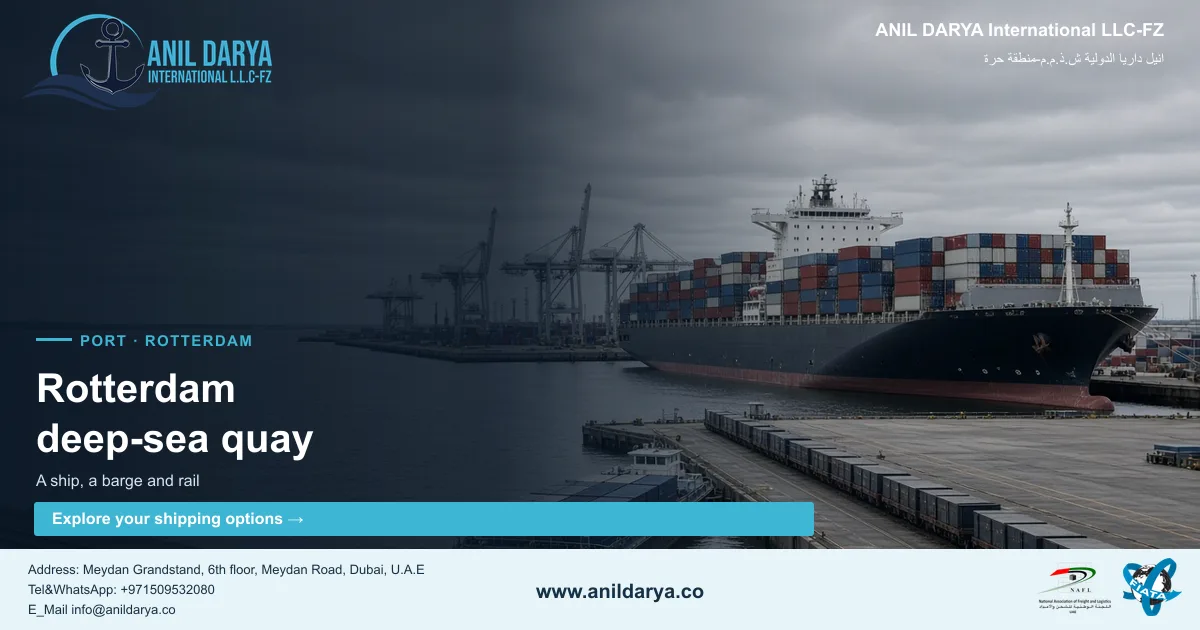
Port of Rotterdam shipping covers most of the containers, breakbulk and bulk that enter the Netherlands by sea. The port is run by the Port of Rotterdam Authority, handled 14.2 million TEU in 2025, and clears cargo through Dutch Customs. This guide covers the Maasvlakte terminals, cargo types, dangerous goods rules, customs and documents, and how we ship your cargo from Dubai to Rotterdam. We ship both from Dubai to Rotterdam and from Rotterdam to Dubai.
Port of Rotterdam guide: key facts at a glance
| Item | Detail |
|---|---|
| Port manager | Port of Rotterdam Authority (Havenbedrijf Rotterdam N.V.) |
| UN/LOCODE | NLRTM |
| Customs authority | Dutch Customs (Douane) |
| Port community system | Portbase |
| Port length | Over 40 km |
| Port area | 12,500 ha of land and water, over 6,000 ha of it industrial sites |
| Total throughput 2025 | 428.4 million tonnes |
| Containers 2025 | 14.2 million TEU, up 3.1% |
| RoRo 2025 | 25.6 million tonnes |
| Other breakbulk 2025 | 6.1 million tonnes, up 4.6% |
| Ship calls | About 27,384 seagoing vessels and 93,680 inland vessels a year |
| Maximum draught | 22.55 m |
| Gulf container flow | About 155,000 TEU a year, mainly via Jebel Ali and Khalifa Port, on three liner services |
| Inland links | Daily barges to more than 100 European destinations; rail to the German border within three hours |
| Rotterdam to Dubai | Shipper or its agent files the EU export declaration in DMS; UAE duty 5% of CIF for most goods plus 5% import VAT |
Where is the Port of Rotterdam and how is it laid out?
The port sits at the entrance of the Nieuwe Waterweg, where the Rhine and Maas reach the North Sea. It runs for over 40 km from the city centre to the coast. The Port Authority's nautical area covers the Eurogeul and Maasgeul approach channels, the Nieuwe Waterweg and the Nieuwe Maas.
From the city out to the sea, the main port areas are:
| Area | Main use for shippers |
|---|---|
| Waalhaven and Eemhaven | Short sea, barge terminals and container depots |
| Botlek | Chemicals and liquid bulk |
| Europoort | Bulk, oil and RoRo |
| Maasvlakte | Deep-sea container terminals, bulk and distribution parks |
| Maasvlakte 2 | The newest deep-sea container terminals on reclaimed land |
Maasvlakte 2 covers 2,000 hectares and moved the Dutch coastline three and a half kilometres out to sea. APM Terminals Maasvlakte II opened there in 2015. For containers from Dubai, the Maasvlakte is where your box is almost certainly discharged.
Which container terminals does Rotterdam have?
The deep-sea container terminals are all on the Maasvlakte. Your carrier's service decides which one your box uses, so check the terminal on the arrival notice before you book delivery. The table below uses the Port Authority's terminal map, which is dated April 2021, so treat quay and capacity figures as a guide and confirm current details with the terminal.
| Terminal | Area | Quay length | Draught | Cranes | Capacity (TEU/year) |
|---|---|---|---|---|---|
| Hutchison Ports ECT Delta | Maasvlakte | 3,600 m | 16.65 to 17.45 m | 34 | Not stated |
| Hutchison Ports ECT Euromax | Maasvlakte | 1,500 m | 17.65 m | 16 | Not stated |
| APM Terminals Rotterdam | Maasvlakte | 1,600 m | 16.65 m | 14 | 3,350,000 |
| APM Terminals Maasvlakte II | Maasvlakte 2 | 1,500 m (barge 500 m) | 20 m | 10 deep-sea, 3 barge, 2 rail | 2,700,000 |
| Rotterdam World Gateway (RWG) | Maasvlakte 2 | 1,700 m (barge 550 m) | 20 m | 16 | 2,350,000 |
| Rotterdam Short Sea Terminals (RST) | Waalhaven/Eemhaven | 1,800 m | 11.65 m | 14 | 1,440,000 |
Which terminals handle the Gulf services?
In its review of 2025, the Port Authority said three liner services carry Rotterdam's Gulf container trade. Two are handled at ECT Delta and one at RWG. So a container from Jebel Ali will most likely arrive at one of those two terminals, but the carrier's arrival notice is the only reliable answer.
Automation and capacity
APM Terminals says around 80% of crane movements at Maasvlakte II are automated, with 73 electric lift AGVs and two rail cranes spanning eight tracks. RWG also runs most operations automatically. The Port Authority reports expansions under way at APMT2, Euromax and RWG, with room for up to 8 million more TEU a year and capacity rising from 2027.
Reefer plugs
The same terminal map lists 3,600 reefer plugs at APM Terminals Maasvlakte II, 3,500 at ECT Delta, 2,250 at APM Terminals Rotterdam and 1,700 each at Euromax and RWG. Tell us the set temperature and ventilation at booking, and plan the delivery so the reefer does not sit in the yard longer than needed.
Container depots and empty returns
Empty containers do not go back to the deep-sea terminal in most cases. The carrier names a depot on the release, and the Port Authority's terminal map lists depots across the Maasvlakte, Waalhaven and Eemhaven, from small yards to sites storing over 20,000 TEU. Check the return depot before the truck leaves the consignee, because a box returned to the wrong place still counts against free time.
LCL cargo at Rotterdam
LCL boxes from Dubai are discharged like any other container, then trucked to a warehouse where the consolidator unpacks them. Your part is released only after the whole container is declared and stripped, so send your documents early and make sure carton marks match the packing list. If your volume is close to a full box, ask us to price FCL as well.
What cargo does the Port of Rotterdam handle?
| Cargo type | 2025 figure | How it moves |
|---|---|---|
| Containers | 14.2 million TEU | Deep-sea terminals on the Maasvlakte, short sea and barge terminals inland |
| RoRo | 25.6 million tonnes | RoRo terminals with short sea links |
| Other breakbulk | 6.1 million tonnes | Specialised breakbulk terminals |
| LNG | 13.0 million tonnes | LNG terminal |
| Dry bulk | Down 6.5% on 2024 | Ores, minerals, coal and biomass terminals |
| Liquid bulk | Down 1.5% on 2024 | Tank storage, pipelines and chemical clusters |
For a Dubai shipper, the usual mix is containers (dry and reefer), flat racks, and breakbulk for machinery or steel. Liquid and dry bulk move on chartered tonnage under separate terms.
Reefer and food cargo through Rotterdam
The Port Authority says chilled and dry food often moves through Rotterdam in containers, backed by cold chain facilities and quality control. For food from the UAE, three things decide how fast the reefer leaves the terminal:
- The right product code and origin, because duty and any import conditions follow the code.
- Any health certificate or licence the product needs, ready before arrival.
- A delivery slot at a cold store, booked so the box does not wait on a plug.
Food products usually take the 9% VAT rate rather than 21%, which matters for cash flow if you do not have an Article 23 permit.
Breakbulk, heavy-lift and project cargo at Rotterdam
The Port Authority calls Rotterdam Europe's breakbulk hub. It lists heavy lift and project cargo, steel, forest products and non-ferrous metals, and says breakbulk from Rotterdam can reach Europe's main industrial areas within 24 hours by inland shipping and rail. Project cargo for offshore work is also handled through specialised terminals.
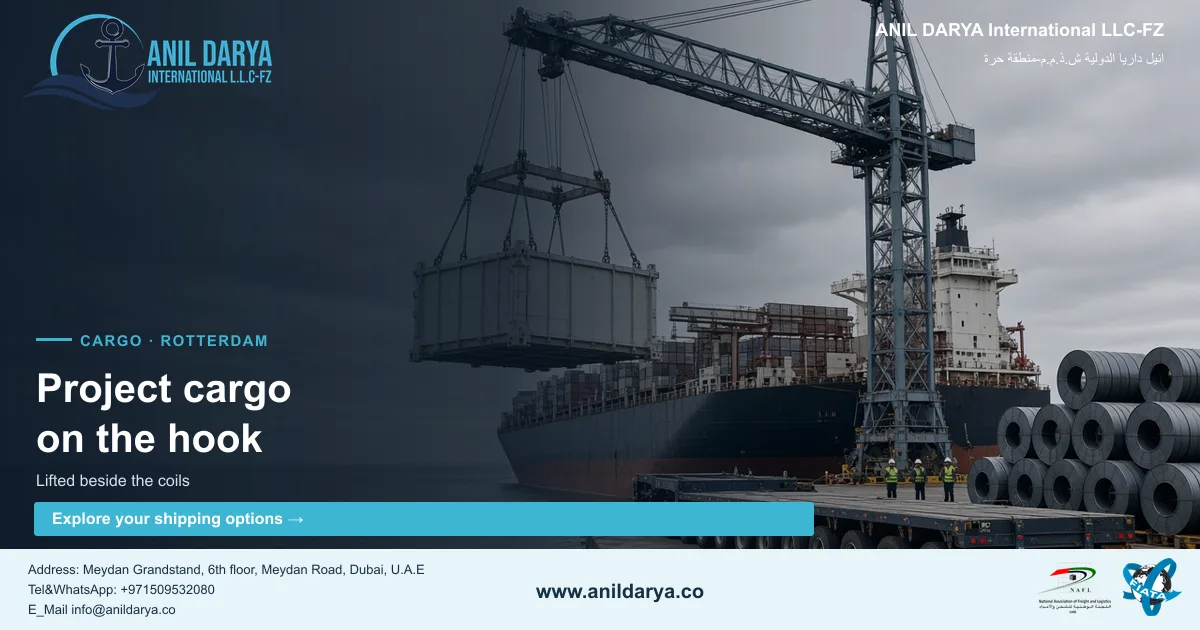
When we plan project cargo from Dubai to Rotterdam, we work in this order:
- Collect drawings, dimensions, weights and centre of gravity for each piece.
- Choose flat rack on a container service, or breakbulk or heavy-lift tonnage.
- Agree lifting, lashing and securing with the carrier.
- Confirm the discharge terminal and the onward mode: road, barge or rail.
- Line up the import declaration so the cargo leaves the quay quickly.
A useful rule: if the consignee's site has its own quay or sits near an inland terminal, ask us to compare barge with road for heavy pieces. See our break bulk and project cargo service for what we cover in the UAE.
Dangerous goods at the Port of Rotterdam
International rules such as SOLAS and the IMDG Code apply in the port. On top of these, the Rotterdam Port Bye-laws set the house rules, and the Port Rules on dangerous substances add specific regulations for ships carrying dangerous cargo.
| Rule | What it means |
|---|---|
| DG report | Every ship over 300 GT with dangerous goods on board reports them to the Harbour Master through Portbase, as soon as possible after leaving the previous port |
| Documents on board | Dangerous goods manifest and detailed stowage plan for arrival and departure |
| Berth restriction | Container and general cargo ships carrying certain quantities of hazardous substances may not berth near residential areas |
| Exceptions | Only the Harbour Master can authorise exceptions to the berth rules |
| Containerised chemicals | The Chemical Container Portmap lists companies that handle, store and transport chemicals in containers |
The carrier files the ship's DG report, but it is built from your DG declaration. A wrong UN number or class at origin becomes a wrong report in Rotterdam. What you supply for any DG booking:
- UN number, proper shipping name, class and packing group.
- Safety Data Sheet for each product.
- Signed dangerous goods declaration.
- UN-approved packaging, labels and container placards.
Segregation inside the box also matters. Our guide to IMDG segregation in containers explains which classes can share a container. We confirm carrier and terminal acceptance for each class before booking through our dangerous goods shipping service.
Customs and documents at Rotterdam
Goods from outside the EU are declared to Dutch Customs electronically in DMS, usually by a customs representative. Data flows between carriers, terminals, forwarders and Customs through Portbase, the port community system.
How a container from Dubai is cleared
| Stage | What happens |
|---|---|
| Before arrival | The carrier files the entry summary declaration in the EU's ICS2 system; the ship reports to Customs through Portbase 24 hours before reaching the pilot boarding place |
| Discharge | The box goes into temporary storage at the terminal |
| Release message | A Container Release Message (CVB) is needed for all non-EU goods through a Dutch port |
| Import declaration | Filed in DMS after unloading, with the TARIC code, customs value and origin |
| Checks | Some containers are scanned; a physical check can include gas measurement |
| Release | Duty and VAT paid or deferred, the terminal releases the box |
Celna24 lists the customs office at the port as Rotterdam Haven Kantoor Maasvlakte, code NL000396. Your representative fills this in; it only matters if you check the declaration yourself.
EORI, duty and VAT
The Dutch importer needs an EORI number. It is mandatory for the consignee, representative and declarant on an import declaration, it is free, and one number works in every EU member state. Duty comes from the EU TARIC tariff and depends on the product code and the country of origin. Import VAT is 21%, or 9% for goods such as food, medicines and books. With an Article 23 permit, the importer pays import VAT through its VAT return instead of at the border.
Documents for cargo arriving at Rotterdam
| Document | Provided by |
|---|---|
| Commercial invoice | Exporter |
| Packing list | Exporter |
| Bill of lading | Carrier, through us |
| Certificate of origin | Exporter |
| Importer's EORI number | Dutch consignee |
| Licence or certificate for controlled goods (plants, medicine, CITES, strategic goods) | Importer |
| DG declaration and SDS | Exporter |
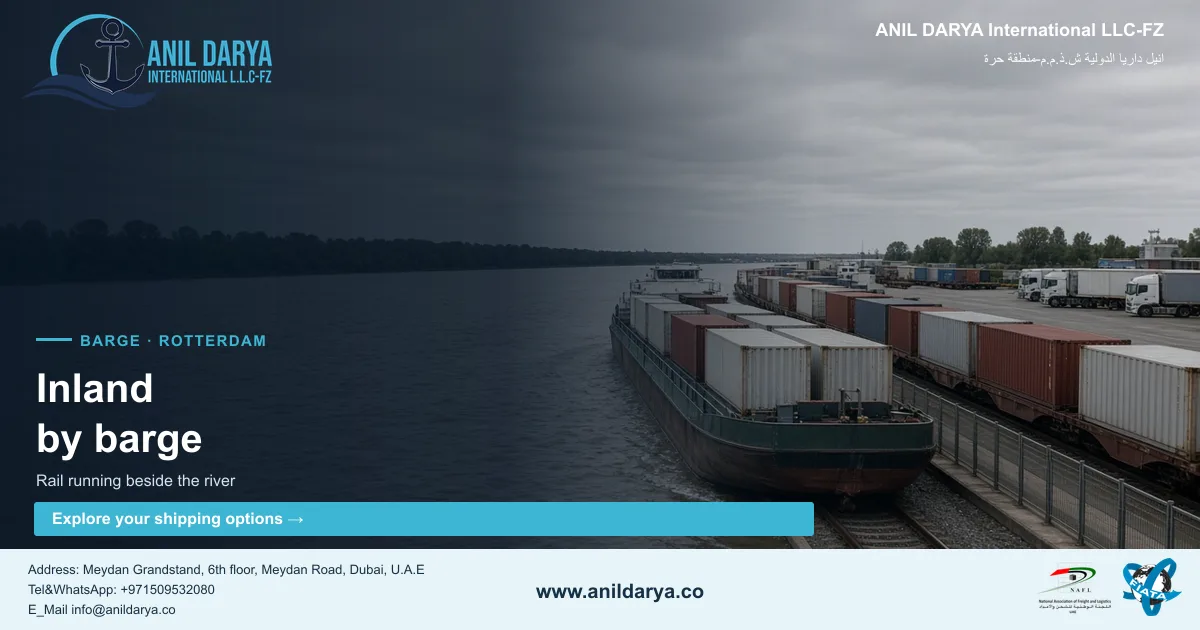
Moving cargo out of the port: barge, rail and truck
Rotterdam is built for onward transport. Choose the mode before the vessel arrives, because each one needs its own booking.
| Mode | What the port offers | Best for |
|---|---|---|
| Barge | Daily connections to more than 100 European destinations via the Maas, Rhine, Main, Danube and canals; 50 to 500 containers per vessel; under a day to four days sailing | Inland terminals in the Netherlands, Belgium and Germany, heavy pieces |
| Rail | Cargo crosses the German border within three hours; many European destinations within 24 hours | Steady volumes to Germany and Central Europe |
| Truck | Access to the A15 motorway; terminal truck slots booked in advance | Delivery to Dutch addresses and short distances |
APM Terminals Maasvlakte II connects to the Betuwe rail line, a 160 km double-track electric freight line. On the Maasvlakte, the Container Exchange Route links terminals and depots so boxes can move between them without using public roads. ECT has introduced a Truck Capacity Management System at its Delta and Euromax terminals, so a truck needs a slot before it turns up.
Rotterdam or another delivery plan: which fits your cargo?
Rotterdam handles about 30% of Northwest European containers, so it is the default for most Dubai cargo to the Netherlands and much of Germany. The choice that matters more is how the box leaves the port.
| Your situation | Plan to compare | Why |
|---|---|---|
| Consignee in the Rotterdam or Randstad area | Truck from the terminal | Short distance, simplest booking |
| Consignee near the Rhine in the Netherlands or Germany | Barge to an inland terminal | Daily sailings, fewer truck slots to fight for |
| Regular volume to Germany or Central Europe | Rail | German border within three hours |
| Goods not cleared in the Netherlands | Transit to the country of clearance | Duty and VAT paid where the goods are released |
| Heavy or oversized pieces | Breakbulk terminal, then barge or road | Avoids handling a flat rack through a busy container yard |
Congestion and timing at Rotterdam: what to plan
The Port Authority's review of 2025 reported dense fog early in the year, two heavy storms and a long lashers' strike in October, and congestion at the container quays. Hinterland volume rose 11.7% and hit a record of over 1 million TEU in November 2025. The Authority expects waiting times to fall once new capacity arrives from 2027.
What this means for you:
- Build buffer days into delivery promises for the Dutch customer.
- Agree free time with the carrier before the box sails, not after it lands.
- Book the truck, barge or rail slot as soon as the terminal is known.
- Send documents to the customs representative before arrival, so the declaration goes in on discharge.
Every day past free time adds charges. Our guide on demurrage and detention shows how they build up.
How to ship from Dubai to Rotterdam step by step
Containers from Dubai to Rotterdam normally load at Jebel Ali, which DP World says has over 80 weekly services to more than 150 ports. Our Jebel Ali port shipping guide covers the export side. For cargo that starts in Abu Dhabi, Khalifa Port shipping is the other UAE port named in Rotterdam's Gulf container flows. Fluent Cargo's route data shows the quickest Jebel Ali to Rotterdam routing at about 27 days port to port, with one transfer.
[AMIR-FACT: the carriers we actually book from Jebel Ali to Rotterdam, which Rotterdam terminal each uses, and our typical port-to-port days]
- Send us the commodity, HS code, weight, dimensions, packing, Incoterm and delivery address in Europe.
- The Dutch importer confirms its EORI number, TARIC code, origin and any licence.
- We book space from Jebel Ali or Khalifa Port and arrange trucking to the port.
- We clear the export with UAE customs and load the cargo.
- The carrier files the EU security data from your shipping documents.
- We send the bill of lading, invoice and packing list to the consignee's customs representative before arrival.
- At Rotterdam, the representative handles the CVB and the import declaration.
- The importer pays or defers duty and VAT, and the terminal releases the box.
- The box leaves by truck, barge or rail, and the empty is returned within free time.
We work with the consignee's own customs representative or a clearing agent they appoint in the Netherlands. We do not have an office there. Read more about our sea freight service from the UAE.
How to ship from the Port of Rotterdam to Dubai
We also handle the other direction: shipping from Rotterdam to Dubai, with arrival at Jebel Ali, Khalifa Port or Sharjah port. We book the space with the carrier and run the UAE side. The Dutch export papers stay with the shipper or its Netherlands agent, because we have no office in the Netherlands.
The Netherlands export side
- Export declaration. Goods leaving the EU need an electronic export declaration. In the Netherlands it goes to Dutch Customs through the DMS declaration system, and the exporter can file it or have a transporter or customs broker do it.
- Where it is filed. Under EU rules the declaration goes to the customs office where the exporter is established or where the goods are packed or loaded. That office releases the goods, and the office of exit supervises their departure from the EU.
- Safety data. The EU needs pre-departure safety and security data, which can be part of the export declaration itself.
- Delivery to the terminal. The shipper or its trucker, or a barge or rail operator, brings the box to the Maasvlakte terminal named on the booking.
The UAE import side
The import declaration goes to Dubai Customs. A company with a Dubai Customs business code can file it, or a licensed clearing agent with the owner's authorisation. Dubai Customs asks for the commercial invoice, packing list, certificate of origin and any permit from the authority that controls restricted goods, and the carrier's agent needs the bill of lading before it issues the delivery order. Customs duty in Dubai is 5% of the CIF value for most goods, with 50% on alcohol and 100% on cigarettes. Import VAT is 5% of the customs value, and a VAT-registered importer accounts for it on its VAT return through the reverse charge.
- Send us the shipper's details in the Netherlands, the cargo, the HS code, the Incoterm and the UAE delivery address.
- We book space from Rotterdam to Jebel Ali, Khalifa Port or Sharjah and send the booking and cut-offs to the shipper.
- The shipper or its trucker collects the empty, stuffs it and delivers the box to the Rotterdam terminal on the booking before the cut-off.
- The shipper or its Dutch customs broker files the export declaration in DMS, and customs releases the goods for exit.
- We check the draft bill of lading against the invoice and packing list before the carrier issues it.
- We file the UAE import declaration before the ship arrives.
- We arrange payment of the duty and VAT.
- We collect the delivery order from the carrier's agent in the UAE.
- We truck the cargo to your site and return the empty container inside free time.
[AMIR-FACT: the carriers we actually use from Rotterdam to Jebel Ali/Khalifa/Sharjah and our real transit days in this direction]
Checklist for cargo to the Port of Rotterdam
- Importer's EORI number on file.
- HS code and origin agreed, and the TARIC rate checked.
- Licence or certificate ready for controlled goods.
- Invoice, packing list and bill of lading show the same weights and descriptions.
- Customs representative in the Netherlands appointed and given the documents.
- Discharge terminal confirmed from the arrival notice.
- Onward mode chosen and the truck, barge or rail slot booked.
- For DG: SDS, DG declaration, labels and carrier acceptance.
- For reefers: set temperature and ventilation given at booking.
- Free time agreed with the carrier.
Common mistakes at Rotterdam
- Booking the truck to the wrong terminal. ECT Delta, Euromax, RWG and the two APM terminals are separate gates.
- No EORI number on the consignee. The declaration cannot be filed and the box waits.
- Late documents. The declaration goes in after unloading, so missing papers turn straight into storage days.
- Wrong origin. Goods re-exported from Dubai keep the origin of the country where they were made.
- Misdeclared DG. The ship's DG report is built from your declaration, and errors can stop the box.
- Paying VAT at the border every time instead of using an Article 23 permit.
Frequently asked questions
Who manages the port in Rotterdam?
The Port of Rotterdam Authority manages the port, and private companies such as Hutchison Ports ECT, APM Terminals and RWG run the container terminals. Dutch Customs handles clearance.
What is the port code for Rotterdam?
The UN/LOCODE for Rotterdam is NLRTM. You will see it on bookings, bills of lading and tracking systems.
How many containers does Rotterdam handle?
The Port of Rotterdam handled 14.2 million TEU in 2025, up 3.1% on 2024. Total throughput across all cargo was 428.4 million tonnes.
Which Rotterdam terminal will my container from Dubai use?
It depends on the carrier's service. The Port Authority says the three Gulf liner services call at ECT Delta (two services) and RWG (one service). Check the terminal on the arrival notice before booking delivery.
How long does shipping from Dubai to Rotterdam take?
Fluent Cargo's route data shows the quickest Jebel Ali to Rotterdam routing at about 27 days port to port, with one transfer. Add time for trucking, clearance and inland delivery at both ends.
What do I need to clear cargo at Rotterdam?
An import declaration filed in DMS, a Container Release Message, the importer's EORI number, a commercial invoice, packing list, bill of lading and certificate of origin. Controlled goods also need a licence or certificate.
Can I ship dangerous goods to Rotterdam?
Yes, under the IMDG Code and the Rotterdam Port Rules on dangerous substances. The ship reports DG cargo to the Harbour Master through Portbase, and some berths near residential areas are closed to ships carrying certain quantities.
Can you ship from Rotterdam to Dubai?
Yes. We book space from Rotterdam to Jebel Ali, Khalifa Port or Sharjah, the shipper or its Dutch broker files the EU export declaration in DMS, and we clear the cargo through UAE customs and deliver it. Most goods pay 5% customs duty on the CIF value plus 5% import VAT.
Do I need an EORI number to import through Rotterdam?
Yes. The consignee, representative and declarant on a Dutch import declaration all need an EORI number, unless the consignee is a private individual. It is free and valid in all EU member states.
How does cargo leave Rotterdam for the rest of Europe?
By barge, rail or truck. Barges sail daily to more than 100 European destinations, rail reaches the German border within three hours, and trucks use the A15 motorway with booked terminal slots.
Get a quote for shipping to the Port of Rotterdam
Send us your cargo details and the final delivery address, and we will come back with a routing and price from the UAE to Rotterdam. Use our freight rate inquiry form, or contact our team to plan a DG, reefer or project shipment first. You can also read about our Dubai freight forwarding team.
Sources
- Port of Rotterdam: Facts and figures (port length, area, vessel calls)
- Port of Rotterdam: Throughput 2025 (TEU, tonnes, RoRo, LNG, breakbulk, bulk)
- Port of Rotterdam: Rotterdam's 2025 container year under review (Gulf services, congestion, capacity)
- Port of Rotterdam: Container terminals and depots in the Rotterdam port area (map, April 2021)
- Port of Rotterdam: Port Information Guide, January 2026 (draught, reports, DG, port rules)
- Port of Rotterdam: Hazardous substances (berth rules, Harbour Master)
- Port of Rotterdam: Breakbulk
- Port of Rotterdam: Inland shipping
- Port of Rotterdam: Rail transport
- Port of Rotterdam: Containers (Portbase)
- APM Terminals Maasvlakte II: Our terminal
- Rotterdam World Gateway: About RWG (Maasvlakte 2)
- Hutchison Ports ECT Rotterdam: Terminals and TCMS notice
- Rotterdam Transport: Maps of the Port of Rotterdam (A15, Container Exchange Route, Chemical Container Portmap)
- Wikipedia: Port of Rotterdam (port areas, UN/LOCODE)
- Business.gov.nl: Declaring goods to customs (DMS, CVB, EORI)
- Business.gov.nl: Importing products from a non-EU country (TARIC, VAT, Article 23, licences)
- Business.gov.nl: VAT rates (21% and 9%)
- Dutch Customs: When an EORI number is required
- KVK: What is an EORI number?
- European Commission: Import Control System 2 (ICS2)
- Celna24: Port of Rotterdam customs office (NL000396)
- iContainers: Rotterdam port customs inspection
- DP World: Jebel Ali Port
- Fluent Cargo: Dubai to Rotterdam route data
- Business.gov.nl (Netherlands Enterprise Agency): Dutch customs (declarations in DMS, customs broker)
- European Commission: What is exportation (export declaration, office of export, office of exit)
- Dubai Customs: Submit customs declaration (invoice, packing list, certificate of origin, permits)
- Dubai Customs: FAQ (customs business code, clearing agents with owner authorisation)
- UAE Government portal: Customs duty (5% of CIF, alcohol 50%, cigarettes 100%)
- Federal Tax Authority: VAT guide (5% import VAT on the customs value, reverse charge)
Reviewed: 10 November 2026