
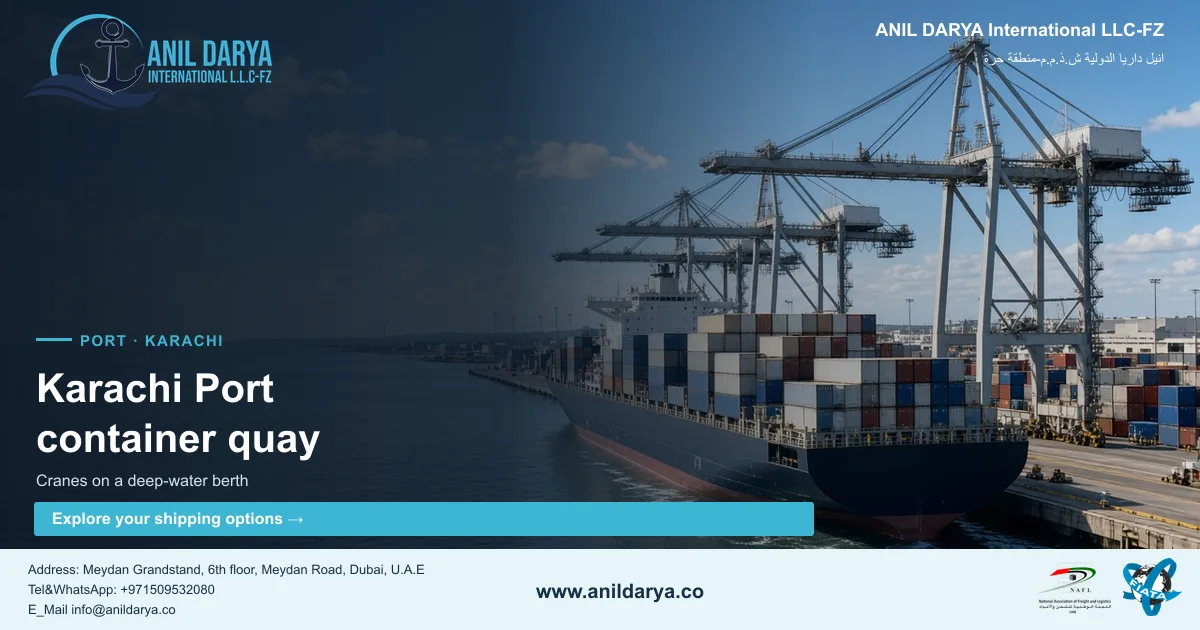
Karachi Port shipping covers the oldest and one of the busiest sea gateways in Pakistan. Karachi Port Trust (KPT) runs the port, three private container terminals handle the boxes, and Pakistan Customs clears the cargo through the Pakistan Single Window (PSW). This guide covers the terminals, the cargo the port takes, the customs and document rules, and how we ship your cargo from Dubai to Karachi. We ship both ways: from Dubai to Karachi and from Karachi to Dubai.
Karachi Port shipping guide: key facts at a glance
| Item | Detail |
|---|---|
| Port authority | Karachi Port Trust (KPT) |
| Customs | Pakistan Customs, part of the Federal Board of Revenue (FBR) |
| UN/LOCODE | PKKHI |
| Port area | Almost 33 square kilometres |
| Wharves and berths | Three wharves, 34 berths: East Wharf 17, West Wharf 13, South Wharf 4 |
| Container terminals | Three: KICT, KGTL and SAPT |
| Designed depth at container terminals | 13 to 16 m |
| Liquid cargo | Three oil piers |
| Cargo handled, FY 2023-24 | 51.65 million tons (dry 40.24, liquid 11.41) |
| Imports and exports, FY 2023-24 | Imports 32.85 million tons, exports 18.80 million tons |
| Containers, FY 2023-24 | 2.28 million TEU, up 17.9% on the year before |
| Share of cargo containerised | 57% |
| Largest ship handled (reported by KPT) | MSC ANNA, 400 m long, 19,368 TEU |
| Published carrier transit from Jebel Ali | 3 days on one carrier's table (February 2024) |
| Sales tax on imports | 18% of the value of goods imported |
| Shipping from Karachi to Dubai | Also handled: arrival at Jebel Ali, Khalifa Port or Sharjah, cleared by UAE customs with 5% duty on most goods and 5% VAT |
How is Karachi Port laid out?
Karachi Port is built around a bay that forms a natural harbour, protected from storms by a group of small islands. KPT describes a port spread over almost 33 square kilometres, built around three wharves.
| Wharf | Berths | Main use for shippers |
|---|---|---|
| East Wharf | 17 multipurpose berths (1 to 17) | KGTL container terminal, KGTML bulk and general cargo terminal |
| West Wharf | 13 berths (18 to 30) | KICT container terminal, general cargo |
| South Wharf | 4 berths (31 to 34) | Deep-water container terminal area at the Keamari Groyne |
| Oil piers | 3 | Liquid bulk |
KPT says each wharf has a dedicated container terminal with a designed depth of 13 to 16 metres. The port keeps its channels open with its own dredger fleet, which KPT says makes it the only port in Pakistan with that facility.
Karachi city also has a second big port, Port Muhammad Bin Qasim, further east along the coast. The two ports have different authorities, terminals and customs collectorates, so check which one is on your booking.
Which container terminals operate at Karachi Port?
KPT lists three dedicated container terminals, all developed with private partners. Your carrier's service decides which one your box uses.
| Terminal | Operator | Location | Key facts |
|---|---|---|---|
| Karachi International Container Terminal (KICT) | Hutchison Ports Pakistan | West Wharf, berths 26 to 30 | KPT's oldest container terminal; passed 15 million TEU handled in January 2024 |
| Karachi Gateway Terminal (KGTL) | AD Ports Group | East Wharf, berths 6 to 10 | 750,000 TEU capacity, rising to 1 million TEU after dredging for ships of 305 to 350 m and 13 to 15.5 m draft |
| South Asia Pakistan Terminals (SAPT) | Hutchison Ports Pakistan | Keamari Groyne basin | 1,500 m quay in 4 berths of 375 m, about 85 hectares of yard, designed for super post-Panamax ships |
AD Ports Group said in September 2025 that the KGTL dredging was expected to finish in the first quarter of 2026. SAPT and KICT are both run by Hutchison Ports Pakistan under build-operate-transfer concessions from KPT.
Look for the terminal name on the arrival notice. Truck bookings, delivery orders and empty returns all depend on it.
KGTML: the bulk and general cargo terminal
Next to KGTL, Karachi Gateway Terminal Multipurpose (KGTML) runs berths 11 to 17 on the East Wharf: seven berths on a 1,500 m quay with a current berth depth of 13 m. It handles bulk and general cargo, including breakbulk and heavy lifts. AD Ports Group says its dredging will let bulk vessels of up to 120,000 tonnes call, up from 60,000 tonnes.
What cargo can you ship through Karachi Port?
KPT's figures show a mixed port: dry cargo, liquid bulk and containers. In FY 2023-24 import dry cargo rose mainly on wheat, fertiliser, rock phosphate and iron ore, and exports rose on clinker.
| Cargo type | Where it goes | What to plan |
|---|---|---|
| General goods in containers | KICT, KGTL or SAPT | Terminal on the booking, PSW filing before arrival, free time |
| Chilled and frozen food | Reefer containers at the container terminals | Set temperature, food and health certificates, plug-in time |
| Steel, machinery, equipment | Breakbulk at KGTML or flat racks at a container terminal | Lifting points, lashing, piece list |
| Long or out-of-gauge pieces | KGTML with prior approval | Length over 55 ft and OOG up to 45 t need prior approval |
| Dry bulk (grain, fertiliser, ore, clinker) | Bulk berths, KGTML | Discharge rate, surveys, bagging or trucking plan |
| Liquid bulk | Three oil piers | Receiving tank, product specification |
| Dangerous goods | Container terminals and DG packing stations | Class restrictions, documents, approvals |
KPT also provides transit storage, warehousing and clearance facilities at each berth, customs storage yards, bulk stacking areas and container freight stations.
FCL and LCL: shipping containers to Karachi Port
Most cargo from Dubai reaches Karachi in containers.
- FCL (full container load). You book the whole 20ft or 40ft box. It is sealed at your door in the UAE and opened only at destination, so handling is minimal.
- LCL (less than container load). Your cargo shares a box with other shippers. At Karachi the box is unpacked at a container freight station and your part is released after its own clearance.
Containers do not always clear at the terminal. The FBR licenses off-dock terminals under section 78 of the Customs Act, 1969 to take FCL and LCL cargo straight from the wharves of Karachi Port for clearance. If your consignee uses one, the container moves there under customs control after discharge.
For reefers, tell us the set temperature and ventilation at booking and make sure the food certificates are ready before sailing. If you are not sure whether FCL or LCL is cheaper, our guide to FCL vs LCL costs shows the maths, and we can price both. Our sea freight service covers both options from all UAE ports.
Breakbulk, heavy-lift and project cargo at Karachi Port
For cargo that does not fit a container, Karachi Port's main option is the KGTML multipurpose terminal on the East Wharf. It accepts breakbulk and heavy lifts. Two limits matter at planning stage: cargo longer than 55 feet needs prior approval, and out-of-gauge pieces are accepted up to 45 tons with prior approval.
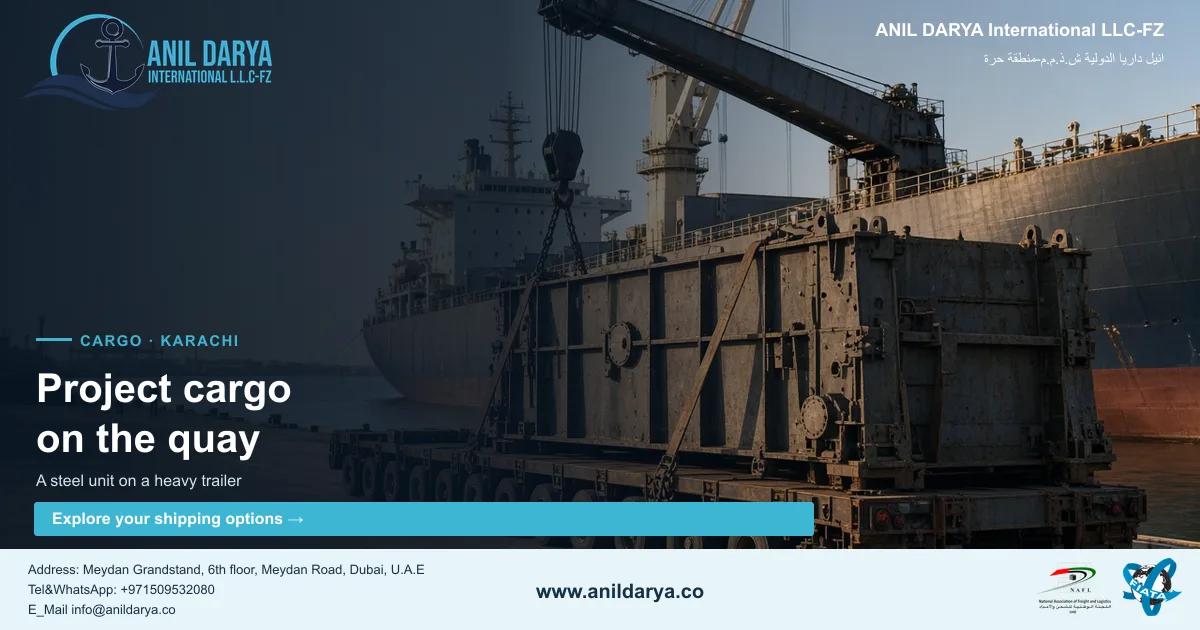
When we ship project cargo from the UAE to Karachi, we plan it in this order:
- Collect drawings, dimensions, weights and centre of gravity for each piece.
- Check the piece against the terminal limits and ask for prior approval where needed.
- Choose the vessel: flat rack on a container ship, or conventional breakbulk or heavy-lift tonnage.
- Agree lifting and lashing with the carrier.
- Send the consignee's clearing agent the piece list and documents so customs can start before arrival.
- Leave the road move in Pakistan, with any permits and escorts, to the consignee's transporter, using our piece list.
A simple rule: if a piece fits a 40ft flat rack by size and weight, a container service gives you more sailings. If not, the breakbulk sailing date drives the whole plan. See our break bulk and project cargo service and our guide to flat rack, open top and OOG cargo.
Dangerous goods at Karachi Port
KPT lists dangerous cargo handling at packing stations among its services. At KGTML, Class 1 (explosives) and Class 7 (radioactive) cargo is restricted and needs prior clearance. For other classes, acceptance depends on the carrier and the terminal on your booking, so we confirm it before you commit to a sailing.
What you need for any DG shipment to Karachi:
- UN number, proper shipping name, class and packing group.
- A Safety Data Sheet for each product.
- A signed Dangerous Goods Declaration.
- UN-approved packaging, labels on packages and placards on the container.
- Any licence, permit or certificate needed in Pakistan, applied for on PSW before sailing.
Our dangerous goods shipping team checks the paperwork and the carrier's acceptance on the UAE side.
Customs clearance at Karachi Port: PSW, WeBOC and documents
Pakistan Customs, part of the FBR, clears cargo at Karachi Port. Its core system is WeBOC. The Pakistan Single Window is now the main interface for traders and offers every WeBOC function they need.
| Situation | How the declaration is filed |
|---|---|
| Goods need a licence, permit or certificate from another agency | PSW Single Declaration is mandatory |
| No such requirement | Trader can choose WeBOC or PSW |
| You want release soon after discharge | File on PSW before arrival; PSW supports pre-arrival filing and clearance |
The consignee or their licensed clearing agent files the goods declaration. We are not a clearing agent in Pakistan; we send the documents from the UAE early so the filing can start before the vessel berths.
Which documents does Karachi customs need?
The US Department of Commerce lists the documents for Pakistan imports as bills of lading, invoices, packing lists, certificates of origin, copies of letters of credit and insurance certificates.
| Cargo type | Core documents | Usually also needed |
|---|---|---|
| General containers | Bill of lading, commercial invoice, packing list, certificate of origin | Letter of credit copy, insurance certificate |
| Food | Core set | Health or phytosanitary certificate from origin |
| Dangerous goods | Core set | DG declaration, SDS, PSW licence or permit if required |
| Breakbulk | Core set with piece list | Drawings and weights, terminal prior approval |
| Used machinery | Core set | Check against Appendix C of the Import Policy Order, 2022 |
Duties and taxes on cargo cleared at Karachi
Duty depends on the PCT code. These are the main charges:
| Charge | Rate or rule |
|---|---|
| Customs duty | Per PCT code; the FY 2025-26 budget introduced 5%, 10% and 15% slabs and widened 0% |
| Additional customs duty | Linked to the duty slab; cut again in the FY 2026-27 budget |
| Regulatory duty | Listed codes only; capped at 20% on 359 lines in FY 2026-27 |
| Sales tax | 18% of the value of goods imported |
| Income tax at import | 1% to 6% for importers on the Active Taxpayers List, 2% to 12% for others |
Rates change with each year's Finance Act, and the importer's tax status changes the income tax at import, so ask the clearing agent for a full estimate on your PCT code before you ship. Restricted goods are set by the Import Policy Order, 2022: Appendix A lists banned items, Appendix B restricted items and Appendix C items banned in used condition.
Shipping from Dubai to Karachi Port: step by step
Here is how we handle a typical shipment from the UAE to Karachi Port. We book space with carriers, prepare documents and arrange trucking and export clearance in the UAE. Your consignee's clearing agent handles import clearance in Karachi.
- Send us the cargo details. Commodity, HS code, weight, volume or dimensions, pickup point and Incoterm.
- Confirm import rules with the consignee. PCT code, any Import Policy Order condition and any licence or permit on PSW.
- Choose the service. We compare sailings from Jebel Ali or another UAE port and confirm which Karachi terminal each uses.
- Book and get acceptance. DG, reefer and out-of-gauge cargo need carrier acceptance; breakbulk at KGTML needs terminal approval for long or heavy pieces.
- Pick up and stuff. We arrange the empty, stuffing, sealing and the truck to the UAE port.
- Clear UAE export. We file the export or re-export declaration and gate in before the cut-off.
- Release the bill of lading. We check the draft against the invoice and packing list before it is issued.
- Send documents to Karachi. The clearing agent gets the full set before the vessel arrives so they can file on PSW.
- Arrival. The vessel berths at KICT, KGTL or SAPT, the agent clears the goods, pays duties and taxes and collects the delivery order.
- Delivery and empty return. The consignee's transporter delivers and returns the empty within free time.
On the sea leg, Emirates Shipping Line's February 2024 advisory shows 3 days from Jebel Ali to Karachi on its Gulf Pakistan Shuttle. In January 2025, DP World and Pakistan's National Logistics Cell also started a weekly feeder from Jebel Ali to Karachi. Schedules change, so we confirm the current service when we quote.
[AMIR-FACT: Our real port-to-port transit time from Jebel Ali to Karachi Port, which Karachi terminal our usual carriers call at, and one real Karachi shipment we can describe]
If your cargo is not yet at Jebel Ali, see our guide to shipping through Jebel Ali Port.
How to ship from Karachi Port to Dubai
We also handle the other direction: shipping from Karachi to Dubai, with arrival at Jebel Ali, Khalifa Port or Sharjah port. We book the space with the carrier and run the UAE side. The Pakistani export papers stay with the shipper or its Pakistani agent.
The Pakistani export side
- Export declaration. The exporter or its customs agent files the goods declaration with Pakistan Customs. PSW says traders can file through PSW or WeBOC.
- Regulated goods. Where a regulatory requirement applies, PSW says filing through the PSW Single Declaration is mandatory.
The UAE import side
When your container from KICT, KGTL or SAPT is bound for Dubai, the import declaration goes to Dubai Customs with the Pakistani shipper's commercial invoice, the packing list, the certificate of origin and any permit from the authority that controls restricted goods. The shipping line releases the box against the bill of lading. Dubai charges customs duty of 5% of the CIF value for most goods, 50% on alcohol and 100% on cigarettes. Import VAT is 5% of the customs value, freight and insurance included. If you are VAT-registered and your customs number is registered with the Federal Tax Authority, you pay no VAT at the border and account for it on your next VAT return.
- Send us the shipper's details in Karachi, the cargo, the HS code and the UAE delivery address.
- We book space with the carrier from Karachi to Jebel Ali, Khalifa Port or Sharjah and send the booking and cut-offs to the shipper.
- The shipper or its trucker picks up the cargo and delivers the container to the Karachi container terminal named in the booking before the cut-off.
- The shipper or its Pakistani agent files the export goods declaration through PSW or WeBOC.
- We check the draft bill of lading against the invoice and packing list before the line issues it.
- We file the UAE import declaration before the vessel arrives.
- We arrange payment of the duty and VAT and collect the delivery order from the shipping line.
- We truck the container to your site in the UAE.
- We return the empty container to the line's depot within free time.
Emirates Shipping Line's February 2024 advisory shows 3 days from Karachi to Jebel Ali on its Gulf Pakistan Shuttle, which runs Jebel Ali, Karachi, Jebel Ali, Kuwait, Dammam and back to Jebel Ali.
[AMIR-FACT: the carriers we actually use from Karachi to Jebel Ali, Khalifa Port or Sharjah and our real transit days in this direction]
What happens after your vessel arrives at Karachi?
Knowing the sequence on arrival helps you see where delays come from. This is the usual order for an FCL import:
| Stage | Who acts | What can hold it up |
|---|---|---|
| Vessel berths and discharges | Carrier and terminal | Berth waiting time, weather |
| Container moves to the terminal yard or an off-dock terminal | Terminal, under customs control | Consignee's choice of off-dock terminal not set |
| Goods declaration assessed | Clearing agent and Pakistan Customs | Wrong PCT code, value query, missing permit |
| Examination, if selected | Pakistan Customs | Cargo not matching the packing list |
| Duties and taxes paid | Importer through the clearing agent | Funds or tax status not ready |
| Delivery order and gate-out | Carrier's agent and terminal | Unpaid local charges, original bill of lading not surrendered |
Most of these holds start before the ship leaves the UAE. A correct PCT code, a matching packing list and permits in hand cover the first three.
How to track your container at Karachi
Use three references: the container number (four letters and seven digits), the bill of lading number, and the booking number. One bill of lading can cover several containers, so track each box by its container number once it is discharged. Check the terminal name on the arrival notice first: KICT, KGTL and SAPT at Karachi Port each run their own systems, and a container shown as not found is often simply at another terminal or at Port Qasim.
Inland delivery from Karachi
Cargo for inland cities such as Lahore, Faisalabad, Sialkot or Islamabad usually lands at Karachi and moves on by road or rail. Some consignees clear in Karachi and truck the cleared goods. Others move the container under customs control to an inland dry port and clear there. The choice changes who files, where duty is paid and how long the container is away, so agree it with the consignee before you ship.
Free time, demurrage and detention at Karachi
The shipping line gives free days on its container. After that, demurrage runs while the full box stays in the port or off-dock terminal, and detention while it is out with the consignee. Days and rates differ by carrier, so read them on the quote and the arrival notice.
The fastest way to lose free time at Karachi is a late or incomplete PSW filing. File before arrival, have permits ready before sailing, and book the truck and empty return early. Our article on demurrage and detention shows how the charges build up.
Karachi Port or Port Qasim: which fits your cargo?
| Your situation | Port to look at first | Why |
|---|---|---|
| Containers on a service that calls KICT, KGTL or SAPT | Karachi Port | Three container terminals and many services |
| Containers on a service that calls QICT | Port Qasim | QICT is Port Qasim's container terminal |
| Breakbulk and heavy lifts | Karachi Port (KGTML) or Port Qasim (Marginal Wharf) | Compare terminal limits and the inland route |
| Consignee near the Port Qasim industrial zones | Port Qasim | Shorter truck leg |
| Liquid bulk | Either | Depends on the receiving terminal for your product |
Our advice: ask the consignee where their clearing agent works and where the goods are going, then let us compare services into both ports.
Checklist before you ship to Karachi
- PCT code confirmed with the consignee's clearing agent.
- Goods checked against the Import Policy Order, including used-goods rules.
- Any licence, permit or certificate applied for on PSW before sailing.
- Consignee registered on PSW, or a licensed clearing agent appointed.
- Terminal known: KICT, KGTL, SAPT, or an off-dock terminal.
- Invoice, packing list, certificate of origin and bill of lading match on names, weights and piece counts.
- For breakbulk: piece list, drawings and KGTML prior approval for long or heavy pieces.
- For DG: SDS, DG declaration, packaging, labels, and no Class 1 or 7 cargo without prior clearance.
- Free time agreed with the carrier.
- Cargo insurance arranged.
Common mistakes when shipping to Karachi Port
- Confusing Karachi Port with Port Qasim. They are separate ports with separate collectorates, and the clearing agent must file for the right one.
- Filing after arrival. A goods declaration filed after the vessel berths eats into free time.
- No permit for regulated goods. Without the PSW licence or certificate the cargo cannot be cleared.
- Shipping long or heavy pieces without terminal approval. KGTML needs prior approval for cargo over 55 feet and OOG cargo.
- Mismatched documents. Different weights or consignee details on the invoice and bill of lading cause holds.
- Assuming one duty rate. Customs duty, ACD, RD, sales tax and income tax all apply differently by PCT code and importer status.
Frequently asked questions
Who runs Karachi Port and its terminals?
Karachi Port Trust (KPT) is the port authority. The three container terminals are run by private operators: KICT and SAPT by Hutchison Ports Pakistan, and KGTL by AD Ports Group.
What is the port code for Karachi?
The UN/LOCODE for Karachi Port is PKKHI. Port Qasim has its own code, PKBQM.
How many berths does Karachi Port have?
KPT lists 34 berths on three wharves: 17 on the East Wharf, 13 on the West Wharf and 4 on the South Wharf, plus three oil piers for liquid cargo.
How many containers does Karachi Port handle?
KPT handled 2.28 million TEU in FY 2023-24, up 17.9% from 1.93 million TEU the year before. Containers made up 57% of its cargo.
How long does shipping from Dubai to Karachi take?
One carrier's published table from February 2024 shows 3 days from Jebel Ali to Karachi. Booking, customs and delivery add time, so ask for a door-to-door estimate.
Can I ship breakbulk and heavy lifts to Karachi Port?
Yes. The KGTML terminal on the East Wharf handles breakbulk and heavy lifts. Cargo longer than 55 feet and out-of-gauge pieces up to 45 tons need prior approval.
Can I ship dangerous goods to Karachi Port?
Yes, with the right documents and carrier acceptance. KPT handles dangerous cargo at packing stations, and Class 1 and Class 7 cargo is restricted at KGTML without prior clearance.
Is Karachi Port the same as Port Qasim?
No. Both are in Karachi, but Karachi Port is run by Karachi Port Trust and Port Qasim by Port Qasim Authority, with different terminals and customs collectorates.
What is the sales tax on imports at Karachi?
Pakistan charges sales tax of 18% on the value of goods imported through Karachi, under the Sales Tax Act, 1990. Customs duty by PCT code and income tax at import come on top of it.
How do I ship from Karachi to Dubai?
The Pakistani shipper or its customs agent files the export goods declaration through PSW or WeBOC, using a PSW Single Declaration if the goods are regulated, and delivers the box to the Karachi terminal on the booking. We book the space to Jebel Ali, Khalifa Port or Sharjah, file the UAE import declaration and arrange payment of the 5% duty (on the CIF value of most goods) and the 5% import VAT.
Get a quote for Karachi Port shipping
Send us your cargo details and we will come back with a routing and price from the UAE to Karachi Port. Use our freight rate inquiry form, or contact our team to talk through a breakbulk, project or DG shipment.
Sources
- Ministry of Maritime Affairs: Karachi Port Trust Year Book 2023-24 (wharves, berths, terminals, FY 2023-24 cargo, services)
- AD Ports Group: Karachi terminals dredging agreement (September 2025)
- Karachi Gateway Terminal: KGTML and KGTL terminal facts
- Hutchison Ports Pakistan: SAPT, our company
- Hutchison Ports Pakistan: KICT, our company
- Pakistan Single Window: WeBOC to PSW
- US International Trade Administration: Pakistan import requirements and documentation (February 2026)
- FBR: Sales Tax Act, 1990, updated to 30 June 2026
- FBR: Withholding tax rate card, updated to 30 June 2026
- FBR: Budget 2025-26 salient features (customs)
- FBR: Budget 2026-27 salient features (customs)
- FBR: SRO 1788 of 2024 (off-dock terminal, section 78 Customs Act)
- Emirates Shipping Line: GPS service advisory (February 2024)
- Radio Pakistan: DP World and NLC feeder, Jebel Ali to Karachi (January 2025)
- Wikipedia: Port of Karachi (UN/LOCODE, KGTL berths)
- Wikipedia: Port Qasim (location east of Karachi city centre, UN/LOCODE)
- Dubai Customs: Submit customs declaration (invoice, packing list, certificate of origin, permits)
- UAE Government portal: Clearing customs and paying customs duty (5% of CIF, alcohol 50%, cigarettes 100%)
- Federal Tax Authority: VAT (5% rate)
- Federal Tax Authority: VAT guide, section 3.5 on VAT on imports (5%, deferral for VAT-registered importers)
Reviewed: 10 November 2026