
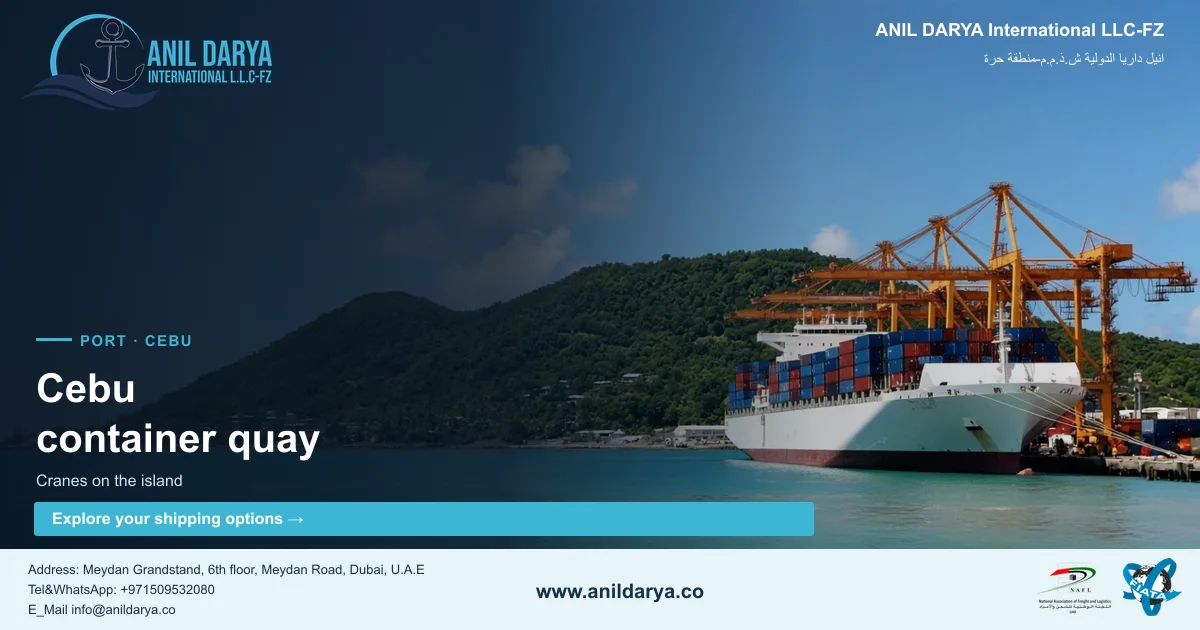
Port of Cebu shipping means sending foreign cargo through Cebu International Port (CIP), the container terminal the Cebu Port Authority runs in Cebu City, with Oriental Port and Allied Services Corp. (OPASCOR) handling the cargo. Cebu is the main gateway for the Visayas and a big domestic hub for Mindanao, and it handled 377,086 foreign TEU in the first nine months of 2025. This guide covers the terminal, its depth, the new container port being built at Consolacion, customs at Cebu and the steps to ship from Dubai. We ship both from Dubai to Cebu and from Cebu to Dubai.
Port of Cebu at a glance
| Item | Detail |
|---|---|
| Official name | Cebu Baseport: Cebu International Port (CIP) and the domestic zone |
| UN/LOCODE | PHCEB |
| Port authority | Cebu Port Authority (CPA), created by Republic Act 7621 of 1992, running the Cebu ports since 1 January 1996 |
| Location | North Reclamation Area, Cebu City, on the Mactan Channel between Cebu and Mactan Island |
| Foreign container terminal | Cebu International Port, cargo handling by OPASCOR |
| CIP main berth | 624 m, plus a finger pier |
| CIP vessel draft | 9.5 m today; dredging to a 12 m draft under way (OPASCOR, 2025) |
| CIP yard and reefers | 11,017 TEU at any one time; 513 reefer plugs |
| Foreign containers, Jan-Sep 2025 | 377,086 TEU, up 7% |
| All containers, H1 2026 | 515,150 TEU, up 7.7% |
| New container port | New Cebu International Container Port, Consolacion, target Q2 2028 |
| Customs office | Bureau of Customs, Port of Cebu and Sub-port of Mactan |
| Nearest airport | Mactan-Cebu International, about 11 km |
| Import VAT | 12% |
| Shipping to Dubai | We also ship from Cebu to Jebel Ali, Khalifa Port or Sharjah. Dubai duty is 5% of CIF for most goods, plus 5% import VAT |
Where is the Port of Cebu and what does it serve?
The port sits on reclaimed land in Cebu City, on the Mactan Channel, the narrow strait between Cebu and Mactan Island. It has two halves. Cebu International Port handles foreign containers and some bulk. The domestic zone, with its own piers, handles inter-island ships, Ro-Ro and passengers.
The Cebu Port Authority is separate from the Philippine Ports Authority, which runs Manila. CPA was set up in 1992 to run all ports in Cebu Province and took over on 1 January 1996. Its area covers the Cebu baseport plus five subports: Mandaue, Danao, Sta. Fe, Toledo and Argao. Argao and Toledo carry large bulk tonnages, but foreign containers from the UAE come to the baseport.
Cebu matters to you if your buyer is in the Visayas or northern Mindanao. Cargo for those islands can come straight to Cebu instead of landing in Manila and taking a domestic feeder. The domestic zone links Cebu by Ro-Ro and container ships to ports in Luzon, the Visayas and Mindanao, so Cebu also works as a relay point for onward island cargo.
Which terminal handles your cargo at the Port of Cebu?
Foreign containers from the UAE are handled at Cebu International Port. The domestic piers matter only if your cargo moves on by domestic ship after clearance.
| Facility | Who handles cargo | Main use |
|---|---|---|
| Cebu International Port (CIP) | OPASCOR | Foreign containers, reefers, some bulk |
| Pier 1 | Domestic arrastre providers | Domestic general cargo, Ro-Ro and passengers |
| Pier 3 | Domestic arrastre providers | Domestic general cargo, Ro-Ro and passengers |
| Pier 4 | Domestic arrastre providers | Domestic general cargo, Ro-Ro and passengers |
Cebu International Port: the facts that affect your booking
OPASCOR set out the terminal's current numbers at the 2025 Visayas Shipping Conference:
- A 624 m berth, which ran at 32% occupancy in January 2025, and a finger pier at 82%.
- Yard capacity of 11,017 TEU at any one time, with 46% yard use in 2024.
- Reefer plugs raised from just over 300 to 513, with average use around 20%.
- Average container dwell time of about six days.
- About 27 moves per hour per vessel in 2024, with most ships worked in under 24 hours.
- Eight shipping lines calling.
- One new quay crane and two rubber-tyred gantries delivered in April 2024.
Wikipedia gives an older profile of 14 hectares, 512 m of berthing and 1,953 TEU ground slots. The 2025 operator figures above are newer, so we use those.
Low berth occupancy and plenty of reefer plugs mean the quay is rarely the bottleneck. What usually slows a box at Cebu is paperwork: the entry, a permit or the delivery order.
The domestic zone: Piers 1, 3 and 4
The domestic zone covers about 21 hectares with 3,838 m of berthing space, three passenger terminals and two ferry terminals. Five private firms handle arrastre and stevedoring there, among them Cebu Integrated Arrastre and Metro Cebu Arrastre and Stevedoring Services. In the first half of 2026, Pier 1 handled 190,583 TEU and Pier 4 129,738 TEU, almost all of it domestic.
If your cargo goes on to Bohol, Leyte or Mindanao after clearance, the domestic carrier will load it at these piers. Book that onward leg before the vessel from the UAE arrives.
How deep is the Port of Cebu, and which ships fit?
Depth is the main limit at Cebu. The published figures differ by source and date, so here is what each one says.
| Source | Figure | What it means |
|---|---|---|
| OPASCOR, 2025 | CIP takes vessels with a 9.5 m draft; shallowest point of the access channel 10.66 m | Current working limit at CIP |
| OPASCOR, 2025 | Dredging since December 2023 toward a 12 m draft | Becomes official after the nautical chart is updated |
| Findaport | Containers, bulk and tankers 8.5 m tidal draft | Older planning figure |
| Cogoport | Channel 7.1 to 9.1 m; anchorage 14 to 15.2 m | General data, not terminal specific |
OPASCOR says NAMRIA, the Philippine Coast Guard and the Cebu Port Authority are working with it to make the 12 m draft official. Until that happens, plan on 9.5 m.
What this means for you: big mainline ships do not call at Cebu. Cargo from the Gulf arrives on regional vessels after transshipment at a hub. For heavy cargo on a general cargo ship, check the loaded draft against the berth before you fix the vessel.
How much cargo does the Port of Cebu handle?
The Cebu Port Authority publishes preliminary statistics each quarter. Foreign containers are now about half of the baseport's box traffic.
| Measure | Jan-Sep 2025 | H1 2026 |
|---|---|---|
| All containers | 742,673 TEU | 515,150 TEU (up 7.7%) |
| Foreign containers | 377,086 TEU (up 7%) | 257,282 TEU (up 4.2%) |
| Foreign imports | 176,014 TEU | 123,912 TEU (up 8.5%) |
| Foreign exports | 201,072 TEU | 133,370 TEU |
| Cebu International Port | 236,755 TEU | 169,926 TEU (33% of the total) |
| Foreign ship calls | 838 (up 6.6%) | Not reported |
Two things stand out. First, Cebu exports slightly more foreign boxes than it imports, so empty containers for importers are not a problem and carriers want import cargo to balance the trade. Second, foreign imports grew 8.5% in early 2026, so the terminal is getting busier, which is one reason the new port is being built.
Cogoport's March 2026 capacity data shows Maersk with about 30% of the capacity calling Cebu, CMA CGM about 21%, Evergreen about 21% and RCL about 10%. These are the carrier groups you will most often see on a routing from the Gulf.
The new container port being built at Consolacion
Construction of the New Cebu International Container Port (NCICP) began on 5 February 2025 at Tayud, Consolacion, about 8 km north of the current baseport. Once it opens, international cargo moves there and the old baseport keeps domestic, bulk and breakbulk cargo.
| NCICP item | Planned figure |
|---|---|
| Site | 25 ha of reclaimed land, linked by a 300 m bridge and a 1.365 km access road |
| Berth | 500 m, 12 m water depth |
| Ships at one time | Two vessels of up to 2,000 TEU each |
| Quay cranes | Five |
| Yard capacity | 14,400 TEU |
| Annual capacity | 375,900 TEU |
| Target opening | Second quarter of 2028 |
For shipments in 2026 and 2027, nothing changes: your box still lands at CIP. If you sign a supply contract that runs past 2028, check with the carrier which terminal its service will use.
What cargo can you ship through the Port of Cebu?
| Cargo type | Where it goes | What to plan |
|---|---|---|
| Dry containers (FCL) | Cebu International Port | The bulk of UAE cargo; check free time |
| LCL | Unpacked at a container freight station after discharge | Each house bill clears on its own |
| Reefer containers | CIP reefer plugs | Food and plant imports need DA clearances |
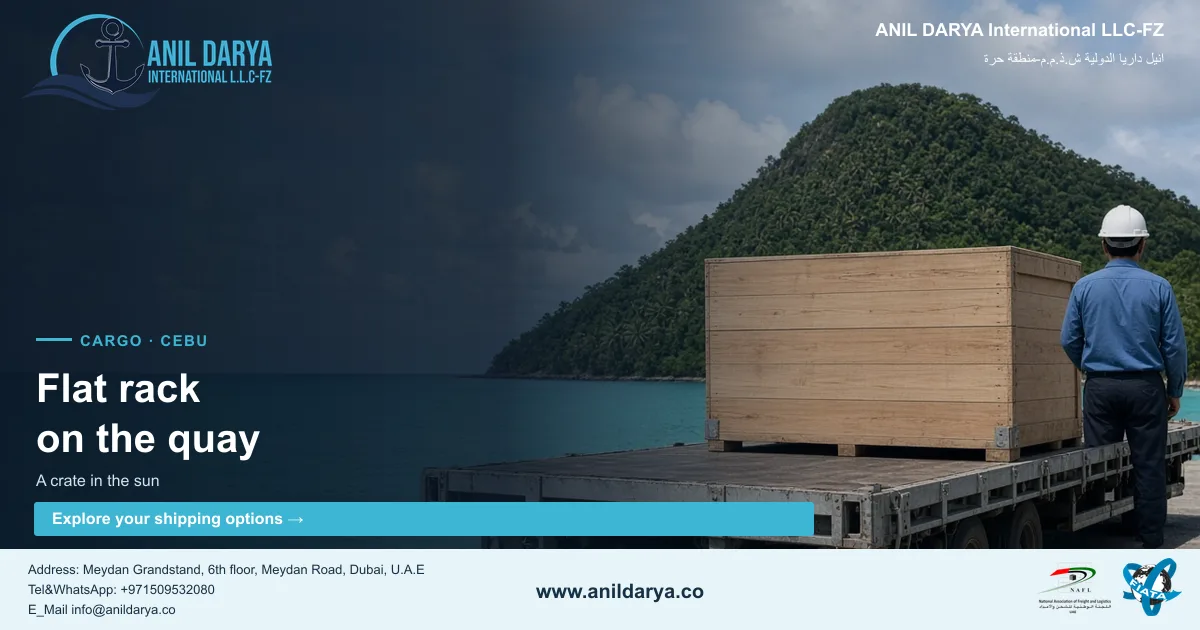
| Flat racks and open tops | CIP, by prior agreement | Lifting plan, yard space, road permits |
| Bulk and breakbulk | CIP bulk berth and other baseport berths | Draft on arrival, discharge rate |
| Vehicles | Check the method with the carrier | Used vehicles need DTI clearance; right-hand drive is prohibited |
| Dangerous goods | CIP, with carrier and terminal acceptance | IMDG papers plus Philippine permits |
FCL and LCL shipping options for the Port of Cebu
FCL is the normal choice for commercial cargo from Dubai to Cebu. The sealed box goes from Jebel Ali to the CIP yard and clears under one entry. Use 20ft boxes for heavy, dense cargo and 40ft or 40ft high cube for light, bulky goods.
LCL to Cebu takes more handling. The consolidated box usually travels via a hub, and at Cebu it is unpacked at a container freight station before each house bill clears. Your release can wait on another shipper's papers. Our guide to FCL vs LCL shipping shows where the break-even point usually falls.
| Point | FCL to Cebu | LCL to Cebu |
|---|---|---|
| Who clears | Consignee's broker, one entry | Consignee's broker, after unpacking |
| Handling | Sealed to the CIP yard | Packed and unpacked with other cargo |
| Best for | Regular trade, machinery, food in reefers | Samples, spare parts, small first orders |
| Main risk | Demurrage if the entry is late | Delay if a co-loaded shipment is held |
We book space with carriers that serve Cebu through our sea freight service, and we confirm the hub, the box type and the cut-off at Jebel Ali.
[AMIR-FACT: the carriers and transshipment hub we normally use from Jebel Ali to Cebu, and our real port-to-port days on this lane]
Breakbulk, project and bulk cargo at Cebu
Cebu International Port includes a bulk handling terminal, and the baseport handles bulk and breakbulk across its berths. Once the new container port opens, CPA plans to keep bulk and breakbulk at the old baseport.
Cebu is not a deep port. With a 9.5 m working draft at CIP, a loaded heavy-lift or general cargo ship may not fit. Before you fix a vessel, check:
- The vessel's loaded draft against the berth draft on arrival.
- Whether ship's gear or shore cranes will discharge the cargo.
- The weight and dimensions of each piece, with lifting points marked.
- The road route from the port to site, including permits and escorts in Cebu City traffic.
Out-of-gauge pieces that fit a flat rack or open top often move more easily on a container service. Bigger pieces need breakbulk tonnage. See our break bulk and project cargo service for how we plan these moves from the UAE.
Dangerous goods to the Port of Cebu
DG cargo to Cebu must be packed, marked and declared under the IMDG Code, and the carrier and terminal must accept it before you load. You need the UN number, proper shipping name, class and packing group, a safety data sheet (SDS), a signed DG declaration and UN-approved packaging.
Many DG products also need a Philippine clearance before they arrive:
| Product | Clearance from |
|---|---|
| Essential chemicals and drug precursors | PDEA and the Dangerous Drugs Board |
| Priority chemicals | DENR |
| Hazardous substances such as cyanide or mercury | DENR |
| Explosives, blasting agents and detonators | PNP Firearms and Explosives Office |
| Fertilisers, pesticides and farm chemicals | DA Fertilizer and Pesticide Authority |
Ask the consignee to apply before you book. A DG box that lands without its clearance can sit in the yard for weeks. Our dangerous goods shipping team gets carrier acceptance and checks the permit list before you commit to a sailing.
Customs at the Port of Cebu: the short version
Cargo at Cebu is cleared by the Bureau of Customs office for the Port of Cebu, which also covers the Sub-port of Mactan. The national rules are the same as in Manila, and our Manila page covers them in detail. Here is what you need for Cebu.
- Importers and customs brokers must be accredited by the BOC before they lodge entries.
- The goods declaration must be lodged within 15 days from discharge of the last package. One 15-day extension is possible if requested in time.
- Each entry gets a risk lane: green (no review), yellow (document review), red (document review and inspection). Blue is for post-clearance audit.
- Entries are lodged electronically, but hard copies still go in for verification.
- No duty or tax is collected on goods with an FOB or FCA value of PHP 10,000 or less.
- VAT is 12% on imports, based on the value used by the BOC.

| Document | Why it matters at Cebu |
|---|---|
| Bill of lading | Must name the accredited consignee exactly |
| Commercial invoice and packing list | Values and HS codes for the entry; must match each other |
| Certificate of origin | Needed for any preferential rate |
| Import clearance or permit | For regulated goods (DA, FDA, DTI, PDEA, DENR) |
| DG declaration and SDS | Carrier and terminal acceptance |
| Delivery order | From the carrier's agent, to collect the box from CIP |
The UAE and the Philippines signed their CEPA on 13 January 2026. Before you quote a lower rate to a Cebu buyer, ask the consignee's broker at the Port of Cebu whether the agreement is in force for your tariff line, and send a certificate of origin with the documents in case it is.
How to ship from Dubai to the Port of Cebu, step by step
- Confirm the consignee is BOC-accredited and has a licensed customs broker who works at the Port of Cebu.
- Check the tariff code, duty, VAT and any permit for each line, and get the permits before shipment.
- Agree the Incoterm. Our guide to Incoterms 2020 for sea freight explains who pays which charges.
- Send us the commodity, weight, volume and cargo type. We book a service from Jebel Ali that reaches Cebu, usually via a hub.
- Prepare the invoice, packing list and certificate of origin with matching HS codes, values and consignee details.
- We truck the cargo to the port in the UAE, file the export declaration and load. Our Jebel Ali port guide covers the export side.
- Send the bill of lading and full document set to the Cebu broker before the vessel arrives.
- The broker lodges the entry within 15 days of discharge, pays duty and VAT and gets release.
- The consignee collects the delivery order, trucks the box out of CIP and returns the empty within free time.
How to ship from the Port of Cebu to Dubai
We also handle the other direction: shipping from Cebu to Dubai, with arrival at Jebel Ali, Khalifa Port or Sharjah port. We book the space with the carrier and run the UAE side. The Philippine export papers stay with the shipper or its Philippine agent.
The Philippine export side
- Registration. The exporter must first register with the Bureau of Customs Client Profile Registration System (CPRS).
- Export declaration. The exporter or its broker lodges the export declaration, then submits the documents to the Export Division of the port of loading through the BOC Portal.
- Release. The declaration goes through selectivity (Green, Yellow, Orange or Red), and the Export Division issues the Authority to Load once the cargo is cleared.
The UAE import side
For a box loaded at Cebu International Port, we file the UAE import declaration with Dubai Customs using the Cebu shipper's commercial invoice, packing list and Philippine certificate of origin, plus a permit from the relevant authority if the goods are restricted. The carrier issues the delivery order against the bill of lading from Cebu. Dubai charges customs duty of 5% of the CIF value on most goods; alcohol pays 50% and cigarettes 100%. Import VAT of 5% comes on top.
- Send us the shipper's details in Cebu, the cargo, the HS code and the UAE delivery address.
- We book space to Jebel Ali, Khalifa Port or Sharjah and send the booking and cut-offs to the shipper.
- The shipper or its trucker delivers the cargo to Cebu International Port before the cut-off.
- The shipper or its Philippine agent lodges the export declaration and gets the Authority to Load.
- We check the draft bill of lading against the invoice and packing list before it is issued.
- We file the UAE declaration with Dubai Customs before the ship arrives.
- We arrange payment of the duty and VAT and collect the delivery order from the carrier.
- We truck the cargo to your site in the UAE and return the empty container within free time.
[AMIR-FACT: the carriers we actually use from Cebu to Jebel Ali/Khalifa/Sharjah and our real transit days in this direction]
Cebu or Manila: which port should you choose?
Many shippers send all Philippine cargo to Manila because it has the most sailings. That can cost more if the buyer is in the Visayas.
| Your consignee is in | Port to price first | Reason |
|---|---|---|
| Metro Cebu, Mandaue, Lapu-Lapu | Cebu | Short truck leg, local customs office |
| Bohol, Leyte, Negros | Cebu, then domestic ship | Cebu's domestic piers link the Visayas |
| Northern Mindanao | Compare Cebu and the nearest Mindanao port | Domestic Ro-Ro and container links from Cebu |
| Metro Manila and Luzon | Manila | Most sailings, shortest truck leg |
We can price both and show the total cost to the door.
Free time, storage and dwell at Cebu
Average container dwell at CIP was about six days in OPASCOR's 2025 figures. Cogoport's monthly data from September 2025 to February 2026 shows import dwell between 4.6 and 10.3 days, with the January peak after the holidays.
Two clocks run once the box lands. The terminal charges storage after its free days, and the carrier charges demurrage and then detention after its free time. A late entry, a missing permit or a red-lane inspection can use up both. Agree carrier free time in writing at booking, and plan more if you ship in December or January. Our article on demurrage and detention shows how the charges build up.
What drives the cost of Port of Cebu shipping?
| Cost element | What drives it |
|---|---|
| UAE origin | Trucking to Jebel Ali, export declaration, terminal handling |
| Ocean freight | Carrier, hub connection, container type, season |
| Cebu terminal charges | Arrastre and handling, storage after free days, LCL unpacking |
| Customs | Broker fee, inspection, permits |
| Duty and VAT | Tariff rate, 12% VAT, any preferential rate |
| Delivery | Trucking in Cebu, or a domestic ship to another island |
We do not publish fixed rates because they change with every sailing. Send us the cargo details for a real quote.
When air cargo to Cebu makes more sense
Mactan-Cebu International Airport is about 11 km from the port. For samples, spare parts and urgent stock, air is often cheaper than storage on a delayed box. The same accreditation, duty and VAT rules apply. See our air cargo service.
Checklist before you ship to the Port of Cebu
- Consignee's BOC accreditation and Cebu broker confirmed.
- Tariff code, duty and VAT checked for every line.
- Permits issued for regulated goods before shipment.
- Invoice, packing list, bill of lading and certificate of origin consistent.
- DG declaration, SDS, carrier acceptance and Philippine clearance for hazardous cargo.
- Vessel draft checked against 9.5 m for any breakbulk or project fixture.
- Free time agreed and trucking or domestic onward shipping booked.
Common mistakes
- Routing Visayas cargo through Manila and paying for a domestic feeder you did not need.
- Shipping to a buyer who is not yet BOC-accredited.
- Missing the 15-day entry deadline after discharge.
- Booking a deep-draft breakbulk ship without checking the CIP draft.
- Shipping DG before the PDEA, DENR or FPA clearance is in hand.
- Assuming the CEPA rate applies without checking whether it is in force.
- Forgetting the January dwell peak when planning free time.
Frequently asked questions
What is the port code for Cebu?
The UN/LOCODE for Cebu is PHCEB. You will see it on bookings, bills of lading and tracking systems.
Who manages the Port of Cebu and its terminal?
The Cebu Port Authority owns and manages the Cebu ports. At Cebu International Port, the foreign container terminal, cargo handling is done by Oriental Port and Allied Services Corp. (OPASCOR).
Which terminal handles international containers at Cebu?
Cebu International Port (CIP) in the North Reclamation Area handles foreign containers. Piers 1, 3 and 4 in the domestic zone handle inter-island cargo and passengers.
How deep is the water at Cebu International Port?
OPASCOR says CIP takes vessels with a 9.5 m draft, and dredging toward 12 m has been under way since December 2023. The deeper draft becomes official once the nautical chart is updated.
How many containers does the Port of Cebu handle?
Cebu Port Authority data shows 515,150 TEU in the first half of 2026, up 7.7%, with about half foreign. Foreign containers reached 377,086 TEU in the first nine months of 2025.
What is the new Cebu container port?
The New Cebu International Container Port is being built at Tayud, Consolacion, about 8 km from the current baseport. It is planned to open in the second quarter of 2028 with a 500 m berth, 12 m depth and 375,900 TEU a year.
How long do I have to file the import entry at Cebu?
The Customs Modernization and Tariff Act gives the Cebu broker 15 days from discharge of the last package at CIP to lodge the goods declaration. One 15-day extension can be requested before the first period ends, so send the bill of lading and documents before the vessel arrives.
Should I ship to Cebu or Manila?
Ship to Cebu if your consignee is in the Visayas or can be reached by domestic ship from Cebu. Use Manila for Metro Manila and Luzon. For northern Mindanao, compare the total cost to the door.
How do I ship from Dubai to Cebu?
We book space from Jebel Ali on a service that reaches Cebu, usually via a transshipment hub, and handle UAE export clearance. The consignee's licensed broker lodges the entry within 15 days of discharge and pays duty and VAT before release.
Can you handle shipping from Cebu to Dubai?
Yes. We book the space from Cebu to Jebel Ali, Khalifa Port or Sharjah, file the Dubai Customs declaration and arrange payment of the 5% duty on the CIF value and the 5% import VAT. The shipper or its Philippine agent handles the export declaration and Authority to Load at origin.
Get a quote for Port of Cebu shipping
Send us your cargo details and we will come back with a routing and a price for shipping from Dubai to Cebu. Use our freight rate inquiry form, or contact our team to talk through a DG, reefer or project shipment first. You can also read more about our Dubai freight forwarding team.
Sources
- Cebu Port Authority: official site (RA 7621, start of operations 1996)
- Cebu Port Authority: Cebu Baseport domestic zone profile (piers, cargo handling providers)
- PortCalls Asia: Opascor to deepen Cebu port's draft to 12 meters (2025)
- PortCalls Asia: Cebu ports cargo volume Jan-Sept 2025 (CPA preliminary data)
- PortCalls Asia: Cebu ports cargo volume H1 2026 (CPA preliminary data)
- PortCalls Asia: New Cebu International Container Port breaks ground (February 2025)
- Wikipedia: Port of Cebu (location, UN/LOCODE, domestic zone)
- Findaport: Port of Cebu (draft limits, airport distance)
- Cogoport: Port of Cebu (depths, carrier capacity, dwell times)
- Bureau of Customs: Port of Cebu and Sub-port of Mactan
- Republic Act 10863, Customs Modernization and Tariff Act (15-day entry, de minimis)
- US International Trade Administration: Philippines customs regulations (accreditation, lanes)
- US International Trade Administration: Philippines prohibited and restricted imports
- PwC Worldwide Tax Summaries: Philippines VAT on imports
- UAE: signing of the UAE-Philippines CEPA (13 January 2026)
- Bureau of Customs: Guidelines on exportation (CPRS registration, export declaration, selectivity, Authority to Load)
- Dubai Customs: Submit customs declaration (invoice, packing list, certificate of origin, permits for restricted goods)
- Dubai Customs: FAQ (duty 5% of CIF value, 50% alcohol, 100% cigarettes)
- UAE Government portal: Clearing the customs and paying customs duty (5% of CIF)
- UAE Federal Tax Authority: VAT (5% rate)
Reviewed: 10 November 2026