
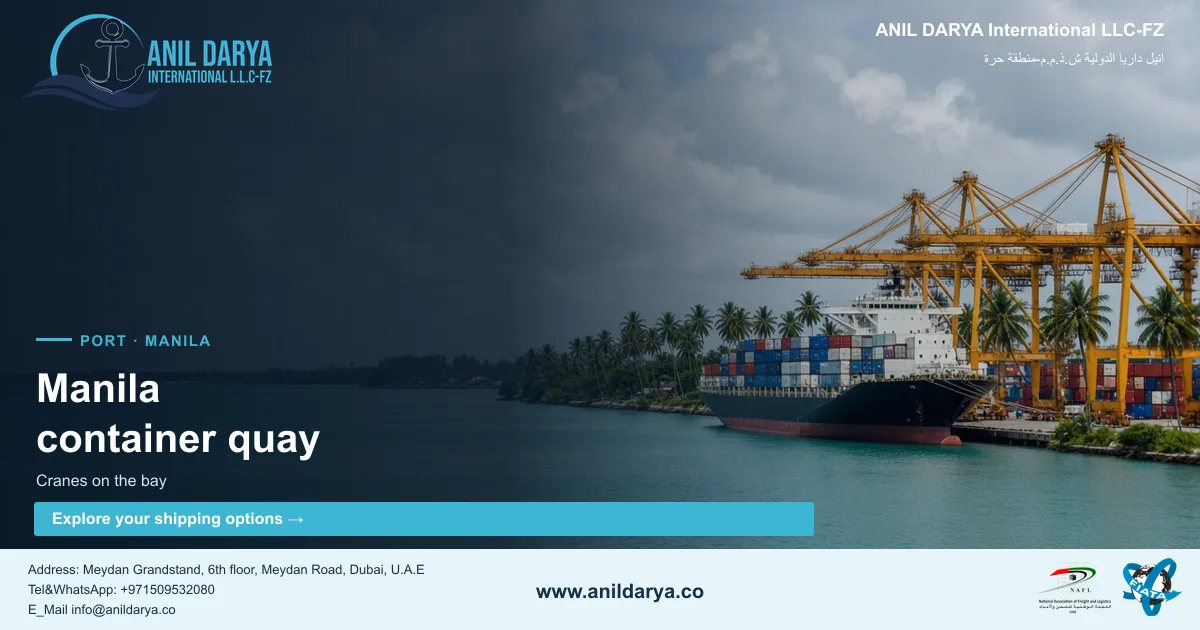
Port of Manila shipping covers most international container cargo entering the Philippines. Foreign containers land at two terminals on Manila Bay: the Manila International Container Terminal (MICT), run by ICTSI, which handled a record 3 million TEU in 2025, and Manila South Harbor, run by Asian Terminals Inc. (ATI). This guide covers the terminals, depths, cargo types, customs rules and each step to ship from Dubai to Manila. We ship both ways: from Dubai to Manila, and from Manila to Dubai with UAE clearance on arrival.
Port of Manila guide: key facts at a glance
| Item | Detail |
|---|---|
| Location | Port Area and Tondo, City of Manila, on the eastern shore of Manila Bay, Luzon |
| Port authority | Philippine Ports Authority (PPA) |
| UN/LOCODE | PHMNL (MICT), PHMNS (South Harbor), PHMNN (North Harbor) |
| International container terminals | MICT (ICTSI) and Manila South Harbor (ATI) |
| Domestic terminal | Manila North Harbor, mainly domestic shipping |
| Port area | 137.5 hectares, 22 berths and 12 piers (PPA figures cited on Wikipedia) |
| MICT volume | 3 million TEU in 2025, about 70% of Manila port volumes |
| MICT capacity | 3.5 million TEU a year once Berth 8 is complete |
| South Harbor capacity | Nearly 2 million TEU a year after the 2025 expansion |
| Published max depths | Containers and ro-ro 13.0 m; breakbulk and bulk 10.7 m |
| Nearest airport | Ninoy Aquino International (MNL), about 10 km |
| Customs | Bureau of Customs, under the CMTA (Republic Act 10863) |
| Manila to Dubai | Export declaration in the BOC E2M system, Authority to Load from the Export Division; UAE duty 5% of CIF for most goods plus 5% import VAT |
Where is the Port of Manila located?
The port sits in the City of Manila on the east side of Manila Bay, on the west coast of Luzon. MICT lies between the North and South Harbors and extends west into the bay at the mouth of the Pasig River. The port is about 10 km from Ninoy Aquino International Airport and about 95 km from Clark.
The port connects to the North Luzon Expressway through the NLEX Harbor Link, so trucks can reach Central Luzon without crossing the city centre. Road traffic in and around the port is the main delay risk, not the berth.
Which terminals handle international cargo at Manila?
The Port of Manila has three main facilities. Two handle foreign cargo. Your bill of lading names the terminal, and the terminal decides where the box is picked up and which BOC office handles the entry.
| Terminal | Operator | Main cargo | Code |
|---|---|---|---|
| Manila International Container Terminal | International Container Terminal Services Inc. (ICTSI) | International containers | PHMNL |
| Manila South Harbor | Asian Terminals Inc. (ATI) | International containers, general cargo, passengers | PHMNS |
| Manila North Harbor | Manila North Harbour Port Inc. | Domestic cargo and passengers | PHMNN |
MICT: the main container terminal
ICTSI has run MICT since 1988 under a 25 plus 25 year concession won in an international tender. ICTSI calls it the Philippines' largest and busiest container terminal. It handled 3 million TEU in 2025 for the first time in a single year, and the record box came off an Evergreen vessel on 22 December 2025.
- Equipment: 18 quay cranes and 60 rubber-tired gantries as of September 2025.
- Berths 6 and 7 handle neo-Panamax ships.
- Berth 8 is under construction: a 300-metre quay, a 15-metre design depth and room for ships of up to 18,000 TEU. Of its 12 hectares of quay and yard, 6.5 hectares were already operating in December 2025, and three quay cranes are due in 2027.
- Once Berth 8 is complete, annual capacity rises to 3.5 million TEU.
- Gates: 14 automated lanes and six optical character recognition portals. MICT reported average truck dwell time of 47.82 minutes in February 2025.
- Digital tools: the ICTSI App shows vessel, container and truck status, billing and electronic interchange receipts, and e-wallet payments speed up gate-out.
Manila South Harbor: the second international terminal
ATI runs South Harbor, which DP World describes as the Philippines' premier international trade gateway. In May 2025, DP World and ATI completed an investment of about US$100 million there.
- The Pier 3 berth was extended to over 600 metres with a depth of 13 metres.
- Expanded yards have a static capacity of more than 20,000 TEU.
- Annual capacity rose from 1.45 million TEU to nearly 2 million TEU.
- Two new neo post-panamax ship-to-shore cranes with 58-metre outreach can work vessels 20 containers wide.
- South Harbor handled around 1.3 million TEU in 2024.
South Harbor also handles general cargo, and the port directory Findaport lists it as the part of the port mainly used for international cargo. For breakbulk to Manila, South Harbor is the usual first question to ask the carrier.
Manila North Harbor: domestic cargo only
North Harbor mainly serves domestic shipping lines and passenger ferries. You will meet it only if your cargo moves on to another island on a domestic vessel after clearance.
How busy is the Port of Manila today?
MICT alone handled 3 million TEU in 2025, and ICTSI says that is about 70% of Manila port volumes. South Harbor handled around 1.3 million TEU in 2024. A Philippine Institute for Development Studies (PIDS) study found shippers prefer Manila because more shipping lines call there, it is close to importers and warehouses, BOC staff there are specialised, and its schedules are more frequent and reliable than those at Batangas and Subic.
The same study warned that heavy use congests the roads inside the port and around Metro Manila, and it suggested moving cargo for areas south of Manila to Batangas and cargo for the north to Subic. That advice still matters when you choose a discharge port.
What cargo can you ship through the Port of Manila?
| Cargo type | Where it goes | Notes |
|---|---|---|
| Dry containers (FCL) | MICT or South Harbor | The bulk of foreign cargo |
| LCL | Container freight stations after discharge | Unpacked and cleared per house bill |
| Reefer containers | MICT or South Harbor | Food and plant imports also need DA clearances |
| Flat rack and open top | Container terminals | Agree crane and yard handling in advance |
| Breakbulk and project cargo | South Harbor general cargo berths | Published max breakbulk depth 10.7 m |
| Ro-ro and vehicles | Ro-ro berths | Right-hand drive vehicles are prohibited; used vehicles need DTI clearance |
| Dangerous goods | Container terminals, by prior acceptance | IMDG declaration, plus Philippine permits for controlled chemicals |
FCL and LCL shipping to the Port of Manila terminals
For FCL, the carrier discharges at MICT or South Harbor depending on its service. Check which terminal your service calls at, because pick-up, storage tariffs and the BOC office follow the terminal. The importer's broker lodges the entry and, once released, a trucker collects the box through the terminal gate and returns the empty inside free time.
For LCL, the box is unpacked at a container freight station and each house bill is cleared on its own. Release can wait on the consolidator's paperwork as well as yours, so send complete documents early. Our guide to FCL vs LCL shipping helps you pick between them, and our sea freight service page explains what we book from the UAE.
[AMIR-FACT: the carriers and terminal (MICT or South Harbor) we normally use from Jebel Ali to Manila, and our typical port-to-port days]
Breakbulk and project cargo at the Port of Manila
Cargo that does not fit a container moves as breakbulk on a general cargo or heavy-lift vessel. Findaport lists a maximum breakbulk depth of 10.7 m at Manila, against 13.0 m for containers, so deep-draft heavy-lift ships need a berth check before fixture. For bulk and breakbulk entries, the Philippine document set can include survey reports.
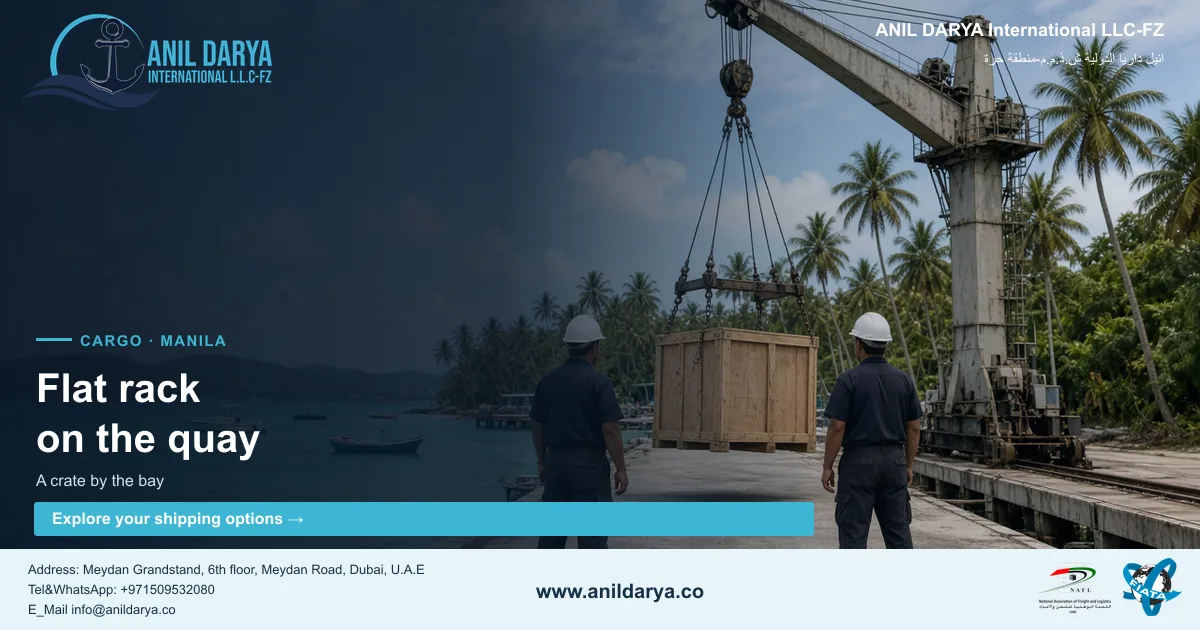
Plan the Manila road leg early. Heavy and wide loads need a route survey, escort and timing that fits city traffic rules. If the site is south of Manila, a Batangas discharge can shorten the road move. We collect drawings, weights and lifting points, book flat racks or breakbulk space and plan the UAE road move to the quay. See our break bulk and project cargo service and our guide to flat rack, open top and out-of-gauge cargo.
Dangerous goods to the Port of Manila
DG cargo must be packed, marked and declared under the IMDG Code. You need the UN number, proper shipping name, class and packing group, a safety data sheet, a signed DG declaration and UN-approved packaging. The carrier and the terminal must accept the booking before you load.
Some DG cargo also needs a Philippine import clearance before it arrives:
- Essential chemicals and controlled precursors: PDEA and the Dangerous Drugs Board.
- Chemicals on the Philippine Priority Chemical List: DENR.
- Explosives, blasting agents and detonators: the PNP Firearms and Explosives Office.
- Fertilisers and pesticides: the DA Fertilizer and Pesticide Authority.
Our dangerous goods shipping team gets carrier acceptance and checks permit needs before you commit to a sailing.
Customs clearance at the Port of Manila: rules, lanes and documents
The Bureau of Customs applies the CMTA. Most steps run in its electronic system, but hard copies of import documents still go in for verification, and other agencies' permits are applied for separately.
Who can clear cargo at Manila?
Importers and customs brokers must be accredited by the BOC before they lodge entries. The goods declaration is processed by the declarant or by a licensed customs broker. Accreditation gives a BOC Certificate of Registration, which is renewed with company records, a mayor's permit, the latest income tax return and proof of financial capacity to import.
Time limits that cost money
- Manifest: the shipping company sends the electronic manifest before arrival. On voyages of 72 hours or more, a forwarder that does not submit its manifest at least 24 hours before entry faces a penalty.
- Entry: the goods declaration must be lodged within 15 days from discharge of the last package. One 15-day extension is possible if requested in time.
- Claim: after paying duty and taxes, the importer has 30 days to claim the goods.
- Abandonment: goods not declared in time can be treated as impliedly abandoned. The owner can reclaim them within 30 days after the filing period lapses.
Green, yellow and red lanes
Each entry is assigned a lane by risk. Green means no document review or inspection. Yellow means document review only. Red means document review and physical inspection. A blue lane is used for shipments selected for post-clearance audit. Clean, consistent documents are the best way to stay out of red.
Which documents are needed?
| Document | Who provides it | Notes |
|---|---|---|
| Endorsed bill of lading | Carrier or forwarder | Or a carrier certification |
| Commercial invoice | Shipper | Or L/C or other payment document |
| Packing list | Shipper | Must match the marks and counts |
| Supplemental Declaration on Valuation (SDV) | Importer | Notarised |
| Certificate of origin | Shipper | Needed for any preferential rate |
| Import permit or clearance | Importer | For regulated goods (DA, FDA, DTI, PDEA, DENR) |
| Survey report | Surveyor | For bulk and breakbulk |
Duty and VAT at Manila
Duty depends on the AHTN tariff code. The simple average MFN applied rate was 6.0% in 2023, and some sensitive farm products carry 20% to 50%. Check your code in the Tariff Commission's Philippine Tariff Finder. Imports also pay 12% VAT on the customs value plus duty, excise and other charges. No duty or tax is collected on goods with an FOB or FCA value of PHP 10,000 or less.
The UAE and the Philippines signed their CEPA on 13 January 2026. Ask the broker whether it is in force before you count on a preferential rate.
How to ship from Dubai to the Port of Manila step by step
- Confirm the consignee is BOC-accredited and has a licensed customs broker in Manila.
- Check the AHTN code, duty, VAT and any permit for each line, and get permits before shipment.
- Agree the Incoterm. Our guide to Incoterms 2020 for sea freight explains who pays what.
- Book the service and check whether it discharges at MICT or South Harbor.
- Prepare the invoice, packing list and certificate of origin with matching HS codes, values and the importer's details.
- Truck the cargo to Jebel Ali, clear UAE export and load. Our Jebel Ali port guide covers the export side.
- Send the bill of lading and full documents to the broker before arrival.
- The broker lodges the entry within 15 days of discharge, pays duty and VAT and gets release.
- Collect the box at the terminal gate, deliver, and return the empty inside free time.
How to ship from the Port of Manila to Dubai
We also handle the other direction: shipping from Manila to Dubai, with arrival at Jebel Ali, Khalifa Port or Sharjah port. We book the space with the carrier and run the UAE side. The Philippine export formalities stay with the shipper or its licensed customs broker.
The Philippine export side
- Registration. Exporters first get accreditation from their agency, such as PEZA or BOI where that applies, and register in the Bureau of Customs Client Profile Registration System (CPRS).
- Export declaration. The exporter or its broker opens a ticket on the BOC Portal and sends the printed export declaration, the invoice and the packing list to the Export Division of the port of loading. A customs officer retrieves the declaration from the E2M database.
- Lanes and release. The declaration goes through a green, yellow, orange or red selectivity lane. Cargo cleared for loading gets an Authority to Load from the Export Division.
- Permits. BOC says the permits and regulating agencies for each product are listed in the Philippine National Trade Repository.
- Pickup. The shipper or its trucker delivers the box to MICT or South Harbor, as named on the booking, inside the cut-off.
The UAE import side
On arrival in Dubai, the declaration goes to Dubai Customs with the commercial invoice, the packing list, a certificate of origin and any permit for restricted goods. The carrier releases the cargo against the bill of lading. Customs duty in Dubai is 5% of the CIF value for most goods, with 50% on alcohol and 100% on cigarettes. Import VAT is 5%, and a VAT-registered importer accounts for it on its VAT return under the reverse charge. Ask us whether the UAE-Philippines CEPA is in force before you count on a lower rate.
- Send us the shipper's details in the Philippines, the cargo, the HS code and the UAE delivery address.
- We book space from Manila and send the booking, terminal and cut-offs to the shipper.
- The shipper or its trucker collects the empty, loads it and delivers it to the terminal.
- The shipper or its broker lodges the export declaration and gets the Authority to Load.
- We check the draft bill of lading against the invoice and packing list.
- We file the UAE declaration before the vessel arrives.
- We arrange payment of the duty and VAT and collect the delivery order.
- We truck the box to your site and return the empty inside free time.
[AMIR-FACT: the carriers we actually use from Manila (MICT or South Harbor) to Jebel Ali, Khalifa Port or Sharjah, and our real port-to-port transit days in this direction]
Tracking your container at the Port of Manila
For boxes at MICT, the ICTSI App shows vessel, container and truck status in real time, along with billing computation and electronic interchange receipts. MICT also sends SMS alerts to truck drivers when a container hold is released and when truck instructions are issued at gate-in. E-wallet payments deduct terminal fees automatically, which speeds up gate-out once customs has released the box.
For boxes at South Harbor, ask the consignee's broker or the carrier's Manila agent for status, because the terminal's own systems are separate from MICT's. In both cases, the useful milestones are the same.
| Milestone | What it tells you | Who acts next |
|---|---|---|
| Vessel arrival and discharge | The 15-day entry clock starts at discharge | Broker lodges the entry |
| Lane assigned | Green, yellow or red | Broker answers queries or attends inspection |
| Duty and VAT paid | The 30-day claim period starts | Importer books trucking |
| Customs release and hold lifted | The box can leave the terminal | Trucker collects at the gate |
| Empty returned | Detention stops | Carrier closes the file |
Trucking cargo out of the Port of Manila
Most containers leave the port by road. The NLEX Harbor Link connects the port area to the North Luzon Expressway, which helps cargo heading to Central Luzon. MICT's 14 automated gate lanes and six OCR portals cut average truck time inside the terminal to 47.82 minutes in early 2025, so the slow part is usually the city road network, not the gate.
Three practical rules help:
- Book the trucker before release, not after. A released box that sits waiting for a truck still uses free time.
- For out-of-gauge or heavy loads, plan the route, permits and escort before the vessel arrives.
- If the warehouse is far south or north of Manila, compare the truck cost with a Batangas or Subic discharge before the next booking.
Our guide to the project cargo logistics process covers route surveys and escorts for heavy pieces.
Port of Manila or another Philippine port?
| Consignee location | Port to consider | Why |
|---|---|---|
| Metro Manila | Manila (MICT or South Harbor) | Most sailings, shortest truck leg |
| Laguna, Batangas, Cavite | Batangas | PIDS suggests southern cargo use Batangas to avoid Manila congestion |
| Central Luzon, Clark | Subic | PIDS suggests northern cargo use Subic |
| Visayas | Cebu | Avoids a domestic feeder from Manila |
| Mindanao | Davao, General Santos, Cagayan de Oro | Avoids a domestic feeder from Manila |
Free time, storage and demurrage at Manila
Two clocks run once the box lands. The terminal charges storage after its free days, and the carrier charges demurrage and then detention after its free time. A late entry, a missing permit or a red-lane inspection can easily use up both. Agree carrier free time at booking, have the broker ready before arrival and plan trucking before release. Our note on demurrage and detention shows how these costs build up.
What drives the cost of Port of Manila shipping?
| Cost element | What drives it |
|---|---|
| UAE origin | Trucking to Jebel Ali, export declaration, terminal handling |
| Ocean freight | Container type, carrier, transshipment, season, surcharges |
| Manila terminal charges | Arrastre and handling, storage after free days, LCL unpacking |
| Customs | Broker fee, inspection, permits |
| Duty and VAT | AHTN rate, 12% VAT, excise where it applies |
| Delivery | Trucking from the port, out-of-gauge permits, escorts |
When air cargo to Manila makes more sense
For samples, spare parts and urgent stock, air is often cheaper than paying storage on a delayed box. Fluent Cargo lists direct flights from Dubai (DXB) to Manila (MNL) of about 8 hours 50 minutes, 2 to 4 times a day. The same BOC accreditation, entry, duty and VAT rules apply. See our air cargo service.
Checklist before you ship to the Port of Manila
- Consignee's BOC accreditation and broker confirmed
- Discharge terminal (MICT or South Harbor) known
- AHTN code, duty and VAT checked
- Permits issued for regulated goods before shipment
- Invoice, packing list, SDV and certificate of origin consistent
- DG declaration, SDS and carrier acceptance for hazardous cargo
- Out-of-gauge drawings, berth depth and road route checked for project cargo
- Free time agreed and trucking booked
Common mistakes
- Shipping to a buyer who is not BOC-accredited yet.
- Missing the 15-day entry deadline.
- Getting a DA, FDA or PDEA permit after the goods sail.
- Assuming every service calls at MICT when it calls at South Harbor, or the other way round.
- Booking a deep-draft heavy-lift ship without checking the breakbulk berth depth.
- Choosing Manila for a consignee near Batangas or Subic.
- Declaring a value that does not match the SDV and the invoice.
Frequently asked questions
Who operates the terminals at the Port of Manila?
The Philippine Ports Authority oversees the port. ICTSI operates MICT, Asian Terminals Inc. operates South Harbor, and Manila North Harbour Port Inc. operates North Harbor.
What is the port code for Manila?
PHMNL is the code for MICT and the port in general. South Harbor uses PHMNS and North Harbor uses PHMNN. Check the code on your booking before filing documents.
What is the difference between MICT and South Harbor?
Both handle international containers. MICT is the larger terminal, with 3 million TEU in 2025. South Harbor, run by ATI, has capacity of nearly 2 million TEU a year after its 2025 expansion and also handles general cargo.
How deep are the berths at the Port of Manila?
Findaport lists maximum depths of 13.0 m for containers and ro-ro, and 10.7 m for breakbulk and bulk. MICT's Berth 8 is designed for 15 metres, and South Harbor's extended Pier 3 berth is 13 metres deep.
How long do I have to clear cargo at Manila?
The goods declaration must be lodged within 15 days from discharge, with one possible 15-day extension. Late filing risks implied abandonment.
Can I ship dangerous goods to Manila?
Yes, with an IMDG declaration and carrier acceptance. Controlled chemicals, explosives and agricultural chemicals also need a Philippine clearance from PDEA, DENR, PNP or DA-FPA.
Does the Port of Manila handle breakbulk?
Yes. Breakbulk and general cargo are handled at South Harbor, with a published maximum breakbulk depth of 10.7 m. Check the berth and road route early for heavy pieces.
How do you ship from Dubai to Manila?
We book space from Jebel Ali, check which terminal the service uses, prepare the documents and clear UAE export. The consignee's licensed broker in Manila lodges the entry within 15 days of discharge and pays duty and VAT.
Can you handle shipping from Manila to Dubai?
Yes. We book the space, check the bill of lading and clear the cargo in Dubai. The shipper or its broker lodges the export declaration with the Bureau of Customs. In Dubai, duty is 5% of CIF for most goods, plus 5% import VAT.
Get a quote for Port of Manila shipping
Send us the cargo details, the Manila delivery address and the Incoterm, and we will come back with a routing and a price. Use our freight rate inquiry form or contact our team to plan breakbulk, DG or permit-sensitive cargo first.
Sources
- ICTSI: Manila flagship terminal achieves 3M TEUs (22 December 2025)
- ICTSI: MICT adds green cranes (15 September 2025)
- ICTSI: Manila International Container Terminal
- MICT: investments continue to advance service delivery (5 February 2025)
- Hellenic Shipping News: ICTSI expands large vessel capability of Manila flagship
- DP World: DP World and ATI invest US$100 million at Manila South Harbour (2 May 2025)
- Findaport: Port of Manila (depths, terminals, airports)
- Wikipedia: Port of Manila (area, berths, terminals)
- iContainers: Port of Manila (LOCODEs)
- Philippine Institute for Development Studies: Port of Manila, Batangas and Subic study
- Republic Act 10863, Customs Modernization and Tariff Act
- US International Trade Administration: Philippines customs regulations
- US International Trade Administration: Philippines import requirements and documentation
- US International Trade Administration: Philippines import tariffs
- US International Trade Administration: Philippines prohibited and restricted imports
- Bureau of Customs MICP support centre: importer accreditation renewal
- PwC Worldwide Tax Summaries: Philippines other taxes
- UAE: signing of the UAE-Philippines CEPA
- Fluent Cargo: Dubai to Manila
- Bureau of Customs: Guidelines on exportation (CPRS, BOC Portal, E2M, Authority to Load, permits)
- Dubai Customs: Submit customs declaration (documents)
- UAE Government portal: Customs duty (5% of CIF, alcohol 50%, cigarettes 100%)
- Federal Tax Authority: VAT guide (5% rate, import VAT, reverse charge)
Reviewed: 10 November 2026