
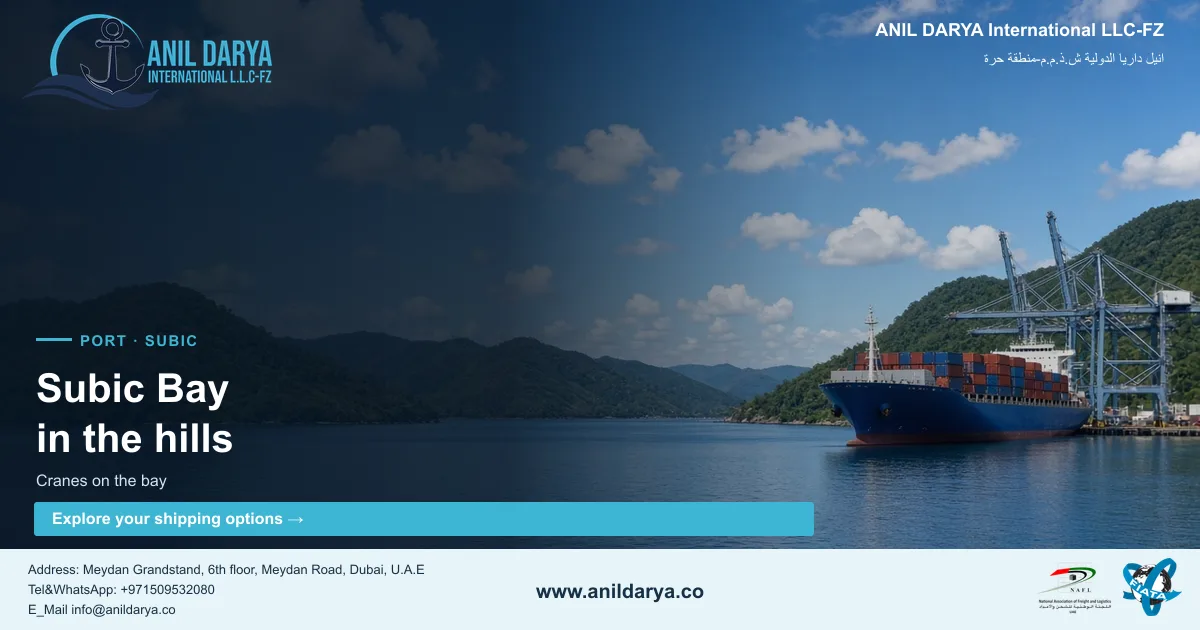
Subic Bay port shipping means moving cargo through the Port of Subic inside the Subic Bay Freeport Zone, on the west coast of Luzon about 85 km from Manila. Containers are handled at New Container Terminals 1 and 2, run by Subic Bay International Terminal Corp. (SBITC), and the port also handles bulk, breakbulk and Ro-Ro cargo. This guide covers the terminals, depths, carriers, the freeport duty rules, customs and the steps to ship from Dubai. We ship both from Dubai to Subic Bay and from Subic Bay to Dubai.
Subic Bay port at a glance
| Item | Detail |
|---|---|
| UN/LOCODE | PHSFS |
| Port authority | Subic Bay Metropolitan Authority (SBMA) |
| Legal basis of the freeport | Republic Act 7227 of 1992, a separate customs territory |
| Location | Subic Bay Freeport Zone, west coast of Luzon, about 85 km west-northwest of Manila |
| Port area | 41 hectares, 19 operational piers and wharves |
| Approach channel | Natural deep channel of 22 to 45 m |
| Container terminals | NCT-1 and NCT-2, operated by SBITC (an ICTSI company) |
| Container quay | 2 berths, 560 m in total |
| Container berth depth | 13 m controlling depth (MLLW), 13.7 m actual |
| Container capacity | 600,000 TEU a year |
| Reefer plugs | 210, expandable to 310 |
| Largest carrier groups (capacity, March 2026) | Hapag-Lloyd, Maersk, CMA CGM, Evergreen |
| Customs office | Bureau of Customs, Port of Subic |
| Road link | Subic-Clark-Tarlac Expressway (SCTEX), 93.77 km |
| Import VAT (for cargo entering the rest of the Philippines) | 12% |
| Subic Bay to Dubai | Also handled: export declaration by the shipper or its broker, UAE clearance at Jebel Ali, Khalifa Port or Sharjah by us |
Where is the Port of Subic and who does it serve?
The port sits inside the Subic Bay Freeport Zone, which covers parts of Olongapo and Subic in Zambales and Hermosa and Morong in Bataan. The harbour is well sheltered, and Findaport places it about 85 km west-northwest of Manila, with Manila's international airport about 95 km away. Subic Bay International Airport is inside the zone.
The SBMA runs both the freeport and the port. SBITC says its terminals serve industries inside the freeport and in northern and central Luzon, and it presents Subic as an alternative gateway to the Port of Manila. ICTSI lists the hinterland as the Subic and Clark free ports and economic zones plus Pampanga, Bataan, Tarlac and La Union.
The reason to use Subic is the road. SCTEX runs 93.77 km from Tipo in Dinalupihan, Bataan, to Tarlac City. A spur at Clark joins the North Luzon Expressway (NLEX), and at Tarlac the road continues north as TPLEX toward La Union. A box landed at Subic can reach Clark and central Luzon without crossing Metro Manila traffic.
Which terminal handles your cargo at Subic Bay?
All foreign containers use the SBITC terminals at NCT-1 and NCT-2. Other cargo is worked at the SBMA's other piers and wharves, with handling arranged through SBMA-accredited ship agents.
| Facility | Who handles cargo | Main use |
|---|---|---|
| New Container Terminals 1 and 2 | SBITC (ICTSI) | Containers, reefers, out-of-gauge cargo |
| Other SBMA piers and wharves | SBMA-accredited ship agents and handlers | Bulk grain and fertiliser, breakbulk, general cargo, Ro-Ro |
| Boton area terminals | Private terminal operators | Fuel and liquid storage |
| Passenger and cruise berth | SBMA-accredited ship agents | Cruise ships and ferries |
NCT-1 and NCT-2: the facts that affect your booking
SBITC won the NCT-1 concession in 2007 and started commercial operations in 2008. ICTSI Subic won NCT-2 in 2011, and the two terminals were later run as one. ICTSI reported a 25-year extension of its Subic concession in 2025.
| NCT item | Figure | Source |
|---|---|---|
| Berths | 2, each 280 m | SBITC, SBMA |
| Depth | 13 m controlling (MLLW), 13.7 m actual | SBITC |
| Terminal area | 26.32 ha | SBITC |
| Container yard | 11.15 ha | SBITC |
| Quay gantry cranes | 4, each rated 40.6 tonnes | SBMA |
| Annual capacity | 600,000 TEU (300,000 per berth) | SBITC, SBMA |
| Reefer plugs | 210 at 440 V, expandable to 310 | SBITC |
SBITC describes the site as a common-user, multipurpose terminal with on-dock and off-dock handling, and it is ISPS certified. In 2024 it promoted itself as a gateway for out-of-gauge cargo in the northern Philippines and added handling equipment.
How deep is the water at Subic Bay?
Depth is one of Subic's strengths. The bay is naturally deep, and the SBMA says its berths take vessels needing up to 14 m. Figures differ slightly by source and berth.
| Source | Figure | How to read it |
|---|---|---|
| SBMA | Natural channel 22 to 45 m; berths for vessels needing up to 14 m | Port-wide official figure |
| SBITC | NCT berths 13 m controlling, 13.7 m actual | Container terminal limit |
| Findaport | Containers and Ro-Ro 13.7 m; breakbulk 12.9 m; bulk and passenger 12.0 m | Maximum depth by cargo type |
| Findaport | Tankers up to 50,000 DWT, 190 m LOA, 11.0 m draft | Liquid cargo berths |
| Cogoport | Cargo pier 11 to 12.2 m; channel and anchorage over 23.2 m | Older standard port data |
Compare this with the 9.4 to 10 m published for the government cargo pier at Davao. Even so, confirm the berth and its depth for your arrival date through the ship's agent before you fix a vessel.
Which shipping lines call at Subic Bay?
Cogoport's March 2026 snapshot tracked 5,271 TEU of capacity calling Subic. The largest shares were:
| Carrier group | Share of tracked capacity |
|---|---|
| Hapag-Lloyd | 29.3% |
| Maersk | 18.8% |
| CMA CGM | 16.4% |
| Evergreen | 11.3% |
| Ocean Network Express | 7.6% |
| MSC | 5.9% |
| Others | 10.7% |
Subic is a smaller gateway than Manila, so check sailing dates early. Its weekly volume in Cogoport's data ran from about 2,500 to 6,200 TEU between December 2025 and February 2026, with imports above exports in most weeks. Cargo from the Gulf reaches Subic after transshipment at a hub, and Cogoport lists Mundra and Nhava Sheva among the import lanes. The SBMA also lists local contacts for APL and Wan Hai.
[AMIR-FACT: the carriers and transshipment hub we normally use from Jebel Ali to Subic Bay, and our real port-to-port days on this lane]
Freeport or mainland: how customs works at Subic
This is the part that makes Subic different from every other Philippine port. Under Republic Act 7227, the Subic Special Economic and Freeport Zone is run as a separate customs territory. Where the goods end up decides how they are treated.
| Your consignee | Treatment at import | What to check |
|---|---|---|
| A registered locator inside the freeport | Raw materials, capital goods and equipment can enter free of tax and duty under RA 7227 | The locator's SBMA registration and what its incentives cover |
| A company elsewhere in the Philippines | Goods leaving the zone for the customs territory pay duties and taxes under national law | BOC entry, duty, 12% VAT, permits |
| A locator that later sells into the Philippine market | Duties and taxes apply when the goods leave the zone | Records that link imports to withdrawals |
RA 7227 also says no local or national taxes are imposed within the zone. The duty-free benefit belongs to the registered locator, not to the port. If your buyer is a trader in Pampanga or Metro Manila, landing the box at Subic does not make it duty-free.
A simple decision rule: before you quote, ask the consignee for its SBMA registration. If it has none, treat the shipment as a normal Philippine import that happens to arrive at Subic.
Customs rules for cargo entering the Philippine market
The Bureau of Customs office for the Port of Subic handles entries. The national rules are the same as in Manila:
- Importers and customs brokers must be accredited by the BOC.
- The goods declaration must be lodged within 15 days of discharge of the last package. One 15-day extension can be requested on valid grounds.
- Entries are filed electronically, and hard copies still go in for verification.
- Each entry gets a green, yellow or red risk lane. Red means document review and inspection.
- No duty or tax is collected on goods worth PHP 10,000 or less (FOB or FCA).
- VAT is 12%, on the customs value plus duty, excise and other charges.
The BOC Port of Subic regularly posts notices to file entry for goods already discharged, and it holds public auctions of unclaimed cargo. Late filing is how cargo ends up on those lists.
| Document | Why it matters at Subic |
|---|---|
| Bill of lading | Must name the consignee exactly as registered with the BOC or SBMA |
| Commercial invoice and packing list | Values and HS codes; must match |
| Supplemental declaration on valuation | Notarised, part of the core BOC import set |
| SBMA locator documents | Needed for duty-free entry into the freeport |
| Certificate of origin | For any preferential rate on goods entering the customs territory |
| Import clearance or permit | For regulated goods (DA, FDA, DTI, DENR, PDEA) |
| DG declaration and SDS | Carrier and terminal acceptance |
The UAE and the Philippines signed a CEPA on 13 January 2026. Ask the broker whether it is in force for your tariff line before you count on a lower rate.
What cargo can you ship through Subic Bay port?
| Cargo type | Where it goes | What to plan |
|---|---|---|
| Dry containers (FCL) | NCT-1 and NCT-2 | Freeport or mainland entry, free time |
| LCL | Unpacked at a container freight station after discharge | Each house bill clears on its own |
| Reefer containers | NCT reefer plugs | DA clearances for food and plant goods |
| Livestock feed and raw materials in containers | NCT, endorsed by the DA as a discharge port in 2021 | DA import clearances |
| Out-of-gauge and flat rack cargo | NCT, by prior agreement | Lifting plan, road permits on SCTEX |
| Bulk grain and fertiliser | SBMA bulk piers | Berth depth, discharge rate, FPA clearance for fertiliser |
| Breakbulk and project cargo | SBMA general cargo piers | Ship agent, cranes, laydown space |
| Vehicles | Ro-Ro berth or containers, check with carrier | Used vehicles need DTI clearance; right-hand drive is prohibited |
| Dangerous goods | NCT, with carrier and terminal acceptance | IMDG papers plus Philippine permits |
FCL and LCL shipping from Dubai to Subic Bay
FCL is the usual way to ship from the UAE to Subic. The box is loaded at Jebel Ali, transshipped at a hub and discharged at NCT. A full container for a freeport locator can move inside the zone without crossing the customs line. A box for central Luzon clears at the Port of Subic and goes out on SCTEX.
LCL services into Subic may be limited. Ask early whether an LCL service exists for your dates. If not, compare LCL to Manila with trucking north, or a small FCL straight to Subic. Our guide to FCL vs LCL shipping shows where the break-even point usually falls.
We book space with carriers serving Subic through our sea freight service and confirm the hub, the box type and the Jebel Ali cut-off.
Breakbulk, bulk and project cargo at Subic
Subic's deep berths make it a strong option for bulk grain, fertiliser and heavy cargo bound for central and northern Luzon. Findaport lists breakbulk at up to 12.9 m and bulk at 12.0 m. Cogoport records lifting capacity above 100 tonnes. SBITC also markets NCT for out-of-gauge cargo.
When we plan a breakbulk or project move to Subic from the UAE, we check:
- Drawings, weights, centre of gravity and lifting points for every piece.
- Whether a flat rack on a container service will do, or breakbulk tonnage is needed.
- The berth and its depth on arrival, through an SBMA-accredited ship agent.
- Ship's gear or shore cranes for the heaviest lift.
- The road route to site, including SCTEX and any escort or permit.
- Customs entry, or freeport documents, ready before the vessel berths.
See our break bulk and project cargo service and our guide to flat rack, open top and out-of-gauge cargo.
Dangerous goods to Subic Bay
DG cargo to Subic must be packed, marked and declared under the IMDG Code, and the carrier and SBITC must accept it before loading. You need the UN number, proper shipping name, class and packing group, a safety data sheet, a signed DG declaration and UN-approved packaging.
For goods entering the Philippine market, many chemicals also need clearance from the DENR, PDEA, the PNP Firearms and Explosives Office or the DA Fertilizer and Pesticide Authority. For a freeport locator, ask the SBMA what its own permits require. Our dangerous goods shipping team checks acceptance and the permit list before you commit to a sailing.
How to ship from Dubai to Subic Bay, step by step
- Find out whether the consignee is an SBMA-registered locator or a company outside the zone.
- For mainland cargo, confirm BOC accreditation, a broker at the Port of Subic and any permits. For freeport cargo, confirm the locator's documents.
- Agree the Incoterm. Our guide to Incoterms 2020 for sea freight shows who pays what.
- Send us the commodity, weight, volume and cargo type. We book a service from Jebel Ali that discharges at Subic.
- Prepare the invoice, packing list and certificate of origin with matching values and consignee details.
- We truck the cargo to the UAE port, file the export declaration and load. Our Jebel Ali port guide covers that side.
- Send the bill of lading and full document set to the Subic broker or locator before arrival.
- The broker lodges the entry within 15 days of discharge, or the locator completes freeport entry.
- The consignee collects the delivery order, trucks the box out of NCT and returns the empty within free time.
How to ship from Subic Bay to Dubai
We also handle the other direction: shipping from Subic Bay to Dubai, with arrival at Jebel Ali, Khalifa Port or Sharjah port. We book the space with the carrier and run the UAE side. The export papers at origin stay with the shipper or its Philippine customs broker.
The Philippine export side
- Freeport locators. Under Customs Memorandum Order 9-2026, a business registered with SBMA, or its authorised representative, lodges the export declaration (ED-SAD) in SBMA's automated export declaration system through an accredited value-added service provider. Once approved, it goes electronically to the Bureau of Customs.
- Regulated goods. For regulated products, SBMA checks that the export clearance, permit or licence matches the goods before it approves the declaration.
- Authority to Load. The Bureau of Customs notifies the exporter when the Authority to Load is issued. An approved ED-SAD is valid for 24 hours, and the shipment must leave the freeport inside that window.
- Exporters outside the freeport. Enterprises registered with the Board of Investments still file through the Bureau's own export declaration system. A shipper elsewhere in Central Luzon should ask its broker which route applies.
The UAE import side
On arrival, the declaration goes to Dubai Customs with the commercial invoice, packing list, certificate of origin and any permit for restricted goods. The bill of lading is what the line needs before it issues the delivery order. Customs duty in Dubai is 5% of the CIF value for most goods, with 50% on alcohol and 100% on cigarettes. Import VAT is 5% of the customs value, which includes freight and insurance. A VAT-registered importer whose customs number is linked with the Federal Tax Authority accounts for that VAT on its VAT return instead of paying it at release.
- Send us the shipper's details at Subic or in Central Luzon, the cargo, the HS code and the UAE delivery address.
- We book space on a service loading at NCT-1 or NCT-2 and send the booking and cut-offs to the shipper.
- The shipper or its broker lodges the ED-SAD and waits for the Authority to Load.
- The shipper or its trucker delivers the box to the terminal before the cut-off, and for freeport cargo inside the 24-hour window.
- We check the draft bill of lading against the invoice and packing list before the carrier issues it.
- We file the Dubai Customs declaration before the ship arrives.
- We arrange payment of the duty and VAT, or the VAT deferral if you are VAT-registered, and collect the delivery order from the line.
- We truck the cargo to your site in the UAE and return the empty inside free time.
[AMIR-FACT: the carriers and hub we actually use from Subic Bay to Jebel Ali, Khalifa Port or Sharjah, and our real port-to-port transit days in this direction]
Subic Bay or Manila: which port should you choose?
| Your consignee is in | Port to price first | Reason |
|---|---|---|
| Subic Bay Freeport Zone | Subic | Duty-free entry for registered locators, no city trucking |
| Clark, Pampanga, Tarlac | Subic, then compare Manila | SCTEX links Subic to Clark and Tarlac |
| Bataan, Zambales | Subic | Short truck leg |
| La Union and northern Luzon | Compare Subic and Manila | SCTEX continues as TPLEX |
| Metro Manila, Cavite, Laguna | Manila | More sailings, shorter delivery |
We can price both and show the total cost to your door.
Free time, dwell and demurrage at Subic
Cogoport's monthly data from September 2025 to February 2026 shows average import dwell at Subic between 4.7 and 9.1 days, with the January peak after the holidays. In 2021 SBITC's general manager said the terminal offered up to 10 days of free storage for its partners. Check the current tariff for your box.
After the free days, the terminal charges storage, and the carrier charges demurrage and then detention. Agree carrier free time at booking and plan more in December and January. Our article on demurrage and detention explains the charges.
Checklist before you ship to Subic Bay
- Consignee status known: freeport locator or mainland importer.
- BOC accreditation and broker, or SBMA locator documents, in place.
- HS codes confirmed for every line.
- Invoice, packing list and bill of lading match on weights, counts and consignee.
- Permits issued before sailing for regulated goods.
- For DG: SDS, DG declaration, packaging, labels and carrier acceptance.
- For bulk or project cargo: berth, depth and lifting plan confirmed with a ship agent.
- Free time agreed with the carrier.
Common mistakes
- Assuming any cargo landed at Subic is duty-free. Only registered freeport locators get the benefit.
- Booking LCL to Subic without checking that a consolidator serves it.
- Naming the consignee on the bill of lading differently from its BOC or SBMA registration.
- Filing the entry after 15 days and finding the cargo on the BOC unclaimed list.
- Fixing a bulk vessel on a depth figure from the wrong berth.
Frequently asked questions
What is the port code for Subic Bay?
The UN/LOCODE for Subic Bay is PHSFS. It appears on bookings, bills of lading and tracking systems for cargo to the Subic container terminals.
Who operates the container terminals at Subic?
Subic Bay International Terminal Corp. (SBITC), an ICTSI company, runs New Container Terminals 1 and 2. The Subic Bay Metropolitan Authority is the port authority.
How deep are the container berths at Subic Bay?
SBITC gives a 13 m controlling depth and 13.7 m actual depth at its two 280 m berths. The SBMA says the port's berths take vessels needing up to 14 m.
Is cargo shipped to Subic Bay duty-free?
Only for registered locators in the Subic Freeport, under Republic Act 7227. Goods that leave the zone for the rest of the Philippines pay normal duties and taxes, including 12% VAT.
How big is the Subic container terminal?
SBITC lists 26.32 hectares, a 560 m quay with two berths, 600,000 TEU of annual capacity and 210 reefer plugs, expandable to 310.
Which shipping lines serve Subic Bay?
Cogoport's March 2026 data shows Hapag-Lloyd, Maersk, CMA CGM, Evergreen, ONE and MSC with the largest shares of capacity. Cargo from the UAE arrives via a transshipment hub.
How far is Subic Bay from Manila and Clark?
Findaport places Subic about 85 km west-northwest of Manila. SCTEX connects the freeport to Clark and Tarlac and links to the North Luzon Expressway.
How do I ship from Dubai to Subic Bay?
First find out whether the consignee is an SBMA-registered locator or a company outside the freeport, since that decides the customs route. We then book from Jebel Ali, clear UAE export and send the documents to the locator or its broker before arrival.
Can you ship from Subic Bay to Dubai?
Yes. The shipper or its Philippine broker lodges the export declaration and gets the Authority to Load. We book the space, clear the cargo with Dubai Customs and arrange payment of the 5% duty on most goods and the 5% import VAT.
How long do I have to file the import entry at Subic?
For goods entering the Philippine customs territory, the goods declaration must be lodged within 15 days of discharge of the last package, with one 15-day extension possible.
Get a quote for Subic Bay port shipping
Send us your cargo details and we will come back with a routing and a price for shipping from Dubai to Subic Bay. Use our freight rate inquiry form, or contact our team to talk through a freeport, bulk or project shipment first.
Sources
- SBMA: Why Subic (port area, piers, channel depth, NCT figures)
- SBMA: Port facilities (NCT-1)
- SBMA: Port services (SBITC, cranes, pilotage, tugs, ship agents)
- SBITC: Terminal (berths, quay, depth, yard, reefer plugs, capacity)
- SBITC: home page and news (2024 out-of-gauge gateway, equipment)
- ICTSI: Subic Bay International Terminal Corp. (hinterland, concession extension)
- ICTSI: DA endorses ICTSI Subic as livestock and raw materials discharge port (February 2021)
- Republic Act 7227, Bases Conversion and Development Act of 1992 (Section 12)
- Wikipedia: Subic Bay Freeport Zone (location, area, roads, airport)
- Wikipedia: Subic-Clark-Tarlac Expressway (length, links)
- Findaport: Port of Subic Bay (distance from Manila, depths by cargo type, airports)
- Cogoport: Subic Bay (depths, carrier capacity, weekly TEU, dwell times)
- ShipNext: Subic Bay port data (cargo types)
- Ship4wd: Top container ports in the Philippines (Subic section)
- Bureau of Customs: Port of Subic (notices, auctions)
- Republic Act 10863, Customs Modernization and Tariff Act (15-day entry, de minimis, free zones)
- US International Trade Administration: Philippines customs regulations
- US International Trade Administration: Philippines prohibited and restricted imports
- PwC Worldwide Tax Summaries: Philippines VAT on imports
- UAE: signing of the UAE-Philippines CEPA (13 January 2026)
- Bureau of Customs: Customs Memorandum Order 9-2026 (AEDS Plus, ED-SAD lodgement by freeport enterprises, Authority to Load, 24-hour validity)
- Dubai Customs: Submit customs declaration (documents for import, export and re-export declarations)
- UAE Government portal: Customs duty (5% of CIF in Dubai, alcohol 50%, cigarettes 100%)
- Federal Tax Authority: VAT guide, section 3.5 (5% import VAT, customs value, deferral to the VAT return)
Reviewed: 10 November 2026