
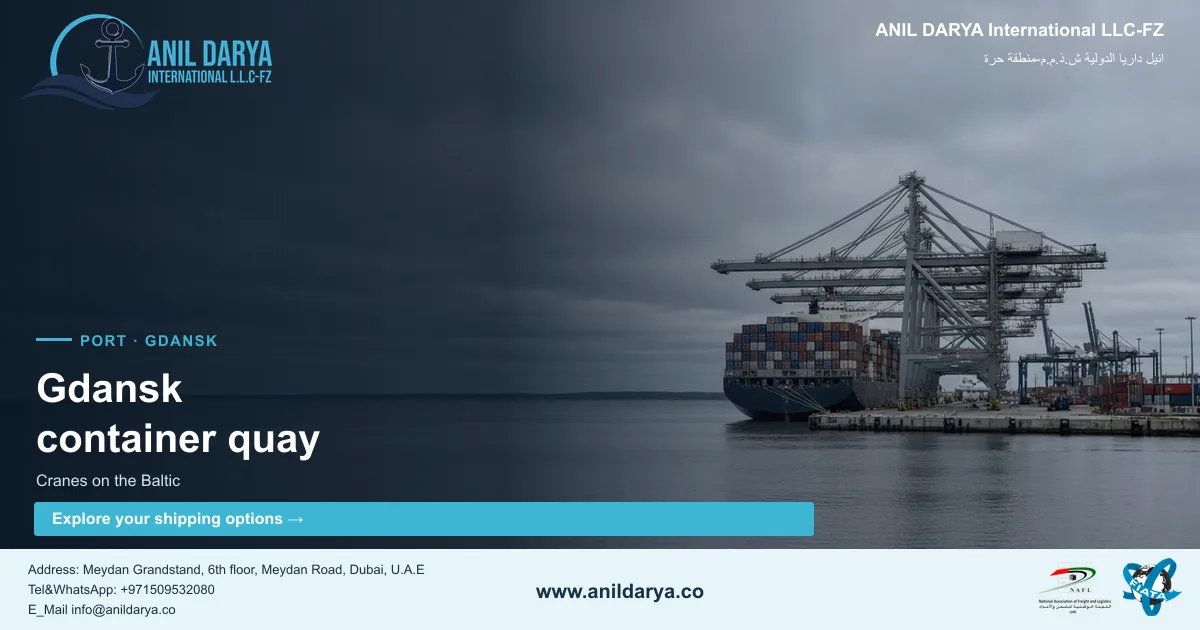
Port of Gdansk shipping runs through two areas: the Outer Port on Gdansk Bay, home to the Baltic Hub container terminal, and the older Inner Port along the Dead Vistula for breakbulk and bulk. Gdansk handled 80.4 million tonnes and nearly 2.8 million TEU in 2025, enough to rank 6th in the EU by cargo volume. This guide covers terminals, depths, cargo types, customs and documents at the port, and how to ship to Gdansk from Dubai step by step. We ship both ways: from Dubai to Gdansk, and from Gdansk to Dubai with UAE clearance on arrival.
Port of Gdansk at a glance
| Item | Detail |
|---|---|
| UN/LOCODE | PLGDN |
| Port authority | Port of Gdansk Authority (ZMPG S.A.) |
| Location | Southern Baltic coast, 54°25'N, 18°39'E |
| Port areas | Outer Port on Gdansk Bay; Inner Port on the Dead Vistula and port channel |
| Fairway depth | 17 m; ships with up to 15 m draft can enter |
| Main container terminal | Baltic Hub Container Terminal, capacity 4.4 million TEU a year |
| 2025 cargo | 80.4 million tonnes, nearly 2.8 million TEU (up 23%) |
| January to September 2026 | 65.2 million tonnes, nearly 2.5 million TEU (up 21%) |
| Ranking | 8th in Europe and 6th in the EU by cargo volume (port authority, March 2026) |
| Working hours | 24 hours in three shifts; ice-free all year |
| Free Zone | Yes, near the Inner Port entrance |
| Customs | National Revenue Administration (KAS); branches at the port and the container terminal |
| Gdansk to Dubai | Export declaration filed electronically in the AES system; UAE duty 5% of CIF for most goods plus 5% import VAT |
What is the Port of Gdansk used for?
Gdansk is a general port on Poland's Baltic coast that handles containers, vehicles, liquid fuels, dry bulk and chemicals. The port authority calls it a sea gateway to Central and Eastern Europe. In 2025 it handled 80.4 million tonnes, up nearly 4% on 2024, and 4,394 vessel calls.
The port grew fast in the last two years. Container volume rose 23% in 2025, and in the first nine months of 2026 total cargo reached 65.2 million tonnes against 59.1 million in the same period of 2025. For a shipper, that means frequent mainline and feeder services, but also busy terminals, so book early and plan clearance before the ship arrives.
What cargo moves through Gdansk?
| Cargo group (2025) | Volume | Change on 2024 |
|---|---|---|
| Liquid fuels | 39.6 million tonnes (49.3% of total) | +0.4% |
| General cargo, including containers | 27.2 million tonnes | +16.6% |
| Containerised cargo (within general cargo) | 24 million tonnes | +18% |
| Coal | about 7 million tonnes | -10.8% |
| Other dry bulk | 3.7 million tonnes | +8.5% |
| Grain | about 2.5 million tonnes | -14.8% |
| Ro-ro vehicles | 118,000 units | -15% |
Port of Gdansk terminals and quays
The two port areas do different jobs. Your cargo type decides which one you deal with.
| Area | Max draft | Handling capacity | Main cargo |
|---|---|---|---|
| Outer Port | 15.0 m | 65.5 million tonnes | Containers (Baltic Hub), liquid fuels, coal, LPG, ore |
| Inner Port | 10.6 m | 13.7 million tonnes | General cargo, metals, heavy and oversized cargo, cereals, fertilisers, ores, coal |
Baltic Hub, the main container terminal
Baltic Hub, formerly DCT Gdansk, is the main container terminal. It began operations on 1 June 2007 and is owned by PSA International, the Polish Development Fund and IFM Global Infrastructure Fund. Its third deepwater quay, T3, opened in 2025 and lifted capacity to 4.4 million TEU a year. In 2025 the terminal handled 2,766,475 TEU.
| Baltic Hub item | Figure |
|---|---|
| Quays | T1 625 m, T2 570 m, T3 717 m |
| Max draught | 15 m |
| Largest vessel | Up to 425 m long, over 24,000 TEU |
| Terminal area | 124 hectares |
| Cranes | 21 ship-to-shore, 52 RTG, 20 automated RMG, 4 rail-mounted RMG |
| Reefer plugs | 2,134 |
| Rail | 5.25 km of siding on 7 tracks |
| Warehouse | 8,200 m² |
The rail siding matters if your consignee is inland. A container can leave the terminal by train rather than by truck, which often suits central and southern Poland.
Breakbulk and general cargo quays
Breakbulk is handled in the Inner Port at the Oliwskie, Wislane, Szczecinskie, Przemyslowe and Obroncow Westerplatte quays and at the Free Zone quays. The port lists palletised, bagged, heavy, oversized, metallurgical and hazardous goods among the cargo handled there. There is a citrus handling base and a food coldstore in the Free Zone.
Bulk, liquid and ro-ro terminals
- Dry bulk: the coal terminal in the Outer Port has an export side at Weglowy Pier and an import side at Rudowy Pier, which takes Capesize ships over 150,000 DWT.
- Liquid fuels: an automated liquid fuel terminal in the Outer Port, linked to refineries by pipeline, and an LPG terminal that ships by rail and road.
- Chemicals and fertilisers: Chemikow Quay handles phosphorite, fertilisers, liquid chemicals, minerals and molasses.
- Grain: elevators at Zbozowe and Oliwskie quays.
- Ro-ro and ferries: Westerplatte Ferry Terminal, with fixed and floating ramps, about 15 minutes from central Gdansk.
Shipping containers, breakbulk and dangerous goods to Gdansk
Container shipping: FCL and LCL
Most container cargo from the Gulf reaches Gdansk at Baltic Hub. Carriers that the port lists among its customers include Maersk, CMA CGM, Cosco, OOCL, K-Line and MSC. Because Gdansk is on the Baltic, many services from the Middle East reach it after transshipment at a larger European hub.
- FCL: you book a whole 20ft, 40ft or 40ft high cube that stays sealed to the consignee. It suits heavy cargo and larger volumes.
- LCL: your pallets share a box. LCL from Dubai may be reworked at a European hub, so ask where the box is unpacked before you promise a date.
Our guide to FCL vs LCL costs shows where the break-even sits. Reefer cargo is also an option, with 2,134 reefer plugs at Baltic Hub.
Breakbulk, heavy lift and out-of-gauge cargo
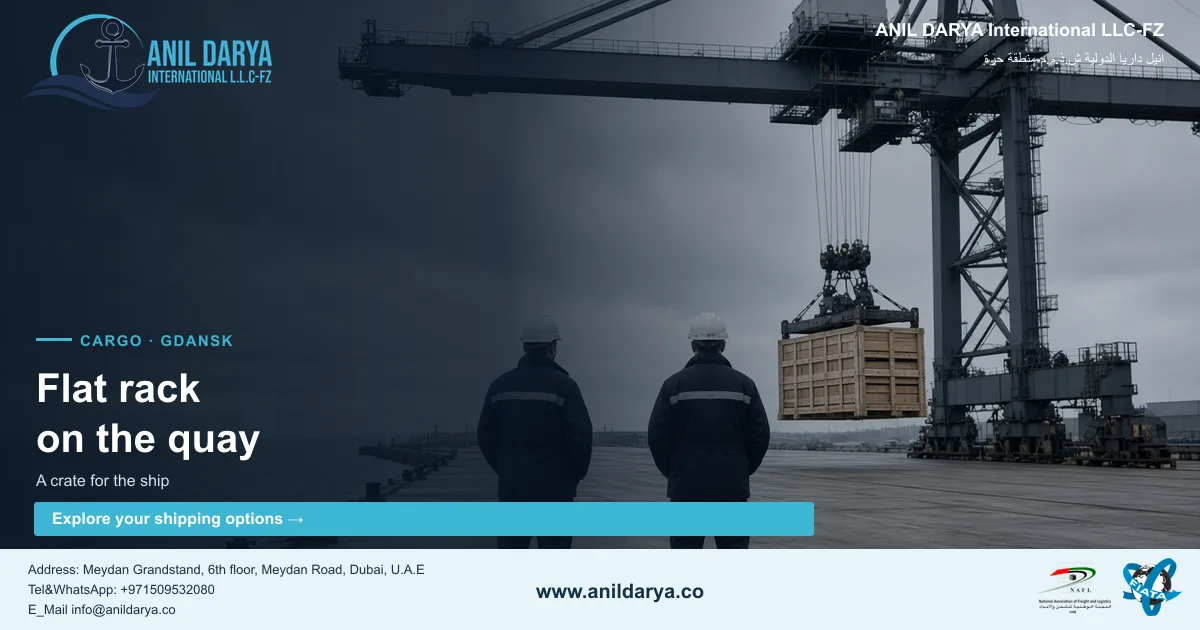
For cargo that fits a flat rack or open top, a container service through Baltic Hub gives you more sailings. For pieces that need a general cargo or heavy-lift vessel, the Inner Port quays are the usual discharge point. The Inner Port's 10.6 m maximum draft limits vessel size there, so confirm the berth with the carrier before you fix the ship.
We collect drawings, weights and lifting points, agree lashing with the carrier and plan the UAE road move to the load port. See our break bulk and project cargo service and our guide to flat rack, open top and out-of-gauge cargo.
Dangerous goods
DG cargo to Gdansk must be packed, marked and declared under the IMDG Code. Every carrier and every transshipment hub on the routing must accept it, not only the first vessel from the UAE. The port lists hazardous goods among the cargo handled at its Inner Port breakbulk quays.
You need the UN number, proper shipping name, class, packing group, a safety data sheet, a signed DG declaration and UN-approved packaging. Our dangerous goods shipping team confirms acceptance for the whole routing and sends the DG data to the consignee's agent in Gdansk early, so port notifications are made on time.
Customs and documents at the Port of Gdansk
Poland is in the EU customs union and applies the Union Customs Code. Customs is run by the National Revenue Administration (KAS). At the port, cargo is handled by customs branches of the Pomeranian Customs and Fiscal Office in Gdynia.
| Customs branch | Code | Typical use |
|---|---|---|
| Oddzial Celny "Terminal Kontenerowy" w Gdansku | 322080 | Container terminal cargo |
| Oddzial Celny "Port Gdansk" | 322030 | Port cargo outside the container terminal |
| Oddzial Celny Port Lotniczy Gdansk-Rebiechowo | 322050 | Air cargo at Gdansk airport |
EORI, the ENS and the import declaration
- EORI: the importer needs one. Polish companies get it on the PUESC portal; a non-EU company can get a Polish EORI if no EU country has issued one.
- ENS: the entry summary declaration must be lodged before goods are loaded for, or brought into, the EU. In Poland it goes to AIS/ICS2.
- Import declaration: filed electronically on PUESC into AIS/IMPORT PLUS. If it is lodged before arrival, the goods must be presented within 30 days.
- Representative: most importers use a customs representative, who as a rule must be based in the EU and hold a power of attorney.
Duty, VAT and payment
Duty is the EU rate for the goods code and origin, shown in TARIC and in ISZTAR4, Poland's tariff system. The EU has no trade agreement in force with the UAE; talks were formally launched on 28 May 2025. Duty is charged on the customs value, which includes freight and insurance up to the EU border. Polish import VAT is 23% for most goods, with 8% and 5% for listed goods. Duty must be paid within 10 days of notification, or within 30 days with an approved deferment and a guarantee.
Steel, aluminium, cement, fertiliser and hydrogen imports fall under CBAM, whose definitive regime started on 1 January 2026. An importer above 50 tonnes a year needs authorised CBAM declarant status.
Documents to ship to Gdansk
| Document | Who provides it | Notes |
|---|---|---|
| Commercial invoice | Shipper | Value, Incoterm, HS codes and full goods description |
| Packing list | Shipper | Must match marks, weights and package count |
| Bill of lading | Carrier, data from us | Consignee and notify party with EORI |
| Certificate of origin | Shipper or UAE chamber | Country of manufacture, not of shipment |
| Health or phytosanitary certificate | Origin authority | For food, plant and animal products |
| DG declaration and SDS | Shipper | For hazardous cargo |
| Licence or permit | Importer | For weapons, dual-use goods, medicines, waste and other controlled goods |
Veterinary and plant checks
Food, animal and plant products are checked at the port. The port authority lists Border Veterinary Inspectorate centres at Baltic Hub, near Wislane Quay and in the Free Zone. Send health certificates to the consignee's agent before arrival so the check can be booked.
Storing goods in the Gdansk Free Zone
The Free Zone sits near the Inner Port entrance. The port authority says non-EU goods can be stored there without customs guarantees, quotas, duty or tax for an unlimited period, and cleared in batches as you sell them. It suits importers who bring in a full container but sell in smaller lots, and it is used for car imports.
How to ship to Gdansk from Dubai: step by step
Shipping from Dubai to Gdansk normally starts at Jebel Ali. Our Jebel Ali port shipping guide covers the export side. Cargo from Abu Dhabi can load at Khalifa Port; see our Khalifa Port guide.
Fluent Cargo lists its quickest Jebel Ali to Gdansk option at 35 days 7 hours with two transfers, sailing every 2 to 4 weeks (CMA CGM). Its most frequent option, from Khor Fakkan, takes 43 days 2 hours with two transfers and sails every 1 to 2 weeks. Check the schedule for the service you book, because transshipment time varies.
[AMIR-FACT: the carriers and transshipment hubs we actually use from Jebel Ali to Gdansk, and our typical port-to-port days]
- Agree the Incoterm with your buyer, so both sides know who books freight and who clears at Gdansk.
- Check the HS code in TARIC or ISZTAR4 for duty, VAT and any licence, CBAM or health check.
- Confirm the consignee's EORI number and customs representative in Poland.
- Send us cargo details: goods, HS codes, weights, dimensions, packing and the final delivery address.
- We compare services and hubs, then book space from Jebel Ali or another UAE port.
- We check the invoice and packing list, prepare the certificate of origin and bill of lading data, and send precise goods data for the ENS.
- We arrange trucking to the port and the UAE export declaration, then load and seal the container.
- We send documents and the arrival notice to the consignee's agent in Gdansk before the vessel arrives.
- The agent files the declaration on PUESC, duty and VAT are paid or guaranteed, and the box leaves Baltic Hub by truck or rail.
How to ship from the Port of Gdansk to Dubai
We also handle the other direction: shipping from Gdansk to Dubai, with arrival at Jebel Ali, Khalifa Port or Sharjah port. We book the space with the carrier and run the UAE side. The Polish export formalities stay with the shipper or its customs agency in Poland.
The Polish export side
- Export declaration. It is filed electronically in AES, the EU automated export system, through the PUESC platform. The exporter can file it, but the Polish business portal suggests a customs agency for regular exports.
- EORI. Every exporter quotes its EORI number to customs.
- Release. After any inspection the goods are released for export and an export accompanying document (EAD) is generated.
- Exit and VAT. Once the goods leave the EU, the customs office closes the procedure and notifies the exporter or its agency. Only after that confirmation can the exporter apply the 0% VAT rate.
- Pickup. The shipper or its trucker delivers the box to Baltic Hub inside the carrier's cut-off.
The UAE import side
On arrival in Dubai, the declaration goes to Dubai Customs with the commercial invoice, the packing list, a certificate of origin and any permit for restricted goods. The carrier releases the cargo against the bill of lading. Customs duty in Dubai is 5% of the CIF value for most goods, with 50% on alcohol and 100% on cigarettes. Import VAT is 5%, and a VAT-registered importer accounts for it on its VAT return under the reverse charge.
- Send us the shipper's details in Poland, the cargo, the HS code and the UAE delivery address.
- We book space from Baltic Hub and send the booking and cut-offs to the shipper.
- The shipper or its trucker collects the empty, loads it and delivers it to the terminal.
- The shipper or its customs agency files the export declaration in AES.
- We check the draft bill of lading against the invoice and packing list.
- We file the UAE declaration before the vessel arrives.
- We arrange payment of the duty and VAT and collect the delivery order.
- We truck the box to your site and return the empty inside free time.
[AMIR-FACT: the carriers and hubs we actually use from Gdansk to Jebel Ali, Khalifa Port or Sharjah, and our real port-to-port transit days in this direction]
Checklist for Port of Gdansk shipping
- Consignee's EORI number on the bill of lading and invoice.
- HS codes checked for duty, anti-dumping and other measures.
- Certificate of origin showing the country of manufacture.
- Customs value includes freight and insurance to the EU border.
- VAT rate and payment method agreed with the importer.
- CBAM status checked for metals, cement or fertilisers.
- Health or plant certificates sent ahead for food and agricultural cargo.
- DG acceptance confirmed for every carrier and hub.
- Berth draft checked for breakbulk vessels going to the Inner Port.
- Free time at Baltic Hub known, with clearance planned before it ends.
- Free Zone considered if you will sell the goods in smaller lots.
Common mistakes when shipping to Gdansk
| Mistake | What happens | How to avoid it |
|---|---|---|
| Quoting a direct-service transit | The box arrives weeks after the promised date | Use the schedule for the booked service, with hub time included |
| No EORI on file | The declaration cannot be lodged and storage builds up | Register on PUESC before the cargo sails |
| Vague goods descriptions | ICS2 queries and holds | Give precise descriptions and HS codes at booking |
| Wrong origin on re-exported goods | Wrong duty and possible anti-dumping charges | Declare the real country of manufacture |
| Breakbulk ship too deep for the Inner Port | Cargo discharged elsewhere at extra cost | Check the 10.6 m draft before fixing the vessel |
| Health certificate sent late | Food cargo waits for the veterinary or plant check | Send it to the agent before arrival |
Delays at the terminal turn into demurrage and detention quickly. Our note on demurrage and detention explains how these charges build up.
Frequently asked questions
Which port code should you use for Gdansk?
The UN/LOCODE is PLGDN. Use it on bookings, bills of lading and customs data so the cargo is routed to Gdansk and not to nearby Gdynia.
What is the main container terminal in Gdansk?
Baltic Hub Container Terminal, formerly DCT Gdansk, in the Outer Port. It has three deepwater quays, a capacity of 4.4 million TEU a year and handled 2,766,475 TEU in 2025.
How deep is the water at the Port of Gdansk?
The deepwater fairway is 17 m, and ships with up to 15 m draft can enter the Outer Port. The Inner Port has a maximum draft of 10.6 m.
How big are the ships that call at Gdansk?
Baltic Hub can take ships up to 425 m long carrying over 24,000 TEU. The port authority says its Outer Port deepwater terminals take the largest ships that can pass the Danish Straits.
How long does shipping from Dubai to Gdansk take?
Fluent Cargo lists its quickest Jebel Ali to Gdansk option at 35 days 7 hours with two transfers. Its most frequent option, from Khor Fakkan, takes about 43 days. Add time for customs and inland delivery.
Can you handle shipping from Gdansk to Dubai?
Yes. We book the space, check the bill of lading and clear the cargo in Dubai. The shipper or its Polish customs agency files the export declaration in AES. In Dubai, duty is 5% of CIF for most goods, plus 5% import VAT.
Does Gdansk have a free zone?
Yes. The Free Zone near the Inner Port entrance lets you store non-EU goods without duty, tax or customs guarantees for an unlimited period and clear them in batches.
Is the Port of Gdansk open all year?
Yes. The port authority says it never freezes and works 24 hours a day in three shifts.
Which customs office handles containers at Gdansk?
The customs branch "Terminal Kontenerowy" w Gdansku, code 322080, part of the Pomeranian Customs and Fiscal Office in Gdynia. The declaration itself is filed online on PUESC.
Get a quote for Port of Gdansk shipping
Send us your cargo details, the delivery address in Poland and the Incoterm, and we will come back with a routing and a price. Use our freight rate inquiry form, or contact our team about breakbulk, DG or reefer cargo. Read more about our Dubai freight forwarding team and our sea freight service.
Sources
- Port of Gdansk: General information (port areas, depths, quays, Free Zone)
- Port of Gdansk: About the port
- Port of Gdansk: Baltic Hub Container Terminal
- Port of Gdansk: 2025 cargo results
- Port of Gdansk: January to September 2026 results
- Port of Gdansk: European ranking, March 2026
- Dz.U. 2024 item 898: customs and fiscal offices and customs branches
- KAS / podatki.gov.pl: Investor's Guide, Customs Law, legal status as of 1 January 2026
- PUESC: EORI number
- podatki.gov.pl: General VAT rules and rates
- European Commission: EU Customs Tariff (TARIC)
- European Commission: EU-UAE agreement negotiations
- European Commission: CBAM definitive regime
- Fluent Cargo: Dubai to Gdansk schedules
- Biznes.gov.pl: How to export goods outside the EU (AES, EORI, EAD, exit confirmation, 0% VAT)
- Dubai Customs: Submit customs declaration (documents)
- UAE Government portal: Customs duty (5% of CIF, alcohol 50%, cigarettes 100%)
- Federal Tax Authority: VAT guide (5% rate, import VAT, reverse charge)
Reviewed: 10 November 2026