
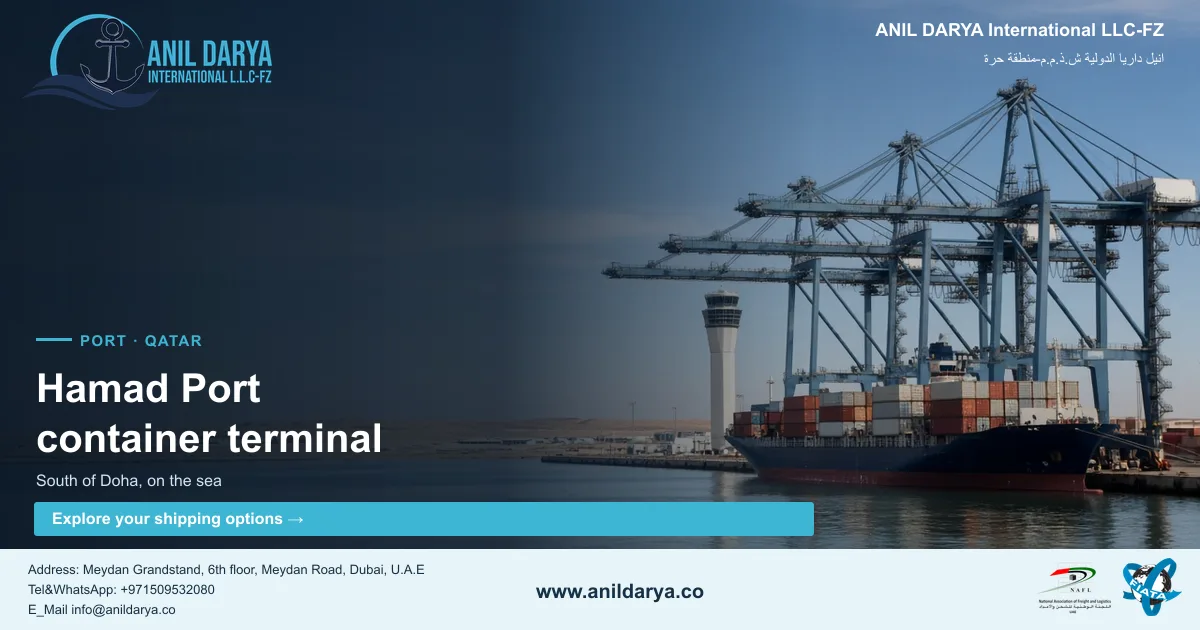
Hamad Port shipping covers almost every container, vehicle and breakbulk cargo that enters Qatar by sea. The port sits at Umm Al-Houl, south of Doha. Mwani Qatar manages it and QTerminals runs the terminals, and the General Authority of Customs clears cargo through the Al Nadeeb system. This guide covers the terminals, cargo types, customs and documents, and how we ship from Dubai to Hamad Port. We ship both ways: from Dubai to Hamad Port, and from Hamad Port to Dubai.
Hamad Port at a glance
| Item | Detail |
|---|---|
| Port manager | Mwani Qatar, under the Ministry of Transport |
| Terminal operator | QTerminals, a joint venture of Mwani Qatar and Milaha |
| Customs authority | General Authority of Customs (GAC), Al Nadeeb single window |
| UN/LOCODE | QAHMD |
| Location | Umm Al-Houl, south of Doha, near Mesaieed |
| Area | 29 square kilometres |
| Operations began | December 2016 (official inauguration 5 September 2017) |
| Container capacity | 5 million TEU a year with two terminals running; 7.5 million TEU when all three are complete |
| General cargo capacity | 7 million tonnes a year |
| Grain capacity | 1 million tonnes a year |
| Vehicle capacity | About 500,000 vehicles a year |
| Containers handled in 2024 | 1.421 million TEU, 48% of it transshipment |
| Customs inspection area | 5,600 containers a day |
| Standard customs duty | 5% of CIF value |
| Free zone | Next to the port |
| Shipping Hamad Port to Dubai | Export declaration on Al Nadeeb by the shipper or its agent; import declaration with Dubai Customs, 5% duty on non-GCC goods and 5% VAT |
Where is Hamad Port and who runs it?
Hamad Port is on the coast at Umm Al-Houl, south of Doha and close to the industrial city of Mesaieed. Operations moved from the old Doha port to Hamad at the start of December 2016, and the port was officially inaugurated on 5 September 2017.
Three bodies matter to you as a shipper:
- Mwani Qatar is the port authority. It manages Hamad Port under the Ministry of Transport and sets the rules for port users.
- QTerminals runs the container and non-container terminals. It is a joint venture between Mwani Qatar and Milaha, and it holds the concession for Container Terminal 2.
- The General Authority of Customs clears goods. Declarations go through Al Nadeeb, and the terminal operating system is linked to the customs single window.
The site covers 29 square kilometres and includes a 110 m port control tower, a base for offshore and marine support vessels, and a free zone next to the port for storage, manufacturing and re-export.
Which terminals does Hamad Port have?
Hamad Port has three container terminals planned, two of them running, plus a general cargo terminal, a multi-use terminal for RoRo and livestock, and an offshore supply terminal. The specifications below come from QTerminals and the Ministry of Transport. Some date from 2020 to 2022, so treat them as a planning guide.
| Terminal | Berth length | Water depth or draft | Yard area | Capacity a year |
|---|---|---|---|---|
| Container Terminal 1 (CT1) | 1,200 m | 17 m alongside | 352,000 m² | 2 million TEU |
| Container Terminal 2 (CT2), phases 1 and 2 | 624 m | Not published for these phases | 380,000 m² | Part of the 5 million TEU total |
| General Cargo Terminal (GCT) | 1,200 m | 17 m depth, 14 m allowable draft | 190,268 m² | 6.3 million freight tonnes |
| Multi Use Terminal (MUT) | 770 m | 12.5 m depth, 11 m allowable draft | 204,626 m² | 0.5 million units |
| Offshore Supply Terminal (OST) | 540 m | Shallow, for supply boats | 133,687 m² | 5 supply boats at a time |
CT2's first two phases have 7 ship-to-shore cranes and 26 rubber-tyred gantry cranes. In 2024, Mwani's annual report put berth use at 45% on CT2 and 17% on CT1, which tells you most mainline calls now work CT2. The carrier's service decides the terminal, so check your arrival notice before you book a truck.
What cargo can you ship through Hamad Port?
| Cargo type | Where it is handled | 2024 volume | What to plan |
|---|---|---|---|
| Containers, dry and reefer | CT1 and CT2 | 1.421 million TEU | Terminal on the booking, free time, truck slot |
| LCL cargo | Container freight station at CT1 | Within container total | Destuffing time, carton marks |
| Breakbulk, steel, project cargo | General Cargo Terminal | 1.018 million tonnes general cargo | Lifting points, trailer, permits |
| Dry and liquid bulk | General Cargo Terminal | 399,554 tonnes bulk | Discharge plan, receiver ready |
| Vehicles and RoRo | Multi Use Terminal | 130,332 units | Vehicle documents, storage time |
| Livestock | Multi Use Terminal | 20,000 heads | Health certificates, direct delivery |
| Grain | Grain facility | Not reported separately | Silo booking through the receiver |
| Dangerous goods | Container terminals and DG warehouse | Not reported separately | Class, permits, carrier acceptance |
Hamad Port received 1,578 vessels in 2024. Imports were 472,927 TEU and exports 274,436 TEU, so the port is import-heavy. That matters if you need an export empty or a backhaul booking out of Qatar.
Container shipping at Hamad Port: FCL and LCL
For FCL you book a whole 20ft or 40ft box, and it travels sealed from the stuffing point to the consignee. For LCL your cargo shares a box and is unpacked at the container freight station (CFS) at CT1 before release.
QTerminals describes three CFS sheds:
- Shed 1 for LCL destuffing, weighing, shelving, customs examination and delivery.
- Shed 2 for auction cargo.
- Shed 3 for IMDG cargo and stripping of FCL cargo, with examination and delivery.
The CFS has customs inspection and scanning, tags each parcel with a barcode, and lets consignees check cargo availability online. Licensed freight forwarders can issue their own delivery order for LCL, which speeds up release when the consolidator's papers are in order.
On short lanes like Dubai to Hamad, the time spent in the CFS can be longer than the sea leg. If you are near half a container, compare both. Our article on FCL vs LCL costs shows how to work out the break-even.
Reefer cargo and food
Chilled and frozen boxes are plugged in at the container terminals. The General Cargo Terminal also handles reefer vessels and has a refrigerated warehouse of 5,200 m², next to two dry warehouses of the same size, with customs inspection inside. Meat and poultry need a health certificate from the exporting country and a halal slaughter certificate.
Breakbulk, project and RoRo cargo at Hamad Port
The General Cargo Terminal takes bulk, breakbulk, liquid bulk and reefer vessels. QTerminals lists steel plates and coils, pipes, rails, household appliances and project cargo among the goods it handles. The terminal has a 1,200 m berth with 14 m allowable draft, a stacking area of 190,268 m², customs inspection on site, and parking for more than 50 trucks waiting for inspection. Breakbulk magazine reported over 1.3 million tons of breakbulk at Hamad in 2023, mostly machinery, steel, dry bulk, building materials, fertilisers and petrochemicals.
Oversized boxes have their own gate lanes. The container gate has an out-of-gauge lane in each direction and an 11 m special lane for wide loads. Flat racks and open tops suit cargo that is too tall or wide for a standard box but still fits a container service. Our guide to flat rack, open top and breakbulk options helps you choose.
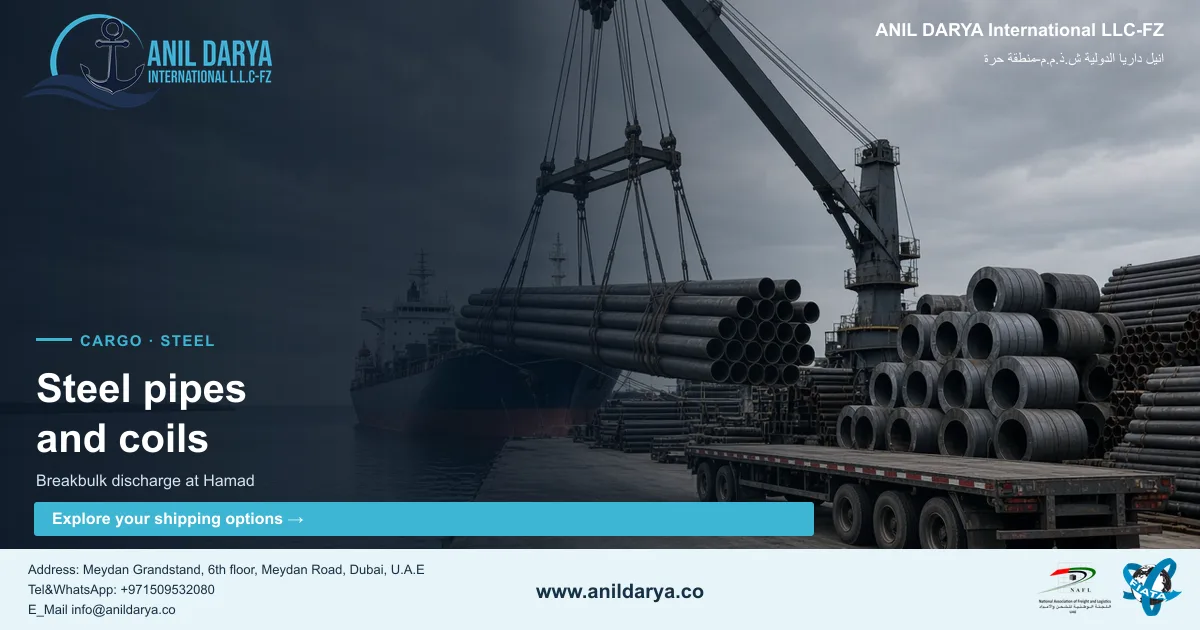
The Multi Use Terminal handles RoRo, livestock and landing craft. It has a 770 m berth, 5,346 parking slots for vehicles and a heap area for around 200 heavy units such as machinery on wheels. Mwani gives the port a capacity of about 500,000 vehicles a year.
How we plan a breakbulk or project move into Hamad Port:
- Collect dimensions, weights, centre of gravity and lifting points for each piece.
- Choose flat rack on a container service, or breakbulk tonnage into the General Cargo Terminal.
- Agree lashing and discharge with the carrier and confirm the terminal can take the piece.
- Check the consignee's trailer, road permits and escort in Qatar.
- Send customs documents early, because a 20% duty applies to steel and errors delay release.
See our break bulk and project cargo service for what we cover from the UAE side.
Dangerous goods at Hamad Port
Hamad Port handles IMDG cargo. QTerminals lists a fully approved DG warehouse with class-wise segregation at the container freight station, and CFS Shed 3 handles IMDG cargo. The terminals have radiation surveillance at the gates.
Qatar's prohibited list includes ammunition, explosives, flammable goods and radioactive material, so some DG need an approval from the competent authority or cannot be imported. Restricted goods are declared on Al Nadeeb and can be sampled and held until approval.
What to prepare for DG into Hamad:
- UN number, proper shipping name, class and packing group.
- Safety Data Sheet for each product.
- Signed Dangerous Goods Declaration and container packing certificate.
- UN-approved packaging, labels and placards.
- Any Qatar import permit for the product, arranged by the consignee before sailing.
- Carrier acceptance on the feeder vessel you plan to use.
Our dangerous goods shipping team checks classification and acceptance before you commit to a sailing.
Customs clearance at Hamad Port
The General Authority of Customs clears all cargo at Hamad Port. Declarations are filed on Al Nadeeb, where the declarant can submit and track declarations, send them automatically to other agencies for approvals, authorise a clearing agent and pay duty online. Goods are inspected at the customs station with the owner or a representative present. The port's customs inspection area can handle 5,600 containers a day.
Who can clear goods?
Every importer needs an import licence registered with the Ministry of Commerce and Industry. Licences go to Qatari nationals or the Qatari partner in a company, and the rule also covers foreign-owned entities operating in Qatar. The consignee files the declaration itself or authorises a clearing agent on Al Nadeeb.
Which documents does Qatar Customs need?
| Cargo type | Core documents | Usually also needed |
|---|---|---|
| General cargo (FCL or LCL) | Customs declaration, official invoice, packing list, certificate of origin, bill of lading, import licence | Delivery order from the line or LCL forwarder |
| Food and reefer | Core set | Health certificates; halal slaughter certificate for meat |
| Dangerous goods | Core set | DG declaration, SDS, product permit |
| Breakbulk and project | Core set with piece-by-piece packing list | Drawings, weights, road permits |
| Vehicles | Core set | Vehicle ownership and specification papers |
| Restricted goods | Core set | Approval from the competent authority |
Invest Qatar says documents must be attested, translated and verified. Qatar has also required an official invoice, official certificate of origin and packing list for sea and air shipments since 1 April 2011. The HS code of every item must appear on the invoice and certificate of origin, and "Made in" marks on every piece and carton must match them. Since January 2025, Qatar uses 12-digit HS codes for all imports and exports, so map your codes before you ship.
Duty and taxes
Qatar applies the GCC common tariff of 5% of the CIF value on most goods. Some goods pay more.
| Goods | Duty |
|---|---|
| General goods | 5% of CIF |
| Records and musical instruments | 15% |
| Steel | 20% |
| Urea and ammonia | 30% |
| Alcohol, cigarettes and tobacco | 100% (tobacco: or QAR 1,000 per 10,000 cigarettes if higher) |
| Fresh or chilled chicken (2026 decree) | 18%, up from 5% |
| Tomatoes, eggplants, zucchini in peak season (2026 decree) | 15%, up from 0% |
Over 600 goods are exempt under the GCC Customs Union, including basic foods such as rice, wheat and flour. Excise tax applies to tobacco, energy drinks and sweetened beverages, and since 17 September 2026 these goods must be registered with the General Tax Authority before import. If goods do not match their documents, Qatar can charge extra duty and a fine.
Transshipment and transit cargo through Hamad Port
Almost half of Hamad Port's container volume is transshipment: 683,552 TEU in 2024, up 23% on 2023. In late 2024 Mwani Qatar, the Ministry of Interior, the General Authority of Customs and QTerminals announced simpler procedures for transit cargo through the port, with reduced tariffs, extra free storage and lower handling fees. Trucks use automated gates, truck appointments and electronic payment through the MWANINA port community system. If your cargo is passing through Qatar to another destination, ask us to check the transit option before you book.
How to ship from Dubai to Hamad Port, step by step
Most cargo from the UAE to Hamad Port loads at Jebel Ali. Milaha's Intra Gulf Express is one published service: weekly, with Jebel Ali (DP World Terminal 1) to Hamad in 4 days via Sohar, two vessels of 1,015 TEU nominal and 90 reefer plugs per vessel (schedule updated January 2025). CargoGulf announced a weekly direct sailing with a 36-hour transit in March 2021. Schedules change, so we confirm the current service on each booking.
[AMIR-FACT: our real transit time Jebel Ali to Hamad Port, port to port and door to door, and the carriers or feeder services we actually book into Hamad]
Here is how we run a shipment from Dubai to Hamad Port. We book space, prepare documents and handle UAE export clearance and trucking. The consignee or its clearing agent clears the goods in Qatar.
- Send cargo details. Commodity, 12-digit Qatar HS code if the consignee has it, weight, volume, pickup point and delivery address in Qatar.
- Confirm the Qatar side. The consignee's import licence, clearing agent and any permit for the goods.
- Pick the routing. We compare sailings from Jebel Ali port or, for Abu Dhabi cargo, Khalifa Port, and check which Hamad terminal each service uses.
- Book space. DG, reefer and out-of-gauge cargo need carrier acceptance first.
- Prepare documents. Official invoice and certificate of origin with HS codes, packing list, origin marks on every carton, and permits.
- File the UAE export or re-export declaration with Dubai Customs and gate the container in before the cut-off.
- Send the bill of lading and document set to the consignee's agent before arrival, so the Al Nadeeb declaration is ready when the vessel berths.
- The agent clears the goods, collects the delivery order and books the truck through the terminal's vehicle booking system.
- The empty container goes back to the depot the line names, within free time.
How to ship from Hamad Port to Dubai
We also handle the other direction: shipping from Hamad Port to Dubai, with arrival at Jebel Ali, Khalifa Port or Sharjah port. We book the space with the carrier and run the UAE side. The Qatari export papers stay with the shipper or its Qatar agent.
Hamad Port is import-heavy. In 2024 it handled 472,927 TEU of imports against 274,436 TEU of exports, so empty containers are usually easier to find in Qatar than export space is to fill. On Milaha's published MIG rotation, the vessel calls Jebel Ali straight after its eastbound Hamad call.
The Qatar export side
- Export declaration. The shipper or its clearing agent files it on Al Nadeeb, the General Authority of Customs platform for exporters, importers and clearing agents. Al Nadeeb handles export and transit as well as import.
- Gulf national product certificate. Goods made in Qatar need proof of origin for GCC treatment in the UAE. The Ministry of Commerce and Industry runs the service that issues Gulf National Product Certificates to factories, and published a guide to it in January 2026.
- Returning UAE goods. Goods exported from the UAE temporarily, such as project equipment, need the original export papers so you can show they are coming back.
- Pickup. The carrier releases an empty, and the box is stuffed and gated in at Hamad before the cut-off on a booked truck slot.
The UAE import side
We file the import declaration with Dubai Customs before the vessel arrives. Dubai Customs asks for the commercial invoice, the packing list, the certificate of origin and a permit from the relevant authority for restricted goods, and the carrier releases the cargo against the bill of lading. Customs duty in Dubai is 5% of the CIF value for most goods, with 50% on alcohol and 100% on cigarettes. Import VAT is 5%. A VAT-registered importer accounts for it on its VAT return under the reverse charge; anyone else pays it before the goods are released.
Qatari-made goods are a different case. Under the GCC Customs Union, goods produced in any member state are treated as national goods in all member states, so they do not pay the 5% duty when the certificate of origin proves where they were made. The UAE government portal, in its section on Sharjah customs, gives the test as at least 40% of the raw materials coming from the GCC. Foreign goods that already paid duty at their first GCC point of entry are not charged again if the payment is proven. Neither rule removes the 5% import VAT.
- Send us the shipper's details in Qatar, the cargo, the HS code and the UAE delivery address.
- We book space from Hamad Port and send the booking and cut-offs to the shipper.
- The shipper or its trucker stuffs the container and delivers it to the Hamad terminal on a booked truck slot.
- The shipper or its Qatar agent files the export declaration on Al Nadeeb.
- We check the draft bill of lading against the invoice, packing list and certificate of origin.
- We file the UAE declaration with Dubai Customs before the vessel arrives.
- We arrange payment of the duty and VAT and collect the delivery order from the carrier.
- We truck the container to your site and return the empty to the depot the line names within free time.
[AMIR-FACT: the carriers we actually use from Hamad Port to Jebel Ali/Khalifa/Sharjah and our real transit days in this direction]
Ask the carrier about free time at both ends. On a short Gulf leg, the box can arrive before your paperwork does.
Hamad Port or another way into Qatar?
| Your situation | Usual choice | Why |
|---|---|---|
| Containers, LCL, reefer | Hamad Port | Qatar's container gateway, CT1 and CT2 |
| Steel, machinery, project cargo | Hamad Port General Cargo Terminal | 1,200 m berth, 14 m allowable draft, inspection on site |
| Vehicles and livestock | Hamad Port Multi Use Terminal | RoRo berth, vehicle parking, livestock handling |
| Pallets door to door from the UAE | Road through Saudi Arabia to Abu Samra | No port handling at either end |
| Urgent or light cargo | Air cargo to Hamad International Airport | Fastest, priced on chargeable weight |
Trucks, gates and free time at Hamad Port
The container gate has 4 in lanes and 6 out lanes, each set with one out-of-gauge lane, plus weighbridges, optical character recognition cameras and radiation screening. Trucks need an appointment on the web-based vehicle booking system. The non-container terminals run their gates 24 hours a day, seven days a week. Mwani's 2024 report put average truck turnaround at 23 hours, so book the slot as soon as customs releases the cargo.
Shipping lines give free days on their containers. After that, demurrage runs while the full box sits in the port, and detention while you keep it outside. Free days and rates depend on the carrier, so check your quote and arrival notice. Our article on demurrage and detention explains how the charges add up.
Real shipment example
[AMIR-FACT: one real shipment we sent from the UAE into Hamad Port: cargo, terminal, how long clearance took and the outcome]
Checklist before you ship to Hamad Port
- 12-digit Qatar HS code confirmed for every item.
- HS codes printed on the official invoice and certificate of origin.
- Country of origin marked on every piece and carton, matching the documents.
- Consignee holds an import licence and has a clearing agent on Al Nadeeb.
- Permits ready for food, meat, DG, telecom or other restricted goods.
- Excise goods registered with the General Tax Authority.
- Duty rate checked, including 2026 changes.
- Terminal on the arrival notice checked before the truck is booked.
- For DG: SDS, DG declaration, packaging, labels and carrier acceptance.
- For breakbulk: drawings, lifting points and the consignee's trailer plan.
- Free time agreed with the carrier.
- Cargo insurance arranged.
Common mistakes at Hamad Port
- Using an old 8-digit HS code. Qatar has required 12 digits since January 2025.
- Invoice or certificate of origin without HS codes. Shipments can be returned to origin.
- Origin marks missing on cartons, or not matching the documents.
- Shipping before the consignee has an import licence or product permit.
- Pricing steel at 5% duty. It is 20%.
- Booking the truck to the wrong terminal. CT1, CT2 and the General Cargo Terminal have separate gates.
- Letting free time run out while documents are fixed.
Frequently asked questions
Who manages and operates Hamad Port?
Mwani Qatar manages Hamad Port under the Ministry of Transport. QTerminals, a joint venture of Mwani Qatar and Milaha, operates the container and non-container terminals.
Where is Hamad Port located?
Hamad Port is at Umm Al-Houl, south of Doha and near Mesaieed. It replaced the old Doha port as Qatar's main commercial port in December 2016.
What is the port code for Hamad Port?
The UN/LOCODE for Hamad Port is QAHMD. The old Doha port is QADOH, so check that your booking shows the right code.
How many container terminals does Hamad Port have?
Three are planned and two operate today, CT1 and CT2, with an optimum capacity of 5 million TEU a year. Capacity rises to 7.5 million TEU when the third terminal is complete.
How long does shipping from Dubai to Hamad Port take?
Milaha's published schedule shows 4 days from Jebel Ali to Hamad via Sohar, and CargoGulf announced a 36-hour direct service in 2021. Add time for export filing, clearance in Qatar and delivery.
What documents do I need to clear cargo at Hamad Port?
A customs declaration on Al Nadeeb, official invoice, packing list, certificate of origin, bill of lading and the consignee's import licence. Restricted goods also need a permit.
What is the customs duty at Hamad Port?
Most goods pay 5% of the CIF value. Steel pays 20%, urea and ammonia 30%, and alcohol and tobacco 100%, and over 600 goods are exempt under the GCC Customs Union.
Can Hamad Port handle breakbulk and vehicles?
Yes. The General Cargo Terminal takes breakbulk, bulk and reefer vessels, and the Multi Use Terminal handles RoRo vehicles and livestock, with capacity for about 500,000 vehicles a year.
Can I ship dangerous goods to Hamad Port?
Yes, if they are declared under the IMDG Code, accepted by the carrier and allowed into Qatar. The port has a DG warehouse with class-wise segregation, and some goods such as explosives are prohibited.
Can you ship from Hamad Port to Dubai?
Yes. The shipper or its Qatar agent files the export declaration on Al Nadeeb. We book the space, file the Dubai Customs declaration, arrange payment of the duty and VAT, and deliver from Jebel Ali, Khalifa Port or Sharjah. Qatari-made goods with valid proof of origin do not pay the 5% duty, but import VAT of 5% still applies.
Get a quote for Hamad Port shipping
Send us your cargo details and we will come back with a routing and a price from the UAE to Hamad Port. Use our freight rate inquiry form, or contact our team about a breakbulk, DG or reefer shipment. For containers, see our sea freight service, and read more about our Dubai freight forwarding team.
Sources
- Mwani Qatar: Hamad Port (area, dates, capacities, facilities)
- QTerminals: Hamad Port terminal presentation (September 2020)
- Ministry of Transport: Container Terminal 2 initial operation
- Gulf Times: CT2 phases 1 and 2 fully operational (February 2022)
- Gulf Times: Hamad Port 2024 volumes from Mwani Qatar's annual report (April 2025)
- Breakbulk: Shaping Hamad Port's future (September 2024)
- The Peninsula: Mwani Qatar transit procedures (November 2024)
- Wikipedia: Hamad Port (location)
- iContainers: Port of Doha (UN/LOCODE references)
- Invest Qatar: Customs laws, duty rates, documents and Al Nadeeb
- US International Trade Administration: Qatar import requirements and documentation
- US International Trade Administration: Qatar moves to 12-digit HS codes
- EY Tax News: Qatar excise update and tariff increases (September 2026)
- Gulf Times: Qatar land cargo links and Al Nadeeb (March 2026)
- Milaha: Intra Gulf Express (MIG) service profile, January 2025
- CargoGulf: Direct sailing between the UAE and Qatar (March 2021)
- Dubai Customs: Submit customs declaration (invoice, packing list, certificate of origin, permits)
- UAE Government portal: Customs duty (5% of CIF in Dubai, alcohol 50%, cigarettes 100%; GCC-origin goods and the 40% test)
- Federal Tax Authority: VAT Taxable Person Guide, chapter 9 Import of goods (5% rate, reverse charge, payment before release)
- UAE Federal Authority for Identity, Citizenship, Customs and Port Security: Customs Union for GCC States (national goods, duty paid at first point of entry)
- QNA: MOCI issues guide on Gulf National Product Certificates for factories, January 2026
Reviewed: 10 November 2026