
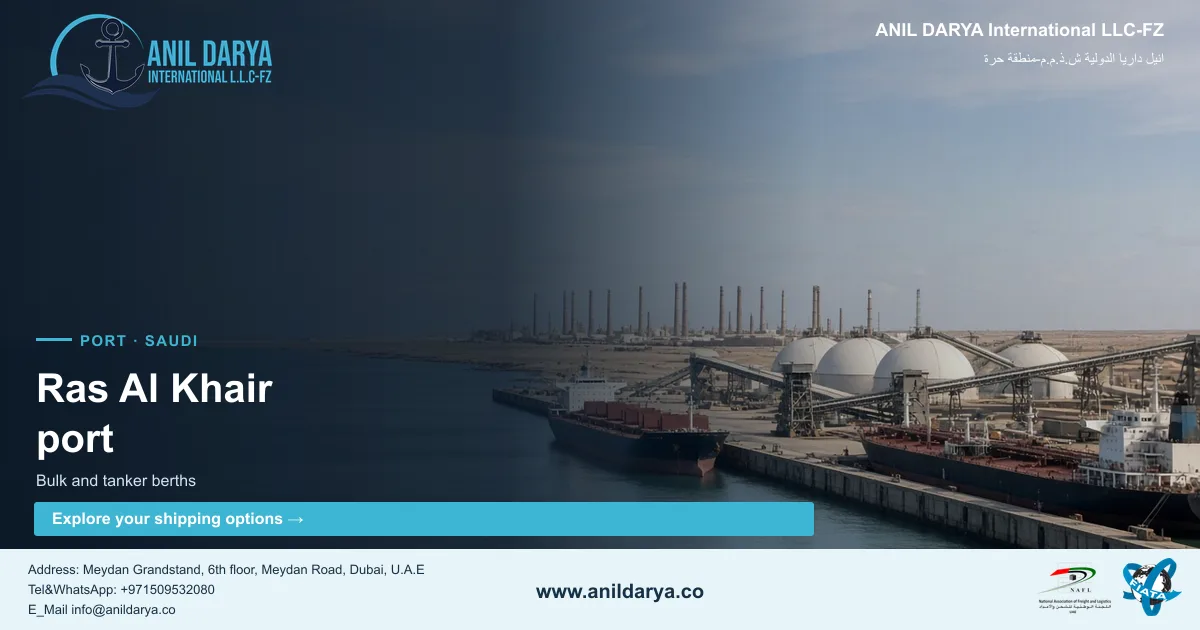
Ras Al Khair port shipping is mainly about mining and industrial cargo: phosphate fertiliser, ammonia, sulphuric acid and aluminium moving in and out of the Ma'aden plants in Ras Al Khair, plus the equipment and spares those plants need. The port is owned by the Saudi Ports Authority (Mawani), Saudi Global Ports now runs its multipurpose terminal, and cargo is cleared by ZATCA through Fasah. This guide covers the berths, the cargo, the vessel limits and how we move your cargo there from Dubai by sea or by road. We ship both from Dubai to Ras Al Khair and from Ras Al Khair to Dubai.
Ras Al Khair port shipping: key facts at a glance
| Item | Detail |
|---|---|
| Port owner | Saudi Ports Authority (Mawani) |
| Multipurpose terminal operator | Saudi Global Ports, through Modern Port Services Company, 20-year concession signed 23 June 2025 |
| Customs | Zakat, Tax and Customs Authority (ZATCA), declarations on Fasah |
| UN/LOCODE | SARAZ |
| Location | Arabian Gulf coast, Eastern Province, about 80 km from Jubail Industrial City |
| Port area | 23 sq km |
| Berths | 14, with 3,711 m of quay |
| Depth | 15 to 16.2 m |
| Design capacity | 35 million tonnes a year |
| Cargo in 2022 | 8,691,506 tonnes, up 24% on 2021 |
| Record month | 1,060,835 tonnes in December 2022 |
| Main cargo | Phosphate fertiliser, ammonia, sulphuric acid, soda, aluminium, general and bulk cargo |
| Main users | Ma'aden Aluminium, Ma'aden Phosphate, Ma'aden Wa'ad Al Shamal Phosphate |
| Import duty and VAT | GCC common external tariff of at least 5% on most goods, VAT 15% |
| Shipping from Ras Al Khair to Dubai | Export declaration on Fasah; UAE duty 5% of CIF for most goods, GCC-origin goods treated as UAE local goods, import VAT 5% |
What is Ras Al Khair port and who runs it?
Ras Al Khair is an industrial port on Saudi Arabia's Gulf coast, built for the minerals industry. Construction started in 2008 and Saudipedia dates first operations to February 2011, while Mawani's own releases describe 2016 as the opening. The port serves more than 100 industrial projects in Ras Al Khair, which is the kingdom's mining hub on the coast.
Three parties matter to you as a shipper:
- Mawani owns the port and sets the rules for ships and berths.
- Saudi Global Ports (SGP) runs the multipurpose terminal under a 20-year concession. The same award covers multipurpose terminals at Dammam, Jubail Commercial Port and King Fahd Industrial Port, and SGP plans to invest SAR 700 million across the four.
- ZATCA clears the cargo through the Fasah platform, as at every Saudi port.
The industrial plants are the reason the port exists. Ma'aden's aluminium complex in Ras Al Khair smelts and rolls more than 1 million tonnes of aluminium a year, and Ma'aden's phosphate business exports fertiliser and chemicals through the same berths.
Berths, depth and vessel limits at Ras Al Khair
Saudipedia and Mawani give 14 berths with 3,711 m of quay and 15 to 16.2 m of water. ShipNext splits those berths by use. Use this as a planning guide, then confirm your berth with the agent.
| Berth use (ShipNext) | Number of berths | Typical cargo |
|---|---|---|
| Bulk | 4 | Phosphate, alumina, petroleum coke |
| General cargo | 5 | Aluminium products, building materials, equipment |
| Liquid and bulk | 3 | Ammonia, sulphuric acid, other liquid chemicals |
| Not allocated | 2 | Not stated |
Sources disagree on vessel limits, so read them carefully:
| Source | Limit given |
|---|---|
| Saudipedia | Berth depth 15 to 16.2 m |
| MarineLink | Drafts up to 16 m, depths 10 to 16 m |
| Sharaf Shipping (agent port sheet) | Channel draft 14 m, pilot station 4 nautical miles from the berth, tide 1 to 1.5 m |
| ShipNext | Maximum draft 11.5 m, LOA 230 m, 82,000 dwt |
A safe rule: plan a general cargo or multipurpose ship at the lower figures unless the agent confirms the berth and tide window. Large bulk carriers loading for the plants work to their own berth limits, which the plant and the agent agree.
Work on the port is under way. In June 2023 MEED reported Mawani plans to deepen berths 11 and 12 to 16 m and to widen the approach channel from 300 m to 500 m while dredging it 3 m deeper to 19 m. We could not confirm whether that work is finished, so ask before you rely on the new depths.
Working hours at the berths
Sharaf Shipping's port sheet says stevedoring is done by the port in two shifts, 07:00 to 18:00 and 19:00 to 06:00, which is about 20 working hours a day. Night navigation is allowed 24 hours, subject to visibility and weather. Allow for the shift gaps when you plan a tight loading window.
What cargo moves through Ras Al Khair?
December 2022 gives a good picture of the port's trade. In that month 43 ships loaded mineral bulk cargo, including 303,458 tonnes of ammonia, 59,983 tonnes of soda and 54,543 tonnes of sulphuric acid. ShipNext also lists phosphate, tar, alumina, petroleum coke, building materials and specialised equipment.
| Cargo | Direction | How it usually moves |
|---|---|---|
| Phosphate fertiliser (DAP, MAP) | Export | Dry bulk ships at the bulk berths |
| Ammonia | Export | Gas tankers at the liquid berths |
| Sulphuric acid and other chemicals | Export and import | Chemical tankers, or ISO tanks and drums as DG |
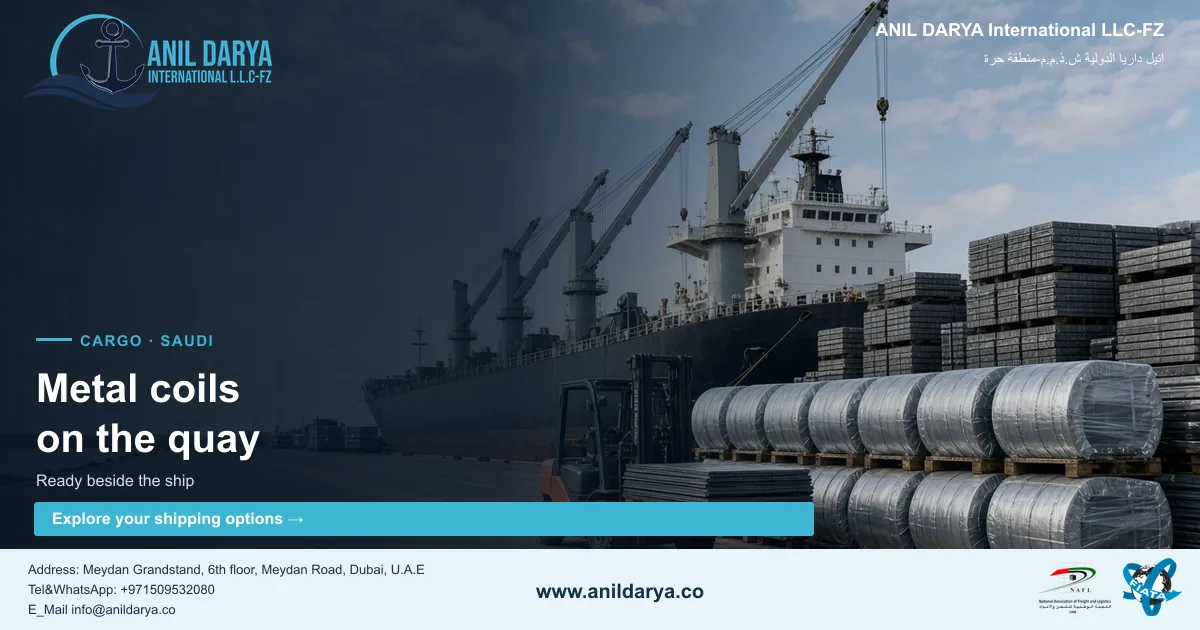
| Aluminium ingots, coils and sheet | Export | Breakbulk on general cargo ships, or containers |
| Alumina, petroleum coke, raw materials | Import | Dry bulk |
| Plant equipment and spares | Import | Breakbulk, project cargo, or containers via a nearby port |
| Building materials | Import | General cargo |
Bulk lots are usually fixed by the plants themselves. If you are sending spares, chemicals in drums, steel or a heavy unit to a contractor or plant in the industrial city, the real question is which port to land it at.
Containers to Ras Al Khair: direct call or via Jubail and Dammam?
MarineLink says the commercial berths at Ras Al Khair can handle general cargo and containers. We did not find a regular container line service that publishes Ras Al Khair as a port of call. In practice your container may land at a larger container port on the same coast and travel the last leg by truck.
| Option | When it fits | What to check |
|---|---|---|
| Container to Jubail, then truck | Plant spares, drums, general goods | Carrier service, free time covers the truck leg |
| Container to Dammam, then truck | When Jubail has no suitable sailing | Longer road leg, plant gate booking |
| Container direct to Ras Al Khair | Only if a carrier confirms the call | Written routing on the booking |
| Breakbulk or multipurpose ship direct | Heavy, oversized or large lots | Berth, depth, tide window, port equipment |
Saudipedia places Ras Al Khair about 80 km from Jubail Industrial City, so the road leg from Jubail is short. Make sure the carrier's free time covers the extra truck move and the empty return. Our article on demurrage and detention shows how those charges build up.
FCL is the normal choice for plant cargo. If you only have a few pallets, LCL into Dammam or Jubail and a truck is usually simpler. Our guide to FCL vs LCL costs helps you decide.
Breakbulk and project cargo for the Ras Al Khair plants
Plant shutdowns and expansions bring heavy and oversized pieces: pumps, heat exchangers, transformers, steel structures. These can go direct to Ras Al Khair on a breakbulk or multipurpose ship, or in a flat rack through a container port.
When we plan project cargo for Ras Al Khair, we work in this order:
- Collect drawings, weights, dimensions and centre of gravity for each piece.
- Decide flat rack via Jubail or Dammam, or a breakbulk ship direct to Ras Al Khair.
- For a direct call, confirm the berth, draft and tide window with the agent and the terminal.
- Check whether the ship needs its own cranes or the terminal can lift the piece.
- Plan the road move from the quay to the plant gate, with permits and escort if needed.
- Line up the Fasah declaration so the cargo clears before it lands.
A rule of thumb: if every piece fits a 40ft flat rack by size and weight, a container service via Jubail usually gives you more sailings. If not, you need breakbulk tonnage, and the sailing date drives the plan. Our guide to flat racks, open tops and OOG cargo covers the choice, and our break bulk and project cargo service covers what we arrange.
Chemicals and dangerous goods to Ras Al Khair
Ras Al Khair is a chemical port. Ammonia and sulphuric acid move in bulk through its liquid berths. Packaged DG for the plants, such as process chemicals in drums or ISO tanks, moves as IMDG cargo, usually in containers.
We did not find published DG port rules for Ras Al Khair itself. We confirm acceptance with the carrier and the terminal for each booking. What you need to give us:
- UN number, proper shipping name, class and packing group.
- A Safety Data Sheet for each product.
- A signed Dangerous Goods Declaration.
- UN-approved packaging, marks, labels and placards.
- Any registration the consignee needs to import the chemical into Saudi Arabia.
Ask the consignee early whether its plant needs a delivery slot or a gate permit for DG trucks. Our dangerous goods shipping team checks the paperwork before you commit to a sailing.
Rail and road links around Ras Al Khair
The 1,390 km minerals railway links the Al-Jalamid phosphate mines and the Al-Zabirah bauxite mines to the Ras Al Khair industrial complex, with a capacity of 4 million tonnes a year of minerals. It is part of the 2,750 km North-South Railway. This line carries mine output to the plants. It is not a general container service, so do not plan your cargo around it.
For general cargo, the link is road. From the UAE, trucks enter Saudi Arabia at Al-Batha, which Saudipedia describes as the only land port connecting the kingdom with the UAE. From there the route runs up the coast past Dammam and Jubail.
Shipping from Dubai to Ras Al Khair: sea or road?
| Your cargo | Usual choice | Why |
|---|---|---|
| Urgent spares, a few pallets | Road | No port handling, door to plant gate |
| Full truckloads of general goods | Road or sea, compare | Border time against port free time |
| Several containers | Sea to Jubail or Dammam, then truck | Usually cheaper per box |
| Heavy or oversized pieces | Sea, breakbulk or flat rack | Oversized road loads need permits in two countries |
| Restricted DG classes | Sea, with approvals | Road DG needs permits in two countries |
GCC-origin goods are exempt from Saudi customs duty under the GCC agreements. Goods made outside the GCC and re-exported from Dubai do not get that exemption, so check the origin before you price either route.
Customs at Ras Al Khair: a short summary
Ras Al Khair follows the same Saudi rules as every other port. Our Dammam port guide covers Saudi customs, SABER and duty in full. The short version:
- ZATCA asks for the declaration and documents on Fasah at least 48 hours before the cargo reaches the port of entry.
- Core documents are a commercial invoice, a bill of lading and a certificate of origin. The certificate of origin is not needed if the origin is clearly established.
- Some products need extra certificates, such as IECEE, or registration with the relevant authority.
- Regulated consumer and industrial products need SABER certificates. SABER charges SAR 500 to register a product certificate and SAR 350 for a shipment certificate, which is valid for 90 days.
- Duty is the GCC common external tariff, at least 5% on most goods, and VAT is 15%.
What is specific to Ras Al Khair is the plant side. Chemical and equipment imports often go through the consignee's own broker and registrations, so ask for the broker's name before you ship.
How to ship from Dubai to Ras Al Khair, step by step
[AMIR-FACT: our real routing and transit time for Jebel Ali to Ras Al Khair cargo (direct breakbulk, or container via Jubail or Dammam plus truck) and the carriers we use]
- Send us the cargo details: commodity, HS code, weights and dimensions, DG data if any, the plant address and the Incoterm.
- We compare routings: container via Jubail or Dammam, breakbulk direct, or truck via Al-Batha.
- We book space and, for DG or out-of-gauge cargo, get carrier and terminal acceptance.
- We arrange trucking to Jebel Ali or Khalifa Port, stuffing or lashing, and UAE export clearance.
- We check SABER status, origin evidence and any chemical registrations with you and the consignee.
- We send the documents to the Saudi broker so it can file on Fasah at least 48 hours before arrival.
- ZATCA assesses duty and VAT, inspects if selected, and releases the cargo.
- The cargo is trucked to the plant gate and the empty container goes back within free time.
If your cargo leaves the UAE through Jebel Ali, our Jebel Ali port guide covers the export steps there.
How to ship from Ras Al Khair to Dubai
We also handle the other direction: shipping from Ras Al Khair to Dubai, with arrival at Jebel Ali, Khalifa Port or Sharjah port. We book the space with the carrier and run the UAE side. The export papers at origin stay with the shipper or its agent there.
The Saudi export side
- Registration. The exporter registers as an importer or exporter on ZATCA's Fasah platform with its commercial register number.
- Export declaration. The declaration is filed on Fasah with the invoice, the bill of lading and the manifest. The shipper's licensed customs broker can file it.
- Road option. Urgent or smaller loads can come by truck through the Al-Batha crossing instead of by sea.
The UAE import side
For cargo discharged at Jebel Ali, the import declaration goes to Dubai Customs. It asks for the commercial invoice, the packing list, a certificate of origin and, for restricted goods, the approval of the authority that controls them. The carrier's agent releases the cargo against the bill of lading with a delivery order. Customs duty in Dubai is 5% of the CIF value for most goods, with 50% on alcohol and 100% on cigarettes. Import VAT is 5% of the customs value, which takes in insurance and freight, plus customs fees and any excise tax. A VAT-registered importer whose customs number is registered with the Federal Tax Authority can account for that VAT on its VAT return instead of paying it at clearance. The UAE government portal says goods originating from GCC countries are treated as UAE local goods, provided at least 40% of the raw materials used to make them originate in the GCC. Keep the Saudi certificate of origin with the shipment. Goods made outside the GCC and only passing through Saudi Arabia do not qualify and pay the normal duty.
- Send us the shipper's details in Ras Al Khair, the cargo, the HS code and the delivery address in the UAE.
- We book space from Ras Al Khair with the carrier and send the booking and cut-off dates to the shipper.
- The shipper or its trucker delivers the cargo to the Ras Al Khair terminal inside the receiving window, or loads the truck for the road route.
- The shipper or its Saudi customs broker files the export declaration on Fasah.
- We check the draft bill of lading against the invoice and packing list before the carrier issues it.
- We file the UAE import declaration before the ship arrives.
- We arrange payment of the duty and VAT and collect the delivery order from the carrier's agent.
- We truck the cargo to your site in the UAE.
- We return the empty container to the carrier's depot inside free time.
[AMIR-FACT: our real routing and transit days from Ras Al Khair to Jebel Ali, Khalifa or Sharjah (sea via Jubail or Dammam, breakbulk, or truck via Al-Batha), and the carriers we use in this direction]
Checklist before you ship to Ras Al Khair
- Port of discharge agreed: Ras Al Khair direct, Jubail or Dammam.
- Plant delivery address, gate rules and contact person confirmed.
- HS code checked and SABER certificates in place for regulated products.
- Invoice, packing list and bill of lading match on weights and piece counts.
- Certificate of origin ready, and GCC origin evidence if you claim the exemption.
- Saudi broker ready to file on Fasah at least 48 hours before arrival.
- For DG: SDS, DG declaration, labels and the consignee's import registration.
- For breakbulk: drawings, lifting points, berth and draft confirmed by the agent.
- Free time covers any truck leg from Jubail or Dammam.
Common mistakes when shipping to Ras Al Khair
- Booking a container to Ras Al Khair without a carrier confirming the call.
- Planning a ship on the highest published depth when sources disagree.
- Forgetting the plant gate. Many sites need a delivery slot and a permit.
- Filing late on Fasah. The 48-hour rule applies here as at every Saudi port.
- Claiming GCC origin on goods that were only re-exported from Dubai.
- Shipping chemicals before the consignee has its import registration.
Frequently asked questions
Where is Ras Al Khair port?
Ras Al Khair port is on Saudi Arabia's Arabian Gulf coast in the Eastern Province, about 80 km from Jubail Industrial City. It sits inside the Ras Al Khair minerals industrial city.
What is the port code for Ras Al Khair?
The UN/LOCODE for Ras Al Khair is SARAZ. Use it on bookings and bills of lading if your cargo discharges there directly.
Who operates Ras Al Khair port?
Mawani owns the port. Saudi Global Ports runs the multipurpose terminal under a 20-year concession signed in June 2025, and ZATCA handles customs.
How many berths does Ras Al Khair port have?
Ras Al Khair has 14 berths with 3,711 m of quay and 15 to 16.2 m of water. ShipNext splits them into bulk, general cargo and liquid berths.
What cargo does Ras Al Khair port handle?
Mostly mining and industrial cargo: phosphate fertiliser, ammonia, sulphuric acid, soda and aluminium for the Ma'aden plants, plus alumina, building materials and equipment.
Can I ship a container from Dubai to Ras Al Khair?
Yes, but check the routing. We found no regular container service publishing Ras Al Khair as a call, so containers often land at Jubail or Dammam and travel the last leg by truck.
Can I send cargo from Dubai to Ras Al Khair by truck?
Yes. Trucks enter Saudi Arabia at Al-Batha, the only land port between the two countries, then run up the coast past Dammam and Jubail. A licensed broker handles the Saudi declaration.
What customs duty applies to cargo landed at Ras Al Khair?
Saudi Arabia applies the GCC common external tariff of at least 5% on most goods, plus 15% VAT. Goods of GCC origin are exempt from customs duty.
Can you ship from Ras Al Khair to Dubai?
Yes. We book sea or road transport, the shipper or its Saudi customs broker files the export declaration on Fasah, and we clear and deliver the cargo in the UAE. Goods of GCC origin with a valid certificate of origin are treated as UAE local goods; other goods pay 5% of CIF in Dubai, and import VAT is 5%.
Get a quote for Ras Al Khair port shipping
Send us your cargo details and we will come back with a routing and a price to Ras Al Khair, by sea direct, via Jubail or Dammam, or by road. Use our freight rate inquiry form, or contact our team to talk through chemicals, project cargo or a plant delivery first. You can also read about our Dubai freight forwarding team.
Sources
- Saudipedia: Ras al-Khair Port (berths, quay length, depth, capacity, area, users, 2022 records)
- Saudipedia: Ras al-Khair Port, article view (construction and opening dates, cargo types)
- TradeArabia: Ras Al Khair record December volumes, Mawani release (January 2023)
- Global Trade: Ras Al-Khair December volumes hit a new record (February 2023)
- Maritime Executive: Saudi Global Ports awarded four 20-year concessions (June 2025)
- PSA: SGP concessions for multipurpose terminals in eastern Saudi Arabia (signing date)
- MEED: Saudi Ports Authority projects, Ras al-Khair berth and channel works (June 2023)
- ShipNext: Ras Al Khair SARAZ (berth allocation, vessel limits, cargo)
- MarineLink: Ras Al Khair (commercial berths, draft)
- Sharaf Shipping: Saudi port information (Ras Al Khair channel draft, pilotage, shifts)
- MagicPort: Ras Al Khair SARAZ (UN/LOCODE, coordinates)
- Wikipedia: Ras Al-Khair (industrial city, rail link)
- Ma'aden: Aluminium (Ras Al Khair smelting and rolling, capacity)
- MEED: The industrial railway links minerals reserves with manufacturing facilities (May 2017)
- ZATCA: Import instructions (documents, Fasah, 48-hour rule)
- SABER platform: certificate fees and shipment certificate validity
- US International Trade Administration: Saudi Arabia import tariffs (CET, VAT, GCC exemption)
- Saudipedia: Al-Batha Port (land port with the UAE)
- ZATCA: Export instructions (invoice, bill of lading, manifest)
- ZATCA: Register as an importer or exporter on Fasah
- Dubai Customs: Submit customs declaration (import documents)
- UAE Government portal: Customs duty (5% of CIF, alcohol 50%, cigarettes 100%, GCC-origin goods)
- Federal Tax Authority: VAT (5% rate)
- Federal Tax Authority: VAT guide, section 3.5 (import VAT at 5%, accounting on the VAT return)
Reviewed: 10 November 2026